Author: Al-Ahad Ekram

  • Insect robots: How do they fly?


    “How do airplanes stay afloat?”

    “The same way a bird stays afloat.”

    When we give that answer to a kid, we fondly realize the connection between nature’s creatures and machines, and that the nature influenced creation of many machines from time to time. That is why the Wright brothers spent a great deal of time observing birds in flight and realized that when birds soared into the wind, the air flowed over the curved surface of their wings, and thus generated lift which helps them stay in flight. They noticed the wings of birds minutely, and realized that they change the shape of the wings to turn and maneuver, and thus flaps and stabilizers were born in the airplane wings. In a similar fashion, various insects and birds have influenced designs of many machines for their structural and aerodynamic ability. These creatures not only helped design the structural and aerodynamic systems of large machines, but attracted considerable attention from scientists and engineers for small-scale robots. Today we deep dive into the world of small robots and how they fly!

    Insects were the first organisms on Earth to take to the skies – estimates on the origin of insect flight range from ~320 to ~400 million years ago (Misof et al., 2014). That is a long, long time before vertebrates achieved this feat. Over time, insects mastered their flying ability, and achieved great perfection in speed, agility, and grace in the air. By design, insects such as hover flies and birds such as hummingbird have remarkable abilities to hover in the air, as well as being able to perform aerobatic maneuvers such as sideways or backward flying. The technique that they use is called a flapping wing motion. This remarkable ability is a key in the design of small-scale aircraft for surveillance or reconnaissance. Traditionally, engineers designed a medium to large scale aerodynamic vehicle with traditional mechanical linkage systems (Van Breugel et al., 2008). However, when it comes to an unmanned small-scale aerial vehicle (or even micro-scale that mimics the size of an actual small insect such as a hover fly), one of the key challenges in traditional designs was that the flapping-wing action was not stable because of the power and weight ratio that needs to be achieved to match the hovering and flying abilities of the insects and birds observed in nature.

    Historically, there have been a number of research efforts that focused on the mechanical and structural aspects of a small-scale flying robot design. One such project was the Entomopter project in Georgia Tech (Michelson et al., 1998). The researchers used a chemical muscle to produce linear actuation strain. Two sets of rigid wings (front and back) were placed, and chemical muscle actuated them. Other traditional designs of small-scale flying robots used gears and links for the movements needed for of an airborne vehicle.

    How do the “insect” robots get up in the air?

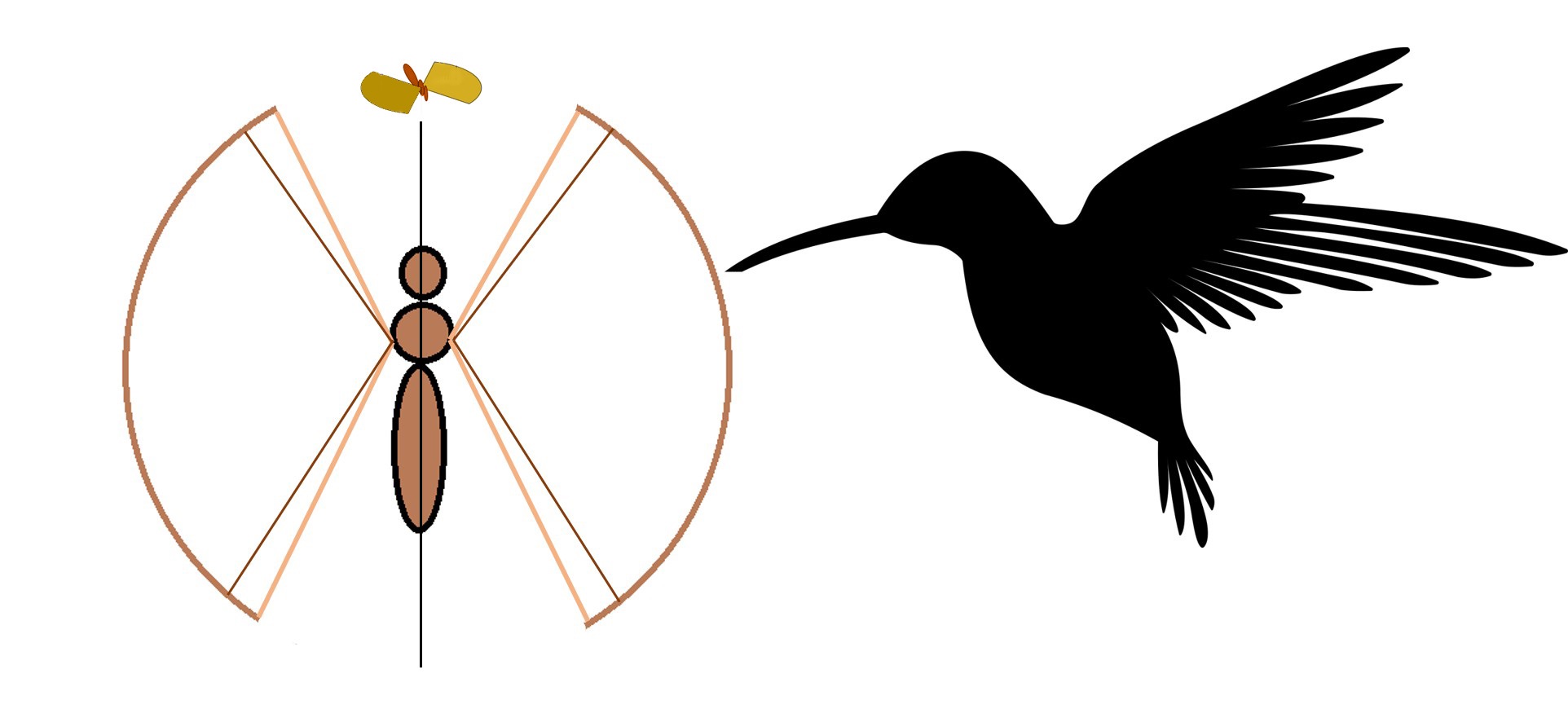
    In order to achieve a flapping action in-flight to gain altitude, sweeping and the pitching motions are needed to be achieved. The current design is set up to exploit resonant properties, as exhibited by flying insects, to reduce the energy expenditure and to provide amplitude amplification for the wing sweeping motion (Bolsman, 2010). Design objective for a small-scale flying machine is to reproduce a reference motion based on the kinematics of insects. Insects and birds perform wing flapping and adjustments of the body orientation in order to control speed, altitude and orientation of the flight. As shown in the figure below, to transfer this analogy to a micro-robot, the sweeping motion of the wings are emulated as a steady-state motion. The details of a control system can be found in advance literature (Bolsman, 2010). However, in simple terms, the design takes into account a constant resonance frequency, and a maximum wind sweeping stroke. As the stroke increases (shown by the extreme lines in the figure), the wings generate lift. The mass of the device (as in an insect) is centered towards the geometric center of the device, resulting in maximum possible stability. This is the stage where the robots get airborne and continue hovering.
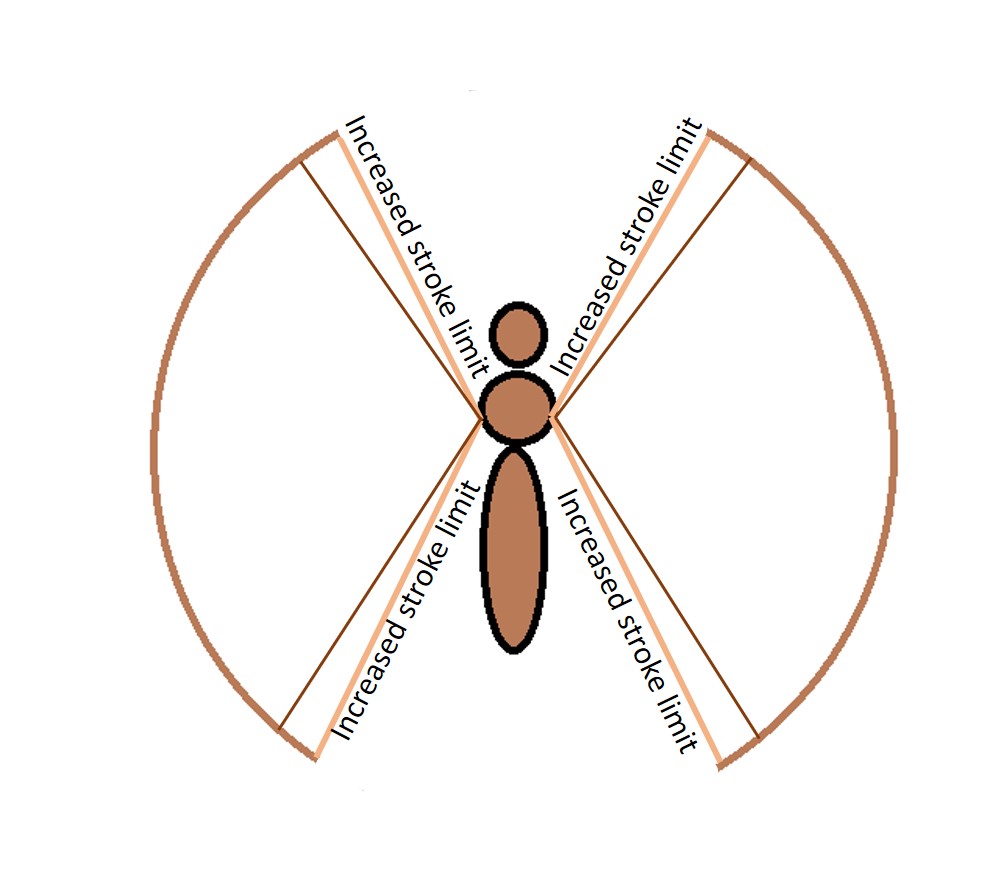
    Lift: Flapping wing motion with sweeping stroke

    How do the “insect” robots move in the air?

    The hovering is the first state of condition that the robots achieve, similar to an insect. The figure above shows a simple two wing device. Each wing is designed to have independent controls to change flapping In order to change the direction to left or right, so that each wing is capable of having a different sweeping motion. This inevitably creates a sweeping motion that are not equal in each wing, and results in a rotation in the direction of the difference. An insect performs these exact same maneuvers to create a rotational motion for left-right (rolling) movement.

    As shown in the figure, the center position holds the center of mass for the whole assembly. As such, changing the center position of the sweeping motion will change the direction of flight as well. This is performed by shifting the positions of the effective centers of pressure of the left and right wings. This invariably creates a backward motion (or pitch), and more power from the device’s power source provides a required forward motion while maintaining the achieved altitude.

    How strong are these “insect” robots?

    A simple model of a small-scale flying robot has been described here to depict the fundamentals that are derived from an insect or a small bird for flapping motion design. A fully fledged flying micro robot has more control systems that are able to achieve a full range of motions if needed, with more complicated actuations that are associated with multiple wings and wing rotations. In addition, structural integrity is also a key factor which, surprisingly, is also derived from insects. One of the most fascinating and extraordinary creatures in earth are ants, they can carry objects several times of their body weight. Ant’s neck has a very sturdy construction by nature, because of the fact that they lift the large weights with their mouth, and the load is transferred through the neck. Researchers found from models that an ant’s neck can withstand loads of about 5,000 times the ant’s body weight! (Nguyen, 2012). This design is also simulated to be able to provide the micro robots a sturdy yet very lightweight construction, a critical requirement for such a device.

    Ultra-light, small scale robots are in use for surveillance, military operations, rescue missions, medical sector, hazardous material test/retrieval, and many other scenarios. We will continue to see the marvelous development of these micro machines, inspired by the insects and small birds around us, while pondering over the question: “how birds fly?”

    References:

    1. Bolsman, C. T. (2010). Flapping wing actuation using resonant compliant mechanisms: An insect-inspired design.
    2. Van Breugel, F., Regan, W., & Lipson, H. (2008). From insects to machines. IEEE robotics & automation magazine, 15(4), 68-74.
    3. Misof, B., Liu, S., Meusemann, K., Peters, R. S., Donath, A., Mayer, C., … & Niehuis, O. (2014). Phylogenomics resolves the timing and pattern of insect evolution. Science, 346(6210), 763-767.
    4. Michelson, R. C. (2000). S. Patent No. 6,082,671. Washington, DC: U.S. Patent and Trademark Office.
    5. Michelson, R. C., & Reece, S. (1998, March). Update on flapping wing micro air vehicle research-ongoing work to develop a flapping wing, crawling entomopter. In 13th Bristol International RPV/UAV Systems Conference Proceedings, Bristol England(Vol. 30, pp. 30-1).
    6. Nguyen, V. N. (2012). Development of a Finite Element Model of an Ant Neck Joint for Simulation of Tensile Loading(Doctoral dissertation, The Ohio State University).
  • Electric Vehicles: Will EVs make our climate better?

    Electric vehicles have gained momentum in the recent years due to a considerable percentage of personal vehicle users as well as freight companies that converted from using internal combustion engine vehicles to some type of electric vehicles. Electric vehicles by definition, have at least some electric powerplant that powers the engine particularly or completely by one or more electric motors. This article forces on the environmental impacts of electric vehicles that entirely depend on batteries for storage and delivering  electric power for the motors.

    Plug-in hybrid electric vehicles (PHEVs) are being developed for a decade or so for mass production by the automotive industry by some major automakers. However, the rise of Tesla, the most valued automaker at the moment during the time of writing this article,  have pushed the limit of how an average car user can adopt completely to an all electric car and thereby save the environment from massive carbon footprint resulting from fossil fuels. PHEVs do not use any type of fuel other than battery packs that store and deliver energy. PHEVs have been touted for their potential to reduce the transportation system’s petroleum dependence and greenhouse gas emissions by using off-peak excess electric generation capacity and increasing the vehicle’s energy efficiency. As such, PHEVs are in a massive boom as several other companies have emerged with large financial backings that have pledged to produce EVs to save the environment and to ensure a zero emission transportation system in the future. The burning question is of course: do EVs actually have a significant impact in the improvement of environment?

    The U.S. Department of Energy’s has a Vehicle Technology Program that examines the precompetitive, high-risk research needed to develop the component and infrastructure technologies necessary to enable a full range of affordable cars and light trucks that are expected to reduce the U.S. dependence on imported oil and minimize harmful vehicle emissions, without sacrificing freedom of mobility and freedom of vehicle choice [1]. Although PHEVs are similar to the regular hybrid electric vehicles (HEVs), the battery can be charged using electricity from the grid by being recharged through a wall outlet. In terms of the overall environmental impact, PHEVs not only have direct impact as a result of not burning traditional fuels, but also the battery chemistry, the amount of grid electricity that can be stored in the battery, recycling ability of the raw materials, and the ability to give unused “power back to the grid” could significantly impact the environment. 

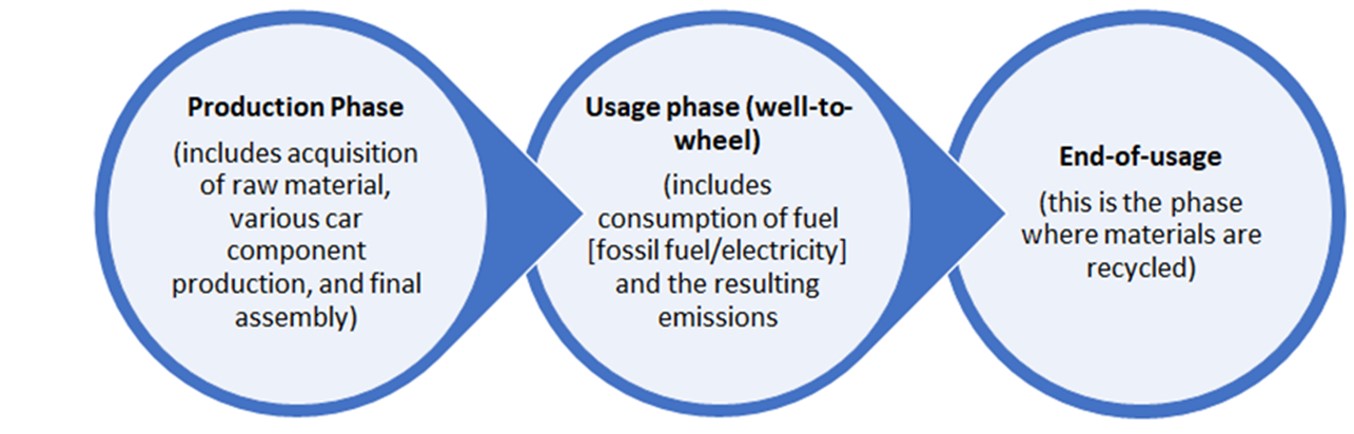
    Below is a schematic showing the life-cycle for a typical EV from production to termination of usage. An EV, by its nature of production type as well as type of usage, typically have less carbon footprint in each lifecycle phase compared to that of a fossil fuel burning vehicle.

    It is important to note that while PHEVs offer the potential for significant reduction in the usage of fossil fuel and resulting emissions of greenhouse gases, the actual benefit calculations need to take into account the upstream energy and emissions penalties that are associated with the electricity generation needed to power the charging systems and the load on the grid. Few studies have indeed taken all of these factors into account for certain vehicles that offer a choice of electric or internal combustion engine options for the same model. A study on the well known Volkswagen Golf model showed that, using the latest EU electricity mix, the current Golf TDI (Diesel) emits 140g CO2/km on average over its entire life cycle, while the e-Golf1 reaches 119g CO2/km. Based on the report, most of the emissions occur during the use phase of the internal combustion engine vehicle. Here the diesel reaches 111g CO2/km while a corresponding vehicle with electric drive emits only 62g CO2/km during the same phase [2].

    Key findings about EV and carbon emission

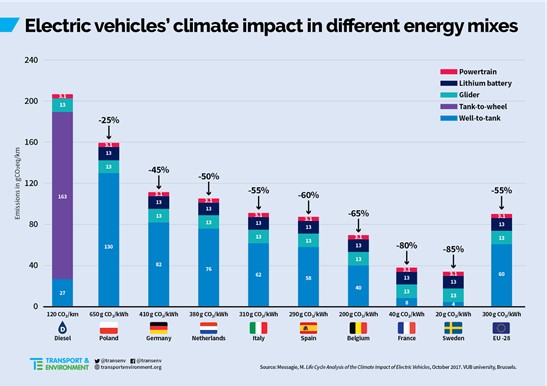
    1. Several european countries where EVs are prevalent have significantly more carbon-intensive power generation – due to reliance on coal plants – EVs still perform better there on a lifecycle basis, which includes the emissions in manufacturing the battery and vehicle. Based on the Polish average, an EV emits 25% less CO2 over its lifetime. In Sweden, which has one of the cleanest energy mixes in the EU, an EV emits 85% less than a diesel car [3]. The figure below shows a summary of the study [3,4].

          EV Climate impact for different Energy Mixes (reproduced from Transport and Environment) 
    2. Replacing a traditional ride-hailing car with an electric vehicle would deliver three times the environmental benefits and emission reductions, according to a new study. The finding comes as a new cost analysis shows that e-vehicles are cheaper to run for Uber drivers in many European cities, and Uber in Portugal says it will only take on new drivers if they have an EV.
    3. Both Uber and Lyft have made recent statements expressing their intention to move towards a totally electric fleet. But now, for the first time, a study has looked at what the environmental impact might be. The study by University of California’s transportation institute, looked at 400,000 journeys made in a battery EV by 1,000 ride-hailing drivers, and compared the impact with 118,668 journeys made in a petrol or diesel car, as well as over 15,000 in a plug-in hybrid EV [5].
    4. The biggest finding is that the potential environmental and emission reduction benefits of replacing a ride-hailing traditional car with an EV are ‘approximately three times higher compared with those of regular vehicle usage in California’, and on emissions alone this was ‘the most pessimistic scenario’. This is because vehicles owned by Uber, Lyft and other ride-hailing drivers are driven more than if they were only used for private use (about 305km on average per day compared to 48km) [5].
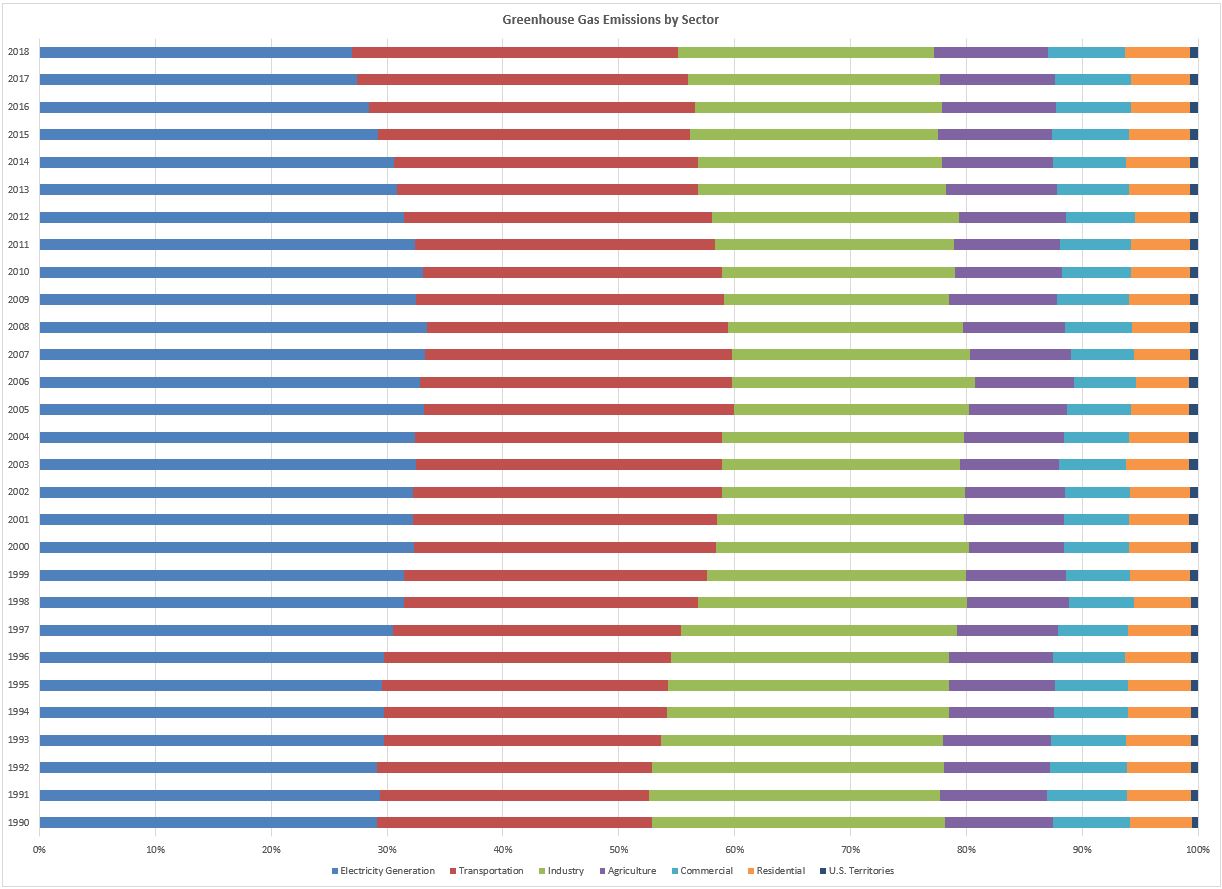
    5. Below is a chart based on data from EPA in the US for greenhouse gas emissions by different sectors [9] . Based on the data, it can be seen that transportation sector contributes to a large amount of green house emission. It will be interesting to see the insights about how EVs and PHEVs come into play.
    Share of Greenhouse Gas Emission by Sector

    How to calculate carbon footprint:

    Carbon offsetting funds solutions to reducing carbon emissions now. Frequently carbon offsetting reduces emissions much faster than you can as an individual/single company. Carbon offsetting projects help to combat global climate change as well as caring for local communities. In many instances providing much needed employment, health improvement, biodiversity,  reforestation and broad social benefits to impoverished communities.

    Calculator:

    This free to use online carbon calculator tool is independently audited on an annual basis as part of the Quality Assurance Standard (QAS) for Carbon Offsetting. 

    https://www.carbonfootprint.com/calculator.aspx

    Reference:

      1. Elgowainy, A., Burnham, A., Wang, M., Molburg, J., & Rousseau, A. (2009). Well-to-wheels energy use and greenhouse gas emissions of plug-in hybrid electric vehicles. SAE International Journal of Fuels and Lubricants, 2(1), 627-644.
      2. https://www.lowcvp.org.uk/news,vw-study-shows-co2-benefits-of-evs-over-whole-lifecycle_3946.htm (accessed October 2020)
      3. https://www.transportenvironment.org/press/electric-cars-emit-less-co2-over-their-lifetime-diesels-even-when-powered-dirtiest-electricity (Accessed September 2020)
      4. Messagie, M. (2014). Life cycle analysis of the climate impact of electric vehicles. Journal of Life Cycle Assessment, 2014, 14.
      5. Jenn, A. (2020). Emissions benefits of electric vehicles in Uber and Lyft ride-hailing services. Nature Energy, 5(7), 520-525.
      6. Noori, M., Gardner, S., & Tatari, O. (2015). Electric vehicle cost, emissions, and water footprint in the United States: development of a regional optimization model. Energy, 89, 610-625.
      7. Data from US Dept of energy: https://afdc.energy.gov/data/10347  (annual energy usage impact) (Accessed September 2020)
      8. https://afdc.energy.gov/data/10301  (US HEV sales by model) (Accessed September 2020)
      9. https://afdc.energy.gov/data/10802  (Green house gas emission by economic sector) (Accessed September 2020)