Author: Ashu Gupta

  • Coloring Space Green

    “It appears a colonization of the moon could become a reality,” state Cornell University researchers R. W. Langhans and D. R. Dreesen hopefully in 1988 – and it would only be a “true colony [if] food could be produced” (Langhans and Dreesen, 1988).

    The quest for interplanetary travel and colonization is one that, in the modern day, remains far-fetched and distant. While governments and research organizations have landed robots on Mars and mapped much of the Moon, the dream of a permanent, or at least self-sustaining, Moon base is still far off in the distance. One of the largest barriers to that dream is the challenge of growing food in space.

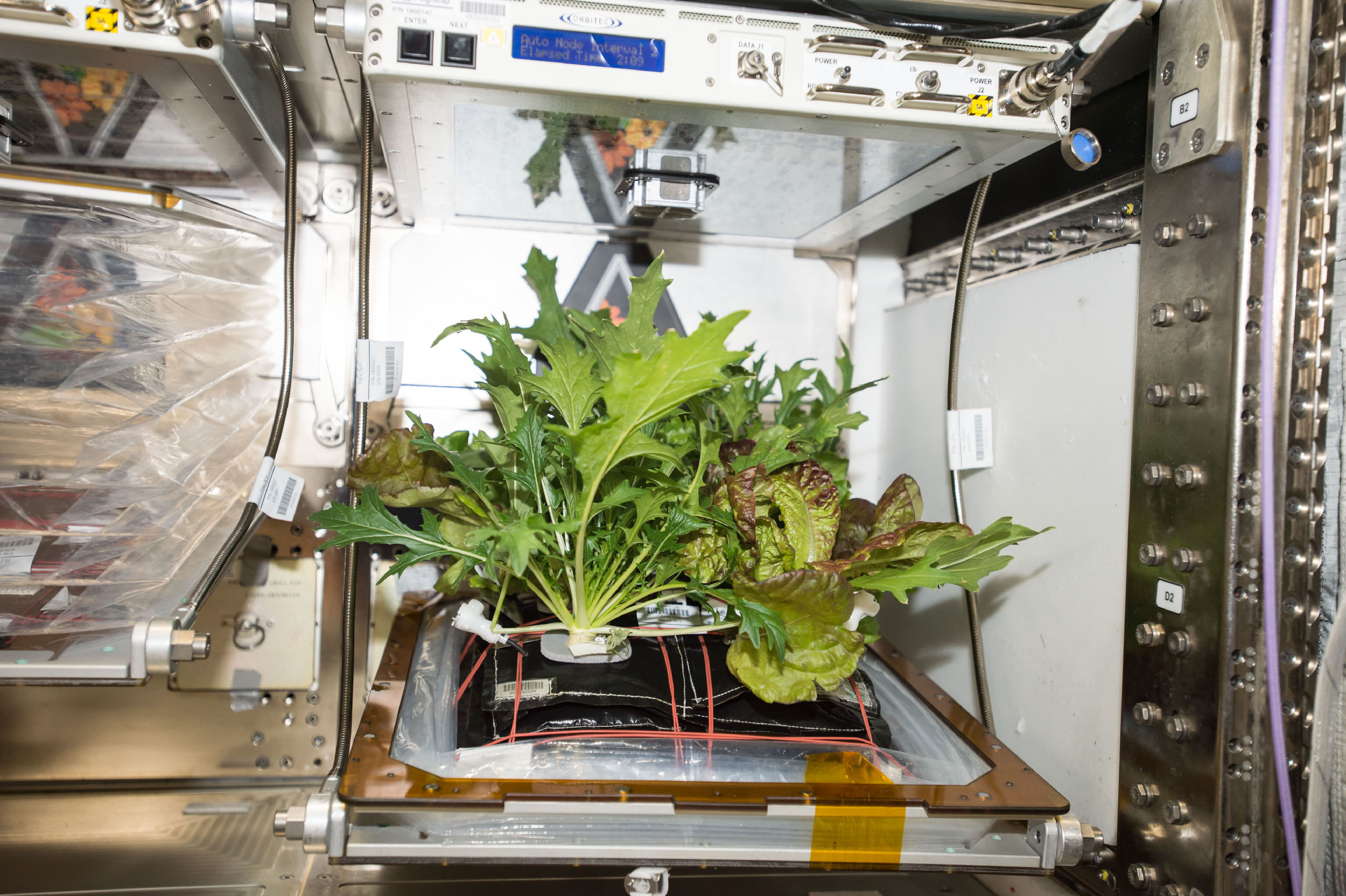
    Plants grown in space through NASA's Veggie system.

    Image Credit: NASA/ISS

    “The opportunities are exciting and almost unlimited in scope” (Langhans and Dreesen, 1988)


    Plant growth in space is challenging for a number of reasons due not only to the harsh conditions of space, but also the harsh design and engineering conditions of the spacecraft. Plants in space need to be able to survive radiation, microgravity, and low-light conditions, while also being physically compact, non-disruptive to the spacecraft’s oxygen and carbon-dioxide levels, and unable to produce excess waste, toxins, and dangerous microbes (Musgrave, 2008; Langhans and Dreesen, 1988; Reed and Vanden Bosch, 2023). Beyond those requirements, these compact space-grown plants must provide all the essential nutrients required for a human diet in the absence of animal products and larger plant products like large fruits (Langhans and Dreesen, 1988).

    While difficult, growing plants in space is extremely rewarding. NASA has determined that only eight species of plants – wheat, rice, white potato, sweet potato, soy bean, peanut, lettuce, and sugar beet – contain all the essential elements, carbohydrates, oils, and amino acids for a balanced human diet (Langhans and Dreesen, 1988). Vitamins, while not fully covered by these eight species of plants, can be supplemented for shorter missions, although they break down when prepackaged for longer ones (Langhans and Dreesen, 1988; and NASA, 2023). In addition, plants have been shown to be positively correlated with psychological well-being on Earth and in space (NASA, 2023). Plants then, are not only beneficial for the astronauts physical health, but their mental health too.

    Currently, NASA employs two growth habitats: the Vegetable Production System (nicknamed Veggie) and the Advanced Plant Habitat (APH) (NASA, 2023). Both Veggie and the APH use enclosed microbiomes with simulated radiance from LED lights and carefully controlled gas content, temperature, and moisture levels (NASA, 2023). While not all eight of the ideal plants identified in 1988 have been successfully grown, the advancements of Veggie, APH and other new technologies shine a light on a hopeful future of plant-filled space exploration.


    Credits

    Langhans, R. W., & Dreesen, D. R. (1988). Challenges to plant growing in space. HortScience, 23(2), 286-293.

    Musgrave, M. E. (2008). Growing plants in space. CABI Reviews. https://doi.org/10.1079/pavsnnr20072065

    NASA. (2023, December 8). Growing plants in space. NASA. https://www.nasa.gov/exploration-research-and-technology/growing-plants-in-space/

    Reed, D. W., & Vanden Bosch, C. A. (2023). Engineering perspectives of growing plants in space. Journal of the Indian Institute of Science, 103(3), 797–805. https://doi.org/10.1007/s41745-023-00369-6

  • What’s Up (Literally) With Cloud Seeding?

    Dubai, one of the richest and driest cities in the world, is flooding. Many have been quick to blame cloud seeding, a climate-engineering strategy the city uses to wrench every drop of moisture it can from its dry air.

    Is cloud seeding really to blame? And regardless of if it is… what even is it?


    What is Cloud Seeding?

    Clouds form around nuclei, small particles that cool the area around them, causing water to condense and form the early wisps of clouds. These clouds then grow and take shape as more water condenses in the atmosphere, forming larger clouds. Eventually, clouds break, giving way to a deluge of rain.

    It stands to reason then, that if there were more of these small particles in the atmosphere, more clouds would form and there would be more rain. Governments in dry areas, like state governments of the American Southwest and city, state, and national governments in the Middle East and South Asia have been quick to turn to cloud seeding as an opportunity to increase rainfall and bring more moisture down from the atmosphere. Specifically, governmental cloud seeding programs tend to use planes and cannons to seed clouds with dry ice and liquid iodine, creating more cloud nuclei and thus more and denser clouds (Borenstein and Peterson, 2024).

    While the practice makes sense in theory, weather scientists disagree on whether or not it actually works (Al Hosari et al., 2021). In particular, the difficulty of proving anything weather related due to the complexity of cloud formation processes and shifting climatic patterns has made cloud seeding a difficult to test subject (Bruintjes, 1999).

    Some studies, like this one by the United Arab Emirates’ National Center for Meteorology, argue in favor of cloud seeding, highlighting results that prove an average increase in annual rainfall by 23% over seeded areas (Al Hosari et al., 2021). The center reports that cloud seeding practices have increased storm volume by over 150%, area cover by just over 70% and lifetime by roughly 65% (Al Hosari et al., 2021). Surely such explosive results are significant?

    And yet, many scientists still cast doubt. A study by the American Meteorological Association argues against cloud seeding, stating that the variation in “precipitation formation mechanisms” between locations and at a location given shifting climatic patterns weaken the scientific credibility of cloud seeding’s reported progress (Bruintjes, 1999). As AP News reports, “cloud seeding, although decades old… has been hard to prove [to do] very much” (Borenstein and Peterson, 2024).


    Did Cloud Seeding Cause Dubai’s Floods?

    The resounding consensus: no.

    According to AP News, while many blame cloud seeding, it certainly is not the cause of Dubai’s recent floods. The record breaking storm was “forecast days in advance” and more or less expected by climate scientists (Borenstein and Peterson, 2024). Cloud seeding, while potentially effective, can not create water out of moisture-less air, and to state that cloud seeding could cause the deluge is “akin to [believing in] perpetual motion technology” (Borenstein and Peterson, 2024). At its best, cloud seeding can bring more water from the atmosphere down to the ground, but it cannot create moisture where there wasn’t any before. Regardless of whether cloud seeding works – the storm must’ve gotten moisture from somewhere.

    Where did that moisture come from? Scientists blame climate change. As the climate warms, so does the atmosphere, and warmer air can hold more moisture (Borenstein and Peterson, 2024). The strangely large concentrations of moisture in an otherwise dry region are likely due to a warming global climate, one that allows for larger build-ups of moisture and stronger storms. These storms, termed “whopper storms” have been predicted (with statistical significance) to increase over the southeastern Arabian Peninsula, forewarning of more storms to come (Borenstein and Peterson, 2024).

    At the end of the day, cloud seeding did not cause Dubai’s record-breaking storm. Climate change did.


    Citations

    Al Hosari, T., Al Mandous, A., Wehbe, Y., Shalaby, A., Al Shamsi, N., Al Naqbi, H., Al Yazeedi, O., Al Mazroui, A., & Farrah, S. (2021). The UAE Cloud Seeding Program: A statistical and physical evaluation. Atmosphere, 12(8), 1013. https://doi.org/10.3390/atmos12081013

    Borenstein, S., & Peterson, B. (2024, April 18). Here’s why experts don’t think cloud seeding played a role in Dubai’s downpour. AP News. https://apnews.com/article/dubai-united-arab-emirates-oman-flooding-cloud-seeding-2f8c12854017e11ac7438579646b3758

    Bruintjes, R. T. (1999).  A Review of Cloud Seeding Experiments to Enhance Precipitation and Some New Prospects. Bulletin of the American Meteorological Society, 80(5), 805–820. https://doi.org/10.1175/1520-0477(1999)080<0805:AROCSE>2.0.CO;2

  • What Even Is Cuteness?

    Have you ever seen something so cute you want to squeeze it? Maybe it was a puppy or kitten, or perhaps a teddy bear or doll. You may wonder why you feel this way – after all, it seems rather strange to mimic violence against something endearing. What makes cute things just so emotionally powerful, and what makes them cute in the first place?


    Cuteness as Affect

    In an article by the University of Oxford, Associate Professor Morten Kringelbach explains that cute things draw in our senses, attract our attention and spark rapid brain activity in the orbitofrontal cortex – a region associated with emotion in pleasure. In fact, the presence of something cute (in the case of this research article, a baby’s face) can activate the orbitofrontal cortex in 140 ms, or just under a seventh of a second (Kringelbach, 2016). Cuteness overloads the emotional state of the brain, drawing in mental attention and the five senses.

    The feeling of cuteness, what researchers call its “affect,” has very interesting roots. From a biological perspective, an emotional response to cuteness may be derived from an evolutionary need to protect babies from harm. As Dr. Kringelbach explains, the evolved instinct to protect and care for babies may drive our wider perceptions of cuteness. Humans tend to express affection not only for babies and small children, but also for animals with baby-like features, and even dolls, teddy-bears, and miniature objects. These animals and objects trigger similar evolutionary protective desires – as well as a drawing in of attention and a general increase in emotional pleasure.

    If cuteness is an evolutionary instinct to care and protect, why do we feel “cuteness aggression” – the “urge to squeeze or bite cute things” without causing harm (Alba and Stavropoulos, 2018)? Researchers at the University of California, Riverside, took on this challenge and made some interesting findings. Summarizing greatly, cuteness aggression was found to be an evolutionary response to the overwhelming emotions of experiencing cuteness (Alba and Stavropoulos, 2018). Evolutionarily, it would be less than ideal if early humans were “incapacitated” with emotion (as the researchers put it) in the presence of cuteness, and thus experienced a counter-emotion (scientifically called a “dimorphous expression” – when human action expresses the opposite feeling as to what they feel, like laughing when you cry). In the case of overwhelming cuteness, this dimorphous expression of playful harm held an evolutionary role to stop early humans from being too affected by cuteness.


    Cuteness as Aesthetic

    While this simple definition of cuteness – an evolutionary instinct to care for and be emotionally attached to babies (and by extension, baby-like animals and objects) – contains an incomplete and shallow understanding of how cuteness exists as a concept in society. As Joshua Paul Dale writes in his academic publication, The Aesthetics and Affects of Cuteness, “cuteness occupies both the aesthetic and affective realms” – and the modern extent of research places extensive focus on the affective side and avoids discussing the aesthetic. Note that in this usage, Dale does not mean aesthetic to mean cottage-core or punk – instead, the word is used within its sociological background, to understand how cuteness exists in the modern world.

    Dale writes that the emotional response of cuteness is “manipulated for a variety of purposes” – including commercial, artistic, and social (Dale, 2016). The feeling of cuteness is emotionally powerful, and for that reason, is manipulated (malevolently and selfishly at times, yes, but also largely in acts of self-expression) to produce action. As Dr. Kringelbach discovered in her article for the University of Oxford, cuteness invites such powerful emotions that it drives the subject to action, causing them to put in work to continue to be able to receive and engage with the source (Kringelbach, 2016). Socially, cuteness has further effect than its core, biological and evolutionary response. In the modern world, cuteness causes the subject “catharsis” (as Dale writes) that fosters a need to protect a vulnerable object from harm (Dale, 2016). This effect of cuteness links it to vulnerability, a link that Dale dives into (in more depth than is relevant for this article) to understand the connections between violence and cuteness. Remember that cute thing you wanted to squeeze? The association between cuteness and vulnerability may be why. As Dale writes, cuteness is disarming and tender, but also “involves a cognitive reaction in which the power differential between subject and object comes into play” (Dale, 2016). Cuteness is, in many ways, an expression of a power dynamic.

    So… what is cuteness? There’s the affective component: baby-like things trigger a biological response that draws attention and fosters feelings of care, and there’s the aesthetic component: cuteness is linked with vulnerability, intensity of emotion, and power dynamics, defining its socially constructed half. Together, these components create the feeling of cuteness that we understand today. It’s youthful, tender, disarming, attention-grabbing, and (in large part, but not entirely) biological.


    References

    Dale, J. P. (2016). The Appeal of the Cute Object: Desire, Domestication, and Agency. In The Aesthetics and Affects of Cuteness (1st ed., pp. 35–55). essay, Taylor & Francis Group.

    Kringelbach, M. L. (2016). How cute things hijack our brains and drive behaviour University of Oxford. How cute things hijack our brains and drive behaviour. https://www.ox.ac.uk/research/how-cute-things-hijack-our-brains-and-drive-behaviour

    Stavropoulos, K. K., & Alba, L. A. (2018). “It’s so cute I could crush it!”: Understanding neural mechanisms of cute aggression. Frontiers in Behavioral Neuroscience, 12. https://doi.org/10.3389/fnbeh.2018.00300

  • Science Fiction – A Blessing or Curse to Emerging Discoveries?

    When you think of robots, does your mind jump first to ABB Robotics and Mitsubishi Electric, or to R2-D2, HAL 9000, and WALL-E? If someone asked your opinion on the advancements in robotics and AI, do you think of OpenAI’s Figure or the dangers posed by the Terminator?

    Public perception of new technology shapes and is shaped by mass media – especially science fiction. From Isaac Asimov’s I, Robot to Gene Roddenberry’s Star Trek, science fiction has played a major role in how the public builds mental frameworks to understand emerging technologies. In a 2008 Working Paper for the Social Contexts and Responses to Risk Network (SCARR) journal, researchers at Cardiff University discovered that participants frequently referenced Frankenstein, Gattaca, and Brave New World, among other science fiction sources, to explain and form perspectives on emerging technology (Hughes, Kitzinger, 2008). Phrases like “Frankenstein foods” and “nano Robocop threat” were cited as examples of science fiction influencing public perception of GMO crops and nanobots (Hughes, Kitzinger, 2008).

    So how exactly does science fiction impact the public’s perspective?


    HAL 9000, a “rogue” AI from Stanley Kubrick’s 2001: A Space Odyssey


    Science Fiction as Cautionary Tale

    One perspective, touted by scientists and policy makers alike, is that science fiction narratives serve as cautionary tales that teach audiences to mistrust science through imagery of unchecked curiosity, mad scientists, and unethical experimentation. In a 2003 study, researchers discovered that “individuals who frequently watch television are more likely than infrequent viewers to lack confidence in the scientific community” (Kirby, 2003). Clearly, fictional representations of science have eroded trust between the public and science.

    In this perspective, science fiction serves the role of a cautionary tale. Stories like 2001: A Space Odyssey caution the audience at the dangers of artificial intelligence, amplifying existing fears of antagonistic AI software. Coupled with films like The Terminator and even pulp fiction like Avengers: Age of Ultron narratives of human-robot conflict and betrayal from artificial intelligence emerge. Through such fictional representations, scientific advancement is demonized and mistrusted.


    Science Fiction as Inspiration

    While the narrative of science fiction as a cautionary tale is held by many in both the scientific and policy communities, including even the National Science Foundation, it is not the only perspective (Hughes, Kitzinger, 2008 and Kirby, 2003). In fact, in the aforementioned working paper, only one research group “clearly confused fact and fiction in the way so often highlighted by scientists and policy makers” (Hughes, Kitzinger, 2008). Science fiction then, was not entirely negative – instead, science fiction served as entertainment, a reference point, and a source of inspiration when discussing scientific advancements.

    This more positive perspective of science fiction is clearly visible in the researchers’ discussions with participants about nanotechnology. Participants “routinely identified” science fiction as a reference point when discussing nanotechnology, and for many, it was the only reference point they could find (Hughes, Kitzinger, 2008). Images of nanotechnology in science fiction were largely positive, “with a strong association with useful inventions and radical medical treatments”, leading to a positive image among the participants (Hughes, Kitzinger, 2008). Unexpectedly, of the topics the researchers discussed with participants, the one with the most science fiction references (nanotechnology) had the best image, while the one with the least references (GMO crops) had the most fears. For some, science fiction was even “treated with amusement” when discussing nanotechnology, rather than fearmongering (Hughes, Kitzinger, 2008).

    As another scientist concluded, concerns about misuses of technology “are often combined with an extremely optimistic view of technical possibilities… grounded in an underlying positive discourse about progress” (Kirby, 2003). Science fiction, while introducing fears of misuse and unethical practice, ultimately proved to be an inspiration of scientific progress.


    In Conclusion

    As we now know, science fiction can hold both positive and negative implications for the public’s perception of technology. For some, science fiction is cautionary and mistrustful, playing on the public’s fears to sow distrust between the audience and the scientific community. For others, science fiction is an inspiration, providing the audience with a vision into the many possibilities at their fingertips.

    Taken as a whole, science fiction is neither strictly positive nor strictly negative. Some technologies (like GMO crops) are feared regardless of science fiction representations, while other technologies (like nanobots) are viewed more positively due to the reference points posed by science fiction. Other technologies still (such as artificial intelligence) are feared in part due to science fiction, in which case science fiction plays a more negative role on public perception.

    Science fiction is ultimately neither a blessing nor a curse. It is, like other forms of science media, to be examined individually, rather than generalized as a whole. So the next time you flip to the newest episode of Star Trek or The Expanse, consider the show’s perspective on science and form your own opinions.


    Citations

    Hughes, E., Kitzinger, J. (2008). Science Fiction Fears? Social Contexts and Responses to Risk Network (28). https://orca.cardiff.ac.uk/id/eprint/17529/1/HughesKitzingerWkPpr28.pdf

    Kirby, David. (2003). Scientists on the Set: Science Consultants and the Communication of Science in Visual Fiction. Public Understanding of Science – PUBLIC UNDERST SCI. 12.261-278. 10.1177/0963662503123005.

    Kubrick, Stanley. 1968. 2001: A Space Odyssey. Warner Bros.

  • Demystifying Transgender Healthcare

    Fueled by misinformation, transgender healthcare has become a flashpoint of political controversy in recent years. Here at Charged, we’re going to debunk the myths and get down to the science to understand how transgender healthcare works, why it’s important, and what political messages are scientifically supported.


     

    Activists from the National Center for Transgender EqualityActivists from the National Center for Transgender Equity

    Activists from the National Center for Transgender Equality (Health Coverage Guide)


    Terminology

    Cisgender: “People whose gender identity is congruent with what is traditionally expected based on their sex assigned at birth” (Streed et al., 2021).

    Transgender: People “whose gender identity, gender expression, or behavior does not conform to that typically associated with the sex to which they were assigned at birth” (American Psychological Association, 2023).

    Gender Dysphoria: “Intense, persistent gender incongruence” (American Psychological Association, 2023).

    Gender Affirming Care (GAC): “Psychosocial and medical support” that allows people to live in alignment with their gender identity (Lepore, Alstott, McNamara, 2022).


    How Does Transgender Healthcare Work?

    Transgender healthcare involves many steps and processes, not all of which are pursued by all transgender patients. The most common form of GAC for transgender patients is exogenous hormone therapy.

    During hormone therapy, transgender men use testosterone to suppress feminizing characteristics and develop masculinizing characteristics (Unger, 2016). Transgender women use anti-androgens to suppress masculinizing characteristics and use estrogen to develop feminizing characteristics (Unger, 2016).

    Hormone therapy is a strongly positive force in many transgender patients’ lives. Patients that have undergone hormone therapy have shown positive physical and psychological changes, including improvements in sexual function and mood, and a reduction in stress and cortisol levels (Unger, 2016). For these reasons, hormone therapy is considered a core element of GAC.


    Myth 1: Only Transgender People Seek GAC

    Many arguments against the availability of GAC base themselves on the myth that only transgender people seek GAC. This is false. In fact, both cisgender and transgender individuals seek GAC, including such instances as “estrogen for menopause, breast surgery, genital surgery for sexual development disorders, etc.” (Lepore, Alstott, McNamara, 2022). Gender affirming care is not limited to transgender patients, and should be viewed as a general standard of care for patients, rather than a requirement specific to transgender people.


    Myth 2: GAC is Experimental

    Arguments in favor of legal bans against GAC for transgender patients state that GAC is experimental and unsafe, and thus not yet ready for use. This is another myth. GAC is used by cisgender people without legal complaints, involving the “same medications as used in [transgender] hormone therapy, like estrogen, testosterone, and spirolactone” (Lepore, Alstott, McNamara, 2022). Furthermore, puberty and androgen blockers, used by transgender patients to lower the effects of other types of hormones, are also used by cisgender people for “developmental disorders and general medical procedures” (Lepore, Alstott, McNamara, 2022). Evidently, both transgender and cisgender patients take GAC, and cisgender patients have been taking GAC without complaint. Thus, GAC cannot be experimental, and even if it was, it should not be blocked from transgender patients specifically, but from both transgender and cisgender patients, as they both benefit from GAC.


    Myth 3: GAC is Entirely Irreversible

    Another argument against the use of GAC for transgender patients, especially in the case of hormone replacement therapy (HRT) is the myth that GAC is entirely irreversible. While the effects of HRT are irreversible in the long term, patients are “only offered reversible treatments first,” and only take further hormonal treatments for long term symptoms of gender dysphoria (Lepore, Alstott, McNamara, 2022). Beyond treatment, transgender individuals are still able to conceive, and all individuals considering hormone therapy are recommended fertility preservation methods (Lepore, Alstott, McNamara, 2022). Furthermore, irreversible genital surgeries are only reserved for adults who have “adhered to their new identities for at least a year” (Lepore, Alstott, McNamara, 2022). Thus, it can be observed that GAC is not entirely irreversible, and all irreversible decisions are made after long-term, reversible treatment has already begun. To assuage the fears of youth taking irreversible, rash decisions, let it be known that young people seeking GAC are not capable of making irreversible medical decisions within the current guidelines.


    Myth 4: GAC is Unsafe

    Many argue that GAC for transgender patients is unsafe and too dangerous to be medically prescribed. However, dangerous chemicals have been removed from GAC prescriptions for many years, and the risks of cardiovascular disease, which is more prevalent among transgender people, are reviewed before any medication is prescribed (Lepore, Alstott, McNamara, 2022).

    In particular, transgender patients face an excess risk to cardiovascular disease, which can be attributed to “psychological stressors” such as discrimination and structural violence, rather than lower standards of care (Streed et al., 2021). Rates of cardiovascular disease are heightened for people suffering from HIV and AIDS, which are conditions more prevalent among transgender populations for reasons outside of medically prescribed GAC (Streed et al., 2021). While GAC has been shown to increase risks of cardiovascular disease, it is by no means the sole cause of transgender patients’ increased risk, nor is it likely the major cause of it (Streed et al., 2021).

    While GAC is a risk, it is by no means a risk too dangerous to be medically prescribed, and is not a prescription that distorts standards of care.


    Conclusion

    As transgender healthcare remains a sensitive political topic, it’s important to keep the science in mind. Gender affirming care does come with risk, but is not too dangerous to be prescribed, and is shown to be psychologically helpful and at times medically necessary for transgender patients (Unger, 2016).


    Sources

    Lepore C, Alstott A, McNamara M. Scientific Misinformation Is Criminalizing the Standard of Care for Transgender Youth. JAMA Pediatr. 2022;176(10):965–966. doi:10.1001/jamapediatrics.2022.2959

    Streed, C. G., Beach, L. B., Caceres, B. A., Dowshen, N. L., Moreau, K. L., Mukherjee, M., Poteat, T., Radix, A., Reisner, S. L., & Singh, V. (2021). Assessing and addressing cardiovascular health in people who are transgender and gender diverse: A scientific statement from the American Heart Association. Circulation, 144(6). https://doi.org/10.1161/cir.0000000000001003

    American Psychological Association. (2023, March 9). Answers to your questions about transgender people, gender identity, and gender expression. Understanding transgender people, gender identity and gender expression. https://www.apa.org/topics/lgbtq/transgender-people-gender-identity-gender-expression

    Unger CA. Hormone therapy for transgender patients. Transl Androl Urol. 2016 Dec;5(6):877-884. doi: 10.21037/tau.2016.09.04. PMID: 28078219; PMCID: PMC5182227.

    Health Coverage Guide, National Center for Transgender Equality, transequality.org/health-coverage-guide. Accessed 4 Dec. 2023.