Author: Alex Gurgis

  • Neuromyths: What We Know, and What We Think We Know

    TAKE THE QUIZ HERE: https://www.tryinteract.com/share/quiz/5f7fc0088a3cf300140577ed

    Neuroscience is an ancient subject, but a very young science. 

    What I mean by that is, while people have been fascinated with the concepts relating to the mind and consciousness for as long as we have recorded records, the scientific, empirically supported study of the nervous system is a relatively new field. Our innate curiosity to understand ourselves and how we interact with the world, paired with the relative lack of scientific literature, might be one of the reasons there are so many false beliefs about the brain and nervous system in mainstream culture.

    In fact, public misconceptions about neuroscience are such a common phenomenon that we have a specific word for them: neuromyths. This term was coined by neurosurgeon Alan Crockard in the 1980s as a way to describe widespread but unscientific beliefs about the brain in the medical community and was formally re-defined as a “misconception generated by a misunderstanding, a misreading or a misquoting of facts scientifically established (by brain research) to make a case for use of brain research in education and other contexts” by the Brain and Learning project section of the UK’s Organization of Economic Co-operation and Development (OECD)  in 2002.

    People have been noticing this trend, however, and have tried to explain where neuromyths come from, and why they are so convincing to so many. They have noted that these false notions persist in a strange manner, similar to the way that illusions can continue to seem real even after facts have been presented (Pasquinelli, 2012), or the way that urban legends are resilient and appealing regardless of the presence or lack of evidence (Brunvald, 1981). Neuromyths are often vaguely rooted in some true research, albeit research that is largely misinterpreted, overblown, or entirely overturned by the academic community. This, along with inaccurate or sensationalist reporting of neuroscience discoveries in popular media, may be what gives them such an air of credibility, and why they are as potent as they are. 

    Some of these ideas seem intuitive. Others, like the popular commercialized Brain Gym regimen which purports that rubbing areas of tissue around the sternum (called “brain buttons”) can help improve interhemispheric communication among other things, sound less feasible from the start (Hyatt, 2007). As quirky, benign, or even downright ridiculous as neuromyths can seem though, they are not harmless.  For every well-intentioned dollar and minute spent implementing policies based on pseudoscience, there are fewer resources left to give to evidence-based scientific principles. Like any opportunity-cost model, neuromyths “cost” a lot in terms of what we “could” be teaching and applying about the brain.” They also “cost” us in terms of public receptiveness and curiosity for new research. By simplifying complex topics and claiming knowledge we don’t actually have, neuromyths can give the impression that certain ideas are already “solved problems”,  when they are still questions we should be actively pursuing. In addition, when neuromyths are disproven, they may make people less trusting of true results from studies, since the previous “science” they heard wasn’t right. It lends substance to the notion that scientists are constantly “flip-flopping” on topics, hastily publishing results and then issuing retractions left and right, although the original claims were never made by scientists  in the first place. Allowing neuromyths to pass unchecked as truth undermines the credibility of neuroscience, and ultimately science as a whole, by propagating ill-informed ideas with the authority that the disguise of a “lab coat” gives the public.

    Given this context, it’s time to start challenging the beliefs we hold and start to critically differentiate between the “urban legends” of neuroscience and data-supported hypotheses. Try your hand at this quiz to see how well you know what is and is not true about the human brain and nervous system!

    TAKE THE QUIZ HERE: https://www.tryinteract.com/share/quiz/5f7fc0088a3cf300140577ed

    References:

    Bangarter, A., & Heath, C. (2004). The Mozart effect: Tracking the evolution of a scientific legend. British Journal of Social Psychology, 43, 605– 623.

    Boyd, R. (2008, February 07). Do People Only Use 10 Percent of Their Brains? Retrieved October 24, 2020, from https://www.scientificamerican.com/article/do-people-only-use-10-percent-of-their-brains/

    Craik, F. I., & Lockhart, R. S. (1972). Levels of processing: A framework for memory research3. Journal of Verbal Learning and Verbal Behavior, 11(6), 671-684. doi:10.1016/s0022-5371(72)80001-x

    Craik, F. I. M. & Tulving, E. (1975). Depth of processing and the retention of words in episodic memory. Journal of Experimental Psychology, 104(3), 268-294.

    Crockard, A. Confessions of a brain surgeon. New Scientist 2061, 68 (1996).

    Giuffre BA, Jeanmonod R. Anatomy, Sciatic Nerve. [Updated 2020 Jul 31]. In: StatPearls [Internet]. Treasure Island (FL): StatPearls Publishing; 2020 Jan-. Available from: https://www.ncbi.nlm.nih.gov/books/NBK482431/

    Draganski, B., & May, A. (2008). Training-induced structural changes in the adult human brain. Behavioural Brain Research, 192(1), 137-142. doi:https://doi.org/10.1016/j.bbr.2008.02.015

    Driemeyer J, Boyke J, Gaser C, Büchel C, May A (2008) Changes in Gray Matter Induced by Learning—Revisited. PLOS ONE 3(7): e2669. https://doi.org/10.1371/journal.pone.0002669

    Howard-Jones, P. Neuro, science and education: myths and messages. Nat Rev Neurosci 15, 817–824 (2014). https://doi.org/10.1038/nrn3817

    Hyatt, K. J. Brain Gym: building stronger brains or wishful thinking? Remedial Spec. Educ. 28, 117–124 (2007).

    Koch, C. (2016, January 01). Does Brain Size Matter? Retrieved October 16, 2020, from https://www.scientificamerican.com/article/does-brain-size-matter1/

    Lodish H, Berk A, Zipursky SL, et al. Molecular Cell Biology. 4th edition. New York: W. H. Freeman; 2000. Section 21.1, Overview of Neuron Structure and Function. Available from: https://www.ncbi.nlm.nih.gov/books/NBK21535/

    Macdonald, K., Germine, L., Anderson, A., Christodoulou, J., & McGrath, L. M. (2017). Dispelling the Myth: Training in Education or Neuroscience Decreases but Does Not Eliminate Beliefs in Neuromyths. Frontiers in Psychology, 8(1314). doi:10.3389/fpsyg.2017.01314

    Organisation for Economic Co-operation and Development. Understanding the Brain: Towards a New Learning Science. (OECD Publications, 2002).

    Pashler, H., McDaniel, M., Rohrer, D., and Bjork, R. (2008). Learning styles concepts and evidence. Psychol. Sci. Public Interest 9, 105–119. doi: 10.1111/j.1539-6053.2009.01038.x

    Pasquinelli, E. (2012), Neuromyths: Why Do They Exist and Persist?. Mind, Brain, and Education, 6: 89-96. doi:10.1111/j.1751-228X.2012.01141.x

    Nielsen, J. A., Zielinski, B. A., Ferguson, M. A., Lainhart, J. E., & Anderson, J. S. (2013). An evaluation of the left-brain vs. right-brain hypothesis with resting state functional connectivity magnetic resonance imaging. PloS one, 8(8), e71275.

    Rauscher, F., Shaw, G. & Ky, C. Music and spatial task performance. Nature 365, 611 (1993). https://doi.org/10.1038/365611a0

    Riener, C., and Willingham, D. (2010). The myth of learning styles. Change 42, 32–35. doi: 10.1080/00091383.2010.503139

    Ruigrok, A. N., Salimi-Khorshidi, G., Lai, M. C., Baron-Cohen, S., Lombardo, M. V., Tait, R. J., & Suckling, J. (2014). A meta-analysis of sex differences in human brain structure. Neuroscience and biobehavioral reviews, 39(100), 34–50. https://doi.org/10.1016/j.neubiorev.2013.12.004

    Treiman, R., Gordon, J., Boada, R., Peterson, R. L., and Pennington, B. F. (2014). Statistical learning, letter reversals, and reading. Sci. Stud. Reading 18, 383–394. doi: 10.1080/10888438.2013.873937

    Vellutino, F. R. (1979). Dyslexia: Theory and Research. Cambridge, MA: MIT Press.

    Wickelgren, W. (1981). Human learning and memory. Annu. Rev. Psychol. 32, 21–52. doi: 10.1146/annurev.ps.32.020181.000321

    Willingham, D. T., Hughes, E. M., and Dobolyi, D. G. (2015). The scientific status of learning styles theories. Teach. Psychol. 42, 266–271. doi: 10.1177/0098628315589505/;=   

    Wittbrodt MT, Millard-Stafford M. Dehydration Impairs Cognitive Performance: A Meta-analysis. Med Sci Sports Exerc. 2018 Nov;50(11):2360-2368. doi: 10.1249/MSS.0000000000001682. PMID: 29933347.

  • Clarified Purple Cow Punch

    This year, continuing the theme from the Taste of Science, the Georgia Tech STEMcomm team decided to host a Sober Science Speakeasy, a party all about the science of drinks. While looking around for something to prepare, the concept of “clear milk” was brought up, and I was intrigued. Clear milk? That’s practically oxymoronic. And yet, these drinks, called “clarified cocktails” or “milk punches”,  added milk to end up with clear, colorless products. Naturally, we had to investigate and try for ourselves. This is what we learned:

    The Science:

    Milk, looking decidedly not clear, due to the Tyndall effect.

    Milk is a colloid, with fat and proteins suspended in the aqueous solution. Since these are fairly evenly distributed, they usually scatter the light beam around in all directions in the Tyndall effect, making the liquid appear white and opaque.    Proteins in the milk, particularly caseins, repel each other at the normal pH of milk, which is what maintains that even distribution throughout. This is because the isoelectric point of casein, or the point at which it it is electrically neutral (uncharged) is around 4.6, but milk’s normal pH is closer to 6.6. The casein proteins therefore have a negative charge that makes them repel one another and spread out as far apart as possible.

    When pH of milk is lowered however, by adding acid, the casein proteins will lose their negative charge, and stop repelling one another. This, along with the protein degradation, or unfolding of their shape, at the lower pH, causes many of them to clump together in solid blobs we call “curds”. They will separate out to the bottom, and the liquid left behind is called the “whey”. But these proteins don’t just separate from the rest of the drink- they take compounds with them, including much of the color! The proteins bind to molecules from the drink, especially polyphenols, which are associated with bitter/astringent tastes, like tannins in black tea or red wine.

    Therefore, when you strain out the curds, you also remove compounds bound to the caseins. This “clarifies” the drink, stripping away most of its original color, and giving it a less harsh flavor. Some also claim that the addition of the remaining milk whey also gives the drinks a sliker texture, making them even more desirable.

    The Drinks

    This property of milk has been used to make clarified cocktails for many years, with the first written recipe dating all the way back to 1711. Even our favorite kite-flying founding father, Benjamin Franklin, was a fan, recording his own recipe for brandy-filled milk punch in 1763. You can still see the original document online in the Massachusetts Historical Society archives: https://www.masshist.org/database/263.

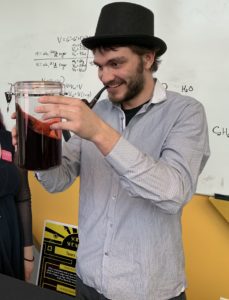
    A resident “mad scientist” with the original base, sans milk.

    In our case, we went for a non-alcoholic version, with a base of black tea, grape juice, lemon juice, and of course, milk.

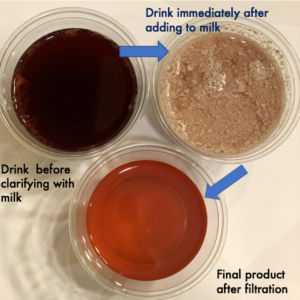
    This concoction, lovely nicknamed “clarified purple cow punch” or CPCP, was initially dark reddish-purple, and while sweet, was also tad bitter from the black tea flavoring. The addition of the juice to milk resulted in a (rather unappetizing) mixture of curdled milk and juice in a clumpy, brown…milkshake? Ick.

    At that stage, I was pretty doubtful that this was going to work. With a bit of patience, however, and several rounds of straining through cheese clothes and coffee filters, we ultimately ended up with a pale pink, ultra-sweet drink that proved pretty popular. There was no hint of milk flavoring or bitter taste, and all together, CPCP was a surprising success.

    If you want to try making clear drinks yourself, all you need is some juice mix, an acid, and milk- and a lot of time to sit and watch the straining process. Make sure to add the acid slowly to the milk, and not the other way around, to ensure the proteins have time to bind to the polyphenols before curdling, and you’ll be all set to impress with your friends with this magically clear milk.

  • That sounds fishy…

    While scrolling somewhere in the interwebs, I saw a post someone had made about trying to hold their breath during action movies whenever the characters went under water, to see how realistic/unrealistic the scenes really are. Someone responded with a comment in the spirit of, “Yeah! It’s sooooooo unrealistic. I almost died during Finding Nemo!”. As dumb as that joke was, it made me smile and got me thinking about how fun it would be to apply realism standards to an animated movie like Finding Nemo. Acting on the impulse (and if we are being completely honest, needing an excuse to rewatch a children’s movie), my friends and I attempted to view the movie from a scientific perspective, asking questions and pulling out scenes about marine life to research their factual basis.

    Here is some of what we discovered:


    400 Eggs

    Q: What is a typical clutch size for clownfish? Is their statement that there are “over 400 eggs”, accurate?

    A: Yes, a clownfish can actually have anywhere from 100 to 1,000 eggs in a single clutch! They actually have a very interesting and unusual life history, as all clownfish are protandrous hermaphrodites, meaning that they are born with dominant male reproductive organs and inactive/recessive female reproductive organs as well. Within a single anemone, there is a single, monogamous mating pair, consisting of the only female of the group and the largest male, and the rest of the clownfish are developmentally “undeveloped”, sexual juveniles. Eggs are first released by the female into the nesting site, and then fertilized by the male and attached to a substrate surface, normally rock or coral. The male is in charge of caring for the eggs, fanning them to regulate oxygen levels and temperature. In addition, they will eat any damaged or unfertilized eggs to clear the nest…Marlin would have been feasting after that first, gory scene…Ew!


    Barracuda Feast

    Q: Will/do barracudas eat clownfish eggs?

    A: Nope, that’s very unlikely. The typical diet of a barracuda is smaller fishes such as jacks, grunts, groupers, snappers, small tunas, mullets, killifishes, herrings, and anchovies, but they aren’t known to eat fish eggs. Marlin has got that covered.


    Clownfish and Sea Anemones

    Q: What is the relationship between clownfish and sea anemones? Do they actually have to brush themselves to avoid getting shocked?
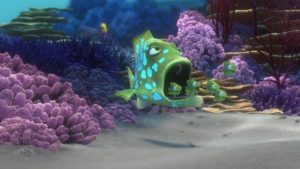
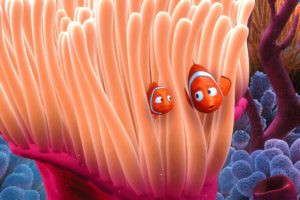
    A: Sea anemones and clownfish have one of the most well-known symbiotic relationships, and it’s actually a bit more complex than one might expect. Sea anemones have nematocysts, stinging cells with toxins, on their tentacles, that they use for protection. The clownfish, however, has a unique mucus coating that prevents them from being affected by it, and they can therefore live in safety in and amongst the anemone. The sea anemone isn’t just protecting the fish for free though- the clownfish provides protection by chasing off potential predators, and also provides nutrients in its waste products, such as ammonia, sulfur and phosphorus. Recent research has also found evidence that the relationship between this organisms may be even more intimate, with evidence that microbiomes of the partners changes with their interactions and contact over time, possibly cycling carbon between them. However the physical touch modifies them though, the depiction of brushing to achieve recognition seems to be a bit of an exaggeration on the film’s part. Oh well, creative liberties I guess.


    Lifespan of a Sea Turtle


    Q: Marlin and Nemo talk a decent bit about how long sea turtles live. What is the average lifespan really?

    A: Assuming the turtles shown are representations of green sea turtles (Chelonia Mydas), we don’t have an exact answer. The estimated lifespan is around 60-70 years, though, which is pretty darn long!


    Mouthbrooding Mother

    Q: What’s up with that fish that carried it’s kids to school in its mouth? Is that real?


    A: Yes! There actually are types of fish, called “mouth-brooders”, that use their mouths to shelter their eggs and/or young offspring. There are many different types, including cichlids, sea catfish, cardinalfish, Bagrid catfish, pikeheads, jawfishes, gouramis and arowanas, and either the male or female may keep the offspring in their mouth. The most famous example is probably the female african cichlids, which carry their eggs for between 21 and 36 days, from fertilization to hatching, without eating. They also carry the juveniles in times of perceived danger, using specialized behavioural signals to call her young back into her mouth. That is what I can dedicated parenting!


    4800 Teeth

    Q: Bloat, the pufferfish, claims there are “4,800 teeth” between the 3 sharks Marlin had encountered- is that accurate?

    A: Based on their animated appearance, there is a great white, a mako, and a great hammerhead. Assuming that is the case and they are all full-developed adults, we can make the following estimate:

    • For the great white- the average is 300 total in up to seven rows (but only 50 are “working” at any given time)
    • For an adult hammerhead, you can expect 24 to 37 teeth per row and several rows (3-4) per jaw

    Data on the odontology of mako sharks was harder to find, but I think it is safe to safe that it will not fair  make up the >4,000 teeth difference needed to match the statement.

    Bloat was just exaggerating a bit, and who can blame him? There are certainly enough teeth to be afraid.


    Riding the EAC

    Q: Is the East Australian Current real?

    A: Yes, the EAC actually is a really thing, even if it isn’t used for thrill-seeking by surfer sea turtles. It’s actually a really influential current as well, moving warm water down the eastern coastline of Australia. It is the largest ocean current near Australia, and according to data from NASA and CSIRO Marine Research, moves as much as “30 million cubic meters of water per second in a path that is as large as 100 kilometers in width and 500 meters deep”. Pretty gnarly surfing!


    Flo and Deb

    Q: Are Flo and Deb an accurate representation of self-awareness in fish? Can fish pass the mirror test?

    A: The mirror test is the ability for an organism to recognize itself in a mirror. It is a way to get an organism’s self-awareness and consciousness. In Finding Nemo, the character Flo acknowledges her reflection as a separate being, Deb. This raises the question; are fish are able to pass the mirror test? While there are no sources on the specific type of fish Deb is, a PLOS report records that ¾ fish tested on were able to pass the mirror test after being accustomed to it. Sorry Deb…


    Fishy Formations

    Q: In the movie, a school of fish makes impressions and formations to comfort Dory. How do fish really coordinate school movement?


    A: Fish coordination is actually a super fascinating area of research, and while, they might not be making improv impressions underwater, many fish can make some impressively complex movements. There are two distinct types of movement, shoaling, and schooling; shoaling is less structured, more, temporary, and can be a loose aggregation of fish of differing species, while schooling is highly structured, with common directionality and coordinated movements. While we don’t understand the exact mechanisms of how some of the really complicated movements work, we do know that fish have a unique sensory system to allow for this behavior. In addition to using their vision, they have a lateral line, an extremely sensitive mechanosensory organ along the sides of the body that helps detect any changes in water pressure around them, helping them keep track of the movements of their neighbors precisely.


    Overall Accuracy Score: 6.5/10

    Despite the whale speaking, seagull-mocking silliness that is Finding Nemo, we think it does a good job overall presenting some of the fascinating science that happens under the sea. Golf claps all around!


    References and Further Reading:

    Berends, Betsy. “Reproduction and Life History.” Amphiprion Ocellaris, Apr. 2007, bioweb.uwlax.edu/bio203/s2007/berends_bets/reproduction.htm.

    Bester, Cathleen. “Sphyraena Barracuda.” Florida Museum, 12 May 2017, www.floridamuseum.ufl.edu/discover-fish/species-profiles/sphyraena-barracuda/.

    East Australian Current. (n.d.). Retrieved from https://earthobservatory.nasa.gov/images/15366/east-australian-current

    Herbert-Read, J. E. (2016). Understanding how animal groups achieve coordinated movement. The Journal of Experimental Biology, 219(19), 2971–2983. doi: 10.1242/jeb.129411

    “How Many Teeth Does a Hammerhead Shark Have?” Reference, IAC Publishing, www.reference.com/pets-animals/many-teeth-hammerhead-shark-6cb321753fe81324.

    Kohda, M., Hotta, T., Takeyama, T., Awata, S., Tanaka, H., Asai, J.-Y., & Jordan, A. L. (2019). If a fish can pass the mark test, what are the implications for consciousness and self-awareness testing in animals? PLOS Biology, 17(2). doi: 10.1371/journal.pbio.3000021\

    LiveScience. (2013, September 18). New Study Sheds Light On THIS Fishy Behavior. Retrieved from https://www.huffpost.com/entry/fish-schools-genes_n_3947303

    MacDonald, J. (2017, June 21). How Do Fish Schools Work? Retrieved from https://daily.jstor.org/how-do-fish-schools-work/

    Noaa. “Green Turtle.” NOAA, www.fisheries.noaa.gov/species/green-turtle.

    Ocean Portal Team. “Great White Shark.” Smithsonian Ocean, 18 Dec. 2018, ocean.si.edu/ocean-life/sharks-rays/great-white-shark.

    Pratte, Z.A., Patin, N.V., McWhirt, M.E. et al. Association with a sea anemone alters the skin microbiome of clownfish. Coral Reefs 37, 1119–1125 (2018). https://doi.org/10.1007/s00338-018-01750-z

    “The Protective Mouthbrooding Fish.” PADI Blog – Scuba Diving and Freediving Tips, Dive Travel Insights & More, 8 Feb. 2016, blog.padi.com/2014/07/30/creature-feature-the-protective-mouth-brooding-fish/.


    Fair Use Statement: On the Utilization of Pixar Clips and Images in the Article

    This site may contain copyrighted material the use of which has not always been specifically authorized by the copyright owner. We are making such material available in an effort to advance understanding of environmental, political, human rights, economic, democracy, scientific, and social justice issues, etc. we believe this constitutes a ‘fair use’ of any such copyrighted material as provided for in section 107 of the US Copyright Law.

    In accordance with Title 17 U.S.C. Section 107, the material on this site is distributed without profit to those who have expressed a prior interest in receiving the included information for research and educational purposes. For more information go to: http://www.law.cornell.edu/uscode/17/107.shtml

  • An Egg-istential Question

    Which came first, the chicken or the egg?

    A classic philosophical conundrum, intentionally baffling and likely argument-provoking.

    “You need a chicken to lay an egg, but chickens come from eggs, so you need an egg to get the chicken… to lay the egg, from which to get a chicken to lay an egg…”

    This can (and often does) go on forever, an endlessly frustrating loop of logical fallacy.

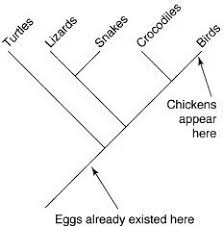
    I was pretty surprised  then, when the answer was suddenly provided in one of my classes, a course on evolutionary ornithology. We were discussing a phylogenetic tree,  when my professor casually pointed out an easy, glaringly logical, loophole in the age-old query.

    So, scientifically speaking, which came first, the chicken or the egg?

    Egg Timeline:

    The amniotic egg, or cleodic egg as it is also sometimes called, is thought to have evolved between 340-370 million years ago, and is highly conserved across many classes and families, from mammals like us to crocodiles. The classification of amniotes includes all vertebrate animals with four limbs and amniotic eggs, so think all mammals (Synapsida), and reptiles/birds (Reptilia) (Sander 2012).

    What exactly is so special about this egg?

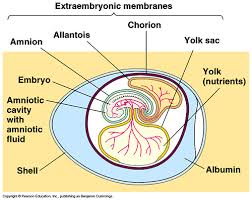
    The amniotic egg is characterized by its complex of inner membranes. The allantois, which is directly attached to the embryo, primarily holds the waste products, while the yolk sac contains all the nutrients the embryo will need for development. The embryo is bathed in a stable fluid environment, surrounded amniotic fluid and enclosed in amnion membrane. The outermost membrane, the chorion, provides close contact between the eggshell and its internal contents, allowing for the necessary gas exchanges of O2 and CO2, and holding the other structures together. Finally, there is the outer shell layer, which can be leathery (as can be seen in some turtle species) or calcified, like the hard eggshells of birds and crocodiles. This outer shell is semi-permeable, again to permit the gas exchanges needed for respiration, and to keep moisture in and harmful microorganisms out (Sander 2012).

    Quick aside- yes, mammals generally don’t lay eggs (excepting the monotremes such as platypuses and echidnas). However, the eggs that develop in the uterus before live birth are still considered to be amniotic eggs, since the embryo is surrounded by necessary membranes to encase fluid. They simply lack the outer eggshell and remain inside the mother’s body.  It is also worth noting that while the placental organ does perform some of the functions internal membranes have in other animals, most noticeably the nourishing role of the yolk, mammal embryos still have a yolk sac in early stages of development, as well as the other characteristic structures of the amniotic egg.

    This general structure of the amniotic egg is a major landmark in the evolutionary history of life. By providing a way to contain fluid, it eliminated the dependence of reproduction on bodies of water to lay and incubate in, and thus opened up a whole world for vertebrates to expand into. In fact, it’s considered the most defining development allowing for the evolution of life on land! And these eggs are quite old, evolving no later than 310 million years ago with the last common ancestor of mammals and birds. Most estimates place the appearance of the amniotic egg between 340 and 370 million years ago (Sues 2016).

    Chicken Timeline:

    Alright, now let’s consider the chicken. The modern common domestic fowl (Gallus gallus domesticus), what we know as chickens, have a long and storied evolution like all birds, stretching back into the age of dinosaurs, and more specifically, the therapods. Therapods are thought to have first appeared in the late Carnian age of the late Triassic period, somewhere around 232.4 million years ago, as a clade of saurischian dinosaur. They were a widely diverse group, but main features included hollow, light-weight bones, and bipedality, and they were generally carnivorous. Within the more specialized subsets, there are the Tetanurae, which are further subdivided into Megalosauroidea and the Avetheropoda. The Avetheropoda, contained Carnosauria and the Coelurosauria, from which birds are direct descendants!

    If we jump ahead a few million millennia, we can track down the last relative from which our favorite bird diverged. Gallus gallus domesticus, is a subspecies of the junglefowl, Gallus gallus, of the order Galliformes, suborder Galli, and family Phasianidae. Galliformes are originally from Southeast Asia and have been around for an estimated 50 million years. Although there are other jungle fowl with whom the chicken may share genetics, including the gray jungle fowl, Gallus sonneratii, that likely contributed the trait of yellow skin on their feet,  it well accepted that the chicken diverged most directly from the red junglefowl (Potts 2012). In one study by Sawai et al (2010), an analysis of DNA from 19 birds (including red and green junglefowl and several breeds of chickens), found that that the domestic chicken diverged from the red junglefowl  58,000±16,000 years ago, which had in turn diverged from its last common ancestor with the green junglefowl around 3.6 million years ago. This places our oldest chicken between 42,000 and 74,000 years ago (Sawai et al 2010).

    The Results are in…Eggs are way older

    Compared to the egg’s minimum of 310 million years, the chicken is practically a baby in evolutionary terms, somewhere around a mere 58,000 years old.

    When you set the comparison in these terms, it is an easy landslide. Of course, you may very well be thinking, “that’s great and all, but that’s not technically a chicken egg. Surely you need a chicken for the egg to be a chicken egg, right?”

    And you are not wrong- there are specific enzymes and other proteins that only chickens have which play a crucial role in their eggshell formation, with most people citing ovocledidin-17 as the primary example of this.

    When you think of an egg, a hard-shelled egg, the kind of egg  one might decorate at Eastertime, or buy by the dozen at the supermarket, however, the defining features are not of a chicken egg specifically. First and foremost, you are thinking of the massively distinct amniotic egg, which has existed before birds, much less chickens, were around to lay them.

    Yes, the question is rigged. It is a false dichotomy, and not meant to have a clear solution. If you are like me, however, this is the most satisfying ending; a supportable conclusion and some great practice in phylogenetic problem-solving.

    References:

    Amniote Egg. (n.d.). Retrieved from http://www.biologyreference.com/A-Ar/Amniote-Egg.html.Emma.berthold@science.org.au. (2019, September 19). Which came first: the chicken or the egg? Retrieved from https://www.science.org.au/curious/earth-environment/which-came-first-chicken-or-egg.

    Potts, A. (2012). Chicken. London: Reaktion.

    Sander, P. M. (2012). Reproduction in Early Amniotes. Science, 337(6096), 806–808. doi: 10.1126/science.1224301

    Sawai, H., Kim, H., Kuno, K., Suzuki, S., Gotoh, H., Takada, M., . . . Orban, L. (2010). The Origin and Genetic Variation of Domestic Chickens with Special Reference to Junglefowls Gallus g. gallus and G. varius (The Origin of Domestic Chicken). PLoS ONE, 5(5), E10639.

    Sues, H.-D. (2016). Amniotes, Diversification of. Encyclopedia of Evolutionary Biology, 56–62. doi: 10.1016/b978-0-12-800049-6.00279-1

  • Painting With all the Colors of the Wind Part Two

    PART TWO: WHY DOES SYNESTHESIA HAPPEN?

    So, we know a bit about what synesthesia is. But what actually causes these remarkable perceptions?

    Well the truth is, as usual, that no one really knows for sure. There is strong evidence for a genetic component to synesthesia, as it tends to run in families. Despite this, however, it isn’t inherited directly- that is,  the type of synesthesia, in terms of what stimuli will produce what sensory responses, doesn’t seem to be inherited at all. If your mother had lexical-gustatory synesthesia, for example, you are statistically more likely to have some form of synesthesia, but there is no  preference towards synesthesia involving vision or taste. This, along with the fact that many people have more than one type of synesthesia, suggests that all forms of developmental synesthesia share some common cause and genetic predisposition (Ward). What this genetic component actually does is still contentiously debated though.

    Investigations into synesthesia have been going on for many years. In 1690, John Locke wrote about a blind man who described the color scarlet as “the sound of a trumpet”, and the first well-documented case of synesthesia dates all the way back to 1812, when an Austrian doctor named Georg Sachs included descriptions of his own synesthesia in his medical dissertation (Ward). When the scientist Cornaz reviewed Sach’s paper again in 1848, it generated a lot of interest in the phenomena, and many more cases of synesthesia were discovered and investigated. Cornaz, however, thought that the color-grapheme synesthesia Sachs experienced was related simply to his eyes. He suggested that it was a result of having more color receptors in the eye, and therefore being able to detect additional colors that others couldn’t see (Ward). This explanation has been widely rejected, but it did spark the first significant interest in synesthesia, and people began to suggest other possibilities, such as Lusanna’s 1873 proposal that the “cerebral organs” for music, language and color might be close to each other and might overlap or connect in people with synesthesia (Ward).

    Interest in synesthesia seems to have waned during the early 1900s, but it was definitely revitalized in the 1980s, after the neurologist Richard Cytowic published several case studies and a popular book, “The Man Who Tasted Shapes”, about synesthesia. Although his suggestion that synesthesia might be related to the limbic system has also been discredited, he played a huge role in bringing attention back to synesthesia and starting a new era of neuroscientific and psychological research into it.

    In terms of the current research into the neural mechanism for what is happening in the sensory systems of synesthetes, there seem to be two major competing schools of thought. One views synesthesia as a result of structural differences in the brain and nervous system, and the other claims that it is due to functional differences in use of the neural circuits we all have. To break down each of these hypotheses, we can look a bit more closely into the arguments of each:

    Team Structural Differences
    As the researcher Baron-Cohen sees it, synesthesia is best explained by a difference in the number of connections in the brain- more and unusually strong neural pathways could allow for a physical connection between areas of the brain that typically respond to different senses/stimuli. It has also been suggested, by Dr. Daphne Maurer, that everyone is born with these additional connections, but that they are typically lost are we grow. Under this proposal, synesthesia is therefore a result of changes in development that neglect to “prune” these connections (Carpenter).

    There is data to support the idea that the brains of people with synesthesia are physically different than those without it. Among the many imaging studies that have been done,  a study by Weiss and Fink 2009 found that the intraparietal sulcus had more gray matter in people with color-grapheme synesthesia, and that it is also activated when those participants were viewing graphemes. In addition, imaging data from Rouw and Scholte 2007 found that people with color-grapheme synesthesia had significantly increased white matter connectivity in brain regions they believe to be implicated with synesthesia.


    Team Functional Changes
    Some scientists think that synesthesia is better explained as the result of using the same brain architecture and connections, but in a different way. Proponents of this hypothesis focus on neural pathways common to everyone, but generally inhibited, or blocked, in one direction. Having that pathway be disinhibited would then allow people with synesthesia to distribute information between these neurons differently (Carpenter, Grossenbacher and Lovelace 2001).

    For synesthesia, the major pathways considered are those that function with our sensory systems. A simplified version of these networks goes something like this: Information is carried from receptor cells across the body to different regions of the brain, where it is processed, put into context with the activity of other neurons, and used to form a comprehensive picture of the situation. Then, once the input has been consolidated, and a conscious perception or decision about the course of action has been made, the brain can send feedback and further instructions to the appropriate areas in what are called feed-backward connections.

    The idea, then, is that in synesthesia, the inhibitory nature of some feed-backward connections of the sensory systems is deactivated or “disinhibited”, which means that information may be flowing down paths and/or in directions it normally couldn’t.  This would allow a stimulus to interact with the system differently, and potentially “mix” information from multiple sensory inputs or areas, causing synesthesia (Carpenter).

    Grossenbacher, a lead advocate for this approach to looking a synesthesia, claims that this explanation is supported by the fact that certain drugs, such as LSD, can produce temporary synesthetic experiences. “I don’t think that new connections are forming in the brains of those individuals for a few hours and then disappearing,” he says. “What’s much more sensible is that existing connections become used in a way that’s neurochemically altered for a few hours.” (Carpenter). What may actually be causing the disinhibition of these pathways, on a molecular level, isn’t known yet.


    As with all complex scientific concepts, there are no easy answers when it comes to synesthesia, and as always, there are many suggested explanations. The “Teams” above are definitely not divided into black-and-white, entirely separate categories, and many have suggested ideas that combine different aspects of each theory we’ve discussed, along with novel insights.

    The most interesting proposals I’ve found are briefly summarized below:

    According to scientists, synesthesia could be due to…

    • greater communication in the feed-backward paths (due to either disinhibition or unusual neural connections, both of which could be genetically regulated (Ramachandran).
    • Abnormal connections in the brain (possibly genetic) from resulting from:
      • the way that excess connections are pruned during development (Carpenter, Ramachandran, Ward).
      • the growth of more neural connections than is normal (Ramachandran, Ward).
      • Changed axon-guidance, or pathway formation, that the connections will follow (Ward).
      • Disruption of the formation of border regions in the brain (Ward).
        • Border regions are essentially blockers between adjacent regions, made by inhibition or simply a lack of connections between the areas.

    Whatever the true cause of synesthesia is, there is no debating the fact that it is absolutely remarkable. Synesthesia  has also had tremendous impact on culture over time as well, with many influential artists, musicians, and writers purported to have a form of synesthesia. If you want to read about the way that synesthesia has affected a few people who have it, as well as society at large, check out Part Three here: http://chargedmagazine.org/2019/10/painting-with-all-the-colors-of-the-wind-part-three/

    References

    Carpenter, S. (2001, March). Everyday fantasia: The world of synesthesia. American    Psychological Association, 32(3).

    Grossenbacher, P. G., & Lovelace, C. T. (2001). Mechanisms of synesthesia: Cognitive and physiological constraints. Trends in Cognitive Sciences,5(1), 36-41. doi:10.1016/s1364-6613(00)01571-0

    Hubbard, E. M., & Ramachandran, V. (2005). Neurocognitive Mechanisms of Synesthesia. Neuron,48(3), 509-520. doi:10.1016/j.neuron.2005.10.012

    Ramachandran, V.S., Hubbard, E.M. and Butcher, P.A. (2004). Synesthesia, CrossActivation, and the Foundations of Neuroepistemology. In G. Calvert, C. Spence and B. E. Stein (eds), The Handbook of Multisensory Processes (pp. 867-83). Cambridge, Mass.: The MIT Press.

    Rouw, R., & Scholte, S. (2010). Increased structural connectivity in Grapheme-Color Synesthesia. Journal of Vision,7(9), 108-108. doi:10.1167/7.9.108

    Ward, J. (2013). Synesthesia. Annual Review of Psychology,64(1), 49-75. doi:10.1146/annurev-psych-113011-143840


  • Painting With all the Colors of the Wind Part One

    PART ONE: WHAT IS SYNESTHESIA?

    Read this sentence.

    Now stop. Go back, and read it again, but this time, listen to that sentence as well. No, it’s alright, there is no need to read it aloud, and you don’t need to enunciate carefully with your internal voice either. That’s not quite what I mean. I want you to hear the sentence, listen to each letter’s tone as it comes, observe the unique melody evoked by that specific combination of written symbols and shapes. Hear the sentence.

    If that task seems impossible, that’s okay.

    We can try another if you like.

    “I’ll Follow You into the Dark” by Sigourney Young
    For the Etsy artist Sigourney Young, this task would be perfectly intuitive. Young has color-music synesthesia, and creates beautiful watercolor pieces based on what she sees during a song. My best friend commissioned this painting, inspired by the song “I”ll Follow You into the Dark by Death Cab for Cutie, for me in 2017, and I’ve overlaid the sheet music of the piece on an image of the painting to illustrate how the two are inextricably intertwined.

    Think of a song, perhaps your favorite song. Pick a song that is rich and full, with a vibrant soundscape to immerse yourself in. Now, I want you to go and listen to that song. Yes, right now is fine. Go ahead and close this article- I’ll wait for you right here. Take your time and enjoy the music.

    Back already? Good. Now, I want you to paint that song for me. I need you to paint that song for me and show me what you saw as you listened. Show each note as it appeared, every melody, countermelody, chord and harmony, laid out in vivid pigments. Recreate what you saw as you heard, each color and shape singing out clearly.

    That didn’t make sense to you either?  What about tasting the texture of the nearest object? Or perhaps smelling that first sentence?

    What if I told you that these weren’t just the strange, hypothetical conjuring of an online article, but a genuine way of experiencing the world?

    For the roughly 4% of the world’s population that have synesthesia, an integration of seemingly separate sensations is simply a part of their reality. Synesthesia is a broad categorization of neurological phenomena in which the stimulation of one sensory system, such as the visual or auditory systems, triggers a correlated response in another. This blending or “bleeding” together of sensations is involuntary and unconscious, simply elicited by whatever stimulus was present. The word “synesthesia”, a combination of two Greek words, syn, meaning together or conjoined, and aesthesis, meaning perception, forms a remarkable accurate description of the condition (Phillips, Gross).

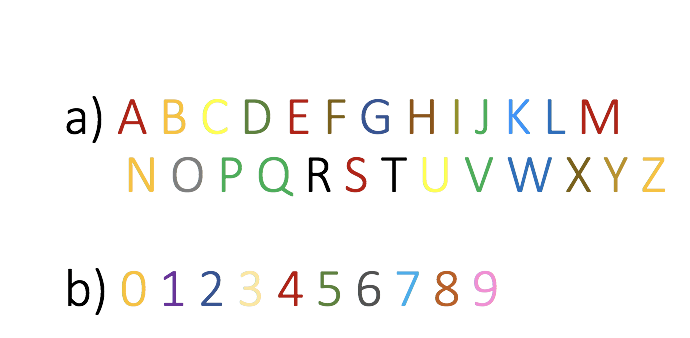
    This figure, adapted from Grossenbacher and Lovelace (2001) illustrates 2 examples of inducer-concurrent pairing in color-grapheme synesthesia.

    There are many different types of synesthesia, but they all have some traits in common. There are at least three fundamental requirements commonly used to define the condition in general. First, as I mentioned earlier, it is an involuntary reaction, one that is unconsciously elicited by the stimulus (Phillips). This means that the synesthete, as people with synesthesia are called, doesn’t have control over what is perceived, or when. It is just like any other sensory experience- you can’t “unhear” or “unsee” something, nor change the color of an object you are looking at (Gross). Additionally, the associations must be consistent. For example, someone with color-auditory synesthesia will always perceive the same color in response to the same sound, and if the number 4 is red to a color-grapheme synesthete, it must always be red. Finally, the experience is  the “adding” of sensory input, not replacing or substituting it. That means that the synesthete is still able to perceive the stimuli in the original sense as well, so if a person has auditory-gustatory, or sound-taste, synesthesia, they will be still be able to taste the food as well as hear it (Ward).

    Aside from those three requirements, the synesthetic experience is extremely varied and idiosyncratic. Typically, the secondary sensation, referred to as the “concurrent” to the stimulus’s “inducer”,  is best described as a “projected” experience. This just means that it isn’t felt as something imagined, but as the perception of something outside the body. For example, if you had lexical-gustatory synesthesia, you would actually have the sensation of tasting something specific when you heard or read certain letters, rather than just associating a taste with it mentally. However, it isn’t always that clear-cut, particularly with color-graphemic synesthesia, the association of numbers or letters with particular colors. Although all will perceive the color as something inherent to the grapheme, the color may not appear to physically overlay with the normal visual field.  Dixon et al. 2004 splits people with this type of synesthesia  into two groups, projectors and associators. Projectors will see the color physically overlaid on a space in their visual field, while associators will see the color in their mind’s eye, as if on an internal screen (Ward). Contrary to the initial definition, synesthesia is also not always the combination of two separate sensory systems, but simply different aspects of them. Using color-graphemic synesthesia again as the example, both the visually-presented character and the color are different facets of the same visual sense (Ward). It has also been shown that for some synesthetes, the concept of the stimulus is enough to trigger the secondary sensory experience. Dixon et al. 2000 found, for instance, that for individuals with color-number synesthesia, giving them sums equal to 7, like 5+2, can often be enough to make them see the color associated with 7 (Ward). It has also been observed that if the inducing word is “inaccessible, as in a tip-of-the-tongue state”, people with lexical-gustatory synesthesia may be able to taste it.

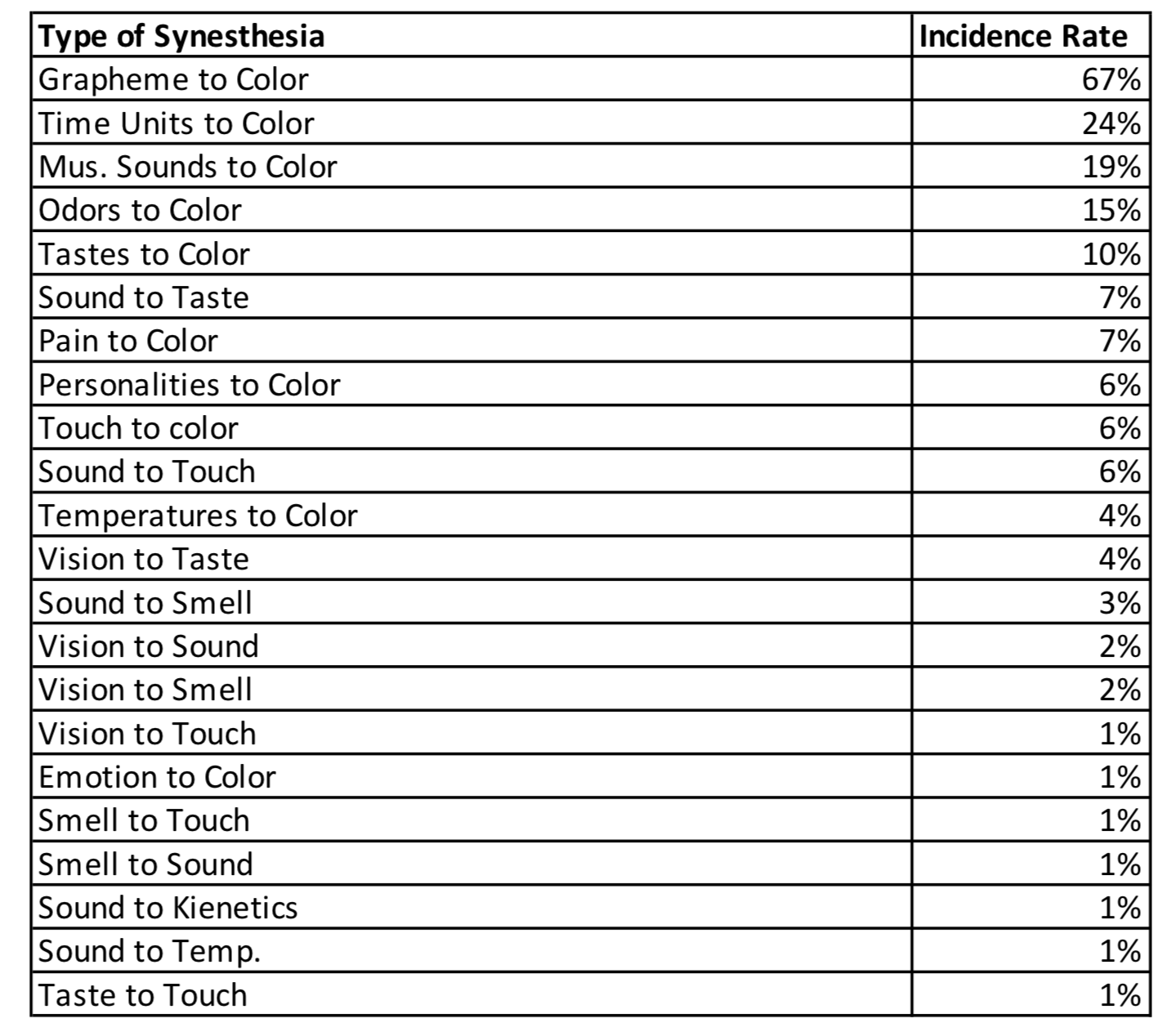
    This table compiles the relative frequency of some inducer-concurrent types pairings, as adapted from data collected by Day (2007), and I think it is a neat way to see a few of the many possibilities for modality pairing in synesthesia.

    There are, theoretically, as many different forms of synesthesia as there are possible combinations of sensory experiences, and it is estimated that there are upwards of 35 different variants documented so far (Gross). In addition to the ones mentioned, this includes auditory-touch synesthesia, where a physical touch or other tactile sensation also produces a sound, mirror or touch-visual synesthesia, where seeing another person receive a tactile stimulus (e.g. get touched or touch something) makes the synesthete feel that touch as well, and variations that include spatial and/or temporal experiences. The most prevalent forms are color-graphemic and color-auditory, and even within these, there is a ton of individuality. Synesthetes will have their own colors for each stimulus, and for some people, each individual character will have a color, while others may have one sensation for an entire word.

    An interesting point to make here, is that thus far (and for the remainder of these articles), we are discussing synesthesia that an individual has always experienced, sometimes called “developmental synesthesia”. While it a topic of debate whether they should be considered synesthesia and/or arise from the same biological mechanisms, there are other related conditions known collectively as “acquired synesthesia” (Gross). These include synesthesia/synesthetic-like experiences that occur later in life, usually due to some form of physical injury or change  that results in the loss of sensory input from one area or sense. The fairly well-known Phantom Limb Syndrome, during which the individual perceives pain and other somatosensations from the area where an amputated limb used to be, is actually linked to some very intriguing cases of acquired synesthesia! People in these cases report perceiving touch from visual input, like seeing something touch either the location of the phantom limb or touch on the corresponding location of another person. This seems to parallel the experiences of mirror synesthesia (Ramachandran). There has also been research on acquired auditory-visual and tactile-visual synesthesia following the onset of blindness, as well as touch-auditory synesthesia after the loss of hearing, and following damage to the thalamus (Ramachandran, Ward). In these cases, the general hypothesis seems to be that the sensory cortex implicated for the lost/damaged sense is still active and able to function, but no longer getting the sensory input from receptor sites as before. It therefore may begin to respond to another sensory system, through some change in neural communication, which can create the dual sensory experiences of synesthesia (Ward).

    If you, like me, are a nonsynesthete, this all may seem incredibly overwhelming and perhaps even a bit difficult to believe. But while the neurological basis of synesthesia isn’t completely understood, there is a substantial body of experimental research and data on the subject. A study by Baron-Cohen et al. in 1987 provided the first experimental evidence that the synesthetic associations of specific stimuli are consistent over time. Working with a control group of people without synesthesia as well as a participant with color-lexical synesthesia, they recorded the color each person reported being triggered by each word on a 100-word list. The control group was asked to repeat the test 2 weeks later, and only retained consistency with the word-color pairing 20 percent of the time. By contrast, when the synesthete was asked, 1 year later and without any prior warning, to repeat the test, she  showed a consistency over 90% (Ward). Further investigations by this research team also found that brain imaging technology can measure a difference in brain activity during synesthetic perception. Using PET and fMRI imaging to measure brain activity in different regions, they were able to observe that people with color-auditory synesthesia have increased activation in area V4, which is correlated to color, than nonsynesthetes do when listening to sounds.

    Another experimental technique used to test for synesthesia is a modified version of the Stroop test. The original Stroop test is something you’ve probably done at some point, and involves reading the color name or identifying the ink color of color names that are either printed in a congruent color, like the word red written in RED, or in an incongruent color, such as like this word RED printed in green ink. Normally, you are able to respond much faster and more accurately when the word and the color are congruent- this is known as the Stroop Effect  and is extremely well-established amongst the scientific community. In the experiments involving synesthesia, the same principle is applied to the inducing stimulus and the concurrent perceptual effect: for people with color-grapheme synesthesia who perceive the number 4 as blue, the congruent task would have a blue 4, while the incongruent would have 4 printed in a different color, like purple. This has been done with color-grapheme, gustatory-auditory, color-auditory, and even spatial synesthesia, and the Stroop Effect has been markedly present for all (Ward).

    Neat, you’ve made it this far! That was my initial look into the phenomena that is synesthesia and what really defines it. While researching, I kept finding out more and more, so if you want to learn about research into the biological basis of synesthesia,  or any of the other interesting facts I found out, check out Part Two here:

    http://chargedmagazine.org/2019/10/painting-with-al…he-wind-part-two/

    References 

    Day, S. (2007). Types of Synesthesia. Retrieved from http://www.daysyn.com/Types-of-Syn.html

    Gross, V. (n.d.). Synesthesia Project: FAQ. Retrieved from https://www.bu.edu/synesthesia/faq/

    Grossenbacher, P. G., & Lovelace, C. T. (2001). Mechanisms of synesthesia: Cognitive and physiological constraints. Trends in Cognitive Sciences,5(1), 36-41. doi:10.1016/s1364-6613(00)01571-0

    Phillips, E. L. (n.d.). What is synesthesia? Retrieved from https://faculty.washington.edu/chudler/syne.html

    Ramachandran, V.S., Hubbard, E.M. and Butcher, P.A. (2004). Synesthesia, CrossActivation, and the Foundations of Neuroepistemology. In G. Calvert, C. Spence and B. E. Stein (eds), The Handbook of Multisensory Processes (pp. 867-83). Cambridge, Mass.: The MIT Press.

    Ward, J. (2013). Synesthesia. Annual Review of Psychology,64(1), 49-75. doi:10.1146/annurev-psych-113011-143840

  • Painting With all the Colors of the Wind Part Three

    If you’ve already read this far, you hopefully have a pretty good picture of what synesthesia is, seen some scientific data that supports its existence, and heard a few of the possible biological explanations.

    Now, let’s take a step back together. Let’s go back to trying to understand the way the world might seem if this sentence also produced music, or the sensation of touching the computer keyboard smelled a certain way.  This is the point in my research where I just began to marvel at the vastness of possibilities, all of the infinite ways sensations could be paired, and how those combinations might affect the lives of people experiencing them.

    I also noticed something a bit strange though. The more than I read, and the further away and more complex synesthesia seemed, the more I started to notice the cross-sensory references all around me. For the first time, it struck me as odd that English-speakers may refer to the taste of a cheese as “sharp”, or the sting of a cold wind as “bitter”. Once I started looking for them, I found similar pairings of different senses everywhere, appearing in idioms such as “speaking in honeyed tones”, as well advertisement campaigns, like Skittle’s “Taste the Rainbow” tagline, and famous works of literature alike, with the infamous “yellow cocktail music” of Fitzgerald’s The Great Gatsby.

    Naturally, this sparked quite a few questions. Where did these types of metaphor come from? Are they related to synesthesia, or merely eerily similar? Are they some sort of “cultural” form of synesthesia? Or are they merely evidence of how synesthetes have influenced society, remnants of people with synesthesia living, working, and integrating their experiences into the common language? Are we all synesthetes, in a small way, when we make these connections and use this imagery?

    A precursory review of the studies I’d read provided a resounding no, at least to that the final question. Nearly every one was quick to point out that  these types of imagery do not fit the three main criteria we laid out in the first article, while defining synesthesia. Synesthesia has to be involuntary, elicited, and stable; metaphorical language is made of voluntary associations, chosen to convey or emphasize an aspect of the stimulus, and is extremely creative and dynamic, depending entirely on what one is feeling in the moment, or what one wishes to say (Deroy and Spence 2013). Although it often includes cross-modal imagery, like colored descriptions of sound or tactile adjectives applied to tastes or emotions, this language is not literally perceptual. As Greg Downey states, ‘…metaphoric analogy may highlights perceptual qualities, but it is driven by elective choices to highlight qualities that may involve symbolic meanings or create meaningful analogies” (Downey). When you think  of “seeing red” and associate it with anger, chances are that you are not actually seeing the color red, as you might see the blue sky or the green grass, whenever you become angry, and while you might choose to communicate the intensity of flavor in your cheese as sharp, chances are that it does not feel physically sharp to the touch.

    That is not to say, however, that these expressions may not have been influenced or inspired by true synesthesia, though.  In fact, there is pretty solid evidence that people without synesthesia were greatly influenced by the phenomena and the concept of linking senses. One example of this can be seen in the copious amount of cross-sensory imagery in the Romanticism movement in literature. There was actually an entire writing theory based on it, often called poetic or literature synesthesia, with classifications of “higher” and “lower” senses, and a prescribed system for linking a subject to a “higher sense” to add stress or emotional emphasis (Duffy). Percy Bysshe Shelley, a very large figure in Romantic poetry, uses it clearly in this stanza from his poem “The Sensitive Plant”, as he compares the smell of a flower to “sweet”, “soft” music (Synesthesia Examples and Definition):

    “And the hyacinth purple, and white, and blue,
    Which flung from its bells a sweet peal anew
    Of music so delicate, soft, and intense,
    It was felt like an odour within the sense.”

     This is a surprisingly relevant issue, especially in historical literature and linguistics research, as academics are trying to define what criteria can accurately help distinguish between authors describing synesthetic perceptions and those using intense cross-modal imagery (Ward).

    To complicate things further, a disproportionately large number of influential artists, musicians, and writers are thought to have some form of synesthesia (Walsh, Ward et al. 2008). The famous composer Olivier Messiaen, is well-documented to have color-music synesthesia, and is often quoted saying “Colours are very important to me because I have a gift…whenever I hear music or even if I read music, I see colours” (Walsh). Alan Menken, the composer behind many classic Disney soundtracks, including music from “The Little Mermaid” and, of course, the song “Colors of the Wind” (and yes, I totally tried to play off of that in the title of these articles) has also reported that seeing music in color. There are tons of well-supported examples of influential figures with synesthesia, including the physicist Richard Feynman, artists like van Gogh and Kandinsky, composer Franz Liszt, musicians like Duke Ellington and Itzhak Perlman, and writers such as Arthur Rimbaud and Charles Baudelaire, among many others.

    “I’ll Follow You into the Dark” by Sigourney Young
    For the etsy artist Sigourney Young, this task would be perfectly intuitive. Young has color-music synesthesia, and creates beautiful watercolor pieces based on what she sees during a song. My best friend commissioned this painting, inspired by the song “I”ll Follow You into the Dark by Death Cab for Cutie, for me in 2017, and I’ve overlaid the sheet music of the piece on an image of the painting to illustrate how the two are inextricably intertwined.

    With all of these tangled up cases of literal and metaphorical synesthesia in nearly every aspect of culture, it becomes a bit difficult to determine exactly how much should be attributed to the neurological phenomena, and what impact synesthesia may have had on humanity over time. It is a bit simpler to see how it has directly affected the individuals who experience it, though.

    So, what do we actually know about synesthetes?

    Well, just like any other group of people, people with synesthesia are all wonderfully unique individuals, from diverse backgrounds around the world. There do seem to be a few trends linking them together, however.

    First of all, as mentioned previously, synesthesia does tend to run in families and is suspected to have an undetermined underlying genetic component. Studies have also suggested that synesthetes tend to be more creative than the average population, spending a larger amount of time engaged in tasks related to the arts and working more often in a job considered “creative”- artist, musician, actor, writer, entrepreneur, researcher, etc. (Ward et al. 2008, Walsh).

    It also seems that synesthesia can be useful in aiding memorization, as many people report that the secondary sensation helps them recall the stimuli better. There are even some extreme cases, such as Solomon Shereshevskii, who was known for performing impossible tasks of memory for audiences, and who also had  multiple forms of synesthesia (Ward). Another example is Daniel Tammet, who recited over 20,000 digits of pi. He said that each number had a color, shape, and texture that helped him memorize the sequence, and in later experimental studies, showed less dependence on traditional memorization techniques (Bor et al. 2007).

    Synesthesia has not been linked to any other neurological condition and is not considered a disorder. Most think of it as an asset, and there are few instances of  synesthetic experience negatively interfering with a person’s life and/or capabilities. According to one researcher, nearly all synesthetes report it as “pleasant experience that they would prefer to have, given the choice” (Walsh).

    Synesthesia provides completely different ways of perceiving the world and is,  at least to me, one of the most beautiful and fascinating examples of individuality and the power of the brain on our perceived  reality. I had a ton of fun looking into this phenomena, and hope you’ve enjoyed learning a little bit about it as well!

    References

    Buja, M. (2016, February 06). Writing Music in Light. Retrieved from       http://www.interlude.hk/front/writing-music-light/

    Carpenter, S. (2001, March). Everyday fantasia: The world of synesthesia. American    Psychological Association, 32(3).

    Day, S. (2007). Types of Synesthesia. Retrieved from http://www.daysyn.com/Types-of-Syn.html

    Denham, J. (2017, March 31). This Artist with Synesthesia Sees Colors in Music and Paints Your Favorite Songs. Retrieved from https://broadly.vice.com/en_us/article/gyxq73/melissa-mccracken-synesthesia-painter-interview

    Deroy, O., & Spence, C. (2013). Why we are not all synesthetes (not even weakly so). Psychonomic Bulletin & Review,20(4), 643-664. doi:10.3758/s13423-013-0387-2

    Duffy, P. L. (2013). Synesthesia in Literature. Oxford Handbooks Online. doi:10.1093/oxfordhb/9780199603329.013.0033

    Downey, Greg. (2008, June 05). Synesthesia & metaphor – I’m not feeling it. Retrieved from https://neuroanthropology.net/2008/06/05/synesthesia-metaphor-im-not-feeling-it/

    Grossenbacher, P. G., & Lovelace, C. T. (2001). Mechanisms of synesthesia: Cognitive and physiological constraints. Trends in Cognitive Sciences,5(1), 36-41. doi:10.1016/s1364-6613(00)01571-0

    Gross, V. (n.d.). Synesthesia Project: FAQ. Retrieved from https://www.bu.edu/synesthesia/faq/

    Hubbard, E. M., & Ramachandran, V. (2005). Neurocognitive Mechanisms of Synesthesia. Neuron,48(3), 509-520. doi:10.1016/j.neuron.2005.10.012

    Rouw, R., & Scholte, S. (2010). Increased structural connectivity in Grapheme-Color Synesthesia. Journal of Vision,7(9), 108-108. doi:10.1167/7.9.108

    Phillips, E. L. (n.d.). What is synesthesia? Retrieved from https://faculty.washington.edu/chudler/syne.html

    Ramachandran, V.S., Hubbard, E.M. and Butcher, P.A. (2004). Synesthesia, CrossActivation, and the Foundations of Neuroepistemology. In G. Calvert, C. Spence and B. E. Stein (eds), The Handbook of Multisensory Processes (pp. 867-83). Cambridge, Mass.: The MIT Press.

    Synesthesia Examples and Definition. (2015, October 31). Retrieved from http://www.literarydevices.com/synesthesia/

    Walsh, V., & Mulvenna, C. (2005). Synesthesia. Current Biology,15(11), R399-R400. doi:https://doi.org/10.1016/j.cub.2005.05.039

    Ward, J. (2013). Synesthesia. Annual Review of Psychology,64(1), 49-75. doi:10.1146/annurev-psych-113011-143840

    Ward, J. , Thompson‐Lake, D. , Ely, R. and Kaminski, F. (2008), Synaesthesia, creativity and art: What is the link?. British Journal of Psychology, 99: 127-141. doi:10.1348/000712607X204164

  • Mayday, Mayday, Are We Syncing?

    There is something funny, maybe even enjoyable, about the camaraderie many people seem to feel with their “period-buddies”. After all, we all know the old cliché: misery loves company.

    Things get a little wacky, though, when you start suggesting that shared cycle times among friends is a result of their closeness, rather than just an amusing coincidence. That this the fundamental idea of period-syncing, or what is more formally referred to as “menstrual synchrony”.

    If you have ever lived in a group of people who menstraute, you have probably heard jokes about how the timing of their periods will line up, with some people even believing that there is a social hierarchy element, where an “alpha” female can induce others to join her cycle timing.

    It sounds pretty cool, actually, as if this is a biological mechanism of solidarity, something induced by social interaction that stands as a strange, yet scientifically objective record of friendship.

     

    But where did this idea come from, and is it actually backed by empirical evidence?

    I decided to do a little sleuthing, and this is what I found out.

    The concept of menstrual synchrony was first introduced into scientific literature in 1971, in a study of college-aged women by McClintock. In the published paper, it was noted that menstrual synchrony was already something reported informally among groups of women, and that previous research with mice had found it possible for social factors, including pheromones and crowding, to affect the endocrine system and hormone secretion (McClintock 1971). With this foundation, the study set out to see if period-syncing was measurable on a large scale. 135 women in a college dorm were asked to report the dates of their previous two periods 3 times over the course of a school year, and data designed to determine how close the individuals were to each other socially was obtained by asking them to report lists of  ten women they considered to be their closest friend. They found that there was statistically significant evidence of synchrony between friends; specifically, period onset dates got about 2 days closer over the course of 4-6 months for pairs of friends.

    This sparked more interest into the subject. If period-syncing was happening, how did it work? And what evolutionary purpose could it possibly serve?

    One proposal suggested that a mechanism for syncing might be related to human pheromone secretion. Pheromones are chemicals that the body secretes that act like signals, eliciting some behavioral response in the other individuals of the same species that receive it. This is easily observable in some organisms, such as termites, who leave and follow path/food-finding pheromones to help each other navigate their complex underground tunnels. There isn’t much known about the role of pheromones in humans, however. Another study by McClintock did find  evidence that compounds taken from the armpits of women could influence menstrual cycle lengths (Stern and McClintock 1998), and these quickly became the most popular hypothesis as to how intrapersonal interactions could leads to synchrony. There were other proposals, of course, including the idea that direct exchange of chemical compounds between women (via sweat, physical contact, the swapping of clothes, saliva, and other mean) could be responsible, and research has been conducted between many different groups to test these ideas, including investigations that predicted athletes and lesbian couples would be more strongly in synch because of the likelihood of increased physical contact (Graham 1991). It was also suggested that the physiological effects of different emotions, like heart rate, blood pressure, and hormonal secretion levels, could be involved, perhaps making the person more sensitive to olfactory signals (Graham 1991). Many of these are speculative explanations, though, and an exact pathway hasn’t yet been identified.


    Lets assume for a moment, though, that there is a working mechanism driving the synching of periods between companions. What biological function would that serve? Is there any reason why it might be advantageous for this part of the reproductive cycle to occur simultaneously between females in close proximity?

    One suggestion was that it evolved because it increases the chances of conception for females living together with a single male, maybe by increasing the total pheromonal signal that could motivate mating in the  for the male (Ziomkiewicz 2006). Another proposal said that it may aid in the post-pregnancy child-rearing; if many women were lactating at the same time it could ensure that there would be someone able to care for the babies if a mother died. As Ziomkiewicz points out in a 2006 review article, however, all of these theories assume that period synchrony would correlate directly to ovulation or fertility synchrony, which isn’t actually something we know to be true (Ziomkiewicz 2006). In fact,  a review of McClintock’s 1971 data, where the period outset timing only changed by a few days over the course of months, found that this change would have no significant impact on conception timing at all (Strassmann 1997).

    Without an impact on fertility timing, it seems as though period-synching would be… kinda pointless.

    Speaking of that original data from McClintock (1971), let’s re-examine research supporting the idea that period-syncing occurs. That original study has actually come under a great deal of criticism and scrutiny by follow-up studies. First of all, many scientists have renounced the paper’s application of statistical methods. Wilson (1992) found three major issues with this study, and subsequent papers on the topic, stating that the studies:

    • Didn’t account for the probability of period onset dates aligning by random chance
    • miscalculated the differences in initial menstrual onsets, in a way that lead “to an erroneous impression of synchronization over time” (Strassmann 1999)
    • excluded data of particular subjects, creating a sampling bias

    In addition, others found discrepancies in the lists they used to rate the level of “closeness” between women, saying that overlaps between lists of roommates and friends resulted in the repetitive inclusion of some data, or “double-dipping” data (Yank and Schank, 2006).

    With such substantial errors in methodology, the initial studies and its statistically follow-ups, are questionable at best.

    So, back to square one: Does research show that period-syncing is real?

    The answer seems to be no, not really. Other studies have found no statistically significant evidence of such a phenomenon.

    One such study took data from 29 rooms of women living together in college dorms in China. There were 4-8 people per room, and data was gathered for more than 1 year (Yank and Schank, 2006). Using each room group as a unit of closely-interacting women, they analyzed the data for rooms that showed “statistical clusterings” of cycle onsets around similar dates. They found that only 9 of the 29 groups showed any clustered onset dates, and that this diverged again over time. According to their analysis, this is not greater than the expected convergence frequency you would find with a random variable. They concluded that there was “no onset convergence and no synchronization of cycles” in the course of their study (Yank and Schank, 2006).

    Another study of college women, this time in Poland, used questions about the amount of time spent together (eating, sleeping, studying, exchanging clothes, spending free time, ect.) to create a indexed score of closeness/interaction between the 200 participants (Ziomkiewicz 2006).They found similarly inconclusive results, with no trend between time spent together and period-onset dates.

    Yet another experimental approach decided to test a population of native Dogon women. The Dogon people are largely millet farmers in the Sahel of northern Africa, and presented a unique research opportunity as a predominately pre-industrialized society. Because the use of contraceptives or family planning is not common, it is what anthropologists call a “natural birth” population, a society where medicinal regulations of natural fertility cycles isn’t a factor (Strassmann 1997). Within this population, Strassmann (1997) selected 3 increasing selective subsets to measure the women’s level of social interaction, where the “village” group included all individuals in the village, “lineage” included those who lived with a line of related males, and “economic unit” referred to those who typically worked and ate together. Once again, no evidence of synchronization was found between any of the groups (Strassmann 1997).

    A  large-scale study from the menstrual period tracking app Clue took a very different approach, examining user data, and also found no relationship between individuals’ cycle schedule and the time spent together (Gunther 2019).

    And I could go on and on- Strassman’s 1997 review article lists at least three more studies with inconclusive results- Jarett 1984, Wilson, Hildebrandt Kiefhaber, and Gravel 1991, Trevathan, Burleson, and Gregory 1993 (via Strassmann 1997).

    With such an abundance of research unable to find evidence of period-synching, and a corresponding dearth of well-received studies detecting it, I think it is safe to conclude that period-synching, at least on the scale the public accepts, simply isn’t true.

    And yet, it is a remarkably common belief. According to one study (Arden et al 1998), over 80% of women believe that menstrual synchrony occurs. That isn’t surprising to me, given the years of casual bantering and bathroom chitchat I’ve heard about it. It is a staple in pop culture, and nearly every woman I know has observed it in their own experiences.

    So if there isn’t actually something scientifically provable happening, why do we keep noticing it? It seems like a strange concept to fixate on.

    There may be an simple explanation for that, though- people just don’t know how likely it actually is to have overlapping cycles. There seems to be a widespread idea that being “timed” together is a rare, or statistically abnormal event, when in fact, mathematical models have shown that it should be expected in half of the studied cases just by random chance (Wilson 1992, Ziomkiewicz 2006). As one researcher notes, if two women both have 30 day cycles (already improbable, due to the large intrapersonal cycle variability), the maximum number of days they could be apart is only 15, and they are expected to be an average of 7.5 days apart. This means that at least half the time, they will be closer together than that, and therefore pretty likely to overlap by a few days anyway (Strassmann 1997).

    Add in the psychological appeal of “sharing” the experience, and it is probable that people are more likely to notice and remember instances of close period-onsets than the ones that aren’t near each other. The conformation bias, or our tendency to ignore evidence that doesn’t support  our ideas, is well known in psychology, and is definitely a potential player in contributing to the long-lasting effect of this myth (Fetters 2019).

    It’s also important to note that cycles aren’t actually that consistent, between women and for an individual person. Cycle lengths differ significantly person-to-person, and it is mathematically impossible to synchronize rhythms with different frequencies (Strassman 1997, Schank 2000). Other factors including, such as physical health, stress, and lactation can also induce changes. As Traloar et al. (1967) succinctly put it, the menstrual cycle is “characterized by variability rather than by regularity”.

    So, unfortunately, no, sharing the suffering with your roommate doesn’t prove your relationship or represent the amount of time you spent together. As cruel as it is to strip away what very well may be the only “fun” part of “that time of month”, it is important to investigate truths behind our collective beliefs about female reproductive health.

    I think it is telling that period-syncing is still popularly accepted, after the original study came under so much fire and the continued research has continued to refute its existence. It seems to indicates a general dismissiveness towards sexual and reproductive health, that while pretty harmless and quirky in this case, is concerning. It is important to note that our misunderstandings have contributed to unfortunate consequences in the past. For example, the incorrect belief that menstrual fluid was partially developed embryo to which semen gave final form, and menstruation before marriage/pregnancy was therefore equated with  child-murder (Finn). This contributed to the practice of child brides to prevent the perceived loss of life in pre-marital menstruation.

    There are many aspects of reproductive health that we still don’t understand much about,  but having mystery and stigma around menstruation doesn’t clarify anything.

    That said, keep enjoying the solidarity of shared cycles- commiserating by chance is still something to bond over, if that’s your thing. Just remember to treat your reproductive health with scientific precision and respect rather than superstition.

    Works Cited

    Arden, M. A., and L. Dye (1998 ).The Assessment of Menstrual Synchrony: Comment on Weller and Weller (1997). Journal of Comparative Psychology 112:323-324.

    Fetters, A. (2019, September 24). Why the Myth of Period Syncing Won’t Go Away. The  Atlantic. Retrieved from https://www.theatlantic.com/family/archive/2019/09/period-syncing-almost-definitely-isnt-real/598714/

    Graham, C. A. (1991). Menstrual Synchrony: An Update and Review. Human Nature, 2(4), 293–311. doi: 10.1007/bf02692195

    Gunter, J. (2019, June 6). The Myth of Period Syncing. New York Times. Retrieved from https://www.nytimes.com/2019/06/06/well/the-myth-of-period-syncing.html

    Mcclintock, M. K. (1971). Menstrual Synchrony and Suppression. Nature, 229(5282), 244–245. doi: 10.1038/229244a0

    Schank, J. C. (2000). Menstrual-Cycle Variability and Measurement: Further Cause for Doubt. Psychoneuroendocrinology 25:837-847.

    Stem, K., and M. McClintock (1998). Regulation of Ovulation by Human Pheromones. Nature 392:177-179.

    Strassmann, B. I. (1997). The Biology of Menstruation in Homo sapiens: Total Lifetime Menses, Fecundity, and Nonsynchrony in a Natural-FertilityPopulation. Current Anthropology 38:123-129.

    Strassmann, B. I. (1999). Menstrual synchrony pheromones: cause for doubt. Human Reproduction, 14(3), 579–580. doi: 10.1093/humrep/14.3.579

    Treloar, A.E., Boynton, R.E., Behn, B.G. et al. (1967) Variation of the human menstrual cycle through reproductive life. Int. J. Fertil., 12, 77–126.

    Wilson, H. (1992). A critical review of menstrual synchrony research. Psychoneuroendocrinology, 17(6), 565–591. doi: 10.1016/0306-4530(92)90016-z

    Yang, Z., & Schank, J. C. (2006). Women do not synchronize their menstrual cycles. Human Nature, 17(4), 433–447. doi: 10.1007/s12110-006-1005-z

    Ziomkiewicz, A. (2006). Menstrual synchrony: Fact or artifact? Human Nature, 17(4), 419–432. doi: 10.1007/s12110-006-1004-0

  • Mum’s the Word

    When most people think of mummies, a strange mixture of ancient curses and toilet paper-wrapped Halloween costumes come to mind. It comes as no surprise that the concept of mummies is linked to the magical and superstitious- after all; it is pretty unbelievable to see intact bodies that are 2,000 years old. How could you not think of zombies or ghosts?

    Like all mysteries, however, mummies actually have a scientific explanation.

    IMG_0779

    Human bodies decay and break down by two major mechanisms: autolysis and putrefaction. Autolysis is essentially a self-destructive process during which enzymes that typically aid in digestion begin to digest the body itself. After this, putrefaction begins when bacteria from the body’s flora or the surrounding environment start to break down the organic matter for their own nutrition, leading to the decomposition of the corpse. The bacteria introduce additional enzymes that continue the liquefaction, and eventually, the body will attract flies and scavengers that can feed on the remains. In order to effectively preserve a body, these processes must be interrupted, or at least slowed significantly. There are several known factors that can do just that:

    • Water content: The bacteria and enzymes need an environment with water; so drying the corpse is essential to its preservation. The drying out of the body is known as desiccation, and can happen naturally in extremely arid environments, like the hot sands of the deserts, or can be chemically induced, like with the Egyptian embalming process, where the bodies were covered natural drying agent named natron.
    • Temperature: In extreme temperatures, especially cold, dry environments, bacteria are unable to survive. In addition, many enzymes denature, or unfold, in extreme environments, and can’t function properly. This slows the decay process down greatly, and can also occur naturally, leading to mummies such as the Iceman found in the Italian Alps. It is actually very similar to the way that your freezer helps you to preserve food!
    • Organ Removal: Removing internal organs that contain a large population of bacteria prevent decay from the inside out. This was an important part of the preparation of Egyptian mummies, where most major organs were removed from the body and placed into sacred canopic jars.
    • Chemical Interactions: Many different chemical interactions can contribute to the preservation of human tissue. Some of the most common include:
      • Exposure to heavy metals ions, including copper and arsenic, can lead to the denaturation of the enzymes involved in autolysis, as the metal ions bind to the polypeptides.
      • Lime, calcium oxide, reacts with water and raises the temperature to form calcium hydroxide. This reaction process dries out the body and raises the pH, which can limit the effectiveness of enzymatic activity.
      • Resins can be also be used in mummification, as an antiseptic and as a barrier against rehydration when spread over the skin.


    I hope you found this interesting, and good luck with those linens!


    References:

    Aufderheide, Arthur C. (university Of Minnesota, Duluth), A. (2011). Scientific Study of Mummies. Cambridge University Press.

    Harris, T. (2018, March 08). How Mummies Work. Retrieved from https://science.howstuffworks.com/mummy.htm

  • Master Memory

    Whether you are cramming for an exam, or simply trying to remember your grocery list, memory is involved in practically every part of everyday life- and if you are anywhere near as forgetful as I am, it can be quite the struggle. One psychology model suggests that there is an easy way to improve how much you remember something of something, simply by adjusting how you engage with it.

    Charged Memory Photo

    The Levels of Processing Model for memory, proposed by Craik and Lockhart (1972), is a major theory within cognitive psychology that attempts to explain the formation and retrieval of memories by detailing a processing hierarchy in the way you learn stimuli. They described three major categories of processing: structural or visual processing, which focuses on the physical characteristics of the material, such as the colors, shapes, or number of letters, phonological or auditory level of processing, which delivers information about how the information sounds, and semantic level of processing, a level that connects to the meaning of the stimulus, by defining it with respect to previous knowledge or evaluating what it means to you. According to their theory as one progresses from structural through the phonetic to the semantic levels, the depth of processing increases, and the better people are able to recall the information. In other words, the quality of memory is a direct consequence of the way information was learned or encoded: the deeper the level at which the information is processed, the longer lasting the memory it creates.

    The model has been criticized for not being a complete picture of how memory works, specifically because it doesn’t explain why processing it at specific levels would result in better recall. In addition, others have said it may not account for the amount of time it takes to perform each of these levels of processing (it might be better remembered just because they spent more time on it), and disregards evidence for separate mechanisms for short-term versus long term memories. However, it is well supported by a number of empirical studies that have found that participants who perform tasks at a “deeper” level when learning have significantly improved memories of the material when recalling it (check out Hyde and Jenkins (1973) and Craik and Tulving (1975) for some deeper analysis and supporting data).

    In my opinion, the Levels of Processing model of memory is one of the most useful psychology has to offer, because of its direct, real world implications. It emphasizes the effect of how we choose to process information, giving individuals more ability to control their memories, and taking some of the mystery out of the mnemonic. Using new vocabulary words in sentences, reframing those physics concepts to a previous experience, or making up stories to go along with your notecards- any technique that allows you to connect and relate to the material- is a great place to start in trying to remember new content.

    Here are some easy ways you can apply the levels of processing model to try to improve your own memory:

    • Tie new information to existing knowledge
      • Try writing out examples from your own life that relate to the concepts you are learning, or find examples from other classes and subjects you can relate the new idea to.
    • Make it your own
      • Put the information into your own words. One way to do this is to talk about and explain the material to someone else.
      • Explain why it is relevant to your life.
    • Use the Loci Method
      • When you have a long list of items to remember, such as a shopping list, link every item on the list with with a familiar place or route, and try to visualize it. This helps you think about the specifics of the item, links it to pre-existing knowledge, and elaborates the encoding process.
    • Combine levels of processing together
      • When it comes to forming memories, the more the merrier! Processing the same information at different levels has been shown to improve memory as well! Mind maps are a great way to enage with something both visually and sematically, but any way to process information on multiple levels is useful.

    References:

    Craik, F. I., & Lockhart, R. S. (1972). Levels of processing: A framework for memory research3. Journal of Verbal Learning and Verbal Behavior, 11(6), 671-684. doi:10.1016/s0022-5371(72)80001-x

    Craik, F. I. M. & Tulving, E. (1975). Depth of processing and the retention of words in episodic memory. Journal of Experimental Psychology, 104(3), 268-294.