Author: Amy Nguyen

  • The Joy of Humanity and Clothing: Growing Culture and Protecting Our Planet Earth

    While exploring the world of clothing and textiles, I created a collage of videos based off what I consider to be “The Joy of Humanity and Clothing”, culture. While culture is beautiful and a root joy for nearly all cultures, it is vital to remember that the unintended consequence of these rapidly evolving trends is over consumerism. Overconsumption is a constant issue in our time as the rise of fast fashion and the quicker and neverending cycle of trends.  

    There are three categories of textile wastes: pre-consumer (“clean” by-products from the manufacturing process), post-consumer (textiles that no longer have value after use such as towels, sheets, etc.), and industrial textile waste (“dirty” waste materials created from their manufacturing process) (Juanga-Labayen). Although textiles can nearly be 100% recyclable and it would be ideal to reuse all parts of textiles, in reality, much of it goes to waste (Juanga-Labayen). The EPA measures the creation, recycling, energy recovery, and landfilling of most textile materials. In 2018, the rate of recycling was estimated, by the Environmental Protection Agency (EPA), to be around 14.7% with the estimated rate of recycling clothing to be around 13%, as reported by the American Textile Recycling Service (EPA 2023). Out of all of the material-specific waste (MSW) combusted in order to recover energy, textiles make up nearly 10% of all recovered energy (EPA 2023). Textiles make up nearly 8% of all waste put into landfills (EPA 2023). Although the rate of recycling and energy recovered via combustion have remained relatively standard throughout the years, so has the rate of textile waste that goes to landfills. And while the rates are relatively stable, the amount of overall consumption has drastically skyrocketed due to overconsumption.  

    There are two major types of textile recycling: mechanical and chemical. Mechanical recycling is the physical recycling that we often think about when we think of recycling such as reusing and repurposing clothes and textiles through upcycling and downcycling. Chemical recycling is the process of depolymerizing the polymers in clothes or dissolving the fibers of cotton (Juanga-Labayen). Polymer or oligomer recycling entails the process of taking apart the fibers while leaving behind the polymers or oligomers intact (Juanga-Labayen). This then allows for the materials to be fully recycled into new textiles. For textiles that contain biodegradable materials such as cotton with over 50% cellulose, anaerobic digestion is used in order to create biogas that is rich in methane for energy use. Cotton garments can also be treated to break down and be used as compost for certain things although they have not been approved for use in farming. Another alternative is that textiles can also be treated with alkalis to be fermented and made into feeding for ethanol production. This process is ideal for clothing that may have some polyester blended into cotton such as jeans (Juanga-Labayen).  

    While there have been many innovative ways to reinvent and reuse textiles, the root cause of many of these issues is that there is a staggering increase in textile consumption along with unwanted textiles. Reusing is the best option but both reusing and recycling are much better than burning or landfilling textile materials. While I and many others have been able to find ourselves through our self-expression through clothing, we must also learn more about the “behind the scenes” of the production of our clothing. 

    Sources: 

    EPA, Environmental Protection Agency, www.epa.gov/facts-and-figures-about-materials-waste-and-recycling/textiles-material-specific-data. Accessed 19 Apr. 2024. 

    Juanga-Labayen, Jeanger P., et al. “A Review on Textile Recycling Practices and Challenges.” MDPI, Multidisciplinary Digital Publishing Institute, 16 Mar. 2022, www.mdpi.com/2673-7248/2/1/10. 

    “The Aftermath of Fast Fashion: How Discarded Clothes Impact Public Health and the Environment.” SPH The Aftermath of Fast Fashion How Discarded Clothes Impact Public Health and the Environment Comments, 22 Sept. 2022, www.bu.edu/sph/news/articles/2022/the-aftermath-of-fast-fashion-how-discarded-clothes-impact-public-health-and-the-environment/. 
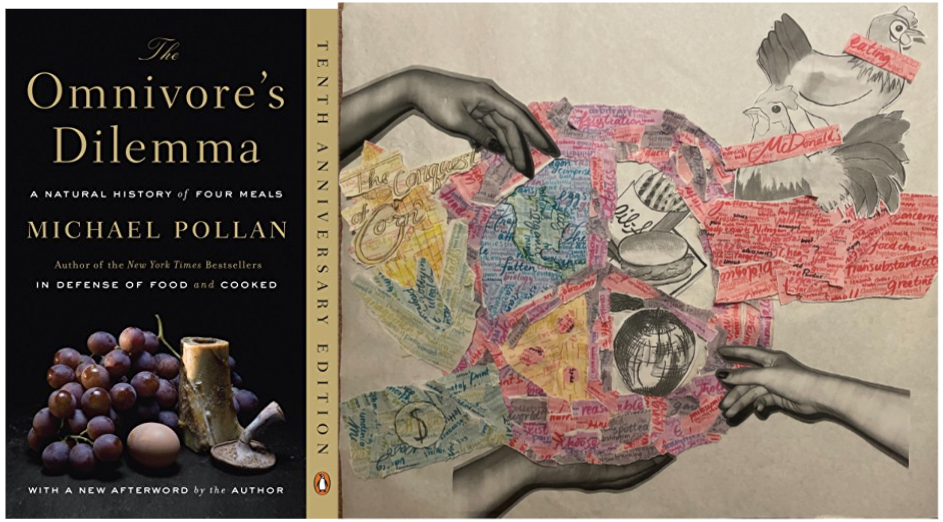
  • The Omnivore’s Dilemma: What Will You Put on Your Plate?

    The Omnivore’s Dilemma: A Natural History of Four Meals written by Michael Pollan is an intriguing book about the current food situation of America and by marking major developments in food and his journey to find “the best” way to eat. To choose to eat every day is to choose to survive but we rarely think about the science behind our choices or behind why those are the only seemingly available choices. While researching this topic and throughout reading this book, I made word clouds around central themes using words said throughout the book in order to point out things to consider while we make our food choices. Every time you look closer at any of the word collages, you notice something different to consider when thinking about food. I then made a collage incorporating these various topics because I believe that art would be the best way to communicate about food, another lesser thought about art form. Both food and art are forms of therapeutic activities that we oftentimes fall back on.  

    Michael Pollan coins an interesting term: the People of Corn which he uses to contrast the difference between the usage of corn by Americans and Native Americans (Pollan). America can very easily be considered a nation run on corn, on corn syrup, on corn-starch, and on corn-based fuel.  

    Unlike the Native Americans, current Americans heavily process corn to the point that it is no longer recognizable. This is not only an amazing feat of innovation, but its impact is also astounding as well. Corn was originally an incredibly thin and weed-like grass with some seeds at the top, but its current form is the result of generations of domestication and modification (Smithsonian 2020). The modern corn is very large, sweet, and fleshy making it an ideal source of energy in both food, livestock feed, and fuel. America grows over a third of the entire world’s corn and dominates the industry in the use of corn-based products in food and in bioethanol (Swain 2019). Corn is an incredible fuel source with it being one of the biggest components in the bioethanol industry, but it has many drawbacks considering that producing more fuel will limit how much food can be produced (Swain 2019). There are also many more unintentional effects of the abundance, and many uses for corn. Corn is a large factor as to why so many processed foods exist today. 

    Credit Thomas Hopper. 

    Processed foods are by no means entirely terrible, but it is important to consider that many processed foods exist solely because they are profitable even though they are at the expense of many of us. But interestingly, there is a high correlation between the higher income countries having higher rates of processed foods and obesity while middle income countries are following suit (Monteiro 2013). A neat way to sum it up is that “When consumed in small amounts and with other healthy sources of calories, ultra-processed products are harmless; however, intense palatability (achieved by high content of fat, sugar, salt, and cosmetic and other additives), omnipresence, and sophisticated and aggressive marketing strategies (such as reduced price for super-size servings), all make modest consumption of ultra-processed products unlikely and displacement of fresh or minimally processed foods very likely (Monteiro 2013). 

    Michael Pollan takes drastic steps of attempting to forage, strictly buying locally and freshly farmed and raised foods (Pollan). While that is certainly not possible for everyone, something that anyone can take from Michael Pollan’s approach is that we should be more mindful about what we eat but also remember to savor our food a little more. For example, there has been a lot of discourse surrounding a TikTok creator named Nara Smith who goes by the handle @naraazizasmith. She started making foods from scratch because of her eczema and skin conditions that caused her to reconsider many of the foods she was consuming, and she now primarily creates videos of her creating many foods from scratch such as yogurt, ice cream, breads, etc. Many others commented on her videos especially about her portion control because she seemed to be very satisfied with the small amounts of treats, such as ice cream, that she gives herself. It was apparent to see that she savored every single bite of the ice cream that she made from scratch and that she was truly satisfied with everything that she ate. 

    An interesting thing that Michael Pollan notes is that food and cooking is not as valued today. More often than not it is seen as a chore which is easy to do when life is constantly busy and throwing curve balls at you from left and right. But isn’t it more satisfying eating something that you took the time to make yourself? Of course, it can be very taxing and difficult but without cooking, most of us don’t take the time to reflect upon what we are eating. Do we take the time to enjoy our food? Rather than needing to cook everything ourselves, I believe that it is up to us to set aside time to enjoy food thoroughly by eating with friends and family or by reflecting upon ourselves and the joys within our lives. The dilemma isn’t whether or not we consume meat but rather what we have as food for thought!

    Sources: 

    Mohanty, Sujit K., et al. “Bioethanol Production from Corn and Wheat: Food, Fuel, and Future.” Bioethanol Production from Food Crops, Academic Press, 24 Aug. 2018, www.sciencedirect.com/science/article/pii/B9780128137666000035?via=ihub#s0070. 

    Monteiro, C. A., et al. Ultra‐processed Products Are Becoming Dominant in the Global Food System – Monteiro – 2013 – Obesity Reviews – Wiley Online Library, onlinelibrary.wiley.com/doi/full/10.1111/obr.12107. Accessed 19 Apr. 2024. 

    Pollan, Michael. The Omnivore’s Dilemma: A Natural History of Four Meals. Penguin Group, 2006. 

    Smithsonian Institution. “Ancient DNA Continues to Rewrite Corn’s 9,000-Year Society-Shaping History.” Smithsonian Institution, 1 Jan. 1970, www.si.edu/newsdesk/releases/ancient-dna-continues-rewrite-corns-9000-year-society-shaping-history#:~:text=Some%209%2C000%20years%20ago%2C%20corn,a%20handful%20of%20stony%20kernels.