Author: Mclain Brogdon

  • Sucrose V.S. Sucralose

    Sucrose vs Sucralose

    Sucrose is the sugar we use in baking, but sucralose is an artificially made sugar. Some artificial sweeteners like Splenda come from sucralose. It enhances the sweet taste of sugar, but without the added calories (heath Cleveland). Sucralose in drinks and food may seem better for you than sucrose because of the lesser calories. Low calories and higher sweetness sounds amazing, but how does sucralose affect the body in comparison to sucrose?

    Sucrose is made up of both glucose and fructose and can be found in nature. Sucrose is a carbohydrate, therefore it must break down the sucrose into smaller sugars, glucose and fructose (Libretext). From those sugars: they break down even more, get into the blood stream, and energy goes to all the cells! The body needs carbohydrates to survive because they provide calories. Sugar tastes wonderful and the body needs it, however eating a lot of sugar is not very healthy. Using calories as a measuring tool helps keep the body healthy. When eating a lot of sucrose, the body could have “higher blood pressure, inflammation, weight gain, diabetes, and fatty liver disease” (The Sweet Danger of Sugar). The body absorbs sucrose, but in excess serious side effects show.

    Sucralose provides no calories because it can’t be broken down for energy due to its manipulated structure. Of the sucrose that is ingested, 15 percent is absorbed then excreted through the urine and 85 percent goes through the digestive tract (Everything You Need to Know about Sucralose). Even though sucralose passes through the body, It still has an effect on the body.  A study published in the journal Nutrition, Obesity, and Exercise “indicated sucralose, when compared to sucrose, may increase appetite and cravings in women and those considered obese” (29). Sucralose in moderation has no side effects, but when sucralose becomes a  habit there becomes a problem. The body rejects sucralose and it has a sweeter taste, but may cause cravings. 
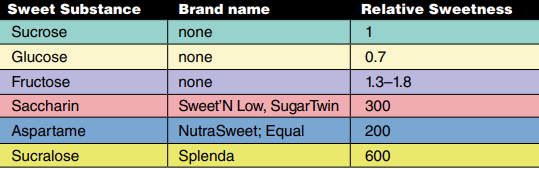
    This diagram shows more than just sucrose and sucralose’s relative sweetness. It also shows that sucralose has 600 times the relative sweetness than sucrose (Brownlee).

    Sucrose helped make sucralose and share a similar chemical structure, however they have many differences. Sucrose is a natural sugar that our body can process, but sucralose gives more of a sweet taste with less calories. The sugar sucrose in excess provides many long term issues, however sucralose in excess has minimal long term issues. To keep the body most healthy, tend towards sucrose, but sucralose in moderation is fine.


    Bibliography

    Brownlee, Christen. “The Skinny on Sweetners.” Acs, Oct. 2011, https://www.acs.org/content/dam/acsorg/education/resources/highschool/chemmatters/archive/chemmatters-oct2007-percyjulian-brownlee.pdf. 

    “Everything You Need to Know about Sucralose.” Food Insight, 10 Feb. 2022, https://foodinsight.org/everything-you-need-to-know-about-sucralose/.

    Libretexts. “3.3: Digestion and Absorption of Carbohydrates.” Medicine LibreTexts, Libretexts, 14 Aug. 2020, https://med.libretexts.org/Courses/American_Public_University/APUS%3A_An_Introduction_to_Nutrition_(Byerley)/APUS%3A_An_Introduction_to_Nutrition_1st_Edition/03%3A_Carbohydrates/3.03%3A_Digestion_and_Absorption_of_Carbohydrates#:~:text=Carbohydrates%20are%20not%20chemically%20broken,and%20delivered%20to%20the%20liver.

    “The Sweet Danger of Sugar.” Harvard Health, Harvard Health Publishing, 6 Jan. 2022, https://www.health.harvard.edu/heart-health/the-sweet-danger-of-sugar#:~:text=%22The%20effects%20of%20added%20sugar,Hu.

    29, Alex Smolokoff | Sep. “Artificial Sweetener Linked to Increased Appetite, Cravings.” Food Beverage Insider, 29 Sept. 2021, https://www.foodbeverageinsider.com/sweeteners/artificial-sweetener-linked-increased-appetite-cravings. 
  • Probiotics in Food

    Probiotics are living microorganisms like bacteria and help intestinal issues. Issues that can be helped through probiotics are bloating, irritable bowel syndrome (IBS), diarrhea, and even lactose intolerance. They help “prevent diarrhea when taking antibiotics and help to ease some symptoms of IBS” (Probiotics). For all the lactose intolerant readers, probiotics like Lactobacillus acidophilus and Lactobacillus bulgaricus help with lactose digestion (Aubrey). Ways to supplement intestinal probiotics exist through food, for example specific foods like yogurts and kefir. I would like to know if probiotics in different foods work enough to significantly improve intestinal health. 

    Yogurt remains a common and known source of probiotics, however not all yogurts label as probiotic. Probiotic yogurts claim their product “inhibits the growth of unfriendly bacteria, regulates bowel transit time and helps maintain a healthy gut microbial balance”( Beck). Probiotic labeled yogurt needs a minimum of 100,000 cfu in the yogurt. One would want to know if the bacteria lives long enough that it stays alive until eaten. The health of probiotics depends on many factors such as temperature, number of day within the yogurt and probiotic food source within the yogurt. Probiotic regulation lacks the intensity of regulating other foods, so “we can’t always be sure that: the product contains the bacteria stated on the label; the product contains enough bacteria to have an effect; the bacteria are able to survive long enough to reach your gut” (Probiotics). To consume the probiotic strain to help intestinal health, yogurt like Danon’s Activia has less than 25 times the needed serving proven to help (Beck). Reliable yogurts do exist, but they may be harder to find. Yoplait’s Yoptimal provides the amount of specific probiotic bacteria proven to decrease cavity-causing bacteria (Beck). Therefore, research into individual yogurt contents prove necessary if probiotics are needed rather than simply the flavor.


    A balanced and healthy diet helps your intestines, but if extra help is needed here are a few food items to look for. Barley and red kidney beans are excellent sources of fiber, which is fuel for the probiotic bacteria (Cadman). Sources of probiotic bacteria like pickles made with salt and not vinegar, miso, and kefir have a substantial amount of probiotics. Cheeses that have live probiotic cultures like gouda, mozzarella, cheddar, and cottage cheese show that flavor coincides with health (Palsdottir). Cheeses fermented but not all of them have live cultures, therefore reading the label proves necessary. Fermented foods like kimchi and sauerkraut prove beneficial because they both contain a large amount of probiotics, however kimchi has more probiotics and better benefits. Throughout the world wonderful and flavorful ways of intaking probiotics remain. To maintain intestinal health, a diverse diet of these foods and other probiotic filled foods proves mandatory. If these foods do not have the amount of probiotics to help your gut, supplemental vitamins provide a more powerful source and would have large amounts and diversity of probiotics. Maintaining a healthy lifestyle and listening to your body will manifest healthy results for your intestinal tract.


    Bibliography

    Aubrey, Allison. “Confusion at the Yogurt Aisle? Time for Probiotics 101.” NPR, NPR, 9 July 2012, https://www.npr.org/sections/thesalt/2012/07/09/156381323/confusion-at-the-yogurt-aisle-time-for-probiotics-101.

    Beck, Leslie. “Not All Probiotic Yogurts Are Created Equal. Does Yours Measure up?” The Globe and Mail, The Globe and Mail, 21 Apr. 2017, https://www.theglobeandmail.com/life/health-and-fitness/health/not-all-probiotic-yogurts-are-created-equal-does-yours-measure-up/article34780110/.  

    Cadman , Bethany. “The 19 Best Prebiotic Foods Suitable for Vegans.” Medical News Today, MediLexicon International, 1 Oct. 2018, https://www.medicalnewstoday.com/articles/323214#fruits. 

    Palsdottir, Hrefna. “11 Probiotic Foods That Are Super Healthy.” Healthline, Healthline Media, 6 Jan. 2022, https://www.healthline.com/nutrition/11-super-healthy-probiotic-foods. 

    “Probiotics.” NHS Choices, NHS, 27 Nov. 2018, https://www.nhs.uk/conditions/probiotics/. 

  • Thalidomide: What is it?

    Thalidomide was originally created in Germany to be a non-addictive sedative with a lower risk of dependency for sleep. The drug became popular because it was a morning sickness reprieve that was over the counter and affordable. This drug had an unforeseen effect on fetuses. It caused an influx of miscarriages and congenial mutations. One of the mutations is “the hands and feet are bound to the child’s trunk, absent or underdeveloped” ( Fact Check-FDA did not approve thalidomide for pregnant women in 1950s or 1960s). Other mutations include ocular, auricular, and internal organ mutations. Children unborn and born suffered the effects of Thalidomide. “An estimated 80,000 fetuses had mutations, and 20,000 more who survived were born without limbs” (1). These connections were not found until a significant amount of children were born. Thalidomide was not safe for pregnant women, but we did not find that out until Thalidomide submitted an application to the FDA for the drug to be approved in America.


    FDA not approved!

    This was Frances Kelsey’s second NDA case, meaning she didn’t yet have a backlog of reviews to get through. She dismissed physicians’ testimonies in favor of actual scientific evidence. She asked for more information from the developer, but they responded with another application. Knowing that thalidomide causes neurological toxicity in adults, she was wary of what effect it would have on human fetuses. Kelsey kept digging and stalled the FDA’s approval (McNeill). There have been no mutations caused by Thalidomide in the US because of Kelsey’s thoroughness. “Kelsey received the President’s Award for Distinguished Federal Civilian Service for her work in protecting the public from the drug.” (1) This very public case increased the basic testing done on pharmaceuticals so much so that “the 1962 drug amendments bill passed that year to change drug regulation” (1). Through Kelsey’s discretion, the US has more regulation and testing required for FDA approval saving countless lives. Thalidomide is not a very safe drug to use and many have suffered because of it, however it’s creation led to the FDA bolstering their requirements for our future.


    Other Uses!

    In general, Thalidomide helps prevent skin symptoms, nerve damage caused by leprosy, and blocks certain natural substances that cause swelling. Some more uses for Thalidomide is that it treats certain complications of HIV, HIV-associated diarrhea, HIV-associated wasting syndrome, a type of skin cancer. It also treats multiple myeloma by strengthening the immune system to fight cancer cells (Thalidomide: Medlineplus Drug Information). Thalidomide has also been used to treat some types of cancer and tumors, severe weight loss in patients with weakened immune systems, chronic graft versus host disease, and Crohn’s disease (4). A side effect in using Thalidomide to treat cancer is damage to nerves in the fingers and toes. There may also be blood clots, drowsiness, rashes, or dizziness. Some “Doctors found that it helps regulate the body’s immune system and helps control inflammation” (Thalidomide: Research advances in cancer and other conditions). The risks associated with Thalidomide are very high, therefore they must match the risks of illness to be treated.


    Creating a safer Thalidomide!

    Thalidomide has some benefits for other illnesses, which led to the investigation and creation of drugs that were safer. Two chemically similar drugs are Revlimid and Pomalidomide (Pomalyst). “Pomalidomide is the generic name for the trade name chemotherapy drug Pomalyst ” (Cancer, Cleveland Clinic). There are normally no side effects with this Pomalidomide and if there are side effects, they are reversible and stop when the treatment stops (5). It should never be taken during pregnancy, just like thalidomide. What causes this drug to work against cancerous cells is unknown. It may act by inhibiting the growth of new blood vessels in tumors, enhancing the immune system, or decreasing cytokine and growth factor production (5). Pomalidomide lowers the risks and side effects of Thalidomide. Revlimid is an oral cancer drug that is used for the treatment of multiple myeloma, myelodysplastic syndrome, and mantle cell lymphoma (Revlimid Drug Information: The MMRF). It works against cancer cells partly by supporting the immune system. Revlimid side effects are reversible and has a clearer treatment process, but it has fewer uses. Pomalidomide is effective for many things, however it is not known how it helps decrease cancerous cells. There are pros and cons to both medications, but they are safer than Thalidomide. Thalidomide had an extremely negative effect on the world, but Thalidomide’s errors led to safer regulations and more scientific advancements.

    Bibliography

    1. “Fact Check-FDA Did Not Approve Thalidomide for Pregnant Women in 1950s or 1960s.” Reuters, Thomson Reuters, 27 Aug. 2021, https://www.reuters.com/article/factcheck-thalidomide-fda/fact-check-fda-did-not-approve-thalidomide-for-pregnant-women-in-1950s-or-1960s-idUSL1N2PY2F7. \
    2. “Thalidomide: Research Advances in Cancer and … – Mayo Clinic.” Thalidomide: Research Advances in Cancer and Other Conditions, 3 July 2021, https://www.mayoclinic.org/diseases-conditions/cancer/in-depth/thalidomide/art-20046534. 
    3. McNeill, Leila. “The Woman Who Stood between America and a Generation of ‘Thalidomide Babies’.” Smithsonian.com, Smithsonian Institution, 8 May 2017, https://www.smithsonianmag.com/science-nature/woman-who-stood-between-america-and-epidemic-birth-defects-180963165/. 
    4. “Thalidomide: Medlineplus Drug Information.” MedlinePlus, U.S. National Library of Medicine, 15 Aug. 2009, https://medlineplus.gov/druginfo/meds/a699032.html. 
    5. Cancer, Cleveland Clinic. “Pomalidomide.” Pomalidomide | Chemotherapy Drug Information | Chemocare.com, https://chemocare.com/chemotherapy/drug-info/pomalidomide.aspx. 
    6. “Revlimid Drug Information: The MMRF.” Themmrf.org, 10 June 2020, https://themmrf.org/multiple-myeloma/treatment-options/standard-treatments/revlimid/#:~:text=Revlimid%2C%20also%20known%20as%20lenalidomide,Revlimid%20is%20manufactured%20by%20Celgene.