Author: Caroline Gellene

  • Sending Out an S.O.S.

    For a long time, scientists have known that plants respond to their surroundings. There are flowers that open during the day and close at night and many plants will grow towards a light source whenever possible.

    However, it has also been proven that plants can warn each other when danger is present and even scream when under duress.

    When something happens to an individual plant such as an insect laying its eggs or an herbivore starting to munch away, it releases specific scents and volatile gasses that warn other nearby plants that danger is near. Nearby plants respond by secreting toxic chemicals to coat their surfaces to deter animals such as caterpillars.

    It’s also been found that plants respond to sound and can communicate via sound. Some plants, such as corn seedlings, make high frequency clicking noises with their roots to communicate with their neighbors. When exposed to a noise on the same frequency, the seedlings grew towards the source of the noise.

    In case your mind wasn’t quite blown yet, there’s also evidence to support plants’ ability to recognize other plants from the same parent. When a new plant is introduced to an environment in close contact, such as in a pot, the resident plant will rapidly accelerate its root growth to seize resources like minerals or water. However, when a plant sprouted from the same parent is introduced, the resident plant does not attempt to starve out its new friend.

    There’s a lot we still do not know about plants and how they work but there are many scientists around the world dedicated to figuring out a bit more about the not-so-silent friends we share this world with. And next time your neighbor mows their lawn, take a deep breath and savor the sweet smell of a dying plant’s cry of warning to its doomed friends.

    potted plants

    Resources:

    Christine Hsu. “Discovery Reveals How Plants Cry for Help When an Attack is Imminent” Medical Daily. https://www.medicaldaily.com/discovery-reveals-how-plants-cry-help-when-attack-imminent-242379 (accessed 23, April 2018)

    Dan Charles. “Stressed Plants Cry for Help” New Scientist. https://www.newscientist.com/article/mg15320720-800-stressed-plants-cry-for-help/ (accessed 23, April 2018)

    Taranisen Panda and Rajballa Mohanty. “Are Plants Intelligent?” Science Horizon. http://www.orissabigyanacademy.nic.in/pdf/August_2017_Science_Horizon-1182017.pdf#page=40. Pages 30-41. (accessed 23, April 2018)

    Photos obtained from creative commons then edited.

  • LSD and Scientific Advancement

    vip charged 1

    LSD. Acid. Lucy. Whatever you decide to call it, lysergic acid diethylamide has been illegal for years in most countries world-wide despite a lack of science supporting its schedule 1 status. (Schedule 1 drugs are classified by the DEA as drugs with a high potential for abuse and no medicinal uses. LSD was approved as medication to treat a range of mental disorders in both the US and Europe prior to its ban in the 70’s.)

    Despite the illegality, several of the greatest minds known to man have openly attributed LSD with making them who they are today. Here’s a list of 4 great STEM-minded people who fell down the rabbit hole and came out just a little bit bigger:

    1. Kary Mullis. PCR, or the polymerase chain reaction, was invented by Kary Mullis in the 1980s. PCR is one of the most significant contributions to biological science in modern history, and Mullis frequently references LSD as a major contributing factor to his conceptualization of the PCR technique in interviews. It is even discussed in his autobiography.
    2. Francis Crick, you’ve probably heard of Watson and Crick. The dynamic duo that proposed the double helix structure of DNA. What you probably haven’t heard of is that Crick was famous at the time for throwing wild parties featuring LSD.
    3. Steve Jobs. Again, if you live in the 21st century you should know who this man is. And now you know that he has openly admitted to having used LSD repeatedly in the desert with his coworkers just before starting Apple. Whether or not the iPhone would have been invented without these adventures has never been directly confirmed but prior to his death he admitted in interviews that the experience was life changing, eye opening, and an experience he was overall glad he didn’t miss.
    4. Last but certainly not least, Albert Hofmann. The inventor of LSD himself. While working on synthesizing medications to improve heart and lung function, Albert Hofmann accidentally ingested the drug and discovered its psychedelic properties. He discusses his intention and personal uses of the drug in his autobiography and believed strongly in its potential as a psychotherapeutic.

    There are many other notable people throughout history who have attributed some of their greatest successes to a love of LSD both in and out of the STEM field. Recently several researchers in Europe have opened new trials to experiment with the drug in a psychotherapeutic setting with preliminary success. While the future of LSD is unknown, it is safe to say our lives today wouldn’t be quite the same without it.


    Sources:

    https://www.dea.gov/druginfo/drug_data_sheets/LSD.pdf

    https://www.washingtonpost.com/archive/lifestyle/1998/11/03/nobel-chemist-kary-mullis-making-waves-as-a-mind-surfer/31e7e720-44e4-49ff-8458-a9822cdcb47e/?utm_term=.26b79c188753

    http://www.hallucinogens.com/lsd/francis-crick.html

    https://www.scientificamerican.com/article/inventor-of-lsd-embarks-on-final-trip/

    https://journals.lww.com/jonmd/Fulltext/2014/07000/Safety_and_Efficacy_of_Lysergic_Acid.1.aspx

  • Get Ready for Earth Day!

    vip cover 2

    The Earth’s core is red

    The oceans are blue

    We’d like to keep it that way

    And you can help too!

    In preparation for Earth Day here are 5 ways you can help the cause and save the planet.

    1. Educate yourself on the threat plastics pose to the environment and animals that live there.
    2. Find your local recycling center and check out all the things that CAN be recycled you may not have known about.
    3. Organize a stream clean-up.
    4. Donate to organizations that contribute to environmental efforts.
    5. Support legislation that benefits the environment.

    Plastics:

    http://science.sciencemag.org/content/304/5672/838

    http://derraik.org/resources/Publications/003.Derraik_2002-Mar_Poll_Bull.pdf

    Recycling:

    http://www.iwanttoberecycled.org/search

    http://www.wm.com/thinkgreen/what-can-i-recycle.jsp

    Clean up events:

    http://createthegood.org/toolkit/clean-river

    Organizations to donate to:

    https://www.theoceancleanup.com/

    http://www.surfrider.org/programs/rise-above-plastics

    Stay up to date with legislation involving environmental issues:

    https://www.epa.gov/laws-regulations

    Make a difference in environmental legislation in your area:

    https://publicaccess.zendesk.com/hc/en-us/articles/212071687-Does-EPA-handle-all-environmental-concerns-

  • Scientific Glassblowing

    Ever walk by an organic chemistry teaching lab and wonder why people were standing behind blowtorches looking frustrated?

    First week of my senior year, I actually walked into that classroom.

    In this class we learned a lot about organic and inorganic synthesis, lab techniques, and how to really think like chemists. It was much less structured than previous classes so a lot of times things wouldn’t go as expected and we had to troubleshoot the problems. These are all skills I expected to learn sometime in my Georgia Tech chemistry education, but there was one skill I never anticipated needing to master before graduation: glassblowing.

    I don’t know why it never occurred to me that scientific glassblowing was a profession or even a position that universities frequently kept on staff but it didn’t. And that first day of class they announced a semester-long project where we would have to create 3 glass pieces for a grade.

    At first we all shrugged, watched the demonstration, decided it didn’t look too difficult and gave it our first try. I’ve always considered myself a fairly artistic person so I figured it would be an easy grade buffer for what was shaping up to be a very difficult class. Boy was I wrong. The glass melted and curled in ways we didn’t expect, getting the right gas/oxygen ratio to have the right flame shape and heat was impossible, people burned themselves left and right and nothing we made came out to look anything like the simple demonstration she gave us. Frustrated and burned, the 10 of us muddled through the 4 hour demonstration and practice session with the professional glassblower and when she finally left we looked at our TAs in horror and asked, “will we need to be able to do this well if we ever want to be chemists?”.

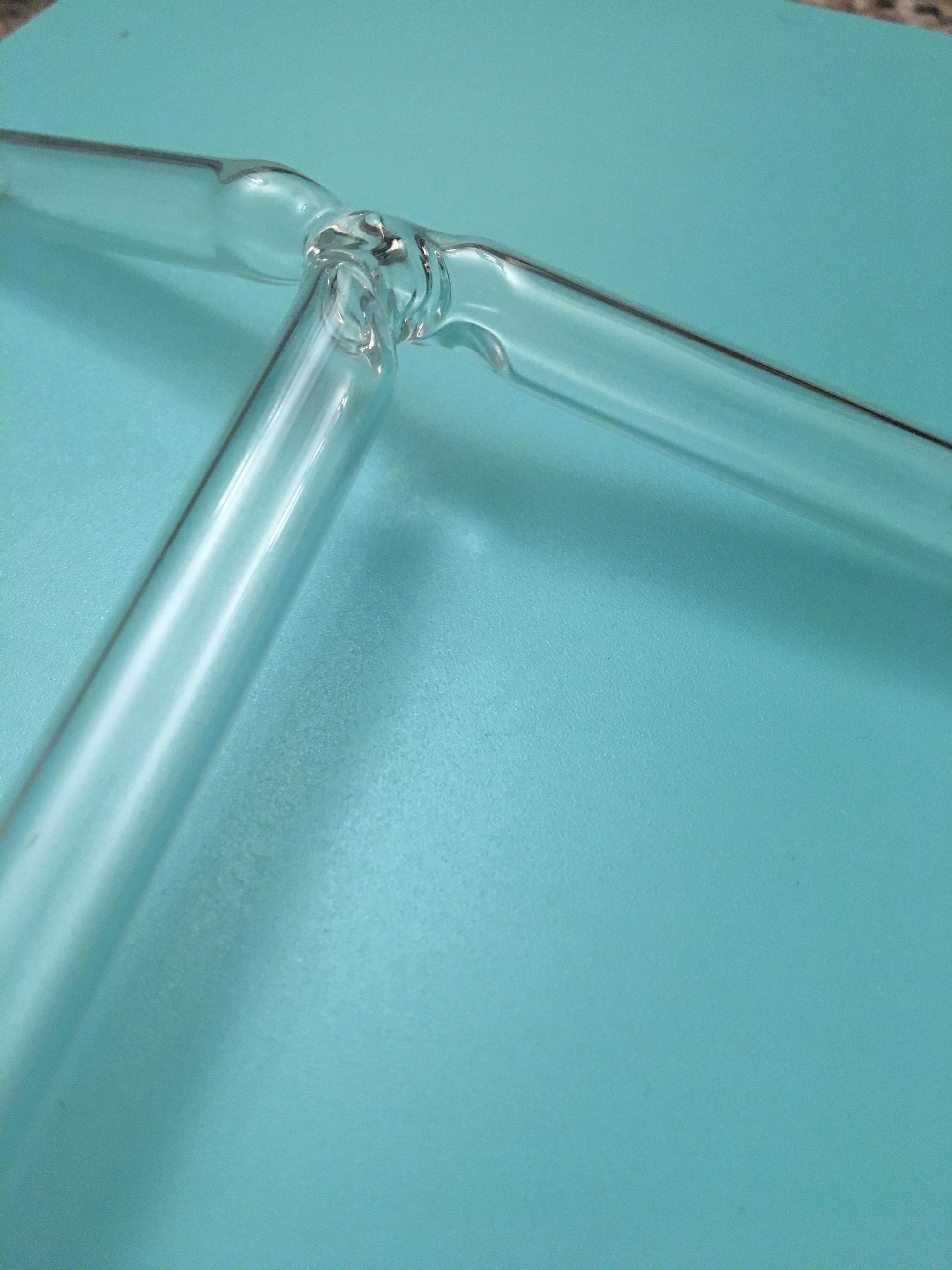
    tjoint1

    (10th attempt at a T-joint)

    Their response? Laughter. What did we expect. They probably go through this every year with the new crop of students.

    They told us that we wouldn’t need to be able to do this perfectly or really make custom glassware on a regular basis in order to be chemists. However, custom glassware was occasionally needed for experiments and one big point of the assignment was that we would then have an appreciation for what is and is not possible in glassblowing and just how difficult whatever we design would be to make. They also told us that even though as chemists we probably would never have to blow something as complicated as a Shlenck line ourselves, there is a very good chance we may need to have two pieces of glassware fused or a crack repaired and being able to quickly repair it yourself instead of waiting for a glassblower to get to your piece in a long line of work can be important to the success of a project up against a deadline.

    So we worked on creating our three pieces: an ampule, a T-joint, and a straight seal. They didn’t have to be pretty but the ampule needed to be air-tight and all of the pieces had to be worked out to the point where you couldn’t tell they were once separate pieces of glass.

    At the end of the semester, they loaded our ampules with [Co(NH3)5(ONO)]Cl2, a compound that changes color with prolonged air exposure, and had us seal them. Then we turned in our straight seals and T-joints.

    Long story short? Glassblowing is much harder than I ever thought it would be. I will probably never have to do it on a regular basis, but this was an incredibly fun, if somewhat stressful, skill to have the opportunity to develop. And if I ever need to seal something airtight I’ll know how!