Author: Christie Lin

  • What’s with the Rising Egg Prices?

    On a particularly cold night after hours of studying at a cafe, me and my friends are standing in the empty parking lot trying to plan dinner. We see a Tofu House nearby, and decide that a warm bowl of tofu soup is just what we needed. Each of us took off, beating the cold air to rush into the Tofu restaurant. As we sit down, we familiarize ourselves with the restaurant and the menu, eager for some warm soup and watching that raw egg cook in the Korean earthenware bowl they would serve the tofu soup in. 

    There were small conversations from other customers in the restaurant, but I distinctly remember hearing one of my friends call out, “they’re not serving any eggs here.” I mean, how could you serve tofu soup without eggs? I instantly felt the disappointment creeping in, but as I looked up and saw the sign that my friends were pointing at. It read, “Bird Flu, No Eggs.”

    Bird flu? No eggs? Is it some kind of salmonella? Eggs can’t be that expensive. I quickly wiped out my phone and searched for bird flu in Georgia. The news reports didn’t look too bad, so certainly this would pass in a few weeks, right? I don’t think a lot of people know about this right now either. Plus, I can tolerate no eggs now, and I’ll just go get some at the store later. That was what I had thought. But the following week, I would end up realizing that it had affected eggs prices too. I knew then that this bird flu could not be taken lightly.

    So where did this bird flu come from? This bird flu is a type of avian influenza A virus, also H5N1, that causes a highly infectious and severe respiratory disease in birds (Mahase, 2023). First detected in chickens in Scotland in 1959, and then discovered in geese in Southern China and Hong Kong in 1996 (Mahase, 2023). And then in 2003, HPAI A/H5N1 had been identified in poultry and wild birds across Asia, Africa, and some parts of Europe (Sellwood et al., 2007). An outbreak of the bird flu on a poultry farm in the east of England led to the culling of over 150,000 birds in 2007 (Sellwood et al., 2007). And finally, the first report of the virus in the US wasn’t until January 2022. The bird flu strand, H5N1 2.3.4.4b, affected 58 million commercial poultry and backyard flocks (Mahase, 2023). Of course this raises one question: with this history of bird flu, should there be any concern? 

    One thing about this bird flu is that this virus seems better adapted to infecting wild birds, and that there are potential antiviral drugs that have been approved to treat seasonal flu if you get infected (Mahase, 2023). And according to Ian Brown, the head of virology at UK’s Animal and Plant Health Agency, actions traditionally means detecting and killing infected folks, leading to a limited supply of eggs. With the demand for eggs rising, prices have been rising. The average price for a dozen grade A large eggs have reached a high of $6.23 as of March 2025. It has been reported that there are hopes of cheap eggs by Easter and egg prices have indeed been slowly decreasing. For the meantime though, I will just appreciate my tofu soup in its natural form and get my protein from the tofu and beef.

    Sources Cited

    Sellwood, C., Asgari-Jirhandeh, N., Salimee, S. (2007). Bird flu: if or when? Planning for the next pandemic, Postgraduate Medical Journal, 445-450. https://doi.org/10.1136/pgmj.2007.059253

    Mahase, E. (2023). H5N1: Do we need to worry about the latest bird flu outbreaks? BMJ : British Medical Journal (Online), 380 doi:https://doi.org/10.1136/bmj.p401


  • Benefits of Composting: why you should start composting now!

    There is less than 5% of residential food waste that is currently being composted around the world. To be exact, about 3.7% as of an April 2023 report. However, in contrast to the 1.3 billion tons of food wasted each year, this percentage doesn’t even scratch the surface. This food waste ends up in landfills, waiting to be decomposed to release methane, a potent greenhouse gas. So, what can we do in order to prevent this from happening?

    Composting is widely known for its beneficial effects for recycling organic waste materials to create valuable soil amendment. Scientifically, it is the transformation of raw organic materials into biologically stable, humic substances suitable for a variety of soils and planet uses (Leslie, 2000). But if it’s so good, why aren’t more people composting their food waste? This could be due to a variety of reasons from perceived inconvenience, odor, and limited infrastructure, but most importantly, less and less people know of its actual environmental benefits. In this article, we examine the importance of composting and the science behind it. 

    The process of composting involves the breakdown of a molecular structure into its elemental components–into simpler compounds or even atoms (Insam & de Bertoldi, 2007). There are two main phases in the process of composting: decomposition and stabilization. The final product is compost which is made up of carbon dioxide, water, minerals, and stabilized organic matter, which is essentially used as plant fertilizer to enrich the oils and support plant growth (Insam & de Bertoldi, 2007) Decomposition requires its very first step, the exothermic process, where it takes the waste and turns it into the form of heat simply by increasing the temperature in the mass (Insam & de Bertoldi, 2007). As temperature increases, thermophiles take over, continuing to the thermophilic phase. This stage becomes known as the active phase of composting, where degradable compounds and oxygen are consumed, pathogens and weed seeds are killed, and phytotoxins are eliminated (Leslie, 2000). Then we proceed to the two mesophilic phases. In these stages mesophilic organisms recolonize the whole waste pile and the curing phase begins (Leslie, 2000). Curing allows organic materials to continue to decompose, which are then converted to biologically stable humic substances. It is common practice in commercial composting to cure for 1 to 4 months, and for homeowner compost piles to cure for as long as 6 to 9 months (Leslie, 2000). Finally, the stabilization phase occurs after the temporary release of phytotoxins, where phytotoxicity is completely overcome and the final product is beneficial to plant growth (Insam & de Bertoldi, 2007).

    Now you know how composting works, so what should you compost? You should compost greens–think nitrogen-rich materials like vegetable scraps, coffee grounds, and fresh grass clippings. These green materials have a lower supply of carbon relative to nitrogen (C:N), which means it has a faster composting process (Insam & de Bertoldi, 2007). For non-food waste, brown materials that are carbon-rich like dried leaves, cardboard, and straw. And if you’re worried about creating odor or attracting pests, avoid composting meat, dairy, oily foods, or pet waste. Wastes like these are more nitrogen rich, so it lowers the C:N ratio to less than 20:1, causing nitrogen to be lost to the atmosphere leading to foul odor (Insam & de Bertoldi, 2007). Lastly, make sure to keep it moist to speed up the decomposition process. Low moisture content impedes the composting process because it leaves your compost pile more susceptible to spontaneous combustion due to temperature (Insam & de Bertoldi, 2007). With patience and consistent practice, you’ll transform waste into nutrient-rich compost for your garden!

    Sources Cited

    Leslie, R. C. (2000) Composting: Art and Science of Organic Waste Conversion to a Valuable Soil Resource. Laboratory Medicine, 31(5), 283-290. https://doi.org/10.1309/W286-LQF1-R2M2-1WNT.

    Insam, H., de Bertoldi, M. (2007) Chapter 3 Microbiology of the composting process. Waste Management Series, 25-48. https://doi.org/10.1016/S1478-7482(07)80006-6.


  • What a cat-astrophia! Diving into the GT Cat Community – Pro or Against Cats?

    This article was made in collaboration with Rachel Weng.

    Tucked among the brick pathways, buzzing scooters, and campus fields of Georgia Tech is a quieter, fuzzier community. These consist of those with soft paws and watchful eyes. The Georgia Tech Campus Cats have become quite a beloved icon of the Institute in addition to Buzz and the Ramblin’ Wreck. They have quickly gained popularity among the students and many have started to care for them. While these cats may charm students and campus pedestrians, they also affect the urban ecology and species management.

    The Georgia Tech Campus Cats Program started in 2001 with a mission to humanely manage the feral cat population on campus. They do so through a method called a trap, neuter, and release (TNR) program (Budd, 2024). Volunteers trap the cats, get them spayed or neutered, and then return them to their original location. This method helps control the population while allowing the cats to live out their lives in familiar territory. Over the years, the program has grown into a tight-knit community of students, staff, and alumni committed to the well-being of these feline residents (Budd, 2024).

    Since Fall 2023, Campus Cats have become more active and involved in supplying food and water. According to data gathered through iNaturalist, the most common cat sightings have been East campus with 14 sightings, Tech tower with 11 sightings, Central campus with 8 sightings, and Tech Parkway with 8 sightings. These are followed by West campus and the retention pond with 6 sightings. And lastly, the recycling area with 4 sightings, and the student center with 2 sightings.

    map of cat sightings on gt campus
    An overview map of cat sightings around GT

    Feeding stations are often placed around areas the cats are sighted in and monitored to ensure they stay healthy without becoming overly dependent on humans. Volunteers are encouraged to post on the iNaturalist community page and follow ethical practices to minimize environmental impact. And come springtime, aka “kitten season,” the population can temporarily increase as new litters appear, aligning with the national trend of increased feline births due to longer daylight hours and hormonal cycles (Mulkey, 2024). 

    Unfortunately, as lovable as they are, free-roaming cats are considered invasive species, and known as non-native animals that can disrupt ecosystems. Studies show that domestic and feral cats kill billions of birds, mammals, and reptiles each year in the United States alone (Arnold, 2023). Even well-fed cats may instinctively hunt, which threatens local wildlife, especially in urban greenspaces like Georgia Tech’s EcoCommons and Retention Pond areas.

    This creates a paradox: the cats are part of the Georgia Tech experience, yet they challenge the ecological balance. The TNR strategy used by the Campus Cats Program helps address this issue. Research into TNR programs shows promising results. For example, two Australian TNR studies showed that there was a 30% reduction in cat numbers over 2 years, and a 50% reduction over 5 years (Spehar & Wolf, 2019). This highlights TNR’s potential effectiveness when consistently implemented. However, the success of TNR often depends on the percentage of cats sterilized and the community cooperation to be effective. This makes Georgia Tech’s ongoing effort important to long-term population control.

    If you spot a cat on campus, you should try saying hello from a distance, especially if you are allergic, but don’t try to pet or feed them unless you’re a trained volunteer. You could also volunteer with the Campus Cats Program to help with feeding, data tracking, or TNR operations by joining their GroupMe – GT Cat Pics. Or if you feel particularly attached to a campus cat or multiple, consider adopting! Some of the cats are friendly or young enough to be rehomed. Listings can be found on the GT Campus Cats website at https://www.gtcampuscats.org/. Lastly, know that you can spread awareness simply by educating others about responsible cat ownership to help prevent more stray animals.

    Georgia Tech’s cats remind us that even in a high-tech environment, nature finds a way to sneak in. It lives in how we understand and coexist with all living things, even those with whiskers and tails.

    Sources Cited

    American Bird Conservancy. (n.d.). Cats | Invasives. American Bird Conservancy; American Bird Conservancy. Retrieved April 7, 2025, from https://abcbirds.org/threat/cats-and-other-invasives/

    Arnold, C. (2023, June 6). Cat-astrophe. NOEMA; Berggruen Institute. https://www.noemamag.com/cat-astrophe

    Budd, A. (2024, June 3). Cat-alysts of community: Georgia tech campus cats | news center. Georgia Tech News Center . https://news.gatech.edu/features/2024/05/cat-alysts-community-georgia-tech-campus-cats

    Campus cats list. (n.d.). Georgia Tech Campus Cats. Retrieved April 7, 2025, from https://www.gtcampuscats.org/campus-cats-list

    Georgia tech cat sightings. (n.d.). iNaturalist. Retrieved April 7, 2025, from https://www.inaturalist.org/projects/georgia-tech-cat-sightings

    Mulkey, S. K. (2024, March 18). Kitten season is out of control. Are warmer winters to blame? Grist. https://grist.org/science/kitten-season-animal-shelter-cat-wildlife/

    Wolf, P. J., Rand, J., Swarbrick, H., Spehar, D. D., & Norris, J. (2019). Reply to crawford et al.: Why trap-neuter-return(Tnr)  is an ethical solution for stray cat management. Animals : An Open Access Journal from MDPI, 9(9), 689. https://doi.org/10.3390/ani9090689

  • The Amazing Race: Speed of Light Reflection

    This semester marks my last contribution to planning and participating in events as a member of STEMComm. The last two semesters were eventful, and I always enjoyed helping plan out the logistics by being a team player. However, this semester’s challenge was to lead a group activity planning for a topic that I was not quite familiar with.

    For the Atlanta Science Festival, we organized an Amazing Race event. Each group planned both a mental and physical activities for our participants to choose from. My group choose an interesting topic, optics, focusing specifically on light and color. Being a computational media major who works on designing user experiences, I had never quite dealt with any so physics related, so it was kind of difficult to brainstorm actual activities that would be engaging. In previous events that I helped planned, my group always considered how accessible resources were before finalizing any details. This was the same case for my group this semester.

    Our physical proposal idea was to plan an event related to light, which lead to having the participants bend light with prisms. We knew that prisms made out of glass can analyze and reflect light, and paired with a laser beam, light would become refractured. As one of our learning objectives, we had a hands on activity with refraction by having the participant use a laser, a single wavelength, and prisms to create a path where the light had to bounce off of all the prisms. Additionally, although we didn’t have a natural white light, our other learning objective was dispersion, when different wavelengths bend differently, splitting white light into colors.

    For the mental activity, I wanted it to be correlated with colors. After some researching, I found the stroop effect, with learning objectives aligning with how our brain processes color and text simultaneously when presented with both visually. The Stroop effect occurs because reading is automatic, but naming colors requires more effort, causing delays with conflicting words. When presented with incongruent stimuli, which is a situation where two aspects of a stimulus contradict each other, like seeing the word “red” written in blue ink, the idea is that you take longer to process. Your anterior cingulate cortex (ACC), located in the medial wall of the frontal lobe, helps resolve this conflict, showing more activity with incongruent color-word pairs versus the congruent color-word pairs such as the word “red” written in red ink. To recreate this, I used Figma, a design tool that I used often, to create this activity. Being able to combine design and science was very fun and it made me become more motivated.

    stroop effect twisted
    click on this gif image!

    On the day we had to execute our plan, it went way better than I had expected. I could see the reminiscing of younger days on older participants as they watched their kids engage with the prisms and light. We presented our learning objectives and then had them complete short quiz. Although the stroop effect didn’t get as much attention as the prisms, we had a psychologist who administers this mental activity for their patients explain more in depth the processing with incongruent and congruent stimuli and other test variations. We also got swamped with many groups arriving at the same time, but we adjusted by splitting our group into two and running either the mental or physical activity. This event was truly an insightful experience and I learned many valuables skills that went beyond science.

    Sources Cited

  • Does a Full Moon effect our Sleep?

    There are many myths surrounding the effects of a full moon on humans from higher rates of insanity to our sleep cycles. But you’re wondering if any of these are actually true. A full moon occurs when the Earth is between the sun and the moon, and usually occurs about once per month. During a full moon, the moon is at its brightest because the side of the moon that faces the Earth is being fully illuminated by the sun. This causes some concerns over whether the luminosity of the moon may cause our sleep cycles to be disturbed or affected. Some believe it to be true while some aren’t so sure, so let’s take a closer look.

    A study was conducted to examine the sleep activity of children during 3 moon phases, including a full moon, half moon, and new moon after the nearest full moon. They measured the nocturnal sleep time among 9 to 11 year olds from 12 different international countries using an elasticized belt. The children had to wear these belts for 24 hr per day, and the experiment went on for 7 days. The results of sleep duration between the different moon phases were significant (Chaput et al., 2016). Sleep duration was 4.9 minutes per night shorter at full moon compared with new moon (Chaput et al., 2016). This shows that a full moon does have some impact on the sleep behaviors of children; that the nocturnal sleep duration is about 5 minutes shorter around a full moon compared to the new moon or half moon phase (Chaput et al., 2016). 

    Although this study didn’t specifically target adults, some effects on adults were also discussed in this study. From previous studies conducted by other researchers, namely Cajochen et al. and Smith et al. They both discussed sleep duration in adults during a full moon. Cajochen et al. reported that sleep duration was reduced by 20 minutes, resulting in a decrease in sleep quality in 33 adults (Chaput et al., 2016). Smith et al. supported those findings after reporting a reduction of 25 minutes per night in 47 healthy adults tested in the laboratory (Chaput et al., 2016). There were also some other studies in other adults that didn’t have those findings; however, the 2021 studies have found that people fell asleep later and slept less overall on the nights before the full moon, so it is not entirely impossible.

    Citations

    Chaput, J., Weippert, M., LeBlanc, A., Hjorth, M., Michaelsen, K., Katzmarzyk, P., Tremblay, M., Barreira, V., Broyles, S., Fogelholm, M., Hu, G., Kuriyan, R., Kurpad, A., Lambert, E., Maher, C., Maia, J., Matsudo, V., Olds, T., Onywera, V., Sarmiento, O., Standage, M., Tudor-Locke, C., Zhao, P., Sjödin, A. (2016) “Are children like werewolves? full Moon and its association with sleep and activity behaviors in an international sample of children.” Frontiers in Pediatrics, vol. 4, https://doi.org/10.3389/fped.2016.00024. 

  • The Amazing Race: Citrus Circuit GoSTEM Reflection

    This semester, STEMComm was invited to participate in the Latino College & STEM Fair, hosted for k-middle grade schoolers to engage and learn about the variety of science topics exhibited in colleges. It was an exciting opportunity to share and demonstrate what we were passionate about at GT. 

    Our event for the Latino College & STEM fair was the Amazing Race, for the various activities hosted by members of STEMComm. Each activity involved some action ranging from testing cognitive ability, response time, to memorization. My group, the Citrus Circuit, was the computational media group, and we set up a trivial game and a potato circuit using a simple arduino program to act as the buzzer. We connected the potato to a circuit board, so that when you make contact with the potato, it’ll light up and create a buzzing sound generated on the circuit board. The kids had to use the potato to buzz in to answer the trivial questions.

    The simple potato board circuit is much like a potato battery, with the potato acting as a power bank. The potato in that sense becomes an electrochemical battery, or cell. Since it contains certain metals, it will experience a chemical reaction with the acids inside of the potato that then creates the electrical energy that can power a LED light or a clock, and in our case, a LED light. One difference is that our contact with the potato creates that chemical reaction due to the fact that our bodies also conduct electricity, prompting the potato to start the process of turning the LED light on the circuit board. To make a better response, we recommend limes or any kind of citrus because of the amount of water and acidity in them.

    The event was overall super successful and went smoothly. The kids had fun and were able to learn something more interesting about science, and even apply what they had learned at school at our Citrus Circuit activity.

    Read more about potato circuits:

    https://stemgeneration.org/potato-power/#:~:text=The%20potato%20battery%20is%20a,an%20LED%20light%20or%20clock.

    https://www.vedantu.com/physics/potato-battery-experiment

  • Is Immortality Possible?

    We’ve only ever seen immortality on TV, but what if I told you, we seem to be closer to it than we think. In 1952, a cervical cancer patient, Henrietta Lacks, was admitted to the John Hopkins hospital where a sample of her cells were collected without her consent (Hongbao, 2017). The doctor who had treated her took a sample of the tumor onto a dish, and sent it down the hall to George Gey, the head of tissue culture research at John Hopkins. At that time, George Gey was researching how to grow cells outside of the human body for decades until Henrietta Lacks.

    A later discovery revealed that her cells were durable and could be kept alive, multiplying on their own when a single cell was separated. For unknown reasons, Henrietta’s cells could just double their cell numbers every 24 hours. They became known as HeLa Cells, the first “immortal human cell line,” being able to grow and divide forever. These HeLa Cells became the first human cells grown in a lab that were naturally immortal, surviving even after a set number of cell divisions (Hongbao, 2017).

    After the discovery of HeLa cells, the news spread fairly quickly, with many researchers requesting for HeLa cells, which George Gey gave to anyone who wanted them. They quickly became one of the most important things that happened to medicine. One researcher, Jonas Stalk, was able to successfully grow polio virus and quickly develop a vaccine for it. Due to its highly proliferative nature and its innate ability to be easily infected by the poliovirus, HeLa cells were made as the ideal source for testing vaccines. This cell line went on to be the first human cells to be successfully cloned as the results from vaccine testing could be easily obtained, but still remained the same tumor cells that were removed from Lacks (Hongbao, 2017). They helped develop all kinds of vaccines that we use today, and most can be traced back to Henrietta’s cells. HeLa cells have been used for research into cancer, AIDS, the effects of radiation and toxic substances, gene mapping, and countless other scientific pursuits (Hongbao, 2017). Additionally, they even went up into the first space missions to see what would happen to human cells in zero gravity. Evidently, not a single person hasn’t benefited from Henrietta’s cells.

    Citations

    Hongbao, M. (2017). Hela cells and immortality. Cancer Biology, 3(7), 71-78.

    BBC. (2022, Feb 23). How one woman’s “immortal” cells changed the world. BBC News. https://www.bbc.com/reel/video/p08wr9gf/how-one-woman-s-immortal-cells-changed-the-world

  • Late night studying: effects of warm and cool LED lamps

    Are you trying to pick out the right kind of fluorescent LED light for your room? One search for light bulbs on amazon shows results that range within 3000K or 6500K LED light. They look either warm or cool, so which one should you be purchasing? Sure, the decision can come down to personal preference, but you know you want to buy the right kind.

    Here’s a scenario to consider: you’re a newly admitted college student and you’ve moved into your new space with default warm light bulbs installed already. And after a few late night study sessions in your room, you’ve noticed that you’ve been getting drowsy super fast. So, when it comes down to what might truly benefit you, we can take a closer look at what each kind of light temperature offers.

    A study conducted to examine the effects of warm/cool white LED lamps and warm/cool color environments on mood and performance showed that perhaps inhabiting a study environment with a cooler light and a cool color environment help with study productivity (Shahidi et al., 2021). Additionally, another suggestion was to have a combination of the white color and warm light or the blue color with cool light can have a more favorable effect on visual comfort and mood (Shahidi et al., 2021). Some further discussion also revealed that cool lighting in white and blue colors stimulated less fatigue than warm light, and that warm light significantly reduced the amount of vigor than cool light. However, it is advised that increased exposure to cool fluorescent lighting can lead to increased rates of anger and depression (Shahidi et al., 2021). This is pretty typical with college students and late studying, since it can lead to eye strain and tiredness. Getting the right studying environment, like what fluorescent LED lamp you should place in your room, is the first step, but other factors like your attention and mental energy can also contribute to a successful late night study session.

    So, should you be installing warm or cool light LEDS in your room? Hopefully, this provides a better insight into what type of environment is ideal, but that would also depend on if you’re trying to be more or less productive.

    Citations

    Shahidi, R., Golmohammadi, R., Babamiri, M., Faradmal, J., & Aliabadi, M. (2021). Effect of warm/cool white lights on visual perception and mood in warm/cool color environments. EXCLI journal, 20, 1379–1393. https://doi.org/10.17179/excli2021-3974

  • The Magic of Shrinky Dinks and My ASF After Dark Experience

    My first semester at StemCOMM VIP offered both excitement and trepidation when I learned about the ASF After Dark event. Since high school, I hadn’t been involved in planning science-related activities, and I worried my knowledge in science related topics might be limited. However, through working with my sub-team during the planning phase, I discovered that science is everywhere around us, not something you have to constantly seek out.

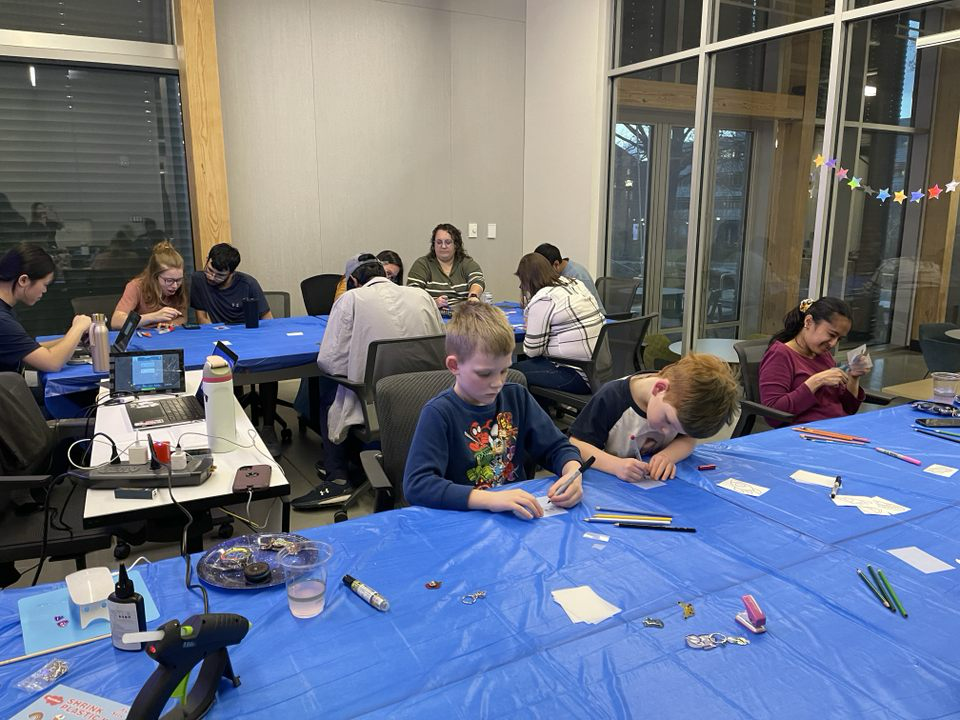
    Initially, my sub-team and I envisioned a “create your own planet” activity using Styrofoam spheres and planetary trivia. But we were worried that adults might not find this as engaging, so we pivoted to shrinky dinks. These are incredibly simple: secure a shrinky dink kit, draw on the flexible plastic sheets from the kit, shrink them with heat, and transform them into keychains, magnets, or pins!

    The reason we choose to do shrinky drinks was because of the unique process of how shrink dinks formed—almost like magic. This magic of shrinky dinks lie in the scientific process triggered by heat. These plastic sheets contain polystyrene, a material made of long, chain-like molecules called polymers. When heated, these polymers straighten out, allowing them to pack together more efficiently, shrinking the material to roughly one-third of its original size.

    At the event, I helped with guest reception, brief explanation of the science behind shrinky dinks, and distributing supplies. We provided stencils for tracing and a variety of charm options. The event itself was filled with excitement as guests delighted in the activities and the new experiences our shrinky dink provided. Witnessing countless faces light up as their shrinky dinks transform into their personalized charm was truly magical. Guests would kept going back and create new designs, even our own sub-team! The magic of shrinky dinks, it seems, never gets old!

    The turnout for the ASF event went so much better than I had expected. I had concerns about low attendance, but it was fantastic to see guests genuinely enjoying the experience and immersing themselves with all the science activities for the night. The guests that were in attendance were eager to learn what shrinky dinks were and I loved seeing their designs form into charms. My experience with ASF after dark was a truly a heartwarming reminder of how science brings the world around us to life.

    Sources:

    University, Carnegie Mellon. “Shrinky Dinks – Gelfand Center – Carnegie Mellon University.” Shrinky Dinks – Gelfand Center – Carnegie Mellon University, www.cmu.edu/gelfand/lgc-educational-media/polymers/molecular-rearrangement/shrinky-dinks.html#:~:text=When%20the%20film%20is%20heated,by%20rapid%20cooling%20during%20manufacture. Accessed 20 Apr. 2024.

    (View the source above to learn more about shrinky dinks!)