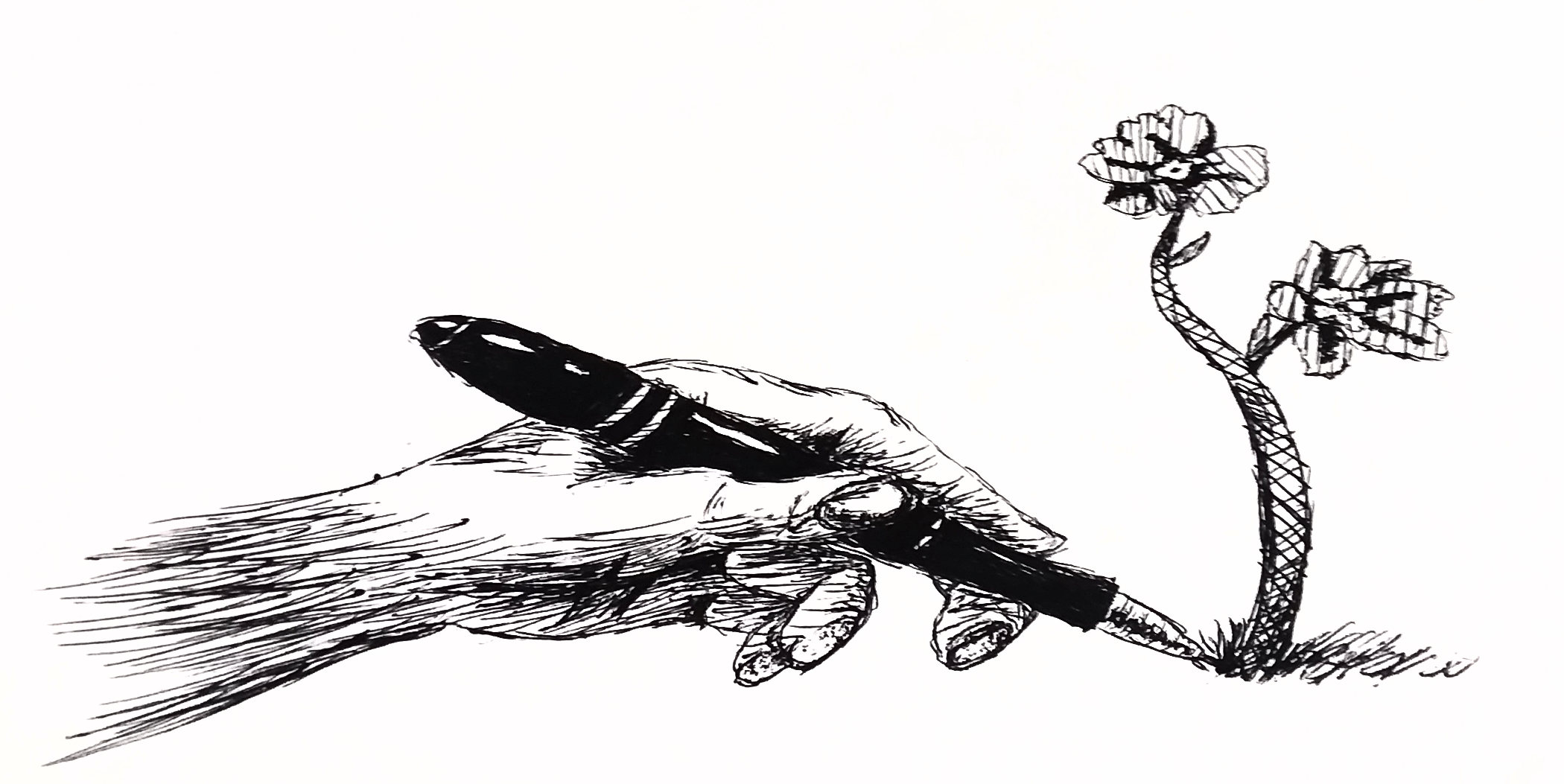
Author: DJ Baker

  • To the Depths (a sci-fi short story)

    “What’s the password?” Said the person whose eyes peeked through the crack in the door.


    “Cal.” Mel growled. Mel would have been stunning if xe didn’t currently resemble Odysseus during the worst of his trials. Xe was soaked through to the bone, chiton stuck to xer form like a second skin, and xer hair was only saved from complete disaster by the many, many pins in it that would be a nightmare to get out and that Mel probably wouldn’t completely accomplish for many weeks.


    “You’ve looked better.” Cal said mildly.


    Mel growled again and shoved xer way inside.


    The aforementioned Cal backed up without complaint chuckling lightly as he headed back behind his bar.


    Mel, who was raised with common decency– unlike some people– closed the door behind xem and gracefully avoided the squeaky floorboard as xe followed behind.


    “You promised me Rome, Cal.” Mel said, knocking sharply on the bartop.


    “And Rome you had.” Cal returned, tossing Mel the towel he’d been looking for. Mel took it and began drying xemself. “Or, at least a version of it. Let me get you a new chiton, and you’ll be back out and exploring in no time.” So saying, the bartender ducked down to rummage behind the bar, placing various items on the bartop to be out of the way.


    “Oh!” Cal popped back up, startling Mel. “Don’t you dare sit on my barstools while you’re still wet they’re ori-”


    “Original to the saloon, yes, I know Cal.” Mel rolled xer eyes.


    Cal pouted a bit, but went back to his search.


    Mel turned to lean against the bar and peruse the space while xe waited out the clattering behind xer. Cal’s saloon didn’t look exactly like it had stepped it’s jangling, spurred boots right out of a spaghetti western, but it was an incredibly close call. Rough wood floors, hard leather seats, dim lighting, and the scars of all of the many brawls the place had seen were certainly telling, but Cal’s had its own quirks. The changing stalls that lined the front wall by the door, for one thing. The metal on those stalls was painted with painstaking care to look wooden, but enough bottles and glasses had been thrown at them over the years that the shine of the metal came through the chipped paint. The leather seats were surprisingly well padded, and the alcohol stock came from everywhere and everywhen in this universe, and others besides. Cal himself was his own oddity, no one knew how many Cals were before him, or how many would come after, or if some of them were the same, but Cal was a good sort. Mel wouldn’t work with him if he wasn’t.


    There weren’t too many patrons this go round, only a few regulars who were looking for something, and a relatively new guest, a nervous young lady who had some rather long, webbed fingers, scales, and big, bright eyes. Mel though that she might find what she was looking for in the city outside.


    Mel turned xer contemplation back to the bar, where Cal’s shuffling was now sounding more purposeful, and to the oddities that had been displaced onto the bartop.

    “What even is half of this stuff?” Mel muttered.


    There on the bar seemed to be a host of items with no discernable pattern. There was a bayonet without a gun, a glowing amulet, a few small bottles of what looked to be antivenoms, three plants that were either incredibly alien or incredibly extinct for how odd they were, and what appeared to be an astrolabe made for the use of someone who didn’t have hands or bifocal vision.


    Cal made a triumphant noise as he finally came up from behind the bar, holding a bright green mass of cloth in his hands. He passed it over to Mel, and xe went to the nearest changing booth.


    Xe returned, mostly dry and carrying the sopping wet orange garment xe had been wearing, and passed it over the bar to Cal, who grimaced before chucking it underneath the bar. Mel heard a wet thunk and a louder crash before a light hum let xem know that Cal had put xer old outfit in his dryer.


    “So tell me.” Cal said, automatically going to fix xem a drink. “What has you so upset about this Rome?”


    “When I asked for Rome, I expected a Colosseum, some of those famous Roman Roads.” Mel returned.


    “What do you mean?”


    “There aren’t any.” Mel said.


    “… There aren’t any… roads?” Cal asked, sliding xer drink over to xem.


    “No.” Mel gave a sardonic smile. “This Rome seems to be the love child of Rome and Venice. All of the streets are paved with water.” Xe took a sip of xer drink, making an appreciative sound. “That’s how I got into that state. It was too dark. I fell into a canal.”


    Cal snorted before quickly covering it and making Mel another drink.


    “Well, that certainly is a new one, but not the strangest reality this place has visited.” Cal said.


    It was Mel’s turn to snort. “True enough.”


    Cal finished a drink for both of them this time and they saluted each other with their glasses.


    “Did you spot anyone who might join us? Or anyone that might become a regular?” He asked.


    “Mmmm. There were some.” Mel allowed. “The mermaids all seemed to clock me as someone not from around here, and there were a few young women that seemed to have the air of revolution around them. We might end up losing a regular, rather than gaining one.” Mel turned to look at the fish-girl, and Cal followed xer gaze.


    “Well,” he nodded slowly “if it happens, it happens. Now, what’s this about mermaids?”


    “Not like you’re thinking. Mermaid is a profession here, sort’ve like street sweepers mixed with traffic directors. For a fee, a mermaid will lead your boat through a canal to where it needs to go and protect it from minor damage, or they’ll dive to the bottom of the canal and retrieve items you may have dropped. I also got the impression that they were paid by the city to keep the canal’s clean of trash and debris that was too heavy for the current to sweep away.” Mel said. “And, most of them are young women, interestingly enough.”


    “Hm. This will need some investigating.”

     

    A headshot of the Lochmaenean woman, Aure.

    The next day, Cal came down late to the bar floor. Mel had been out in Rome for a few hours already and Cal was expecting her to be out a while longer. He left his regulars to Ka’al, the new kid needed to work some time and this trip was shaping up to be a slow one.


    [Excuse me.] Cal startled a bit at the sudden appearance of his newest customer, a young Lochmaen woman, at the bar. He watched her webbed fingers as she continued to sign. [My name is Aure. Is there any way I can get some clothing to go outside?]


    “Aure? Well sure you can, although,” Cal gave Aure a once over, “Although, you probably don’t want to go out until dark, what with the scales and everything. But the dark will make it hard for you to communicate…”


    [I can speak.] Aure signed in return. [I don’t when I’m around humans who can see because it makes them nervous.]


    “Hmmm.” Cal tapped his fingers on the bartop. “May I see? I’ll understand if you don’t want to speak, but honestly?” Here he leaned in, as if inviting Aure into a confidence. “I don’t know if I count as human anymore. I’ve owned this bar for a very, very long time.” He cocked his head to the side, “Or was it no time? Concepts tend to get a bit muddled if you stay here long enough, but I wouldn’t have it any other way.” He grinned at her. Aure smiled back helplessly.


    “If you insist?” Aure said. Her voice was low but light, a tone that could easily carry a fair distance before it needed to be raised, but still incredibly lyrical. What probably made the humans she had met before nervous were her very large, slightly translucent teeth. When she opened her mouth the rows of teeth were reminiscent of a shark or a cartoon piranha. Cal thought that they must retract into her face as when she closed her mouth her face was incredibly human in shape, ignoring the purple scales, the barely visible gills, and the slightly bioluminescent eyes and hair.


    “Let me get you an appropriate outfit.” Cal said, ducking underneath the bar for just the right thing. He emerged with a pale pink bundle of fabric which he handed off to Aure, along with a small paper.


    “What?” Aure wobbled the paper.


    “Instructions on how to put on the chiton. It’s not as intuitive as it looks.” Cal replied.


    Aure thanked him and took the clothes and paper to the furthest changing booth.


    Cal began to idly clean the bar, keeping an eye on the door, when he caught sight of Aure making her way back.


    “I think, miss Aure, that you have the potential for being mistaken for a siren if you go out there.” Cal mused. Aure ducked her head.


    “A siren?” Came a voice from the door.


    Both Cal and Aure looked over to see a young woman who was obviously local standing in the doorway, haloed in the light of the setting sun. The young woman had olive skin, light brown hair, dark eyes, the build of a runner, was noticeably taller than Aure, and had an air about her that said that she was used to commanding respect. She seemed to take in the anachronistic bar in which she found herself— Cal who was wearing a vest and fitted dress shirt, Aure, who was obviously inhuman with her dark purple scales, webbed appendages, and a tail, and the other alien patrons— in stride, closing the door behind her, and making her way to a seat at the bar, somehow avoiding the squeaking floorboard in the process.


    Aure found herself quickly pinned by the gaze of the other woman. She felt those dark eyes roam over her as if she were having her soul measured against the value of one of the Pure Pearls which had brought her planet to the Assembly’s attention.


    “You are the siren?” The woman demanded softly.


    “My name is Aure.” Aure just barely managed to reply. She was nearly blinded by the smile the other woman sent her.


    “I’m Penelope, I think the two of us will get along famously.” So saying, Penelope turned to rummage through the bag on her waist, finally giving up her hold on Aure’s lungs so she could catch her breath.


    Cal was about to say something, when Penelope made a noise of triumph and turned back to the others at the bar.


    “So, I don’t suppose either of you is good at decoding things?” Penelope said, slapping down a piece of parchment on the bartop.


    “Hn. Not my area of expertise.” Cal admitted.


    Aure had already drawn the parchment towards her and clicked to herself as her large eyes roved over the words.


    “I have it.” Aure said.


    “You do?” Cal asked.


    “Already?” Penelope asked.


    “Not, not the message.” Aure said, “But I know what kind of code it is. It’s a shift cipher. I believe the key is the number five so…” Aure looked up.


    Cal caught her drift and produced a pen and paper from behind the bar, quickly passing it to Aure.


    “You see, a shift cipher is a very simple one, really, but effective. See, at the top of the message here is a date?” She pointed, Cal and Penelope both nodded. “Well the V the 5 in the date is darker than the rest of it, which means it’s important. It is also the rightmost 5 in the date, which I believe means that the cipher is shifted to the right by five. A shift cipher is made by writing out all of the letters or symbols of whatever writing system you are using, and then rewriting them underneath with the applied shift so, with a right shift of five:


    A B C D E F G H I J K L M N O P Q R S T U V W X Y Z

    Becomes

    F G H I J K L M N O P Q R S T U V W X Y Z A B C D E


    So for the message you would take the letter from the original alphabet, and replace it with the cipher version. To decode it, simply work in reverse.” Aure showed them.


    “It’s so simple!” Penelope grunted in frustration.


    “Only if you know what to look for.” Aure tried to reassure the other woman.


    “So, what does the message say?” Cal got them back on track.


    “It says: To the General: the tunnels within tunnels were a genius idea, and no one will be the wiser. I’m having my people take over important positions on the route. Soon our communication will be unbreakable and undetectable, then it is on to the next phase. For the Glory of the Atlanteans.” Aure read.


    “Atlanteans?” Cal asked.


    “Atlanteans.” Penelope snorted. “Most of the patrician men are obsessed with the idea that there is some underwater civilization that is incredibly advanced and that, if they find the civilization, they will be welcomed with open arms into paradise.”


    “Well that’s…” Cal trailed off.


    “Really stupid.” Aure finished. She ducked her head at the approving look Penelope sent her way.


    “It really is.” Penelope agreed. “Aure, how would you like to join me, and my Nereides?”


    “What?”


    “The Nereides are a group of young women who don’t believe that Atlantis exists, but believe that it could and want to build it.” Penelope said. “With your help decoding messages and notes, we can take back what the patricians have been keeping from us to build our future.”


    “You, but won’t it be obvious that something is going on? I mean I don’t exactly look…”


    “It doesn’t matter.” Penelope insisted. “The Nereides will adore you, and if anyone takes issue with how you look we have places to hide you, people you can go to for protection. If I say you are an emissary of the Gods, no one would dare call me a liar.”


    “You must have some pull, miss.” Cal said, skeptically.


    “I am a Vestal.” She said proudly, “I can go where I please in the city, I am a woman that most men wouldn’t dare to talk down to.”


    Cal gave a low whistle of appreciation.


    “Please, Aure, at least meet the others. You could do an incredible amount of good.” And with Penelope looking at her, hope and a righteous fervor shining in her eyes, what else could Aure do?


    “Okay.”


    Mel came back to the bar a few minutes before midnight— and a few hours after Aure and their newest guest had departed for the most secret places of Rome— and looked around. “So, what did I miss?”
  • Pride and [ERROR: FUNCTION TERMINATED]

    It is a truth universally acknowledged that any homework of significant difficulty is in want of long hours to completion. In this case, twenty hours, give or take some breaks to re-hydrate from where the tears slipped away unnoticed among the frustration and eye strain. Even then, the outcome isn’t what you wanted and you may not make the deadline at all.

    May whatever powers-that-be bless professors that give their students who fail part one of a multi-part homework a working version to complete the next section.

    All dramatics and literary reference aside, animation is hard. I know this for a fact, I’ve been doing frame-by-frame animation since middle school and, while that can get tedious, it is much, much more straightforward than the computer graphics assignment I was referencing above. However, I’m getting ahead of myself; this is a story about learning, frustration, trial, error, failure, success, and at the end of it all, the final product.

    The first thing to note is that Computer Graphics is a known grade killing class, and has been that way for at least five years, if not since it’s conceit. You talk to any Georgia Tech student who has taken the course and they’ll tremble in horror, either fake or very real, the reaction is the same at its core. I, unfortunately, didn’t know this until after I had begun.

    The second thing to note is that the professor that I had for the class was infinitely preferable to previous holders of the position, as referenced by the second paragraph.

    The third thing to note is that I’m still not entirely sure what a scene graph is. Of course, I understand what it is in concept — a data structure designed to keep graphic elements organised in a certain configuration for ease of use. Say you had a character with the parts: body, head, left arm, right arm, left leg, right leg, left hand, right hand, left foot, and right foot. The graph would be organized something like this:

    Body
    /           |            |            |             \
    Head    left arm   right arm      left leg     right leg
    |               |              |            |
    Left hand    right hand    left foot    right foot

    The character would then be connected to the world of the scene through the Body node. Using this construction, all of the pieces of the scene graph of the character are moved relative to its parent nodes– the nodes above it and connected to it within the scene graph. It’s fairly simple for anyone with a basic knowledge of coding languages, but understanding a scene graph and implementing one are two entirely separate things. It’s the implementation where I stumbled and was left in the dust on the side of the road.

    However, homework waits for no one, especially not a homework with multiple parts. Part two of the homework was to create a character using the scene graph implementation from part one, and to connect the pieces appropriately to make a recognizable image of at least ten parts and three levels like the scene graph above. This was accomplished mostly by trial, error, and begging my fellow students to take pity and help me. If there is one thing I can say about college, it really does destroy any pride you may have once had when it comes to school work.

    The third and final part of the homework was to take the character from part two and create an animation in the scene graph. Camera movements, movement of at least one part of the character, and one part of the surrounding scene were required. This part came the easiest to me, but it was still an exercise in frustrated guess-and-check. Moving the camera a few degrees only to find you turned it the wrong direction, making sure that the piece of your character that you decided to move doesn’t visually disconnect itself and become a floating arm spinning into the distance.

    I’ll admit, I laughed aloud at some of the things my errors caused, but it felt more hysterical than anything at the time. When your entire animation starts spinning into the endless void, you have to start laughing, or you’ll cry. Still, I lived in the TA office hours until I finally managed to create a working product. It isn’t what I wanted, not nearly as good as it could have been, but remember what I said earlier about pride. If it completes all of the requirements and doesn’t look like hot garbage, it is a success.

    You can view the finished version that took 20 hours out of my life by clicking the link below.

    https://dj-baker.github.io/charged-animation/

  • Maria Sibylla Merian

    [rev_slider alias=”msmslider”]

  • Stephen Hawking Tribute Comic Review

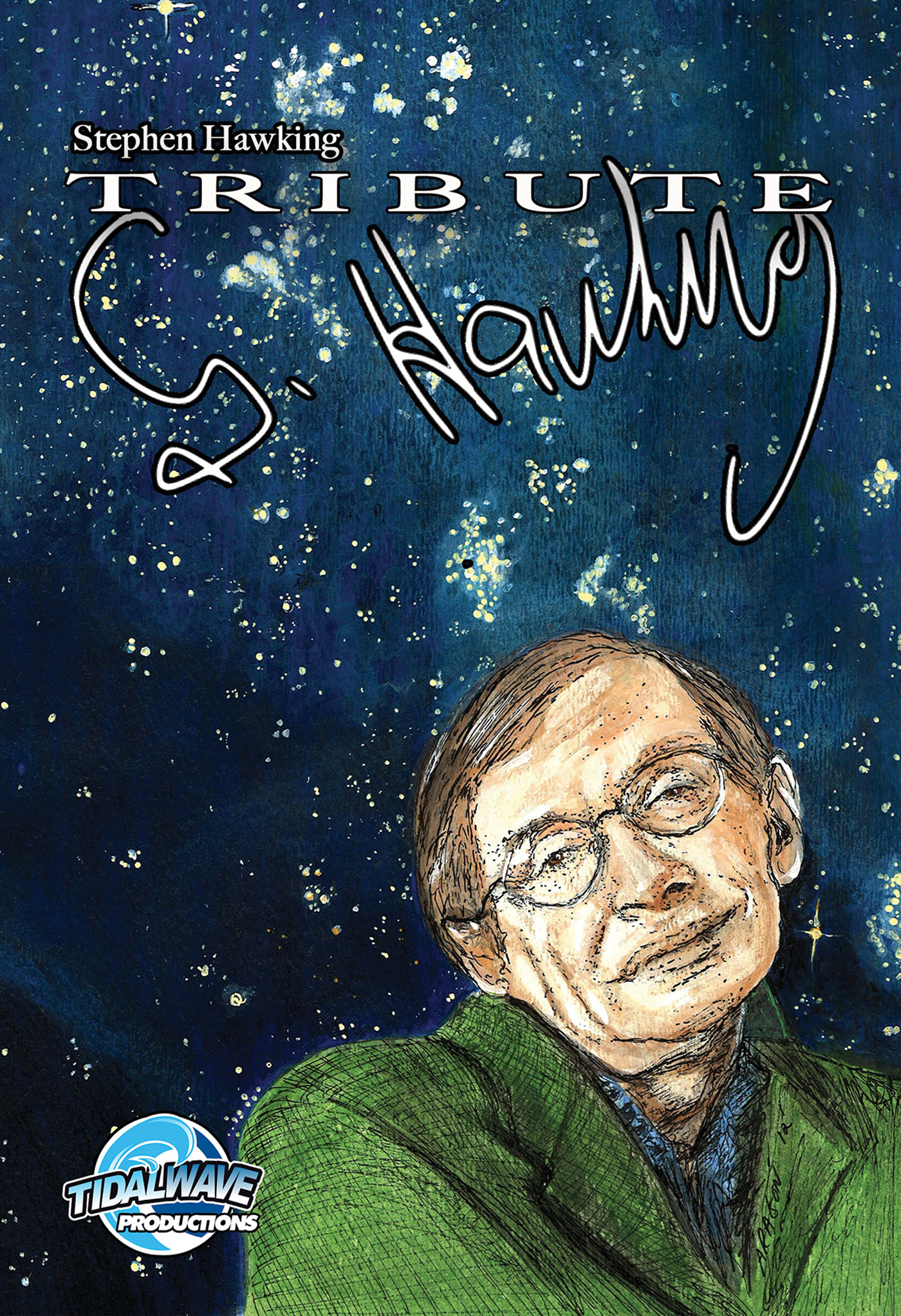
    “Tribute: Stephen Hawking” by Michael Lent and Brian McCarthy with art by Zach Bassett and published by Tidalwave Productions, released 2019.


    I confess: I never really paid attention to Stephen Hawking. I knew who he was: a popular scientist and a man with ALS. He would appear on TV shows I watched in some form or another, so I recognized him. I didn’t think his area of expertise was anything that interested me, so reading this comic was rather eye opening. I didn’t think his area of expertise was anything that interested me, so I was surprised by everything I learned when reading  “Tribute: Stephen Hawking.”


    Stephen Hawking was obviously intelligent, and probably got “needs to apply himself more” written on his report card more than once. In school, he was funny, had a lackadaisical attitude towards studying, and an apparent lack of respect for authority. Stephen Hawking, sports team, and opera goer were never phrases I connected in my mind, but there it was in ink on paper, right in between discussions of his science, his disability, and his belief in aliens.


    The art of the comic is fantastic. I loved some of the more symbolic artistic choices. In one scene, Hawking argued with a professor and the artist set up the confrontation as a wild west shoot out. The references to both popular and classic art– Professor Xavier from X-men and The Creation of Adam, respectively– just highlighted how well rounded and influential an individual Hawking was.


    I wasn’t very affected when Stephen Hawking died. Plenty of people were, and I know a few of them personally. Still, this comic impressed me with how much content there was for the avid fan and layman alike.


    You can read more about the comic by clicking the link here.


  • It’s a ghost… it’s a UFO… It’s… Ball Lightning?

    Lightning is a phenomenon that we are all familiar with. Everyone has seen it, and some people have been hit by it. What you may be less familiar with is it’s spherical sibling. Ball lightning has fascinated people for centuries. There are plenty of eyewitness reports of ball lightning, and many give conflicting reports. People have claimed that ball lightning has flown through their homes or other buildings. One specific eyewitness report was an unusual case in which the ball lightning floated down the aisle of a plane in flight, from front to back, before dissipating. (Jennison, 1969)


    The reason most people have never heard of, or seen ball lightning, is that it is a phenomenon that is easily mistaken for an optical illusion, an extraterrestrial encounter, or someone messing around in the woods. Ball lightning is usually low to the ground, and while it can last for a long time relative to streak lightning, it still only lasts around 10 seconds. (Abrahamson, 2000) Ball lightning has been proven to be a true phenomenon and not an optical illusion, due to the quantifiable physical aspects such as heat and voltage, and the fact that the lightning after image effect cannot hold for the length of time that ball lightning exists.  An illusion doesn’t make noise, nor does it explode and have a chance of hurting surrounding people or damaging planes. (Doe, 2013)


    Ball lightning has an incredibly variable reported physical characteristics. Most ball lightning is spherical, however some can have a fractured appearance. Ball lightning dies by explosion, slow decay, or fractal decay. (Smirnov, 1993)  The diameter of natural ball lightning can extend from 1mm to 150 cms in extreme cases. (Smirnov, 1993) Ball lightning has been seen ranging from red to yellow and blue to white. Different reports claim different spectrums of light for ball lightning. (Cen, 2014) Some reports say that ball lightning spans the entire visible spectrum; the most stereotypical image of ball lightning is that of a blue-white sphere. According to one study, the color of the ball might result from it being created by streak lightning hitting soil with different chemical compositions. The chemicals in the soil burn different colors when hit, producing a spectrum of ball lightning colors. (Abrahamson, 2000)


    Ball lightning generally forms around thunderstorms, tornadoes (St, 2006), and other natural phenomena, and there have been correlations between increased ball lightning appearances and increased solar activity. (Arabadji, 1976) Some people have reported heat coming from ball lightning, some people said no heat comes from ball lightning. All of these differences have led people to theorize that there may be more than one kind of ball lightning. (Cen, 2014)


    Lab trials have been conducted to approximate ball lightning, but none have been able to fully recreate all of the characteristics. One of the main difficulties is that we do not know whether or not the energy to sustain ball lightning comes from an internal source or external source. There have been multiple experiments of both types, but nothing that has been able to replicate every nuance of natural ball lightning. And even among people who agree whether the source is internal or external, the actual composition of ball lightning has multiple models such as: electromagnetic waves inside of a plasma ball, combustion, and cosmic rays of antimatter to name a few. (Doe, 2013)


    One experiment explored ball lightning as a hydrated plasma. Hydrated plasma is formed when positive and negative ions enters water vapor or humid air. The ions move closer to each other and their movements slow down and produce light. What physicists did to emulate ball lightning is they filled a cup with water and put a copper ring at the bottom and had an electrode with quartz in it over the cup and sent a current through it. The resulting plasma ball lasted for a fraction of a second on average. (Egorov, 2004)


    Personally, I think that ball lightning is one of those phenomena that humans will never fully understand. The occurrences are fairly random and don’t last long which is bad for data collection, and different instances of ball lightning have different characteristics. It would be interesting to see how well heat, atmospheric, and luminosity measuring instruments as well as video recording is enhanced in the pursuit of finding the truth of ball lightning. I look forward to seeing what theories develop in the future surrounding the phenomenon, and if the scientific community will be able to come to a consensus about what ball lightning really is and how it forms.


    Abrahamson, J., & Dinniss, J. (2000). Ball lightning caused by oxidation of nanoparticle networks from normal lightning strikes on soil. Nature, 403(6769), 519.

    Arabadji, W. I. (1976). On the problem of ball lightning. Journal of Geophysical Research, 81(36), 6455-6456.

    Cen, J., Yuan, P., & Xue, S. (2014). Observation of the optical and spectral characteristics of ball lightning. Physical review letters, 112(3), 035001.

    Doe, R. K. (2013). Ball lightning: an elusive force of nature. In Forces of Nature and Cultural Responses (pp. 7-26). Springer, Dordrecht.

    Egorov, A. I., Stepanov, S. I., & Shabanov, G. D. (2004). Laboratory demonstration of ball lightning. Physics-Uspekhi, 47(1), 99.

    Jennison, R. C. (1969). Ball lightning. Nature, 224(5222), 895.

    Smirnov, B. M. (1993). Physics of ball lightning. Physics Reports, 224(4), 151-236.

    St, W. (2006). A unified theory of ball lightning and unexplained atmospheric lights. Journal of Scientific Exploration, 20(2), 215-238.

  • Life and Laterality

    I have spent my life struggling to open jars, use scissors, play video games, and shake people’s hands because the world is built for the 90% of it who are right handed, the 90% that isn’t me. Like most lefties, I have learned how to use my right hand to do almost everything except write or throw things, because that is how technology is set up. I got so used to some of it that something like a left handed computer mouse is anathema to me; However, I remember having to struggle with both the piano and my teacher, because the whole concept was built opposite to me, or rather, I was built opposite to the concept. For one of my birthdays, I received scissors designed for left handed use and it’s still one of my favorite gifts.

    I am the only lefty in my family. Both of my parents are right handed, and so is my sister. If we look at side preference from a genetic point of view it’s clear that right preference is a dominant gene. Starting with a Mendelian approach to genetics, to get both a right handed and a left handed child, both of my parents would need to have a recessive gene for left preference. Parents who are both left handed are more likely to produce left handed kids, but the ratio is only about 40% at its highest. (McManus, 1991) Families where the mother is left handed are more likely to produce left handed kids, which could be due to genetics or to socialization as the mother is often the primary caretaker, and there have been few adoption studies on the subject of laterality which could have helped clear up the nature vs. nurture debate. Men are more likely to be left handed than women. The ratios are still around 10% of the total population, but there is a small difference between sexes.

    There have been a variety of tests to determine laterality in humans, split up into two main groups: hand preference and hand performance. The first type involves sending out a questionnaire to people, asking them to identify if they use their left, right, or either hand to perform a task and then measure the frequency of answers one way or the other. The second type involve asking participants to perform various tasks, such as placing pegs into holes, and measuring the time taken for the right hand and the left hand and measuring that way. (Porac, 2015)

    By looking at the tools used by paleolithic people– the construction, wear, and reconstructing some of the hand grips– anthropologists have discovered that the ratio of human laterality (10% left to 90% right) has remained about constant since the beginning of human society. (Llaurens, 2009) The question is why this minority of left handed people has persisted almost unchanged. Scientist look both at genetics and social upbringing. It is unlikely though, that laterality is anything other than a mixture of the two.

    One theory for the persistence of lefties is that there is a combat advantage. When most of the population uses their right hand to fight with a sword or spear, people who are left handed often learn how to fight against people who are right handed when they are young, while people who are right handed only know how to fight against right handed people. So, when a righty comes upon a lefty in a battle, the righty is tripped up by their opponent being opposite to what they expect, allowing the lefty an easier victory as they are already used to fighting right handed people. In fact, one study (Raymond, 1996) seems to support this theory; the researchers compiled data of the frequency of handedness in sports participants. Sports with a clear adversary like fencing or soccer had a larger ratio of left handed people than the normal population, while sports without opposition like bowling remained consistent with the normal population.

    There is something to be said for the biological component as well. Plenty of lefties die of accidents caused by living in a society that is built for right preference (Coren, 1989), and many societies historically have killed, ostracized, abused, and retrained their left handed individuals to conform with the right handed majority, however, the ratio of lefties to righties in these societies is still close to the global average. The persistence of this polymorphism suggests a biological component that is nigh impossible to weed out completely. For example, fetuses have been shown to have lateral preference, which leads some people to believe that the cause of human laterality could stem from the uterine environment and/or hormonal composition, specifically how much testosterone is present.

    The persistence could also be due to the aforementioned retraining. When people lose the use of their right hand– either because they lost their right hand entirely or had some other loss of dexterity– they are more than capable of retraining themselves to be left handed. Some humans probably learn to use their left hand because they were bored, think it was a useful skill, or just because human beings are contrary. People who have weaker natural side preferences are more likely to bow to the way they were taught, which could also be a cause for persistent left handedness.

    Human beings are not the only creatures to display side preference. Most apes also show a preference for using one had over another when completing tasks on the individual level. (King, 1993; Lehman, 1993; McGrew, 1997) However, primates ratio of handedness is about 1:1 for left handed and right handed individuals in the total tested population. Lateral asymmetry in primates is a difficult thing to prove.

    Why does laterality in humans present so asymmetrically? Some researchers have tried to connect this to language learning ability which is the basic trait used to separate humans from other primates. (McManus, 1991) The theory goes that the dominance of right preference has somehow lead to language development in homo sapiens. Researchers over the years have connected left handedness to shorter life spans and learning disabilities, but I think that this should be taken with a grain of salt and a reminder that correlation does not equal causation especially since a person’s laterality can change over their lifetime.

    I am left with three questions at the end of my own research: Why do bilateral animals have a preference at all? Why isn’t everyone ambidextrous? Why are humans so asymmetrical as a species where laterality is involved? I don’t know, and an answer is unlikely to be found within my lifetime, but it’s fascinating nonetheless.


    day1poisonous


    References:
    Coren, S. (1989). Left-handedness and accident-related injury risk. American Journal of Public Health, 79(8), 1040-1041.

    King, J. E., & Landau, V. I. (1993). Manual preference in varieties of reaching in squirrel monkeys. In Primate laterality(pp. 107-124). Springer, New York, NY.

    Lehman, R. A. (1993). Manual preference in prosimians, monkeys and apes. In Primate Laterality (pp. 149-181). Springer, New York, NY.

    Llaurens, V., Raymond, M., & Faurie, C. (2009). Why are some people left-handed? An evolutionary perspective. Philosophical Transactions of the Royal Society of London B: Biological Sciences, 364(1519), 881-894.

    McGrew, W. C., & Marchant, L. F. (1997). On the other hand: current issues in and meta‐analysis of the behavioral laterality of hand function in nonhuman primates. American Journal of Physical Anthropology: The Official Publication of the American Association of Physical Anthropologists, 104(S25), 201-232.

    McManus, I. C. (1991, February). The inheritance of left-handedness. In Ciba Found Symp (Vol. 162, No. 251281.8).

    Porac, C. (2015). Laterality: Exploring the enigma of left-handedness. Academic Press.

    Raymond, M., Pontier, D., Dufour, A. B., & Møller, A. P. (1996). Frequency-dependent maintenance of left handedness in humans. Proc. R. Soc. Lond. B, 263(1377), 1627-1633.