Author: Destiny Cobb

  • Neuroethics: expanding horizons

    I LOVE science. From genetics to astronomy, neuroscience to botany, this branch of knowledge endears me with its concrete facts, equations, and straightforward answers.

    Engineering? It’s cool too. As an engineering major in my second year, I’m in the process of learning a ton about what engineering actually is, and I’m enjoying it! You certainly have to know the science behind the technology you’re working on, but you also get to think creatively and innovate. On paper, you can have no limitations and let your designs go wild, but I’m learning that engineering in practice poses limitations that aren’t exactly fun to think about — cost and means of production for instance.

    Now, philosophy of science? That’s a whole new level for me. I’m currently taking a philosophy and public policy class on the topic of neuroethics. The problems we’re examining look at how new developments in science and technology can be implemented, with all the ethical, legal, and moral issues that come with it. These types of complex issues enter a completely grey area where there is no right answer. Until taking this class, I generally avoided these types of topics because they’re out of my comfort zone; I think of them as being “fuzzy,” whereas my beloved sciences are concrete.

    However, by taking this ethics class, I realized exploring these grey areas is essential. After all, if new discoveries in science are to come to any real world importance, they need to be applied in a practical, ethically sound way.

    Let me give you an example. The most recent problem my classmates and I tackled was that of using neuroimaging technology to identify students who are at risk for committing acts of violence. Specifically, we were targeting both bullying in schools and more serious matters such as school shootings.
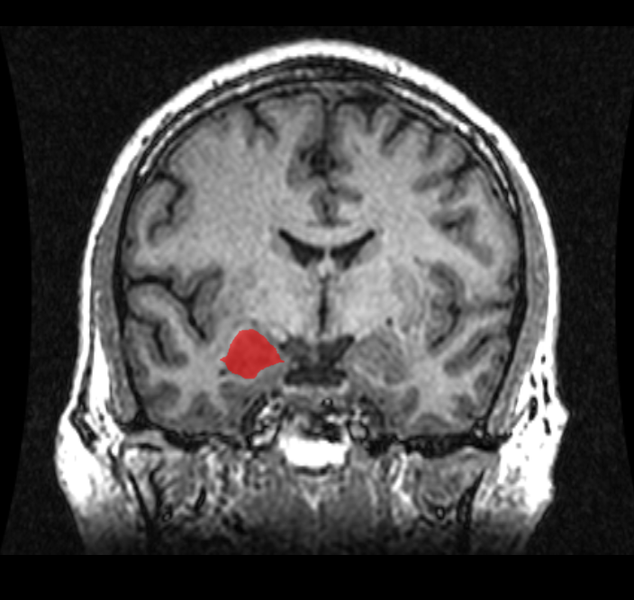
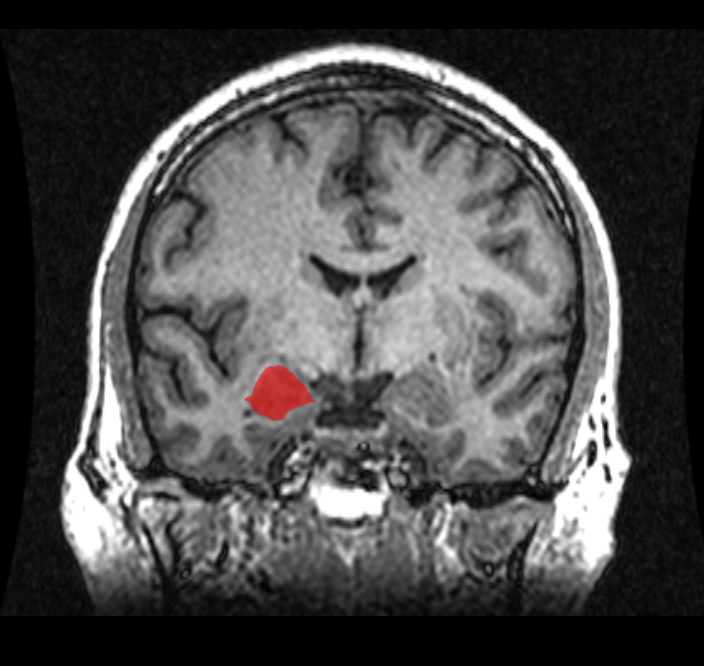
    MRI coronal view of the amygdala.
    Taken from the Wikimedia Commons.

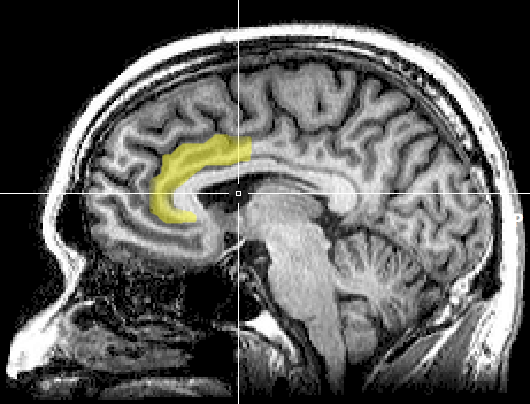
    First, we examined the technology. (This part was really fun!) Recent neuroscience studies have examined the fMRI results of those who have committed various violent crimes (assault, homicide, etc.) and have been identified with various disorders (conduct disorder, antisocial personality disorder, etc.). Generally, results show the subjects to have decreased activity in certain regions of the brain as compared with the average person. These regions include the amygdala, prefrontal cortex, and the anterior cingulate cortex (ACC), all of which are part of the limbic system, or the “emotional brain.” (Sterzer, 2009). These brain abnormalities may be why some children, adolescents, and even adults do not empathize with others or even derive pleasure for putting others in pain.
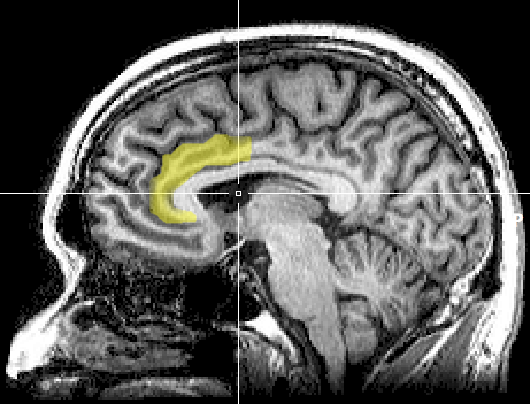
    Sagittal MRI slice with highlighting indicating location of the anterior cingulate cortex.

    So clearly there’s an inherent difference between the brains of violent and nonviolent individuals; shouldn’t we scan everyone for these defects and have them treated? Well not so fast. There is vast range of what “normal” is for a human brain. Scans have also found those with abnormal brain structure and no tendencies toward violence whatsoever. On the flip side of things, there are many violent criminals who lack these abnormal brain structures. If a scanning requirement were put in place for schools, false positives would create unnecessary stigma and hassle, and false negatives would allow students at risk for committing violence to slip through the system.

    On a related note, we need to consider that correlation does not equal causation. Just because a student may have a certain brain structure associated with violent tendencies, does not guarantee they will commit a violent act in the future. The brain is incredibly plastic, meaning it can change over time in response to experiences. An abnormal brain structure seen in a violent offender could be a result of actually committing the crime, or even a result of a negative childhood environment (Tsouderos, 2010).

    Beyond reading through the studies published on neuroimaging, we also had to look whether implementation of scanning in schools is financially, ethically, and legally sound. Have any of you ever had a PET, CAT, or MRI scan? Those things are expensive, especially if you don’t have health insurance. And in the case of a state program, that cost is placed on the tax payer. How accurate and effective do these scans have to justify paying thousands of dollars per scan? Once we have identified students as having an increased risk for violence, won’t we need the resources to treat them? And how do we manage the information taken from scans? Which school personnel, medical professionals, and authorities will have access to this information? Is it right to force a student to undergo a scan?

    In trying to find a solution, we ran into all of these questions and more. Ultimately, we decided against recommending using expensive neuroimaging technology (which, as cool as neuroscience is, it is still in its infancy) to combat violence in schools, instead looking at alternatives such as providing more resources for school programs to identify and treat mental disorders and promote mental health.

    However, whatever decisions we reached concerning this problem or the other topics in the class (ranging from genetic modification of humans to what type of medical information can be admitted into court), the important part of this experience was the discussion along the way. Thinking about these types of complex issues has really helped expand my thinking and round out my education. In fact, I was so consumed by our ethical debates that I’m seriously considering taking a proper introductory ethics or philosophy class. And to all you students out there, I recommend you do this as well! Or if not ethics, just something outside of your major and outside of your comfort zone; you never know when you’ll discover a new academic love!
    Sterzer, P., & Stadler, C. (2009) . Neuroimaging of aggressive and violent behaviour in children and adolescents. Frontiers in Behavioral Neuroscience, 3. Retrieved from http://www.ncbi.nlm.nih.gov/pmc/articles/pmc2766784/
    Tsouderos, T. (2010, Feb 15) . Exploring links between genes, violence, environment. Chicago Tribune. Retrieved from http://articles.chicagotribune.com/2010-02-25/news/ct-met-genetics-of-violence-20100225_1_genes-scientists-violence
    2. Taken from the Wikimedia Commons. Retrieved from http://upload.wikimedia.org/wikipedia/commons/1/10/MRI_anterior_cingulate.png
  • Biology bucket list: algal blooms

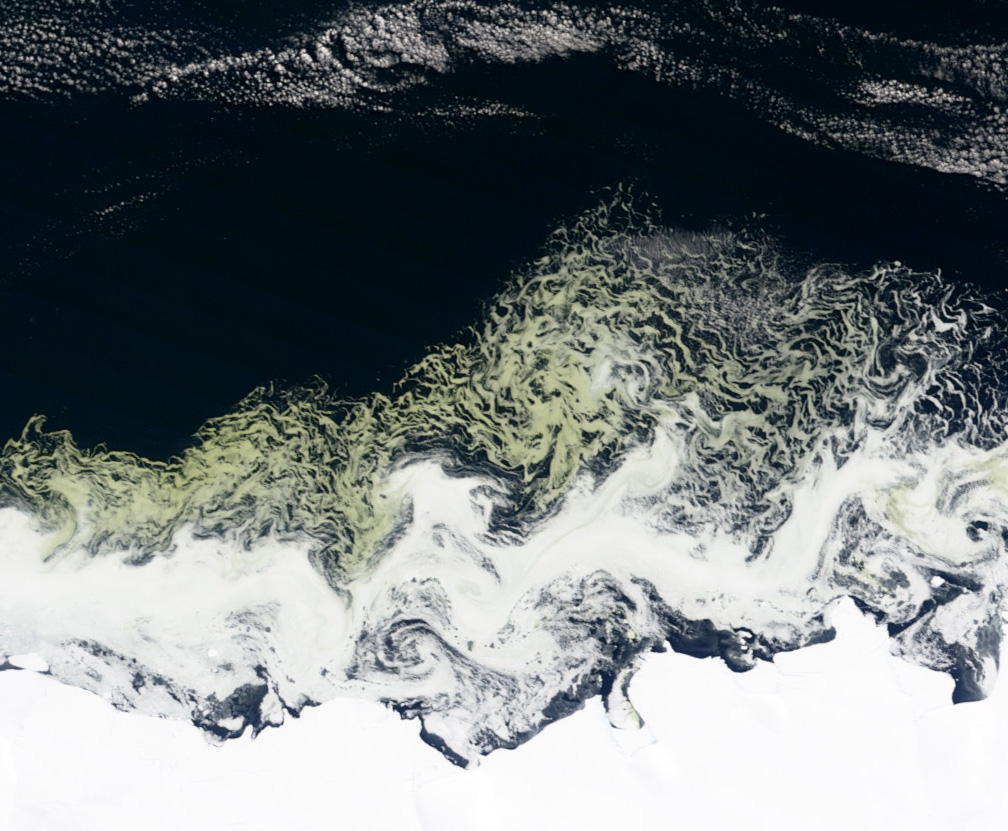
    An algal bloom appears off the Princess Astrid Coast in East Antarctica.
    NASA image courtesy Jeff Schmaltz, LANCE/EOSDIS MODIS Rapid Response Team at NASA GSFC.
    Greetings biophiles! What do algal blooms, great white sharks, and okapis all have in common? They’re all absolutely fascinating and they’re all on my list of events and animals I would jump at the chance to observe. This ever growing list of biology-related items has evolved into something of a bucket list, hence the title, and includes biological phenomena around the globe that I hope to one day see for myself!
    So what ‘s first up on my biology bucket list? Algal blooms.
    First some background: Algal blooms are basically just the growth of aquatic algae at a hyper fast pace, resulting in washes of discoloration over bodies of water. These artworks of nature generally occur due to favorable conditions such as availability of resources like minerals, nutrients, warmth, and sunlight. The algae, usually referred to as phytoplankton, are microscopic, single-celled organisms that make their home in the upper layers of both fresh and marine waters. They serve as vital components of aquatic ecosystems due to their powers of photosynthesis, as they provide food (directly or indirectly) for everything from penguins to blue whales.  Phytoplankton even feed you, as they are used as feed in aquaculture. We depend on these little guys!
    However, I not only appreciate them for their hard work in the upkeep of our oceans, but also for their aesthetic value on both a microscopic and macroscopic level. If you do an image search of either “phytoplankton” or “diatoms” (go, click on it!), you’ll see that these guys come in all kinds of wacky shapes, sizes, and colors. Looking at them under a microscope (and I would love to take my own sample from an algal bloom) is pretty much like walking through an art gallery (except better) because the artwork is made out of living organisms just hangin’ out,  powering an entire ecosystem and being funky shaped. Ahhh, that is the life.
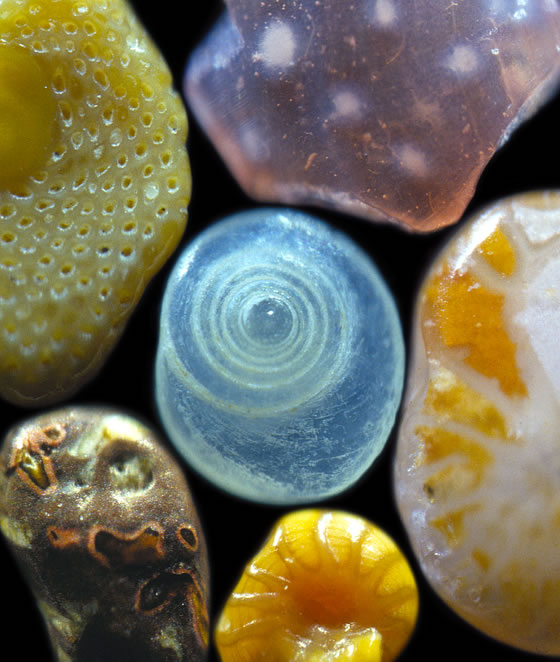
    (Side note: lots of ordinary things look crazy awesome when looked at close up, sand for instance. Oh nature, your beauty reveals itself on so many levels. *swoon*)
    Bits of sand made up of shell, coral, and volcanic rock bits.
    Image Copyright © 2008 Dr. Gary Greenberg, All Rights Reserved.
    How do I plan on experiencing an algal bloom you may ask? By swimming in one of course!* (Or looking at them from the International Space Station, as most algal blooms can be seen from space. NASA, if you want to make dreams come true, hit me up!)

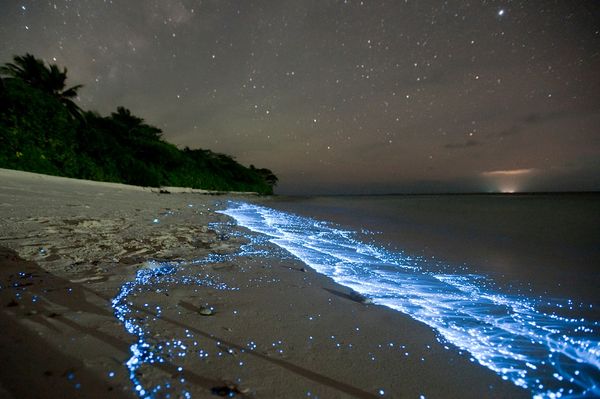
    And no, I’m not talking about taking a dive in the pond scum of the poorly-kept neighborhood pool. Instead, I hope to travel to what are known as bio-bays: bodies of water where bioluminescent phytoplankton, or more specifically dinoflagellates, light up the waters at night and create waves dotted with glowing spots to match the starry night sky. There are several locations around the world where tourists can experience the glowing waters- Puerto Rico, Vietnam, and the Maldives to name a few.

    However, these kinds of trips cost money and, alas, I am a poor college student, so until I can save up to travel to Puerto Rico (or the ISS), I’ll continue looking at satellite photos (like the ones from NASA, linked below). Other types of algal blooms can occur in bodies of water around the world and vary depending on seasonal and causal factors.

    Glowing blue waves on Vaadhoo Island in the Maldives.
    Photograph by Doug Perrine, Alamy

    I like to keep my eye out for new photos of algal blooms, such as this one, which displays Impressionist-esque swirls of green and yellow atop the waters off the Princess Astrid Coast in Antarctica, taken by NASA’s Terra Satellite this past February. Antarctic blooms generally occur in December (the start of summer for Antarctica) as the increased sunlight favors the growth of these photosynthesis superstars and kickstarts the rest of the marine ecosystem in time for baby-making season. This particular algal bloom’s late season appearance excited scientist to the possibility that it was caused by a more unusual factor: nutrients blowing off of a nearby ice shelf. This is just one example of how algal blooms can come about.

    Year round you can find news of all types of algal blooms being spotted in different places around the world, so keep a lookout for this fascinating biological phenomena! If you would like to see more of their intoxicating beauty I would recommend perusing through Visible Earth, a catalog of photos from NASA, or checking out this gallery from Wired magazine, which will also tell you about regional types of algal blooms.

    So, dear readers, what do you think? Would you go swimming in a bioluminescent ocean? I hope you’ll take a look through some of the galleries linked throughout (some of these photos make great wallpapers!), and of course I’d love to know what’s on your biology bucket list via the comments section below. (Also, keep a look out for our next installment of our biology bucket list series!)

    *It should be noted that some algal blooms are harmful (HABs), and certain species, about 2% of the 5000+ species of marine phytoplankton, are associated with toxins and can actually harm an ecosystem through the release of neurotoxins and the depletion of oxygen in water. These HABs can arise naturally and in predictable patterns, but have also increased in frequency due to human activity like agricultural run-off. So please do not just go jumping into any old discolored water and be sure to look out for notifications from your local health and marine departments if you plan on participating in any recreational activities in or near your local lakes or beaches.
    Here are the places I got my information from:
    Diersing, Nancy. “Phytoplankton Blooms: The Basics.” (May 2009). Florida Keys National Marine Sanctuary.
    “Greening the Princess Astrid Coast.” (March 2012). Earth Observatory by NASA.
    Landsberg J.H. “The effects of harmful algal blooms on aquatic organisms.”  (2002). Reviews in Fisheries Science.
    Than, Ker. “Picture: Glowing Blue Waves Explained.” (March 2012). National Georgraphic.
  • A Trip to the Atlanta Botanical Gardens

    This past month I had the absolute pleasure of visiting the Atlanta Botanical Gardens as part of class field trip with my BIOL 4440 Plant Physiology class. Located just up the street from Piedmont Park, a quick 10 minute drive or 30-40 minute walk (for those of us without cars on campus, cough cough, me) from Georgia Tech, the Gardens offer year round awesomeness. My first visit to the Gardens was free of charge thanks to Dr. Jerry Pullman, Georgia Tech’s one and only resident plant researcher. Dr. Pullman works with the Research and Conservation division of the Botanical Gardens to study native endangered plant species such as the Georgia Aster and various types of pitcher plants. Also due to Dr. Pullman’s sweet connections with the Garden’s staff, my classmates and I received a tour of the greenhouses led by the director of Research and Conservation, the lovely and informative Dr. Jenny Cruse-Sanders.

         Cruse-Sanders took us through several of the greenhouses that showcase different genres of botanical wonder. The pride and joy of the spring season is their Orchid collection, with a showcase called ORCHIDdaze which runs February through April before a “Gently Used Plant Sale” is held to sell the orchids to the public. However, the Gardens have orchids on display year-round with different seasonal displays and house an Orchid Reference Library for more bookish visitors, with public access available on Tuesdays. The Research and Conservation department runs a program for the restoration of the orchids native to Georgia. The Gardens also specialize in carnivorous plants, specifically Asian pitcher plants, Nepenthes, which can be seen in the Special Exhibits area of the Fugua conservatory. Also found in the conservatory are tropical conifers, some of which can be seen in the Tropical Rotunda, and Amborella, a rare genus of small trees native to New Caledonia and thought to be one of the earliest angiosperms.

          One the most enjoyable indoor exhibits for me was the Orangerie, which allows guests with the opportunity “to see, touch and smell some of the plants which are so important in our daily lives.” The Orangerie includes common foods such as vanilla, tea, coffee, cocoa, ginger, and many others. The botanical geek in me loved seeing these foods in the context of the whole plant, rather than just the isolated products.

         The Botanical Gardens work not only with plants, but also animals; in the tropical conservatory, quail and yellow saffron finches can be found among the underbrush and canopy, and snapping turtles and various types of frogs can be found in and around the water feature. My class was also treated to a tour of the amphibian displays and amphibian research lab by Amphibian Conservation Scientist, Dante Fenolio.

          The outdoor areas have much to offer as well, including The Edible Garden, The Rose Garden, The Southern Seasons Garden, a children’s area, and much more. The Gardens offer several events and classes, both delicious and educational, throughout the year, as well as volunteer opportunities. The garden is having an Endangered Species Day on June 2nd, where you can learn more about the work the Botanical Gardens do with rare plants and animals. Science Cafe is something I plan checking out soon, a climate change talk series held this May through October on the third Thursday of each month. The series will feature regional speakers discussing different aspects of climate change. This month’s lecture is titled “Pandora Botanicals: What kind of plants might grow on OTHER planets,” led by Dr. Angelle Tanner from Mississippi State University. More information on these events and other information about the Gardens can be found at http://www.atlantabotanicalgarden.org. Happy Exploring!