Author: Gemma OConnor

  • Marie Tharp: An Idol for Female Scientists

    You’ve all heard about the theory of continental drift, right? You’ve heard of Pangaea and how the tectonic plates move around? This is something I remember learning about in elementary school and have always thought of as a theory that has been accepted universally for hundreds of years or so. When we look at world maps, it’s so obvious that the continents would fit together like a puzzle. I recently learned on a visit to Columbia University about the work of Marie Tharp, a woman who worked at the university and made breakthrough ocean floor mapping discoveries that started this theory.
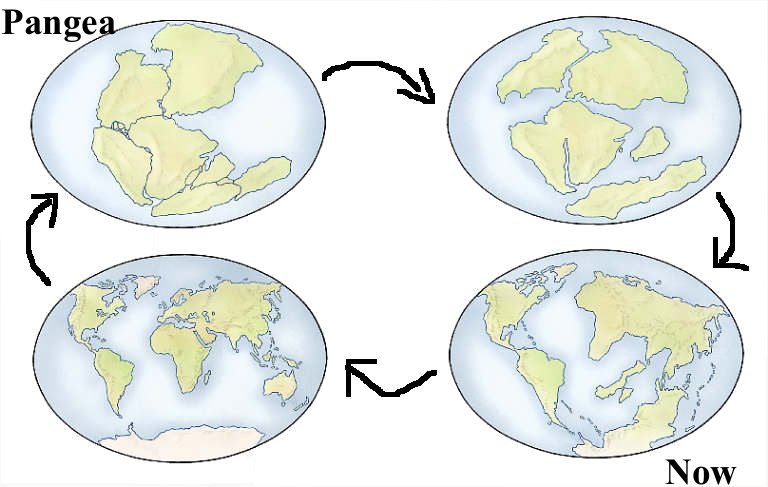
    A simple model of the supercontinent Pangaea turning into the 7 continents we have today via continental drift
    A simple model of the supercontinent Pangaea turning into the 7 continents we have today via continental drift

    Marie’s map wasn’t published until 1959. This was one year after my father was born. He was born into a world that didn’t know about tectonic plate movement or that the seven continents used to be one big continent. To me that’s like being born into a world where most people still think the Earth is flat. In addition to Marie’s work dramatically improving human knowledge of the Earth, her work was impressive because she did it during a time that belittled any ground breaking work done by a female. Whether people realize it or not, she drastically changed the way we understand the Earth and the way people look at the work of females.

    As a female researcher who wants to get my PhD and spend the rest of my life studying the Earth, I find it hard at times just to motivate myself to keep going down this path of endless studying, reading, and working. I realize my struggles are trivial compared to Marie’s. She conducted great science all while battling sexism. Before 1970, women made up less than 4% of all doctorate earth scientists, as they were discouraged from studying geoscience. Despite society telling her to pursue other work, Marie did what she could to contribute to geoscience. She worked as a drafter at Columbia University. Because she was not allowed on the ships that were gathering data in the field, she stayed in New York where the men would send the data they were collecting from the ship. The men on the ship, which set sail in 1953, were collecting sonar data to determine how deep the ocean floor was and to understand ocean floor topography. At the time, they assumed the ocean floor was flat because they had no data to believe otherwise.
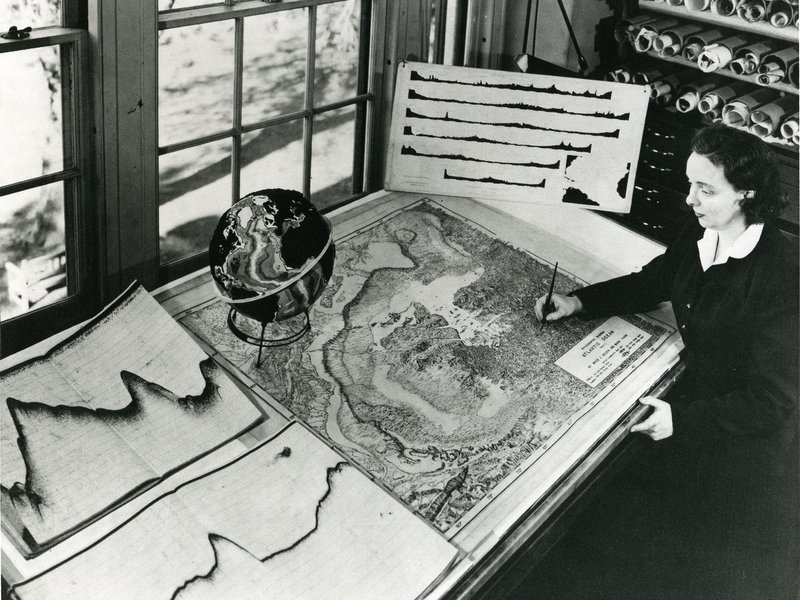
    Marie hard at work turning sonar data into a map of the ocean floor
    Marie hard at work turning sonar data into a map of the ocean floor

    The ship spent years sailing around the world and sending data to Columbia. Marie spent just as much time back in New York crunching the numbers and turning the data into a map of the ocean floor. Because this was a time before computers, Marie mapped out each point by hand. Her first major discovery was the giant rift valley down the bottom of the Atlantic Ocean–what is now called the mid-Atlantic ridge. This had never been previously discovered but is now known as the fault line where the Eurasian and North American tectonic plates are pulling apart. As she continued to draw out the data, she saw more of these large topographic features on the ocean floor. When Marie completed the map, she showed it to the men that were on the ship and they dismissed the theory of continental drift as “girl talk” and refused to believe that she analyzed the data correctly. A few decades earlier, Alfred Wegener proposed the idea of continental drift but it was largely rejected due to lack of sufficient data. Even now, with a map of ocean topography showing robust evidence for continental drift, the theory was still rejected because the evidence was proposed by a woman.

    Marie was forced to check and recheck her work for months due to their pessimism of the quality of her work. It was not until over a year later that people started to accept her map and her theory, when seismic data was collected at the bottom of the Atlantic Ocean supporting her map of the mid-Atlantic ridge. By 1959, the map was widely accepted and published. However even when her map was accepted, she was largely cheated out of credit for her work. The collectors of the sonar data were the primary owners of the map, with Marie receiving partial credit for her years and years of analysis and mapping. Not only did she solely calculate and draft the topographic data, but she was responsible for igniting the acceptance of the theory of continental drift. She revolutionized the way we see the Earth today, yet received minimal credit, pay, and status in the scientific community.

    Only within the last few decades has Tharp been credited for her significant contributions to geological sciences. Her name is now the primary author on most ocean bathymetry maps, as it should be. These maps are seen all over the world and are used to understand tectonic plate dynamics, predict earthquakes, and so much more, to better understand both the past and future of our beloved planet Earth.
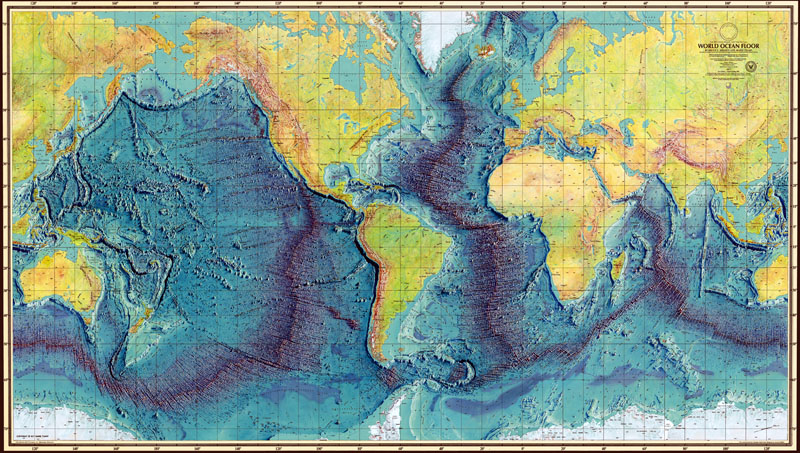
    The final published version of a Marie Tharp ocean bathymetry map
    The final published version of a Marie Tharp ocean bathymetry map

  • How Corals Changed My Life

    I’m a fifth year undergraduate at the Georgia Institute of Technology studying industrial and systems engineering, and I plan to attend graduate school this Fall–but not for anything related to industrial and systems engineering. I plan to pursue a PhD in geoscience, with a focus on paleoclimate. How did I end up here? What even is paleoclimate? I spent five years diligently studying stochastic systems, designing simulations, and developing optimization models. I even spent an entire year training to be an industrial engineer at a manufacturing plant. What made me decide to dedicate the next five years of my life to paleoclimate? Why does paleoclimate even matter? It all began when I was introduced to the endless wonders and wealth of information that corals can provide.

    I started studying corals when I took a class by Dr. Kim Cobb, a professor in the school of Earth and Atmospheric Sciences at Georgia Tech. She was teaching a course on sustainability that I happened to be enrolled in to fulfill some breadth requirement for my degree. Although I enrolled in the course thinking it would be an easy-A class, I quickly became more and more enthralled by Dr. Cobb’s inspiring lectures on climate science, one of the most discussed topics concerning the sustainability of our beloved planet. Her passion for the subject was evident and it reminded me of how much I love and care for the Earth. It’s something that has always been a great interest of mine but has gotten lost in the midst of my time-consuming engineering studies. One day after class she announced that she was seeking an undergraduate research assistant for her climate lab. Having never been involved in research at an R1 research university (the highest research activity classification) and also wanting to experience ways to further pursue my long-lost passion for the Earth, I decided to join Dr. Cobb’s paleoclimate lab.

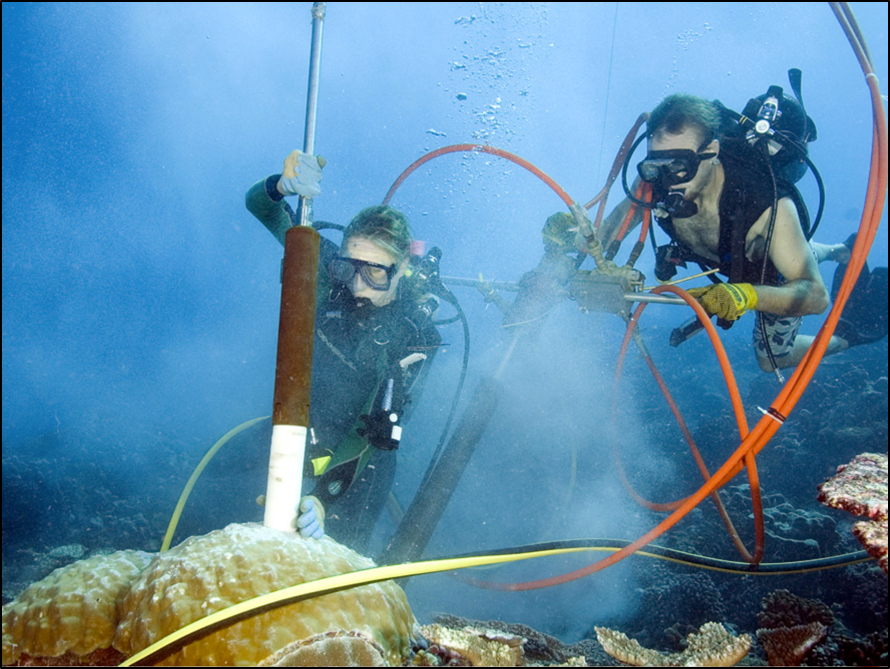
    Paleoclimatology is the study of past climate. Why do we need to study past climate? If it is so important, how do we study past climate from times before we had thermometers? Instrumental climate data only extends to the mid 1800s (1), at best, and a century of climate data on a planet that has existed for over 4.5 billion years (2) is simply insufficient when trying to understand long term climate trends. This is particularly critical when trying to distinguish natural climate change from anthropogenic climate change. How do we know what the temperature was on Earth thousands or even millions of years ago? Luckily for us, the Earth is home to an archive of past environmental information. We can use geochemical proxies, which allow us to reconstruct past environmental conditions to understand atmospheric dynamics, oceanic circulation, hydrological properties, and so much more. The potential from these proxies is endless. These proxies, which are found in geological archives such as corals, tree rings, ice cores, and sediments, are covering the Earth. A wealth of knowledge is sitting at our fingertips, waiting to tell the stories of the conditions in which they have survived. My research in the Cobb lab involves geochemical proxies in corals, or more specifically, oxygen isotopes in the corals.

    Because corals are so sensitive to changes in the condition of the waters they live in, their carbonate skeletons can be chemically analyzed along their growth axes to understand how the conditions of water have changed over time. These conditions include sea surface temperature (SST), salinity, and pH, which in turn tell us temperature in the area the corals are from, rainfall patterns, and intensity of ocean acidification (3). For instance, the coral oxygen isotopes are particularly sensitive to SST, with some influence from salinity. Thus, when we measure the coral oxygen isotopes of the coral from the surface all the way to the base of the coral, we can reconstruct the temperatures in which the coral grew. This is because warmer conditions cause coral oxygen isotope abundances to become depleted, whereas cooler conditions produce an enrichment of these isotopes in the coral skeleton. The reliability of this proxy has been vastly and rapidly improving through replication and, when available, comparison with instrumental SST records.

    Dr. Cobb extracting a coral core from our research site at Kiritimati Island in the central Tropical Pacific
    Dr. Cobb extracting a coral core from our research site at Kiritimati Island in the central Tropical Pacific

    My undergraduate research project involves the paleoclimate reconstruction of corals in the central tropical Pacific during the massive El Niño event of 2015, which is the largest event on record as shown by some instrumental records. El Niño events are natural climate phenomena that occur every 2-7 years and bring climate extremes to various regions of the world, including heavy rainfall and severe droughts. For instance, if you are a resident of Georgia, you have noticed that this past winter has been unseasonably warm and dry. This is because we are currently experiencing a very strong La Niña event, which often brings climate extremes opposite those of an El Niño event (these strong La Niña events often occur for one or two years following a very strong El Niño event). In my research on this 2015 El Niño event, I have reconstructed SST by analyzing the coral oxygen isotopes in several cores from Kiritimati Island in the central tropical Pacific, in the heart of the El Niño region. I have several research goals in my project, but some of the major ones include: understanding the magnitude of the event by analyzing coral oxygen isotopes in an ensemble of corals from the central tropical Pacific, comparing that magnitude to instrumental records to understand how the signals differ, and comparing the magnitude to past coral oxygen isotopic records to understand the variability of El Niño events over time. Some findings suggest that these events are intensifying over time and becoming more variable, so this is an active area of research. Understanding these events in both the natural and anthropogenically-forced sense is critical when trying to understand human impact on the environment and trying to predict the occurrences of these events.

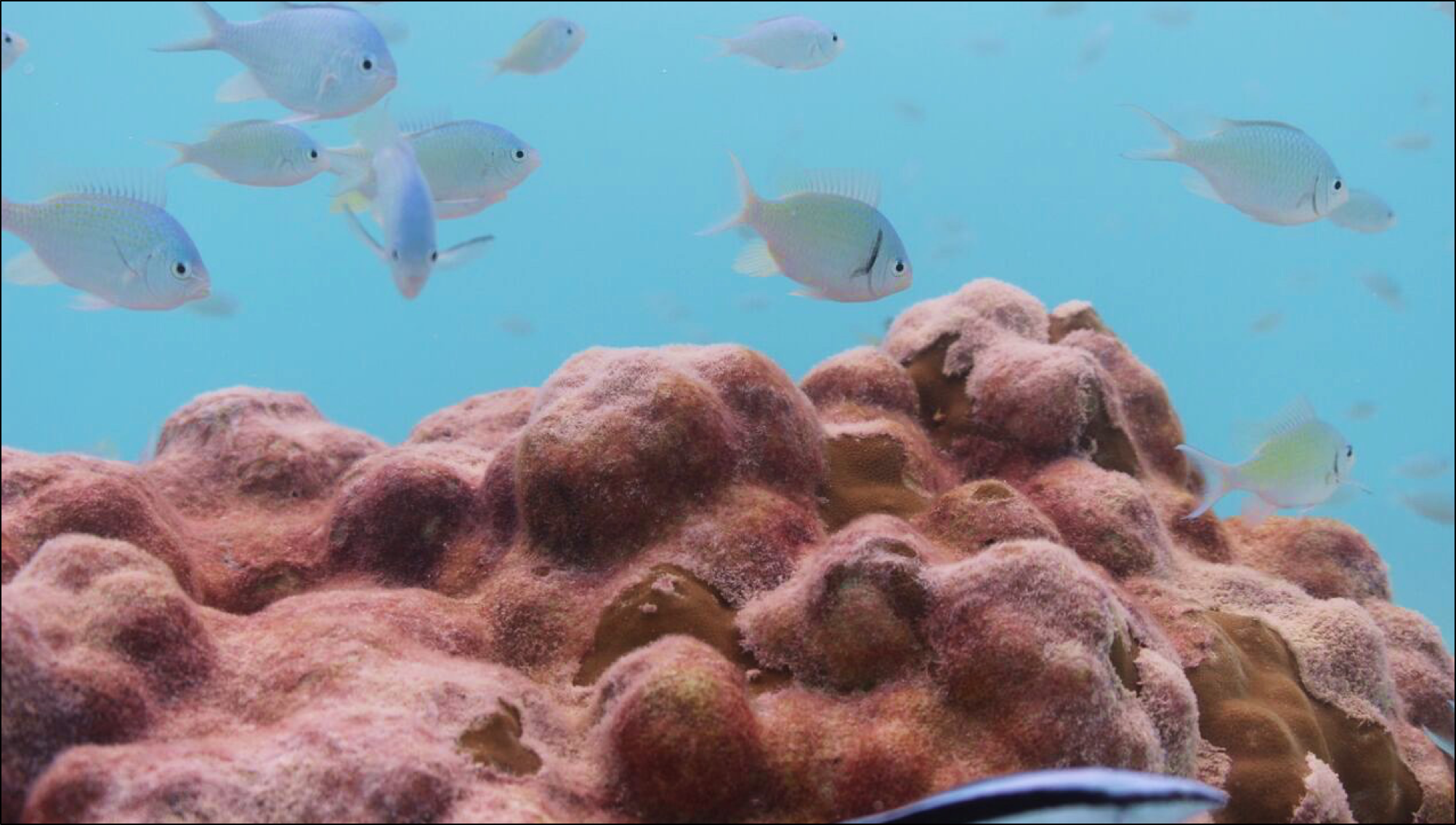
    An algae-covered coral I’m studying. It died from the extreme ocean warming during the massive 2015 El Niño event
    An algae-covered coral I’m studying. It died from the extreme ocean warming during the massive 2015 El Niño event

    So how did these corals change my life? My research on corals has exposed me to a whole new world of science that I never knew I would be so passionate about. In about one year of undergraduate research I took on this independent project, learned how to use a mass spectrometer, did field work on Kiritimati Island, gave a talk at the world’s largest Earth Science conference in the world, and have been accepted to four graduate schools to pursue a PhD in paleoclimate. I also just found out today that I was awarded the National Science Foundation’s Graduate Research Fellowship, which provides me with funding to attend any graduate school for the next three years. If I hadn’t taken Dr. Cobb’s class and fallen in love with her coral climate science research, my life trajectory would be worlds different right now. I never imagined I would be in my fifth year of undergraduate studies and be so eager to spend another five years in school. However, I have been exposed to the world of geochemical proxies and I don’t ever want to leave. It took me two majors, one year of co-oping, one year of research, and five years of school to find my passion, but I wouldn’t change a thing about my undergraduate choices because they led me here. As for my next steps, my list of options for graduate research studies include water isotopes in ice cores, clumped isotopes in sediments, cosmogenic nuclides in subglacial bedrock, and maybe even more corals. I never thought this would be my life path but I’m excited to work on science no one has ever done before and answer questions about the universe that have never been answered. Speaking from experience, it doesn’t matter if you’re already going down one path in life. If you’re not sure if you’re making the right choices, try other things and see if you find something that would bring you more happiness.

    Sources
    Cobb, Kim. “Why Study Paleoclimate?”. http://shadow.eas.gatech.edu/~kcobb/
    “How old is the Earth”. https://image.gsfc.nasa.gov/poetry/venus/q1152.html
    “Picture Climate: How We Can Learn From Corals”. https://www.ncdc.noaa.gov/news/picture-climate-how-we-can-learn-corals

  • 5 Alternative Facts on Climate Change Disproved

    Government officials are making several claims about one of today’s hottest topics, climate change, yet are lacking some scientific proof…

    1. Global Warming is a hoax.

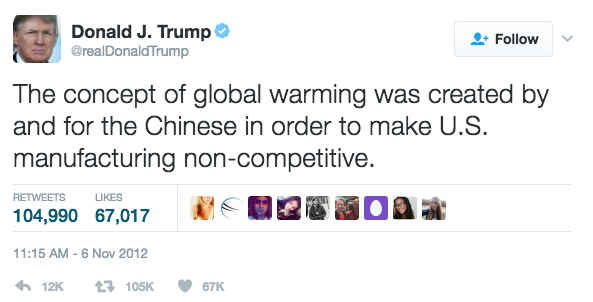
    Twitter 1

    An overwhelming majority of the scientific community agrees that global warming is a real crisis, not a hoax created by the Chinese. According to the Intergovernmental Panel on Climate Change (IPCC), “it is extremely likely (95–100%) that human influence has been the dominant cause of the observed warming since the mid-20th century.”[1] Human actions have been largely attributed to snow and ice melt, changes in the hydrological cycle, and sea level rise. Also stated by the IPCC, “Human influence has been detected in warming of the atmosphere and the ocean, in changes in the global water cycle, in reductions in snow and ice, in global mean sea level rise, and in changes in some climate extremes. It is extremely likely that human influence has been the dominant cause of the observed warming since the mid-20th century.”1 Evidence for climate change due to anthropogenic forcing has been recognized by scientists across the world, with the primary driver being the measured increase in atmospheric carbon dioxide from environmentally harmful processes including fossil fuel combustion.

    2. The Keystone XL Pipeline will not harm the environment.

    Screenshot 2017-02-01 21.32.44

    The Keystone Pipeline, an oil pipeline system running between Canada and the United States, has just been approved by President Trump to advance the construction of an extended line called the Keystone XL. Barack Obama rejected the project last November, due to extensive proof that the disadvantages far outweigh the potential benefits. The Keystone XL would have harmful environmental impacts including a projected generation of over 22 billion tons of carbon pollution, which has been proven to exacerbate climate change (2). In addition to the emissions that will be caused by the pipeline extension Canada will be losing 54,000 square miles of untouched wilderness, which will cause significant loss of habitat, increase erosion, and reduce the amount of trees available to absorb atmospheric carbon (3).

    3. NASA’s Earth Science division’s environmental monitoring efforts are “politically correct”. –Robert Walker

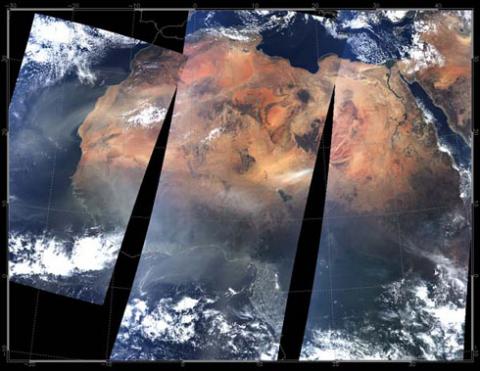
    NASA's Earth monitoring satellites greatly assist with tracking and predicting major climate events, such as this dust storm blowing across Northern Africa. (2)
    NASA’s Earth monitoring satellites greatly assist with tracking and predicting major climate events, such as this dust storm blowing across Northern Africa. (2)

    Walker, a senior adviser for President Trump, also stated that “over half the climatologists in the world doubt the influence of human activity on climate change”5. The latter statement has already been proven to be factually incorrect in the first scientifically disproven alternative fact, demonstrating Walker’s lack of credibility on the matter. NASA’s Earth satellites have consistently proven to be an invaluable resource to humankind. They have repeatedly proven the reality of the climate change issue at stake with evidence of rising global temperatures, sea level, and greenhouse gas emissions. Removing the ability to track these environmental trends with human activity would also remove the ability to show the global harm caused by increased greenhouse gas emissions from projects such as the Keystone XL Pipeline. With Trump’s plan to reassign some Earth monitoring efforts to NOAA (National Oceanic and Atmospheric Administration) and NSF (National Science Foundation), who both have significantly smaller budgets, the performance of these critical satellites will diminish extensively. NOAA and NSF would not have the time, money, and resources to take on these extra duties to sufficiently track essential environmental changes that are rapidly occurring daily. By shutting down NASA’s Earth Science division, a wealth of environmental data that is currently being used to generate predictive models and identify long-term climate trends will greatly diminish. Even if Earth satellites launch in the future, under a different administration, the gap in data will be a severe setback for climate science with long-term impacts that can take decades to recover from.

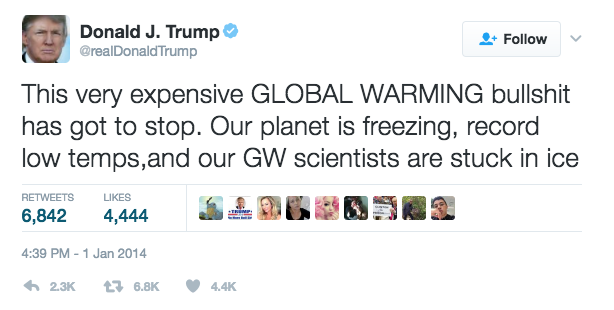
    4. Record temperature lows are a sign that climate change isn’t real.

    Screenshot 2017-02-01 22.46.56

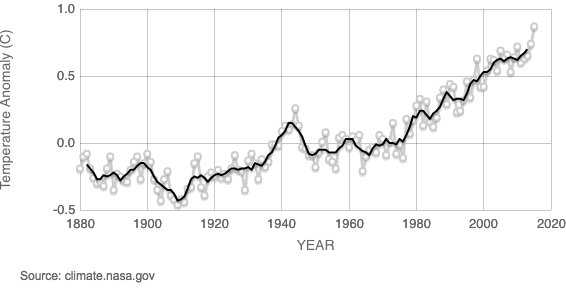
    Rising global temperatures cannot be sensed by a human from day to day life. According to NASA, global mean temperatures have increased by 1.4° Fahrenheit since 1880, with most of this warming (2/3 of it) occurring since 19756. Temperatures fluctuate significantly due to natural cycles such as winter and the El Niño Southern Oscillation (ENSO), which drive temperature extremes to various parts of the world. Despite occurrences of cold weather, the global mean temperature is still rising at a nonlinear rate, as shown below. Additionally, the climate change crisis is not solely about warmer temperatures. Human activity has been related to changes in the hydrological cycle, atmospheric composition, frequency and intensity of climate phenomena such as ENSO and monsoons, and other key earth systems that impact global communities and ecosystems (1).

    Global Surface Temperature since 1884, with the 10 warmest years occurring since 2000 (3).
    Global Surface Temperature since 1884, with the 10 warmest years occurring since 2000 (3).

    5. We cannot conclusively say how much human activity is interfering with the climate.

    “The climate is changing and human activity impacts our changing climate in some manner. The ability to measure with precision the degree and extent of that impact, and what to do about it, are subject to continuing debate and dialogue.” –Scott Pruitt (7)

    With only 5% of climate scientists denying the existence of sufficient proof to link human activity as the primary cause of climate change, Pruitt’s statement of the debate behind climate change is misleading. The overwhelming majority of climate experts are not debating this issue. However, since Pruitt’s argument is based on the fact that 100% of climate scientists are not in agreement over the extent of human activity on the climate, he is emphasizing the need for further research on the topic to be conducted in order to produce more conclusive findings. If the 95% of climate scientists who agree that climate change is a real global crisis, then conclusive findings are necessary to protect the homes and health of both our generation and the next. Climate change has significant potential to threaten future existence of coastal communities, stability of ecosystems all over the world, and the health of the 7.5 billion people inhabiting the planet.

    References

    1. “IPCC, 2013: Summary for Policymakers. In: Climate Change 2013: The Physical Science Basis. Contribution of Working Group I to the Fifth Assessment Report of the Intergovernmental Panel on Climate Change”. [Stocker,T.F., D. Qin, G.-K. Plattner, M. Tignor, S.K. Allen, J. Boschung, A. Nauels, Y. Xia, V. Bex and P.M. Midgley (eds.)]. Cambridge University Press, Cambridge, United Kingdom and New York, NY, USA. http://www.ipcc.ch/pdf/assessment-report/ar5/wg1/WG1AR5_SPM_FINAL.pdf>

    2. Biello, David. “How much tar sands add to global warming”. Business Insider. Jan 2013. http://www.businessinsider.com/how-much-tar-sands-add-to-global-warming-2013-1

    3. “Final Supplemental Environmental Impact Statement for the Keystone XL Project Executive Summary”. Jan 2014. United States Department of State Bureau of Oceans and International Environmental and Scientific Affairs https://keystonepipeline-xl.state.gov/documents/organization/221135.pdf

    4. “Trump to scrap NASA climate research in crackdown on politicized science”. The Guardian. 2017. https://www.theguardian.com/environment/2016/nov/22/nasa-earth-donald-trump-eliminate-climate-change-research

    5. Norianne, Elli. “Climate denial is the official stance of the Trump administration”. Daily KOS. Nov 2016. http://www.dailykos.com/story/2016/11/28/1605040/-Climate-Denial-is-the-official-stance-of-the-Trump-administration

    6. Carlowicz, Eric. “Global Temperatures”. NASA Earth Observatory. http://earthobservatory.nasa.gov/Features/WorldOfChange/decadaltemp.php

    7. “Questions for the Record for the Honorable E. Scott Pruitt”. Environment and Public Works Committee. Jan 2017. http://www.epw.senate.gov/public/_cache/files/6d95005c-bd1a-4779-af7e-be831db6866a/scott-pruitt-qfr-responses-01.18.2017.pdf

    Photo Sources

    1. “Donald J. Trump on Twitter”. Twitter. https://twitter.com/realDonaldTrump/status/265895292191248385

    2. “Global Climate Change: Vital Signs of the Planet”.NASA. http://climate.nasa.gov/vital-signs/global-temperature/