Author: Gordon Waller

  • Berkeley grads grow mushrooms for cash – legally!

    Imagine you are in your last semester at college. You’ve done well academically, studied business, and you have a job offer lined up. Your parents are letting up on the constant brow beating about expectations and preparing for the future. The light at the end of the tunnel that opens up to the real world is as close as you have ever seen it. Just a few more classes to get through and you are home free. But, say, during one of those classes the professor says something that catches your attention.

    “And believe it or not boys and girls, you could potentially grow gourmet mushrooms from recycled coffee grounds.”

    You sit up, stop your doodle and look around. Did everybody just hear that? The professor just told us how we could make money on waste! Free money! Mushrooms! You approach the professor after class as all but one other student in the lecture file out of the auditorium. Though you probably wouldn’t know it at the time you are looking your future business partner in the face. Another light blinks on in the tunnel, and this one is green.

    Sound far-fetched? It’s not. That is exactly how “Back to the Roots”, a startup enterprise centered on bringing consumers in touch with their food in a sustainable way – all while turning a profit and benefiting their community of Oakland, California – began. Nikhil Arora and Alejandro “Alex” Velez met for the first time after a lecture at UC Berkeley during their last semester in college in which the professor made the same proclamation I wrote above. Just as the professor had said, you can grow gourmet mushrooms off of waste like used coffee grounds, which is exactly what the pair did. First by experimenting in a frat-house kitchen after watching videos on YouTube on how the process should go, then to selling their mushrooms at a farmers market in Berkeley, California and eventually to their debut product the Back to the Roots at-home mushroom kit which features coffee grounds collected and re-purposed from Peet’s Coffee & Tea, a Berkeley based café, into do it yourself mushroom kits. Just add water at home to grow over a pound of gourmet mushrooms ready to eat!

    Mushroom-Kit-2
    The Back to the Roots grow-at-home mushroom kit

    Within three years of their founding in 2009 Nikhil and Alex who are self-described “urban mushroom farmers” have secured distribution deals with massive retailers including Whole Foods, Bed Bath & Beyond and the Home Depot. They went from collecting coffee grounds headed for the landfill to being paid to haul it away by Peet’s Coffee & Tea, an early supporter of the young startups. As of 2012 they had diverted millions of pounds of coffee grounds destined for landfills. At roughly 3.6 million pounds in 2012 alone, that’s the equivalent of 175 dump trucks of material.

    I first became aware of Back to the Roots through their recent Kicstarter campaign to launch a new product – the Aquaponics Garden – which like the mushroom kit is a “grow-at-home” concept herb garden using hydroponics. Growing herbs at home using this method is an old trick, but the mushroom wielding duo (Mario and Luigi?) added an interesting twist of a live fish in the nutrient bath. In this way, feeding the fish encourages it to… “feed” the plants which in turn clean the water for the fishy. The Aquaponics Garden has the same closed loop low waste ethos as the mushroom kit and is thus very much in line with the mushroom kit using recycled coffee grounds.

    But I couldn’t avoid the nagging feeling that there was more afoot than delicious herbs and modern architecture inspired fish tanks. Around the same time that the Berkley grads were gearing up to take the DIY culinary world by storm, I began my PhD studies in Atlanta, GA. My new apartment with sweeping views of the side of a building and a dumpster covered in puke didn’t produce the kind of urban living I had expected when moving from rural Virginia where I went to college. Determined to spruce the place up, I wanted some potted plants. After all, there was a spacious balcony from which to enjoy to aforementioned scenery with a cool glass of sweet-tea (Atlanta, remember?). But lo – no direct sunlight. My first batch of plants withered soon after sprouting and becoming spindly, yellowed baby plants.

    I turned to the internet – the font of all knowledge – to seek a remedy. Hydroponics was the logical solution. With hydroponics I didn’t need sun or warm weather. Hell, I didn’t even need soil. I settled on one branch of hydroponics – pardon the pun – called “aquaponics” in which the roots of the plant are interwoven into a passive binder, usually clay pebbles, and dangle into a nutrient rich solution. Through my research I found an easy design using a spray-painted plastic storage bin with holes drilled in the top and a fish tank aerator hot-glued to the bottom, a few feet of aluminum flashing to make a reflective enclosure, and a couple of 20 watt CFL bulbs plugged into the sockets of a “make a lamp kit”. Make a lamp indeed. A grow lamp.

    Unfortunately, some of the critical supplies I needed couldn’t be found anywhere. I remember inquiring in the garden section of a home improvement store for things like “netpots” and “hydroton” and “rock wool” and  “grow max powdered plant nutrients”. After a few minutes of listing name brands to a dumbfounded employee in an orange apron, I told him my intended application.

    “I am trying to make an herb garden in my living room. Like basil and stuff.”

    I felt it was a reasonable claim. After all, I had just put a few packets of seeds for exactly that – basil and stuff – in my basket.

    A knowing look came over the clerk’s face.

    “Oh. We don’t have that here.” he said with a little grin.

    Back to the internet. It had to be done. A specialty store. I searched everywhere I thought was reasonable – head shops with fluorescent posters and glass “tobacco” pipes, local hardware stores serving as fronts for the mob, Jerry who lived behind the dumpster. Nobody had even heard of the stuff. When I finally found what I was looking for  it was on the edge of the city in a run down industrial park. I called the store.

    “Do you guys have…” I paused, remembering the clerk at the home improvement store, “Net pots?”

    The clerk, “What size?”

    This was the place.

    When I arrived I found a brightly lit sign over the top of a small warehouse. Inside was every manner of tubing, pots, nutrient and testing apparatus that I had never heard of. They also had camouflaged “grow room tents”. It was an odd mix of completely legitimate looking industrial equipment – hydroponics is a great choice for farming organic produce in otherwise unsuitable locations – and everything I imagine I would need if I was looking for a great way to get kicked out of school.

    I bought my supplies and a small booklet on hydroponic gardening. I paid in cash.

    Is this aquaponics garden thing legit? I interviewed Nikhil, one of the co-founders of Back to the Roots to learn more. Nikhil and I discussed their recent success with a Kickstarter campaign to raise capital for production of the Aquaponics Garden, lessons learned from development of their grow-at-home mushroom kit, and the business philosophy that has helped them gain recognition.

    —

    Charged Magazine (CM): So, How’s it going?

    Nikhil (N): Doing good. Just wrapping up the year so it’s been crazy. Comes to an end all of a sudden, Ya’ know?

    CM: First, I wanted to congratulate you on the Kickstarter thing. You guys were asking for $100K and I think it closed a little less than week ago and you guys cleared almost two-hundred and fifty thousand dollars?

    N: Yeah. Two-forty-eight. Almost 250 but it was crazy. It was really cool seeing the response from the community. It was the first time I’d really done something like that, the whole crowd sourcing thing, it just works! People we’ve never met before and don’t know who they were just coming out with their support. It was really cool.

    CM: I think you’ve hit on something important – you’re talking about, I guess, the community involvement in your project. Is that the reason you guys decided to go with something like Kickstarter?

    N: Yeah. I think we knew had a lot of support for the mushroom kit from our community and we felt that the aquaponics kit could be something similar. And I think to do really well on Kickstarter, and we were like studying it for a while before, you have to try to hit people on a different level. It wasn’t just a transactional thing. People felt more like they were supporting a movement, and they were supporting something bigger than themselves, and that’s why when we launched this product we felt it was something like that. It was something that inspired people and hit the right chord on Kickstarter so it kind of took on a life of its own. It was really cool to see and we got our product improved so much man, the 30 days from where it started off we got thousands of messages from people just out of good will giving us awesome ideas and suggestions. We just signed off on our final design yesterday to send off to the manufacturers and we made so many changes based on feedback we got from people.

    CM: Right. And uh, speaking of that feedback, I read in a little bit on your Facebook page regarding this particular product and I definitely see what you mean as far as people who are very interested and passionate about the idea – but of course there was a little bit of negative feedback as well – specifically regarding the fact that you guys would have a live fish in the Aquaponics Garden. But you guys handled it surprisingly gracefully. You know, you said “yeah, we are definitely aware that this is something we need to build into our design” and it seemed you owned it right off the bat and the product is not even on the shelves yet, so I have to commend you on that.

    N: Thank you man. It was a big design constraint for us. According to PETA and the most common standards, 1” of fish needs 1 gallon of water. That was our reasoning that for our 3 gallon tank you could have one beta fish in there or two smaller fish so we kept to that. One cool thing about aquaponics and why it’s totally different is that most of the time the health of fish is determined not by the size but more the toxicity of the water. You’re supposed to change the water in regular tanks really frequently, like once a week, to make sure it’s clean and ammonia is not building up but the cool thing with aquaponics is the plants are constantly cleaning the water out so it’s more about the constant quality of water for the fish.

    CM: And definitely having the opportunity to grow yourself some fresh herbs at home is a driver.

    N: Yeah. I think when you put something like that out into the world, on that kind of platform, we knew were going to get a lot of feedback, and we got some negative feedback and we got a lot of positive feedback that we were able to apply and make changes from. Overall it was a really cool experience and it would have taken us so long to get this data back if we had just launched into retail, because here you have such a direct communication with people I thought it was an awesome way to launch a new product.

    CM: So, I think you guys mentioned this during an interview or something, but the connotation with two kids from Berkeley trying to grow mushrooms has a certain connotation – so I thought it was somewhat ironic that the second choice you guys pick is something with an equally, somewhat seedy I guess connotation, that is hydroponics and the whole growing plants in your closet kind of thing. I wonder if that thought occurred to you or what you think of that?

    N: Yeah, you know it’s funny we never even thought about it that way. We had been kicking the idea around for a month or two before somebody said to us, “First you guys were growing mushrooms and now you’re selling hydroponics systems?” We just started cracking up and it hit us that we hadn’t even considered that both products have that same stereotype.

    CM: Regardless of the stereotype though, I think the market you are attracting is a mix of DIY enthusiasts and people interested in knowing their food and on top of that doing something good for the environment and education. That’s the next thing I wanted to talk about, I think it’s pretty impressive what you guys are doing in the schoolrooms. You guys are doing product demos and have a program where you donate the mushroom kit to classrooms. Do you have similar plans to do that with the hydroponics kit?

    N: We are. Actually, for the mushroom kit, every kit that you post a picture of on our Facebook page we donate one to a classroom of your choice. With the Aquaponics Garden we are trying to think how we can make that work. Now we’re thinking because we saw such a cool response to the whole Kickstarter idea, we thought, “Why don’t we implement that on our website?” We are thinking of having people who want to get a kit to a school of their choice can post that school on our website and they can get friends and family to pledge a dollar or two dollars and they can crowd source their own kits for schools or something like that. We are trying to think right now how to incorporate that because we are not launching them until late February or early March. We know this stuff would be amazing for schools because with the mushroom kit, it lasts for maybe a couple crops so maybe you get a month out of it, but with the Aquaponics Garden you buy it once and it lasts you for a lifetime, so teachers can have it for like 10 years you know? We want to see it in every classroom so we are trying to figure out what is the best way to make that happen right now.

    CM: It’s way cooler than the class hamster.

    N: Yeah!

    CM: You and Alex are quite young, and I thought what is particularly interesting is that you guys are kind of wrapped up in the era of the startup culture. I would say some of your contemporaries in the tech fields go a completely different direction. It’s basically they have a handful of guys who work until they spin out an idea and they are seeking venture capital for like a million bucks. You guys every step of the way it seems said “How can we not only build our business and build a community involvement in our business? How can we build these connections where things that are good for our business are also good for getting jobs to the Oakland area?” For example in an interview you guys were talking about trying to find a domestic producer for your fish tanks.

    N: Which we did. They are like 20 minutes away from us right here in northern California.

    CM: Yeah, which I think is fantastic. I guess do you have a comment regarding your own education or maybe people who would be in your age group as far as the typical way of approaching a startup company?

    N: Yeah, I just think for us it’s just been the right thing to do based on our values and I think it goes back to the environment we were in, how we were raised, things like that all played a part into that. But it’s hard to just pitch it to everyone saying “it’s the best thing to do based on our values, based on the environment” but at the end of the day it’s the right thing you do for your business too I think. There has been this transformation towards transparency and community in helping companies grow, and if you are not engaged in community from the start and giving back and being a positive part of that community then you are stunting your own growth. There has been a shift in the kind of companies people want to support and people are really looking for companies that are doing good. That’s the one message we really try to tell people. If you are not going do it because you love the environment or something like that then do it because it’s good for your bottom line. Being open to your community is the next wave of marketing and transparency. There is a really cool movie actually called “The Naked Brand” that talks about how it’s not about clever marketing anymore, it’s about transparent marketing and how transparency is the new clever in how to grow a business. It’s something we’ve become really passionate about and I think us being open about our flaws and what we were doing right and what we were doing wrong has actually helped us grow faster. Admitting mistakes has helped us grow faster. We’ve all graduated in the middle of this whole financial crisis, I think with a sense of “there has got to be a better way to do this.” I think people, consumers, are thinking the same thing that there has got to be a better way to do business and are looking to support companies that they feel are doing it the right way. I just think it makes sense all the way around.

    CM: Another thing I thought was interesting is that when you guys were talking about originally doing product research for the mushroom kits you turned to YouTube, and when you were trying to find buyers for your leftover coffee grounds you turned to Craigs List. I am kind of going back to what I was talking about before with the tech startups where of course their business wouldn’t exist without the internet but it’s because their business is on the internet. How has the internet shaped your company?

    N: Yeah. That’s dead on. We graduated having no clue about anything to do with mushrooms so we just watched every single YouTube video and found all these articles and books on different websites. It’s just cool how you can teach yourself anything now. There is no longer an excuse of “I didn’t know that, or I didn’t know how to do that.” You can just log on and teach yourself anything. We taught ourselves mushroom farming on coffee grounds from YouTube. It democratizes business and startups and education because you can go to a library and long online and just figure it out.

    CM: What are your goals for the launch of the Aquaponics Garden?

    N: For us, so much about the Aquaponics Garden has to do with inspiration and education. Our big vision is to see how many classrooms we can get this into. We’ve taken it to some classrooms right now, this one prototype we have, and honestly it is incredible the response you get from kids. I think it’s maybe the combination of the fish, the bubbles going up from the pump or the sound of water coming back down, but it’s so stimulating for them that they just rush to it and ask all these questions. It’s crazy how fast they understand what’s going on with the whole ecosystem. That’s our biggest goal. We want to build this thing out so we can literally get this into every classroom. We feel like for every classroom you can get this in, you are changing 30 kids perspective on food and the environment. You are teaching them that things work together and there is no such thing as “waste” because the fish waste is making the plants grow. That’s our big vision. We really want to get this into schools.

    CM: Sure. So my background is in engineering, and actually I have attempted to do my own hydroponics before. I moved into an apartment that had no sunlight, so I really couldn’t do any window planters so I made the whole enclosure with some CFL lightbulbs. When I was building my own design I spent a lot of time online to see what other people had done but I ran into a lot of kind of technical hiccups that I had to work through. So out of curiosity, I’m wondering what are some of the biggest technical issues you guys have run into trying to bring something like this to market?

    N: The biggest thing for us has been bring this whole system down to a smaller scale – aquaponics is normally done on a larger scale – we took months of experimentation into how to get the ratios down, looking at flow rates to make sure the system was still functional at such a small scale, how many fish do you need, how many plants can you grow, things like that. It was constant learning, and we finally got to the point where we had produced a ton of these and put them in different households and it we had functional prototypes. Once we saw the basil popping up we got so pumped because we had figured it out. We were always tweaking along the way and we wanted to encourage communal learning around this where people are sharing tips on what worked. We want this to be a platform for people to get really creative with it – people want to try and grow flowers, different foods. One guy emailed us saying he wanted to put shrimp in there. It’s like people hacking into their own creativity.

    CM: I’m interested in some of the manufacturing aspects. You mentioned you were able to find a local provider. Was that difficult given the way that everything – at least when you are trying to do it cheaply and in huge quantities – goes overseas? What did you learn from that experience?

    N: It was a big learning curve all around. We talked to dozens of manufacturers. It’s funny, because you design something, and then you realize the first go-round when you take it to engineers who tell you “you can’t do this, you can’t do that” or it’ll cost you thousands of dollars so there was a lot of back and forth between design and engineering.

    CM: Did you find a lot of pressure from existing industry to abandon your business philosophies as far as sustainability and local design are concerned?

    N: We had a really good design partnership and at the end of the day I think Alex and I knew what we wanted to do and we wanted to keep it domestic – we wanted to keep it local – and there is kind of a statement about that so we shopped around until we found a partner who believed in that same vision. It’s tough. It is cutthroat, because every dollar of cost (in manufacturing) ends up being like 4 more dollars of retail because of markups and stuff like that, but we really wanted to keep it at a $50 price point. That was our big goal and we are working our butts off to do that. With that we had to compromise a lot, because we could have added a lot more features, but for us it was more important to get something out of $50 and leave room for people who really want to get into it with add-ons, but we wanted it to be available and accessible to everyone, at least to a lot wider market than having like a $100 price point.

    CM: When you project into the future, how do you guys imagine you are going to maintain the regional impact you have in the Oakland area. Eventually you are going to need more space. What’s the plan?

    N: Yeah, we are looking at a new space now but we want to stay in Oakland. We see a massive opportunity to connect people to their food and we want to work our butts off to take that on and be the brand that people think about when trying to connect to their food. We want people to feel good that our company is doing stuff in the right way. For us, were not afraid of scale, were not afraid of size so we are working to grow and meet really ambitious goals along the way. The more we grow the more good we can do in the world is how we see it. The more we can develop a platform for our products the more capacity we have to do good and I think the community is going to help us get there. We’re maintaining an open door policy. I’m really pumped. I’m excited for this new year.

    —

    For more information on Back to the Roots products, and a look at their growing list of accolades, you can visit their website: http://www.backtotheroots.com/

     

  • Grad School Confidential: Danger Zone

    I am sitting. More specifically, I am waiting. Waiting on the box in front of me, a box that reminds me of my grandmother’s post-war era microwave on account of its single all-purpose knob, with the only exception being the spaghetti tubing running out of the top in two directions. The box is not an outdated kitchen appliance but a vacuum drying oven. The lollipop shaped vacuum gauge marches counter-clockwise until…

    Well, until nothing. The danged thing has stalled just before bottoming out on the little steel peg that says “stick a fork in me, I’m done.”

    I rouse myself to check my watch. It’s late. I haven’t seen another person save the blue handed, white cloak laden wardens of the halls for some time. The graduate students, we chosen few, patrol the length of linoleum from office to lab. I shimmy my own blue nitrile gloves down a little further and pull up the stained cuff of my lab coat to see if I have mistaken the watch face. I haven’t.

    Leaning forward and squinting, I can see the small vial inside of my grandmother’s “cooker” containing a slurry of manganese dioxide and water has begun to fizzle as its boiling temperature is shifted downward. Water molecules consider their life up to this point and decide things are looking better in the great beyond, say goodbye to their friends and family, sever what remaining bonds they have to the liquid state and float into the void of the vacuum. Things are so bad in the vial, it seems, that enough of the little buggers are escaping to keep the pressure in the box from bottoming out. An imaginary leak produced from within: the bane of vacuum experimenters everywhere. I think of the Armstrong limit and making macaroni and cheese on Mount Everest. Using my phone and the cleanest edge of my glove I search the web aimlessly. The Wikipedia page says manganese dioxide was historically used as a pigment. I am literally watching paint dry.

    Bored with the experiment, I decide to promote the box into the 21st century. As Ron Popeil would say, “set it and forget it”. Forgotten! After a final scrutinizing glance at the little vial, I decide to take an evening stroll around the long abandoned corridors. When I open the door to my lab, air whooshes in from the hall. Another fine example of a mechanically induced pressure gradient, but instead of the little rotary vane pump that is busily gobbling down water molecules from the vacuum oven with its occasional old-man-clearing-his-throat grumbles and burping them into the lab, this one is caused by the fume hood in the back corner of the room. The influx causes my unbuttoned lab coat to unfurl behind me like a cape.

    A good lab coat imbues the wearer with a certain Fonzerellian swagger. The pop-able collar, the carefully placed stains, the pocket full of scoops and tweezers and balled up kim-wipes and what not. It’s all a carefully orchestrated ensemble. I toss my nitriles into the waste bin and move my safety-glasses to the Doc Brown position. Normally I’d put on a Ratatat album and Gene Kelley up and down the halls, but on this eve I stumble upon the Danger Zone.

    The Gateway to the Danger Zone

    The Danger Zone is indicated by a large, multicolored diamond placard hung on the door of a neighboring lab. This diamond is subdivided into four sub-diamonds – one blue, one red, one yellow and one white. In the top three colored diamonds there stands an ominous number four. I can tell it is ominous because of the deliberate choice to use a bold-faced font. Italics is subtle, bold-face is ominous. Common knowledge. The placard is an NFPA safety diamond with the highest simultaneous ratings I’ve ever seen.  The NFPA diamond is the universal indicator for scientists, engineers and common folk alike to tell you the likelihood of imminent liquidation of internal organs. You’ve probably seen one on the sides of chemical trucks on the highway or in your uncle Ned’s doomsday bunker.  I’ve been to enough Environmental Health and Safety seminars to know that pretty much only a nuclear holocaust gets a 4 in every category of the NFPA diamond, those categories being health, flammability and reactivity. For comparison, gasoline, which makes such suburban pastimes as the fire melon possible, gets a three for flammability. Yeah. Meanwhile, “very short” exposure to a number 4 health hazard can be fatal and a number 4 reactivity rating is explosive at room temperature with minimal agitation.

    I have to admit, even swaddled as I am in my lab coat, I begin feeling a little overwhelmed by the idea that a mere 15 feet away from my vial of manganese dioxide (which gets a paltry rating of 1 for health and flammability and 2 for reactivity) are three distinct ways to get sent to the hospital. How do I know there are three? Well, to speak truthfully I don’t, but I would place a wager that no single chemical exists with NFPA ratings of all 4’s that would be allowed within 40 miles of a population center like metro Atlanta. Furthermore, general NFPA labeling like the one on the door to the danger zone indicates the highest combined hazards of all the chemicals found within. I imagine at least two chemicals were needed to propel a lab into the danger zone category. A container of hydrofluoric acid (which will dissolve your bones through your skin) and tri-nitro-tolune (it’s TNT, it’s dynamite) would give you a combined rating of all 4’s.

    I retreat to the relative safety of my lab and barricade the door.


    Image credits:

    http://en.wikipedia.org/wiki/Corrosive

    http://knowyourmeme.com/memes/yao-ming-face-bitch-please


  • Let me check in the back: how 3D printing will revolutionize future commerce

    A commercially available, at home 3D printer from MakerBot Industries


    Allow me to transport your mind for a moment. The year is 1999, being an “internet company” is still a viable business model, and Yahoo! makes hilarious commercials with the following premise: the internet will allow you to find and obtain anything you’ve ever wanted. Today, that’s kind of true. If I want to buy a product, hire a person with a specific skill set, or learn about a new topic, the internet is the first stop. I grew up in this era of instant gratification, at least with digital content, so to me, using the internet to obtain information is so common it’s mundane. Here in present day future land, an emerging technology known as “3D printing” is soon going to do for physical objects, even complex machines, what the internet did for the dissemination of digital information.

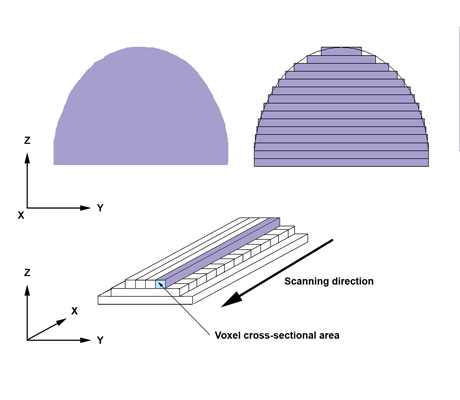
    In a nutshell, 3D printing is a lot like regular printing… in three dimensions. If you accept the simplicity of a cop-out explanation, then you are well on your way to appreciating why 3D printing will be such a transformative technology. In a regular inkjet printer, paper is maneuvered in one dimension, say “X” on a coordinate plane, and a printing head moves in a second direction “Y”. The combined motion in X and Y allows for “two-dimensional” printing, but there is some minute third dimension even for these systems, as the deposited ink has a height on the page. With the addition of a third degree of freedom for movement into the “Z” direction, and replacing the ink with a substance that can be easily deposited and then frozen into place, this afterthought of a third dimension can be capitalized upon. With each successive pass in the XY directions the height grows in the Z direction. If the increments in the Z direction are small enough, even complex geometries can be made perfectly smooth.

    3D Printers make intricate shapes by depositing small amounts of material in successive layers

    This is similar to a physical application of a “Riemann Sum” used for graphically approximating integrals in calculus. This level of precision and flexibility in manufacturing is what makes the possibilities for 3D printing so bizarrely unreal. Typically, if a material cannot be extruded, milled, pressed, or molded by machines the only option is handcrafting by skilled artisans. Think your grandmothers heirloom dining room table versus anything on sale at IKEA. Scale, my friends, is the difference.

    3D printing has enjoyed niche applications in producing product prototypes and custom-ordered artistic pieces. There are a lot of variations on the general technique I have just described, but one thing is for sure – if 3D printing ever reaches a “break-even” point with conventional people-actually-making-stuff manufacturing, the concept of supply and demand economics, that universal truth applying to huge quantities of product, will lose its relevance. 3D printing would allow supply and demand to approach a 1 to 1 ratio – there would never be any imbalance between the two. No reason for a sales clerk to check in the supply room for the last lamp or chair or dining room set or pair of sneakers, because it could just be printed on the spot. Scientists 1: Businessmen 0.  Admittedly, that’s a bit farfetched, but it’s certainly true that with a technology like 3D printing readily available and fully optimized, the gulf between items that are built by the zillions and given away in Happy Meals and manufacturing-intensive high-cost products will shrink. Items would go from existing on a shelf to existing on a hard-drive, made-to-order perhaps even at the point of sale.

    So what’s the catch? Sounds like a sweet deal! For a lot of creative, inventive people, it already is. Take MakerBot Industries for example – the creators of their namesake the MakerBot Thing-o-Matic shown at the top of this article, which is a bonafide do-it-at-home tabletop 3D printer. There is already a bustling community of users who submit their own CAD (computer-aided design) drawings to the Thingiverse for anyone to download and print on their own. Don’t have a 3D printer (or don’t want to spend $1749 for the MakerBot design)? No worries – you can even submit your designs to a third party 3D printer (pun intended) like i.materialise online, and they will print it for you. I uploaded a simple CAD design from Thingiverse to get an idea of pricing. I used a “hose clamp-pinch valve” with dimensions of about 1.5 inches wide and 3 inches long that came to a price of $15.50 (made of polyimide (AKA nylon), which is unfortunately not one of the plastics with a designated recycling code) and $336 to make the clamp out of brass if I was feeling fancy. For the plastic part at least, that is surprisingly affordable when compared to buying a single item of similar size and material at a home improvement store, which might run $5-$10. With prices like that I’ll have to forgive i.materialise for probably naming their company during a board room meeting at a Starbucks.

    But what if I had uploaded a design I had not gotten from an open source development site like Thingiverse or designed myself? What if I downloaded it on a peer-to-peer network or even copied an existing physical object in a store? Is it the responsibility of the people running the 3D printer to analyze every possible design for copyright violations? Is it mine? Certainly it would not be illegal for me to make my own pair of jeans inspired by, even identical to, a pair of Levi’s® if I had the ability and didn’t sell them? What if I had printed out a pair of Nike® basketball shoes with a big “G” on the side and gave a pair to my buddies?

    This, unfortunately, will likely be the Achilles heel for the 3D printing industry, and it is discussed in some detail by Michael Weinberg at Public Knowledge in his hilariously titled white paper on the subject –  “It Will Be Awesome if They Don’t Screw it Up: 3D Printing, Intellectual Property, and the Fight Over the Next Great Disruptive Technology”. They, I guess refers to “the man”, who has been known for previous violations of pointing his plastic finger at Jimi Hendrix and suing college kids for downloading albums in their dorm rooms. Or, say I used my own 3D printing machine to make assault rifles in the comfort of my own home. It’s been done folks, but unlimited capability is no reason to fear but rather to understand, plan ahead, and compromise.

    Use your printers wisely.


    Image sources:

    http://en.wikipedia.org/wiki/File:Rapid_prototyping_slicing.jpg

    http://www.flickr.com/photos/makerbot/5526691737/

  • New Houston: We have a problem


    If you are a technology enthusiast, NASA observer or all around space geek, you don’t need me to point out the connection between two recent news events. First off, SpaceX has successfully launched, maneuvered and docked their spacecraft “Dragon” with the International Space Station. That’s ISS for you acronym junkies. This is impressive not only in the sense that the actual feat is an accolade shared by very few extra-atmospheric vehicles – to my knowledge only the NASA Shuttle, and respective Russian, European and Japanese space agency crafts have ever docked with the ISS – but the Dragon was the first vehicle produced by an independent company. Deeming Space X as “independent” may give some readers pause, as at least at this point, a sizeable portion of their total funding comes from the US government to replace the lost Shuttle capabilities through the “Commercial Orbital Transportation Services” program run by NASA. The second event is the announcement by Dutch company Mars One revealing their plans to colonize Mars. This, again, is really only significant when considering how Mars One has proposed funding their journey to the red planet – namely, and in their own words, via “media spectacle”. I imagine that will include some kind of space Snooki doing shots of Jägermeister while orbiting Phobos or something, but the point is Mars One plans on going where no man (or woman, so as not to exclude Snooki) has ever gone before without being bankrolled by tax dollars. Ironically, the Dutch could be considered experts in the field of corporate colonialism. If memory serves, if you were getting your spice on about 400 years ago you had the Dutch East India Company to thank for that. It does deserve mentioning however that Mars One is not the first organization to ever propose such an undertaking. In fact, independent organizations have been in the planning stages of colonizing Mars for years, with one particularly prominent group being the Mars Society led by Dr. Robert Zubrin, but these organizations are focused on the technical aspects of a journey to and eventual colonization of Mars, rather than how to fund the colonization.

    So, taken in concert, the literal launch of the SpaceX’s Dragon spacecraft and the metaphorical launch of Mars Ones’ venture to fund the colonization of Mars, I would argue that the likelihood of anyone even setting foot on Mars within the next 50 or so years has gone from “not going to happen” to “it might actually happen but still probably not”. Why you ask? Because it’s too expensive, too political, and too dangerous for a single government to do alone.  I have never done any book learning on the Cold War, but from my perspective the whole point of the space race (which as a direct consequence gave us global telecommunications, the above mentioned ISS and the Hubble telescope among others)  between the United States and the former Soviet Union had less to do with legitimate exploration of orbital and sub-orbital space or going to the moon and more with “if my adversary has the capability of global surveillance and strategic space bound nuclear weapons, I want it too.” But now that there are no other communist super powers to compete with (oh wait), why bother going on to Mars? Do the scientific motivations outweigh the risks of sending humans instead of rovers or other autonomous vehicles? I don’t know the answer to that, and I don’t think any government space agency does either, which makes trying to pitch, fund and actually complete a government organized, manned mission to Mars dubious. Thus, as crazy as it sounds, corporate settlement of Mars might be the best option. However, for their part, NASA has not completely given up the ghost (of mars?) on exploring the Martian surface, and has unleashed a parade of satellites and rovers, with an upcoming landing of the curiosity rover celebrated with a recent and admittedly kind of bad ass promo , over the past several years.

    So what would the possible goal of colonizing another planet be? If undertaken by a privately funded company, the obvious answer is money. If Mars One leads the way, it might not be “New Houston” that is home to the future inhabitants of Mars but New Amsterdam (again). Are vast quantities of resources the goal of Mars One and like minded would-be-colonists, or is simply the prospect of settling a new world, unfettered of governments, geopolitical conflict and a breathable atmosphere the ultimate goal? Either way, it’s difficult to grok.


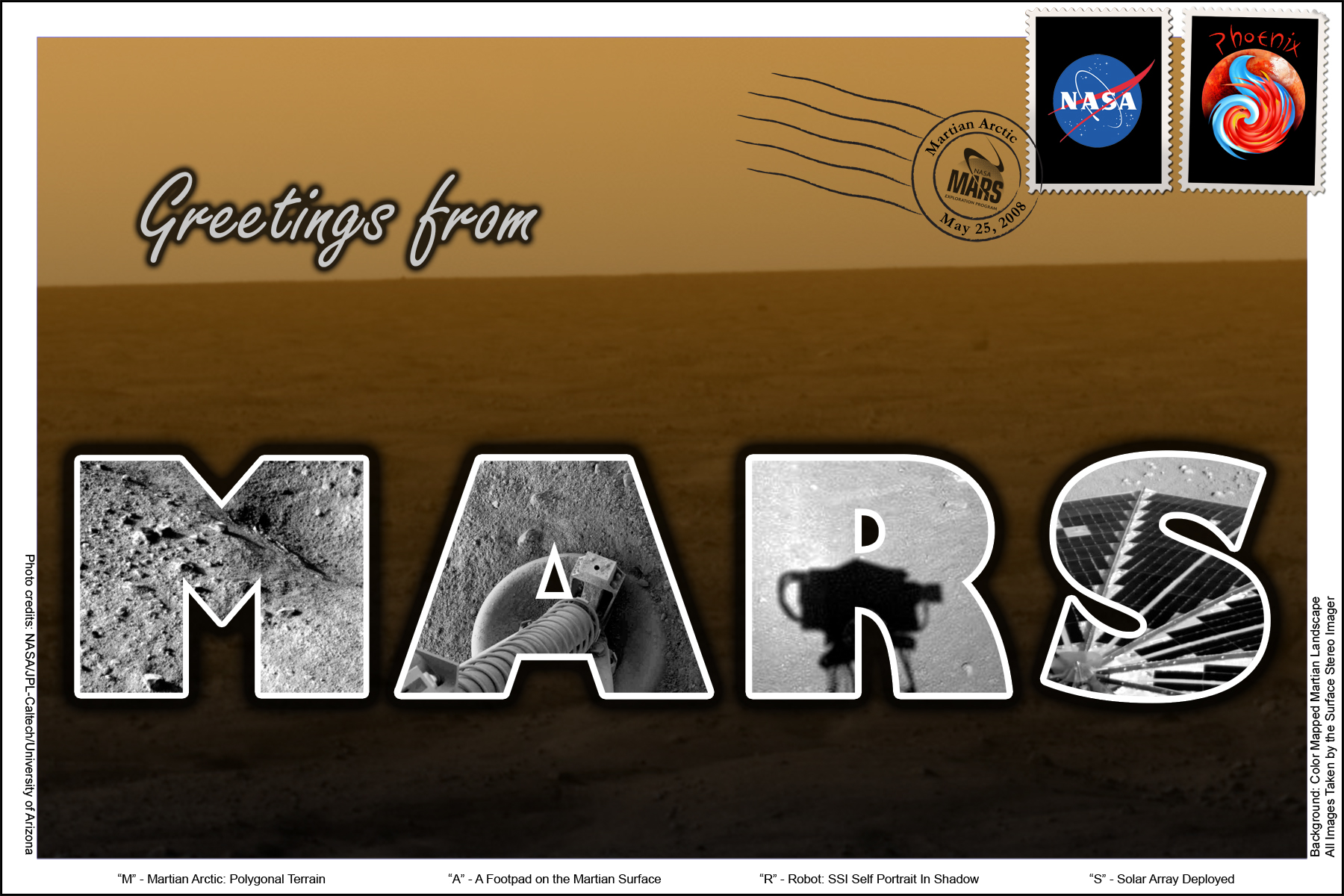
    image source: http://phoenix.lpl.arizona.edu/postcards.php

  • Hey Kids: Brush your teeth, stay in school… and read the citations!

    A co-worker sent this out to our research group in a rare moment of light-heartedness in the otherwise all-work-no-play world of physical chemistry research. His take was that we, as disseminators of scientific research, must be careful not to mislead the impressionable public. My take, which is admittedly more jaded, was that once again non-science media cannot be trusted to re-interpret the work of specialists. Of course a certain amount of external scrutinizing is required to keep we the bespectacled on the straight and narrow, otherwise we’d be spending all our grant money on Ferraris and replica iron man suits, but I’d like to imagine there is a happy medium between the far-fetched interpretations of science and technology that leave people feeling short changed  and some legitimately useful marriage of cutting edge scientific research and mass media.

    While trolling the interwebs for humorous tie-ins to this article, I came across a few pieces on the topic of science journalism written by Ananyo Bhattacharya, the online editor for Nature magazine, who in his own words has turned to the “dark side” of journalism after getting a PhD in physics and working as a researcher. Dark side is right, considering his views on the role of journalists covering science is basically that they have zero obligation to accurately portray scientific research as long as no explicit lies are told. I was particularly dumbfounded on his take regarding a concept of “copy-checking”.  Considering I am not a famous enough scientist to have articles written about my research I had never heard of copy-checking, but the basic idea is that journalists should not allow the scientists who they are writing about to preview their articles before submission. Ostensibly, this is to prevent scientists from doctoring the article to shed a more favorable light on their work, which I guess is an institutional convention for journalists to prevent politicians or other public figures from massaging press releases. That’s all well and good, but considering scientific researchers are supposed to be following rigorous ethical guidelines anyways, especially regarding publications and authorship, this seems to be a superfluous condition. Nature publishing group (who employs the journalist mentioned above) explicitly states the following regarding the requirements of authors.

    “Submission to a Nature journal is taken by the journal to mean that all the listed authors have agreed all of the contents.”

    That is to say, if your name appears on the work you are tacitly vouching for its content. Why the same consideration should not be extended to “non-scientific” reporting of research results I don’t know, but I digress. There is a simple solution to the ancient struggle between science and the media: read the references yourself. If you ever find yourself in the strange land of pseudo-scientific explanations or questionable presentation of the latest research, quit while you’re ahead and go straight to the source of the research being reported. Presumably even bad science journalism should cite the source of their topics, maybe even including the title of a research publication. A quick search in your favorite internet search engine will usually take you straight to the desired publication, and if you’re on a college campus you can probably even access the entire article gratis. Even reading the abstract (a brief overview of the research methods and findings used in the article) can go a long way in telling you with how much vigor you should roll your eyes.

    But what possible consequence could bad reporting of scientific research have? In some of the most esoteric research areas I’d say very little. For example, when the research occurring at the CERN Large Hadron Collider is misrepresented or even completely wrong in a news report, likely only the most familiar with their research (that excludes me!) would ever notice. Meanwhile, a piece on climate change with an appropriately alluring title might encourage residents of southern Florida to head for the hills. Medical research may be the one exception in which media claims are taken with a grain of salt, maybe because they’ve got this guy who makes this article feel a little redundant, but I’ll just tell myself we’re on the same team.

    Bottom line: you owe it to yourself as an inquisitive person (you ARE reading Charged Magazine after all) to apply a healthy dose of skepticism to any scientific report or study. The whole point of science after all is not to persuade with vagaries, but to convince with facts.

    Sources:

    http://www.nature.com/authors/policies/authorship.html

    http://www.memegenerator.net

  • The Pollinator Commeth!

    It’s pollen season, and where I live in Atlanta Mother Nature has given everything with the misfortune to be outside a healthy dusting. Now that my car has the same greeny-yellow slime color of an abandoned pool I am resolved to do some digging into the phenomenon. However, I feel pollen is fairly well known natural event. It’s part of plants making baby plants and bees are involved. What else is there to know right? Well for starters, how are pollen levels measured? Pollen levels being the standard metric by which news organizations inform drugstores to stock up on tissues and anti-histamine. This concept has gotten my engineer-sense tingling…unless that’s just… Oh geez…

    ::Achoo!::

    Just kidding. My immune system is like an impregnable fortress made of Dwarven forged mithril (the good stuff), but if you are one of the many people who suffer from pollen allergies (known collectively as allergic rhinitis AKA hay fever) you should take solace in the fact that science is on your side. Right now, on a rooftop somewhere in your area is a greased up rod spinning around in a tube that is sucking in air and pollen. This doohickey has the understandable but perhaps uninspired name of a “rotorod”. Air is sampled for a fixed interval, usually for one minute out of every ten minutes for a twenty-four hour period, and any pollen grains in the sampled air are stuck to a layer of silicone grease on the rotorod as they pass over its surface. After the sampling period a special staining solution that contains a dye designed to adhere preferentially to the surface of the pollen grains (and not for example on mold or dust also in the air) is put onto the rotorod localized pollen, and then a fixed area of the rotorod surface is observed under an optical microscope. By utilizing the fact that the sampling rate, volume of air sampled and observation area are all fixed the number of pollen grains on the observed area of the rotorod can be used to calculate the average concentration of pollen grains floating around in the air.

    If your response to that last paragraph was, “Wait, somebody has to physically count every single pollen grain collected during the test AND because they are a good scientist and want to minimize the scatter in their data took multiple tests? I thought you said science was on MY side!” then I am right there with you friend o’ mine. Sounds like a lot of work, especially when automated particle counters exist to constantly measure the concentration and size of particulates in the air. These particle counters use either the blocking of light (for particles larger than about 1000 nanometers) or scattering of light (for particles around 50-500 nanometers) and with similar methodology to the rotorod and microscope method (known volume of sampled air at fixed sampling intervals) these devices can determine total particle concentrations and size distributions for a given volume of air. This type of sampling technique is commonly used to monitor the “cleanliness” of clean rooms used for semiconductor and satellite fabrication where even minor levels of contaminants can cause device failure. The best clean rooms have as few as one or less particle with a diameter of 500 nanometers in every cubic foot of air. As someone who has spent some time as a famous clean room technician (that’s me in the background!), and considering the fact that normal “dirty” room air has over a million particulates of the same size for every cubic foot, I can tell you these are some pretty clean rooms.

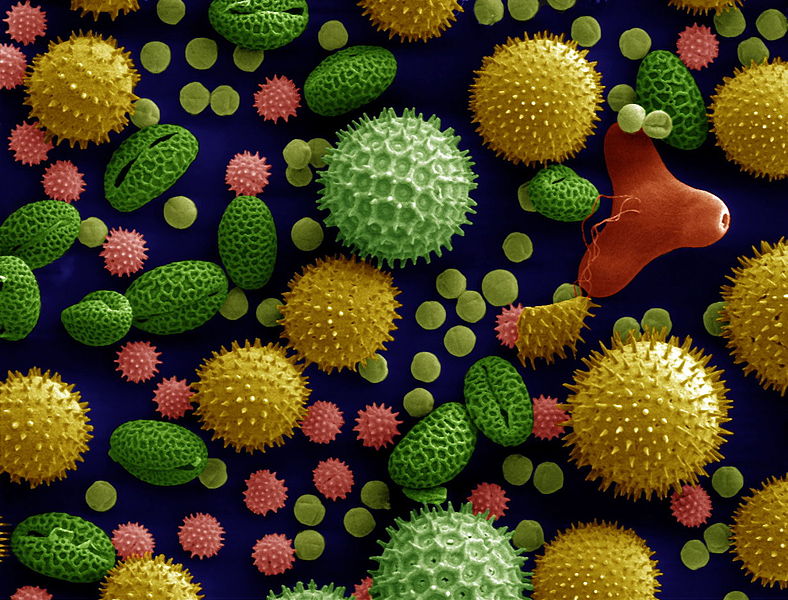
    Images of pollen grains in SEM with false color added

    One very important reason for not using this technique is the fact that pollens of different varieties imply different allergic responses for different people. Thus reporting a total pollen count or grain size distribution might not be an effective method to inform the public about the likelihood of a runny nose in their future which is the whole point of monitoring pollen levels in the first place. As a consequence, a trained specialist must identify both the species and concentration of pollen grains with the method described above which results in the reported “pollen count”. The myriad of sizes and shapes among different pollen grains, which macroscopically have very similar appearances, is shown in this false color image taken in a scanning electron microscope shown to the left. The original grey scale image (all SEM images are taken in grey scale) can be found here with call-outs to identify the pollen grains.

    All of this finally brings us to the featured topic: the pollen count. From some sources only a value of high or low, moderate or severe or something of this nature is given, but this belies what we should now understand is a much more detailed piece of data from a very sensitive measurement system: a trained scientist. One source reported that the pollen count in Atlanta hit a record at over 9000 grains per cubic meter which seems like quite a lot, but not so bad when you consider the recent panic in Moscow when clouds of pollen from trees were so thick people thought they were toxic chemical fumes. Bonus points if you can spot the trained scientist in the video from Russia. With that knowledge, I’m feeling a little better about my car.

  • Water: Prankster of the Natural World Part 2

    Water: Prankster of the Natural World Part 2

    If you haven’t read part 1 (why would you do that?), here is a review of the scenario we are considering in part 2:


    Two identical containers of water (same volume, same container size and material) are placed into a freezer. One container contains water at just below its’ boiling point (< 100 °C) and the other at roughly room temperature (21 °C). Which will freeze first?


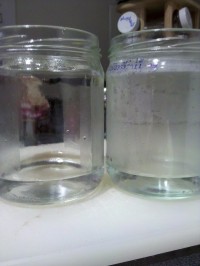
    Well I have two jars right here!

    In part 1 I discussed the Leidenfrost effect, named after a guy named Leidenfrost. In part 2 I will discuss the Mpemba effect named after, you guessed it, a guy named Mpemba. Interestingly, Erasto Mpemba was a young student when he made the initial observation that hot water can freeze faster than cold water. While he was not the first to make this discovery, his observation led to the first scientific study of the topic so it bares his name.


    At first glance, the second scenario is decidedly less exciting. No boiling, no sizzling, and unfortunately no shoddy videography, but unlike the Leidenfrost effect the mechanism behind the Mpemba effect is still hotly debated. During the boiling experiment the lower thermal conductivity of a trapped steam layer prevented efficient heat transfer to the remaining liquid droplet. Several competing explanations are offered for the Mpemba effect, but I will only consider the influence of variation in heat transfer upon freezing. In general “heat transfer” can be considered to explain both the Mpemba and the Leidenfrost effect, and there are three modes of heat transfer. Last time I described conduction which is the transfer of heat within a solid material or between two physically connected bodies. Conduction assumes that the atoms involved in the transfer of heat are fixed in space, like they would be in the solid pan from the Leidenfrost scenario or the walls of the container for the Mpemba effect. Thermal conductivity as described in part 1 is a measure of heat conduction. In a fluid convection is the major mode of heat transfer and implies that atoms or molecules are free to move around. Convection is the reason a bath of cold water with hot water poured into it will eventually reach a single homogenous temperature or opening the front door on a cold day will “let the cold in”. When dealing with both solids and “fluid” phases (a fluid means a non-solid phase) both conduction and convection can be considered. A more detailed explanation of conduction and convection can be found here.

    The third mode of heat transfer is radiation, which is the transfer and absorption of electromagnetic radiation. This was indirectly discussed in a previous article but is not important for these scenarios. A nice animation of each of the three modes mentioned here can be found on the web.

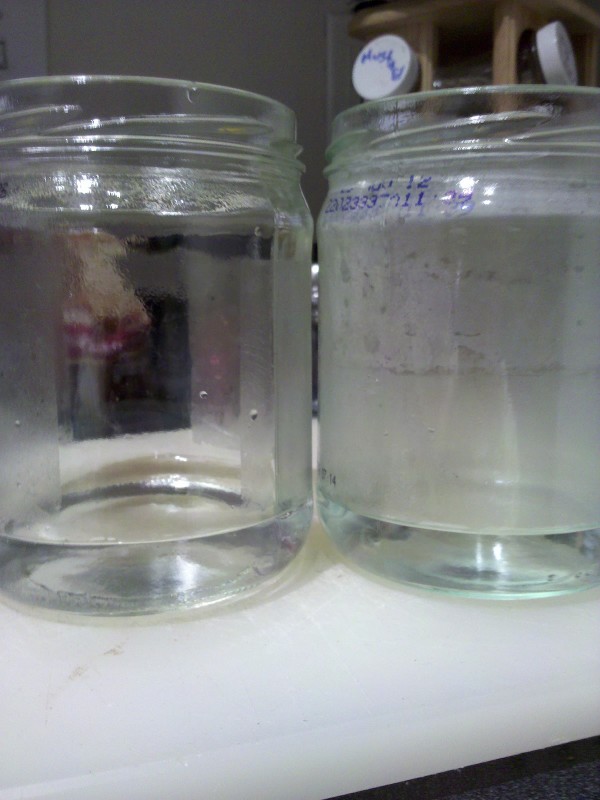
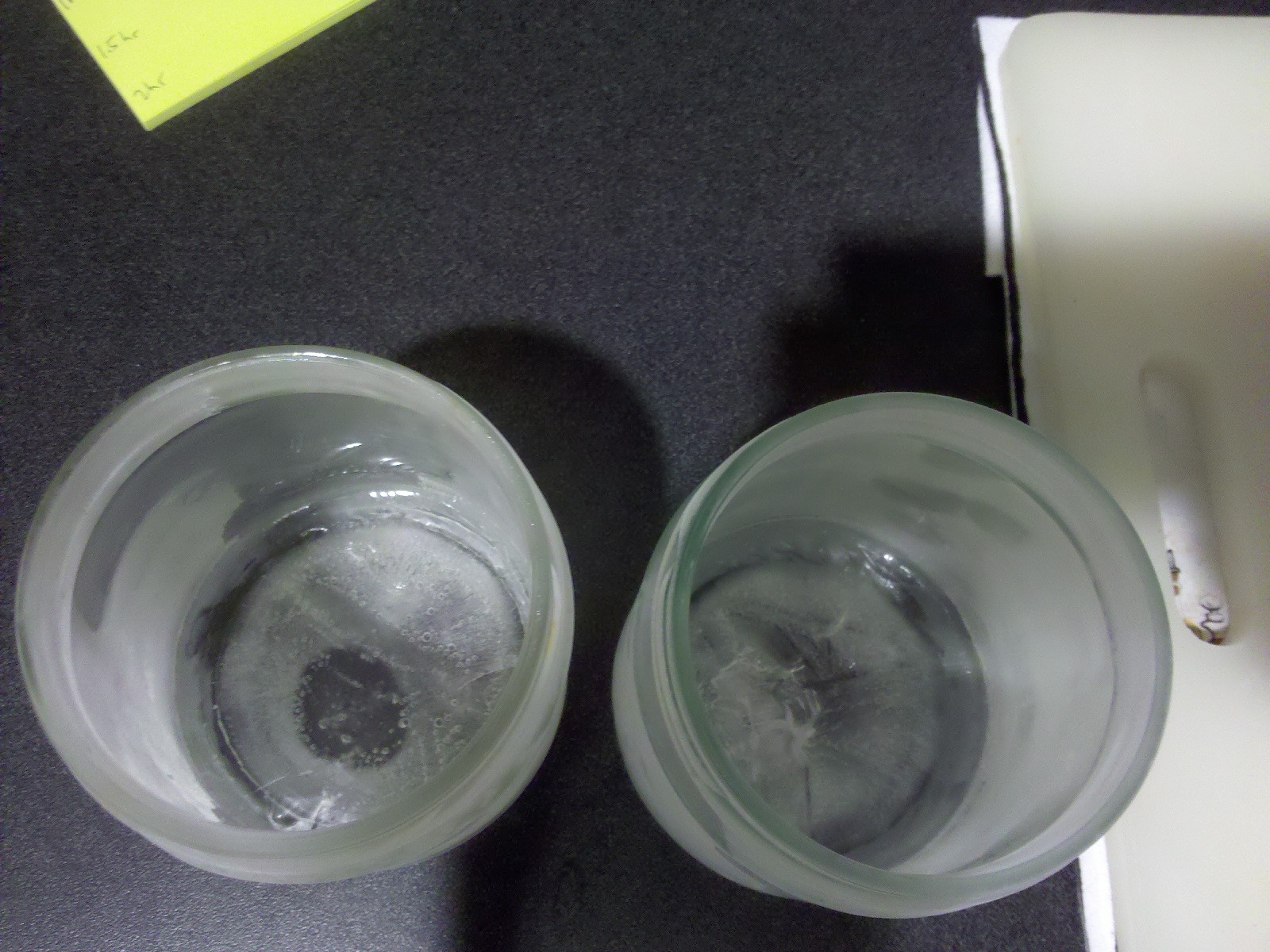
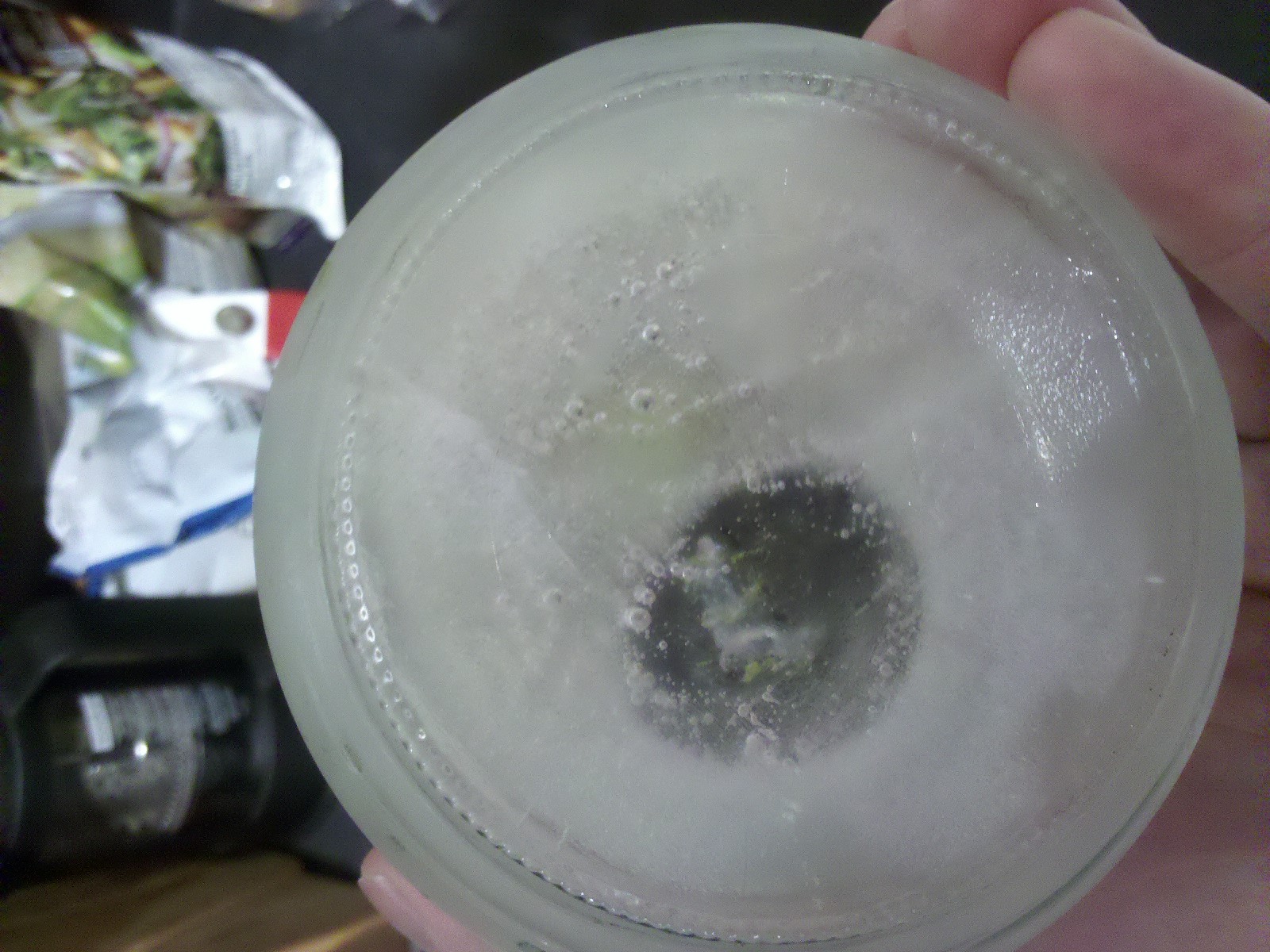
    To observe the Mpemba effect I took two identical salsa jars and ate their contents. This did not result in the Mpemba effect so I cleaned the jars and set about a second experiment. In one jar I put ¼ cup of tap water and allowed the water to reach room temperature by setting it on the counter for a few minutes. The temperature of my room was about 24 °C (75 °F). In the second jar I put ¼ cup of boiling water. By the time I poured the water it had cooled slightly from the boiling point (100 °C or 212 °F) to about 88 °C (190 °F). I checked these temperatures with a meat thermometer intended for porkchops and roasted chickens so the accuracy is not perfect but for this experiment it doesn’t matter – we only want to confirm that one container has water at a significantly higher temperature than the other. I placed both containers into my freezer which according to the same thermometer is somewhere around -15 °C (5 °F). After two hours I took the containers out and had a look-see. The room temperature water was mostly frozen except for a cavity between the ice at the top of the jar and the bottom of the jar itself. The boiled water was frozen solid. If I moved both jars around motion of the remaining liquid water in the tap water jar was obvious. From left to right below is both jars from the top after freezing, the room temperature jar from the bottom, and the boiling water jar from the bottom. The opening image for this article shows both jars unfrozen.


    Both jars after freezing – tap water on left
    Boiled water frozen
    Frozen tap water


    The heat transfer explanation that fits my results goes something like this: due to a difference in density between hot and cold water, hot water in the boiled container rises to the top and delays freezing. When the hotter water cools slightly it sinks to the bottom of the jar and stirs the rest of the container, keeping the temperature in the container homogenous. These movement within the water due to relative density differences are called convective currents. The convective currents are strong enough to keep the average temperature in boiled hot water jar above freezing until the entire container freezes simultaneously. Convective currents due to temperature differences are responsible for many naturally occurring events like the movement of an atmosphere around a planet. Meanwhile, the initially cooler tap water freezes at the top of the container preventing convective heat transfer between the water and the cold air in the freezer. Convective currents are also present in the tap water jar, but the remaining heat distributed by them is not enough to prevent a top layer of ice from forming.


    I feel obligated to admit that I had some difficulty getting this experiment to work. At first I tried using a whole cup of water in the same jars, checking the temperature in each container every five minutes. In this test I found that the boiled water dropped in temperature very rapidly at first whereas the tap water changed temperature very slowly. Both jars reached around 34 °F, just above the freezing point, at about the same time. The tap water jar froze on the top first making subsequent measurements of the underlying liquid difficult. Eventually both containers were mostly frozen but I couldn’t tell when the interior of either jar had frozen. Repeatedly opening the freezer door to inspect the jars also manipulates the experimental conditions, so when trying this at home I recommend you only check the freezer once an hour or so to see if anything is frozen. Transparent containers like my glass salsa jars make a quick inspection easier, but using containers of different materials could lead to some interesting results. It is this apparent sensitivity to experimental conditions that makes the mechanism responsible for the Mpemba effect subject to question. You can read more about some of these on the Wikipedia article for the Mpemba effect, but I encourage you to try some of your own tests and see what you find!

  • Water: prankster of the natural world part 1

    Water: prankster of the natural world part 1

    If you’ve ever taken a life sciences course your teacher probably mentioned one of several properties that make water particularly interesting. Water is cohesive meaning it sticks to itself, adhesive meaning it sticks to other things (superhydrophobic surfaces notwithstanding), and is considered the “universal solvent” because it readily dissolves many other substances. These properties are some of the most critical that allow water to function as the key to most terrestrial forms of life. Another interesting fact about water is that it is one of the few substances that exists in all three states of matter (solid, liquid and gas) in fairly non-extreme locals on earth. Furthermore, these phases exist within a relatively narrow range of temperatures – the entire transformation from solid to gas spans only 100 degrees Celsius (from melting of ice at 0 °C to boiling of liquid water at 100 °C). Compare that to ethyl alcohol (the alcohol in “alcoholic” beverages) which solidifies at -114 °C  and boils at 78 °C (a range of only about 200 °C, but with freezing occurring at a temperature below the coldest temperature ever recorded on earth) or a pure metal like iron with a melting temperature of 1538 °C and boiling temperature of 2862 °C  – that’s a phase range of over 1000 °C!

    It is important at this point in my introduction to define a phase: a phase is one of several atomic or molecular configurations for a given composition. When considering melting and boiling points, we are observing only the transition between the three states of matter mentioned above, however it is equally correct to consider multiple crystal structures for one composition of solid as different phases. Some of these solid phases are not easily distinguishable without sophisticated analytical techniques, while others have characteristic changes in physical properties.  No one would confuse graphite and diamond though they are in fact different phases of the same element. Plasma, also known as a superheated gas, is considered a fourth phase of matter but not one normally observed in nature with a notable exception being bolts of lightning. However, when heated to the point of being a plasma the atoms defining a given composition become ionized and for this reason plasma is normally considered separate from the more conventional states of matter. Fun fact for gamers: this is the plasma in all your favorite late game super-weapons.

    This is where things get weird for our old friend agua.

    Consider the following scenarios:

    1) Two identical pans are pre-heated to temperatures above the boiling point of water. The first pan is heated to 150 °C and the second pan to 300 °C. If drops of water at room temperature are placed into each pan, which drop will undergo the phase change from liquid to gas (boil) first?


    2) Two identical containers of water (same volume, same container size and material) are placed into a freezer. One container contains water at just below its’ boiling point (< 100 °C) and the other at roughly room temperature (21 °C). Which will freeze first?


    If considering only the energetics of each scenario, the logical conclusion is that a higher temperature pan means faster boiling, and a lower starting temperature means faster solidification. But if you were to perform these exact experiments at home (which I hope you do!) the opposite would occur.


    So whats going on? Is water playing by the rules (of thermodynamics)? Fortunately for us, Gibbs will remain stationary in his grave. As it turns out, both of these scenarios are good examples of how the properties of matter can change dramatically after a phase change. In both of these cases, variations in heat transfer between phases is likely to blame.


    For the water in the pan scenario, there exists a temperature above which water is so quickly vaporized upon hitting the pan a thin layer of steam is trapped below the liquid droplet, causing it to literally levitate above the surface of the pan on cushion of water vapor. Think air hockey table, but droplets of boiling water replacing the plastic puck. This temperature is called the “Leidenfrost point”, which according to unreferenced figure from Wikipedia is about 200 °C. Steam has a thermal conductivity roughly 10-100 times lower than that of liquid water depending on the temperature. In an idealized example, thermal conductivity is a measure of how easily a quantity of heat in a high temperature region can travel from one side of a 100% dense (no porosity) slab of material to the other. Thermal conductivity has units of energy per length per degree per second (Joules/(meter*°C*seconds)), meaning for a fixed length and temperature a material with lower thermal conductivity will take more time than a material with higher thermal conductivity to transfer the same amount of energy.

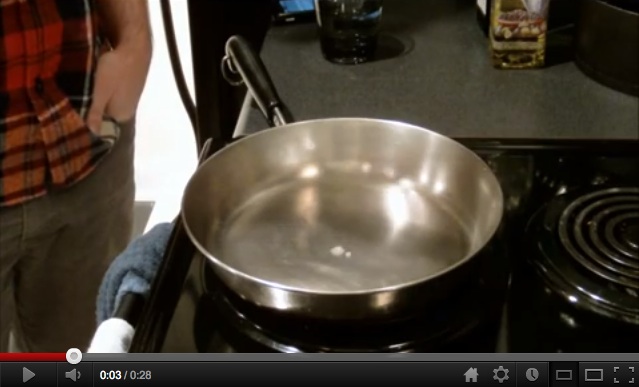
    At temperatures above the Leidenfrost point the Leidenfrost effect is observed and drops of water on a pan will take longer to boil because the steam trapped below the liquid water takes more time to transfer heat to the droplet from the pan. The videos below demonstrate drops of water into a pan below (top) and above (bottom) the Leidenfrost point. Above the Leidenfrost point, the droplets can barely be heard to sizzle as they zoom around on cushions of steam. For the pan heated above the Leidenfrost point, occasional contact with the edges of the pan, which are actually at a lower temperature or placing drops repeatedly in the same area which leads to local cooling will lead to momentary sizzling as the entire droplet boils. For the videos below, I used a nonstick pan and an eyedropper to put a few drops of tapwater onto the pan at a time. For the lower temperature I set my range to setting of 2 out of 10 and for the higher temperature I set it to about 6 out of 10 and waited a few minutes at each temperature for the pan to heat up.


    You may have heard of ole’ Leidenfrost’s namesake before associated with dipping things (namely one’s hand) into boiling lead after placing it in water. The Myth Busters did it after significant deliberation and preliminary testing, but somehow the alpha geeks at PopSci seemed to think it would make a good “DIY” project. I have to say, I can understand why dipping digits is the sexier version of the Leidenfrost effect demonstration, but the pan + water trick seems a little less invasive. In their defense, PopSci also covered this demo and the equivalent effect with boiling Nitrogen instead of steam as well.

    However you plan to enjoy the Leidenfrost effect, do so under proper supervision and be careful.

    Check out part 2 for a discussion on the second scenario!


  • Zinc has bigger game than you do

    Zinc has bigger game than you do


    Still struggling to pick out that one in a million Valentine’s Day gift? Worry no longer, because I have the perfect gift idea sure to make anyone melt. No – it’s not superhot plasma from your favorite star gone supernova (the Biebs?) – We’re talking zinc baby. Baby. Baby. Baby. Oh baby.

    Zinc coatings on steel to be exact, through the process of “hot dip” galvanization.  The hot dip part is literal – pieces of steel are dunked in a bath of molten zinc metal and when they are removed a thin layer of zinc is atomically attached to the surface of the steel. The “galvanized” part belies the true function of the coating, considering this word is derived from a certain Italian who took liberties with dead frogs.

    “Why bother?” Your significant other may ask.  “Here I had this nice piece of steel and now you’ve gone and hot dipped it. I think we’re at two different places in our relationship.” We’ve all been there.

    The role of the zinc is to protect the iron in iron alloys (most importantly steel) from rusting. Like a proverbial knight in shining (preferably hot dipped) armor, zinc prevents the steel from rusting by selflessly doing all the rusting itself. As I describe it, this is starting to sound a lot less romantic and more like zinc has wandered into the friend-zone. Poor zinc.

    If you read my last article, you know that natural corrosion resistance is rare among the elements, but ironically zinc protects steel by being less good at resisting the undesirable reactions with oxygen and water that cause the formation of rust on steel. A good analogy for this process is if both zinc and iron open lemonade stands on the same block and oxygen is the customer. Every time iron is trying to seal the deal zinc unleashes a humorous ad campaign and slashes their prices, so naturally oxygen buys lemonade from zinc instead. Now replace lemonade with electrons and you’ve got a half-decent understanding of how zinc does its job – as far as oxygen is concerned it came to this two bit lemonade town to buy lemonade from somebody (form an atomic bond), and zinc sure is looking pretty good right now. The only discrepancy with this analogy is that in the business world iron would have to resort to foul play and steal all of zinc’s lemons or deface their billboards or something. Probably shouldn’t write that on your next chemistry exam though. But don’t feel bad for zinc – the corrosion products of zinc with the environment (zinc oxide and zinc carbonate), actually prevent continued corrosion of the underlying zinc. This is called “passivation” which is the way that many other metals, like aluminum, avoid needing a hot dip.

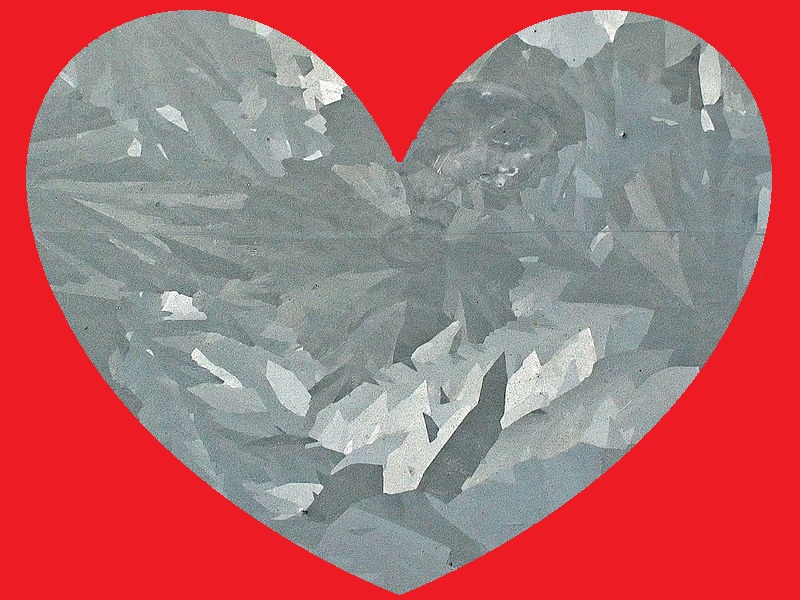
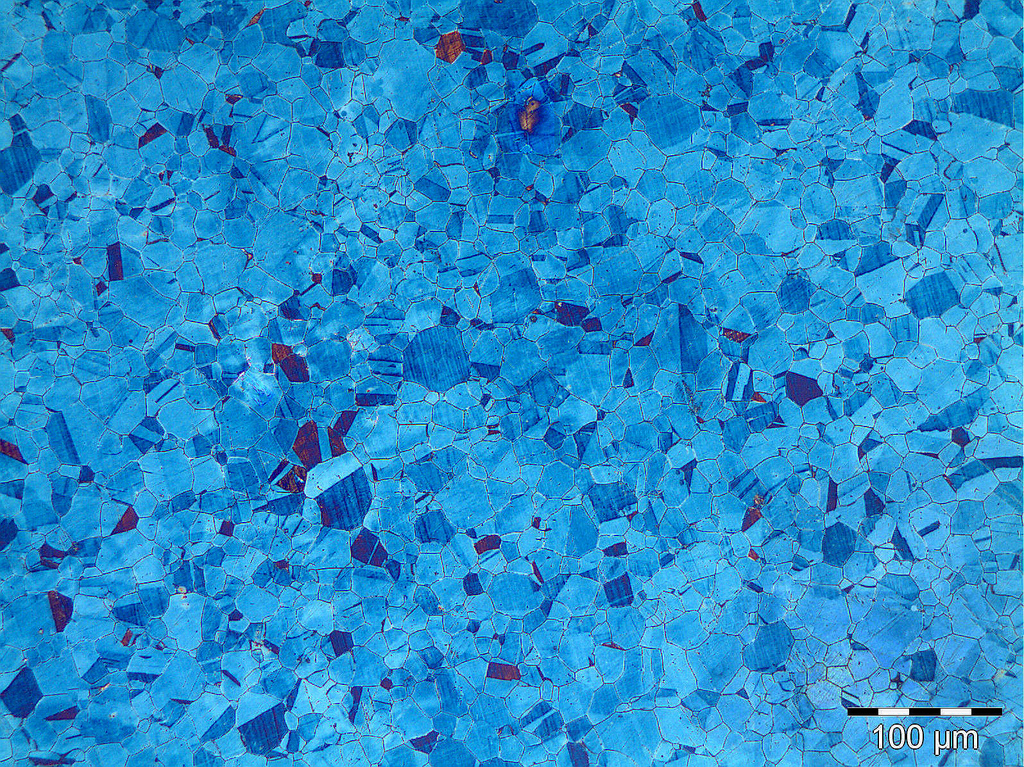
    So we’ve covered the “from the heart” part of a good V-day gift, but a box of galvanized nails might not send the right message to the apple of your eye. The good news is hot-dip galvanized steel looks really cool. The next time you’re passing a guard rail, street light pole or the like, you might notice a kind of patchwork series of flecks on the surface of the steel. No, that’s not art deco, those are the macro-sized crystalline grains of zinc busy oxidizing away. You can see some of these flecks inside the heart at the beginning of this article. In fact, all metals crystallize in this way, but because of how the zinc coating is applied the crystals of zinc that form on the surface of the steel are able to grow very large. If you were to take a high powered microscope and have a look at the surface of un-galvanized steel you would see a very similar grain structure but about 1000 times smaller. A good example is shown below from the Flikr photostream by the department of engineering at the University of Cambridge –  I admit I am a little jealous at all the cool science photos they have. Do yourself a favor and check them out.  The grains in this image are about 30-50 micrometers, which is about half the width of a human hair.

    Normally the grain size in so called “engineering materials” like steel is intentionally kept very small because it improves strength. Zinc, whose only role is as a sacrificial coating, can flaunt its’ big ole’ grains. The only other example I can think of where crystal grains are visible like this is in polycrystalline silicon solar cells. The fact that all three of these materials have the same general appearance is not by chance, but more on that another time.


    If love is sacrifice, then zinc has got it down. I will close with a poem that you can use with your gift:

    Roses are red,

    Rust is red too,

    A coating of zinc,

    says I – LOVE – YOU


    And don’t I just.


    – Gordon


    Original image sources:

    hot dip galvanized

    grains of steel


  • Even though Kim Kardashian’s marriage didn’t last, her engagement ring will. Like forever.

    Even though Kim Kardashian’s marriage didn’t last, her engagement ring will. Like forever.

    I have a joke for you:


    How long does a two million dollar engagement ring buy you with everyone’s favorite (well, mine anyways) Kardashian sister?


    As Kris Humphries found out, about 72 days.


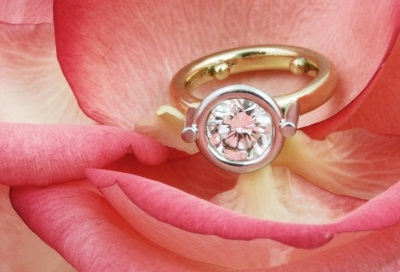
    Sorry Kris, but at least you should take some comfort in the fact that the ring you gave Kim will sit as shiny as it is right now until it’s ready to win hearts and headlines once again. At least the platinum band will anyways. What I’m referring to as the simply staggering resistance of Platinum to oxidation, more commonly known as rust or tarnish.  Platinum, along with gold and to a lesser extent silver are  the only metals on the periodic table that enjoy this distinction. As a logical consequence, these metals were some of the first discovered by ancient peoples because they would have quite literally been found lying on the ground, super shiny. In fact, gold was the first metal discovered ever and goes back as far as the entire history of… well as far back as recorded history itself! I like to imagine when cavemen discovered gold they tried to eat it before proposing to cave ladies with chunks of the stuff. Given that these un-reactive metals are now relatively commonplace, the idea of a metal that doesn’t rust may not seem that cool but trust me, it is.


    So why aren’t these magical metals applied to more commonplace items where rust is a concern? The obvious answer is their astronomical expense. Unfortunately the expense of platinum, gold and silver is not because they don’t rust but because they are super rare, representing some of the rarest elements found it the earths crust. Even if they were more common, each of these metals are extremely ductile and malleable allowing them to be easily fashioned through pulling and hammering into jewelry but preventing their use as structural metals. Gold’s softness is the origin of the quintessential gold rush miner biting into a dubious coin to ensure it’s authenticity. Thus even if you wanted to and were rich and crazy enough to do so, it would be unwise to make solid gold or platinum rims because they would buckle when popping over a curb.


    The diamonds in Kim’s ring are another story. Formed from carbon under extreme conditions of huge temperatures and pressures, diamonds are chemically identical to pencil lead but differ in the way the atoms are arranged. Instead of being soft enough to smear onto a sheet of paper when pressed by hand, diamonds are the hardest naturally occurring substance on earth. Ironically, according to calculations using thermodynamics, a discipline used to determine the equilibrium structure for a given set of conditions and composition, diamonds should not even exist outside of the extreme conditions in which they are formed! Instead, thermodynamics predicts that diamonds should deteriorate to graphite (pencil lead) at the temperatures and pressures found around Kim Kardashian’s hand. Then why don’t they?


    To answer that we can consider again our friends platinum and gold. It is not exactly correct to say that these metals can never oxidize, but more accurate to say that without a huge input of energy they never will. Meanwhile, metals like iron actually give off some energy when they rust. From the standpoint of iron, it is energetically favorable to rust than remain as elemental iron in the presence of oxygen. A good analogy to this kind of “favorable energetics” is a cart balanced at the top of a hill – the cart has potential energy that is converted to kinetic energy and then depleted  when it rolls down the hill. An unfavorable energy case would be a cart in a deep valley. Even though the cart could reach the top of the hill, someone would have to push it up there. Maybe you could get those cavemen to do it by feeding them gold. To transform diamonds into graphite and oxidize platinum will take energy. Lots of energy. So unless Kim visits the National Ignition Facility, an active volcano or these guys, her ring is staying put. Just maybe not on her finger.

    Image: Maggie Smith / FreeDigitalPhotos.net