Author: Hunter Ashcraft

  • What makes a figure interpretable?

    Science communication is an often-overlooked but very important part of furthering the scientific process, and both researchers and publishers often use graphical means to display experimental results and data through figures, as presenting data this way is considered standard within reporting results and finding as it is easily interpretable for a vast array of audiences. However, as a neuroscience student, both involved with research in a computational cognition and neuroAI lab and involved with STEM communication as a communications assistant for an institutional research institute, an interesting nuance to researchers’ use of graphs and figures to portray their results, both statistically, as the results of an experimental analysis, and methodologically, which shows their experimental process, is that while we think that we know what cognitive mechanisms people are using while interpreting these figures, in reality, the neural mechanisms are, for the most part, completely unexplored.

    Inherently, almost anyone that you ask would believe that graph and figure comprehension is a visual task; however, research as recent as 2023 published by the National Eye Institute has shown that this might not be as true a heuristic – a mental shortcut or “cheat” that makes solving a problem easier – as initially thought. The National Eye Institute’s research showed that connections to the first region of the brain where visual information is processed, the primary visual cortex (V1), are rather small, accounting for between only 2 and 10 percent of neural connections that would be thought to inform us as to what we are perceiving. This is really interesting from a systems perspective in neuroscience, as this implies that what we are seeing only accounts for a relatively small portion of what we perceive. Therefore, in terms of graph and figure comprehension, the vast majority of neural connections are from other, non-visual,  regions of the brain, leading us to believe that our cognitive processing of graphs is largely a top-down process; a process where our understanding is heavily biased by prior experience and not what we are seeing in the moment.

    From our understanding of the cognitive processes of how we interpret graphs and figures, many different brain regions could theoretically be responsible for this task; until neuroimaging research is done, we will never know for certain. However, one region of the brain that is non-visual and could be responsible for and contribute to our ability to understand information embedded within graphs is the language network and its associated regions. The language network is a portion of the brain made up of many distinct regions, such as Broca’s and Wernicke’s areas, which are commonly known to be involved with speech generation and understanding, respectively, that neuroscientists know contribute to our linguistic abilities. This region of the brain, along with other associated regions such as the cerebral cortex, suggested by some recent research in the context of semantics (Ivanova et. al., 2025), might play a large role in our ability to understand and interpret graphs and figures.

    Additionally, research that has looked at large language models (LLMs), a form of artificial neural networks loosely modeled after how researchers understand the nervous system to process language, has interestingly shown that while really bad at processing graphs and figures, LLMs do technically use language to interpret and draw conclusions as to what they are looking at and pull from prior experience and reinforcement learning (Wang 2025).

    Overall, because of this, I believe that our ability to process and understand graphs and figures would rely on another cognitive mechanism, such as language or semantics, for example, where we can “think through” and connect what we are observing in a figure to information that we already know – so this inherent visual task, may not be as much about seeing, as it is about knowing. In general, rephrasing this question to What is the neural basis of data visualization comprehension? to explore The Semantics of Data Visualization is a really interesting idea that sits at the intersection of computational cognition, neuroAI, and STEM communication.  


    References

    Ivanova, A. A., Kauf, C., Gao, R., She, J. S., Kean, H. H., Goldhaber, T., Nieto-Castañón, A., Varley, R., Kanwisher, N., & Fedorenko, E. (2025). Semantic reasoning takes place largely outside the language network (Version 1) [Preprint]. bioRxiv. https://doi.org/10.64898/2025.12.07.692873

    National Eye Institute. (2023). Sparse, small, but diverse neural connections help make perception reliable, efficient. U.S. Department of Health and Human Services, National Institutes of Health. 

    Wang, H. W., Wang, Z., Xu, Y., Chen, Z., Wu, Y., Qu, H., & Hullman, J. (2025). How aligned are human chart takeaways and LLM-generated insights? IEEE Transactions on Visualization and Computer Graphics. https://doi.org/10.1109/TVCG.2024.10681139
     

  • What Canon Captures CoCo?

    On March 13, 2026, the Georgia Tech Center of Excellence in Computational Cognition (CoCo) held its sesquiannual Computational Cognition Conference (CoCo Con) – an event where researchers from Georgia Tech and other Atlanta area universities working at the intersection of the mind and advanced computing to gain insights into both human cognition and artificial intelligence could come together and collaborate. Attending both as a student who is studying CoCo and someone who was documenting the event for the Institute, the conference itself was very interesting, as over 100 researchers from various disciplines, such as neuroscience, psychology, computing, mathematics, and physics, came together to share surprisingly similar research spanning across all disciplines— from exploration and avoidance in anxiety, what makes music memorable, the theory of mind in humans and machines, dynamic drift diffusion modeling, and the structure of memory for narratives – there was no shortage of interesting and insightful discussion on the inner mechanism of the mind. However, what stood out the most was how the conference ended. Ending with a panel of interdisciplinary researchers trying to define CoCo was arguably the most interesting conversation of the day, especially as a student studying and doing research within this field. This section was particularly interesting because while all of these people claimed that what they do is computational cognition, they all did distinctly different things and, therefore, none of them could similarly define computational cognition, further complicating the panel’s theme of attempting to define a clear CoCo canon.

    Typically, especially in the case of STEM disciplines, researchers often don’t take into consideration that their fields arise through a defined canon, or set of literature and ideas that fundamentally define and drive their field (Easterling, Patricia E, 2015). For example, a piece of canon from a STEM field that many should be familiar with, from chemistry, for example, is the relationship between a chemist and the periodic table. Any chemist you talk to should know the periodic table, and to some extent, whether directly or indirectly, and work with it in some capacity pretty much daily. However, In the case of CoCo, a canon is much harder to define, as stated by a panelist at CoCo Con 2026, CoCo is “an interdisciplinary space trying to become a disciplinary space,” and this is what makes it challenging to articulate set boundaries or literature that define what is CoCo and what is in the same sense that the period table serves as an integral component that allows us to articulate what chemistry is.

    The easiest place to start in all of this is arguably Google, as even professionals, such as the director of the GT CoCo Center of Excellence, will rely on Google sometimes – for example, to help articulate CoCo Cons’ occurrence; “sesquiannual is the word the AI gave.” As defined by Google, “computational cognition is the scientific study of the mind and its processes—such as learning, reasoning, and perception—using mathematical modeling, computer simulations, and behavioral experiments.” While this definition works, especially in the case of the research I am involved with, which is language cognition and intelligence research in a computational cognition and neuroAI lab, this definition fails to capture the full extent of what everyone at CoCo Con 2026 studies. 

    For example, a talk that stood out to me was from a researcher looking at the overall impact of how researchers are preparing for the ethical, social, and practical challenges that studying brain data brings – this includes the common practice of following proper IRB participant confidentiality guidelines, and open-sourcing brain data. While open-sourcing isn’t inherently a negative thing, in the case of brain data, an inherent clause arises in essentially protecting participants’ thoughts, as, while from our current knowledge, there’s no way to read inherent thoughts from neural data, as often neural data is some result of system dynamics rather than direct neural signals, there’s no telling what we could do in the future leading to an interesting predicament that is inarguably a CoCo problem. 

    Additionally, a possible literature base for CoCo was discussed; however, following a similar trend as in trying to define what CoCo even is, this also proved challenging due to many interesting caveats. For example, as a neuroscientist, I am familiar with and have even read some literature, such as Donald Hebb’s highly influential and fundamental 1949 book The Organization of Behavior, and while I would argue that this is a fundamental article for what I do, which is arguably CoCo, a physicist who also claims to do CoCo would most likely have little to no reason to read a book that argues the for fundamental concept in another discipline that simply states that “neurons that wire together, fire together.” Ultimately, to a physicist, the dynamics of why would matter more than the concept, so while I may consider this as canon-defining literature in regards to what I do, why should a physicist care? This idea then further brings to light the idea that while CoCo is defined as a discipline, defining what CoCo is depends on perspective and implementation rather than a coherent disciplinary problem.

    Overall, while it may be challenging to define a domain such as CoCo, as articulated by a conference attendee, “in recent years, it has become very apparent to us that we have new ways to study the brain.” Whether this be through using mathematical modeling, computer simulation, or behavioral experiments, this disciplinary space is inherently interdisciplinary. Ultimately, I feel that while it would be convenient to define a canon for CoCo from a communications perspective, it might be better not to define a set canon for CoCo and let the field continue to flourish as an interdisciplinary, disciplinary space that brings together specialists from a vast array of domains to study the mind and its processes.

    If you would like to read more about the event, read about it here: https://neuro.gatech.edu/computational-cognition-conference-showcases-georgia-techs-advancements-research-related-mind

    References 

    Easterling, Patricia E, ‘canon’ (30 July 2015), in Lucy Grig (ed.), Oxford Classical Dictionary (New York, NY, online edn, Oxford Academic, 15 July 2015 – ), https://doi.org/10.1093/acrefore/9780199381135.013.1342, accessed 3 Apr. 2026.

    Hebb, D. O. (1949). The organization of behavior: A neuropsychological theory. Wiley. 

  • The Science of Sharing Information: The A, B, Ts of Storytelling

    And, the explosion of information across scientific and technical fields over the past few decades has created a world overflowing with data. Scientific publications, repositories, visualization platforms, as well as computational tools, have expanded dramatically to accommodate this surplus; however, the rate of knowledge production now exceeds the capacity of most audiences to process and internalize it meaningfully (Schröder et al., 2023). The dominant assumption remains that more information leads to more clarity, yet the trend of adding more slides, graphs, bullet points, along with articles, produces fact-stacked communication that fails to recognize that clarity does not come from completeness (Olson, 2013). Clarity emerges from narrative. Audiences do not automatically derive meaning from information. Although accuracy remains a priority in an information-dense world, narrative structure is often avoided in fear of oversimplification, even though effective communication is increasingly essential.

    But, information alone does not create understanding. The pursuit of more information mirrors the linguistic pattern of “and, and, and,” a communication style that overwhelms audiences with unordered detail and no narrative arc (ABT Narrative Training Program, n.d.). The brain requires structure to make meaning. The human language network encodes experience and knowledge as causal chains, not isolated facts (Chen & Bornstein, 2024); therefore, understanding relies on semantic cognition, the ability to construct a mental situation model from relationships among elements. Without narrative causality, no such model can form (Schröder et al., 2023), so when information is embedded in a narrative framework, audiences understand faster, remember longer, and also make more informed decisions (Schröder et al., 2023). Even expert audiences benefit from narrative scaffolding. Therefore, the MIT Communication Lab explicitly teaches Randy Olson’s And, But, Therefore (ABT) narrative structure in scientific communication because raw information is insufficient; without a narrative, understanding does not transfer.

    Therefore, understanding is the recognition of context, conflict, and resolution (Chen & Bornstein, 2024). The brain naturally thinks in stories, so Olson’s ABT model formalizes this cognitive pattern: “And” establishes shared reality, “But” highlights tension or a knowledge gap, and “Therefore” delivers implication or resolution (Olson, 2015). ABT is effective because it aligns with the brain’s cognitive architecture by providing meaning through structure, communicating the why, the stakes, as well as the direction; therefore, narrative is not optional for understanding. When findings are presented with contextual relevance, interpretation, and recall improve because ABT mirrors the brain’s process for constructing understanding.

    We live in a world full of information, yet sharing it effectively is essential. But without a narrative structure, information fails to transfer. Therefore, the ABT model enables communication that conveys not only data, but meaning, memory, as well as insight. This article not only describes the ABT narrative but also embodies it through performing it. Using Randy Olson’s ABT-O-Meter, which quantifies narrative coherence, the writing scored an AND Frequency of 2.5% percent, which falls within the optimal 2% to 6% range, ensuring the writing remains connected but not repetitive. This article also has a Narrative Index score of 44, which remains above the threshold of 20 associated with narratively strong composition. This confirms that this article itself functions as a real-world example of the ABT framework in practice.


    References

    ABT Narrative Training Program. (n.d.). The ABT framework. https://abtframework.com/

    ABT Narrative Training Program. (n.d.). Randy Olson’s ABT-ometer: Analyze your text using narrative metrics. https://abtnarrative.com/abt_analyzer.html

    Chen, J., & Bornstein, A. M. (2024). The causal structure and computational value of narratives. Trends in Cognitive Sciences. https://doi.org/10.1016/j.tics.2024.01.003

    MIT Communication Lab. (n.d.). Scientific storytelling: The ABT method. Massachusetts Institute of Technology. https://mitcommlab.mit.edu/cee/commkit/scientific-storytelling/

    Olson, R. (2013). Randy Olson: Great Challenges Day [Video]. TEDMED. https://www.youtube.com/watch?v=ERB7ITvabA4

    Olson, R. (2015). Houston, we have a narrative: Why science needs story. University of Chicago Press.

    Schröder, K., Eberhardt, W., Belavadi, P., Ajdadilish, B., van Haften, N., Overes, E., Brouns, T., & Calero Valdez, A. (2023). Telling stories with data: A systematic review. arXiv. https://arxiv.org/pdf/2312.01164

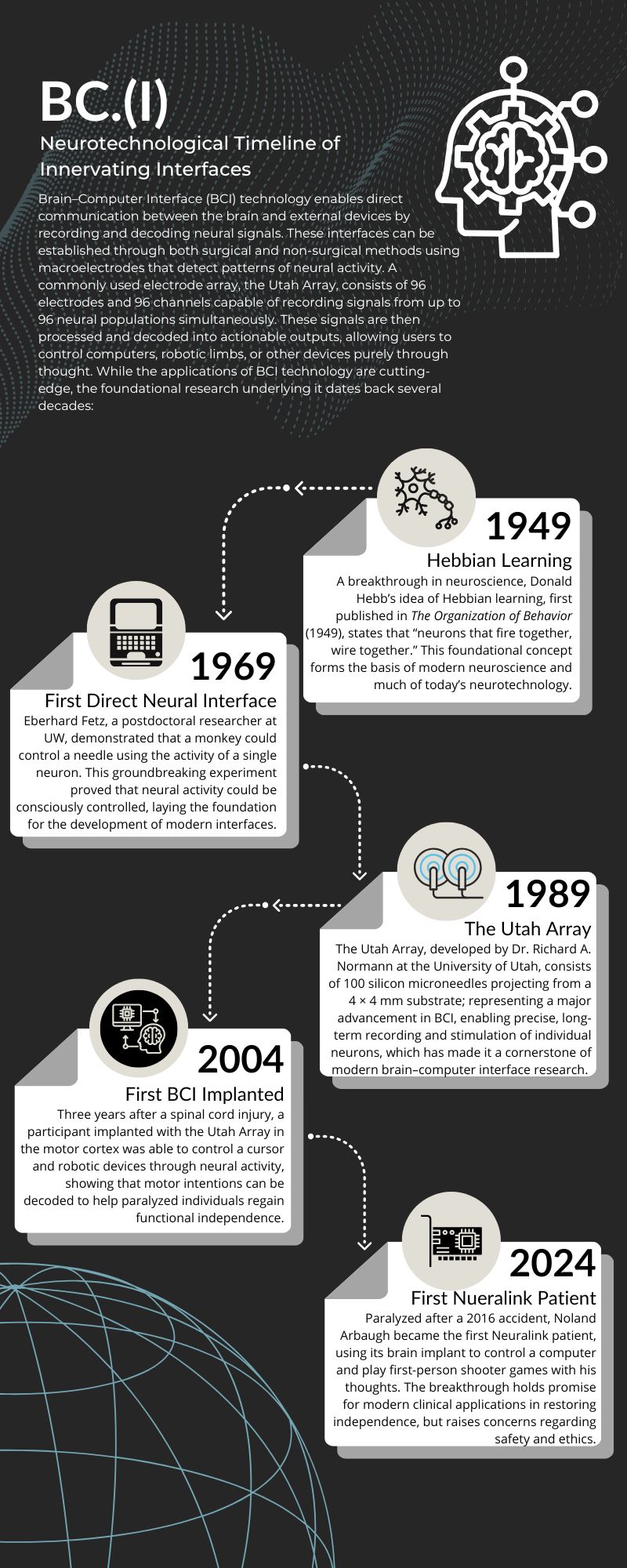
  • BC.(I): A Neurotechnological Timeline of Innervating Interfaces

    References

    Hebb, D. O. (1949). The organization of behavior: A neuropsychological theory. New York: Wiley.

    Hochberg, L. R., Serruya, M. D., Friehs, G. M., Mukand, J. A., Saleh, M., Caplan, A. H., Branner, A., Chen, D., Penn, R. D., & Donoghue, J. P. (2006). Neuronal ensemble control of prosthetic devices by a human with tetraplegia. Nature, 442(7099), 164-171. https://doi.org/10.1038/nature04970

    Mullin, E. (2024, May 22). Neuralink’s first user is ‘constantly multitasking’ with his brain implant. WIRED. https://www.wired.com/story/neuralink-first-patient-interview-noland-arbaugh-elon-musk/

    University of Washington. (n.d.). WaNPRC neuroscientist featured for pioneering work on brain-computer interface. Washington National Primate Research Center. Retrieved from https://wanprc.uw.edu/pi-feature-pioneering-work-bci/

    Wilkes, T. (2018, May 16). Prof. Normann describes the Utah Electrode Array. Department of Biomedical Engineering, University of Utah. Retrieved from https://www.bme.utah.edu/2018/05/16/prof-normann-describes-the-utah-electrode-array

  • Oscillatory Syntax – The Cognitive Optimizations of Creative Flow in Music

    While many would not often not regard music similarly to language, as a communicative form of expression, studying music in a similar fashion to language has ultimately provided some very interesting as well as unique insights into many different psycholingistic, the study of the psychology of language, and cognitive properties that can be associated with the art form. On a more technical and psycholinguistic level, music, as compared to language, can also be broken into multiple distinct syntaxes, or genres in the case of music, each of which carries its own respective sociolinguistic connotations. An example of this is genres such as rap and hip-hop that are generally associated with social commentary. In addition to this, genres also often carry unique and specific syntactical applications with them as well, with genres such as jazz being a great example of this as jazz places a heavier emphasis on the musician’s personal biases through improvisation. With these different and sometimes highly technical psychological applications often unthought of as situated within music,  a large intersection between neurophysiology and music is revealed—and this is an area that is often left largely unexplored by science.

    Through understanding how music functions linguistically, we can begin to explore the cognitive states that are triggered by music. Even as an art form, music is a remarkable field for studying human cognition; by applying neurophysiological perspectives to music, such as the intricate coordination of motor skills, cognitive processing, and emotional regulation with the more mathematical structures, such as rhythm, harmony, and melody that ultimately elicit emotional triggers neuroscientists can link the fine arts with with sciences. Through computational modeling, we can begin to uncover how music fosters unique cognitive optimizations found particularly during the creative flow state. A powerful tool for optimizing cognitive function, flow is “a state in which people are so involved in an activity that nothing else seems to matter (Rosen et al., 2024).” Originally identified by psychologist Mihaly Csikszentmihalyi (Dolan, 2024), cognitive flow is a state of highly optimized task-specific processing that is often linked to constant domain-general associative ideation, better known as creativity. Generally, through practice, dedication, and a little bit of passion, musicians of all levels can both demonstrate and experience this state of consciousness to the extent of the linguistic proficiency to which we generally speak. This ability to “let go” and “to operate with minimal conscious oversight” is what makes the flow state an exciting topic for neuroscientists, as this state ultimately functions through the recruitment of highly specialized brain networks that, when modeled computationally, provide valuable insight into high-level cognitive functioning through neurocomputational modeling.

    This flow state, when explored through neurocomputational modeling, can provide deeper insight into the brain’s processing of musical structure and creativity. Oftentimes, a major factor of emphasis regarding creative tasks performed in flow states is feedback on one’s novel ideas and creative processes that are often generated through a general understanding and conformation to a rigid set of rules associated with the artform, similar to how speech is dictated by grammar rules. Especially in music, “structure and experience are tightly linked. Therefore, music theory lies at a philosophically and methodologically challenging intersection between psychology and formal modeling because it links human musical experience with the formal/mathematical characterization of the structures underlying it. Hence, music theory lies at the heart of the research program of the Cognative Sciences” (Rohrmeier, 2020). This idea that music is shaped by a “formal grammar” is ultimately what leads to the gerneative approach used throughout modern neurocomputational modeling. 

    As neurocomputational models continue to evolve, the potential for deeper insights into how music affects cognition and creativity grows exponentially, opening up new avenues for both science and art; and through exploring unique cognitive states such as flow states, neuroscientific, mathematical, and physical representaions of the brain can be created through more artistic applications to ultimately push and explore the boundaries of neurocomputational models.


    References

    Dolan, E. W. (2024, March 6). Scientists team up with jazz musicians to reveal the neuroscience of creative flow. https://www.psypost.org/scientists-team-up-with-jazz-musicians-to-reveal-the-neuroscience-of-creative-flow/ 

    Rohrmeier, M. (2020, April 1). The syntax of jazz harmony: Diatonic tonality, phrase structure, and form. The Syntax of Jazz Harmony: Diatonic Tonality, Phrase Structure, and Form. https://www.ingentaconnect.com/content/leuven/mta/2020/00000007/00000001/art00001;jsessionid=1h40lgnaq0nqe.x-ic-live-03# 

    Rosen, D., Oh, Y., Chesebrough, C., Zhang, F. Z., & Kounios, J. (2024). Creative flow as optimized processing: Evidence from brain oscillations during jazz improvisations by expert and non-expert musicians. Neuropsychologia, 196, 108824.

  • Electrophysiological … Age? – The Implications of an Observed Age-Induced Decline of Electrophysiological Readability


    Every year, Georgia Tech’s STEMcomm Vertically Integrated Project (VIP), a project group centered around enhancing public understanding and enthusiasm for science through writing, exhibits, and events, partners with organizations like Science ATL and hosts an event at the Atlanta Science Festival, with the 2025 event being the Amazing Race; STEM Edition. With different legs of the race centered around 4 main focus areas in STEM, involving Physics in the Speed of Light, Chemistry in Shocking Conductors, Computer Science in the Cyber Quest, and Neuroscience in the Reflex Relay, groups of participants raced through Georgia Tech’s campus to complete interactive hands-on STEM-related tasks and objectives as quickly as possible.

    Focusing in on the Reflex Relay, which involved 2 stations where participants had to successfully perform a ruler drop experiment centered around reaction time and then move into an experiment centered around the electrophysiological activity associated with motor command. At this 2nd station, participants took turns exploring the electrophysiology of the nervous system through the usage of a Backyard Brains Human-Human Interface to “control” each other’s arms. A common neuroscience experiment performed in many intro neuroscience courses and labs, as described by Greg Gage’s Ted Talk, How to Control Someone Else’s Arm with Your Brain, the human-human interface arm control experiment is a fun and interactive way for people to explore neuroscience in a more hands-on fashion through directly participating in the transmittance of information from one person’s arm into another person’s arm using the Human-Human Interface to do so (Backyard Brains, n.d.).

    Throughout the race, however, to everyone’s surprise, a major issue arose regarding the Human-Human Interface’s ability to read certain older individuals. This observed age-related decline in electrophysiological readability was especially shocking for many of the neuroscience group members as well as VIP team leads because much of the group in general had prior experience with the kits as well as a neuroscience background and had never experienced or even heard of this issue before. However, this unexpected linkage between electrophysiological readability and age can be described as electrophysical age and is ultimately something that, while not typically even thought of in neuroscience, is a studied topic of interest and is an interesting byproduct of neuronal noise.

    Aging in general is typically associated with some form of mental decline and/or detriment on a more cognitive level, and this generally understood age-related decline in cognitive functioning isn’t typically observed until far later in life. However, some niche research related to changes in electrophysiological noise, specifically what is considered 1/f noise, has proven that, similar to many of the neurobiological precursors linked to typical cognitive decline, there are similar electrophysiological precursors associated with age-related cognitive decline. Electrophysiology is the study of electrical properties associated with biological systems, and since the nervous system is bioelectric, electrophysiology is often very heavily intertwined with the discipline. Through data collected by using intracranial electroencephalography (EEG), a technique neuroscientists use to read the electrophysiological activity in the brain, Voytek et al.’s study titled Age-Related Changes in 1/f Neural Electrophysiological Noise done in 2015 ultimately defines characteristics of 1/f neural noise. Neural noise is interesting in that it is a byproduct of the brain’s constant processing of stimuli; however, in being a ‘noisy’ system, the nervous system can sometimes be challenging to record through devices such as EEG. In defining that the frequency of 1/f neural noise can fall rapidly to what can be considered “white noise” due to the reciprocal nature of the function (f), Voytek et al.’s study is really interesting in that it connects and applies mathematical concepts to neurobiological principles. It was also found that even at rest, the 1/f noise mediated many aspects of cortical functioning like memory, which is especially interesting considering that it directly supports the electrophysiologically based neural noise hypothesisc of aging “that the signal-to-noise ratio of the central nervous system degrades during aging, leading to deficits in processing speed”  first proposed by Robert Kail in 1997 (McCormick et al., 2023). Furthermore, neuroelectrophysiological studies have shown that electrophysiological changes that occur due to age happen as a result of decreases in cellular excitability or the rate in wich neurons can communicate with eachother, which in turn constraints intraneuronal communication by limiting the rate at which neurons can commintate with eachother through the alteration of parameters that are integral to neural functioning (Cepeda et al., 1992). Ultimately, these observed electrophysiological changes can contribute to many of the cognitive and behavioral effects that are commonly associated with aging.

    Overall, understanding the key neurobiological functions that degrade over time and lead to cognitive decline is a topic that has been continually researched over the past decade, and more often than not, due to complexity, the electrophysiological components associated with these processes are not thoroughly explored within neuroscience. Even though many computational neuroscientists can contextualize these long-standing problems through different models, such as computational models, much of neuroscience in general looks at noise as troublesome, especially regarding the long-standing issues in computational cognitive modeling where noise is typically thought to indicate a deficit within intraneural communication and is therefore filtered out extensively. Ultimately, however, this phenomenon, known as stochastic resonance, may not always be a bad thing as it is a signaling process that naturally occurs with age in non-linear systems (McDonnell & Abbott, 2009). In a dynamic system, such as the nervous system, extra noise can end up playing a somewhat counterintuitive role as systematically, the noise generated can cause deterministic and predictable changes that end up leading to an overall improved quality of neuronal signaling on a microscopic level while making the signals themselves harder to read on a macroscopic level.

    Overall, what the Reflex Relay group found, while unexpected, is a great example of the many neural processes that go unrecognized due to the overall complexity of a continuing, evolving, and relatively newer field. Ultimately, this unexpected realization linking age to a decline of electrophysiological readability is just another example of where we may initially perceive something as abnormal or inefficient, but it may, in turn, actually be an unknowing observation of an eloquently nuanced solution not typically considered.


    References

    Backyard Brains. (n.d.). Human-human interface. Human-Human Interface. https://backyardbrains.com/products/human-human-interface?srsltid=AfmBOopmTALs9blNPlYVv8nNty1nJUDUmp5rtV5m2wH9T8Tc8lcWJJhC

    Cepeda, C., Lee, N., Buchwald, N. A., Radisavljevic, Z., & Levine, M. S. (1992). Age-induced changes in electrophysiological responses of neostriatal neurons recorded in vitro. Neuroscience, 51(2), 411–423. https://doi.org/10.1016/0306-4522(92)90325-v

    McCormick, E. M., Cambridge Centre for Ageing and Neuroscience, & Kievit, R. A. (2023). Poorer White Matter Microstructure Predicts Slower and More Variable Reaction Time Performance: Evidence for a Neural Noise Hypothesis in a Large Lifespan Cohort. The Journal of neuroscience: the official journal of the Society for Neuroscience, 43(19), 3557–3566. https://doi.org/10.1523/JNEUROSCI.1042-22.2023

    McDonnell, M. D., & Abbott, D. (2009). What is stochastic resonance? Definitions, misconceptions, debates, and its relevance to biology. PLoS computational biology, 5(5), e1000348. https://doi.org/10.1371/journal.pcbi.1000348

    TED. (2015, April 28). How to control someone else’s arm with your brain | Greg Gage. YouTube. https://www.youtube.com/watch?v=rSQNi5sAwuc

    Voytek, B., Kramer, M. A., Case, J., Lepage, K. Q., Tempesta, Z. R., Knight, R. T., & Gazzaley, A. (2015). Age-Related Changes in 1/f Neural Electrophysiological Noise. The Journal of neuroscience: the official journal of the Society for Neuroscience, 35(38), 13257–13265. https://doi.org/10.1523/JNEUROSCI.2332-14.2015

  • Navigating Transition in Higher Education – An Analysis of Transfer Students at Tech

    While often an overlooked and unrepresented population consisting of 1,252,418 students, or roughly 15% of the undergraduate student population at public 4-year institutions, transfer students now more than ever are now making up a larger percentage of student bodies across the country’s 4-year colleges and universities. Created to better help education leaders address policy centered around the enrollment impacts that transfer students can have on an educational institution, research published by the National Student Clearinghouse addresses enrollment demographic characteristics and transfer behaviors of over 11 million undergraduate transfer students from fall 2023 over a fixed panel of institutions that have committed to providing data integral to understanding the transfer rates. On top of that, the report published in February of 2024 also provides insight into why students choose to transfer.

    Up about 3% from years prior, overall undergraduate enrollment of transfer students saw a 5.4% increase, roughly a jump of 65,000 students, in 2023, with around 70% of these students transferring through Transfer Pathway Programs. Transfer Pathway Programs, such as the Georgia Tech Fine Arts & Sciences Transfer Pathway Program, are great ways for students who were not offered admittance to a college or university to still have a chance to later attend.

    Georgia Tech specifically admitted 1,440 transfer students out of the 6,052 total transfer applicants for the 2024 academic year. This transfer class profile pulled from a diverse background of students from 240 total colleges across 43 different states; with around 1125 of these students transferring into Georgia Tech through a transfer pathway program. The Institute in total enrolls over 20,000 undergraduate students in total, however, the school transfer admittance rate is still competitive to that of its standard admittance rate, of which 33% of in-state applicants are admitted and 10% of the institute’s out-of-state applicants are admitted in 2024. Therefore, an admittance of 33% for in-state transfer students and admitting 20% of its out-of-state transfer applicants in 2024 roughly mirrors first-year admittance for the school in general, and even slightly favors out-of-state students.

    Transferring in general also provides many benefits past having an educational background that is diverse from your peers. Using even more stats from Georgia Tech’s 2024 transfer class, the average transfer student transferred with over 40 credit hours of coursework already completed, which is roughly equal to 3 semester’s worth of course-work. Not only does this put transfer students significantly ahead of the curve regarding the overall completion of their degree, but it also possibly saves students thousands of dollars in tuition if the student transferred from a school that costs less, and with more than 40% of students in pursuit of a bachelor’s degree beginning their undergraduate education at a 2-year school or community college, the likely-hood of this being the case is very high (Zuckerman & Lo,  2021). A 2024 report from the Education Data Initiative indicates that the average cost of tuition is up 4.11% year-over-year; with the average tuition of an in-state student at a public 4-year institution being roughly $10,000, the average tuition of an out-of-state student at a public 4-year institution being more than $25,000, and the average cost of tuition for a student at a 2-year institution being less than $5,000 a semester. Therefore, an undergraduate student at a 2-year institution pays roughly 50-80% less than their counterpart at a public 4-year institution. All of this is to say that there is a high likelihood that those 3 semester’s worth of credit hours for an in-state student potentially costs $15,000 less for an in-state transfer student, and $60,000 for an out-of-state transfer student, both of which are no small sum.

    So with roughly 15% of the undergraduate student population at public 4-year institutions such as Georgia Tech now consisting of transfer students, now more than ever transfer students, an overlooked and unrepresented population of students, are on the rise. 


    References

    Georgia Institute of Technology . (n.d.). 2024 transfer class profile – undergraduate admission. 2024 TRANSFER CLASS PROFILE. https://admission.gatech.edu/images/pdf/2024TransferProfile.pdf

    Georgia Institute of Technology. (n.d.). Student demographics. Student Demographics |Institutional Research & Planning. https://irp.gatech.edu/disclosures/student-demographics

    Hanson, M., & Checked, F. (2024, May 28). Average cost of college [2024]: Yearly tuition + expenses. Average Cost of College & Tuition. https://educationdata.org/average-cost-of-college

    National Student Clearinghouse. (n.d.). Transfer and progress. National Student Clearinghouse Research Center. https://nscresearchcenter.org/transfer-and-progress/

    Zuckerman, A. L., & Lo, S. M. (2021, August 23). Transfer student experiences and identity navigation in STEM: Overlapping figured worlds of success. Transfer Student Experiences and Identity Navigation in STEM: Overlapping Figured Worlds of Success. https://www.lifescied.org/doi/10.1187/cbe.20-06-0121 

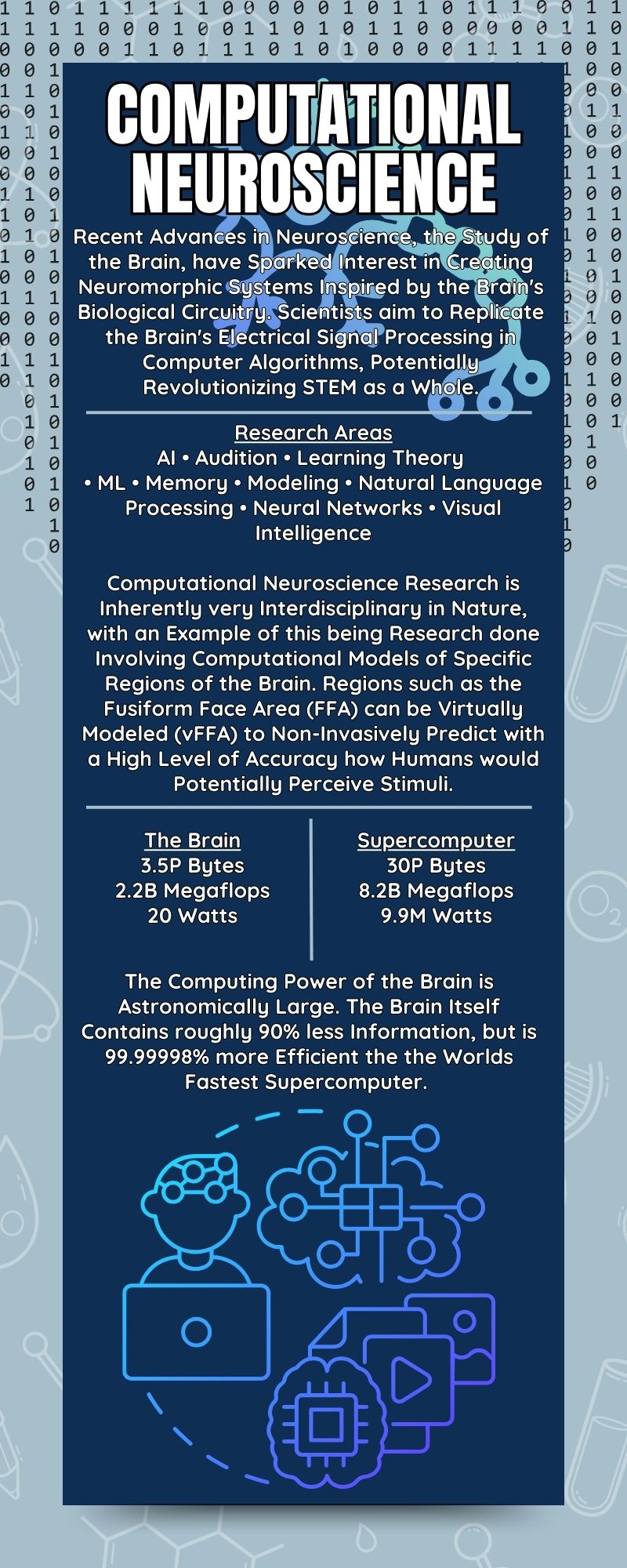
  • Computational Neuroscience Infographic


    References

    DiCarlo, J., Fedorenko, E., Fiete, I., Gosh, S., Harnett, M., Jazayeri, M., Kanwisher, N., McDermott, J., Poggio, T., Saxe, R., & Seethapathi, N. (2024, September 12). Computational neuroscience. MIT McGovern Institute. https://mcgovern.mit.edu/research-areas/computational-neuroscience/

    Michael Douglas, A., Vulisa Q, C., Vigneshwaran, J., Dineva, B., Tsai, Y.-L., de Planque, T., Opanga, P., Verena Rentschler, C., & Wang, J. (n.d.). Big Data: Computer vs. human brain: MS&E 238 blog. MSE 238 Blog Big data Computer vs Human Brain Comments. https://mse238blog.stanford.edu/2017/07/teun/big-data-computer-vs-human-brain/

    Murty, A. R. (n.d.). The murty lab: Georgia tech. MurtyLab. https://www.murtylab.com/

    U.S. Department of Health and Human Services. (n.d.). Infographic: Why do we study neuroscience?. Eunice Kennedy Shriver National Institute of Child Health and Human Development. https://www.nichd.nih.gov/newsroom/digital-media/infographics/neuroscience