Author: Hollie Blake

  • Ain’t No Sunshine When She’s Gone

    Frazer_Park_(Portland,_Oregon)Before I moved away from Florida I never realized how much I depended on good weather to motivate me.  I’d always believed that optimism and happiness came from within, but now I know this is only half true.  Moving to an area that gets less sunshine than from where you came from is a real downer.  Atlanta gets a relatively median amount of sunshine per year (compare Atlanta GA at ~217 days; Tampa FL at ~244 days; Seattle WA at ~164 days) but the pitiful winter here harbors few sunny days.  Gray skies can last for 3 days straight, the harsh cold wind is relentless, and February seems like the longest month of the year despite having the least amount of days.

    What bugs me most is that threatening clouds hover over the city for days but never DO ANYTHING.  At least in Florida when clouds come, they produce rain, thunder and lightning for an hour, then get the hell out and the ordeal is over.  But here, when the weather wants to be gloomy, it’s taking you down too.  It doesn’t help when my family, still in Florida, tells me they’ve taken the boat out every weekend since the beginning of February.

    It’s amazing how the weather can be a source of depression.  I’m sure you’ve heard of seasonal depression, which is technically called Seasonal Affective Disorder.  If you haven’t, it is a type of depression that occurs when bright light and sunshine is limited, most often during the winter months.  Sunshine is the obvious treatment for the disorder but just how effective is sunshine?  Especially when every dermatologist and health magazine advises you to block the sun?

    Studies have shown that the brain produces more of the natural antidepressant serotonin on sunny days than on darker days.  This is regardless of the season.  Not only are serotonin levels higher on bright days than on overcast ones, but the rate of serotonin production is directly related to the duration of bright sunlight.  No other atmospheric conditions are related to serotonin levels (article from WebMD Health News).

    When sunlight interacts with our skin, Vitamin D is produced through photochemical reactions.  Of course, prolonged UV exposure can be harmful for your skin, but some exposure is extremely beneficial.  (DO: Be active in sunlight when possible, with at least 25 SPF on.  DO NOT: Lay by the beach all day without lotion).  Vitamin D works together with calcium to build strong bones and maintain bone strength.   It also has a preventative effect for some cancers including colon, breast, ovarian and prostate.  A deficiency in Vitamin D is linked to these types of cancer as well as to depression, lowered immunity, osteoporosis, and arthritis.

    You might have been aware that sunshine was positive for you, but here are some fun facts that maybe you didn’t know:

    • According to Healthkicker, people tend to buy more lottery tickets on cloudy days because weather-induced bad moods deplete self control, making us vulnerable to temptation.  (Ladies, think Ben & Jerry’s ice cream pint intakes – were those ever on bright sunny days?)
    • People use more alcohol, coffee, tobacco and chocolate when there’s less sunshine because they feel the need to compensate artificially as means to elevating their mood.
    • Getting a daily dose of sunshine increases your number of white blood cells, which in turn enhances your immune system, stated by Natural Health Restored.
    • Sunshine encourages healthy circulation by also stimulating the production of red blood cells, which increases the amount of oxygen in your blood.
    • A study performed at the University of Michigan proved that sunshine is strongly correlated with daily stock returns.  Stocks traded on sunny days yielded nearly 25% more money than those traded during cloudy periods.  Psychologists attribute this to people’s tendency to view situations more optimistically when it’s sunny, and less likely to scrutinize an investment they might cast aside when feeling grumpy.

    March is only a few weeks away, which means warmer weather is coming.  Besides the fact that spring is my favorite season, I am SO excited to shed my layers of fuzzy clothes and to enjoy Atlanta’s parks again.  When the time comes, do yourself a favor and GET OUT of the library, frolic in the daylight like a fool high on Vitamin D and always wear some sunscreen!

    In the spirit of things: [soundcloud url=”http://api.soundcloud.com/tracks/44617965″ params=”” width=” 100%” height=”166″ iframe=”true” /]

    Photo by Maria Fiala courtesy of Creative Commons.

  • The Paleo Phenomenon

    It seems like every other day, a friend of mine declares a newfound dedication to the Paleo Diet.  Nicknamed the “Caveman Diet,” Paleo is this season’s slimmer, fitter (but just as raw) Atkins diet.  I first learned about the elusive Paleo from my dedicated Cross-Fitter friend after asking her for an afternoon snack.  I fully expected some Goldfish or hummus-like options but my friend looked carefully in her fridge and gave me a choice between freshly-watered lettuce or coconut flakes.  Apparently my disturbed look alluded to what I was thinking (when did you start hating your taste buds?) because she then confessed to me that she started this Paleo Diet.  She explained how she stopped eating bread, to which I replied “Dear God,” and went on to describe her new enlightened Paleo lifestyle.

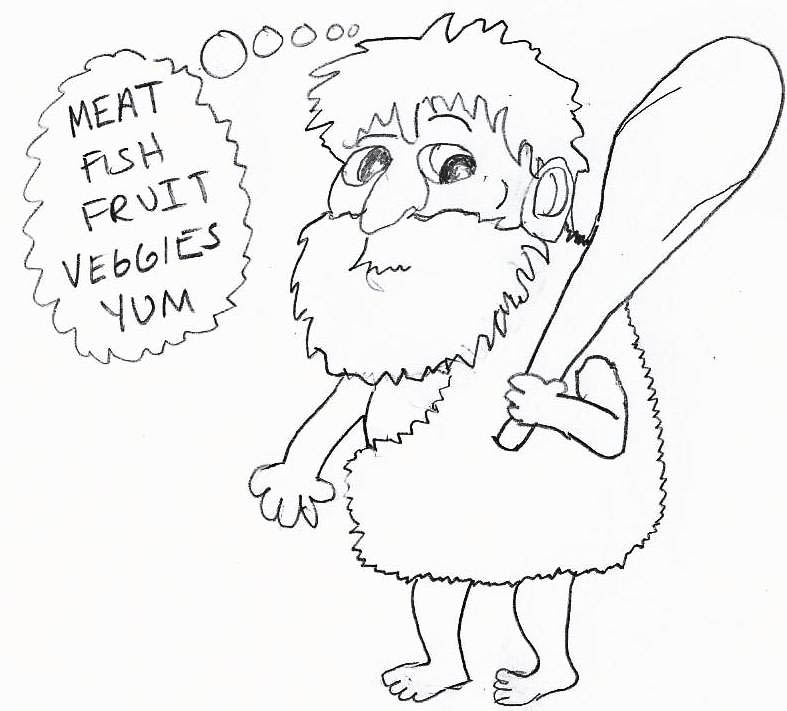
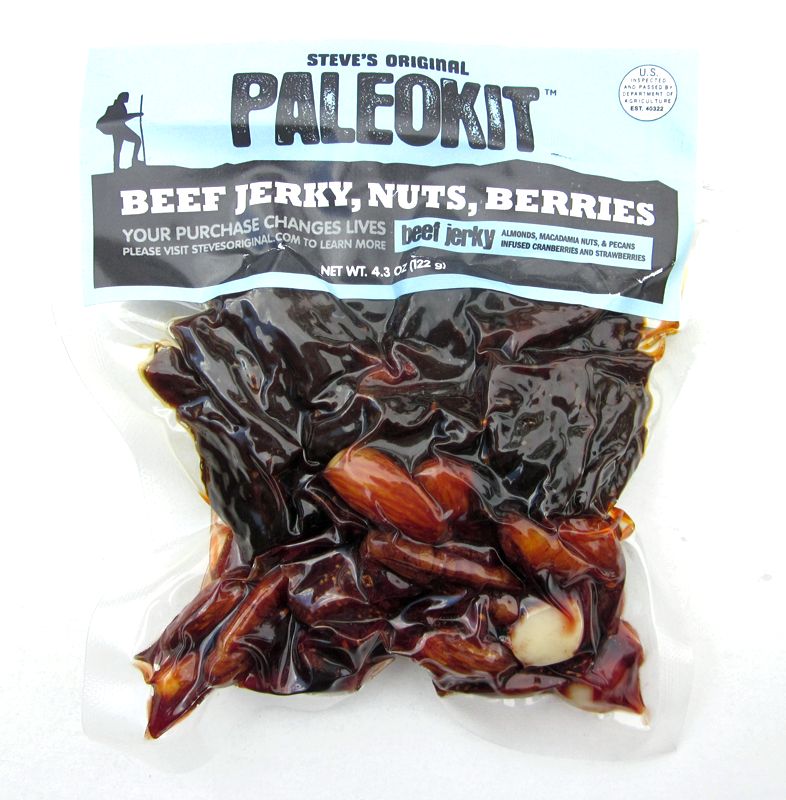
    The Paleo diet theoretically takes us back to our ‘caveman’ days when we hunted rodents with rocks and scurried for nuts and berries.  Protein heavy; processed foods are out of the question; dairy is for infants; and sugar is the devil.  I’m not sure how the Paleo people know this, but apparently cavemen never ate any grains whatsoever, so neither can my friend now.  She carries wild canned tuna in her purse, munches on dried jerky meat from a bag fit for an astronaut (right picture), and mumbles about bacon all the time.

    Shocked at the idea that someone couldn’t indulge in croissants, muffins, or baguettes with chunks of melted brie, I left my friend’s place horrified.  I thought of the possibility that lobbyists for the meat industry were behind the whole conspiracy and hated wheat with a passion.  I needed to find out for myself.  What’s the health benefit behind this fad? Is there any?  How has this pandemic spread to several of my friends already?  Will my love of carbs be strong enough to fight the Paleo takeover?

    The premise behind the ‘Paleolithic’ eating is that humans should only eat what we’ve been genetically adapted for.  For 2.5 million years, the length of the Paleolithic Era, our human ancestors were just a bunch of fit muscular naked hunters-and-gatherers.  Human diets changed 10,000 years ago when agriculture was developed, but our 2.5-million-year-old genetics did not change the way we digested food.  Proponents of Paleo blame ‘Industrial Era’ food such as beans, dairy, alcohol and salt for obesity, cardiovascular disease, cancer, diabetes and high blood pressure.  However, I could not find any known cardiovascular benefits to becoming caveman again.  There IS an increased risk of higher cholesterol because of the increased meat intake, so Paleo might not be a good idea if you have high cholesterol already.

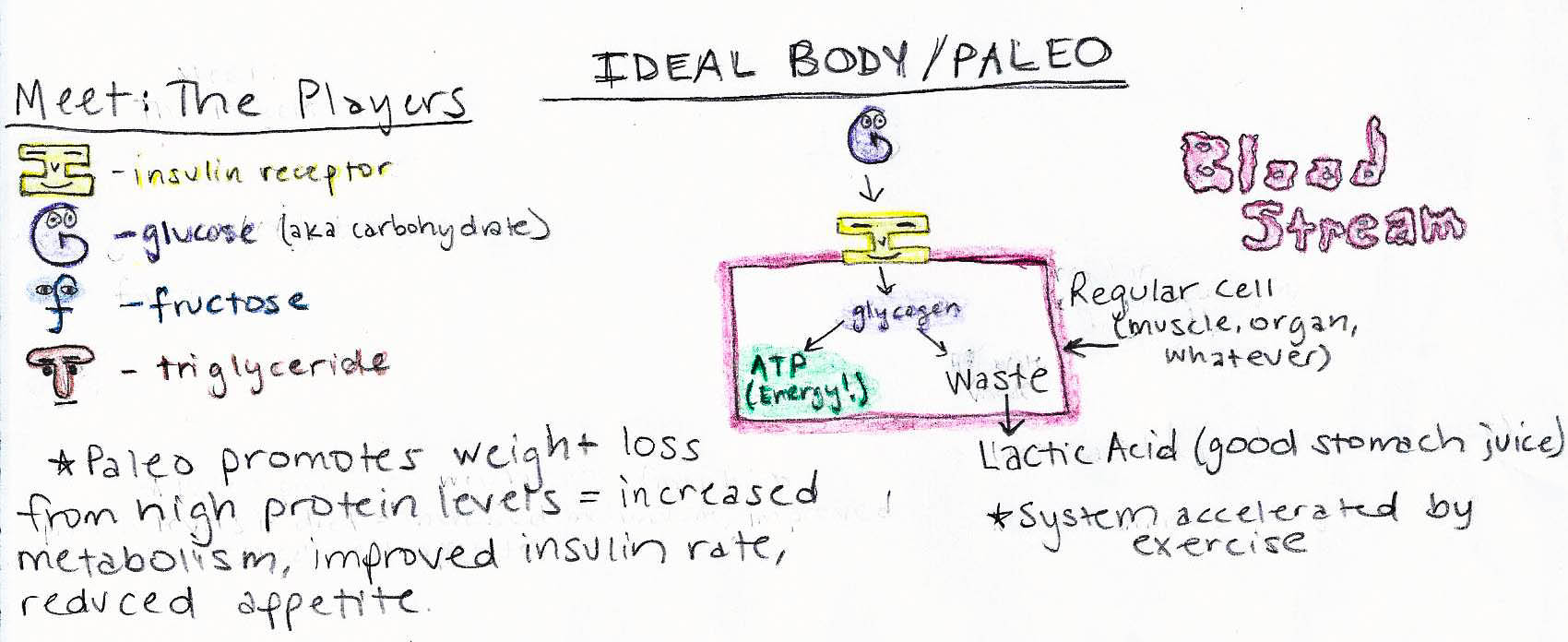
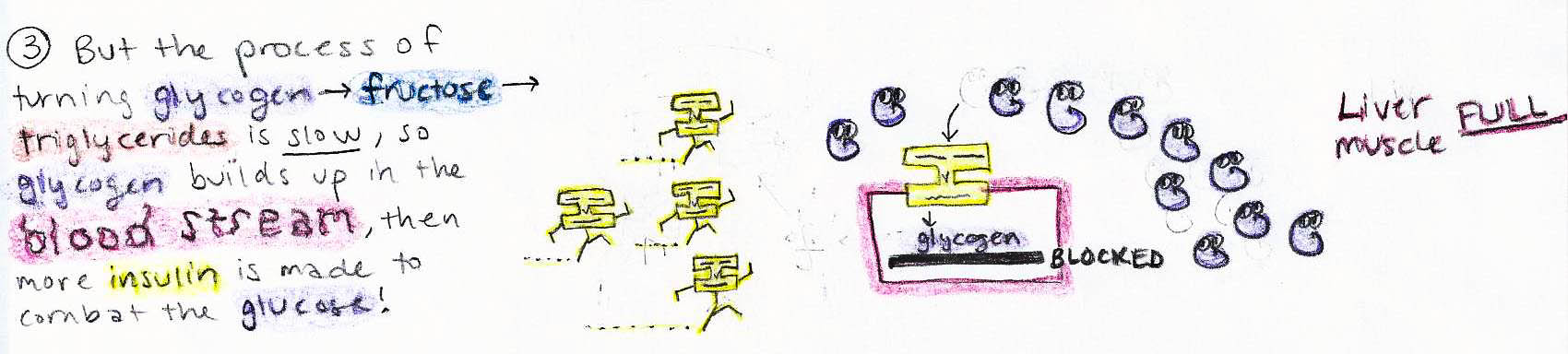
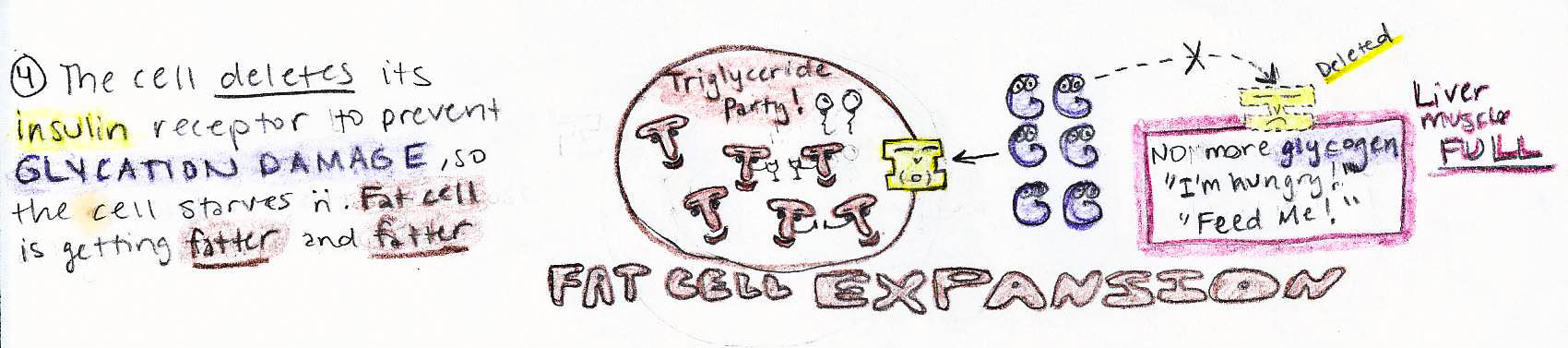
    Paleo basically hates carbohydrates.  They attribute carbohydrates to high blood sugar, insulin resistance and eventual morbid obesity.  Doug McGuff, MD and proponent of the Paleo diet, broke it down like this (with perhaps a few more sophisticated explanations):

    Paleo says that in this metabolic state, consuming high fructose corn syrup, sugar, or fructose of any kind will amplify these effects.  The only way to reverse this is with high intensity exercise.

    In theory, I’d say this Paleo diet sounds good.  But all diets sound good in theory until you’re hungry.  Examples- a few of my Paleo zombie comrades have cheated on a few occasions which they don’t want to admit.  They’ll crave a banana nut muffin all week and allow a bite on an upcoming weekend.  The pizza or cookie monster inside of them might emerge at 3 AM on a Saturday night.  They’ve also ordered light spring salads at dinner only to reach for my deep-fried chicken finger basket after they’ve digested their lettuce in 4 minutes flat.  This worries me.  I do have to say, my friends look extremely fit and healthy, and probably the best looking I’ve seen them in the last 6 years I’ve known them.  So something is working.  It could be the strenuous Cross-Fit workouts though.

    I’m very cautious about new hip diets so even after my research I was still not convinced I could get on board with the I-HATE CARBS Movement Paleo diet.  I needed to do some field research.  Meandering through the bookstore, I came across a Paleo Recipe Book and immediately started perusing through the pages.  The recipes looked pretty delicious so I snapped 18 pictures from my iPhone when no one was looking (don’t judge, I’m on school loans) and dashed from the aisle like a bandit.  I thought cooking one of the recipes would really make up my mind.

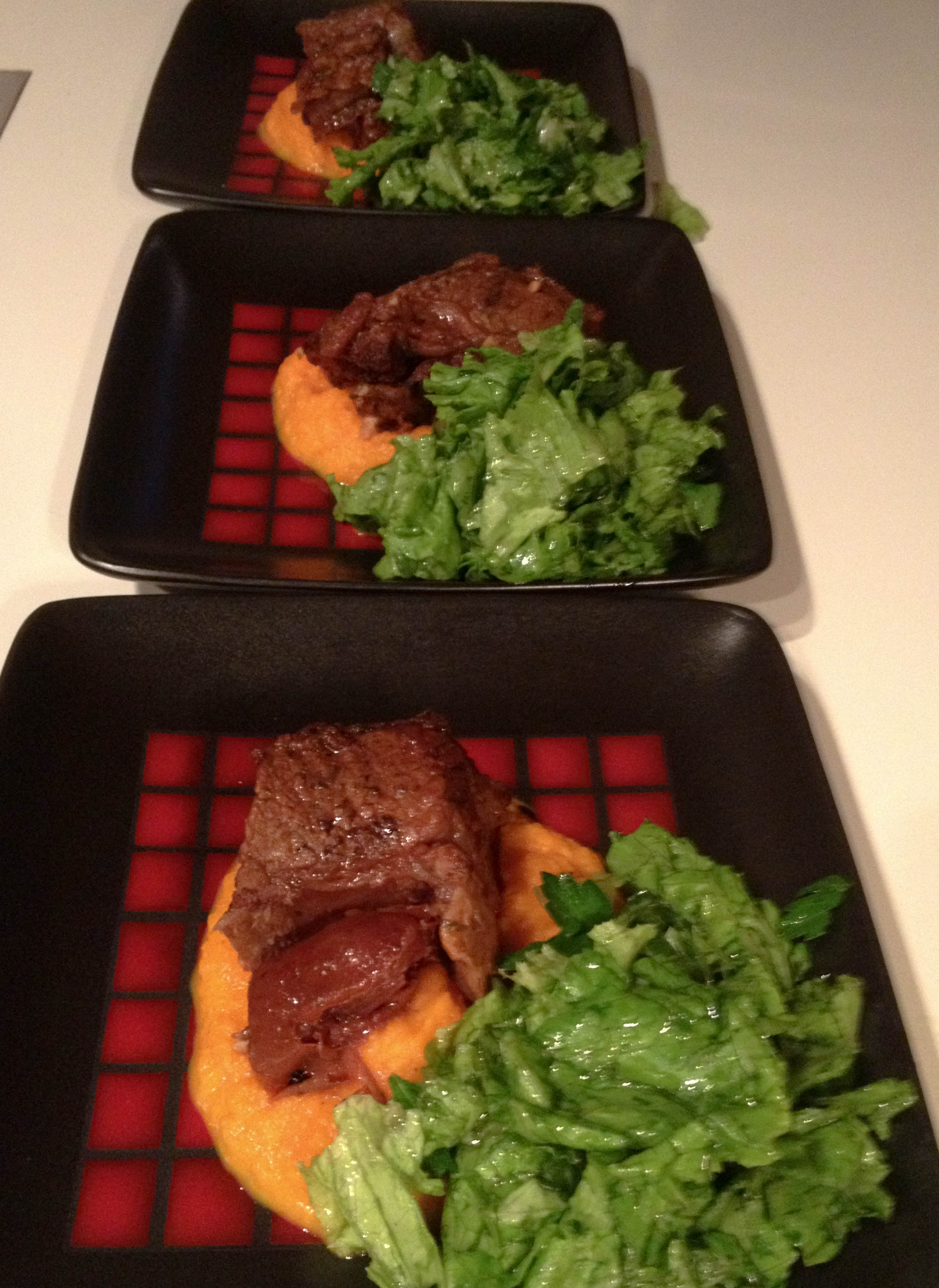
    I decided to conjure up some balsamic braised short ribs with a carrot puree and frisee parsley salad.  I wasn’t sure what to expect but, I have to say, it was damn good (pictured right).  I started to think maybe I could ‘have Paleo and eat it too’….but only on Sundays, and with friends who could split the grocery cost with me.

    All in all, I might consider going temporarily Paleo if I want to shed a few pounds but I’m gonna stick to my own health theory which is ‘everything in moderation.’  I don’t know about you, but I can’t get used to having my milk and cookies without either milk or cookies.  Plus diets that completely eliminate certain food groups are difficult to follow and can get very pricey.  If anything, I believe cutting red meats or the Weight Watchers diet are the best ways to go.  What diet could you get on board with?

  • Tap That

    Conservation is not a commonly exercised word for most Americans.  A booming economy once offered us blissful ignorance from contributing our share of frugality and it prevented us from joining the rest of the world in maintaining a conscience.  However, as vital resources such as freshwater diminish and global population continues to propagate, Americans should begin to choose conservation despite the fact that most financially don’t need to.

    Drinking water is already a precious resource in some countries and climate change will only increase pressure on freshwater supplies1.  The city of Delhi is short on water supply this summer by about 50 million gallons2; children in sub-Sahara Africa drink out of waterholes where animals bathe in from lack of any other water3; and the UN reports that a third of the world’s population is enduring some form of water scarcity4.  Considering other looming water wars across the globe, it seems immoral of us to purchase a plastic water bottle that takes 3 times as much freshwater to produce than what’s in the actual bottle5.  Now more than ever, every drop counts.

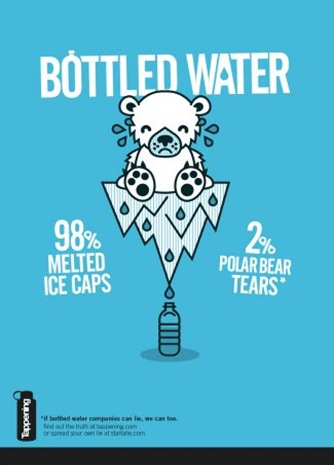
    The bottled water industry, although perhaps not the most environmentally hazardous industry in our country, is one of the cleverest for it seems to have duped us all. It made a $10.6 billion profit in 20106 on something we can all attain for free.  It has managed to “manufacture a demand for water as a commodity to be bought and sold for profit,” stated Gigi Kellet5, director of the Think Outside the Bottle Campaign, by costing consumers $1,400 per year for eight glasses a day versus the $0.49 per year that eight glasses of tap water a day would cost7.

    Not only are bottled waters sneakily detrimental to bank accounts, their production uses 17 million barrels of oil annually – enough to fill one million cars for a year7.  Extracting water for bottling places strain on flows to natural rivers, streams, springs, as well as ecosystems and groundwater levels5.  Also account for the fact that plastic takes hundreds of years to decompose and only 13% of the 29 billion purchased water bottles annually are recycled8, and one might ponder choosing tap water over bottled.

    Most Americans are aware of the world’s water crisis and the environmental consequences of consuming plastic-encased water, yet some still adamantly refuse to drink anything but bottled water.  The largest misapprehension for most people is that bottled water is cleaner than tap water.  Consider though that the bottled water industry spends tens of millions of dollars a year ($162.8 million in 20065) advertising their pristine water sources, falsely leading consumers to believe that it must, in fact, be cleaner than tap.

    The fact of the matter is, 47.8% of all bottled water is derived from tap water9, including Glaceau SmartWater, Nestle Pure Life, Alaska Premium Glacier and Yosemite10.  Pepsi was forced to change their Aquafina label in 2007 to accurately describe that their source came from a public water system11.  Coca Cola’s Dasani is also derived from a municipal source.  In 2003, Nestle’s Poland Spring was sued for false advertising in a class action lawsuit charging that their water, which supposedly came from springs, was actually just heavily treated ground water12.  The suit also stated that another Nestle source “stands over a former trash and refuse dump, and below an illegal disposal site where human sewage was sprayed as fertilizer for many years.”

    The Natural Resources Defense Council (NRDC) reports that the source for Spring Water, the bottle with a picture of a lake surrounded by mountains on the label, was from an industrial parking lot next to a hazardous waste site.  Brands such as Artic Falls Bottled, Glacier Mountain Bottled, and Everest are all bottled in New Jersey, Ohio and Texas, respectively10.

    Not only does bottled and tap water generally come from the same place, the municipal water board purifies these sources more than the bottle manufacturers.  Regulated by two different agencies, the Environmental Protection Agency (EPA) requires more stringent testing and purity standards for tap water13 than the Food and Drug Administration (FDA) does to bottled water.  In fact, bottled water rules actually allow for some contamination by E. Coli or fecal coliform while tap water rules prohibit any contamination.  There are also no requirements for bottled water to be disinfected or tested for parasites, unlike the rules for big city tap water systems.13

    Several cases have been made for contamination in bottled water, including carcinogenic chemicals.  The NRDC tested 103 bottled waters in 1999 and concluded that 4% of the bottles violated the excessive coliform bacteria standard, 21 bottles contained more bacteria than allowed, and 8 bottles had levels of arsenic that tested at a level of potential health concern.13

    According to the Environmental Working Group (EWG), lab tests for Walmart’s Sam’s Choice brand conducted in 2008 found bromodichloromethane, a cancer-causing chemical, at levels that exceed safety standards under California’s Safe Drinking Water and Toxic Enforcement Act of 1986.  The analyses conducted by the University of Iowa Hygienic Laboratory revealed disinfection byproducts, pharmaceuticals, heavy metals including arsenic and radioactive isotopes, fertilizer residue (nitrate and ammonia), plasticizers, and propellants within 10 popular water bottle brands they tested, reported EWG.

    The FDA’s seemingly negligent rules are completely exempt for waters that are packaged and sold within the same state, which account for 60-70% of all bottled water sold in the United States13.  If the product is declared on the bottle simply as “water,” “carbonated water,” “filtered water,” “seltzer water,” “sparkling water,” or “tonic water,” then it is not considered drinking water by the FDA and their quality standards are not required for these labels.13

    On a side note, the vice president for communications of the International Bottled Water Association (IBWA) is Tom Lauria, the former lobbyist for the tobacco industry.  EWG points out that he “has had extensive experience distorting the facts and misleading consumers in an attempt to hide the truth about the industry that pays his salary.”  The man who once denied that smoking was addictive14 is now communicating that bottled water is a beacon of health.  Do you see the parallels?

    Others argue that bottled water is just more convenient than tap water.  Sadly, we have come to confuse a plastic bottle’s disposability with “convenience” but there’s nothing more “convenient” than clean EPA-regulated free water running from your kitchen faucet.  Is the issue an unwillingness to stand at the sink with a reusable bottle for 10 seconds?  Bottles such as Hydros come equipped with a filter so that you don’t even have to pour from a Brita filter pitcher anymore.  Being on-the-go is not a noteworthy excuse either since there are public sources in every park, school, office, and stadium in the United States.

    Although taste is highly subjective, arguments were also made that bottled water tasted better than tap water.  Consumer’s tastes have been shaped by cunning marketing and the erroneous belief that bottled water is healthier than tap water.  However, in taste test after taste test, people can’t tell the difference between the two.  The University of Maryland’s Student Government Association (SGA) conducted a taste test between tap water and Pepsi’s Aquafina, their school’s official bottled water, and found that twice as many students preferred tap over bottled15.  The hosts of Showtime’s television series Penn & Teller: Bullshit conducted a blind taste test comparing waters that showed 75% of New Yorkers preferred city tap water to bottled waters16.  The hosts of the show conducted another test where a sommelier handed out water menus with $7 bottles of “L’eau du Robinet” (French for “tap water”), “Agua de Culo” (Spanish for “ass water”), and “Amazone” (“filtered through the Brazilian rainforest’s natural filtration system”) on them.  The patrons had no idea that all of the extravagant bottles were filled with the same water from a hose in the back of the restaurant.

    In the end, tap water tastes the same as bottled water, is more convenient, is less expensive (about 500 times less expensive17), and is purer than bottled water.   Over 50 universities across North America have joined the Ban the Bottle movement that seeks to eliminate plastic water bottles from campuses.  These campuses have recognized our country’s unspoken responsibility, a responsibly that comes with affluence and the ability to set precedents for other prosperous countries.   They’ve recognized that we need to start conserving whatever we can because we share the world’s resources with 9 billion other people.  They’ve recognized that corporation’s privatization of water has lethal consequences for those less fortunate than us and that tap water is the environmentally noble choice.  It’s time for everyone else to opt for tap water too.


    Image courtesy of Tappening.com


    1  Kundzewicz, Z.W., L.J. Mata, N.W. Arnell, P. Döll, P. Kabat, B. Jiménez, K.A. Miller, T. Oki, Z. Sen and I.A. Shiklomanov, 2007: Freshwater resources and their management. Climate Change 2007: Impacts, Adaptation and Vulnerability. Contribution of Working Group II to the Fourth Assessment Report of the Intergovernmental Panel on Climate Change, M.L. Parry, O.F. Canziani, J.P. Palutikof, P.J. van der Linden and C.E. Hanson, Eds., Cambridge University Press, Cambridge, UK, 173-210.

    2  “Delhi Water Crisis to Worsen.” Gulf News. Al Nisr, 21 June 2012. Web. 31 July 2012. <http://gulfnews.com/news/world/india/delhi-water-crisis-to-worsen-1.1038737>.

    3  “New Straw to Kill Disease as You Drink.” BBC News. BBC, 04 Apr. 2006. Web. 01 Aug. 2012. <http://news.bbc.co.uk/2/hi/africa/4967452.stm>.

    4  “The Global Water Crisis.” UN News Center. UN, n.d. Web. 31 July 2012. <http://www.un.org/works/sub2.asp?lang=en>.

    5  Gies, Erica. “Rising Sales of Bottled Water Trigger Strong Reaction from U.S. Conservationists.” NYTimes.com. The New York Times, 19 Mar. 2008. Web. 31 July 2012. <http://www.nytimes.com/2008/03/19/business/worldbusiness/19iht-rbogbottle.html?_r=1>.

    6  Burnham, Ted. “Battling The Bottle: Students And Industry Face Off Over Water.” NPR. NPR, 12 Feb. 2012. Web. 31 July 2012. <http://www.npr.org/blogs/thesalt/2012/02/12/146692656/battling-the-bottle-students-and-industry-face-off-over-water>.

    7  Bosque, Tomas. “7 Bottled Water Myths Busted.” Ban the Bottle. N.p., 1 Mar. 2012. Web. 01 Aug. 2012. <http://www.banthebottle.net/articles/7-bottled-water-myths-busted/>.

    8  Didier, Suzanna. “Water Bottle Pollution Facts.” Green Living on National Geographic. National Geographic, n.d. Web. 01 Aug. 2012. <http://greenliving.nationalgeographic.com/water-bottle-pollution-2947.html>.

    9  Shapley, Dan. “Almost Half of All Bottled Water Comes from the Tap, but Costs You Much More.” The Daily Green. Hearst Communications, Inc., 12 Aug. 2010. Web. 01 Aug. 2012. <http://www.thedailygreen.com/environmental-news/latest/bottled-water-47091001>.

    10  “6 Types of Bottled Water You Are Drinking.” Reader’s Digest. N.p., Aug. 2011. Web. 01 Aug. 2012. <http://www.rd.com/health/wellness/6-types-of-bottled-water-you-are-drinking/>.

    11  “Aquafina Labels to Spell out Source – Tap Water.” CNN. Reuters, 27 July 2007. Web. 01 Aug. 2012. <http://www.cnn.com/2007/HEALTH/07/27/pepsico.aquafina.reut/>.

    12  “Nestle Sued for Falsely Advertising Poland Spring Water.” Water & Wastes Digest Magazine. Scranton Gillette Communications, n.d. Web. 01 Aug. 2012. <http://www.wwdmag.com/nestle-sued-falsely-advertising-poland-spring-water>.

    13  “Bottled Water.” Natural Resources Defense Council. N.p., 25 Sept. 2000. Web. 01 Aug. 2012. <http://www.nrdc.org/water/drinking/bw/chap4.asp>.

    14  Landman, Anne. “Lauria Quit Cigarettes, But Now He’s on the Bottle.” PR Watch. Center for Media and Democracy, 3 Sept. 2010. Web. 02 Aug. 2012. <http://www.prwatch.org/node/9415>.

    15  Saravia, Claire. “Bottled Water Loses to Tap in Taste Test.” Diamondback Online. The Diamondback, 10 Nov. 2010. Web. 01 Aug. 2012. <http://www.diamondbackonline.com/news/bottled-water-loses-to-tap-in-taste-test-1.1770525>.

    16  The Truth About Bottled Water. Perf. Penn and Teller. YouTube. Showtime Television, 28 Feb. 2009. Web. 01 Aug. 2012. <http://www.youtube.com/watch?v=JdvJOF-2mm0>.

    17  Derbyshire, David. “Tap Water as Healthy and Far Cheaper than Bottled, Says Watchdog.” The Telegraph. Telegraph Media Group Limited, 29 June 2006. Web. 1 Aug. 2012. <http://www.telegraph.co.uk/news/uknews/1522617/Tap-water-as-healthy-and-far-cheaper-than-bottled-says-watchdog.html>.

  • Earth Day Festival Turns A Gray Day Green

    Earth Day Festival Turns A Gray Day Green

    In 1970, 100,000 people gathered in Washington DC to protest the Vietnam War.  The deaths of Jimi Hendrix and Janis Joplin that year had fatally deglamorized the hippie lifestyle.  Smog-darkened skies were accepted as a byproduct of prosperity.  Environmental concerns had never been at the forefront of serious discussion.  It was Wisconsin senator Gaylord Nelson who first proposed a “national teach-in” on the environment to take place at every university campus in the US.  What better way to ignite a grassroots-led movement than to take advantage of the existing energy from anti-war protests?  The poignant events of 1970 awakened an emerging consciousness on which Earth Day was able to capitalize.  Consequently, 20 million Americans participated in the first Earth Day, and thousands of colleges protested against the deterioration of the environment.

    Forty-two years later, new generations are still helping to make Earth Day a huge international event.  Although the subject of most concern has shifted from local toxic pollution to the complexities of climate change, Earth Day continues to stress the importance of a sustainable society.

    This year at Georgia Tech’s 15th Annual Earth Day celebration the opportunity to unite our voices for a sustainable future was palpable.  Events were designed to encourage environmentally aware behaviors such as recycling, energy efficiency, and reducing disposable items.  The event featured a car exhibit, a green market, a clothes swap, an E-waste drop-off, free bike repair stations, Captain Planet, Reynard the Fox, a stage, and 70 exhibitors all on one sidewalk.

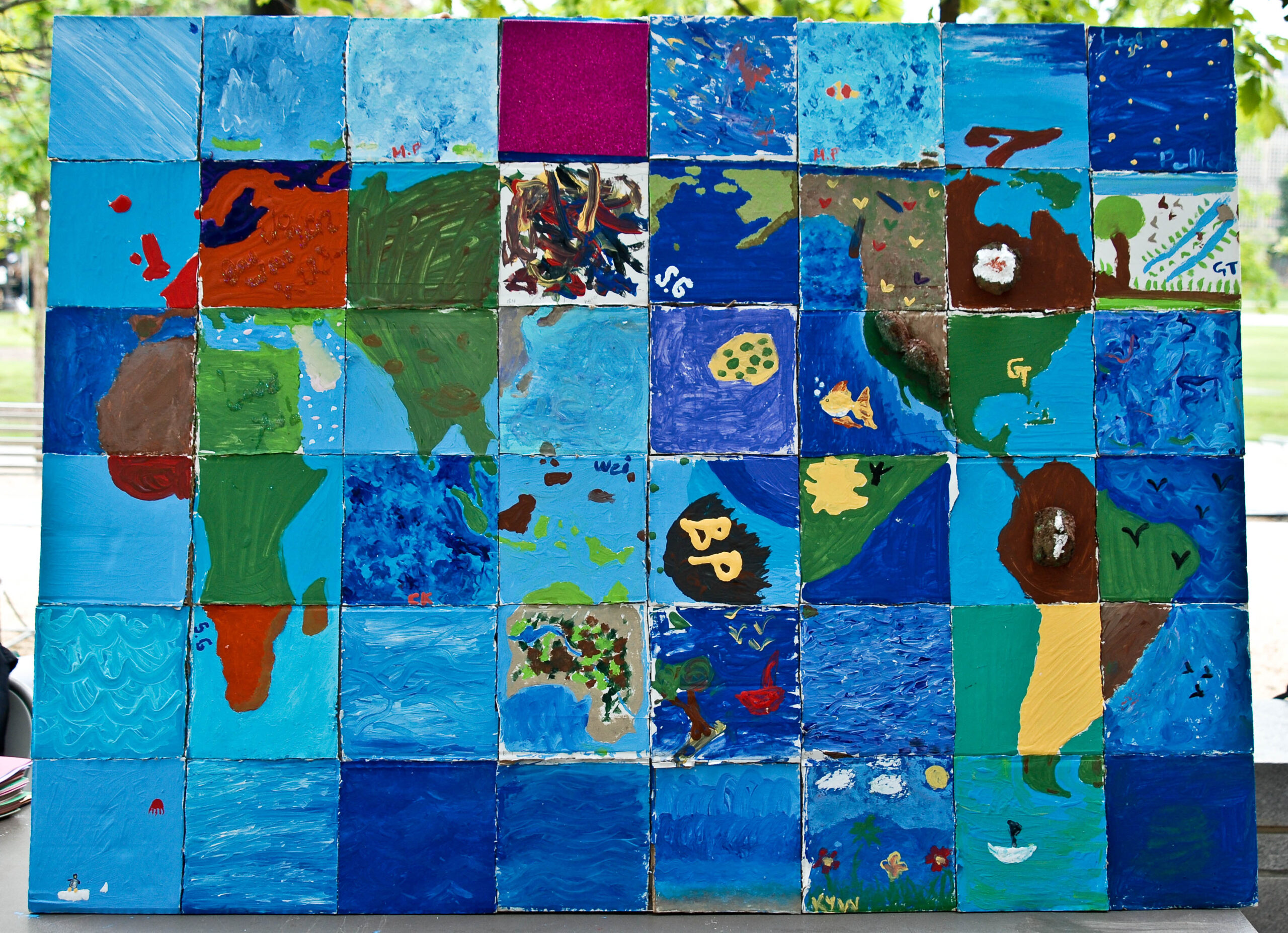
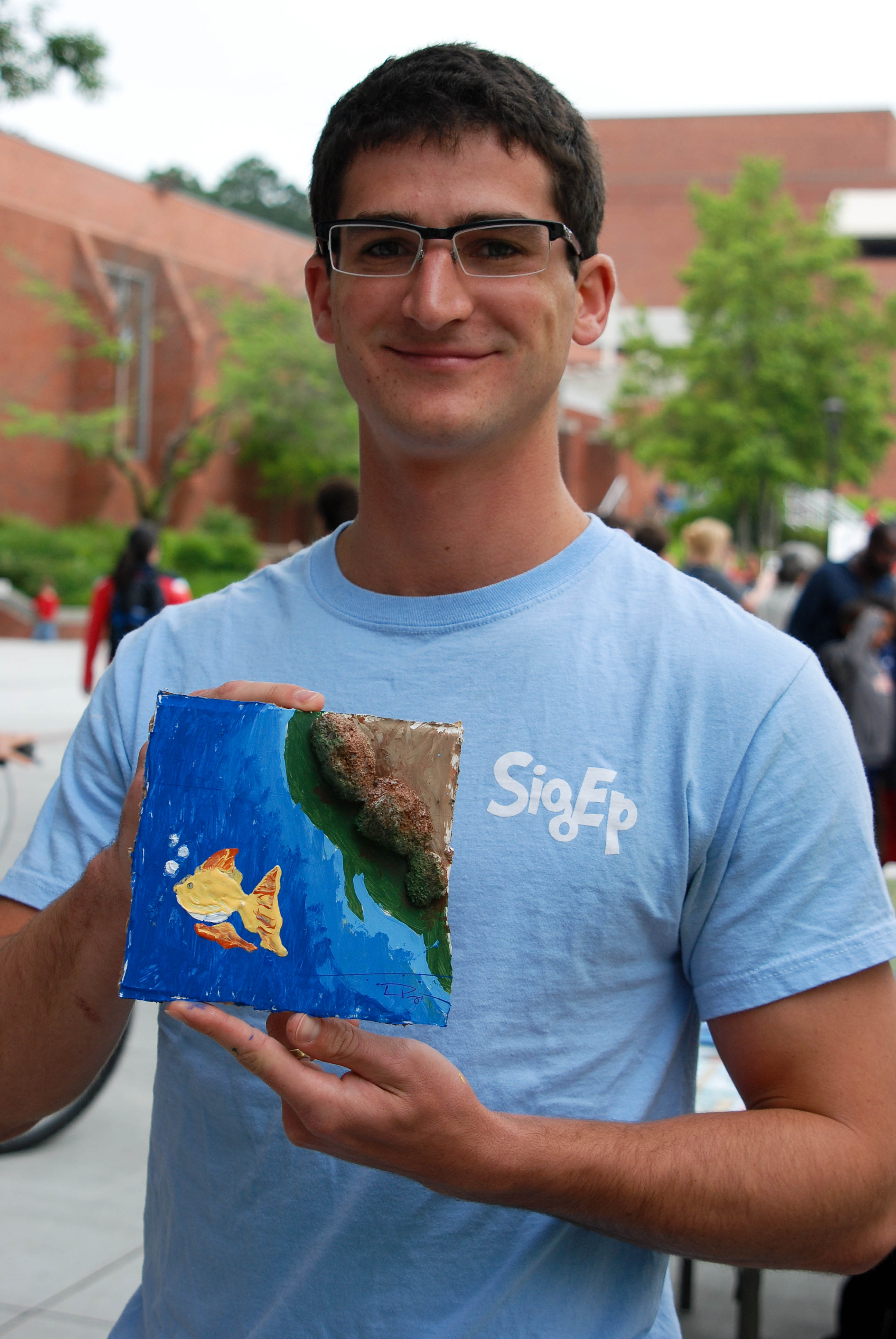
    Most of Earth Day, I volunteered with the Engineers Without Borders (EWB) booth where participants had the opportunity to paint a recycled cardboard tile, with labels “land” or “water” or both, so that when all tiles were pasted together, a map of the world emerged.  The message?  “EWB wants to highlight the interconnectedness of our environment, our world and the importance of sustainability.  Our goal at EWB is to help people on an international level to become more sustainable,” said EWB president Hannah Kates.

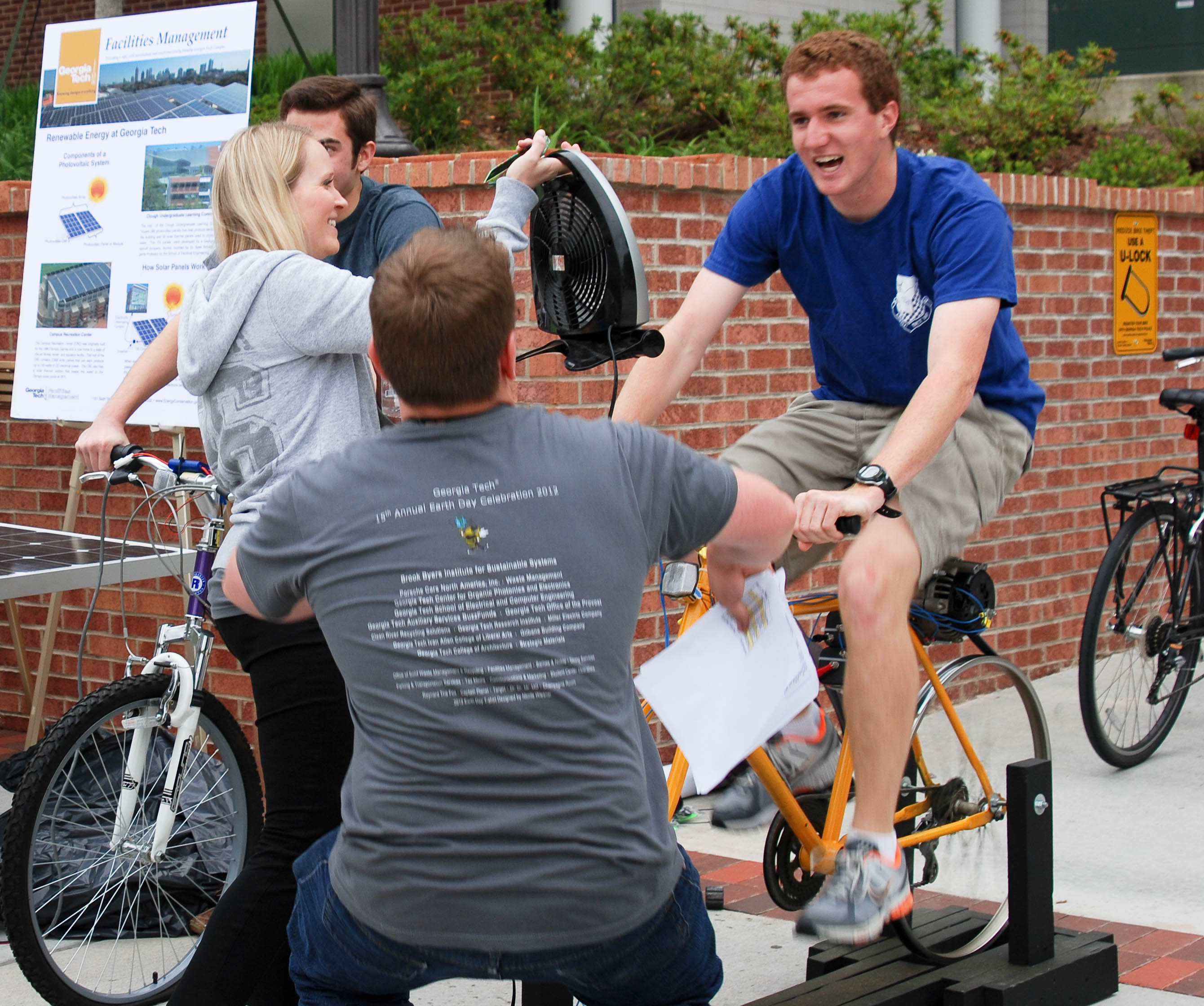
    An Earth Day-goer for the last few years, Janna San Juan noted, “Earth Day seems like it’s growing every year.  It gets people excited and reinforces the idea of being green.”  She was looking forward to trying the ‘Renewable Energy Challenge’ where participants could race against a solar panel on a stationary bike to generate energy.  They could light a bulb or fan themselves, such as the person in this image chose to do.

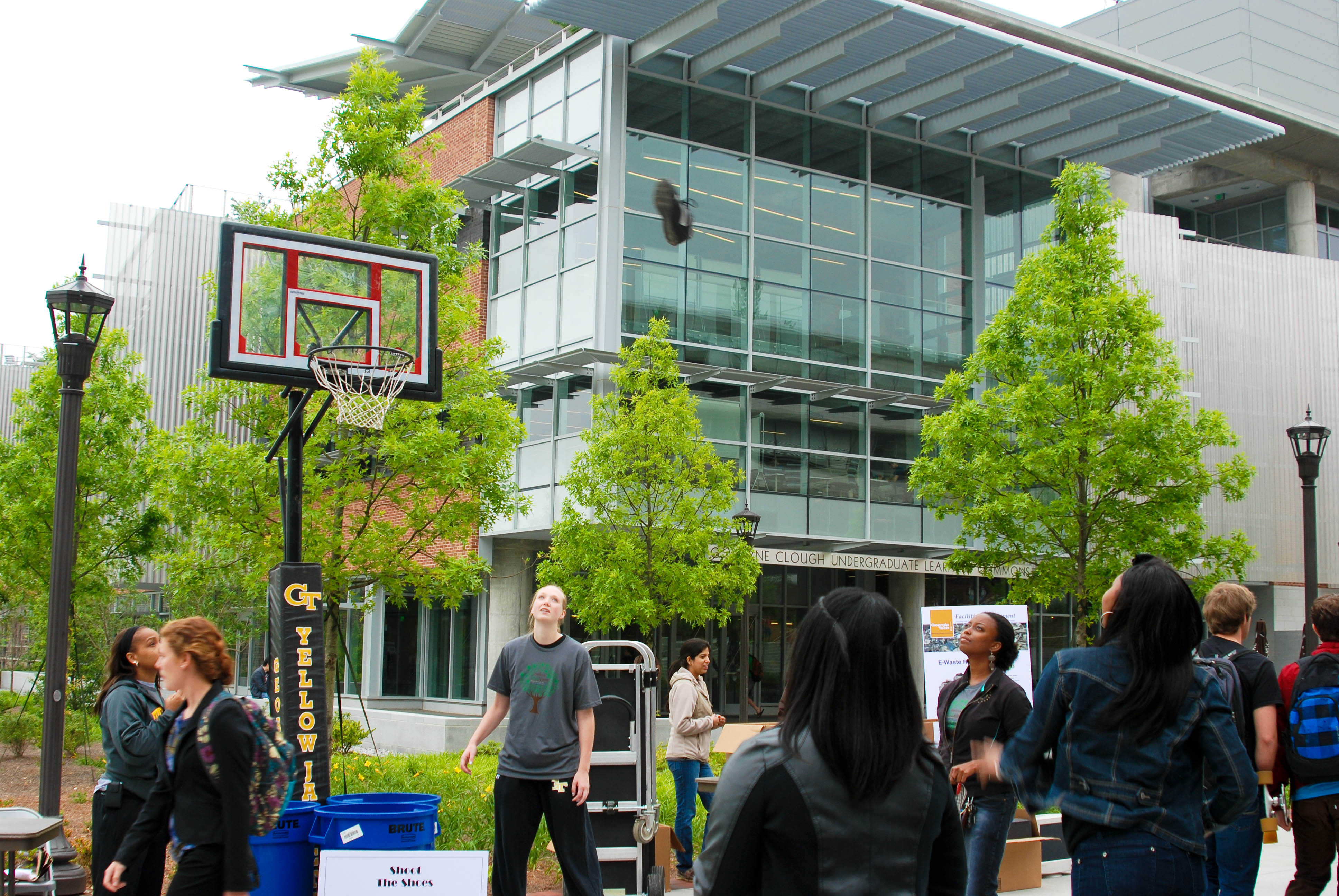
    Shoes flying through the air soon caught my attention.  The ‘Shoot the Shoe’ booth was run by the women’s basketball team, where participants had the opportunity to throw an old tennis shoe through a basketball hoop.  Earth Day committee member, Luke Chambers, who was promoting the booth in collaboration with Nike’s Reuse-A-Shoe program said, “Nike’s shoe recycle program reduces the need for new rubber and other materials which decreases environmental impact.  Our goal is to collect 500 pairs of worn-out tennis shoes.”  He also went on to tell me that $10,500 worth of reusable office supplies were donated for the ‘Office Supply Exchange’ event where students could shop for free.

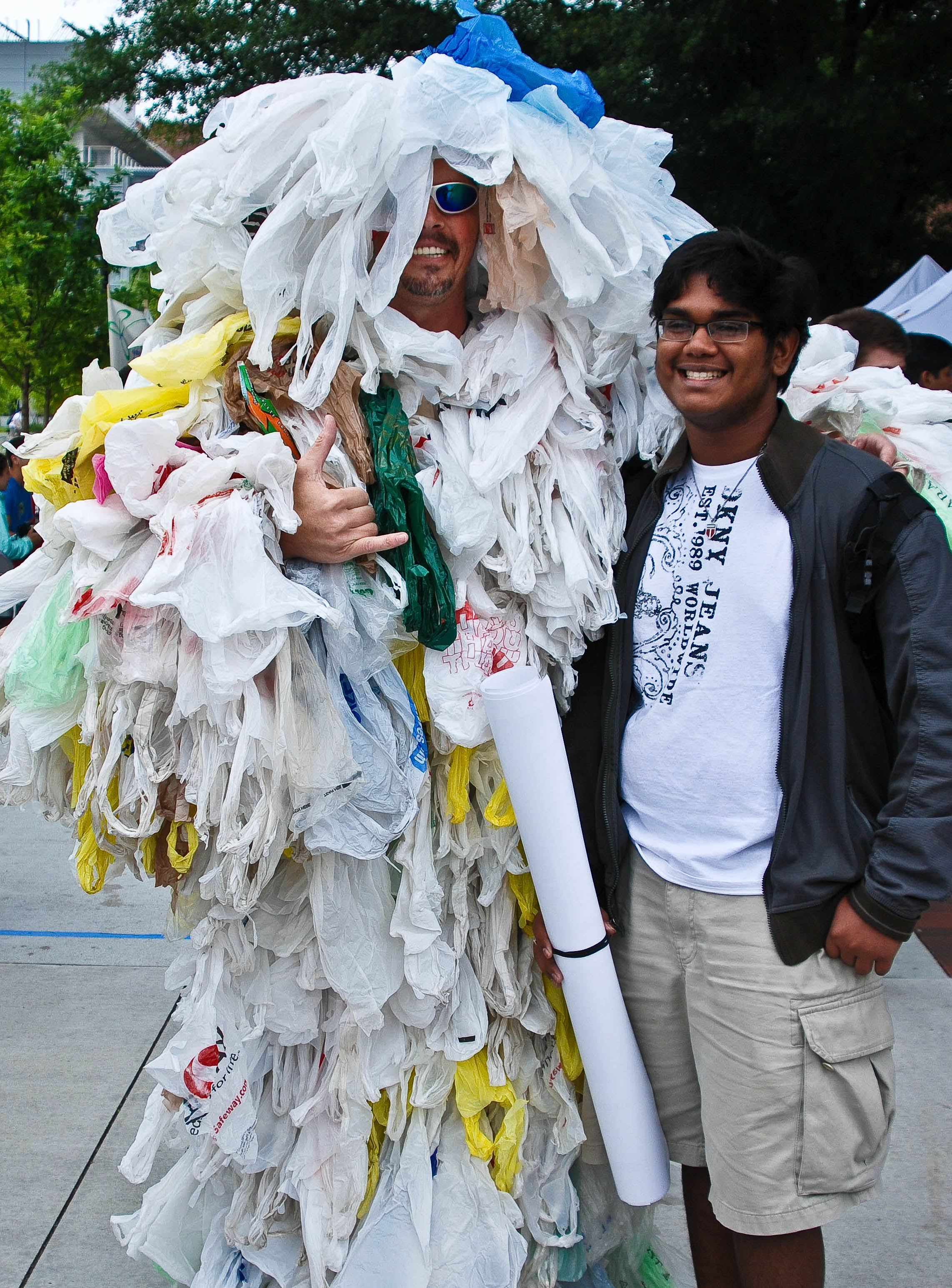
    Before I could walk anywhere else, I was accosted by what could only be described as the Abominable Plastic Bag Man.  One More Generation, the non-profit organization founded by two elementary school students, was at Earth Day to raise awareness about Americans’ plastic bag use.  Fittingly, their “Plastic Bag Monster” donned 500 bags, the average person’s yearly usage and, hopefully, scared many others into purchasing reusable grocery bags.


    Like a child at a carnival, I let my senses lead the way at this event, so I ended up next in front of the live music.  This anomaly of a band, appearing in swing attire while at one point dishing out Spoon’s punk rock song “I Turn My Camera On,” attracted a large crowd with their energetic dancing and old school vibes.  Champagne Room lead singer Jared McGrath announced to the audience in between songs, “My favorite thing that comes from this Earth would have to be… beer.”  Cheers to that.


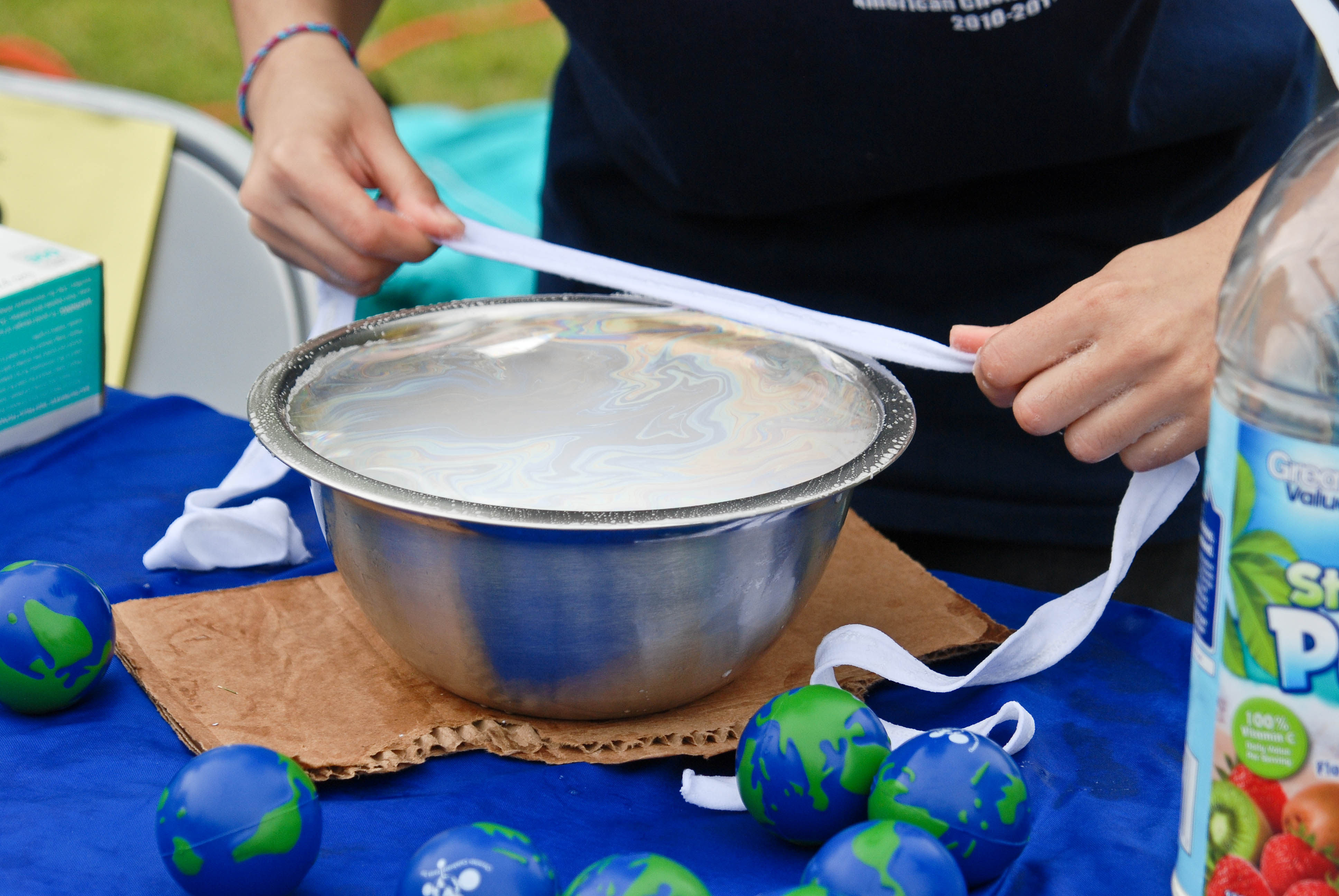
    After taking dozens of photos of the self-proclaimed “Southern Fried Swing Punk” band, I turned around to find another simple sensory boost.  Dry ice!  It was the American Chemical Society giving out cups of cold smoking punch.  They really sealed the deal with some bubble action.  By filling a bowl with a block of dry ice and running soapy water over the top, they created a ‘CO2 bubble’ which eventually erupted into a cloud of fog.  The kids, myself included, loved it.

    Free T-shirts were available for a very small labor fee.  You could collect your olive green “Helluva GREENgineer” shirt by participating in the ‘deconstructed’ maze.  Four eco-trivia stations were distributed throughout the event representing earth, wind, fire, and water.  Participants collected a stamp at each booth by answering the trivia question correctly, and four stamps got you the 100% organic cotton t-shirt.  “We’ve already given out about 150 stamps,” Marcela Moreno, a volunteer at the wind booth, informed me two hours into the event.  I quickly decided to take advantage of this freebie and ran to each station before the event ran out of shirts.

    Near the end of the event, I went back to the EWB booth where all the tiles had been painted.  As I helped paste the painted world back together again, I couldn’t help but think about all of the strides that have been made since the first Earth Day in 1970.  The development of the EPA, the Clean Water Act, the Clean Air Act, necessary laws that were formed because of the grassroots effort behind an unsettled generation.  I then noticed that someone had painted a new continent in the middle of our Pacific Ocean, and someone else had painted trees and flowers in our Antarctica.  Clearly, we still have a lot to work on, but with a united society and events like Earth Day, we can still continue to make large strides to save our environment.


  • Let’s Get Physical – a pumpin’ playlist to get you moving

    Let’s Get Physical – a pumpin’ playlist to get you moving

    Picture a typical 1985 aerobic dancersize class at the local YMCA.  Bright spandex, side pony-tails, colored leg warmers, metallic leotards.  Lots of makeup, minimal sweat and sex appeal were the 80’s requirements for a good work out.  Gym culture has evolved since the Era of Questionable Fashion but one aspect will never change- music.  LOUD music.  There’s no way those 80’s women could do a rhythmic 8-count of floor kicks so enthusiastically without Cyndi Lauper’s motivation.  Nowadays, I don’t even bother to work out if I don’t have access to music.  There are a lot of reasons why I don’t bother to work out but even when I’m feeling particularly motivated to exercise, I still need my IPOD!  And judging by the number of headphones I spot at the gym, most people like working out to their tunes as well.

    So why the dependency?  Not only is music fun to listen to but music can actually make our adrenaline surge.  Several studies have indicated that music tempo correlates to changes in heart rate, blood pressure and breathing rate.  When the tempo (the rate of speed) of a song and athletic performance are synced up, an average person’s endurance is prolonged.  Some athletes even claim music is like a legal drug because of its effect on their endurance.

    It makes sense that listening to fast-paced music can increase your heart rate but a study at Virginia’s Hampden-Sydney College actually proved it.  The study showed that participants who listened to music while riding bikes actually traveled 11% farther than those who rode with no music (McCook 2005).  In another study, dance music at 142 beats per minute (BPM) was used in a 10-kilometer trial and the results were compared to the same study without music.  Average speed, power and heart rate were higher in the group who had music (Harmon 2007).  However, the effect of listening to music while working out is not completely hypnotic; the test subjects cycling at higher speeds also had higher perceived exertions.  This suggests that they were fully aware of how hard they were working, despite the use of music (Harmon 2007).  Therefore music does not reduce the recognition of effort during exercise but it does improve the experience by providing a fun distraction.

    Research also shows that the distraction of music can reduce up to 10% of perceived exertion during treadmill running at moderate intensity (Karageorghis 2008).  One study published found that basketball players prone to performing poorly under pressure during games were significantly better if they listened to catchy, upbeat music (Reynolds 2010). “The music seemed to distract the players from themselves, from their audience and from thinking about the physical process of shooting,” said Christopher Mesagno, a lecturer at the University of Ballarat in Victoria, Australia, and the study’s lead author.  The music let the body work from muscle memory without interference from the brain. “The music was occupying attention that might have been misdirected otherwise,” Mesagno said.

    Another reason music may help you exercise is because of something called “synchronization.”  Music is conceived by our brains, played through our bodies, perceived through our sensory organs and then interpreted back by our brains.  You’re already tapping your foot to the beat before you realize what you’re listening to.  Same with exercising- you want to pedal at the rate of the music or tread to every dominant beat.   Research has shown that the synchronization of music to repetitive exercise (like rowing, cycling and running) is associated with increased levels of output (Karageorghis 2008). The tempo can regulate movement and also create an attainable flow.

    I’m not saying listening to music while working out creates miracles; the body does have its limits.  Research finds that the effect of music seems to decline when exercising at an already intense level (Reynolds 2010).  For example, if running at an intense pace, increasing the music’s tempo will not have an effect on your speed or heart rate because they are already at a high level of intensity.  Which is fine since you wouldn’t want your heart rate to increase indefinitely until it explodes in the middle of spin class.  That’s not exactly the goal, don’t push it.  In conclusion, music can help during moderate exercise but when you increase the intensity of exercise, the feelings of fatigue will eventually override the music.

    There are a couple of other exceptions.  “Background music typically reduces a person’s perception of effort by about 10%,” says Costas Karageorghis, head of research at the School of Sport and Education at Brunel University in West London.  Meaning, don’t forget your headphones.  Listening to the gym’s complementary radio will make you think you are working HARDER than you actually are!

    That said, what’s the best song to work out to?  An exerciser whose goal during warm-up is to elevate the heart rate to 120 beats per minute should select accompanying music that has a tempo in the range of 80–130 beats per minute.  Successive tracks should create a gradual rise in music tempo to match the intended gradual increase in heart rate- tempos of 120 to 140 beats per minute are ideal.  That’s roughly the heartbeat of a casual exerciser who’s been on the treadmill for 20 minutes.

    As obvious as this may be, choose songs you like.  Emotional ties to music can help performance even more (NPR 2011).  For example, Kanye West’s “Stronger,” lifts my mood and pushes me a bit harder, even though the tempo isn’t particularly fast.  I have friends who start every workout listening to Rocky’s theme song “Gonna Fly Now,” by Bill Conti.  Listen to whatever you gotta listen to in order to get motivated!  Start singing on the treadmill if you need to; who cares about a room full of people staring at you sweating profusely and gasping for oxygen as long as you’re feeling good, right?

    I’ve compiled a list of example songs along with their beats per minute.  Try making your own playlist according to your heart rate goals and see if you can tell a difference in your work out.  If you can’t, try wearing a metallic leotard.


    Yoga/ Pilates, 85-95 bpm

    Beck- “Loser,” 85 bpm [soundcloud url=”http://api.soundcloud.com/tracks/346441″ iframe=”true” /]

    Walking, 3.0-4.5 mph (miles per hour), 76- 120 bpm

    Nirvana- “Smells Like Teen Spirit,” 117 bpm [soundcloud url=”http://api.soundcloud.com/tracks/5968275″ iframe=”true” /]

    Elliptical/ Stair-climbers, 124-128 bpm

    MGMT- “Kids,” 124 bpm

    Jogging, 5.2-6.0 mph, 120-150 bpm

    Florence & The Machine- “Dog Days Are Over,” 150 bpm

    Cycling, 60-80 rpm (revolutions per minute), 139-150 bpm

    The Killers- “Mr. Brightside,” 148 bpm [soundcloud url=”http://api.soundcloud.com/tracks/26159719″ iframe=”true” /]

    Running, 6.0-8.0 mph, 147-170 bpm

    Scissor Sisters- “Take Your Mama,” 155 bpm

    TV On The Radio- “Will Do,” 161 bpm

    High Intensity Training, 168 bpm & above

    Beck- “Gamma Ray,” 168 bpm


    Harmon, Nicole M., and Len Kravitz. “The Beat Goes On: The Effects of Music on Exercise.” IDEA Health & Fitness Association. IDEA Fitness Journal, Sept. 2007. Web. 20 Feb. 2012. <http://www.ideafit.com/fitness-library/beat-goes-effects-music-exercise>.

    Karageorghis, Costas, and David- Lee Priest. “Music in Sport and Exercise : An Update on Research and Application.” United States Sports Academy. The Sport Journal, 2008. Web. 20 Feb. 2012. <http://www.thesportjournal.org/article/music-sport-and-exercise-update-research-and-application>.

    “Maximizing Your Workout With The Right Tunes.” NPR, 13 Sept. 2011. Web. 20 Feb. 2012. <http://www.npr.org/2011/09/13/140438368/maximizing-your-workout-with-the-right-tunes>.

    McCook, Alison. “Music Helps Exercisers Go Further with Less Effort.” Hampden Sydney College News & Events. 2005. Web. 20 Feb. 2012. <http://www3.hsc.edu/news/archive/herdegenmeeks.html>.

    Reynolds, Gretchen. “Phys Ed: Does Music Make You Exercise Harder?” Well Blog. New York Times Health, 25 Aug. 2010. Web. 20 Feb. 2012. <http://well.blogs.nytimes.com/2010/08/25/phys-ed-does-music-make-you-exercise-harder/>.

  • The Science behind ‘Frenemies’

    The Science behind ‘Frenemies’

    High school can be very painful for anyone who is the slightest bit different.  Thankfully, I’m 5 years removed from it but my little sister is a freshman so I get to sit back and observe this social phenomenon as an objective outsider.  When you’re in high school (specifically a teenage girl in high school), it seems that every social situation is a CRUCIAL moment in your life.  Not abiding by the invisible rules of pubescent social etiquette could result in getting shunned from the clique.  This, by the teenage spectrum of standard exaggeration, is death.  Girls strive to fit in and seek reassurance that they are ‘secured’ in their pack.  This essentially creates an army of mini tyrants disguised in pink twill.

    This brings me to introduce the concept of a ‘frenemy.’  A ‘frenemy’ is someone who you’re friends with by all appearances, but is actually someone who you would like to squirt ketchup on.  In the high school scenario, she might be characterized as the bully of the group or perhaps the arrogant leader of it.  Either way, you find yourself supporting her terrible behavior because you’re too afraid to speak out and risk losing your social standing.

    There’s a biological reason for this behavior.  According to Dr. Louann Brizendine, who wrote the fantastic book ‘The Female Brain,’ the main job of a girl brain is to keep social harmony.  The teen girl’s brain circuits are wired so that social rejection actually triggers a neural stress response (Brizendine 35).  When a relationship is threatened, the female’s feel-good brain chemicals drop (such as serotonin, dopamine and oxytocin) and the stress hormone cortisol takes over.  Now this has become a matter of life or death.  She’ll start feeling anxious and fearful of being rejected.  She’ll become cranky to family members.  She soon begins to crave that feeling of closeness again, for that great intimacy drug oxytocin.  She’ll eventually decide to stick to her clan of frenemies to keep that utterly important social harmony.

    This can also explain why girls go to the bathroom together.  Those girls hanging out in the bathroom are reinforcing their most important relationships- with other girls.  Many women find biological comfort in one another’s company and language is the glue that connects them together.  Talking and sharing secrets activates even more oxytocin release.  The oxytocin reinforces the desire to gossip and connecting then brings a sense of pleasure and well-being (Brizendine 37).

    Why exactly are girls built this way?  One plausible reason goes back to primitive basics.  Remember- our modern female brain still has the circuitry of our most successful foremothers.  Studies have shown that female mammals in a bonded social group are more likely to come to another’s aid in a threatening situation, such as if a male is overly aggressive to a female.  Members of a group can alert one another of conflict ahead of time, enabling them to move away from potential danger and to continue safely tending dependent children.  This pattern of behavior is called ‘tend and befriend,’ and it is particularly a female strategy (Brizendine 42).  Since teen girls are biologically reaching optimal fertility, their primitive brain begins to stress the importance of this strategy.  It’s saying, “Lose that bond with your peer, and both you and your offspring are toast.”  No wonder girls find it unbearably hard to cope with feelings of being left out.

    There’s even a biological reason for why some teen girls can become so evil to one another.  Hormonal surges can turn these girls mean but so can sexual competition.  This competition is much different in girls than in boys. When females are competing with other females, they often use subtle tools, such as spreading rumors, to undermine a frenemy.  That way she can cover her tracks.  Instead of using force, which is the male’s standard protocol, the female uses her best set skill-language- to get what she wants.  Such tactics lessen the risk of destroying the bond that the teen girl brain sees as essential to survival.

    The teenage girl brain is drowning in estrogen and other chemicals that make it pretty difficult to survive these years. It’s always drama, drama, drama. That’s not to say that teenage boys aren’t dealing with an insurgence of hormones- they are and they have their own set of embarrassing problems.  But research findings like these can reassure a gal that her feelings of mayhem are only temporary.  So if you are a teenage girl, remind yourself that you will mellow out.  Then remember to tell your frenemy that it is not her fault she’s acting like a jerk but that it is just her cortisol coming out to play.

    Brizendine, Louanne. The Female Brain.  New York: Broadway Books, 2006.


    Image: photostock / FreeDigitalPhotos.net