Author: Ivana Olivo

  • My Experience at ASF!

    STEMComm takes Atlanta Science Festival…
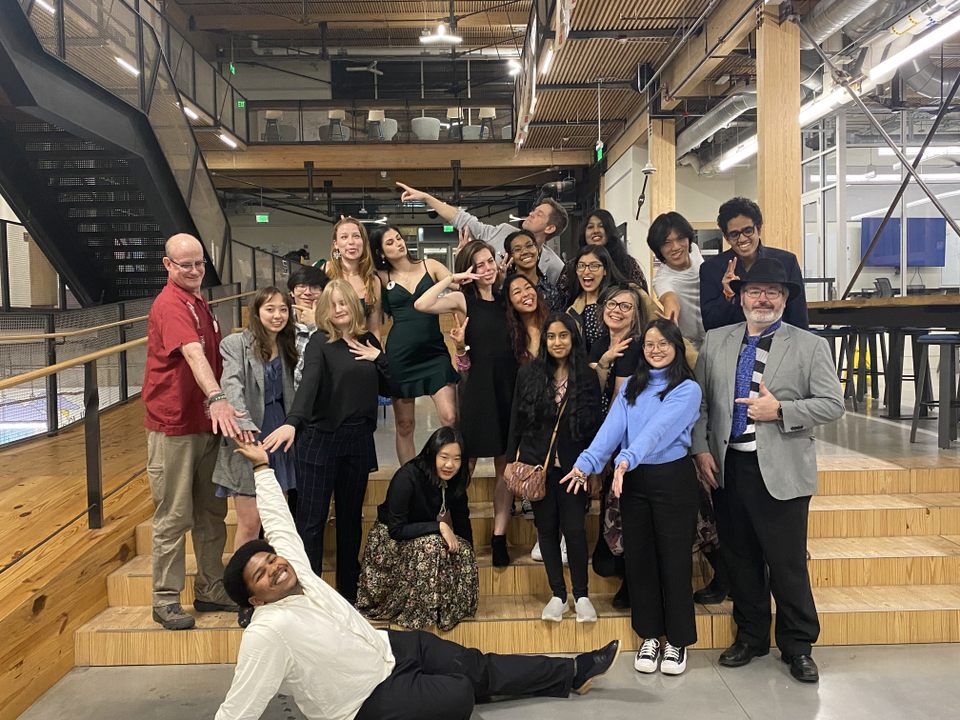
    The entire VIP team!

    A couple of weeks ago, I had the privilege of being a part of a very special presentation: The Devil Wears Science! (I am still obsessed with the name) This was my first time being a part of STEMComm during the Spring semester, which meant that I could finally attend the much-anticipated Atlanta Science Festival that our VIP participates in every year! I was ecstatic to finally see the show with my own eyes and even be an important part of it. I couldn’t be more thankful for the group of people that made this possible, it was truly incredible to watch it unfold. I am also super proud of the models that Dr. Mendelson found in his Ecuadorian friend and her daughters, they truly truly stole the entire show!! They displayed traditional Ecuadorian clothes while also showing off their very-own tagua nut jewelry. Everyone at the show loved their performance from start to end!

    My Team!

    I had the honor of being a part of the Nutty for Tagua team made up of myself, Julia Raver, and Dr. Joe Mendelson. With the whole theme of our science show being centered around sustainable fashion, Dr. Mendelson conjured up the idea of focusing on what is being coined “vegan ivory”. The presentation was on tagua nuts, a fascinating type of nut indigenous to South America that has the ability to mimic elephant ivory. We brought this idea to life by creating a presentation about the tagua nut’s background history, its sacred meaning and physical makeup, and its uses.
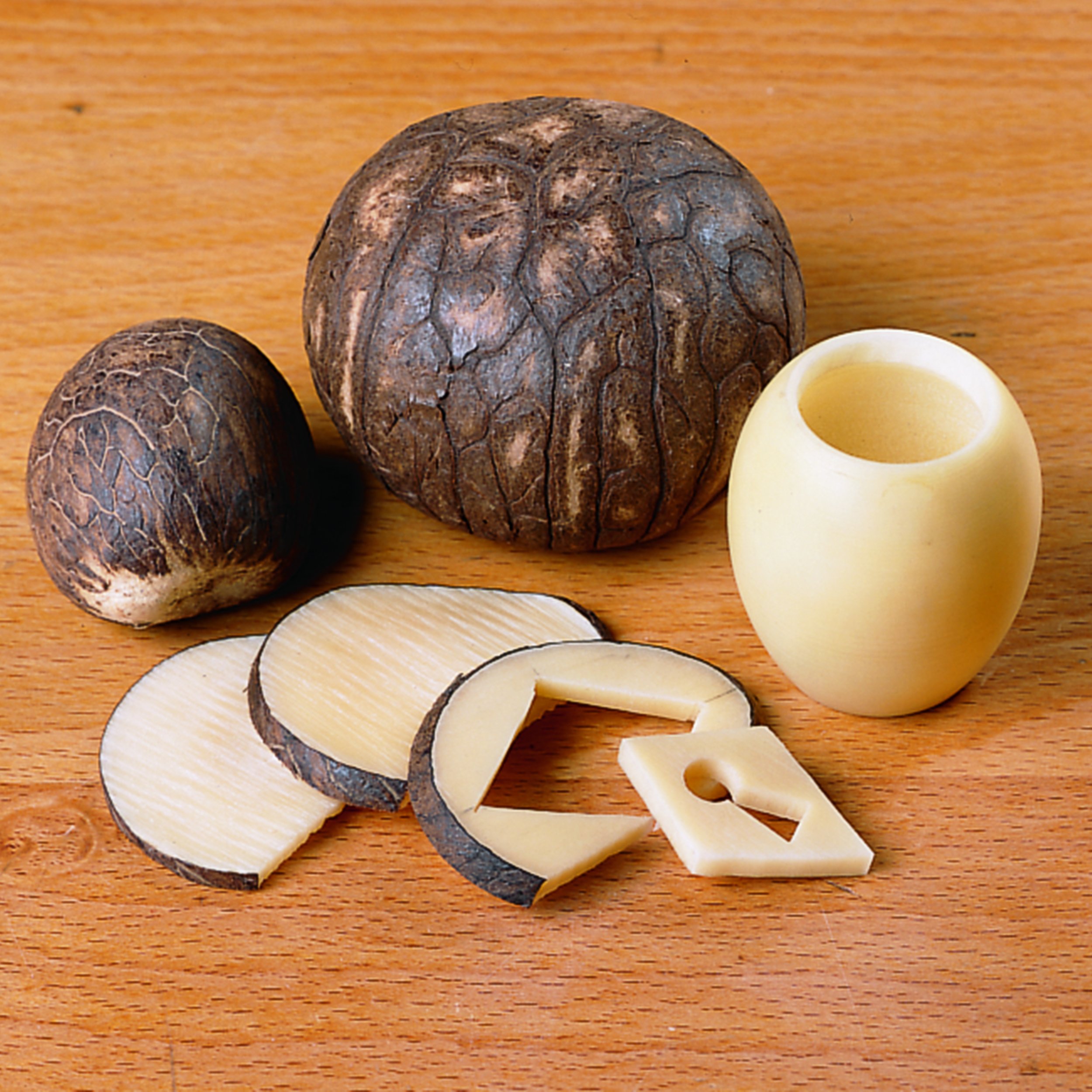
    The tagua nut itself is grown in places like Colombia, Ecuador, Panama, and Peru and has been a significant part of the culture and economy of South America. The nut represents sacred, feminine energy and harmony among the indigenous people in these areas and has different uses depending on the nut’s maturity. At the very beginning of the nut’s life, it falls from the trees onto the floor and is collected to be carved, polished, and dyed. Right after sprouting, the nuts are soft enough to eat, with a sweet and pulpy taste. After hardening though, the texture turns so hard that it requires a saw to cut through! What makes the nut so special is that they closely resemble the ivory that elephants have in their tusks. They have a similar chemical makeup as wood as they are made up of dead-walled cells. The nuts can be turned into beautiful jewelry like necklaces, earrings, bracelets, and more. Not only used for adornment but they can also be fashioned into things like buttons and guitar picks. In fact, tagua nuts were utilized during the Civil War for the buttons of US soldiers’ uniforms since the material was cheaper than metal and ceramic.

    Elephant Ivory Dupe?

    With the poaching of elephant tusks and the illegal trade that has been going on since the 1980s, it has become more important now than ever that an alternative is presented. Although there are bans on poaching, they are not stopping the slaughter of the world’s biggest land mammal, the African elephant. Tagua nuts have created a glimmer of hope for the elephants’ survival since there would be no reason to continue killing the animals with a viable ivory option available. The tagua nut has been called a friend of elephants, and it truly has been serving as a helping hand to the species. The nuts can be shipped anywhere on Earth to act as a substitute for ivory, thus humans must stop looking to elephants for ivory, and welcome into the mix tagua nuts!

    Loxodonta africana

    My Overall Contributions

    The Nutty for Tagua team chose me to be the speaker during the actual fashion show, and I knew I had to take the opportunity to shine as a senior STEMComm student. It would be my last time being a part of the VIP team before graduating, so it was extremely special to me to be able to speak. I was definitely nervous about presenting to a crowd since I am not huge on public speaking but knew that I had to stand strong for the rest of the team and represent us well. As a matter of fact, I am especially proud to be a member of STEMComm, so I had to show that in my presentation! After working with Julia on the script and editing it, I got started practicing the five minute speaking bit. I stumbled at first, but finally got comfortable projecting the information confidently. I was ready to present! When the day finally came, Julia got recruited as a last minute model for the beekeeping suit, which meant I was controlling the slideshow and presenting live- it’s harder than it looks! It surely wasn’t perfect, but I am happy with what our team gave to the show, and I could tell the audience enjoyed it too. I had so much fun participating in this event and I can’t wait to come back to attend STEMComm’s future ASF productions. From the backstage production to the music set-up, it was super cool to be a part of.

  • Veganism- Doing More Environmental Harm than Good?

    Intro/Background

    Vegan- I am sure by now you have heard of the term either from someone you know trying it out, or the millions of social media profiles promoting the lifestyle. Whether you have a friend that’s been vegan for years or want to try it out for yourself, it’s not hard to notice the upsurge in popularity it has been gaining for years. I remember growing up pretty traditionally, eating meat and dairy, without a second thought as to the ethics or implications. Simply put, most children follow what parents show them in terms of eating patterns and habits while growing up and don’t think to question it until living independently (excluding picky eaters and young innovative thinkers). My first exposure to veganism was in my own home- a couple of years ago, my older brother had been working at a pizza place for a couple of months and had developed some pretty stubborn acne (the restaurant let the workers eat the leftovers…you can see where this goes). Of course, the dermatologist that he visited told him to analyze his eating habits and try his best to limit dairy and greasy foods; pizza had to go. That’s when he made the extreme turnaround in his eating and decided to go full-on vegan. He quit his job at the pizza place and got a new job at a vegan restaurant to learn how to make dishes. It was an arduous process for him through and through, and although he isn’t strictly vegan anymore, he still struggles with eating “regular” food without guilt-free.

    Veganism Explained

    Veganism is a word that confuses many because of how simple yet complex its definition is. Veganism purely means a diet without any animal products. Now, this is where it gets a bit hairy- a lot of the foods that people eat on a regular basis have added ingredients that most are unaware of. When I went vegan, it was ASTOUNDING to find out just how little people know about how food is prepared. For example, one of my coworkers last year tried to offer me an M&M and I declined because I was vegan; I told him “I can’t have any dairy”, to which he responded, “M&M’s don’t have dairy!!!”. I was shocked- it was obviously chocolate candy, specifically MILK chocolate. I wondered how people could think like this, blatantly ignorant of what they’re eating. But back to veganism: animal products are a large genre of food that include any kind of animal meat, dairy(milk, cheese, whey), and any kind of animal byproduct like eggs. In some cases, vegans will not eat gelatin because it is created from animal bones. In cases where veganism goes from a diet to a lifestyle, vegans will not wear any clothes or use any products that come from animals, like leather.
    Environmental Perceptions

    The story that follows veganism is that it “will cure the earth and society’s morals”, meaning if nobody is eating or using animals for products, then the world would have more animals to sustain the lands and ecosystem. As well as, abstaining from killing animals for food would better the morals and ethics of society as more cohesive and united to the earth. Moreover, it is no secret that the meat industry is one of the leading causes of high emissions of greenhouse gases, one of the main contributors to climate change. The animals that we discuss in regard to the food industry are cattle, “who are estimated to cause approximately half of the food-related climate emissions due to land use impacts and methane produced by ruminating animals”(Kortetmäki, Oksanen 2021). Knowing this and pairing it with the veganism diet itself makes it clear to see that it is commonly held that going vegan would greatly benefit the environment. Joseph Poore, a writer for the journal Science, once stated in an article regarding veganism that “a vegan diet is probably the single biggest way to reduce your impact on planet Earth, not just greenhouse gases, but global acidification, eutrophication, land use and water use”. It’s almost as if by not going vegan, you are adding to the climate catastrophe that the world is facing and not doing your part.

    What Researchers Say about the Environmental Impact

    Before getting into what the scientific community has been reporting about the true impact of veganism versus traditional diets, I wanted to clarify why it is veganism that is being highlighted as a solution to the climate crisis instead of regular vegetarianism. Vegetarians do not eat any kind of meat, but they can and do enjoy all types of dairy and eggs. Cheese, one of the world’s most beloved foods, has “one of the highest GHG footprints among foods and is common in non-meat diets” (Kortetmäki, Oksanen 2021). Therefore, veganism is a better alternative to vegetarianism when discussing solutions that would most benefit the climate.

    So, what are researchers really saying about veganism and the environment? An article that analyzed the argument for climate-centered veganism brought up three big points worth discussing. The first point and probably the most obvious, was that there are animal-based foods that have close to or even lower carbon emission rates than some plant-based foods. For example, “emissions of a small, 100-g piece of chicken (approximately 1.15 kg CO2eq) equals the emissions of approximately 1.1 L of soymilk or 500 g of tomatoes” (Kortetmäki, Oksanen 2021). That’s crazy! To think that chicken and soy milk have similar carbon emissions is mind-blowing. The second point that was introduced was the food waste problem. A vegan person that is accidentally served chicken ramen instead of veggie ramen would have to send back the original, thereby wasting a nutrient-dense and high-carbon emitting food. This is just one example but can be applied to the grander scheme of things. Lastly, and most important in my opinion, veganism and avoidance of animal-based foods advance the climate-friendliness of a diet, BUT do not guarantee it! The reason behind this is that foods with high fat and protein content have higher carbon footprints than foods that are primarily carbohydrates. This means that foods like avocados, chickpeas, and tofu still have high carbon footprints, and therefore are still contributing somehow to climate change. Thus, a vegan person eating only fast food would not be benefiting the environment whatsoever

    Conclusion

    It is hard to say for sure at this point if veganism is strictly bad or strictly good for the environment, but we have some clues as to which direction the pendulum is currently swinging to. Although the research outlined above does a great job of poking holes in the climate-based argument for veganism, I still find that the environmental pros outweigh the cons. A lot more research is definitely needed to come to a real conclusion on this topic, and I am excited to see what comes of future findings. For now, I stick with the fact that veganism is more beneficial to the environment than an animal-based diet.


    References

    Kortetmäki, T., Oksanen, M. Is there a convincing case for climate veganism?. Agric Hum Values 38, 729–740 (2021). https://doi.org/10.1007/s10460-020-10182-x

  • ADHD Comics: Reflection on Adaptation Project

    Wait, I have ADHD?

    Recently, I found out that I have ADHD, and it seemingly came at a time when many other women in the world were realizing the same thing. But why was I only getting diagnosed now, at 22? It’s a fact that ADHD is under-diagnosed in girls due to a multitude of reasons. The biggest being that plainly, ADHD looks different in girls and women than it does in boys and men. Little boys are usually the ones causing a raucous in school, where the girls try harder to please the teachers and impress their peers with scores. I know that as a little girl, I tried extremely hard in school always and was a bit of the teacher’s pet, which included following the rules super closely and avoiding trouble. It wasn’t until I was an adult that I began seeing posts on social media describing the under diagnosis of ADHD in women and the signs and symptoms that usually appear. This propelled me to reach out to a professional who tested me and confirmed that I had ADHD the whole time.

    How the diagnosis affected me

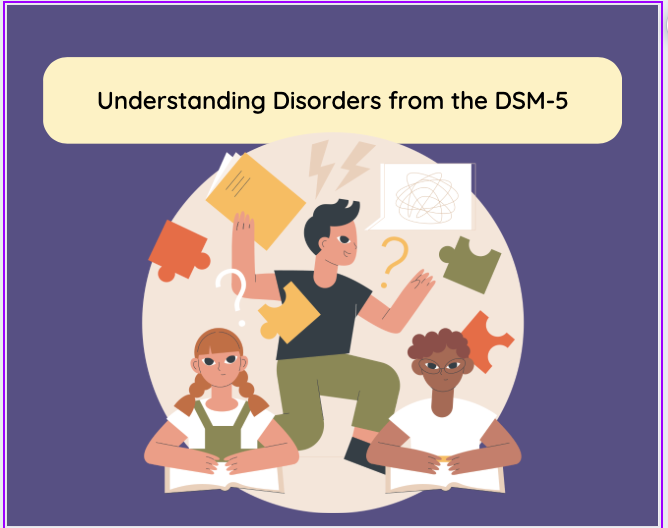
    Hearing the diagnosis was shocking, but also, made everything a little clearer at the same time. I could finally figure out why I behaved in certain ways where my friends behaved differently. I felt seen for who I truly was, and knew I could use this diagnosis to help myself adapt better. So when I found myself in my LMC class this semester, hearing a presentation on the DSM-5 from a classmate, my ears perked up when he began discussing ADHD. The assignment had been to create a plan to adapt a boring piece of technical writing into a more engaging piece of technical writing, and my classmate had chosen to adapt the DSM-5, focusing on the ADHD portion. He went on with his presentation to explain why he had chosen to adapt this, and his reasons really resonated with me. He spoke on how the DSM-5 is making it harder for professionals to diagnose to the fullest degree with the long, drawn-out look of the document and its hard to parse language. This immediately reminded me of the ADHD under diagnosis I had thought so much about.

    The Adaptation Project

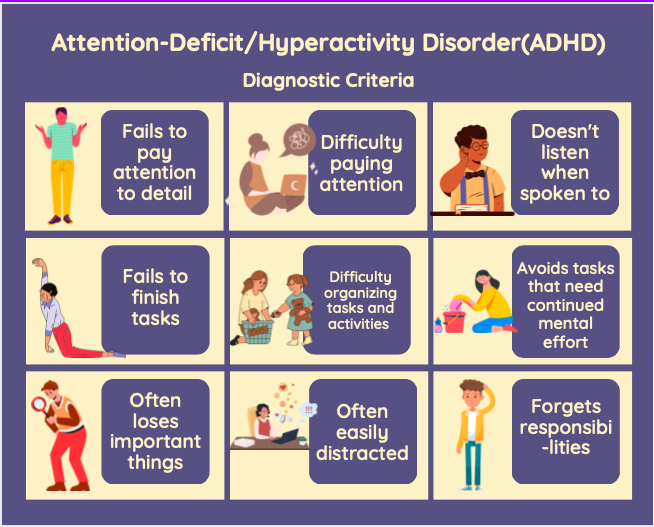
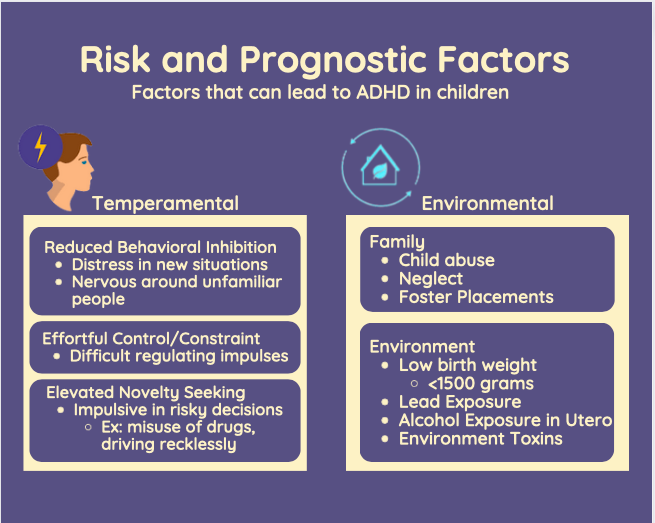
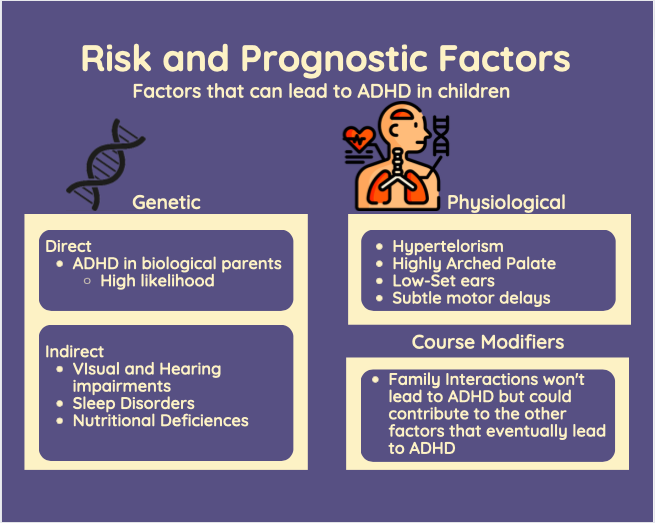
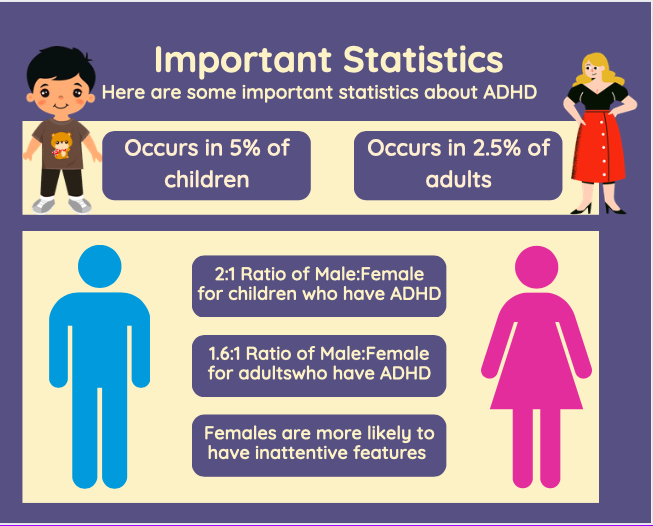
    Our class was to watch all of the presentations, and vote for the person who had the best proposal and pitch for adapting their technical document. My first place choice was the student who did the DSM-5 since he had clearly captured my attention and convinced me of his pitch. The next part of the project involved the winners of the voting to be team captains, and head their teams on actually creating the adaptation. Thankfully, I was placed in the DSM-5 group and super excited to get started. We went on to create many comics elaborating on ADHD as a whole- the signs, the symptoms, and the statistics. Take a look below!

    Conclusion

    Learning that I had ADHD was relieving, illuminating, and insightful for me. It affected me in more ways than I knew because I found myself bringing it into my schoolwork in LMC 3403. As I spoke about in a previous article, I loved being in LMC 3403 because it allowed me to practice group-work, learn a lot about myself, and improve my technical writing. This adaptation assignment was my favorite and I love the comics we created in the end. I hope that in my lifetime we can shed more light on ADHD in young girls and try to correct the gap in diagnoses.

  • My Experience (so far) as a Woman in CS

    Women in STEM! Women in STEM! Women in STEM!

    It seems as though every conversation I have had with a woman I just met in my major of CS never fails to include the line “women in STEM! That’s us! :p” The term “women in STEM” is actually multi-faceted; the term generally refers to the organization called “Women in STEM” that is concerned with empowering and supporting, well, WOMEN IN STEM! Sorry for the repetition, but it is catchy, isn’t it? To be completely honest, I wasn’t even aware that the phrase referred to an actual organization, I always just thought it was the name for the literal group of women that work or study in STEM subjects. Now, you’re probably thinking, why do the women in STEM always say this phrase to each other? Frankly, it serves as a bit of a joke because of the stereotypical perception of women in CS- surrounded by men all the time with few female counterparts present in professional settings. Is this just a stereotype, or does it hold some merit?

    One example out of many: LMC 3403

    I wanted to reflect on this subject with regards to my experience in one of my classes this semester, that being LMC 3403: Technical Communication. Although this class is from the school of LMC, it is required for some CS students depending on their threads. Because of that, all of the computer science students in the course were put into one section. My class was super small compared to the norm for CS; there were only about 25 students compared to the usual 350 in a CS class. Even with this dramatic decrease in size, the same pattern still emerged, but somehow even more prominent. It has never been odd that most of the giant CS classes I have been in are probably 75% men, but it was heightened in this class for a couple of reasons. The actual number of women in my class was five out of twenty-five, so 20% women. This is already smaller than the usual, but further, a lot of people would skip lecture so it was basically three women with about ten or more men in the class at any given time. I didn’t notice that glaring difference in demographic until about halfway through the semester when I realized that every group I had been put in during the class had been all guys. The thing about LMC 3403 is that almost every single lecture, the professor would break the class up into four or five small groups so it was much easier to see the breakdown of people. For some reason I never did end up with another woman in my group, which saddened me a little bit.

    So, what was it like?

    When I was a freshman, a lot of the guys in my classes were a little immature in a sense. They would ignore the women in the class and only speak to their guy friends. As time went on though, I started noticing this less with the guys in my upper-level classes. By the time I was a senior, I was used to working with men as my major was stock full of them. I found that working with men could be really difficult at times as the only women- sometimes, I couldn’t get a single word in over their talking, or they would do all the work before I could contribute anything. I know that every group, regardless of gender, has these problems, but I couldn’t help but feel like this behavior was stemming from the gender divide. Let’s just say they weren’t dying to hear my opinions on any part of the work.

    A different experience

    After working in these groups full of men talking over me enough times, I had gotten used to this behavior and was prepared for it. To my surprise, LMC 3403 was completely different. When I would be put into small groups with the men in this class, it was the complete opposite of what I had encountered before. The guys would hardly talk at all, only speaking to discuss the requirements of the assignments. This time, no one was fighting for attention or talking room- it was wide open. I felt like I could actually talk freely and share my opinions without being judged. This class was one of the few where I contributed all my thoughts without fear of being wrong or being ignored by the other group members. Not only was I able to speak, but my group members would actively listen! I know, the bar is on the ground, but this was really shocking to me, a woman in STEM who had learned how to tiptoe around the men in STEM. LMC 3403 was one of my favorite courses because of this, and it helped me produce some of my best writing and group work of college.

    Conclusion

    The stereotype of women being heavily outnumbered in the computer science field is true, but I know that the percentage of WOMEN IN STEM! is going up every single day, thank goodness! Thanks to the contributions and hard work from organizations like Women in STEM, little girls everywhere are learning about computer science and picturing themselves as future coders. This article is just my experience, and I hope to see more women in CS at Georgia Tech every year.


  • Behind the Baking: Leavening

    Introduction

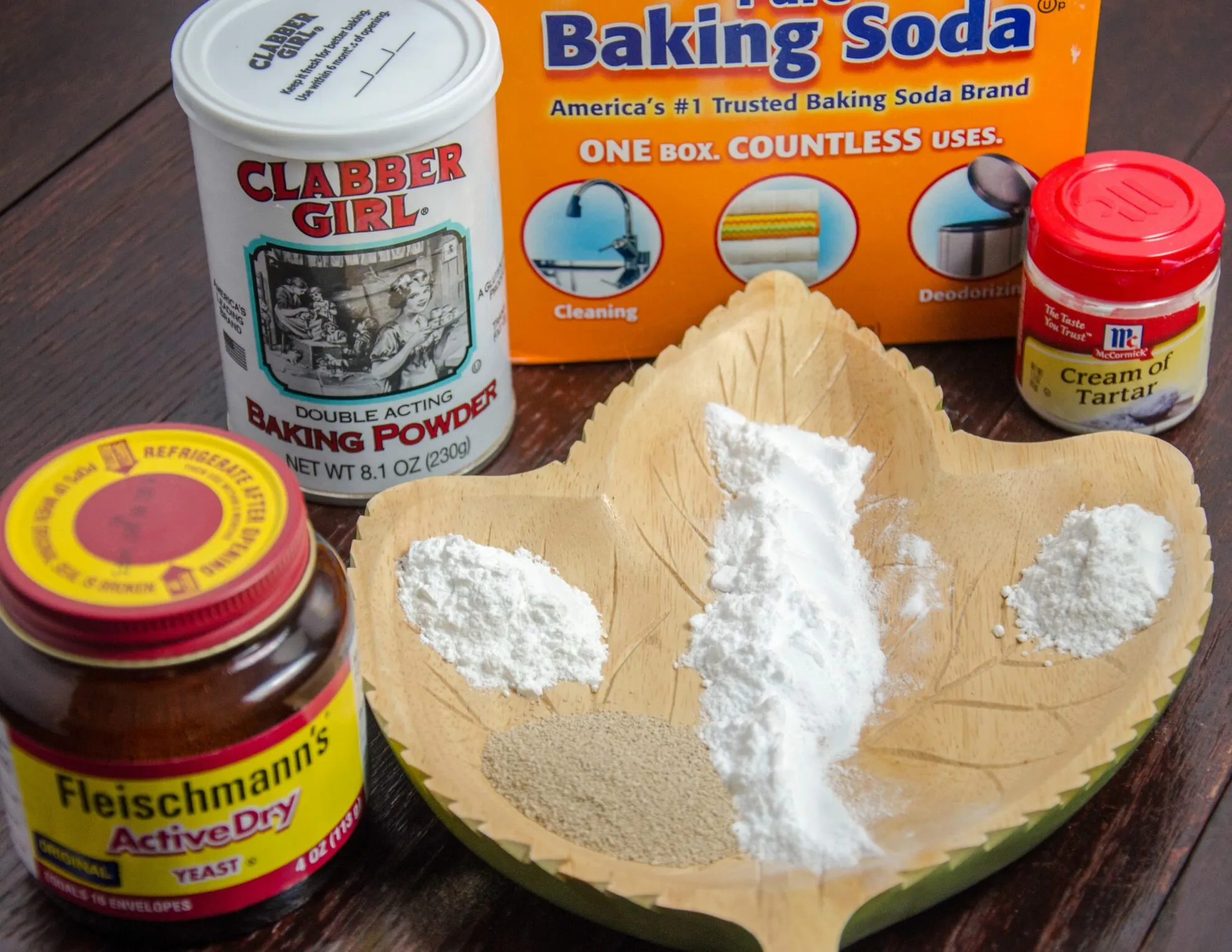
    Welcome to the second installment of my Baking Science series! This time, I’m putting a variety of leavening agents to the test to see how they perform based on taste, texture, and overall look. I will be baking three loaves of bread: one using yeast, one using baking soda, and one using baking powder. I predict that the loaves of bread will all vary greatly from each other, but I am especially interested in finding how the baking soda and baking powder bread differ since a majority of the general population cannot distinguish the two.

    What goes into baking beautiful bread?

    Most kinds of bread come together with only six ingredients: flour, oil, water/milk, a leavening agent, sugar, and salt.

    What’s a leavening agent and how does it work?

    The word ‘leavening’, as defined by Oxford Dictionary, is a substance used in dough or batter to make it rise, such as yeast or baking powder. Without this key ingredient, it would be impossible for the bread to rise, resulting in a flat cracker. In order to create a good ole’ sturdy loaf of bread, a couple of essential chemical reactions need to take place in the oven. The first ingredient, flour, contains two proteins called gliadin and glutenin; when combined with water, these proteins transform into gluten. The chemical makeup of gluten shows that the molecules are chained together to create long chains- this allows the bread dough to be elastic and stretchy. This is also why the longer the dough is kneaded, the more elastic it becomes. The dough’s stretchy quality is super important in achieving the end loaf because of the way the leavening agent works. The agent causes a bunch of tiny gas bubbles to form in the dough either before or while it is in the oven. Ever watched a baking competition and heard the cast talk about ‘proving’ their doughs? I know I have! The proving process involves letting your dough rest and rise before it is put in the oven to bake. This step is integral when using yeast, but not necessary for baking soda and powder since they do their work in the heat of the oven.

    Experiment

    Three loaves. Three agents. One winner. Just kidding, but I will include which bread I enjoyed the most at the end!

    Round 1: Yeast

    Recipe: https://butterwithasideofbread.com/homemade-bread/

    Round 2: Baking soda

    Recipe: https://sallysbakingaddiction.com/no-yeast-bread/

    Round 3: Baking powder

    Recipe: https://www.recipetineats.com/sandwich-bread-without-yeast-quick-easy/

    Observations and Opinions

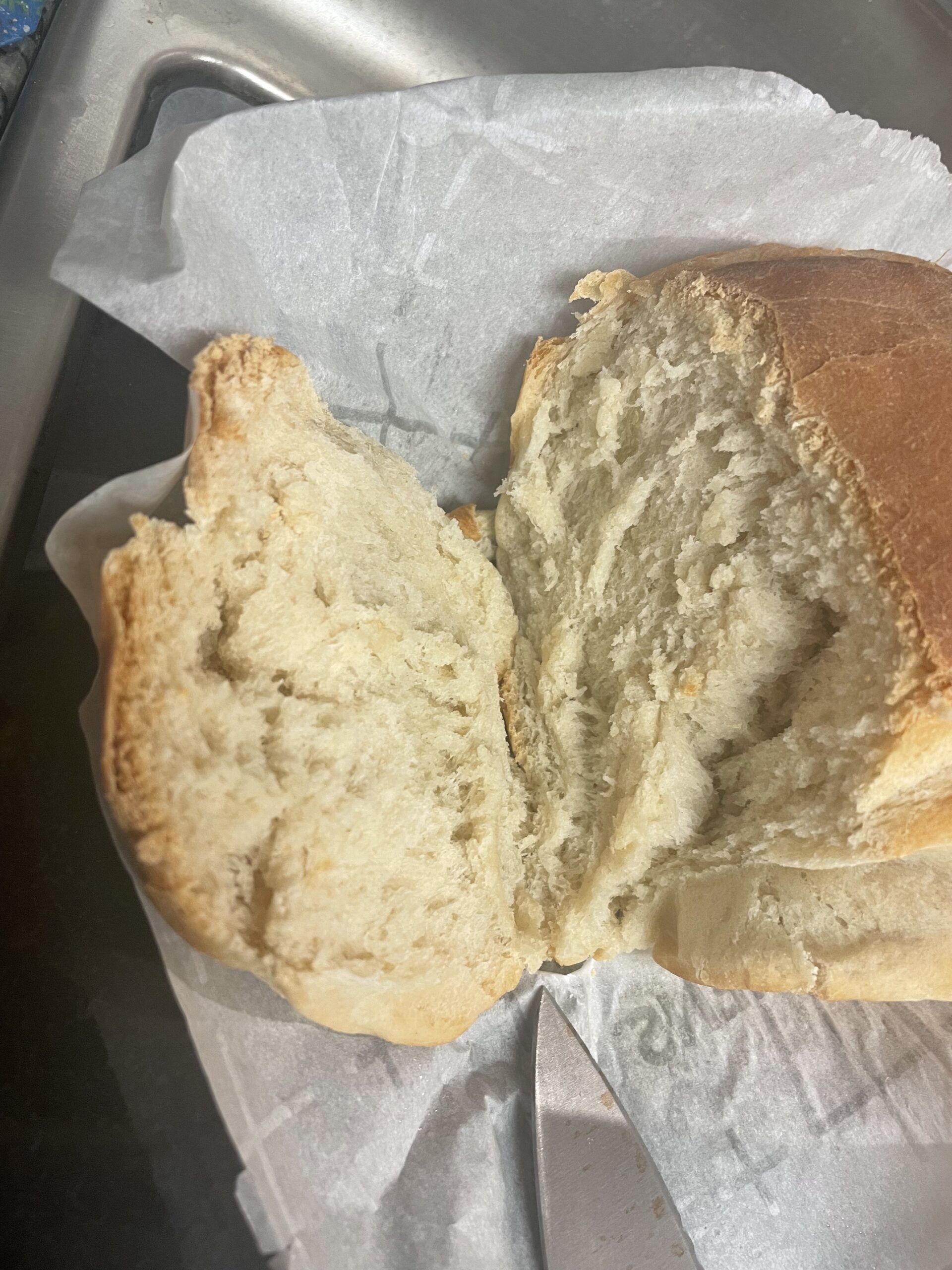
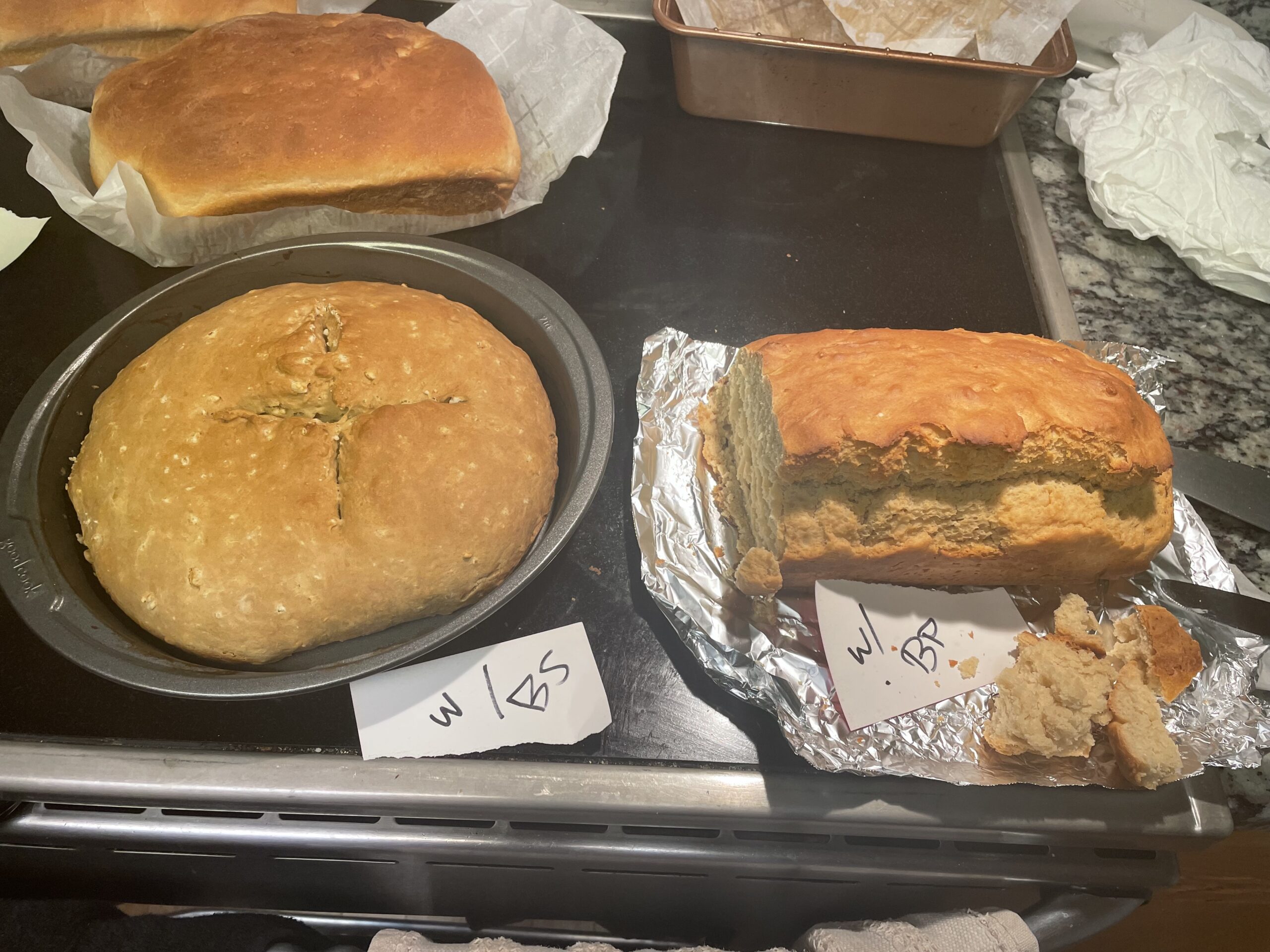
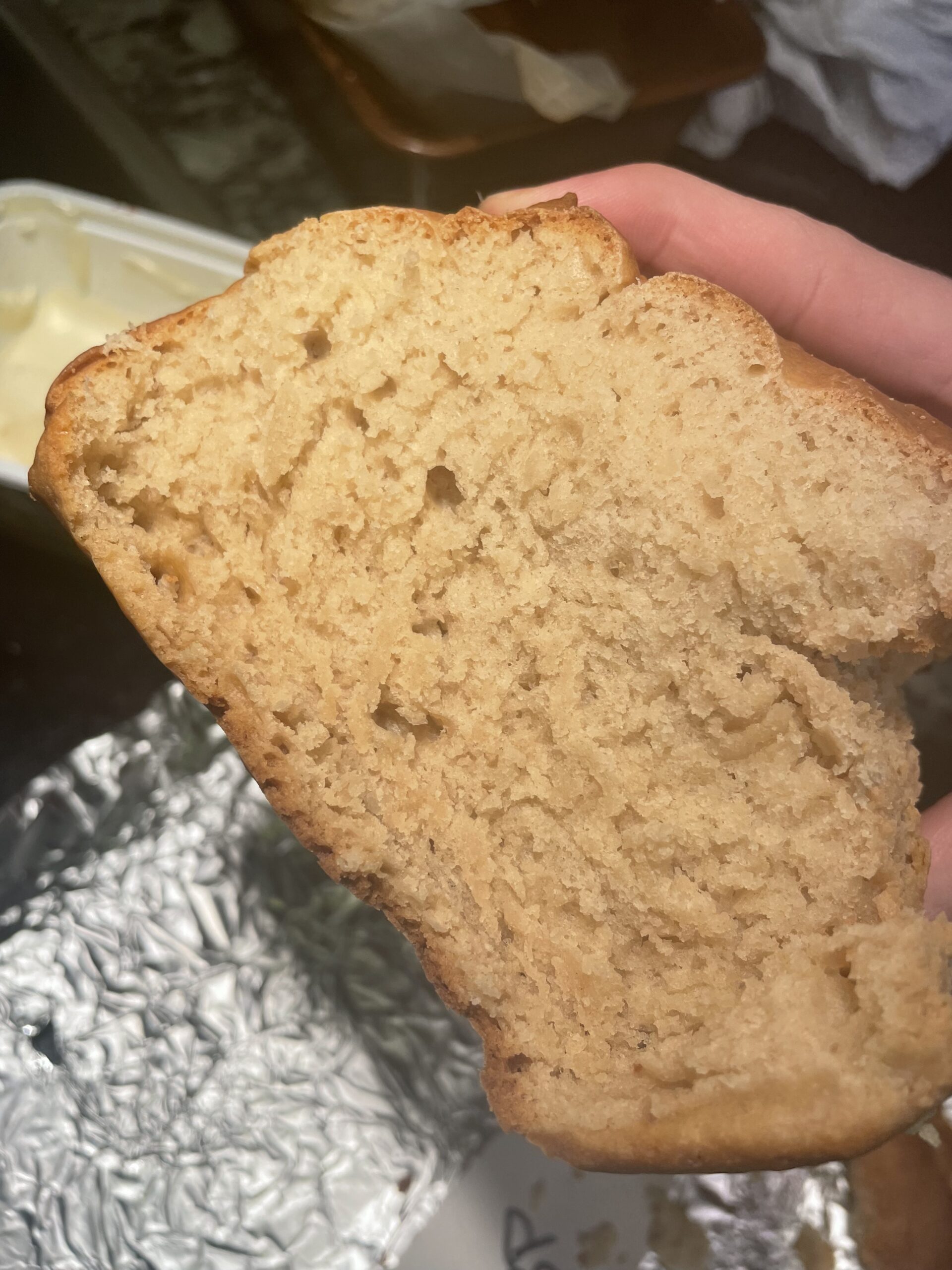
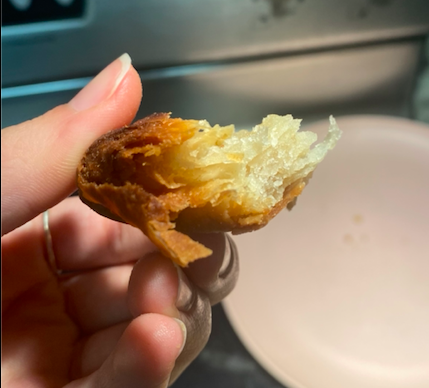
    Unsurprisingly, the bread that came out the best, in my opinion, was the yeast bread. This comes as no surprise because most of the breads that are sold in stores and that people generally think of are made with yeast. It’s hard to beat lightweight, airy feel of the yeast bread crumb. The baking soda bread was also delicious, but much much denser than the yeast bread. The baking powder bread was the weirdest- it was super heavy and stodgy and just not good. That might have been due to my error though, I may have overmixed it or kneaded it too much. The baking powder bread was so tough I didn’t want to cut a slice and eat it.

    Final Thoughts

    My favorite bread of the three was the yeast bread! The other breads honestly did not stand a chance against the tried and true yeast bread and I now know that I do not care for soda bread much. I would advise against making bread with baking powder, it was so hard for me to get it right but maybe some practice could improve it. Overall, it was super fun to test out these leavening agents and see them in their rising action.

  • Is that Marilyn Monroe… or Albert Einstein?!

    Look at this picture from up close and far away. What changes as you move further away from the screen?

    What’s Computer Vision anyway?

    When I hear the term “computer vision”, the first thing that comes to mind is a computer with eyes that enable it to have a sense of vision. Although this is not the exact definition the computer science industry would agree with, my train of thought is on the right path. Computer vision is a subfield of computer science that concerns itself with the problem of matching up how humans see and how computers see. I know what you’re thinking- computers can’t see! That’s precisely the issue! However, after a few weeks in CS 4476 at Georgia Tech, I have begun to learn a few things about how the scientific community has worked to solve this disconnect between machines and humans. In this reflection, I will present a brief walkthrough of my experience completing CS 4476 Project 1 and some of its important concepts with corresponding pictures. If you enjoy optical illusions, get ready for hybrid images!

    There is a common misconception among people outside of the computer science (CS) community that computers are extremely smart and adept- the reason being that computers can do difficult tasks at lightning speed while a human would likely take much longer. This is FALSE! Everything a computer “knows” how to do, it was taught how by a human. Fields like artificial intelligence and machine learning have been wondering how to reflect human cognitive functions like thinking, feeling, and perceiving onto machines. Computer vision is no different- we want to know how to make a computer see the same way a human sees.

    My experience in CS and Project details

    When I started this class this semester, I was just as intimidated as I was walking into the Machine Learning course last year. I did end up surviving that terrifying ML class although I still have nightmares about the assignments. Most CS courses at Georgia Tech are known to be intimidating to me with all of the complex math and science thrown around; computer vision was no exception. The first project, titled Convolution and Hybrid Images, required students to write an image filtering function in order to create hybrid images. What does all this mean? Allow me to explain as best I can without going into intense, scary detail.

    Our project was broken up into three parts: Image Filtering, Hybrid Images with PyTorch, and understanding input/outputs in PyTorch. The first section involved using Gaussian Kernels in order to blur the images given in the prompt: to do this, we had to implement concepts from linear algebra to create vectors and statistics to manipulate variables like mean, standard deviation, and covariance of the Gaussian. The term kernel in this context does not have anything to do with popcorn, although that was my first thought too. A kernel in computer science is the core of any operating system that provides basic functions to every other part of the system.

    the visualization of the Gaussian kernel

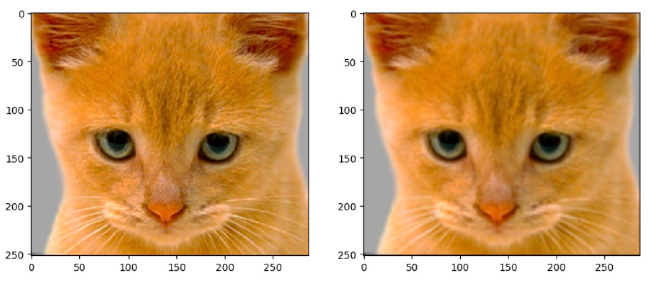
    Using the Gaussian filter, we were able to see the image filtering function we wrote in action, blurring an image of a cute cat. See how the cat on the right is ever-so-slightly blurry?

    Left-original, right-blurred

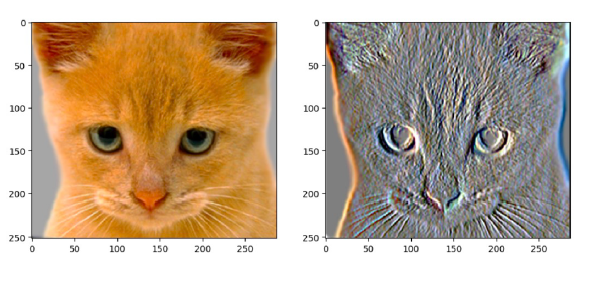
    Next, we implemented something called a Sobel Filter, which uses the Sobel operator to calculate the gradient of image intensity at each pixel. In terms of image altering, here is what happened to our cat picture after applying the Sobel Filter:

    Sobel Filter on cat image

    The real fun begins…

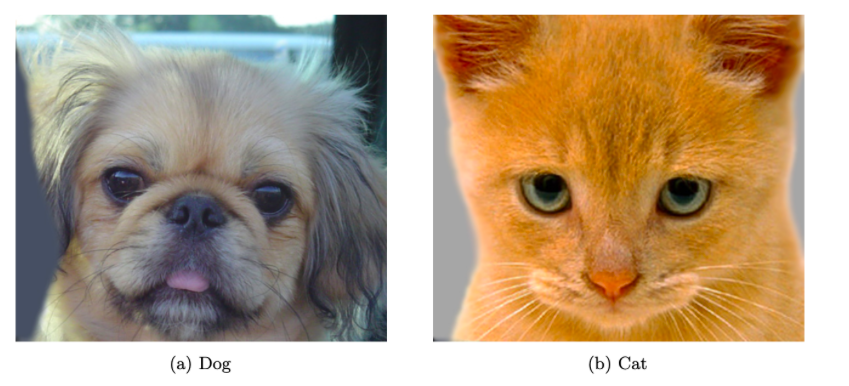
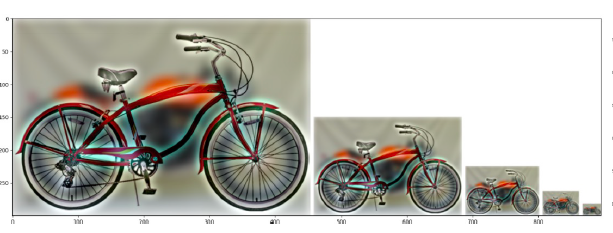
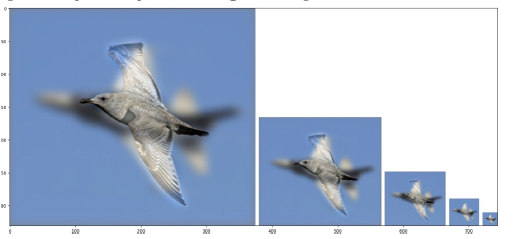
    My favorite part of this entire assignment was the hybrid image portion. A hybrid image is the combination of a low-pass filtered version of one image and a high-pass filtered version of another image. Low and high pass filtering refers to cutting out either the low or high frequencies in an image and only leaving one or the other. You might have heard about frequency in sounds, but what is frequency in an image? The frequency of an image is basically the rate of change of intensity values- if an image has high frequency, the pixels move from one pixel to the next quickly. In low frequency, the pixel’s color values share similar hues since the pixels move slowly to the next pixel. Hybrid images remind me of optical illusions because the eye sees one image from looking near the screen and sees the other image when looking from a far distance. The way that the image filtering sort of tricks the eye into seeing two different images in “one” image is one of the things that makes computer vision so cool! Some more hybrid image examples can be seen below:

    original cat and dog images
    Cat + dog, cat from up close and dog from far away
    Motorcycle + Bicycle
    Bird + plane

    Hybrid images are created by first calculating the low frequencies of both images being used. Then we can find the high frequency of one image by subtracting its low frequency value from all the frequencies in the image. This gives us the low frequency of image 1 and the high frequency of image 2- summing these two values gives us the beautiful hybrid images seen above.

    Conclusion

    Although computer science can be daunting with its vast library of tools and functions, going through the resources bit by bit (no pun intended) and using the help of the class TAs, I was able to complete Project 1! What I learned from this project besides the actual content was that computer vision functions take a long time to run on old computers and that Piazza is one of the best tools ever utilized at Tech. Overall, I had fun making the hybrid images though it took me a while to figure out exactly how. The key to computer science is patience, asking questions, and not giving up when errors keep bombarding your terminal.

  • The Science of Baking Pt.2

    Introduction

    Welcome to Part 2 of The Science of Baking! Since this is the second installment of the series, I would recommend going back and reading part 1. This article will go through an experiment of baking a flaky pastry using two different types of fat: butter and coconut oil. There are accompanying pictures that I took myself showing in detail the two pastry doughs!

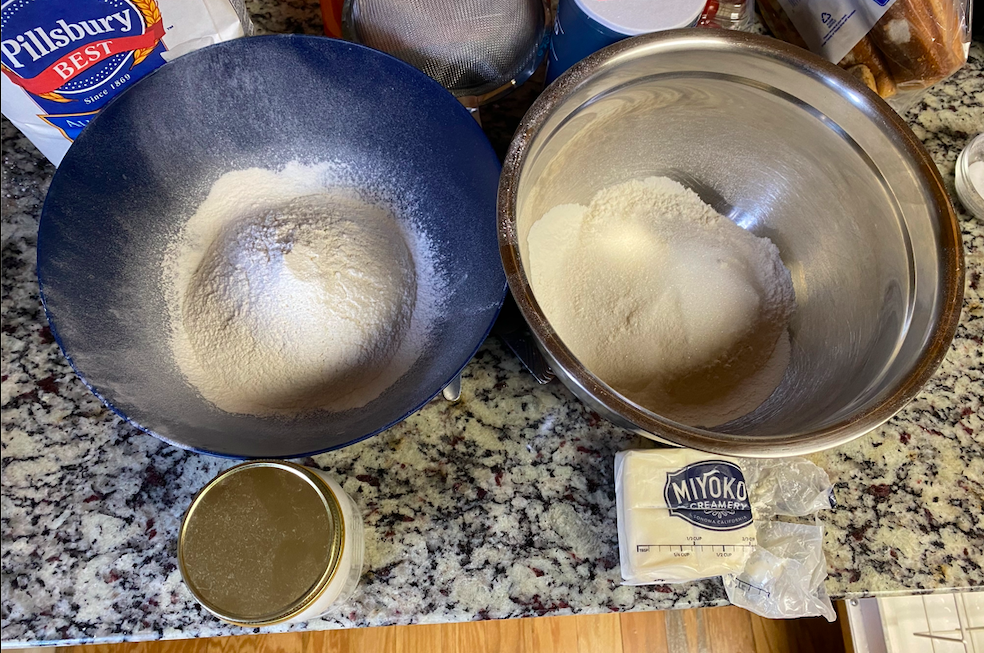
    Step 1: Mix flour, salt, and sugar.

    The two bowls of flour mix for each fat.
    The two bowls of the flour mix and the corresponding fats in front of them.

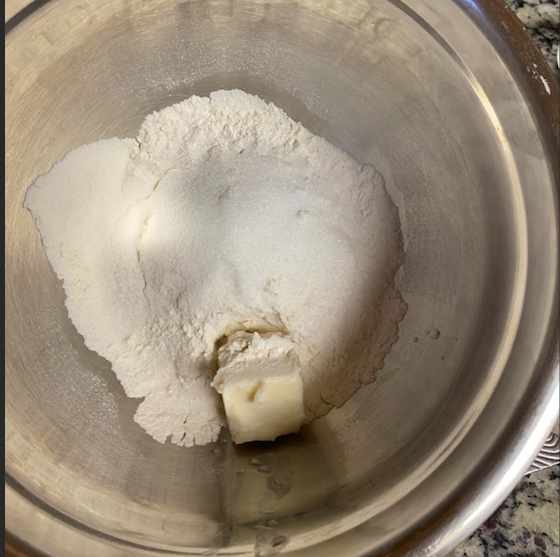
    Step 2: Break the fat up into 4 equal portions and add one portion of the fat component to flour mix.

    The butter + flour mix
    Coconut oil + flour


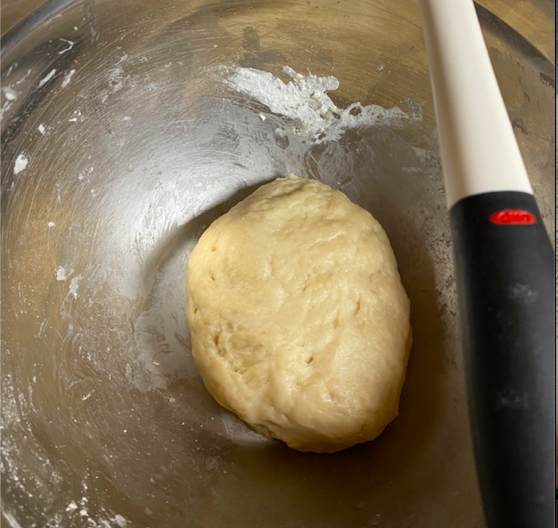
    Step 3: Mix and add water slowly until a dough forms.

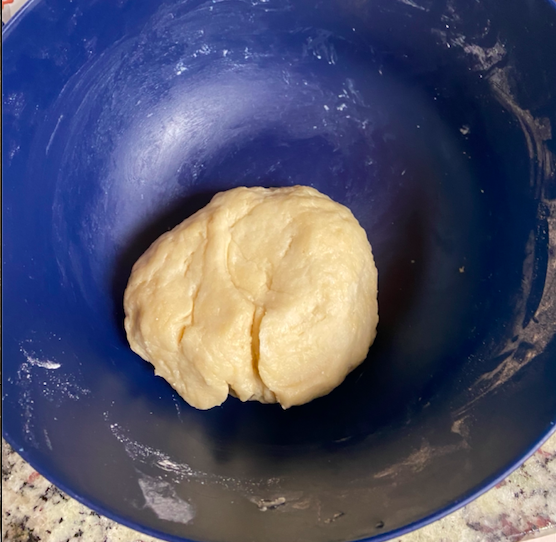
    Dough with butter
    Dough with coconut oil

    Step 4: Roll out dough into flat sheet

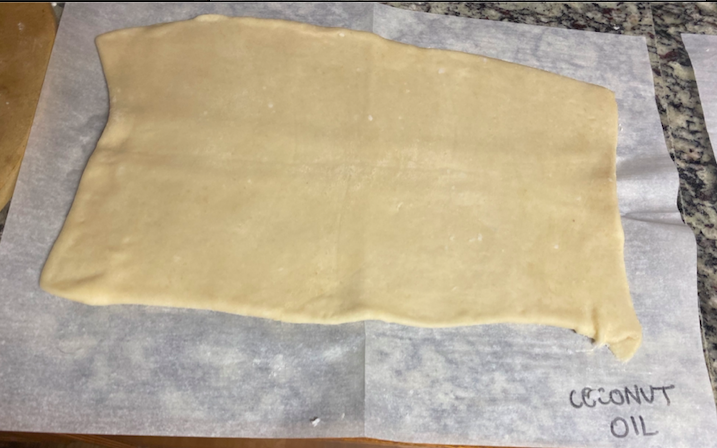
    The doughs rolled out into rectangles

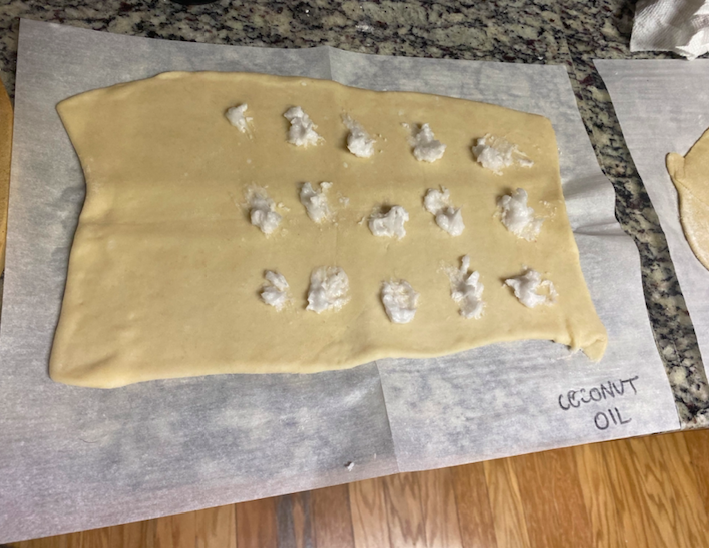
    Step 5: Break up the next portion of fat and spread along sheet of dough

    One portion coconut oil dotted on dough
    Butter dotted on dough


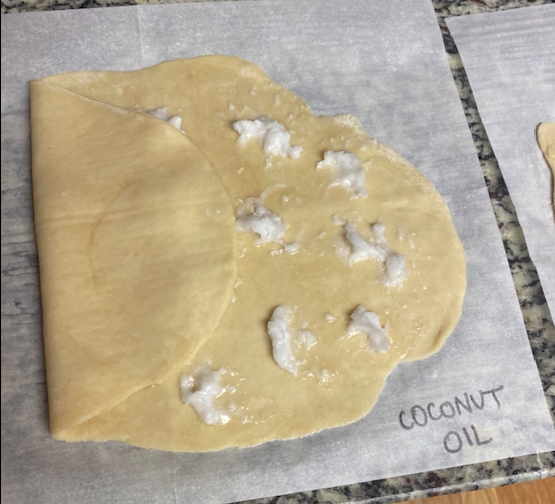
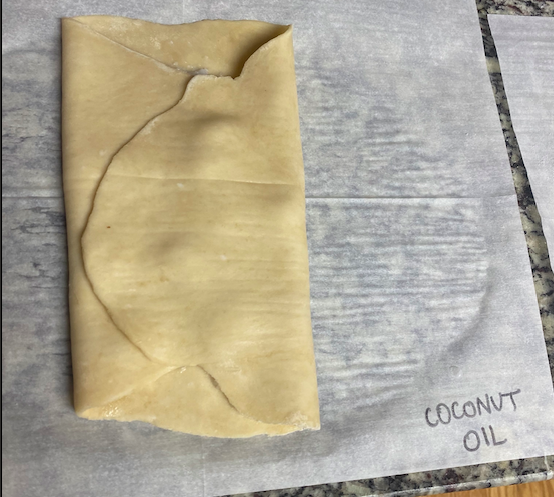
    Step 6: Fold the end without fat over 1/3 of sheet and fold the other end over the top.

    First fold
    Second and last fold

    Step 7: Roll out the dough exactly like in Step 4 carefully.

    Rolled out dough for second time

    Step 8: Repeat steps 5-7 two more times with the next two portions of fat.

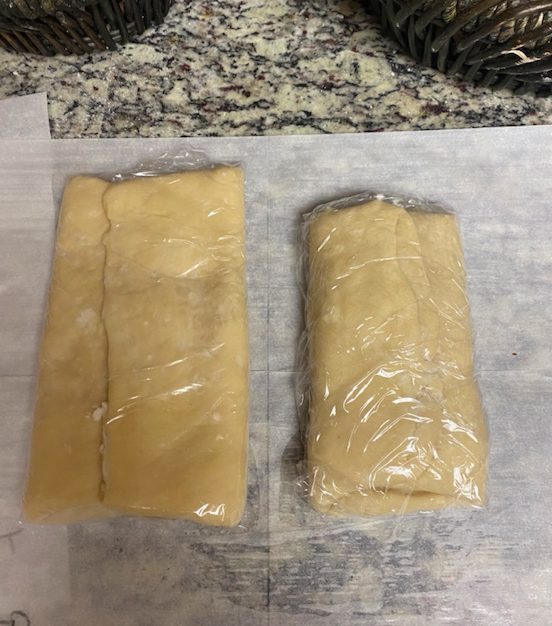
    Step 9: Wrap the dough in plastic wrap and chill in fridge for 30 minutes.

    Wrapped up and ready to go into the oven!

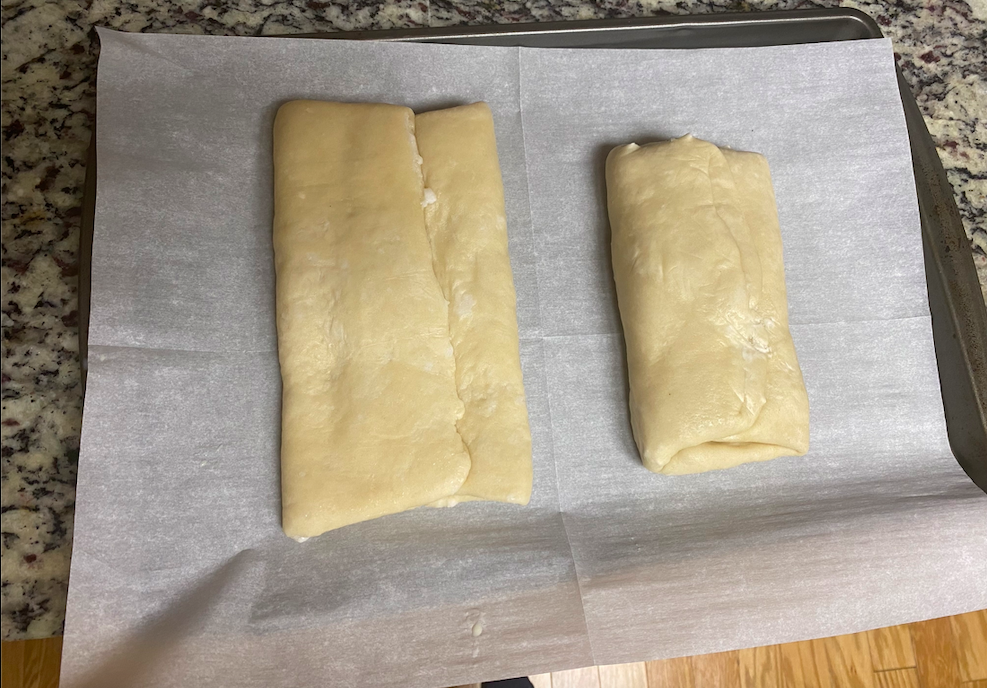
    Step 10: Preheat oven to 450° F and bake pastry for 8-10 minutes. 

    Before baking…
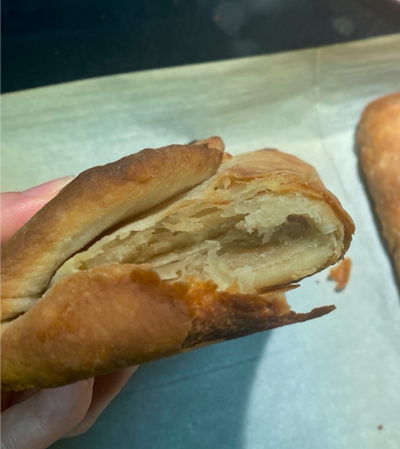
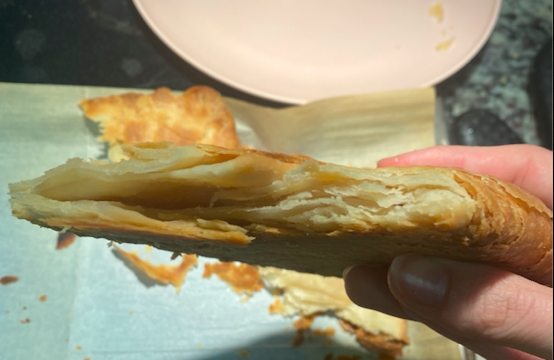
    Crispy, baked flaky pastry fresh out of the oven!


    Observations

    There were many, many differences between the butter pastry and the coconut oil pastry not only during the preparation, but after baking as well. Although coconut oil and butter have very similar structure at first glance, the butter was much creamier and incorporated into the flaky pastry dough much easier than the coconut oil. The oil melted super quickly, making it difficult to keep very doughy as it was getting way too wet. The coconut oil was also much harder to de-clump while the butter of course, had real clumps. Another huge difference between the doughs was their size. As seen from the photos, the coconut oil dough had a much larger size than the butter dough. My theory for this stark difference was that the butter was much thicker than the coconut oil, making the dough much more cohesive and elastic. The coconut oil pastry was clearer flatter and more spread out, due to the silky nature of the coconut oil. The butter pastry was also much taller than the flat coconut oil version; my thinking tells me the butter allowed for the pastry to rise better than the oil did.

    In terms of taste, texture, and overall flakiness, both doughs performed relatively well but the butter dough definitely outshone the coconut oil. Though the butter dough was better in taste and more compact, the coconut oil pastry was also quite delicious as a substitute for butter. For any coconut lover, this is the perfect pastry substitution for fat. All in all, both doughs baked into beautiful flaky pastries with multiple light layers of crisp pastry, but the dough using the butter cooked better and tasted more like a pastry would normally taste.

    The dough with butter and its nice flaky layers
    Buttery, flaky layers of delicious pastry


    The flatter layers of the coconut oil pastry
    The coconut oil flaky pastry result


    Conclusion

    This experiment was so much fun to do considering I love to bake and have never made a flaky pastry dough before! I learned so much from the experience- not just how to make a flaky pastry but also so much new insight on how the science of baking really works together to create a magnificent dessert when heat is introduced to a couple of different ingredients. I encourage anyone reading this post who enjoys baking to try this experiment out for yourself to see if your results are the same! Not only did this experiment make me want to bake even more, but now I have an urge to try this recipe with all possible substitutes for fat like ghee, vegetable shortening, even lard. The possibilities are endless and we are just getting started!

  • The Science of Baking Pt. 1

    Introduction

    Have you ever wondered how exactly baking turns a soupy batter or a thick paste into a beautiful cake or cookie? Think no further, this article will soon explain what goes into the magic that is baking and some other cool facts.

    How does science play its part?

    Baking does a great job of showcasing just how prevalent science is to everyday activities. It combines chemistry, biology, and physics to create the decadent end product. The laws of physics apply to everything, but for baking, those laws are compounded with chemical reactions within ingredients and the processes of biology. The incorporation of many different edible chemicals like baking soda and baking powder to create a cake batter or dough causes reactions like tiny air bubbles forming that are trapped and cause rising. This is where biology also comes in with the culture of yeast as a leavening agent that provides carbon dioxide for bread to rise.

    Role of Ingredients in Bake

    Every single ingredient that goes into a baked good is there for a reason. Many people know from experience that forgetting to include even a single item on a baking recipe can end in total disaster. But what exactly is each basic baking ingredient doing?

    Sugar and Fat

    Many recipes will tell you to add the sugar and fat component, whether it be butter or ghee or oil, and there is a very specific reason for that. When sugar is added to butter, the sharp crystalline structure of the sugar slice the butter molecules and introduce air into the mixture. This is why creaming the sugar and butter before adding it to the other dry ingredients causes a lighter and fluffier outcome! Fat also adds that rich flavor by coating the gluten molecules so they do not combine as easily which also makes the product more tender.

    Creaming of butter and sugar

    Flour

    Flour is made up by grinding raw grains or wheats or nuts to form a powder. The protein in the flour, gluten, works to form a web that traps air bubbles and allows the pastry to set in place. Basically, flour makes up the entire structure of the baked good and without it, the pastry would collapse! While the baked good heats in the oven, the starch in the flour sets in order to add and support the structure of the dish.

    Chemical structure of starches in flour

    Salt

    Salt has many functions in normal cooking, but it does in baking as well! It enhances and strengthens the flavors in other ingredients to form the perfect balance. Salt also allows the gluten provided by the flour to form better as well.

    Baking Soda

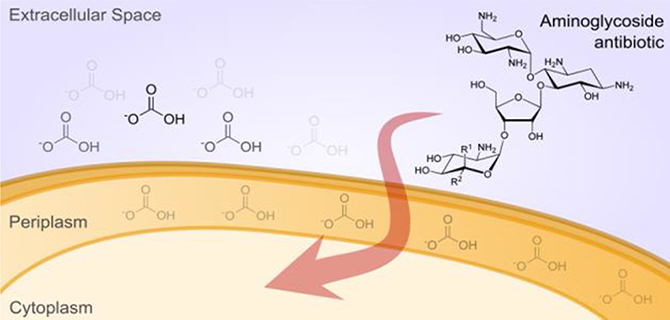
    Baking soda, has a very special role in baking as well. It’s scientific name is sodium bicarbonate, and it is a crystalline salt. For the sodium bicarbonate to work it’s leavening magic, it can either be combined with an acidic component like buttermilk to cause an acid-base reaction or can be left to perform with just thermal decomposition in the oven.

    This graphic shows the chemistry going on with baking soda

    More to come…

    As we can see, there is a lot of science that goes into perfecting a pastry. Without the chemistry, biology, and physics, it would be impossible to create any pastries or bread goodies. In the next article, we play with an at-home experiment of varying the type of fat used in one type of pastry and comparing the two different end products!

    Sources

    Babincáková, Mária. “Leavening Agents: The Chemistry of Baking Discovered with a Computer-Based Learning.” Journal of Chemical Education, vol. 97, no. 4, Apr. 2020, pp. 1190–1194. EBSCOhost, search.ebscohost.com/login.aspx?direct=true&AuthType=ip,shib&db=eric&AN=EJ1250850&site=eds-live&scope=site.

    Bodach, Vijaya. Baking a Cake. Perfection Learning, 2013. EBSCOhost, search.ebscohost.com/login.aspx?direct=true&AuthType=ip,shib&db=nlebk&AN=650384&site=eds-live&scope=site.

    Claire, Jillian, “The Chemistry of Baking” (2014). Senior Theses. 23. https://scholarcommons.sc.edu/senior_theses/23

  • CS4641 Project 3: Neural Networks Reflection

    Introduction

    If you have read my last article, you know that we have been here before. Although I talked about the process of completing and submitting Project 2, I wanted to write about Project 3 but focus on more of the content I learned from it.

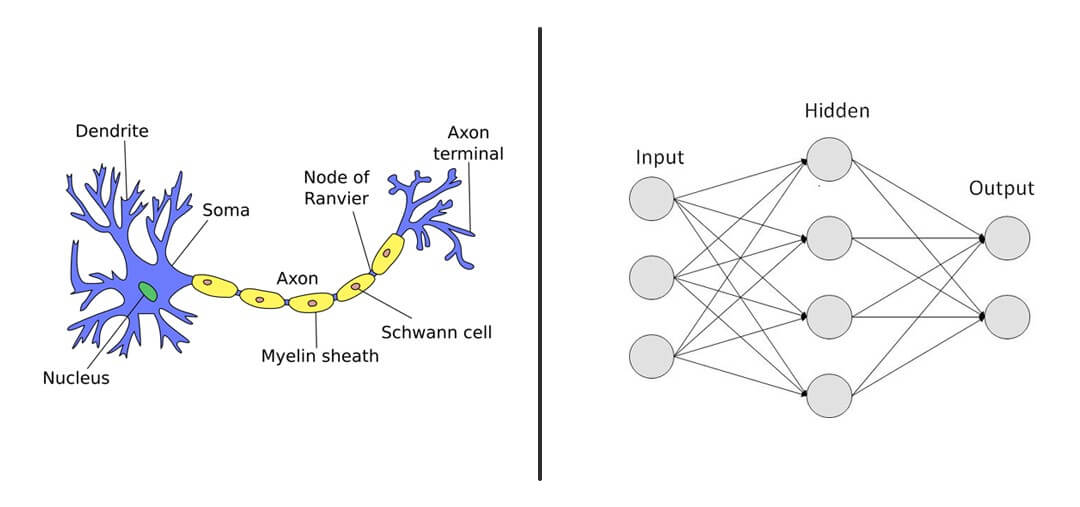
    Project 3 was completely different to Project 2- not only in terms of difficulty, but also what it meant it to me. In high school, I remember binging YouTube videos on neural networks for hours upon hours. I thought they were extremely interesting and powerful- but still had no idea how they really worked. Another reason that the algorithm caught my attention firstly was due to the relation the name has to the human brain, which has always fascinated me. Below is a picture that shows the relation between a brain’s neurons and a computer neural network.

    Neural networks and their allure were part of the reason that I wanted to study the Intelligence thread as CS major- so this particular project in Machine Learning was going to be important for unveiling the black box of how they work.

    What is a Neural Network?

    Neural networks seem extremely complicated, and they definitely can be. However, there are simple ways to think about them that makes the understanding much easier. Simply put, a neural network is a set of algorithms working together to show relationships in a dataset and try its best to mimic the behavior of human brains. They represent one of the most popular algorithms and can be programmed to do almost anything.

    This particular project was focused on one of the algorithms potential uses- text classification. Text classification is when a computer model is able to categorize words based on a certain trait they possess. For example, for this assignment, we were given the iMDB dataset of movie reviews that the computer model would take in and break down to analyze. The model is also fed training data and testing data- the training data is what the computer uses to learn how things are classified and the testing data is used to test the model’s accuracy. The computer model must be accurate on classifying movie reviews as either positive or negative on both sets of data. The coolest part of implementing a neural network like this is when it can accurately predict whether it is reading a nice review or bad review just like a human.

    Neural Bag of Words

    For the sake of length, I will only discuss one of the algorithms we implemented for Project 3, Neural Bag of Words. NBOW represents the situation in which a bag contains a bunch of words; think of someone reaching into a bag and fetching a word, but only paying attention to the amount of times a word appears and disregards grammar and word ordering from the word’s original sentence. This means that every single word in the bag is treated the same, it doesn’t matter what the word’s meaning or significance is.

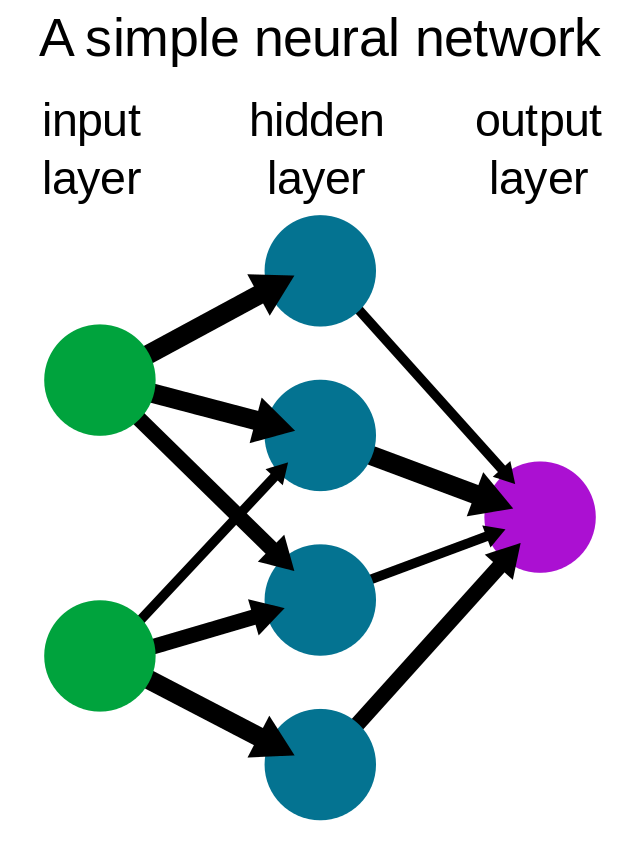
    The Neural Bag of Words model works like any other neural network- with an input and output layer, and a hidden layer in between.

    This algorithm works its magic by using an embedding layer, which helps convert words to vectors that can be used in the neural network. In our situation the input layer consists of the IMDB review dataset and the output we get is an accuracy of the computer’s prediction on the nature of the reviews.

    Conclusion

    Although I have only scratched the surface of what a neural network is made up of and does, the message of how strong it can be should be clear. Using neural networks, computer scientists can train any computer to predict anything at all using just an established dataset and training time! The possibilities of functions are endless!

  • Reflection on CS4641 Project

    Introduction

    When my professor assigned a new project in my CS 4641 class, Machine Learning, I felt panic begin to set in. All I could think of was my unpleasant experience from a couple weeks back. I had never coded for any machine learning project, so when I attempted the first coding project two days before it was due, it did not go smoothly. I had a meltdown because it was all so new and foreign to me and even the coding environment we had to use (Google Colab) was extremely confusing to me. In hindsight, I definitely should not have waited until the last minute to begin the massive project; I had let procrastination win. I had to find a way to turn the situation around, and quickly! 

    Now what?

    With less than two days left before the project deadline, there was no way I could finish the entire thing. Luckily for me, our class is allowed to utilize up to three late days on any assignment throughout the semester. I could finally take a breath and concentrate on the task at hand. Seeing that I had no clue whatsoever how to begin the project or even wrap my head around the concepts meant that I obviously needed to seek outside help. I went over to my professor’s website for the class and located the TA office hours guide on Piazza and signed up for every single office hour possible. In total, I was planning on going to seven different TA’s office hours during the rest of the week. 

    Struggling through the Process

    From there, I put my head down and worked until I could not stand the sight of my computer screen. I woke up early and went to bed late working continuously on the project. Thanks to the late days, I had time to go through the project step by step and write down every question I had. With these questions, I went to a bunch of office hours and learned from every single session with all the different TA’s. Through the non-stop work and meetings, I ultimately got my code to perform the desired outcome. That moment could have very well been the happiest I have felt this entire semester. The utter relief I had when it was all over was insurmountable. I had finally finished the monstrous project that I had put off for so long. 

    Conclusion

    Clearly, the biggest lessons learned here were that when a professor tells you not to start the homework late, listen to them and never be afraid to seek out help. I should never be embarrassed to ask any question I have because there are so many resources out there from GT to help.  Plus, once I eventually understood the machine learning project, it was super cool to see it work in action!