Author: Justin Blaylock

  • Legend of Sumeria: A Scientific and Artistic Read

    Are you looking for a book to read that’s fun, and action packed with science? Check out Legend of Sumeria! It’s a new graphic novel by co-creators Biju Parekkadan and Jay Webb, with amazing illustrations from lead illustrator Anthony Lagaipa,

    In comparison to other graphic novels that I have read, this one definitely has a lot more text in it. While it is a lengthy read, the plot continues throughout the novel at an appropriate pace and is very engaging.

    In terms of audience, I would say this is for a more advanced reader. Those starting high school and older are the most appropriate audience for this book.

    Regardless that the novel is full of great illustrations, all the facts are indeed scientific. Within the first chapter, I saw diagrams for blood cells, viruses, and chemical reactions. Most of these diagrams are represented through a handwritten diary from the novel’s protagonist, Dr. Bruce Abbot. And don’t worry, no spoilers here! If you want a more thorough background of the main components that the book contains, or how you can get the book, check out the official website here!


    Legend of Sumeria Sample
    Screenshot (41)
    Sample image of some scientific principles in the book!

    If you’re someone interested in STEM with artistic hobbies, this book is definitely one that you might want to read. (Check out Joshua Suber’s Charged post and his interview with one of the co-creators on communicating science through art here!)

    In just the first chapter, the novel has already mixed sci-fi, action, and art all into paper while keeping a real focus on life sciences and biotechnologies!  Legend of Sumeria is definitely a novel I look forward to finishing this summer!

    References:

    Parekkadan, B., Webb, J., Lagaipa, A. (2017). Legend of Sumeria. http://legendofsumeria.com/.

    *Featured Image:

    Parekkadan, B., Webb, J., Lagaipa, A. (2017). Sumeria-book-cover [Digital painting]. http://legendofsumeria.com/.

    *Please note that some of the images above were given special permission to use by the owners of the content for the purposes of this blog.*
  • The Primary Colors are What?!

    It’s about that time of the year where projects are due. You want to create a fantastic looking poster to present your research in a neat editing software. Yet you’re having trouble choosing the correct colors. Or wait, is it just your computer that’s having trouble choosing the correct colors? What is this section under the “edit colors” tab that says “RGB values”? You just want to make the perfect shade of orange using red and yellow, but the computer only understands RGB. It turns out that when it comes to computer science, red, blue, and green are the primary colors.

    Let’s break down this computational color system. The RGB (red, blue, and green) is known as an additive color system. The additive system was given its name because when wavelengths of light are added together, the color values approach white light. This system makes use of the physics of light to create the colorful (or colorless) pixels on your screen. To understand this further we have to break down the concept of light.

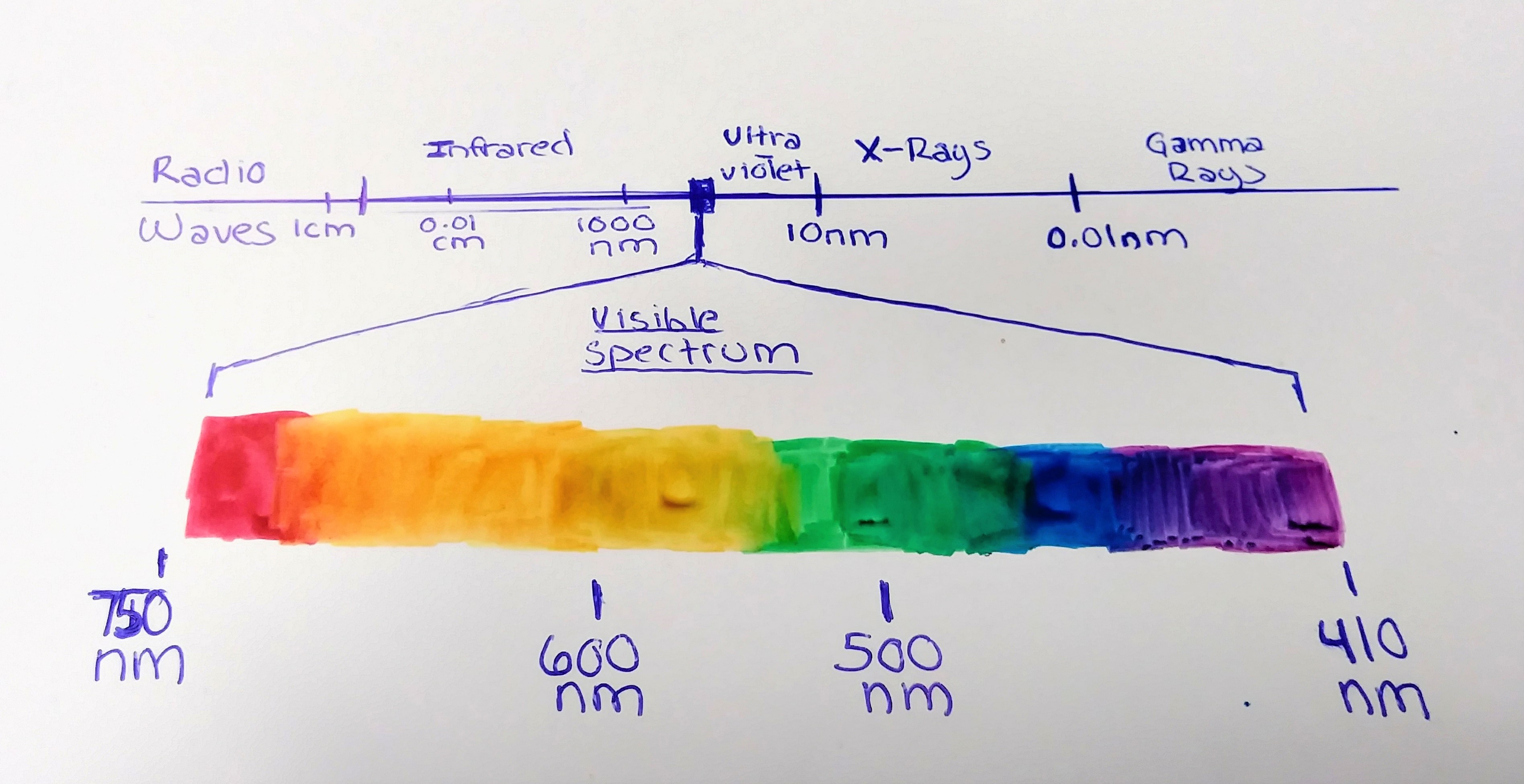
    On a spectrum of radiation, known as the electromagnetic spectrum, light composes the visible part of the spectrum. Light has two natures, but for now, let’s just focus on its wavelike nature. Each range of wavelength corresponds to a different color, with around 700nm (nanometers) being red light, and 400nm being violet light.

    Electromagnetic Spectrum
    Electromagnetic Spectrum

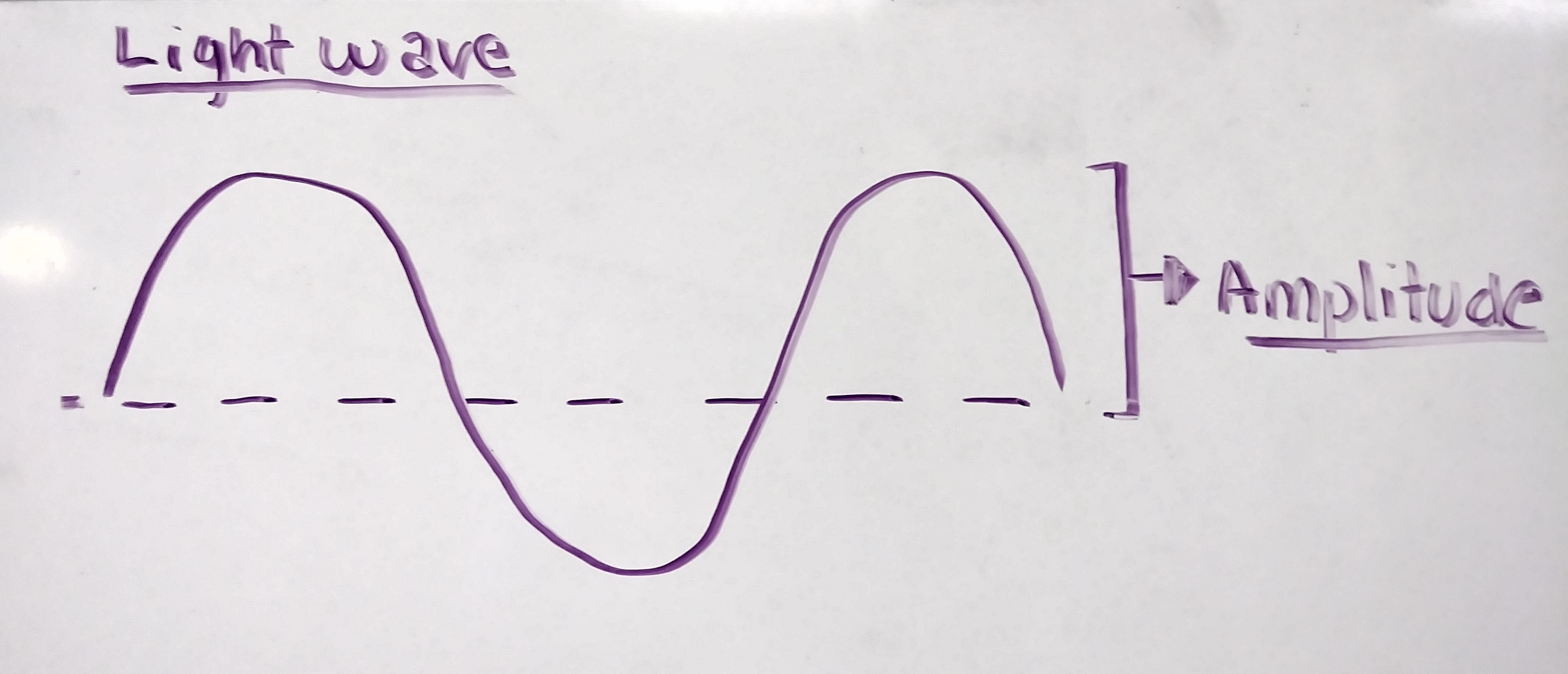
    The height of the wave from its center point, or it’s amplitude, determines how bright the light shines, or how close the value is to white. This means that the colors on your computer screen are not actually programmed into your computer as red, green, or blue. Rather, your computer makes colors by shining specific wavelengths of red, green, and blue lights with different amplitudes through the pixels, tricking your eyes into seeing specific mixes of colors. Neat, right?

    Light waves. The amplitude of the wave is from it's midpoint to the top (crest) of the wave!
    Light waves. The amplitude of the wave is from it’s midpoint to the top (crest) of the wave!

    The colors that you might have learned as primary in your childhood, red, blue, and yellow, follow the subtractive system. This means that as these colors are mixed they approach darker values going towards black. As paints they do not emit wavelengths of energy, like the pixels on your screen. These paints have pigments which reflect the color they show, and absorb all others. For example, a red apple reflects red light, but absorbs all other color wavelengths. Unlike paints, the pixels on your computer screen do not have pigments.

    Now that you know some more about the physics of color on your computer, making that science fair poster should be a breeze! Knowing how to manipulate your red, green, and blue wavelengths of light could save you a ton of time and give you some fantastic looking results! Happy poster making!


    References:

    Stroh, C. (Jul 1997). Basic color theory and color in computers. Art Education; Reston, 50(­4).