Author: Jennifer Light

  • Are Joro Spiders Going to Kill Us All?


    If you live in Atlanta, there’s a large chance you’ve come into contact with the now common Joro Spider. Measuring in at 3 inches long, Joro spiders have neon-yellow abdomens and long legs with bright yellow stripes. They build incredibly large and intricate webs and have seemingly positioned themselves as a super predator of arachnid world, catching basically any insect foolish enough to get caught in their web.

    Joro spiders are native to East Asia and were first introduced to Georgia in 2013. Since then, their populations have been increasing, but still remain mostly confined to North Georgia and Southern Tennessee. These spiders have begun to dominate northern Georgia, setting up shop in forests and urban areas. There is growing concern about their growing populations. Joro spiders are venomous, and families are concerned about the safety of these spiders around their pets and children. In addition, invasive species often pose threats to local ecosystems, and there is growing concern for how the Joro invasion is going to affect native flora and fauna. Lastly, it appears that the Joro population is slowly starting to spread northward, and many are beginning to worry that the Joro troops are planning to dominate the entire east coast, and maybe even… the world.


    To address these concerns, I would like to begin with the assertion that Joro spiders look a lot scarier than they really are. While these spiders are venomous, their venom is only potent enough to kill small insects. If a human is bit by a Joro spider, which is unlikely, it will hurt less than a bee sting and will not require medical attention. Despite their threatening stature, Joro spiders are, for lack of a better word, babies. They are a very docile and non-aggressive species of spider. A study conducted in 2023 by blah, was evaluating how different species of spiders reacted to a environmental stressor. When blown with a light puff of air, most spiders in the study responded by freezing for less than a minute. The Joro spider, however, reacted to the stressor by freezing for over an hour. It is safe to say that these spiders are not going to attack humans or animals they see as a threat.


    Concerns about how Joro Spiders may impact local ecosystems are much more valid. As of right now, scientists are unsure of exactly how these new Joro spiders will impact the environment. It is clear that they have cemented their spot as top predators of the arachnid world, and it is likely that they will out-compete native spider populations for food. This could threaten local spider and insect populations, which could lead to eventual destabilization of ecosystems, but the extent to which ecosystems will be affected is still up for debate.


    The good news is that many scientists are optimistic about the effects that Joro Spiders will have on the environment, some going as far as to say that they may be beneficial. In general, spiders are key pillars of healthy ecosystems, as they control insect populations and act as a key source of protein for birds. Additionally, there is no evidence that Joro Spiders pose any threat to the environment apart from potentially destabilizing insect and spider populations. Take the invasive Spotted Lanternfly, which was introduced to the US from China in 2014 These insects have had disastrous consequences on agriculture due to their intensive feeding of various trees and crops. Americans are advised to kill these lanternflies on sight due to their environmental impact. Luckily for it, the Joro Spider has yet to exhibit any behaviors that could pose a similar threat and could warrant similar measures. In fact, Scientists are optimistic that Joro Spiders could help the environment by preying on another invasive species, the Brown Mamorated Stink Bug. This bug was introduced to the US from East Asia in 1998 and caused significant agricultural damage through their feeding habits. There are very few natural predators of this stink bug, which has allowed their populations to boom. The Joro Spider, however, will happily feast on this stink bug, which could potentially keep their population in check.


    So, where are Joro Spiders headed now? As of right now, Joro Spiders are confined to the southeast, concentrated in Northern Georgia, Tennessee, and the Carolinas. There have been a few sightings of these spiders in Oklahoma, Maryland, and West Virginia, likely from being transported by car; however there is not evidence of any permanent or expanding Joro populations this far north. Joro Spiders prefer the warm climate of the southeast, and they are unlikely to move farther north. However, with climate change continuing to progress, it is possible Joro Spiders may increase their reign as a larger portion of America becomes habitable for them. At this point, it is difficult to predict.


    So, to answer the question, “Are Joro Spiders Going to Kill Us All?” is a definite no. While their large webs and bright colors might seem intimidating, Joro spiders are quite harmless to humans and pets. Although their presence does raise ecological concerns, particularly for native spider populations, scientists remain cautiously optimistic. For now, residents of the Southeast can coexist peacefully with these giant newcomers and perhaps even appreciate the role they play in keeping insect populations in check.


    Works Cited


    Bugwood. (2024, November 5). Home. Joro Watch. https://jorowatch.org/


    Joro Spider is a unique exception to a major threat. Big Think. (2022, May 20). https://bigthink.com/life/joro-spider-invasive/


    Meadows, K. / S. (2021, September 6). Joro spider update: Controlling this invasive species. Joro Spider Update: controlling this invasive species.

    https://gardeningsoul.blogspot.com/2021/09/joro-spider-update-controlling-this.html


    Pappas, S. (2024, June 11). No need to panic about the joro spiders. Scientific American. https://www.scientificamerican.com/article/millions-of-joro-spiders-are-moving-up-the-east-coast-heres-what-to-expect/


    Spotted lanternfly. Spotted Lanternfly | National Invasive Species Information Center. (n.d.). https://www.invasivespeciesinfo.gov/terrestrial/invertebrates/spotted-lanternfly


    Walling, M. (2024, June 7). Everything you need to know about the invasive joro spider. PBS. https://www.pbs.org/newshour/science/everything-you-need-to-know-about-the-invasive-joro-spider

  • The Psychology of Fear and Why We Seek it Out

    If you’re a fan of Halloween, there’s a good chance you partook in one of America’s favorite passtimes this spooky season: watching a great horror movie. Something about getting cozy on the couch and watching a bloody zombie attack, or a thrilling ghost possession, and feeling all the fear and emotions that come with it can quite the thrill. If any of this resonates with you, I ask you to consider the question, “Why do you watch horror movies out?” In every other aspect of our lives, horror is an emotion we find undesirable and seek to avoid. So why do we, in special circumstances, purposely seek out these feelings of fear? If you love horror movies but have never deeply explored what draws you to them, I encourage you to keep reading. If you are one of those people that hates horror and can never understand how so many people get enjoyment out of watching scary movies, stick around and you might get a better understanding of why.


    There are many different reasons that someone could enjoy horror movies, and the appeal can vary based on the individual. One common thread between horror-enjoyers, however, is the thrill that horror provides. Thrill is a difficult emotion to describe, as it can describe emotions associated with extremely positive or negative experiences. A thrill is often defined as a “pierce of emotion” and is often present in high-adrenaline activities, such as skydiving or riding rollercoasters. People who really enjoy this feeling, also known as thrill-seekers, are likely to be especially prone to enjoying horror movies. This relates to the similar concept of sensation-seeking, which is the phenomenon where people desire intense sensations and experiences. Sensation-seeking is a strong indicator of one’s enjoyment of horror films for both genders, but it is notably a stronger indicator for men’s enjoyment of horror films.


    Men and women enjoy horror for different reasons. For men, thrill and adventure-seeking personalities are strong indicators for horror enjoyment, whereas for women, disinhibition is a stronger sensation-seeking indicator. Disinhibition refers to a lack of restraint, or a willingness to engage in risky or socially unacceptable behaviors. Women who have high levels of disinhibition are likely to find enjoyment in horror media.


    On the topic of gender differences, there is strong evidence that men generally enjoy consuming horror more than women. Proposed reasonings for this are that women tend to be more prone to feelings of disgust and anxiety than men, and this can cause them to be turned off from horror. Additionally, studies have shown that women have higher levels of empathy than men, and will be less likely to find enjoyment in the suffering that typically occurs in horror films.


    There are many reasons why people may be drawn to horror, but one of the most widely accepted theories is Dr. Dolf Zillmann’s excitation transfer theory, which poses that we are drawn to horror because of the feelings we get from witnessing high suspense and resolution. According to this theory, as we watch a negative, suspenseful buildup, we experience high emotions that are later converted into euphoria as the suspense ends and a resolution occurs.


    Now, you may be thinking to yourself, “What about horror movies that feature suspense without a resolution? How could we find enjoyment in those?” This is an extremely relevant question, as many horror films do not have happy endings, and fill us with a sense of dread by their lack of a resolution, rather than the comfort that a happy ending would bring. I would argue that horror films without a true resolution still allow us to feel the same euphoria by providing a pseudo-resolution that lies within the realization that we are consuming media. Even if a horror movie has a horrible ending, with no hope for the characters or world, we are able to experience the joy of existing in the safety and comfort of our own world and realizing that the fear and discomfort we are feeling is not real. I would argue that this is a resolution in itself, from the perspective of the viewer.


    This takes me to my final point about horror enjoyment, which I feel that many people can probably relate to. While we do not usually enjoy experiencing fear in most facets of our everyday lives, film and media give us a chance to experience these strong emotions which we typically avoid, in a safe and controlled environment. The contrast between the visceral fear our bodies are experiencing, and the mental certainty that we are not actually in danger allows us to enjoy an emotion that we usually hate. This embodies the same concept of how we feel riding roller coasters. Our bodies sense danger, but our minds know we are safe.


    So, next time you sit down to watch a horror movie, think about what’s really pulling you in. Is it the thrill, the suspense, or the satisfaction of facing fear on your own terms? Whatever it is, remember: fear isn’t always something to avoid—it’s sometimes something to embrace.


    Works Cited


    Martin, G. N. (2019). (why) do you like scary movies? A review of the empirical research on psychological responses to Horror films. Frontiers in Psychology, 10. https://doi.org/10.3389/fpsyg.2019.02298


    Neurominded. (2023, October 31). The Spooky Science of Horror Movies: Why Do We Enjoy Being Scared?. Inspire The Mind. https://www.inspirethemind.org/post/the-spooky-science-of-horror-movies-why-do-we-enjoy-being-scared


    Zuckerman, E. (2017, February 24). Get Out is one of the most terrifying movies in years — because it’s so smart. Vox. https://www.vox.com/culture/2017/2/24/14698632/get-out-review-jordan-peele


  • Why Does Mars’s Moon Look Like That? A Dive into Moon Formation

    The other day, I came across a funny meme on Instagram.


    I laughed, I gave it a like, and I moved on with my life- kind of. As I continued with my day, one thought kept creeping up in the back of my mind- “Why does Mars’s moon look like that?” It doesn’t even look like a moon, from the standards of as average Earth-dweller, who is so used to the beautiful, spherical, and almost perfect moon that we have been spoiled by. Why is Earth’s moon so perfect, while Mars’s moon looks like it just hopped off the nearest asteroid belt into Mars’s orbit?


    Mars has two moons, Phobos and Deimos. There is no absolute consensus among the scientific community on how these two moons came to be, but there are two main theories. The first theory, known as the Capture Theory, is that Mars’s moons are captures asteroids, meaning debris created during the early formation of the solar system were pulled into Mars’s orbit by the planet’s gravitational pull. The fact that the two moons are so small and irregularly shaped supports the Capture Theory, along with the fact that they are visibly much darker in color than the Red Planet. The opposing theory is known as the Impact Theory, proposes that Mars underwent some impact from some collision during its early years, uplifting debris that aggregated into two moons. Recent photographic evidence has suggested that Deimos is composed of a rocky material, very similar to what makes up Mars, which supports the Impact Theory and opposes the Capture Theory, which would expect the moons to be made of a more carbon-rich material. There is also debate to whether or not these two moons are even made of the same material, or moreover, were even formed in the same event.

    There are a great deal of unknowns about how Mars’s moons were formed, but however they came to be, they sure look a lot different from our moon. While formation process may play a role in this, the main reason for this difference, is mass. Our moon has an approximate mass of 7.348 × 10²² kilograms, while Mars’s larger moon, Phobos, has a mass of only 1.060×10¹⁶ kilograms. While these both seem like huge numbers, the masses of these two moons are on vastly different scales, with Phobos being about 0.000014% the mass of Earth’s moon. In summary, Mars’s moons are tiny, and this accounts for the fact that they look so nonuniform.


    When the Earth’s moon was forming, it became rounded due to the same principle that causes every other sizable celestial body to become spherical- self gravity. Self-gravity is the gravitational force that an object exerts on itself. Once a body accumulates enough mass, this force will pull in towards its center, forming a spherical shape. This final stage is known as hydrostatic equilibrium. Every object that has mass has some amount of self-gravity, even people! But of course, we do not have nearly enough mass for our self-gravity to pull us into a sphere. So that’s the main reason Mars’s moons are so misshapen; they’re too small to exert a strong enough self-gravitational pull on themselves. But, there is one more piece to the puzzle. Mass isn’t the only things that cause celestial bodies to become rounded. The other secret ingredient is material.


    For bodies to reach a spherical state, their self-gravity must be strong enough to warp and squish the physical material that they are composed. For example, a hypothetical body made of only liquid water would not need much mass in order to achieve hydrostatic equilibrium, because water molecules can be moved around with very little force. There are other materials, such as iron, that resist gravitational pulls even more, and require even more mass to become spherical. The smallest known celestial body that has reached hydrostatic equilibrium is Saturn’s moon, Mimas, which has a diameter of only 396 km. This moon has a very low density, and is composed of mainly ice, and a small amount of rock. This composition gives Mimas a low resistance to its own self-gravity, hence allowing it to become spherical, even with its small mass.

    While the answer to my original question turned out to be pretty simple, topics involving space always have a way of becoming more complex. I hope you were able to learn something from this article, or maybe find a topic that you would like to learn more about. There are still so many unknowns in this topic, including exactly what Mars’s moons are even made of, but there is also new and exciting research coming out every day.


    Sources

    Coffey, D. (2023, November 13). Why are things in Space round?. LiveScience. https://www.livescience.com/space/why-are-things-in-space-round#:~:text=Gravity’s%20rounding%20effect%20is%20a,into%20a%20sphere%2Dlike%20shape.

    Giant impact may explain origin of martian moons phobos and deimos. Smithsonian Insider. (n.d.). https://insider.si.edu/2010/12/giant-impact-may-explain-origin-of-martian-moons/

    Jonti Horner                          Professor (Astrophysics). (2024, March 5). I’ve always wondered: Why are the stars, planets and Moons Round, when comets and asteroids aren’t? The Conversation. https://theconversation.com/ive-always-wondered-why-are-the-stars-planets-and-moons-round-when-comets-and-asteroids-arent-160541

    Metcalfe, T. (2023, May 18). A new look at Mars’ Moon Deimos highlights its mysterious origin. Astronomy Magazine. https://www.astronomy.com/space-exploration/a-new-look-at-mars-moon-deimos-highlights-its-mysterious-origin/


  • Artificial Rain- Real or Sci-Fi

    It’s a futuristic fantasy that many have dreamed up, that humans could someday possess the power to control the weather. Artificial weather is an interesting, but ultimately fantastical pipe dream, or is it? Would you believe me if I told you that countries around the world have been artificially altering the weather for decades? Maybe you would, and maybe you’ve heard the term “cloud-seeding” going around in the media recently. You may have heard that it is an innovative, new solution to water scarcity and climate change. Or, maybe you heard that it is causing immense harm to the environment, including some extreme cases of flooding in the Middle East. But, what exactly is cloud-seeding, and why is it being done? Is this new innovative process a solution to environmental issues, or is it another cause?


    To understand how cloud-seeding works, it is important to understand the science behind how clouds form. Clouds are formed when evaporated water cools and condenses around a small dust or salt particle in the atmosphere. A common misconception about cloud-seeding, is that these dust particles are being released into the atmosphere to facilitate the formation of clouds. That is close, but not completely accurate to what cloud seeding is. Cloud seeding is less concerned with cloud formation, and more concerned with increasing precipitation. There are multiple types of cloud seeding, but they all involve releasing particles (usually a type of salt) into already existing clouds to act as ice nuclei. These crystalline particles increase the rain-fall capacity of the cloud by causing ice crystals to form around the ice nuclei, thus increasing the ability of the cloud to induce precipitation. Cloud seeding has been used in the US and many other countries in the world for decades to fight drought, help agriculture, disperse fog, and even help out struggling ski resorts by increasing snowfall.


    Cloud seeding has only been a widespread practice for a few decades, and the lack of research on the topic has led to the emergence of many environmental and ethical concerns. Because cloud-seeding has not been in practice for long, it is difficult to predict the long-term environmental effects on ecosystems. Cloud seeding often includes the release of materials such as silver-nitride, dry ice, and salt into the atmosphere, all of which, though being relatively harmless, have not been studied in their long-term ecological effects. There are also concerns about the meteorological effects of artificial rain, and what larger effects altering the climate could produce. More research is required to fully understand this, but there is evidence to suggest that altering weather patterns in one area could inadvertently affect the climate in a completely different region, or disturb climate patterns in general. There are also ethical concerns over this practice, as it brings up the question of who owns and controls natural resources. In regions where water scarcity is a pressing issue, concerns over who controls and owns water resources is a growing debate, and the concept of “creating” rain in one region amplifies these concerns.


    Now, it is time to address one of the biggest accusations that cloud-seeding has received- that this technology has directly caused some disastrous flooding events. On April 16, 2024, a record amount of flooding caused by heavy rainfall hit the United Arab Emirates, heavily affecting the cities of Dubai and Sharjah. Cloud seeding is a common practice in this region and was immediately blamed as the cause of the flooding. However, after some investigation by experts into the flooding cause, it seems unlikely that cloud-seeding played a role. Dr Friederike Otto, senior lecturer in climate science at Imperial College London, stated that, “Even if cloud seeding did encourage clouds around Dubai to drop water, the atmosphere would have likely been carrying more water to form clouds in the first place, because of climate change” (BBC). Meteorologists at BBC also mentioned that heavy storms had already been forecasted by systems that do not take into account artificial rain fall caused by cloud seeding. So, this tremendous weather event was not in fact caused by cloud seeding, but is another long-term effect of human-caused global warming. Higher air and ocean water temperatures from global warming increases evaporation and cloud formation, subsequently leading to increased precipitation. Global warming seems to be a common thread connecting a plethora of increased occurrences of natural disasters that we have seen in the last decade.

    In conclusion, the concept of artificial weather, once confined to the realm of science fiction, has become a reality in many parts of the world through cloud-seeding. While initially seen as a solution to water scarcity, the widespread use of cloud-seeding raises significant environmental and ethical concerns. The lack of long-term research on its ecological impacts, coupled with the potential for unintended meteorological consequences underscore the complexity of manipulating weather patterns. Moreover, recent events such as the flooding in Middle East highlight the need for a deeper understanding of the interactions between human behavior and natural processes in the context of climate change. While cloud seeding may not be directly causing these floods, as many people were quick to believe, it is clear that we as a society have much to learn about the long-term effects our actions have on the environment we are so eager to alter. As we navigate the relationship between innovation and responsibility, it becomes increasingly clear that the quest to control the weather requires careful consideration of its broader implications for our planet.


    Sources

    Anderson, B. (2024, April 23). What is cloud seeding (or Artificial Rain)?. Greenly. https://greenly.earth/en-us/blog/ecology-news/what-is-cloud-seeding-or-artificial-rain

    CBS Interactive. (n.d.). What is cloud seeding and did it play any role in the Dubai floods?. CBS News. https://www.cbsnews.com/news/what-is-cloud-seeding-and-did-it-impact-dubai-floods/

    How climate change is making record-breaking floods the new normal. UNEP. (n.d.). https://www.unep.org/news-and-stories/story/how-climate-change-making-record-breaking-floods-new-normal

    Silva, M. P. & M. (2024, April 17). What is cloud seeding and did it cause Dubai flooding?. BBC News. https://www.bbc.com/news/science-environment-68839043

    What is cloud seeding?. DRI. (2022, September 19). https://www.dri.edu/cloud-seeding-program/what-is-cloud-seeding/#:~:text=Cloud%20seeding%20is%20a%20weather,base%20for%20snowflakes%20to%20form.

  • Is Love Truly Blind? An Analysis of the Popular Dating Show

    \

    From its initial debut on Netflix in 2020, Love is Blind has captured audiences and secured itself as one of the most popular dating reality shows of the 21st century. What makes Love Is Blind different from other popular dating shows is that the contestants date and propose to their prospective partner from behind a wall, without every seeing each other. It isn’t until they solidify their engagement that the contestants are able to see what their partners look like. Another difference between Love Is Blind other reality shows? Love Is Blind takes itself extremely seriously. The hosts, Nick and Vanessa Lachey, are notorious for referring to their show as “an experiment”. Instead of a hypothesis for this “experiment” the hosts simply repeat the leading question: “Is love truly blind?”.

    In this article, I attempt to analyze Love Is Blind as an experiment from a scientific perspective, in an effort to answer the question, “does the inability to see your partner during a dating stage increase the viability of a long term relationship compared to a typical dating scene where both parties can see one another?”. To do this, I will compare Love Is Blind another popular reality dating show, Love Island. In Love Island, contestants are not only able to see each other, but they are encouraged to judge their fellow contestants by their physical appearances. We can compare the outcomes of each of these shows to conclude which dating strategy is more effective in forming successful, lasting relationships.

    Because this is an experiment, we will need to analyze our variables. It is imperative to account for the major differences between these shows, and note that our comparison will be far from perfect. For one, Love Is Blind is a marriage-focused show. Contestants (allegedly) sign up for the show in hopes of finding a husband or wife. Most of the contestants on Love Is Blind are in positions in their life where they are ready to commit to long-term relationships. This is much different than Love Island, which engages in a culture of flirtatiousness, changing partners, and employs a cast of younger contestants, who are less likely to want to pursue a long-term relationship. Love Is Blind is unique in that it involves such a large cast of singles from both sexes, and follows multiple couples’ pursuit of marriage. There are no shows quite like Love Is Blind, which makes it difficult to assess it as a true experiment. An ideal scenario would involve recreating the show perfectly, but with face-to-face dating instead of blind dating. Of course this is impossible, so our comparison to Love Island, is the next best option. To eliminate cross-cultural variables, we will be analyzing the slightly less popular US version of Love Island.

    I will now present the data that I collected from each reality show. To start, Love Is Blind has been running for 6 seasons, each with 30 contestants. Out of these 180 contestants, 61 contestants have become engaged on

    the show, or 31 couples (One contestant was engaged twice to two different partners). Out of these 31 couples, 20 couples broke up on the show, 9 couples are still together, and 2 couples married each other on the show, but eventually broke up. This adds up to a 29% long-term success rate out of all the couples engaged on the show, and an overall 10% success rate out of all the contestants over all 6 seasons.

    In comparison, Love Island, US has taken place over 5 seasons, each with 25 contestants, for a total of 125 contestants over the whole show. Out of these contestants, 15 couples have continued to date after the show. Out of these 15 couples, only three are currently together. This adds up to 20% chance that a couple formed on the show will stay together, and an overall success rate of 4.8%. This number is also likely generous, as Love Island typically introduces new contestants in the middle of seasons, some seasons almost doubling in cast size before the end.

    Based on these numbers, it is clear that Love Is Blind is more successful than Love Island at forming lasting relationships. In fact, Love Is Blind’s statistics of forming 9 married couples after only a 6 season runtime is unprecedented in dating shows. No other show comes close to Love is Blind in the sheer number of successful relationships formed. Even marriage-focused shows like The Bachelor pale in comparison to the success rate of Love is Blind. After 28 seasons of the Bachelor, and 20 seasons of The Bachelorette, only 9 couples from the shows are still together to this day. This means that if you are the “Bachelor” or the “Bachelorette” you have an approximate 18.75% chance of forming a lasting relationship during your time on the show. While this is better than the 10% success rate of Love Is Blind, it isn’t much better. Considering the fact that the bachelors and bachelorettes are dating 25-30 potential partners, and have no competition, it makes sense that there would be a decently high success rate. Additionally, most seasons of The Bachelor and The Bachelorette end in an engagement, so it would be reasonable to expect more than 9 lasting couples after 48 seasons.

    Given the data and considering the variables, it seems evident that Love Is Blind has an impressively high success rate compared to similar reality dating shows. Love is Blind has an overall success rate of more than 2x that of Love Island, US. While it does have an 8.75% lower success rate than The Bachelor/Bachelorette franchise, the average contestant on Love Is Blind has an unprecedentedly high chance of finding love than the average contestant on these shows. It seems very probable that the factor contributing to this high likelihood of success is the blind-dating style. There is evidence in support of blind dating that suggests that deeper, and more lasting bonds are formed when physical appearance is taken out of the equation. It is also possible that age, sociodemographic factors, time frame, and casting decisions could also be contributing to the show’s success. Whatever the reason, there is absolutely evidence that blind dating can lead to a comparatively high relationship success rate in a reality TV format. In other words, there is evidence that love is, (or certainly can be) blind.


    Sources


    Delbyck, Cole. “Which Couples Are Still Together from Every Season of Love Is Blind?” Netflix Tudum, Netflix Tudum, 28 Mar. 2024, www.netflix.com/tudum/articles/love-is-blind-who-is-still-together-every-season.

    “Love Is Blind (TV Series).” Wikipedia, Wikimedia Foundation, 2 Apr. 2024, en.wikipedia.org/wiki/Love_Is_Blind_(TV_series).

    “Love Island (American TV Series).” Wikipedia, Wikimedia Foundation, 7 Apr. 2024, en.wikipedia.org/wiki/Love_Island_(American_TV_series).

    Siwak, Miranda. “Love Island USA Couples: Who Are Still Together and Who Broke Up?” Us Weekly, 29 Mar. 2024, www.usmagazine.com/entertainment/pictures/love-island-usa-couples-who-are-still-together-and-who-broke-up/.

    “Stop Swiping, Start Talking: The Rise and Rise of the Blind Dating App.” The Guardian, Guardian News and Media, 8 Nov. 2022, www.theguardian.com/lifeandstyle/2022/nov/08/stop-swiping-start-talking-the-rise-and-rise-of-the-blind-dating-app.


  • Real or CGI? How Technology is Used in Netflix’s Life on Our Planet


    Life On Our Planet. Cr. Courtesy of Netflix © 2023

          The image above features two Cave Lions, beautifully captured looking out over the icy foothills of Madagascar. The lions look pristine, and the photo would fit right in inside the latest edition of National Geographic. Except for the fact that this picture isn’t real, and Cave Lions have been extinct for around 14,000 years. This photograph is screen captured from an episode of Netflix’s Life on Our Planet, and the Cave Lions are completely computer generated.

          Now, maybe you guessed that these animals were made with CGI. The fur looks a little but too soft and perfect, and their expressions look just a smidge too human. There are certain tells that can give away whether something is real or computer generated, and human eyes are great at spotting them, usually.

         The other day, I was watching an episode of Life on Our Planet, and I found myself completely unable to distinguish between real and computerized animals. Even prehistoric animals, which I knew were long extinct, looked and moved so realistically that I thought the producers could have filmed some real, unique and unknown creature, and edited the scale and colors to make it look like something new. The way the animals moved, the way they interacted with their environments- my brain could not comprehend the notion that these animals were simply rendered and animated computer models. This coupled with the fact that the real wildlife shots from Life on Our Planet are so beautiful, detailed, and crisp, that even the real animals appear fake at times, had me questioning the authenticity of every scene that I saw.

         Most of the animals depicted in this docuseries are completely real, and breathtaking videos are produced from the tireless work of on-site videographers, who can spend months on location just to get that perfect shot. It is only when depicting dinosaurs and other prehistoric creatures, that the production team relies on CGI.

         It was shocking to me how realistic CGI models have become. One way to see how this technology has improved is to compare the CGI rendering of dinosaurs from Jurassic Park, created in 1993, and Life on our Planet, created in 2023.

          Watching these two clips makes the differences over 30 years even more clear. The contrast in texture, movement, and overall quality has gotten remarkably better since the days where CGI was still in its experimental stages. CGI was not truly integrated into movies until the early 70s. Jurassic Park was a trailblazer in CGI, and considering how early it was made, the computer-generated dinosaurs look pretty good. Jurassic Park utilized RenderMan technology, the same program that was adopted by Pixar and used to create Toy Story and Avatar. Since then, RenderMan has evolved with technology, maintaining its position as one of the most advanced rendering technologies by adopting features like raytracing, which could light animated scenes better than ever before by simulating the behavior of actual light. 

         Life on Our Planet works with a variety of technologies to create their hyper realistic, 3D animations. Their process is primarily done through Industrial Light and Magic, or ILM, a visual effects company founded by George Lucas in 1975 to create effects for the original Star Wars film. ILM utilizes the 3D modeling program, Autodesk Maya, and renders with RenderMan.

        The process for creating these hyper-realistic, CGI creatures for Life on Our Planet is quite extensive. As is documented in behind-the-scenes content for the series, it begins with filming the scenery. Taking beautiful shots of nature is no longer enough. The film crew has to plan every detail of the final scene before they even start filming. Where will the animal stand? What path will it move in? Every twig and leaf in its path must be removed or otherwise accounted for in order to produce a believable animation 

         But animals don’t simply glide over the ground; they affect their environment. How can film-makers create the illusion that an animal is interacting with its environment without it even being there? In cases where the animal is making drastic, visual changes to the environment, like a dinosaur eating a branch off a tree, filmmakers will greenscreen (or more accurately, “bluescreen”) themselves into the scene, modifying the environment with a visible hand that will be edited out later. Smaller and less noticeable environmental interactions can be completely done in post-production, but before we can understand that, it’s important to know how the environment is rendered with this type of CGI.

         In Life on Our Planet, the first step of post production takes place within the Layout Department, and it involves baking in images taken on site into a digital environment in which the animation will take place. With CGI this advanced, the entire environment must be rendered before a character can be placed in it. Simply editing an animation into raw footage would not be able to produce the environmental interactions that are needed to make a character truly seem part of a scene. The animal will need a physical terrain to move across. It will need to be placed behind objects in the foreground. The best method to achieving this is a complete environmental rendering, which, as can be seen in the docuseries, is completely indistinguishable from regular footage.

         Once the digital environment is formed, animators can create believable environmental interactions. Slightly adjusting the terrain can give the appearance of a footprint. An animal can scratch a tree, turn up some foliage, or unearth dirt.

         The process for creating CGI animations is complex, and it varies across studios, production companies, and type of work. Life on Our Planet provides us with a view into the potential of CGI so create true to life animations and visuals, and believable environmental interactions. By melding the real world with the computerized, this series has created some of the most realistic and beautiful animations we have seen yet. Considering the fact that CGI has only been meaningfully used in film for around 50 years, it is exciting to imagine the possibilities as technologies advance even further.


    Works Cited

    Life on Our Planet | Filming Dinosaurs in The Real World | Netflix. (2023, November 3). Www.youtube.com. https://www.youtube.com/watch?v=nKRP2Zc6udA

    Nast, C. (2019, April 10). “Our Planet” filming locations: where was the Netflix series shot? CN Traveller. https://www.cntraveller.com/gallery/our-planet-filming-locations

    Petychakis, M. (2020, June 29). How Technology Evolutions changed Animation. APILama. https://apilama.com/2020/06/29/how-technology-evolutions-changed-animation/

    Schrodt, P. (2023, November 9). What Did Dinosaurs Really Look Like? “Life on Our Planet” Filmmakers Explain. Netflix Tudum. https://www.netflix.com/tudum/articles/life-on-our-planet-what-did-dinosaurs-look-like

    Tyson, J. (2000, November 14). How Industrial Light and Magic Works. HowStuffWorks. https://entertainment.howstuffworks.com/perfect-storm.htm


  • Agriculture Overseas- An Examination of Floating Sea Farms

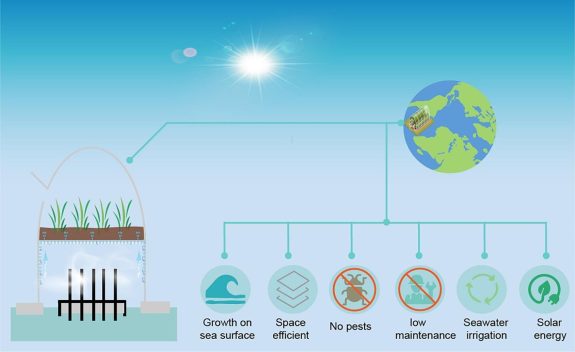
          There is a new technology on the horizon that claims to have the potential to solve two of the biggest global issues: world hunger and freshwater supply. These two problems are, of course, inextricably tied together, as 70% of the world’s freshwater withdrawals are used for agriculture. Professor Haolan Xu and Dr. Gary Owens have developed a design for a “floating sea farm” which would address this problem by producing agriculture without the use of freshwater. In short, the farms sit on top of the ocean, collecting and evaporating seawater that is then used to water crops. The entire system is powered by solar energy, and can potentially be self-sustaining, requiring little to no intervention during crop growth.

         The ability to grow crops over the ocean unlocks a vast potential of usable agricultural space, as oceans make up 70% of the Earth. Moving agriculture overseas could immensely relieve the pressure we are putting our land under and allow us to designate agricultural areas to other purposes. Additionally, these stable systems would reduce farming labor, and drastically reduce global freshwater usage.

         So how exactly do these floating sea farms work? The current model of the double-layered vertical solar sea farm (or DVSSF) is divided into three subsystems: the bottommost solar evaporation chamber, a water condensation and transfer system, and a greenhouse-like plant cultivation chamber on top of the structure. The solar evaporation chamber consists of photothermal evaporators which convert sunlight into heat energy, powering the evaporation of sea water. These devices are partially submerged under the surface of the sea and are supported by floating polystyrene foam. Condensed water vapor is then absorbed by vertically-oriented strips of bamboo paper and transported upwards to the upper soil chamber, where plant irrigation will occur.

         Floating sea farms sound like a utopian dream, but how feasible are all of these promises? Floating sea farms are still in their early stages, and it will likely be years until we see this technology implemented on a large scale. In May 2022, large, open-air experiments were conducted using lettuce, broccoli, and Pak Choi. The growth of all of these plants was successful, demonstrating a real potential of the technology, but also highlighting areas in need of improvement. For instance, these experiments revealed that a surplus of clean water was being produced, and efforts are now being made to design a system that will store this water and use it for other applications. Additionally, the current prototype has only been tested with these three common crops, and much more testing would need to be done to integrate the diversity of agriculture that would be necessary to truly make an impact on global food production. As of right now, the DVSSF has a strong proof of concept, but is still in the experimentation stages. As more work is done improving the prototype and scaling up the project over the next few years, it is certainly possible that this technology could lead to a complete shift in agricultural production as we know it.

    References:

    Floating sea farms: A solution to feed the world and ensure fresh water by 2050. (2023,      September 11). ScienceDaily.                      https://www.sciencedaily.com/releases/2023/09/230911141045.htm

    Pan, W., Wu, X., Yu, H., Zhao, J., Wang, Y., Pi, K., Owens, G., & Xu, H. (2023). An interfacial     solar evaporation enabled autonomous double-layered vertical floating solar sea farm. Chemical Engineering Journal, 473, 145452–145452. https://doi.org/10.1016/j.cej.2023.145452

    The AIM Network. (2023, September 11). Floating sea farms: An ingenious solution to feed the world and ensure freshwater by 2050. https://theaimn.com/floating-sea-farms-an-ingenious-solution-to-feed-the-world-and-ensure-freshwater-by-2050/