Author: Jaden Stutzmann

  • The Evolution from Fossil to Monster

    Humankind as a species is over 200,000 years old. We are travelers, storytellers, and connoisseurs of legends and tales. For thousands of years, mankind has entertained our children and fellow tribesmen with fables and stories of the unknown, the cryptic and the mythological. It is a unifying factor in our world. Every story needs a strong villain to maintain equilibrium and for many, the villain was the monster. From Greek and Roman to Japanese and Native American, fantasy and folklore have been influenced from the history of this planet. All cultures have created monsters to fuel their fears. Either to rationalize the unknown or to provide comfort for themselves, men and women of the past have created these stories for purposes that have been lost to time. Yet, monsters are alive and real today, be it in between a page or in a culture. These beasts came from our imaginations. However, many of these terror-bringers were imagined based on fossils, skeletons, or unknown sightings that frightened the inhabitants of their lands. 

    From tales of creation, to the flood, and even tales of doom, every culture has unifying legends. Some cultures produced monsters so terrifying that they were hidden and lost to time, while some have been immortalized in books, movies, and videogames. The primal fear of the unexplainable had to be justified through something tangible by mankind. Two monsters that have fueled the nightmares of children and men; two giants of terror that were produced from the unknown, can now be explained.  

    THE CYCLOPS:

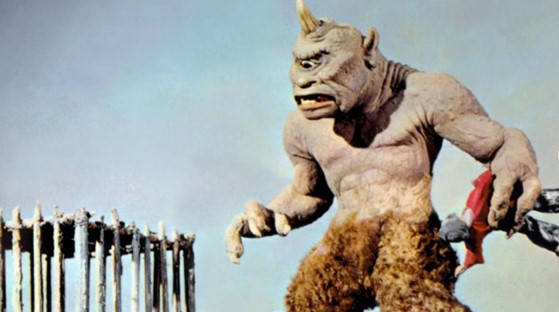
    Cyclops are a cannibalistic giant race bearing a distinct feature: a singular eye in the center of their forehead. Notable cannibals and warriors in Greek mythology, the cyclops were born from the Greek God Poseidon but were cast away because of their grotesque ugliness. In Greek stories and in pop-culture, cyclopes have been used as a formidable opponent to heroes and heroines. The most well known depiction of the cyclops race comes from Homer’s The Odyssey. Other notable depictions have been seen in The Cyclops (1957), Wrath of the Titans (2012), and Tron: The Odyssey (2017). 

    According to Homer, Polyphemus was the cyclops leader on the isle in which Odysseus was stranded on his return home. Polyphemus was a sheep herder and a brutal warrior. During Odysseus’ time on the island, Polyphemus severed a man in half with a single bite and crushed a man in his grasp. A nightmarish scene that captures our fears of these cannibal giants; the infamous cyclops look, from Greek vases to modern day, has endured the test of time.Cyclops from “Seventh Voyage of Sinbad”. Director Nathan Juran
    Their faces look eerily similar to elephant skulls:Elephant Skull. Photo courtesy of Felipe Romao
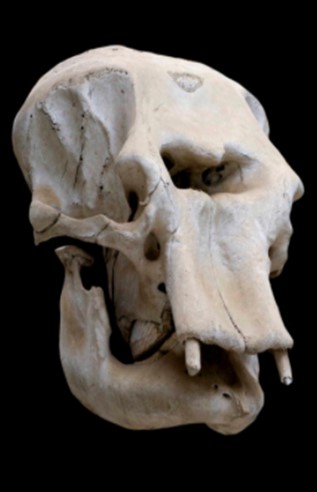
     

    These skulls can easily be viewed as a horrific mono-visual monster. Ancient Greece had two different species of elephants roaming the area: The Cyprus Dwarf Elephant and the Cretan Dwarf Mammoth. Such large skulls would have to be supported by tremendous bodies. These skulls sported massive tusks and teeth which were perfect for crunching the bones of men.  

    In the early 20th century, Paleontologist Othenio Abel suggested that the inspiration of cyclops comes from the fossilized skulls of pygmy elephants found in the ancient Greek region. Found on Cyprus, Crete and many other surrounding Grecian islands, these ancient dwarf elephants died around 11,000 BCE. These elephants had a shoulder height of five feet, with an averaged- size femur of over two feet. Anatomically, elephant and human femurs look similar, which is a proposed explanation to the human element of the cyclops. From these basic anatomical parallels, the cyclops could have been born. When the image of the cyclops was mixed with human fear and superstition, the cyclops became the monster we know today: a giant cannibal terror. 
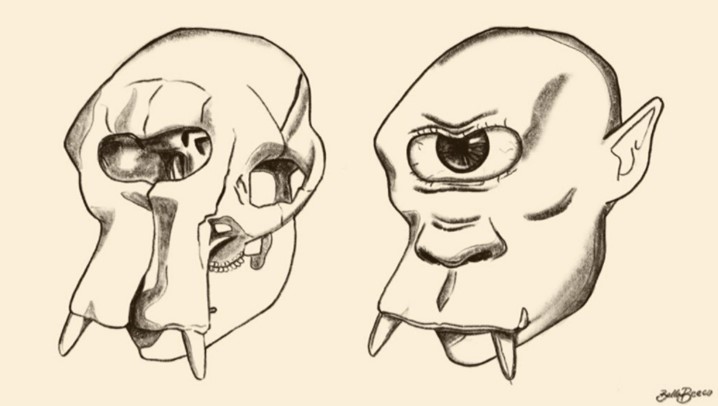
     

    Courtesy of Bella Beeco
    Elephant Skull transforming into a Cyclops Skull, Courtesy of Bella Beeco

    THE YACUMAMA:

    The Yacumama is a South American tale that derives its nature from the Amazon river. Meaning “The Water Mother” in Peruvian, the tale dates back to that of the Incan civilization in the 13th century. A massive 30 meter serpent monster, the Yacumama had jaws that could swallow a man whole. In her legends, any animal or man that disturbed her waters became her prey. The local indigenous people would blow on conch horns to protect themselves before entering the water, believing the Yacumama would reveal herself if present. 

    South America has many depictions and lore of snakes. The Aztec and Incan civilizations both had powerful gods depicted as these slithering creatures. The Aztecs had Quetzalcoatl who created mankind. The Incas had Amaru who was the water God and protector of the rivers. The legend of the Yacumama can be traced back to the 15th century when it was told to the Spanish Conquistadors. 

    A modern depiction of the Yacumama: 

    Photo of a Yacumama Statue in Parque Tematico Peru. Courtesy of Mike Dreckschmidt

    As anacondas and rivers in South America are mutually inclusive, the pairing of Yacumama and her watery home was natural. South America is home to thousands of rivers including the Amazon, and is home to 169 species of snakes, including the world’s heaviest species: the Green Anaconda. The largest Green Anaconda recorded weighed over 500lbs and was nearly 20 feet long. The longest snake species, the Reticulated Python, which measured over 25 feet long, is not native to South America but is a related species to the Anaconda. While these are the largest snakes ever measured in current day, the largest snake ever found hails from South America: The Titanoboa.

    Titanoboa fossil size model. Courtesy of Darren Pepper

    The Titanoboa fossil found in Colombia created a fear of all ancient snakes. Weighing in at over 2,500 lbs. and reaching up to nearly 50 feet in length, this behemoth snake truly could have swallowed a man whole. This dinosaur-sized serpent could strangle and crush every living organism that came within striking distance until its extinction 56 million years ago. If these snake fossils had been found by natives in South America prior to the official paleontological discovery, a giant water serpent named Yacumama could have certainly been created to explain the phenomena. The Yacumama is possibly an exaggeration of a sighting of a large wild anaconda, or it could have been a fossil based explanation from an earlier find of a titanoboa fossil. A massive serpent, a man eater, and a terrifying hunter from the depths, the Yacumama was definitely a monster that inspired fear, but it is also a monster that can be flushed into explanation. 


    References:

    • Aym, Terrence. “History Mysteries: The Legendary Yacumama, Mysterious Monster of the Amazon.” Salem-News.com, Salem-News.com, 16 Aug. 2010, www.salem-news.com/articles/august162010/monster-amazon-ta.php.
    • Combing, Beach. “Cyclops Origins.” Beachcombing’s Bizarre History Blog, Beachcombing’s Bizarre History Blog, 8 July 2011, www.strangehistory.net/2011/06/07/cyclops-origins/.
    • Dreckschmidt, Mike. “Terrifying Legends of Peru #3: Yacumama and Sachamama.” Traveling and Living in Peru, Peru Exprience S.A.C, 6 Aug. 2020, www.livinginperu.com/terrifying-legends-peru-3-yacumama-sachamama/.
    • “Green Anaconda: National Geographic.” Animals, National Georgraphic, 10 Oct. 2018, www.nationalgeographic.com/animals/reptiles/g/green-anaconda/.
    • Hennings, Julie, and Harry Lynch. “Birth of a Monster.” EarthDate, Burea of Economic Geology, www.earthdate.org/birth-of-a-monster.
    • Juran, Nathan, director. Seventh Voyage of Sinbad. Columbia Pictures, 1958.
    • Pepper, Darren. Titanoboa, Www.prehistoric-Wildlife.com., 2011, www.prehistoric-wildlife.com/species/t/titanoboa.html.
  • Getting Back to Our Roots: Using interconnected plant roots as short term data transmitters

    I am an Avatar the Last Airbender fanatic. I remember sitting on the couch awestruck watching the final battle between Ozai and Aang. Avatar the Last Airbender never left my heart and I was absolutely delighted to see Netflix’s revival of the show this year. When the Legend of Korra, Avatar’s sequel, was added to the streaming platform, I was overjoyed. During my binging of the fourth season, something perplexing caught my attention. (Do not worry, this contains no spoilers). In one episode, Korra uses the spirit vines to find and communicate with lost children. My fascination exploded and my engineering brain won the “thought-struggle” contest. The premier question: “could plants be used to communicate and send information”? Imaginative thoughts began: tree roots becoming telegraph lines and conducting Morse Code communications. The possibilities of tree root communication would be useful and wonderful, but the biggest obstacle question became apparent: would it work?

    The short answer is, “possibly”, and the reason being is that there are very few studies on the ability of plants to communicate with electricity. Electricity is the basic building block of data transmission. Channeling electricity holds the key to transferring data from one place to another. Current world-wide working channels include optic fiber, copper wires, and Wi-Fi; these channels work by transmitting data by producing electromagnetic signals. The signals carry the information from the output port to the receiving input port. Since plants have an anatomical ability to transmit electricity from their roots to their leaves and vice versa, plants have the potential to be the next transmitting service platform. 

    How plants can transmit data goes back to their roots, literally! Plants are living structures. They are built in three compartments: the root system, the stem, and the leaves. Each part of the plant has separate functions. The roots are used as an anchor in the ground and to soak up molecular nutrients in the soil. The leaves are used to convert sunlight and carbon dioxide into sugars via photosynthesis, and the stem is used as a highway to transport the chemicals and nutrients to the various parts of the plant. While this is basic science, there is a vast oversight on this knowledge. All of what has been said is chemistry. It seems that plants do not use electrical signals in the same way that animals use them. 

    But what does electricity have to do with plants? Similarly to computer data transmissions,  information is sent in electrical signals within plants. Actually, all living beings do this unknowingly, even humans. Every breath taken, hand signal, or step taken requires electrical pulses from the brain to make the movement or action occur. While plants certainly do not walk or make hand gestures, it does seem that they do use electrical signals to send instructions. Some plants like the Mimosa Pudica or the Venus Flytrap  use electrical signals to close their leaves. But, how do normal plants like flowers, trees, and vegetables use electricity?  

    Normal plants do use electricity and electrical potentials to work. In times of droughts, stress, or infections, plants send signals to regulate and try to fix the problem they are experiencing. These messages may originate from any location in the plant; sometimes they originate from an entirely different plant that is connected by their root system. In a study by Annemart Koornneef and Corné M.J. Pieterse (2008), it was found that plants when under attack can cross talk – or talk to plants beside them using the root system as an electrochemical message board. If this interconnected root system can provide a linkage mechanism between plants for them to communicate, then it could be plausible to manipulate the roots to send messages. But this raises the question of can humans manipulate the electrical messaging system? 

    Possibly! One study proved that human applied current on the plant genus arabidopsis, the plant species that are related to mustard and cabbage plants, can conduct current at 3.5 inches per minute. This study confirms that sending man made electrical currents can happen and work, albeit slowly. Yet, the problem lies on the path of travel: the root system. The root systems of trees are interconnected when living in forests or highly populated plant communities. This is because of mycorrhizal fungal connections. The tree roots are not actually intertwined, but are connected by the interconnecting fungi roots that are attached to each individual tree’s roots. An example would be a vast canyon, where the opposing sides are two separate trees and their roots. The mycorrhizal fungi roots act as a bridge connecting the two trees. This bridge acts as a chemical, electrical, and nutrient highway that one tree can use to provide for the other. 

    These mycorrhizal fungi are in nearly every environment in the world. They act as a super highway between hundreds of trees at one time. In a lab setting it was found that mycorrhizal fungi can act as an electrical conductor. The use of these fungi as an electrical forest super-conductor seems to be the perfect setting of a possible natural underground communication and data transfer center. With the entire forest connected by fungi and trees, the plausibility seems to come more into focus. Even in America there are some forests that are so vast that this could be used as a super highway. 

    Take Malheur National Forest in Oregon, where it proudly hosts the world’s oldest and largest organism on Earth: The Honey Mushroom. Estimated to be 8,700 years old, the mushroom covers 940 acres of underground forest floor. The Malheur forest is covered in trees, bushes and ferns, and other plant species, but is all connected by the honey mushroom mycorrhizal network.

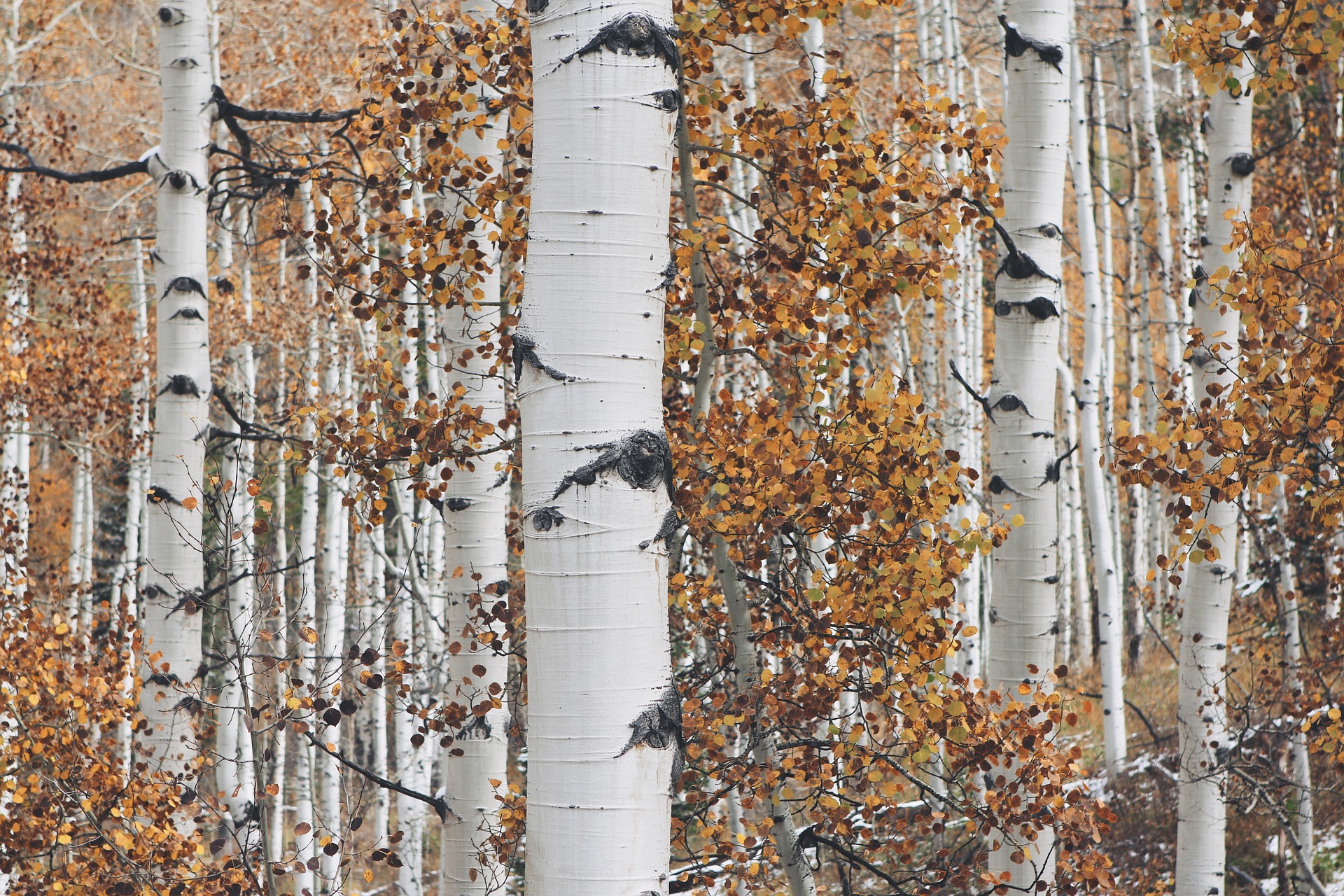
    Or consider the Panda in Fishlake National Forest in Utah. The forest is composed of an enormous grove of interconnected Aspen trees, effectively creating one organism. In the forest lies 47,000 nearly genetically identical aspens trees sharing one root system. Spanning 107 acres, Pando – the name of the single Aspen organism – is the largest tree system in the world that spans the same root system. 

    Beyond North America, think of all the forests in the world: The Amazon in South America, the Congo Basin Forest in Africa, the Sumatra rainforests in Asia, and the hundreds more in Europe and North America. The benefits of implementing and advancing the science of this is world expanding. Some possible benefits for data communication through forest roots include the reduced strain of wireless internet; ecological benefits for increased opposition to deforestation and worldwide planting efforts to rebuild forests. Another benefit is the possible use of discrete non-verbal and non-interceptable communication transfers. Tree root communication has the potential to be used for private and military uses for short range data transmissions. 

    Yet, no task is without its problems. Possible problems that could arise from using this system include lost transmissions from utilizing the wrong root/mycorrhizal pathway; plants and their root systems die and decay, so the cost of upkeep would be massive. Other problems that are the most immediate are that the technology required for this is possibly millions of dollars of research and years away. On both sides of sending the message and receiving the message from a root system is tricky. Beyond picking the pathway, the coding of the message also possesses quite a problem. All these problems are significant roadblocks, but can ultimately be overcome with science, engineering and time. 

    I personally believe that tree root data transmission would and could be of significant use with endless possible benefits. Hiking in the woods with no cell reception? Just tap into a tree and place out a distress call! In quarantine and want to talk to someone in your wooded neighborhood? Send out a tree root instant message! My first thoughts were using tree roots with Morse code or even how farmers in the great depression used their barbed wire fences as communication devices. The root system communication and data transfer would expand and grow over time as more and more forests mature and grow. A future where you could tap into a pine tree and dial up your neighbor down the street may seem foreign, but in the future, calling, texting, sending memes and gifs, or encoded data plans may be a possibility. 

    It all goes back to finding our roots. 

    References

    • Gebelhoff, Robert. “Plants Send out Stress Signals Just like Animals, Scientists Find.” The Washington Post, WP Company, 28 Apr. 2019, www.washingtonpost.com/news/speaking-of-science/wp/2015/07/30/plants-send-out-stress-signals-just-like-animals-scientists-find/.
    • Jabr, Ferris. “Plants Cannot ‘Think and Remember,” but There’s Nothing Stupid about Them: They’re Shockingly Sophisticated.” Scientific American Blog Network, Scientific American, 16 July 2010, blogs.scientificamerican.com/observations/plants-cannot-think-and-remember-but-theres-nothing-stupid-about-them-theyre-shockingly-sophisticated/.
    • Nield, David. “Plants Can Secretly Send Underground Electrical Signals. Here’s How They Do It.” ScienceAlert, Communicative & Integrative Biology, 14 July 2020, www.sciencealert.com/here-s-how-plants-can-secretly-send-each-other-underground-electrical-signals.
    • Thomas, Brian. “Shocking Evidence of Electrical Signals in Plants.” The Institute for Creation Research, The Institute for Creation Research, 11 Sept. 2013, www.icr.org/article/shocking-evidence-electrical-signals.
    • Yoon, Carol Kaesuk. “Plants Found to Send Nerve-Like Messages.” The New York Times, The New York Times, 17 Nov. 1992, www.nytimes.com/1992/11/17/science/plants-found-to-send-nerve-like-messages.html.