Author: Lee Wilkes

  • Understanding Static Electricity

    A Normal Winter Night

    It’s a cold winter night, you’re snuggled up in your favorite blanket sitting on a couch and watching TV, the heater doing its best to prevent the winter winds from disturbing your moment of Zen. You’re thirsty, craving the delicious nature of nice, hot chocolate. So, you get up, placing your fluffy socks on the carpeted floor, blanket wrapped, and head towards the kitchen; however, on your way, you have to go through a closed door, and brace yourself against the icy, wooden floors that is your kitchen. As you take the courage to confront the chilly adversary and reach your hand to the metal knob, you feel a jolt of energy against you, a loud SNAP, and a flash of lighting going from your hand startles you, bringing about a moment of pain. Feeling betrayed, worried, you try again. What you felt was the power of static electricity, something that we’ve all experienced in one form or another.

    What is Static Electricity?

    Static electricity is a common occurrence in life. From rubbing an inflated balloon on your furry pet to rubbing socks on a carpeted floor, the friction between two objects (normally insulators such as fur, plastic, or clothing) causes electrons to move from one object to another. This creates a difference of charge, or electrostatic potential. When there is enough energy to match this electrostatic potential, the electrons will move. Think of it like this: every molecule wants to wants to be in balance, and whenever there is an imbalance, those molecules will do what is necessary to return to said balance, but need the energy to do so. In the example above, your covered feet rub against the carpet and collect electrons that spread throughout your body – this makes you negatively charged, or “electron rich”. Metal – the door knob – is typically positively charged, or “electron deficient”, and therefore wants to take any electrons it can get. When the two objects get close enough, there is less energy required for the electrons to move (imagine trying to move a ball far away from you compared to right next to you… much easier, right?) and so they do. This causes for that “flash” to be seen from your fingertip to the door knob, and the pain you feel is caused by the sudden movement of electrons (look at E-Stim, my other article, it talks a bit about the human body and electricity… this isn’t advertisement, I swear!)) that then trigger nerve receptors, the more electrons that move, the stronger the feeling.

    So, how does all of this tie in with exploding gas? The answer, my dear friend, is one word: combustion. Combustion is the reaction of oxygen, a fuel source, and energy, as seen in the formula for the combustion of rubbing alcohol below:

    Equation

    But wait, what’s a reaction? Remember what I said before about molecules doing whatever it takes to return to balance? Well, that’s a reaction! When atoms combine to form molecules, they use energy to form bonds to stick together and reach a form of balance. In order to break these bonds, more energy is required, and atoms separate and join with other atoms nearby to form new molecules. This causes for energy to be, in this case, released. This is used in your cars to move pistons and make your car move, but that’s another lesson. Now, imagine your clothes rubbing against your seat when you’re getting out of the car to fuel up or after getting something. Considering that the fuel nozzle is metal, that gasoline has a tendency to become a gas, and you have a charge build up… since energy is made from the movement of electrons (they literally crash into other atoms when they move) it causes for this reaction to occur, and now the expansion of heat and air spread out and cause those explosions that many people see in horror movies.
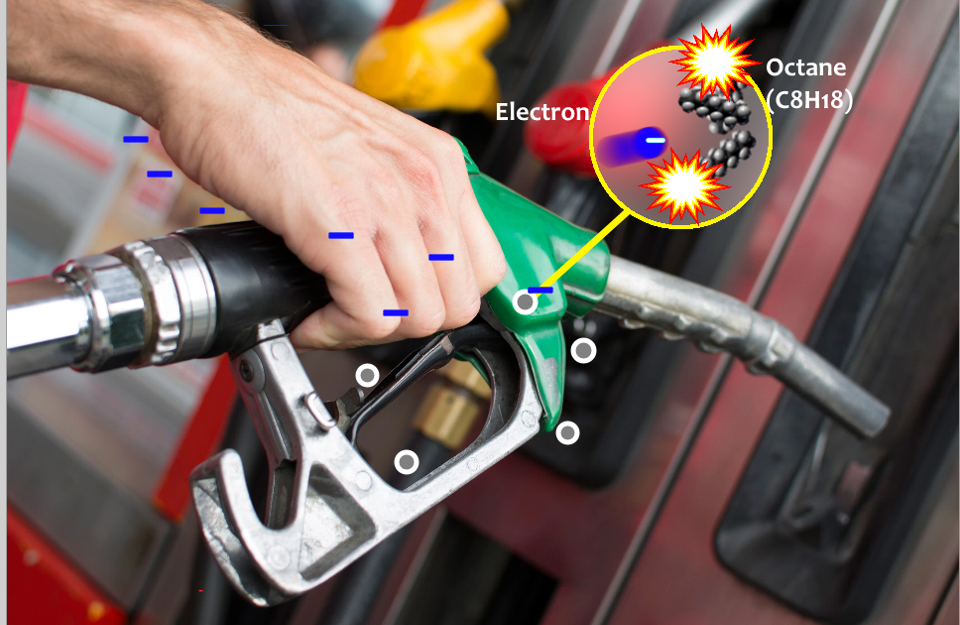
    As electrons move from the hand to the metal, they can collide with gas vapors.
    As electrons move from the hand to the metal, they can collide with gas vapors.


    But how do we counter this?!

    It’s actually pretty simple: touch your car before you touch the nozzle. The extra electrons on your clothes and body will go to the car, and then to the ground instead of to the gasoline vapors near the nozzle. Make sure to do this a ways away from your gas tank – ideally by the doorframe by the driving wheel, and you should be fine!

    Either way, there are other ways for energy to be transferred, so you need to always be careful when going near a fuel source. Just don’t smoke, use flint, or summon the power of the force while you’re gassing up. Be smart, and don’t do anything that might cause for combustion to occur!


    Electric Potential Energy. (n.d.). Retrieved April 14, 2018, from http://hyperphysics.phy-astr.gsu.edu/hbase/electric/elepe.html

    E., E., E., E., E., & E. (n.d.). Electricity – Electrical Charge, Electric Fields, Coulomb’s Law And The Forces Between Electrical Charges, Resistance – Current, Voltage, Ohm’s law. Retrieved April 14, 2018, from http://science.jrank.org/pages/2342/Electricity.html

    Combustion. (n.d.). Retrieved April 14, 2018, from https://www.grc.nasa.gov/www/k-12/airplane/combst1.html

    Combustion Reactions. (n.d.). Retrieved April 14, 2018, from http://www.iun.edu/~cpanhd/C101webnotes/chemical reactions/combustion.html


  • E-Stim and Muscle

    Way back when the internet was just a dream, electricity was seen as a means to power machines, to make life easier, and to warm your bread into its toasty goodness. No one – except for the bored kids – would ever think of letting it run through your body for pleasure, let alone for medical purposes. Everything changed when the Relax-A-Cizor attacked. A device originally created in the 1950s, the Relax-A-Cizor is  one of the first cases in America where electricity was used by the general public to increase muscle mass without actually doing too much. Sadly, it was banned by the FDA in 1970 because the government deemed it “potentially hazardous to health”, because why mindlessly pump your body with electricity when no one understands the side effects  entirely? It just means people have to test it more, make it better, faster, stronger… when we have the technology.  Nowadays, there’s a large variety of machines that zap the body to massage muscle, reteach the brain, help exercise it after surgery, and pain relief.  

    But how does it work? How can 10 to 15 volts cause your muscles to get stronger, relax them, or even exercise them? Well, before the scientist within you tries to experiment, here’s the gist of it:


    THE MACHINE ITSELF

    There are many devices with different designs, but they all follow the same understanding of basic circuits. There are two electrodes (dull metal disks) attached to different parts of the skin that have a positive and negative end. These two ends are points for the electricity to flow. Basically, positively and negatively charged objects relate to the amount of electrons they have. Think of it like two children and the flu. The flu is bad, and so is negative. Child 1 doesn’t have flu, and is happy and positive. Child 2 has the flu, and is unhappy and negative. Being as children are, Child 2 decides to cough on his positive brother, getting him sick and making him negative. This flow of electrons (or in this case the flu) creates a current that goes through the skin, taking the shortest, and easiest route possible. The fluids in our body (like our blood) allow for a number of different currents if the voltage is strong enough. In general, the body has a pretty large resistance, and as found by a guy named Ohm (not a Tibetan monk) you need a good amount of voltage to make a good current. Think of resistance as a mountain and current as a miner going through the mountain, the energy of the miner is the voltage… and you need a whole lot of energy to dig through a mountain. John Henry, anyone?

    A Transcutaneous Electrical Nerve Stimulation (TENS) unit . Used to relieve pain and entertain bored doctors with a thing for electricity.
    A Transcutaneous Electrical Nerve Stimulation (TENS) unit . Used to relieve pain and entertain bored doctors with a thing for electricity.

    WHY ARE MY MUSCLES MOVING ON THEIR OWN!?  

    Now you’re probably asking me: “But Lee, how does this current make my muscles move?” Well, remember the two children? That exact same concept is at play within muscle cells. If you remember your high school biology class, cells have a cell membrane that wrap around it, keeping it divided from the outside world. Typically speaking, there’s a positive charge outside of cells, and a negative charge inside. This is because the cells are dividing Sodium outside and Potassium inside the cell at a ratio of 3 Sodium: 2 Potassium. Both have the same positive charge but because of the 3:2 ratio, there’s more positive outside – this causes it to polarize, where the outside is positive and the inside is negative. If you remember magnets, positive and negative attract, but the membrane doesn’t like either side to be different – so it doesn’t let the charges through. Remember the current? Remember how it’s still flowing through the body where you strapped those two electrodes on? Well now the electricity is flowing through the outside of the cell and makes it negative.  Now, the cell membrane is happy because both sides are negative, so it lets the sodium back inside. If you’ve seen The Martian, there was a scene where Matt Damon had to go into a waiting chamber before entering the main building – this was to equalize  pressure and content in the air so the building wouldn’t explode… like it later did. It’s about the same concept, but without a second chamber.  This is a called an “Action Potential”, where the sodium I mentioned earlier goes into the cell and spreads out. From here the action potential tells the muscle cell that it’s time to contract. When the machine is running the current, the electricity in the current flows through the body and goes along the easiest route possible (often times outside the cells), and since the outside is positive, the flow of electrons outside makes it negative. Since the inside is negative as well, there’s little difference in polarity (the difference in charge) causing certain channels (e.g. proteins)  to open to let sodium inside.  This opening of the door is responsible for causing muscle cells to start contracting through a fairly complicated process. Pretty much, so long as that current is running, sodium will stay inside the cell and continue to make the muscle contract. When the current is turned off, the doors close and the muscle will relax. This is why the machines you get at the local store often deliver a shock in the form of a pulse.  


    But why!?

    You can imagine how doctors use this to help retrain the brain, or have patients exercise after surgery. If someone recently had a stroke and can’t move their limbs, doctors can use an electric stimulation (E-stim) machine to move the muscle, and let the brain re-learn how to use its own body. Similar with patients after surgery, they use it to help the muscles exercise and increase circulation of blood to those regions instead of just swelling and having limited circulation, E-stim also helps with rehabilitation, making sure that muscle isn’t lost for patients who aren’t able to move them – instead letting the E-stim machine exercise the muscle.  But what about relaxing it? Well, to answer that, have you ever ignored something and forgot it was there? Like forgetting where your phone is while you’re talking on it, the same thing goes with nerves. There are nerves throughout the body that sense pain and other things, with a constant current running through whatever muscle you choose, those nerves are going to sense it and let your brain know there’s pain. But, after a while the brain gets tired of it and tries its best to ignore it. The nerves in that area become less sensitive – meaning that they don’t tell the brain as often unless the signals increase – and pretty much mute it out. Think about it: to stop pain, you just keep zapping your nerve endings until they stop saying it hurts!


    BEWARE PSEUDOSCIENCE!!!!

    There’s been some claims that E-stim is able to gain muscle and even reduce fat. DO NOT FALL FOR IT! To date, there aren’t many studies that confirm anything significant. It might be a good thing to add onto an athlete’s training, but it’s costly and won’t get you that summer bod in half the time it takes to actually work out. The best bet for that is to eat healthy and have a daily workout routine… and THEN use E-stims to help relax the muscle when you’re sore!


    The Takeaways

    Overall, the use of E-stem is common in today’s society, though there’s still a decent amount that it can’t do. From retaining muscle in patients unable to move, to providing mild pain relief in athletes, there are a number of practical uses for it. Though, keep in mind, that you’re still running electricity through your body, so moderation is important! A small amount of electricity is good, but don’t go sticking a fork in an outlet because that will probably fry you. There’s not much evidence that demonstrate E-stim can reducing fat or gain muscle for healthy individuals. Will E-stem be the new way to get that beautiful 6-pack? Only future studies will be able to show it, and even then, something else might pop up and revolutionize the world!  


    References:

    Marban, E., Yamagishi, T., & Tomaselli, G. F. (1998). Structure and function of voltage-gated sodium channels. The Journal of Physiology, 508(Pt 3), 647–657. http://doi.org/10.1111/j.1469-7793.1998.647bp.x

    Miller, K. C., Stone, M. S., Huxel, K. C., & Edwards, J. E. (2010). Exercise-Associated Muscle Cramps: Causes, Treatment, and Prevention. Sports Health, 2(4), 279–283. http://doi.org/10.1177/1941738109357299

    Porcari, J. P., Miller, J., Cornwell, K., Foster, C., Gibson, M., McLean, K., & Kernozek, T. (2005). The Effects of Neuromuscular Electrical Stimulation Training on Abdominal Strength, Endurance, and Selected Anthropometric Measures. Journal of Sports Science & Medicine, 4(1), 66–75.

    Page, P. (2012). CURRENT CONCEPTS IN MUSCLE STRETCHING FOR EXERCISE AND REHABILITATION. International Journal of Sports Physical Therapy, 7(1), 109–119.

    Khogali, S., Lucas, B., Ammar, T., Dejong, D., Barbalinardo, M., Hayward, L. J., & Renaud, J. (2015). Physiological basis for muscle stiffness and weakness in a knock‐in M1592V mouse model of hyperkalemic periodic paralysis. Physiological Reports, 3(12), e12656. http://doi.org/10.14814/phy2.12656

    Wilson, J. H., & Hunt, T. (2002). Molecular biology of the cell, 4th edition: a problems approach. New York: Garland Science.

    Import Alert 89-01. (n.d.). Retrieved February 17, 2018, from https://www.accessdata.fda.gov/cms_ia/importalert_240.html

    U.S. Food & Drug Administration. (n.d.). Import Alert 89-01. Retrieved February 17, 2018, from https://www.accessdata.fda.gov/cms_ia/importalert_240.html

    Canning A, Grenie S (2014) Does Neuromuscular Electrical Stimulation Improve Muscular Strength Gains of the Vastus Medialis Muscle. Int J Phys Med Rehabil 2:207. doi: 10.4172/2329-9096.1000207