Author: Nicole Allen

  • Tech’s Energy Conference

    It’s easy to get caught up in the bubble of your classes and peers while at Georgia Tech, as everyone in your major struggles together through the same difficult courses. Quickly, you can forget that the world isn’t made up of people that are interested in learning about and exploring the exact same thing as you. It’s exciting when you’re able to learn about the interests of students that you otherwise wouldn’t interact with. 

    The Southeastern Energy Conference is hosted at Georgia Tech annually and spanned April 7th and 8th this year. The itinerary was packed with keynote speakers and presentations. Most exciting to me, as an undergraduate student, were the poster presentations – put on by other undergrads like myself. Walking around the upper floor of Kendeda, I learned about advancements in water cooling systems for more sustainable building design (it all rests in the texture of the polymers being used!), how electric lines for freight trucks could help us move away from diesel fuel, and how materials for medical devices are being altered to last longer and create less waste – nothing I would ever learn about in my BME classes.

    A view of the poster session on the upper floor of the Kendeda Building

    Talking with a fellow first-year student, I learned in the span of fifteen minutes that:

    (1) I had a lot of misconceptions about solar energy

    (2) The majority of solar energy comes from rooftop panels

    (3) There are ways for solar energy to be leveraged to better impact communities

    Her research focused on the benefits of community solar, something I hadn’t known existed until she mentioned it. Like the majority of Americans (66%, she told me), I believed that the best way for individuals to participate in solar energy was to install panels on the roofs of their houses. 

    Installing solar panels on your house can pose a financial burden on the offset, and may not be practical for all locations. The other commonly known option is to use solar power generated by utility companies, which mix this energy into the grid they supply for. However, consumers don’t usually have many choices in which utility company they use, as it typically depends on the area, leaving them at the whim of the company in terms of their energy sustainability.

    The suggestion made was more community solar farms, in which individuals or businesses contribute to a solar array within their general area. It’s typically a cheaper energy alternative and allows people in apartments or whose houses are in the shade to use solar energy. 

    Community solar initiatives are becoming increasingly popular across the country, as more and more people try to mitigate their environmental impact. The setting of the Southeastern Energy Conference in the Kendeda building was a constant reminder that the energy research being done on and off-campus is being used in real projects, like all the research that went into Kendeda’s creation. And, after finding out that the conference was complete with snacks, I couldn’t have had a better experience.

    References

    Southeastern Energy Conference 2022. Southeastern Energy Conference – 2022. (2022, April 6), from https://www.energyexpo.gatech.edu/

  • Should We Be Ignoring Duolingo’s Threats? A Look at the Sapir-Whorf Hypothesis

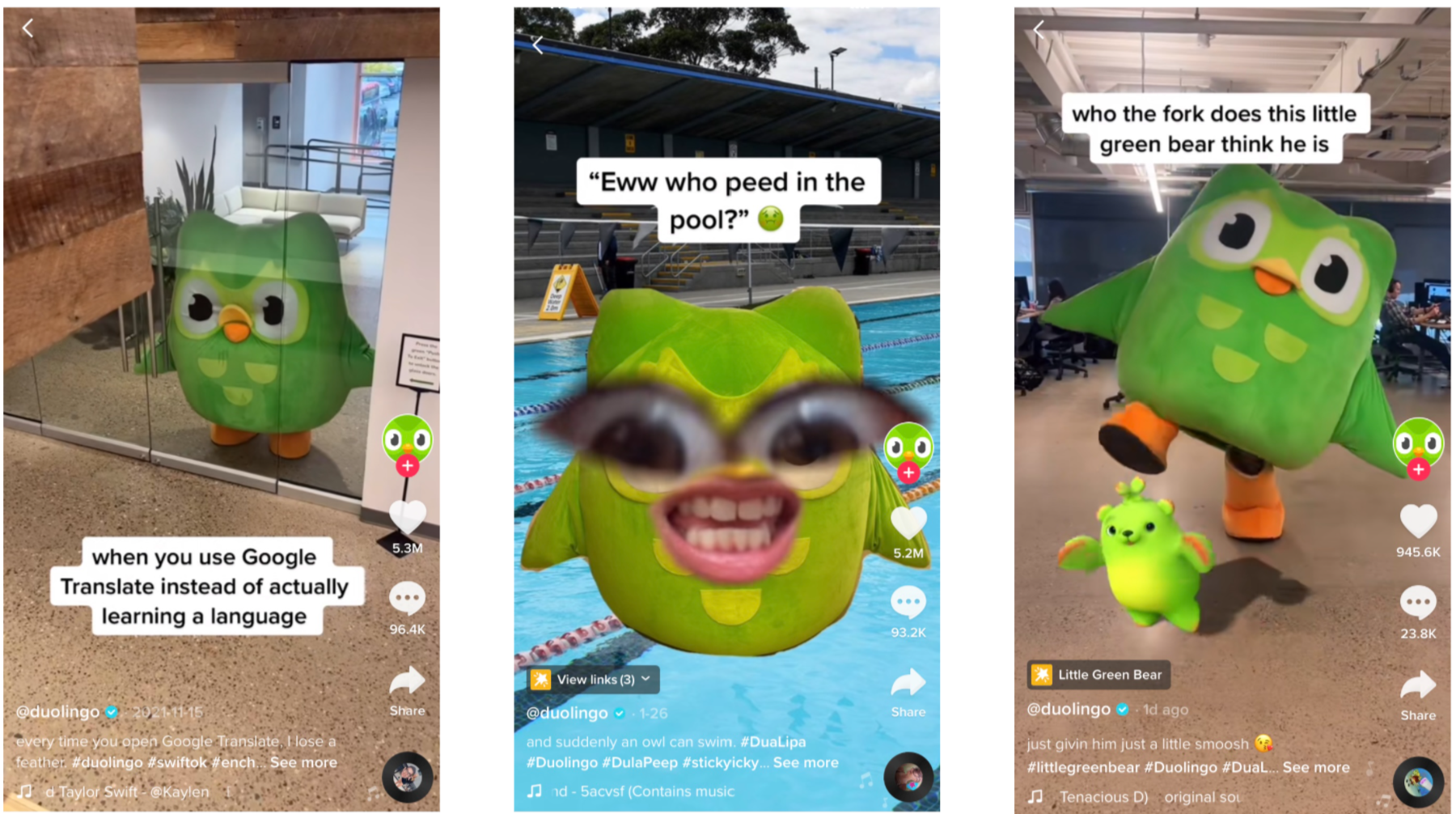
    The recent year has brought to the forefront an unexpected, slightly unhinged new pop-culture icon: Duo, the Duolingo owl. Duolingo is a popular language-learning app that allows users to learn a variety of languages and sends daily notifications to encourage them to keep a language-learning streak. And while the messages coming from the Duo TikTok posts and comments range from threatening to completely out of pocket, the Duo owl seems to recognize the value of learning a second language. And with 3.1 million followers on the brand’s TikTok, this message seems to be reaching the world. Duo definitely has the science to back them up. It’s been thoroughly proven that as you age, multilingualism is a better predictor of cognitive ability than age, education, and gender (Kavé et al., 2008; Mohamed Zied et al., 2004).

    But why does bilingualism have this effect on your brain? Many recent studies have confirmed that you regularly use more regions of your brain if you’re bilingual or multilingual, as compared to someone who is monolingual. What’s known as the Sapir-Whorf hypothesis could help to explain it. 

    Sapir-Whorf hypothesizes that the language you speak influences how you perceive reality. This idea seems to have caught on, as there have been many research studies and fictional pieces that explore it.  

    “Story of Your Life and Others” by Ted Chiang (as well as its 2016 film adaptation, The Arrival) is my favorite example of the hypothesis. Key point: An alien species arrives on Earth. Unlike us humans, who have reflectional symmetry, the aliens had rotational symmetry – think extraterrestrial octopus. In the story, these aliens communicate very differently from humans. While we write in lines and process information sequentially/linearly, the aliens wrote all at once in a nested circular pattern and processed information all at once. 

    The aliens’ writing, as depicted in The Arrival (2016).

    Once basic communication was established, the linguists wanted to set up a frame of communication, so they started with what we assume is constant throughout the universe: physics. The aliens could very easily understand certain physics theories that humans had a difficult time grasping, because the aliens, unlike us, didn’t perceive time sequentially. Because their language communicated information all at once, they thought about information all at once and didn’t have the same sense of past, present, and future that we have.  

    The effect of language on perceived reality can be seen in the real world as well. The Hopi language, spoken by the Hopi people in northeastern Arizona, doesn’t grammatize time the same way as English and refers to it as a verb instead of a noun. This slightly alters how they perceive time. The Himba tribe in Nambia is able to differentiate between more shades of green than the average English speaker because they have words for more different shades.

    The right side is easily discernible to an English speaker, whereas the left side would be just as easily discernible to a Himba speaker.

    As can be seen by the RBG values in the image, the square in the same position as the blue square is a different shade of green. Most Americans have a very hard time distinguishing it. 

    These differences, on a lesser scale, are present between all languages. As aptly discussed in another very interesting linguistical read, “The Idiot”, by Elif Bautman, the main character explains how she “knew [she] thought differently in Turkish and in English — not because thought and language were the same, but because different languages forced you to think about different things”. 

    Given that one language influences, to some extent, how we perceive the world, it’s not a big leap to see how multilingualism would affect the way we think. While there will be some overlap, especially between similarly structured languages like the Romance Languages, each new language learned expands the areas of your brain that are regularly used and may affect how your brain processes information, even when you’re using your native language. 

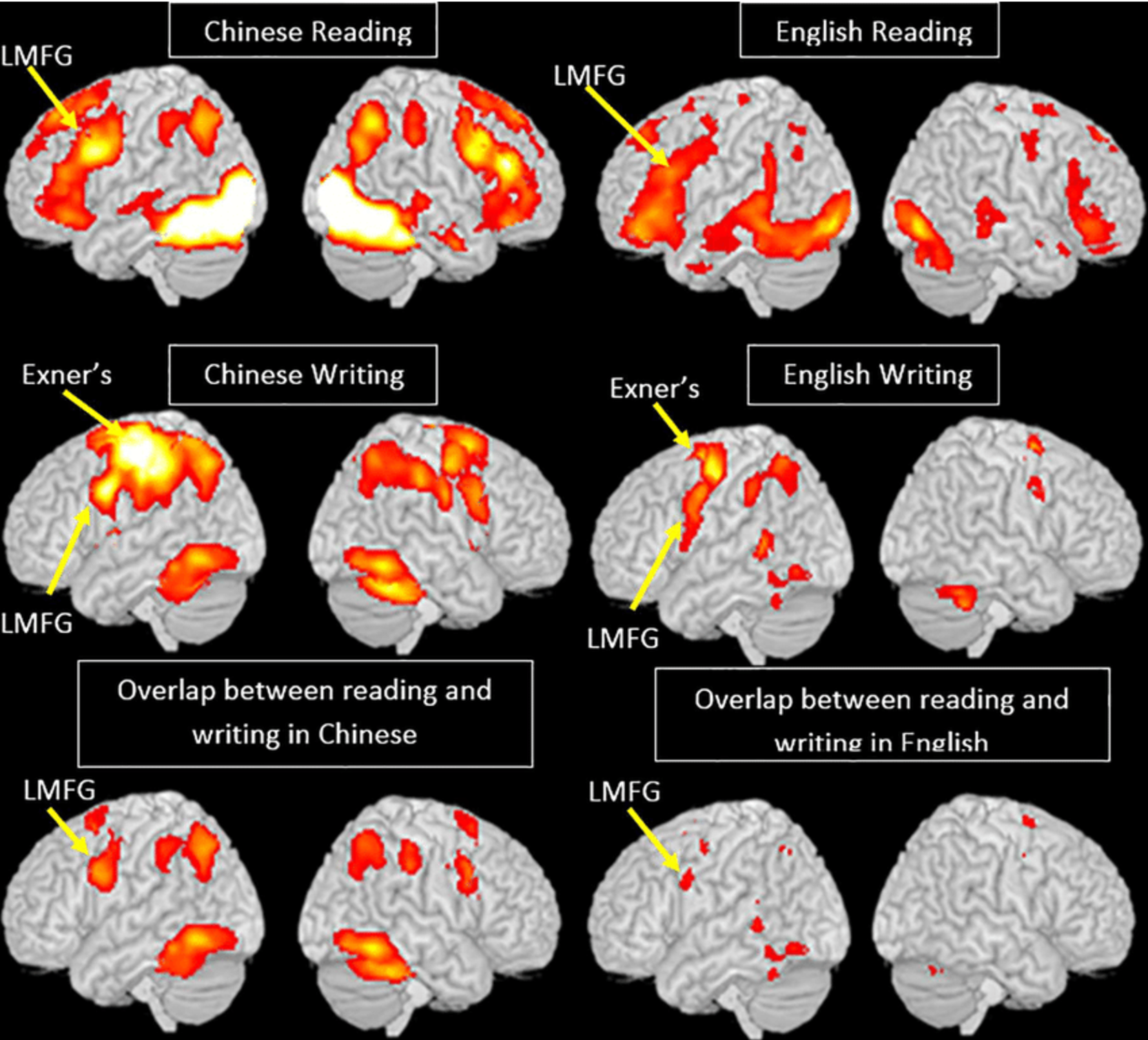
    The difference between brain regions used when reading and writing in Chinese and English (Cao, 2016)

    Different languages use different locations and quantities of the brain. As can be seen from the image above, key examples of this are the LMFG region and Exner’s region. The LMFG region, short for the left middle frontal gyrus, plays a key role in literacy. Exner’s region helps you to process numbers and language. Multilingualism strengthens alternative brain networks within these regions to those that you usually use, allowing your brain to circuit around any deterioration that occurs with aging. This explains the strong correlation between multilingualism and cognitive ability as you age.

    With this in mind, recent studies have been exploring the use of language study for those 65+, and, as expected, it is working to help reduce the deterioration (Antinou, 2013). Moral of the story: if you’re planning on outliving the Duo owl, stepping up your language learning game (or reversing some of the threats Duo regularly levels at its users) is probably your best bet.

    References:

    Antinou, M., Foreign language training as cognitive therapy for age-related cognitive decline: A hypothesis for future research. https://pubmed.ncbi.nlm.nih.gov/24051310/ . 

    Cao, F. (PDF) neural signatures of the reading-writing connection … https://www.researchgate.net/publication/311759524_Neural_Signatures_of_the_Reading-Writing_Connection_Greater_Involvement_of_Writing_in_Chinese_Reading_than_English_Reading . 

    Kavé, G., Eyal, N., Shorek, A., & Cohen-Mansfield, J. (2008). Multilingualism and cognitive state in the oldest old. Psychology and Aging, 23(1), 70–78. https://doi.org/10.1037/0882-7974.23.1.70 

    Lucy, J. A. Sapir–Whorf hypothesis. https://www.sciencedirect.com/science/article/pii/B0080430767030424 . 

    Newton, M. It’s not easy seeing green. https://6thfloor.blogs.nytimes.com/2012/09/04/its-not-easy-seeing-green/ (accessed Mar 2, 2022). 

    Skibba, R. How a Second language can boost the brain. https://knowablemagazine.org/article/mind/2018/how-second-language-can-boost-brain .