Author: Noah Chong

  • Fighting Physics

    Though some may view it as violent, martial arts are an integral part of many cultures around the world. While some were created for warfare, such as Indonesia’s Pencak Silat, others, like China’s Kung Fu, were created to be an extension of one’s morals and principles. After centuries of evolution, some aspects of martial arts have been perfected to take full advantage of all the biological levers and pulleys that our bodies are made up of. With physics and data analysis, one can easily find the mechanics of what makes punches and kicks so deadly.

    The Roundhouse Kick

    The roundhouse kick is one of the simplest kicks in martial arts, but it takes full advantage of our built-in body mechanics. The fundamental principles of the roundhouse kick are dependent on the concepts of torque and angular velocity – or rotational force and speed, respectively. Your intuition might tell you that in order to have a stronger kick, you’d either have to put more force into it or make the kick go faster. However, the real question lies in how that’s done.

    The force that is needed to overcome the mass of the leg and cause it to rotate is torque, which is defined as:

                τ = r x F

                            r = length of lever arm

    F = magnitude of force applied


    In the case of a Muay Thai kick (as shown in the video above), the entire leg is swung around in an arc. In a way, the entire leg acts like a baseball bat, rotating around the center of the body. However, torque means nothing in terms of impact strength unless you apply some kind of speed measurement to it. That’s where the equation for power comes in:

                P = τ x ω

                           τ = torque

    ω = angular velocity
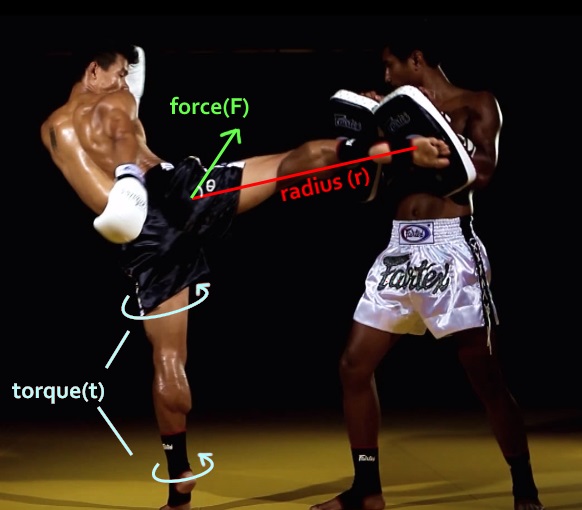
     

    The mechanics involved in a roundhouse kick
    The mechanics involved in a roundhouse kick

    When lifting heavy things, people say that your power comes from your legs. Similarly, when kicking things, your power comes from your hips. Torque is produced by how quickly and how much you rotate your hips and foot, to some extent—you can see this in the feet and hips of the fighter above.

    A study conducted by Colin Gavagan measured the various techniques of experts in Muay Thai, Karate and Taekwondo. He found that the average impact force of a roundhouse kick on a kicking shield from a professional Muay Thai practitioner was 1400 N! The force of this kick is roughly equivalent to a sledgehammer being swung as hard as possible at someone’s body! Through just a simple rotation of the hips and feet, one can deliver kicks strong enough to break bone.


    The Straight Right

    Similarly to the roundhouse kick, the straight right requires torque in order to generate enough power to do any considerable jab. Something most people may not know, however, is that most of the power from a straight right comes from the legs and hips. Rather than rely solely on the shoulder and arm muscles, a boxer uses his legs and hips to add to the power of his punch.
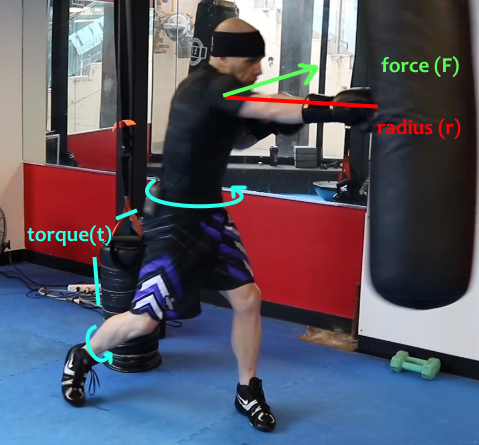
    The mechanics of a punch are similar to that of a roundhouse kick
    The mechanics of a punch are similar to that of a roundhouse kick

    A punch is at a distinct disadvantage from a roundhouse kick in terms of power, however: a roundhouse kick uses the entire lower leg for contact, while a punch makes contact with only one’s hand. Whereas a leg might weigh 10% of someone’s weight, a fist would reasonably make up only 1%. How does a boxer make up for this difference in weight? The answer lies in the “snap”.

    FΔt = mΔv

    F = magnitude of force applied

    Δt = change in time

    m = mass

    Δv = change in velocity


    Δt stands for the total time it takes for the force to be applied, which in the case of a boxing glove on a punching bag or body, can’t be changed much. However, as the time of impact stays constant, if one increases the speed of their punch one can significantly increase the force of it. By focusing on the extension of the punch in your shoulder and forearm, you can significantly increase the speed your hand. The sheer speed of a punch can make up for it’s lack of mass behind it.

    For such seemingly simple moves, there are so many fundamental processes going on at once that it’s impossible to analyze all the nuances that comprise them! There’s a lot of science that goes into something that, at first glance, seems like a simple punch.


    References:

    Kinoshita, M., Fujii, N. The Analysis of Kinematical Characteristics in Taekwondo Roundhouse Kick. Retrieved from https://ojs.ub.uni-konstanz.de/cpa/article/view/5737

    Estevan, I. Falco, C. 2013 December. Mechanical Analysis of the Roundhouse Kick According to Height and Distance in Taekwondo. Retrieved from https://www.ncbi.nlm.nih.gov/pmc/articles/PMC3944546/

    Gavagan, C., Sayers, M. 2017 August. A biomechanical analysis of the roundhouse kicking technique of expert practitioners: A comparison between the the martial arts disciplines of Muay Thai, Karate, and Taekwondo. Retrieved from http://journals.plos.org/plosone/article?id=10.1371/journal.pone.0182645

  • Taste of Science: Spicy Science

    As the leaning tower of Jenga pieces fell after a heated battle of, what my friends and I liked to call “Spicy Jenga”, I could only dread the immense pain and suffering about to come my way. What awaited me was the big daddy, the jefe of the chili world — the undisputed hottest chili pepper in the world (in 2013), the Carolina Reaper. As I bit into that pepper I tasted only regret. And for the next 8 hours that’s all I felt too.

    Regardless of how awful of an experience that was, I still continue to eat spicy foods to this day, so it made me think:

    What’s the science behind spicy things anyway?

    Turns out the main agent for “spiciness” is the chemical compound capsaicin. Found in the placental tissue – tissue that surrounds the seeds of a chili pepper – capsaicin is the primary chemical compound that leads to the “burning” sensation of spicy foods.

    Chemical formula for capsaicin
    Chemical formula for capsaicin

    Strangely enough, your brain – quite literally – believes that is on fire! Capsaicin activates a specific receptor on the tongue called TrpV1, which sends pain messages to your brain, causing your body to react accordingly. TrpV1 is also responsible for more than just spicy foods, however. It reacts to:

    • Extreme heat and
    • Caustic acid

    That’s why when we eat spicy foods, we tear up, have our noses run, sweat in strange parts of our body, etc. in order to flush out the nonexistent heat. However, to our brain, that heat is 100% REAL, and it tries its best to get us away from potential danger. Ever wonder why spicy and hot foods always seem to taste spicier than normal? They both amplify the pain messages sent to the brain! Now, instead of having just spicy pain, your brain also adds in extra pain from the temperature of the foods you ate! Try eating something spicy at different temperatures (heat one batch and refrigerate the other) and see how much of a difference temperature plays in the overall spiciness of the dish.

    This pain-relieving patch is one of the many kinds of capsaicin (or capsicum) medication available over-the-counter.

    Aside from being an essential additive in cuisines all over the world, spicy foods play a larger role in our daily lives than we might think. Research has shown that regular chili intake lowered the risk of high blood pressure in a sample of 13,670 adults by almost 40%, even when controlled for diet and weight! Additionally, spices have shown to fight congestion, aid digestion, and relieve muscle and joint pain, as well as play some part in raising our overall metabolism. In fact, capsaicin is used often in the medical field as an analgesic, or pain reliever, due to its ability to prevent the production of Substance P – Substance P being the primary neurotransmitter responsible for pain from capsaicin.

    The most fascinating aspect of capsaicin is that, the more capsaicin you introduce into your body, the less and less you will feel (you probably noticed how spicy foods are when you first eat them when compared to your last bite). Thus, research has shown that in high concentrations (~8%), a 60 minute application of a capsaicin patch effectively provides pain relief for months on end. Widespread use is slow-going; however, certain prescriptions are available for cancer patients and other people with chronic pain to provide some relief to them.

    The benefits of capsaicin are still being researched, but even now people are hopeful in its potential in advancing our health and the field of medicine. Though, until more research is done, the most we can do is appreciate capsaicin for how much it spices our lives up!


    References:

    Burks TF, Buck SH, Miller MS. 1985 June. Mechanisms of depletion of substance P by capsaicin. Retrieved from https://www.ncbi.nlm.nih.gov/pubmed/2581820

    Byrnes, N., Hayes, J. 2013 April. Personality factors predict spicy food liking and intake. Retrieved from https://www.sciencedirect.com/science/article/pii/S0950329312001917

    Anand, P., Bley, K. 2011 August. Topical capsaicin for pain management: therapeutic potential and mechanisms of action of the new high-concentration capsaicin 8% patch. Retrieved from https://academic.oup.com/bja/article/107/4/490/228083

    Sharma, S., Vij, A., Sharma, M. 2013 November. Mechanisms and clinical uses of capsaicin Retrieved from https://www.sciencedirect.com/science/article/pii/S0014299913008200

    Tékus, V., Horváth A., Hajna, Z. 2016 June. Noxious heat threshold temperature and pronociceptive effects of allyl isothiocyanate (mustard oil) in TRPV1 or TRPA1 gene-deleted mice. Retrieved from https://www.sciencedirect.com/science/article/pii/S0024320516302508

    Miroslav, M. 2010 August. High-concentration capsaicin for the treatment of post-herpetic neuralgia and other types of peripheral neuropathic pain. Retrieved from https://www.sciencedirect.com/science/article/pii/S1754320710705290

    Shi, Z., Riley, M., Brown, A., Page, A. Chilli intake is inversely associated with hypertension among adults. Retrieved from https://www.sciencedirect.com/science/article/pii/S2405457717304965