Author: Nadia Zaragoza

  • That’s The Tea


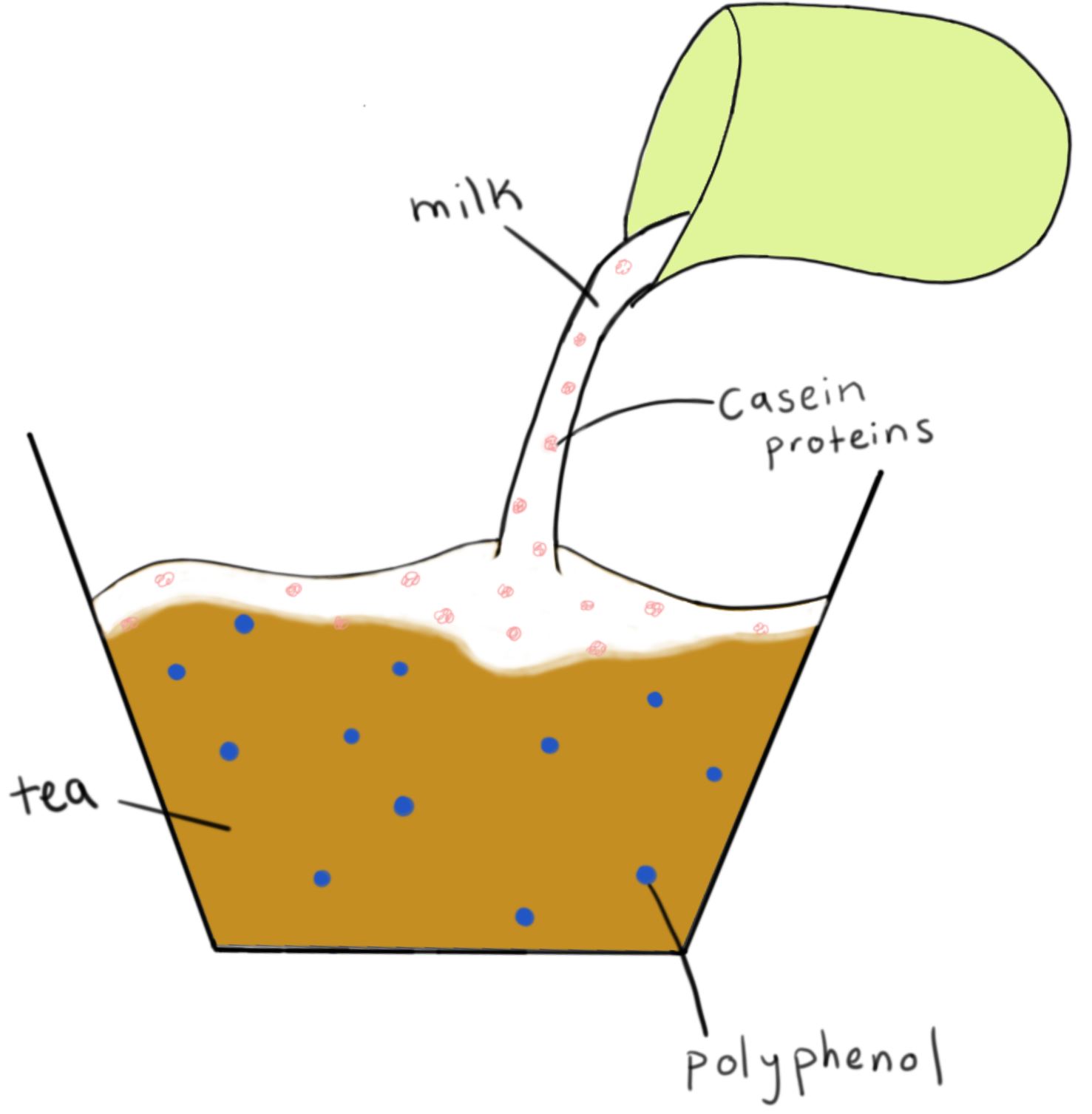
    Recently, our STEMComm class put on a Sober Science Speakeasy event for Atlanta Science Festival, where our classmates explored the science of drinks. One of our drinks was the science behind the tastes and textures of milk tea boba, which I have depicted in a series of illustrations.


    Milk tea is typically made with green tea or black tea. 

    Teas contain polyphenols, which is the chemical responsible for the bitterness of tea.


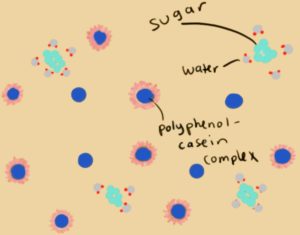
    Milk contains casein proteins. When milk is mixed with tea, these proteins form a complex in which the polyphenol is encapsulated in the protein, decreasing the bitter taste.


    Added sugars contribute further to the sweetness of the tea as they are easily absorbed in the mouth. These sugars also bond with water molecules to leave room for the casein proteins to form complexes with the polyphenols.

    The tapioca pearls are made of amylose and amylopectin (linear and branched starch molecules). When the boba is boiled, they expand, and the glycosidic linkages (the bonds that join these molecules) create a network that is responsible for the chewy texture of the boba.

    After the boba is cooked, it must be served within a few hours, or else it will harden up again. We place the boba into a solution of 1 part brown sugar, 1 part water. The sugar creates a protective layer around the boba that prolongs the hardening.

    If you want to make your own boba at home, you can easily buy your own bags of dehydrated tapioca pearls on amazon or at a local asian market. Stir them into some black tea and milk with added sugar or other flavors, and voila, you have your own bubble tea!

    Sources:

    Dutfield, S. (2019). The science behind bubble tea. Retrieved 20 April 2020, from https://www.howitworksdaily.com/the-science-behind-bubble-tea/

    Bubble Tea Infographic. Retrieved 20 April 2020, from https://www.clayton.edu/chemistry-physics/News/Infographic-bubble_tea/

  • Engineers Exposed: My Favorite Ethics Scandals

    Imagine training your whole life to become an astronaut. Excelling in aerospace engineering degrees, going through years of training and exams, only for some cold weather to ruin your first mission and cost you your life. Even worse, it could have been prevented.

    Every day we put our lives in the hands of engineers, doctors, and other professionals, trusting that our cars won’t explode, the buildings we walk through won’t fall down, the foods we eat won’t poison us. But, what about when these things do go wrong? Who is to blame? Decide for yourself as I take you through my favorite engineering ethics scandals, they might surprise you!


    The Challenger

    On January 28th, 1986, the Challenger spaceship exploded, killing all the astronauts on board, including a schoolteacher. What happened? When the ship took off, the rocket booster was supposed to be sealed off by rubber O-rings that would expand to seal when heated up by the gases from the fuel. However, on the day of the launch, the weather was unusually cold, and below the glass transition temperature of the O-rings. This meant that the rubber polymer chains were “frozen” in place, and could not expand quickly enough to seal off the hot gases. This caused the gases to escape and heat up the external fuel tank, resulting in the infamous explosion. Engineers on the project knew it was too cold and presented their data to NASA, but due to poor communication and lack of good data visualization, the launch went on as scheduled .


    The Dalkon Shield

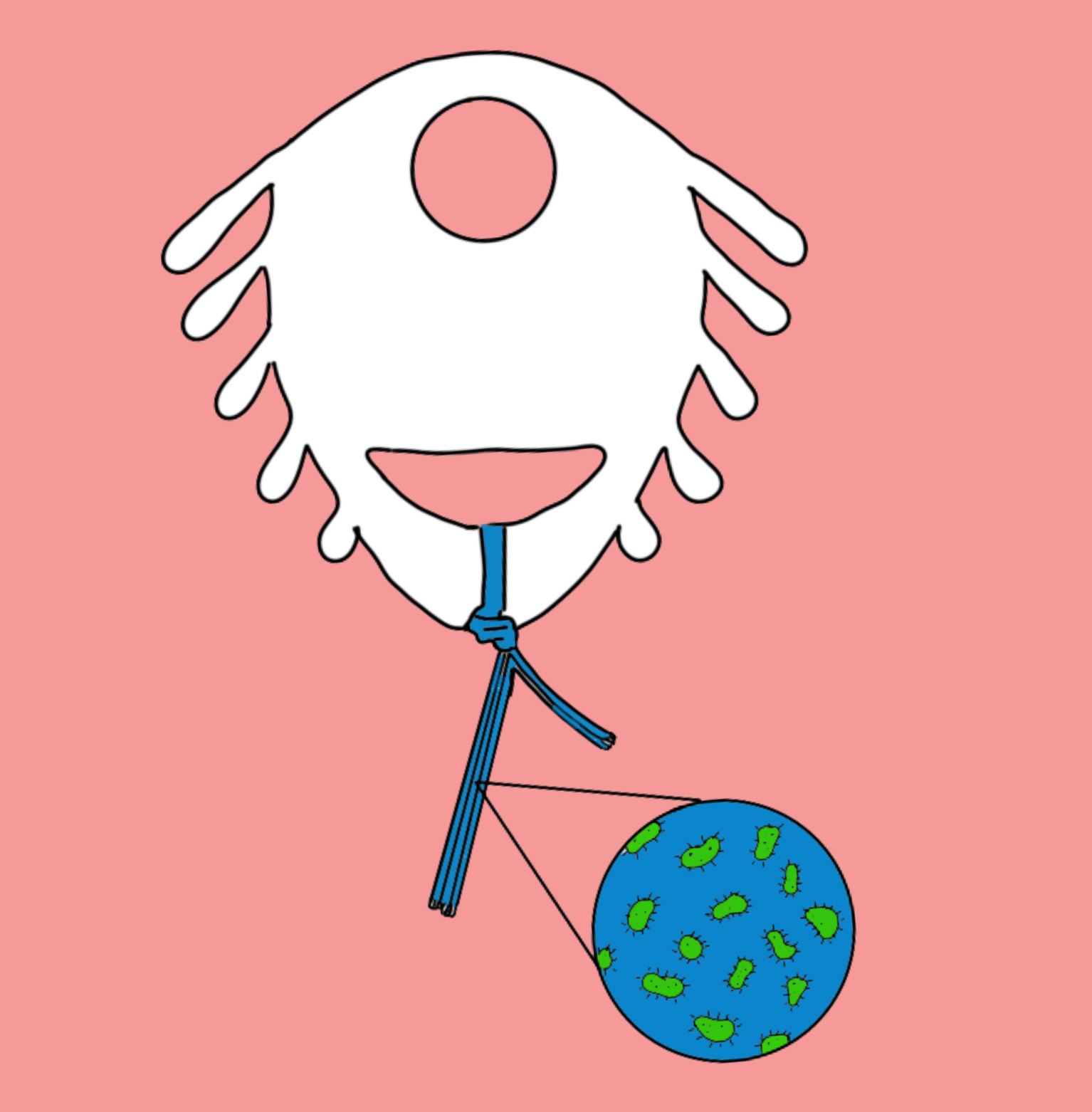
    The Dalkon Shield was an intrauterine device (IUD) sold to women as a birth control alternative in the 1970s and 80s. It was a plastic shield that resembled a crab attached to a string. The plastic shield was embedded with copper, which acts as a natural spermicide. Women were attracted to this non-hormonal device, because there would be no side effects in comparison to the pills that were previously the only available option. It was better than remembering to take a pill at the same time every day. Because it was non-hormonal, it wasn’t considered a drug, so it didn’t need to be FDA approved.

    However, the string attached to the shield was made of a thick filament (cotton/rayon). This would wick up bacteria in the vaginal canal, through the cervix, and into the uterus, causing infections. The company, A.H. Robins, was aware of this problem six months before it was placed on the market.. Pressed to keep costs low, they sold it anyway, with their customers totally unaware. Eventually, the shield resulted in 18 women dead, thousands of women with infections and complications, including infertility.


    The Creep(y) Ceiling Collapse

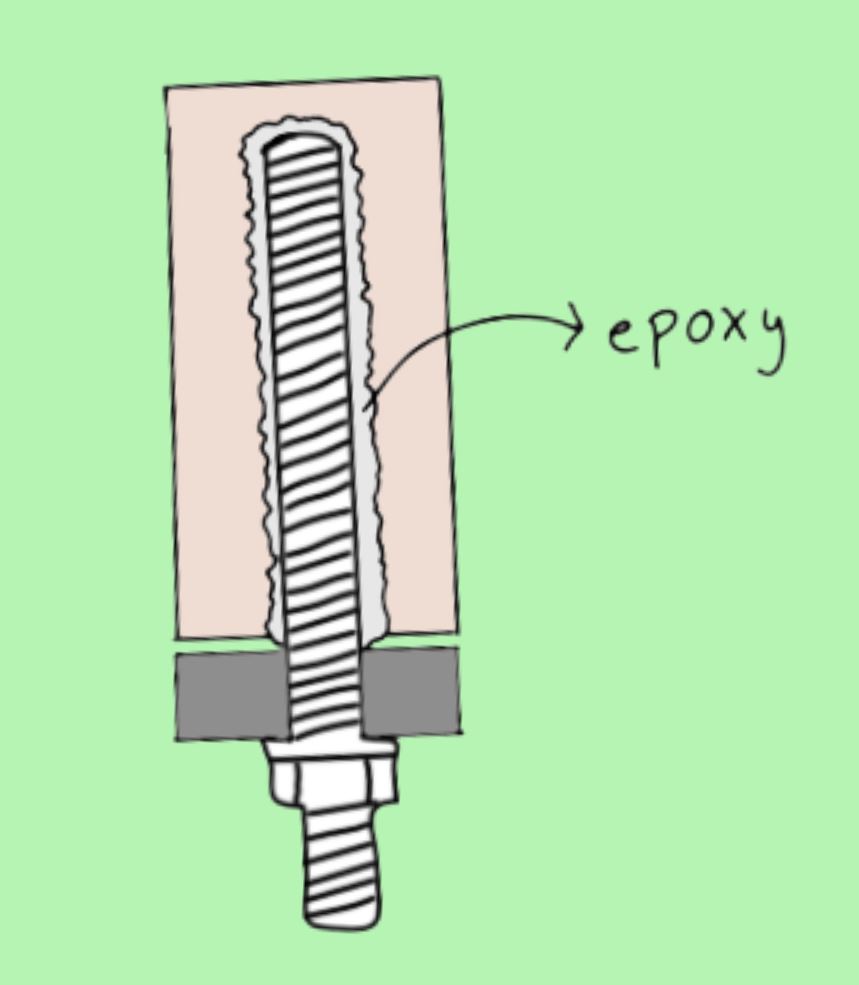
    On July 10th, 2006, concrete ceiling panels in Boston’sTed Williams Tunnel on Interstate 90 suddenly collapsed and killed a woman in her car. The panels were attached to the ceiling with cables to allow air circulation in the tunnel. The problem was that the cables were attached with a material that was susceptible to creep. “Creep” is a term used to describe the phenomenon when a material deforms (or “sags”) after a constant stress is applied over a long time. The accident happened due to miscommunication at multiple levels. The companies responsible for choosing the epoxy, Gannett Fleming, Inc., and Bechtel/Parsons Brinckerhoff, were not well-educated on creep effects, and chose a Fast-Set epoxy supplied by Powers Fasteners, Inc. Powers neglected to inform them of the durability and longevity of the epoxy.  Not only that, but the Massachusetts Turnpike Authority failed to do timely inspections of the ceiling panels and the deteriorating cables holding them up. 


    Do you see the common thread in these cases? I sure do. In each case, important scientific concepts became design flaws that were known by people in the company, but not addressed. Why? It is probably a combination of attitudes of complacency and incompetency in communication skills. It’s also hard for individuals to feel accountable for their actions when there are failures at so many levels of a company, and they too are confused on who to blame

    A cultural shift needs to happen to give engineers and business managers a greater sense of urgency and accountability in their work. This starts from education in ethics and communication. I think universities could be doing much more to train students into becoming better professionals by integrating ethics and communications more heavily into engineering curriculum. Even at Georgia Tech, I’ve seen a lack of education within ethics courses to address topics such as implicit bias and effective communications skills. All of these components impact performance in industry. We can do better. So, why not start now?


    Sources:

    Dalkon Shield:

    1. Horwitz, Rainey, “The Dalkon Shield”. Embryo Project Encyclopedia (2018-01-10). ISSN: 1940-5030 http://embryo.asu.edu/handle/10776/13043.
    2. Dosani, Sanya (Producer). (2020) Sex, Explained.[Video file]. Retrieved from https://www.netflix.com/title/81160763.

    The Challenger:

    1. Wall, Mike. (2016, January 28). Challenger Disaster 30 Years Ago Shocked the World, Changed NASA. Retrieved from https://www.space.com/31760-space-shuttle-challenger-disaster-30-years.html.
    2. Tufte, E.H. (1997) Visual Explanations: Images and Quantities, Evidence and Narrative. Graphics Press.

    Ted Williams Tunnel:

    1. National Transportation Safety Board. (2007) Ceiling Collapse in the Interstate 90 Connector Tunnel Boston, Massachusetts July 10, 2006. (Report ID: NTSB/HAR-07/02 PB2007-916203 Notation 7901A). Retrieved from https://www.ntsb.gov/investigations/AccidentReports/Reports/HAR0702.pdf.
  • Science of Spider Silk

    Every year I move into a new room on campus at Georgia Tech, I buy a package of sticky putty, hoping that it will be strong enough to hold my large posters of the periodic table and Chance the Rapper, because command strips are just way too expensive. They usually fall down in the middle of the night, waking me up in terror. Recently in my polymers class, I learned about the beauty of spider silks and how they secrete different silks to accomplish different tasks. When I googled “spider silk,” I found articles and youtube videos claiming that spider silk is stronger than steel. I wondered how spiderwebs are able to stick to walls better than my command strips, but when I accidentally run into one, it breaks easily.

    After doing some research, I learned that strands of spider silk are actually made of thousands of close-packed, parallel nanostrands, and depending on the gland they are secreted from, their tensile strength is 100-400 kpsi, compared to steel, which is 40 kpsi [1]. The secret is in how the tensile strength is measured. Tensile tests consist of putting a material in tension, essentially stretching it until it breaks. Spider silk is made of semi-crystalline polymer nano strands that can stretch a lot before breaking, and having many strands stacked together makes it even stronger, while steel thread of the same diameter or density has a crystalline structure that doesn’t stretch. This scenario is analogous to breaking a single stick of strong wood versus breaking a bundle of many weaker but stretchier sticks of wood: the bundle wins.

    Spiders have different glands that secrete silks with different properties as protein structures to accomplish different tasks [2]. The tubuliform gland creates the silk to make the hard outer shell for an egg sac, and the aciniform gland makes the inner lining of the egg sac. The aggregate and flagelliform glands produce the sticky droplets and capture spiral threads, respectively, to catch prey.  The major ampullate gland makes the frame of the web as well as the dragline silk that allows the spider to move around. Lastly, the pyriform silk gland is responsible for the silk that attaches the web to the walls, trees, your bedroom window, etc. Pyriform silk is described as a “protein glue” or a “glue-like cement” that holds small amino acid fibroins, which then connect larger dragline silks, and are sometimes reinforced by aciniform silk [3]. Together, all of these components create a very strong network of silks that makes the overall product very adhesive. 
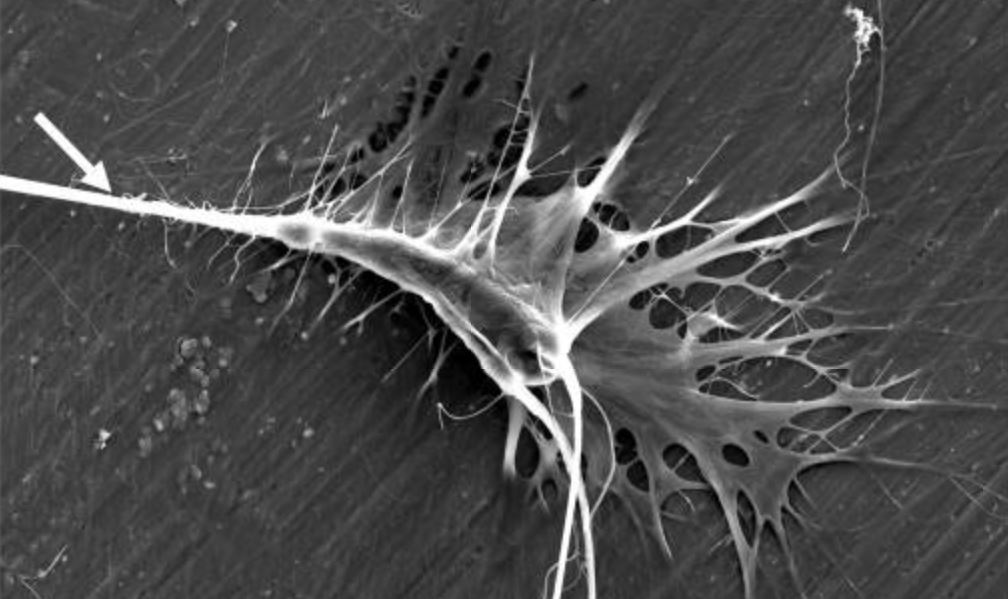
    In this picture from a study that took Scanning Electron Microscope (SEM) images of a single attachment point of a web, it looks like the pyriform silk is a splat of glue with the dragline silk (white arrow) stuck in it [4]. Looking closer, the “glue” looks like a network with many, smaller attachments to the surface of the wall. 

    Meanwhile, the sticky putty that I use to try to hang up my posters isn’t as robust as the spider silk glue. The formula for sticky putty is a trade secret, but it is known that it works as a pressure-sensitive adhesive, so the extent of adhesion depends on the amount of pressure you apply to it, as well as the shape and geometry. So even though I add a lot of pressure to the poster when I first apply it, depending on the weight of the poster and the amount of putty I used, the poster will slowly pull the putty off the wall, depending on how much I used and the temperature of my room [5]. 

    If spider silks are so strong and perform so many tasks well, why don’t we make adhesives or other high performance materials out of it? There have been many ideas for potential uses of spider silk in body armor due to its mechanical properties. It is also antimicrobial, so there are many ideas for biomedical applications, such as scaffolding for tissue generation [2]. However, spider silk is extremely difficult to harvest. This is because spiders are inherently cannibalistic and produce a small amount of silk in comparison to silk worms, which are typically used to harvest silk for textiles. Scientists have attempted to put spider genes in silkworms, but the silk they produce still isn’t of the same quality [6]. So unfortunately, I probably can’t get a spider as a pet and harvest the silk for my dorm posters. But doing all this research made me curious: How is Spiderman’s silk compared to actual spider’s silk? And where are the silk glands?


    References:

    [1]Hayashi, C. Y., Shipley, N. H., & Lewis, R. V. (1999). Hypotheses that correlate the sequence, structure, and mechanical properties of spider silk proteins. International journal of biological macromolecules, 24(2-3), 271-275.

    [2] TED. (Dec 7, 2011). Hayashi, Cheryl: The Magnificence of Spider Silk [Video file]. Retrieved from https://www.youtube.com/watch?v=xossR6eHv3I&t=248s

    [3]Hardy, John & Römer, Lin & Scheibel, Thomas. (2008). Polymeric materials based on silk proteins. Polymer. 49. 4309-4327. 10.1016/j.polymer.2008.08.006.

    [4]Blasingame, Eric et al. “Pyriform spidroin 1, a novel member of the silk gene family that anchors dragline silk fibers in attachment discs of the black widow spider, Latrodectus hesperus.” The Journal of biological chemistry vol. 284,42 (2009): 29097-108. doi:10.1074/jbc.M109.021378

    [5] “Blu Tack FAQs.” Blu Tack, Wayback Machine Internet Archive, 2010, web.archive.org/web/20100418062649/http://www.blutack.com/faq.htm.

    [6] SciShow (Feb 4, 2019). Green, Hank: Why Can’t We Make Spider Silk? [Video file]. Retrieved from https://www.youtube.com/watch?v=UX2LHcLxjio

  • Are sustainability trends legit?

    A lot of us may have seen the VSCO girl memes, telling us to “save the turtles” with their Hydroflasks and metal straws. I find it fascinating that metal straws have become a trend, restaurants have stopped providing plastic straws, and plastic bag bans are being implemented across the country. These sustainability trends sound great, but are they actually helping the environment and making a positive impact? It has been estimated that 8.3 billion plastic straws line the world’s coastlines, but they only make up 4% of total plastic waste, and according to The Atlantic, reusable tote bags use more energy to manufacture than a typical plastic grocery bag, and people tend to accumulate these tote bags, defeating the purpose of reusing them. 

    Sustainability is a big buzz word in the field of materials science. I talked to Nasreen Khan, a PhD candidate in Materials Science and Engineering at the Georgia Institute of Technology, to find out more about sustainable materials. Nasreen and other graduate students in her lab have recently created a podcast called “Talk Green to Me,” with episodes covering different classes of materials and their impact on the environment.

    The first thing I wanted to know was the definition of sustainability. Nasreen describes it as “taking positive action toward the protection and betterment of the environment.” So how are materials a part of the conversation around saving the environment? I asked for Nasreen’s opinion on what materials most affect our environment today. She replied with “microplastics, simply because of the sheer quantity of them that are in our environment, and we don’t quite know how they affect organisms.” Microplastics come from plastic waste naturally breaking down into smaller particles, as well as microbeads present in many consumer products, such as cosmetics. These microplastics pollute water systems, which are ingested by marine life and cause internal damage, and are even present in drinking water, though the extent of these effects are still being researched.

    How do plastics degrade and why do they degrade slower than other materials? Metals and ceramics break down through corrosion, and they eventually become part of the environment. Corrosion of these materials typically happen through interactions with water that strips away ions. Plastics have varying degradation times depending on the polymer, but are typically much longer than metals or ceramics due to functional groups that aren’t easily cleaved by water. These stronger covalent bonds cause plastics to stay in the environment for many years before breaking down.

    I asked Nasreen’s opinion about the effectiveness of reusable bags and straws. She argues that these trends are impactful because they have created awareness of how people’s choices affect the environment. This motivates people to think more about their consumption habits.

    So what else can we be doing? As a recycling connoisseur, Nasreen has many resources to suggest. Some general things included consuming less, reusing and repurposing items, especially textile waste. Nasreen also suggests “[buying] from companies that use recycled content because that will expand the market for recycled products.” Target is an example of a company that is making large efforts to create sustainable products such as packaging, paper, and clothing.

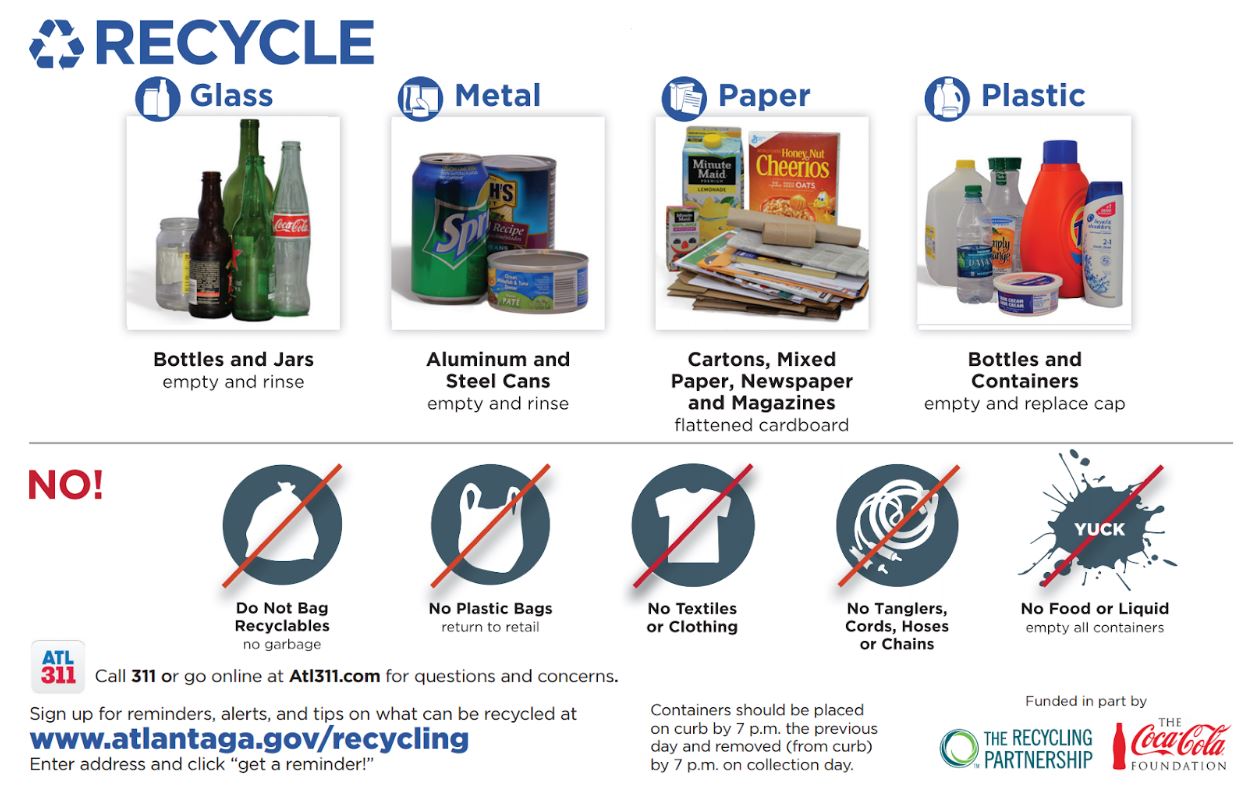
    In addition to choosing companies with sustainability efforts, municipalities typically provide information online that indicates how to recycle and what recycling efforts are happening. A recycling info card is available through atlantaga.gov to help people understand what can and cannot be recycled:

    Other recycling resources in Atlanta include MandM Waste, which recycles scrap metal, UseAgain, which does textile recycling, and the Center for Hard to Recycle Materials (CHaRM). Outside of Atlanta, TerraCycle is an international waste recycling program that can recycle products from used makeup to brita filters. Links to all of these resources are at the end of the article.

    Recycling correctly may take effort, but creating a regular habit can contribute to saving the environment. Looking back to the podcast created by Nasreen and her colleagues, I asked why they decided to create it in the first place. Nasreen said the goal was “to teach people about materials science and help them see the relevance and importance of sustainability.” Materials are such a big part of our daily lives, it’s crucial to be educated on how we are using and consuming them. If you want to learn more about the details of different classes of materials and their impact on the environment, check out “Talk Green to Me”, available on Spotify and iTunes.


    City of Atlanta Recycling Information: https://www.atlantaga.gov/government/departments/public-works/recycling-program

    MandM Waste: https://www.mandmwaste.com/scrap-metal-recycling-in-atlanta-ga-p-60.html

    CHaRM: https://livethrive.org/charm/

    TerraCycle: https://www.terracycle.com/en-US

    Sources:

    1. Borenstein, Seth. “Science Says: Amount of straws, plastic pollution is huge,” Boston News. April 20, 2018. Available: https://www.boston.com/news/politics/2018/04/20/science-says-amount-of-straws-plastic-pollution-is-huge
    2. Dillon, Noah. “Are Tote Bags Really Good for the Environment?” The Atlantic. Sep 2, 2016. Available: https://www.theatlantic.com/technology/archive/2016/09/to-tote-or-note-to-tote/498557/
    3. Jordan, Rob. “Do plastic straws really make a difference?” Stanford Earth. Sep 18, 2018. Available: https://earth.stanford.edu/news/do-plastic-straws-really-make-difference#gs.67cow8
    4. Target’s Sustainability Policies and Partnerships: https://corporate.target.com/corporate-responsibility/planet/sustainable-products