Author: Olive McKay

  • Color Changing Lemonade

    Would you believe the drink above is lemonade, and the blue and purple colors are due to all natural ingredients? That’s right. The lemonade pictured is cooled with not-so-average ice cubes. These cubes are made from frozen butterfly pea flower tea. 

    Butterfly Pea flower tea is a popular non-caffeinated tea from Southeast Asia. It is made simply by steeping butterfly pea flowers in boiling water. Butterfly pea flowers get their deep blue hue from a natural compound called anthocyanin. This compound is the reason for the dark blue color of the ice cubes in the video above, and is also the reason for the amazing color change that occurs when the ice cubes come in contact with the acid from the lemon juice.
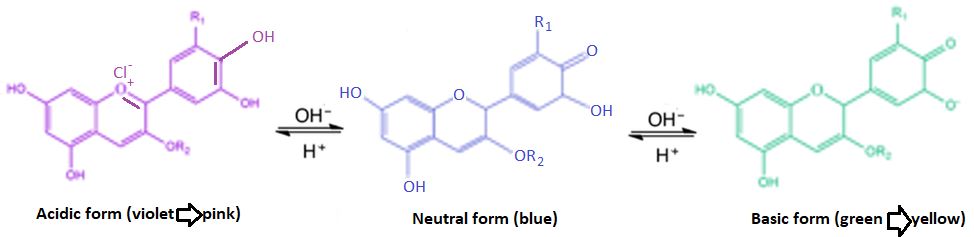
    Anthocyanin undergoes reversible chemical changes (shown above) when exposed to either acids or bases. The chemical change alters the chemical structure, which alters the way it absorbs different wavelengths of light. When anthocyanin is exposed to a base, it reflects green and then yellow, depending on the strength of the base. When anthocyanin is exposed to acid, it turns purple and then red, depending on the strength of the acid. Because lemons are acidic, the melted butterfly tea ice cubes turn purple!

    You can make this cool color changing drink at home with butterfly pea flowers and other normal household ingredients.

    Making the butterfly pea flower ice cubes is simple. Just steep about 4 to 5 butterfly pea flower tea bags, or 25 to 30 dried pea flowers, in about 2.5 cups of boiling water. You can choose to leave the teabags/flowers steeping for up to 30 minutes for concentrated color, but just 10 minutes will get you blue ice cubes that can definitely give you a beautiful color change.

    All that’s left is to make the lemon mix that will turn the ice cubes purple! Mix 1 cup of lemon juice with ¾ cups of sugar and stir until the sugar is completely dissolved. You can heat up the mixture a little to speed the mixing process.

    Next, take your frozen butterfly pea flower tea and put it in the blender or food processor to create shaved ice. If your blender is like mine and can only make crushed ice pieces, that’s okay, just make sure there is some melted tea in your glass to get the immediate color change effect. Fill your glass halfway with crushed or shaved butterfly pea flower ice, and then add the lemon mix! As the anthocyanin comes in contact with the acid from the lemon juice, it will turn a pretty purple color. If you have some bigger crushed butterfly pea flower ice pieces, they will stay blue and only turn purple as they melt, which will create a swirly blue/purple gradient effect. Fill the glass with your desired amount of lemon mix (I fill it about ⅓ full) and top the rest of the glass with club soda! And viola, you have your color changing lemonade!

    Citations

    Kodippili, D. (2020). Color Changing Lemonade Slushie (Galaxy Lemonade). The Flavor Bender. www.theflavorbender.com/galaxy-color-changing-lemonade-slushie/

    Kan, Viirj & Vargo, Emma & Machover, Noa & Ishii, Hiroshi & Pan, Serena & Chen, Weixuan & Kakehi, Yasuaki. (2016). Organic Primitives: Synthesis and Design of pH-Reactive Materials using Molecular I/O for Sensing, Actuation, and Interaction. 
     

  • Color Vision Deficiency and the new Glasses on Facebook

    Color vision deficiency, also known as colorblindness, is more common than one might think. 0.6 percent of women and 8 percent of men are born with colorblindness. The causes can be widespread, but the most common types of color vision deficiency are inherited.

    How do we see color, and what is the reason for color vision deficiency?

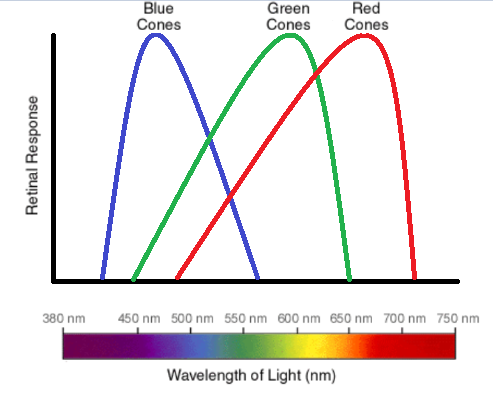
    Light, as a wave, enters the eye through the pupil, and lands on the retina, the collection of cells on the back of your eye. The retina has cells called cone cells and rod cells. Rod cells can be stimulated by a very small amount of light, however they have a molecule called rhodopsin in them, which cannot differentiate between different wavelengths. Cone cells require more light to be stimulated, but they have photopsin in them which can help our brains differentiate between the different wavelengths of light. This is why cone cells allow us to perceive color. All cone cells do not have the ability to differentiate all colors of light though. There are 3 types of cone cells, and each is stimulated by a different range of wavelengths due to the type of photopsin it possesses.

    Because the ranges overlap for some wavelengths, sometimes cones can work together to differentiate certain colors. For example, the wavelength 625 nm, which corresponds to the color yellow, stimulates both red cones and green cone cells. Both of these cell types accept the 625 nm wave and send the signal to your brain that allows you to perceive yellow.

    There are several different kinds of color blindness, and the different kinds can be brought about by different causes. Sometimes colorblindness is caused because there is an absence of one or more types of photopsin in the cone cells on the retina. Other times it is caused because the photopsin in the cone cells is absorbing a range of wavelengths that is abnormal.

    Dichromacy is a type of color blindness where the subjects only possess 2 of the 3 normal photopsin types. Protanopia is a condition where the subject has normal green and blue photopsin molecules, and defective or absent red photopsin molecules. Deuteranopia is a condition in which the subject has normal blue and red photopsin molecules, and defective or absent green photopsin molecules.

    Trichromacy is a condition in which subjects possess all three photopsin types, but one of more of the photopsin types on their retinas absorbs an abnormal wavelength range. One of the most common forms of colorblindness is red-green color vision deficiency. This is caused either when the wavelength absorption peak for the red photopsin molecules is shifted toward the lower wavelengths (i.e. closer to the green wavelength absorption peak), or when the green wavelength absorption peak gets shifted toward the higher wavelengths (i.e. closer to the red wavelength absorption peak). These abnormalities are called protanomaly and deuteranomaly, respectively, and both of them cause an individual to have a lower ability to distinguish the difference between red and green.

    The approximate retinal response of individuals with deuteranomaly. The retinal response of individuals with protanomaly looks similar, with the green and red cone peaks close together. This is what gives those individuals trouble with distinguishing differences between red and green colors. 

    If you’ve been on Facebook recently, you may have seen videos of the reactions of colorblind people putting on colorblind glasses. En-chroma is a brand that has popularized what they call “color blind lens technology”. The technology works by selectively excluding wavelengths of light where the red and green peaks overlap. These wavelengths stimulate both the green and red cones at high levels in individuals with protanomaly and deuteranomaly. Because the glasses filter out these wavelengths, it helps the individual to see more differences between red and green!