Author: Priyanka Singh

  • Turning a Creature into a Cute Character Design

    If your Instagram discover page is full of posts from digital artists like mine is, there’s a decent chance you may have come across posts by an artist named Feefal (@feefal). Feefal is a very popular illustrator on Instagram, with 1.2 million followers and most of their posts gaining tens of thousands of likes and hundreds of thousands of views on Reels. Feefal describes herself as a lover of biology and cute women, which is reflected in the subject matter of the bulk of her illustrations. For example, one of her pinned posts, and the first post of hers I came across in 2023, can be described as “plant, animal, and fungi cells but they’re personified as women.”

    There are many artists who do the same types of illustrations as Feefal where they turn creatures, objects, or even vague ideas into a personified character design. As someone with an interest in both biology and drawing, I wanted to try my own hand at creating an illustration where I turn a creature into a character. 

    In keeping with my theme about sea creatures from my previous post, I chose to base my character design on Pelagia noctiluca, a species of jellyfish that is referred to by many common names, the most popular being “mauve stinger”. A fun nickname I’ve also seen for it is the “purple people eater” (yes, like the song).

    Taking both morphology and cool facts I read about them into account, this is what I came up (with with the help of my boyfriend, who asked to help and I couldn’t refuse):
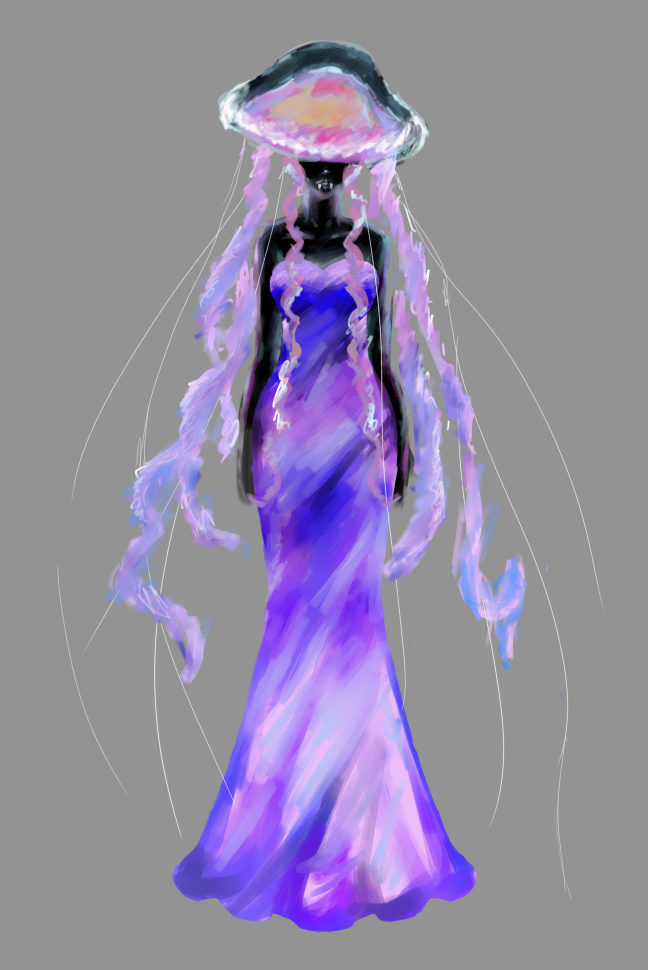
    Illustration by Priyanka Singh and Kojo Ching

    This is the part where I explain my design decisions while telling you cool facts about P. noctiluca. 

    • Hat: Obviously, this is meant to represent the bell, or umbrella, of the jellyfish. It is the main body of the jellyfish where the tentacles branch off from. A jellyfish’s mouth lies in the center of the underside of its umbrella, surrounded by oral arms (we’ll get to those in a second) (Macpherson & Gordon, 2023). You’ll notice that jellyfish have no eyes, so I made the bell-hat cover her eyes. I accept criticisms of this choice as lazy, as I basically just draw a jellyfish on this woman’s head. But will you dare tell her it’s not a look?
    • Dress: Along with the hair-tentacles coming out from the “hat”, this is supposed to be somewhat evocative of the tentacles of the jellyfish with its flowy nature. The mermaid dress silhouette is also supposed to evoke a nautical theme. The mauve stinger has two types of tentacles: thin, string-like ones called statocysts and thicker, frilly ribbon-like ones called oral arms. It has 8 statocysts and 4 oral arms. Statocysts are used for sensing movement and orienting the jellyfish. Oral arms extend from the mouth, contain nematocysts, and aid in prey capture (Macpherson & Gordon, 2023). The sting of a mauve stinger is somewhat severe, although there have not been any fatalities due to their stings (Mariottini et al., 2008).
    • Skin: The skin and the dark parts around the cap are supposed to represent the semi-translucent, soft body of the jellyfish, with the darkness being the ocean showing through.
    • Sharp teeth: I took some creative liberties with this part. No, jellyfish don’t have razor-sharp fangs. Instead, this is supposed to represent the purple people-eater’s predatory nature. They’re said to be opportunistic predators that mainly feed on small phytoplankton, although they can eat prey of various sizes. They can even eat over 1.5 times their body weight in a day. (Larson, 1987). Don’t worry, at least they don’t actually eat people!


    References:

    Macpherson, D., Gordon, D. (2023). Jiggling Jellyfish: a guide to the jellyfish of New Zealand. (Version 2). National Institute of Water and Atmospheric Research (NIWA). 

    Mariottini, G.L., Giacco, E., Pane, L. (2008). The Mauve Stinger Pelagia noctiluca (Forsskål, 1775). Distribution, Ecology, Toxicity and Epidemiology of Stings. A Review. Mar. Drugs, 6(3): 496-513. doi: 10.3390/md20080025

    Larson, R.J. (1987). A Note on the Feeding, Growth, and Reproduction of the Epipelagic Scyphomedusa Pelagia noctiluca (Forskal). Biological Oceanography, 4(4). 
  • Circus Sea Slugs: How clown nudibranchs are like real-life Pokémon

    The Pokémon “Shellos” and its evolution “Gastrodon” (whose pink West Sea variant is one of my favorite Pokémon) resemble a sea slug. Don’t just take my word for it, though—in their Pokédex entries, Shellos and Gastrodon are referred to as the “Sea Slug Pokémon”. The Pokémon Goomy is referred to as a Mollusk Pokémon in many languages, and although sea slugs are a type of mollusk, the resemblance is less apparent. The team behind the games really didn’t have to change much from their real-life inspiration, though, as sea slugs are some of the most unreal-looking creatures in our oceans. As Helen Sullivan writes about sea slugs, which are also known as nudibranchs, in the Smithsonian Magazine, “It is really, really difficult not to compare them to Pokémon characters” (2024).

    Nudibranchs belong to the class Gastropoda, which falls under the phylum Mollusca (mollusks). The term sea slug is used to broadly refer to 11 different subgroups under Gastropoda that do not have hard outer shells. True nudibranchs account for only one of these subgroups, but the others are sometimes also referred to as nudibranchs for convenience (Davey & Willan, 2020). 

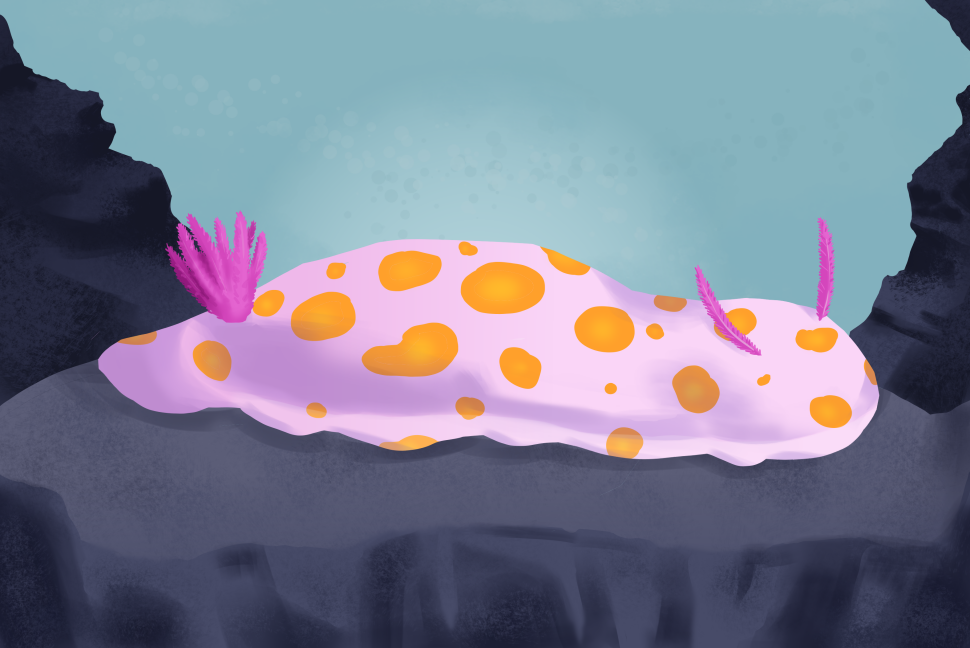
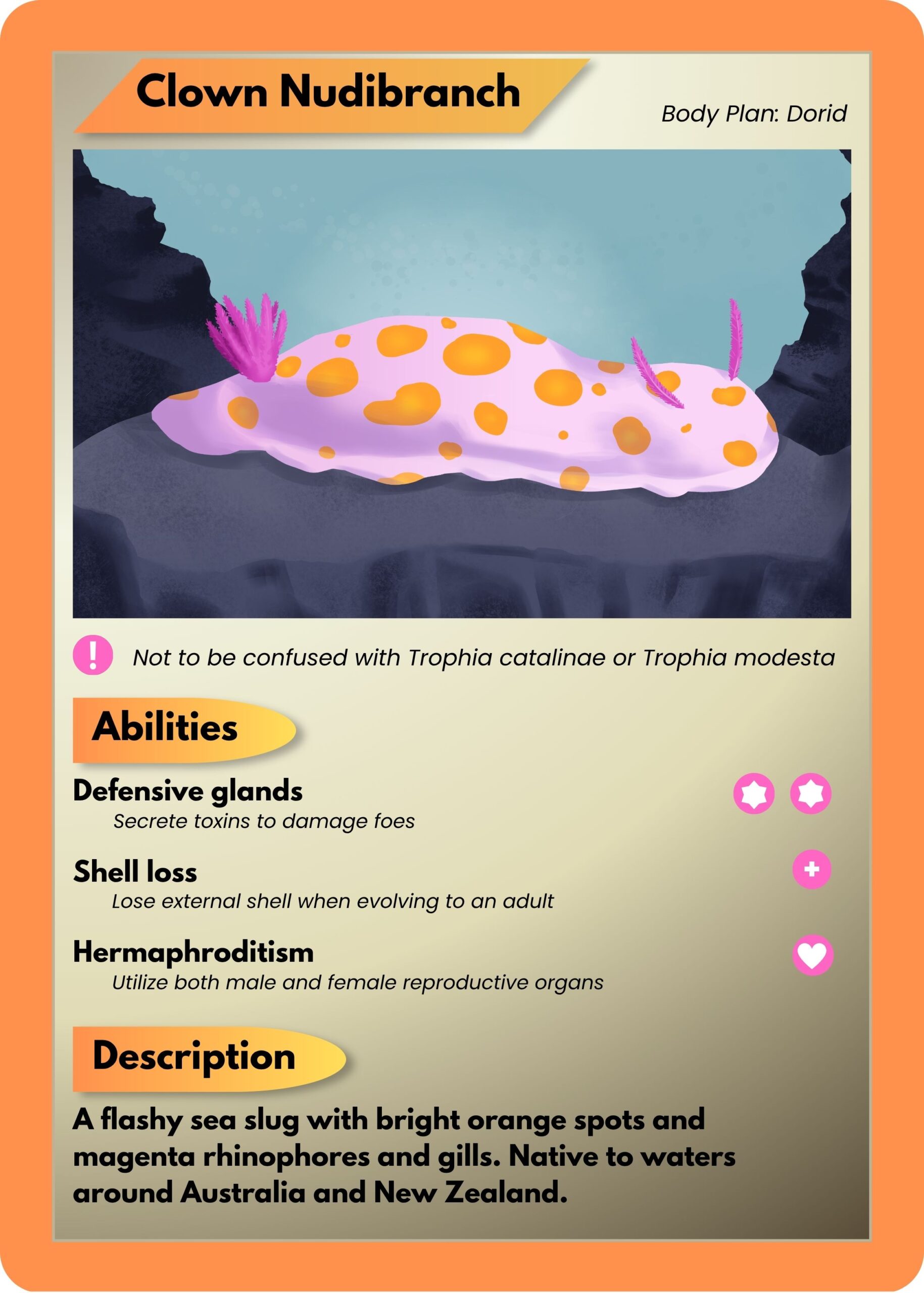
    When reading about species of nudibranch, one caught my eye for its name and bright orange coloration: the clown nudibranch. Even the name makes them sound like some sort of Pokémon! They are quite small—around 3 cm on average for adults—but their orange spots would probably make them hard to miss. The name, appearance, and distinctive characteristics of this creature gave me the idea to make a faux Pokémon card for the species, whose scientific name is Ceratosoma amoenum.

    Illustration/Graphic Design by Priyanka Singh

    Dorid

    Nudibranchs can have a few different body plans that differ in shape, gills, and more. C. amoenum has a dorid nudibranch body plan, which means it has two protrusions on its front end and a bundle of protrusions on its back end. The two protrusions that resemble antennae are called rhinophores while the bunch of protrusions on its backside are actually its gills! This distinctive characteristic is where nudibranchs get their name from. Nudibranch means “naked gills” (Sullivan, 2024).

    Not to be confused with…

    When researching for this article, I found that there are other nudibranch species with a similar appearance and common name as C. amoenum. Trophia catalinae also has a white body with orange spots, although its spots are raised (known as “tubercles”), and its rhinophores and gills are orange rather than magenta. It’s referred to by a similar name: “sea clown trophia” or simply “sea clown”, so you can see where the confusion might arise. Trophia modesta is a species that was recently distinguished from Trophia catalinae in a 2020 study, and it is commonly known as the “modest clown dorid” (Jung et al.). Unsurprisingly, it looks more similar to T. catalinae than it does to C. amoenum, although its body is more translucent than T. catalinae’s. Still, an amateur nudibranch enjoyer may get these species confused at first glance.

    Defensive glands

    Nudibranchs often contain chemical defenses within their bodies. A protective tissue called the mantle contains glands that secrete the toxins (Davey & Willan, 2020). Like other nudibranchs, our clown friend doesn’t produce these toxins on their own—they obtain them from their diet, which consists primarily of sponges (Winters et al., 2018). This chemical defense is critical for the soft, shell-less nudibranchs.

    Shell loss

    Speaking of not having a shell, both the English and Japanese name for Shellos mean “lost shell”: Karanakushi in Japanese, with kara meaning “shell” and nakushi being derived from nakushite (without) or nakusu (to lose); and “shell loss” (Shellos) in English (“Shellos”, 2026). The name origin references one of the nudibranch’s most defining characteristics. Gastropods have an external shell in their larval stage, although members of order Nudibranchia lose it before they reach adulthood, with C. amoenum being no exception (Davey & Willan, 2020). 

    Hermaphroditism

    As members of the Gastropoda class, sea slugs are hermaphrodites. Each individual has both male and female reproductive organs. I know what you may be wondering, but no, they can’t impregnate themselves, although they often donate and receive sperm simultaneously with another individual. Some nudibranchs even shed their penises after intercourse and gain a new one soon after (Sekizama et al., 2013). Talk about freaks of nature….

    I considered designing a creature based on the clown nudibranch for my fake Pokémon card, but why would I when the real thing looks like that? I’ll leave the creature designs to the Pokémon team for now. I hope you’ve come to see that sometimes reality can be stranger than the fiction it inspires, and that our world is full of amazing yet often overlooked creatures like the nudibranch.

    Illustration by Priyanka Singh

    References

    Davey, N., Willan, R.C. (2020). Super sea slugs: a guide to the sea slugs of New Zealand. (Version 1). National Institute of Water and Atmospheric Research (NIWA). 

    Gastrodon. (2026). Bulbapedia. Retrieved April 17, 2026, from https://pokemondb.net/pokedex/gastrodon 

    Jung, D., Gosliner, T.M., Choi, T., Kil, H., Chichvarkhin, A., Goddard, J.H.R., Valdés, A. (2020). The return of the clown: pseudocryptic speciation in the North Pacific clown nudibranch, Triopha catalinae (Cooper, 1863) sensu lato identified by integrative taxonomic approaches. Marine Biodiversity, 50, 84. doi.org/10.1007/s12526-020-01107-2 

    Sekizama, A., Seki, S., Tokuzato, M., Shiga, S., Nakashima, Y. (2013). Disposable penis and its replenishment in a simultaneous hermaphrodite. Biology Letters, 9(2). doi.org/10.1098/rsbl.2012. 1150 

    Shellos. (2026). Bulbapedia. Retrieved April 17, 2026, from https://pokemondb.net/pokedex/shellos 

    Sullivan, H. (2024, May). Dive Into the Exotic World of Nudibranchs, the Spectacular Slugs of the Sea. Smithsonian Magazine. www.smithsonianmag.com/science-nature/dive-exotic- world-nudibranchs-spectacular-slugs-sea-180984013/

    Winters, A.E., White, A.M., Dewi, A.S., Mudianta, I.W., Wilson, N.G., Forster, L.C., Garson, M.J., Cheney, K.L. (2018). Distribution of Defensive Metabolites in Nudibranch Molluscs. Journal of Chemical Ecology, 44, 384-396. doi.org/10.1007/s10886-018-0941-5