Author: Owen Gildard

  • England’s Greatest Engineer: Brunel’s Great Ships

    Isambard Kingdom Brunel was fascinated with the idea of building steam driven metal ships that could travel across oceans. He calculated that though the volume a ship could carry was cubically proportional to its dimension, the drag it experienced was only squared. This meant that the larger a ship was, the more fuel efficient it would be proportionately speaking. Brunel put his theories into practice with the construction of the Great Western (1836), the longest steam ship at the time, powered by the common day technology of paddlewheels and sails.  Brunel’s ship was in a race with the Sirius to make the first transatlantic trip on steam power alone. Unfortunately, a fire in which Isambard was injured, delayed the ship’s departure. Although the Great Western left port four days after the Sirius, she arrived in New York only one day behind and, unlike the Sirius which had to burn furniture, rope, and spars as fuel, the Great Western still had a third of her coal left over.
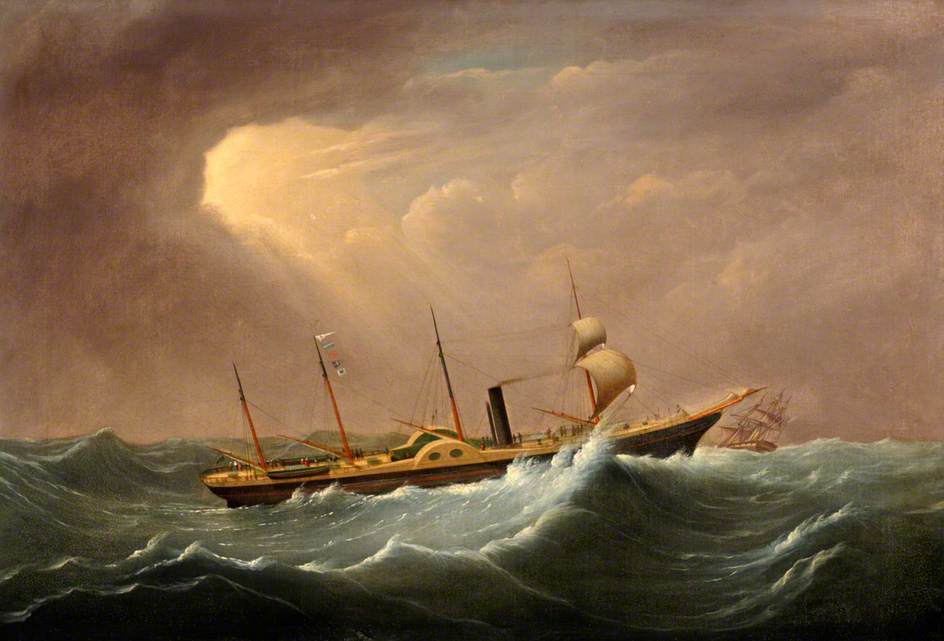
    The SS Great Western by Joseph Walter
    The SS Great Western by Joseph Walter

    Brunel’s theories on the size of ships had been proven correct, and he proceeded to build the Great Britain (1843), the largest ship in the world, which was also not only one of the first screw propeller driven ships, but also had an iron hull. For combining these two technologies, it was considered the first modern ship. 

    Model of the SS Great Britain
    Model of the SS Great Britain

    Finally, Brunel built the Great Eastern (1858), nearly three times the length of the Great Western and was propelled by sails, paddle wheels, and a screw propeller. All three of these ships again gave testimony to Brunel’s genius and vision at combining and applying the technology of the day through a variety of means to bring England roaring into the modern era.
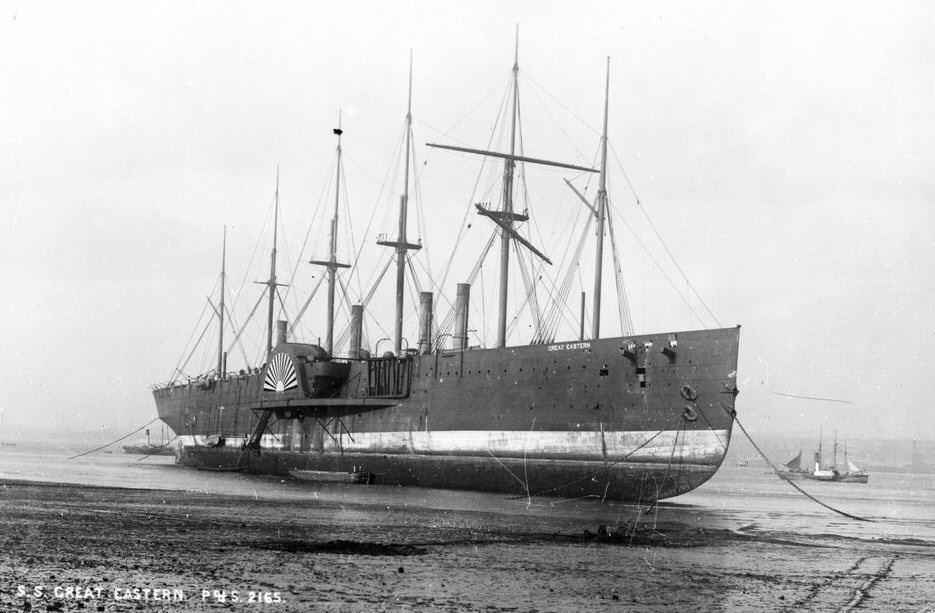
    The SS Great Eastern by Allan Green
    The SS Great Eastern by Allan Green

     So why have I spent three post giving you a history lesson about a man who you’ve probably never heard of? In the early 2000s the BBC had a competition where they asked their public to vote for who they thought the ten greatest Britons were and they then did a one hour segment on each of them. Many recognizable names such as Newton, Shakespeare, Queen Victoria, and Churchill make the list, but Brunel who actually won second place behind Churchill is an unknown figure in America. This oversight is slightly shameful as Brunel is practically the founder of modern England and therefore by extension, America. His vision, courageously enterprising nature, and inexhaustible energy made him not only the leader, but the epitome, of the industrial revolution. Men like Brunel took on projects and works with the help of machines that had never before been tried. He had the incredible audacity to fly in the face of the limitations that man had contended with for centuries. Men like Brunel, through the industrial revolution, dramatically improved the quality of life for the average citizen. It is no wonder then that with Isambard’s resume of accomplishments and legacy that he is not only considered the greatest British engineer who ever lived but also the second greatest Briton in history.  
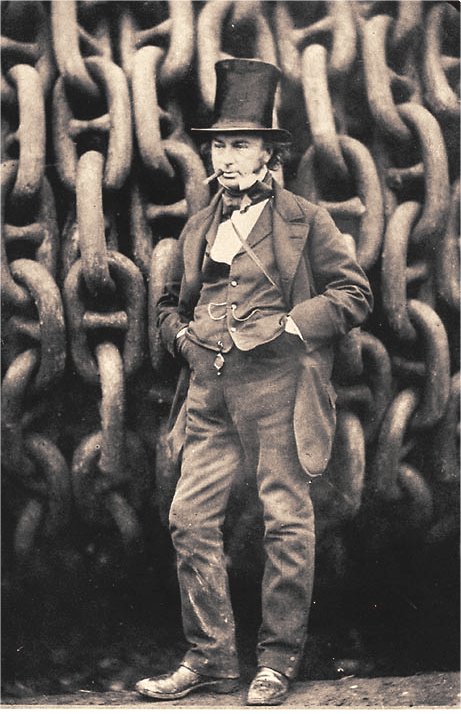
    Brunel at the launching of the Great Eastern by Robert Howlett
    Brunel at the launching of the Great Eastern by Robert Howlett
  • England’s Greatest Engineer: The Great Western Railway

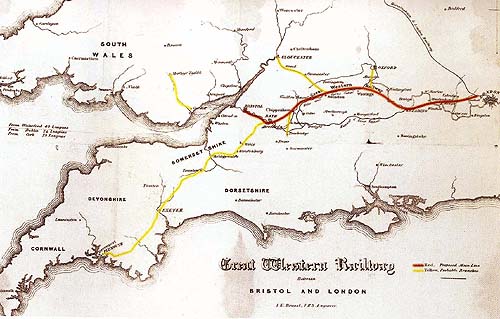
    After living in Bristol for a time, Isambard went on to work on constructing The Great Western Railway (GWR) which would connect Bristol and the south west of England with London.  At the young age of twenty seven in 1833 he began his work.  Isambard was a great visionary who saw potential on a grand scale.  He didn’t just want to build a railway.  He wanted to build the fastest and smoothest railway in England.   

    To accomplish this he tackled a couple of controversial issues.  He decided to use a broad gauge (the width of the track) of seven feet. This was counter to common practice of using the regular gauge which was thinner. This broad gauge would allow for trains with larger wheels where the carriage sat between them instead of on top, lowering the center of mass. The goal of all of this was to allow much faster travel and at the same time a smoother, more comfortable ride.  Secondly he surveyed a route for the railway that would almost never change elevation. By doing this, the train would maintain the same speed for most of its journey. Once finished, This vision of excellence was England’s pride and joy and nicknamed “God’s Wonderful Railway.”  Isambard’s genius was not in inventing new technologies, but in his ability to combine the resources and technology available to him and to expand society’s capabilities beyond what was thought possible.  This genius was evident in the construction of the GWR.

    A Map of the Great Western Railway Connecting Bristol and London
    A Map of the Great Western Railway Connecting Bristol and London

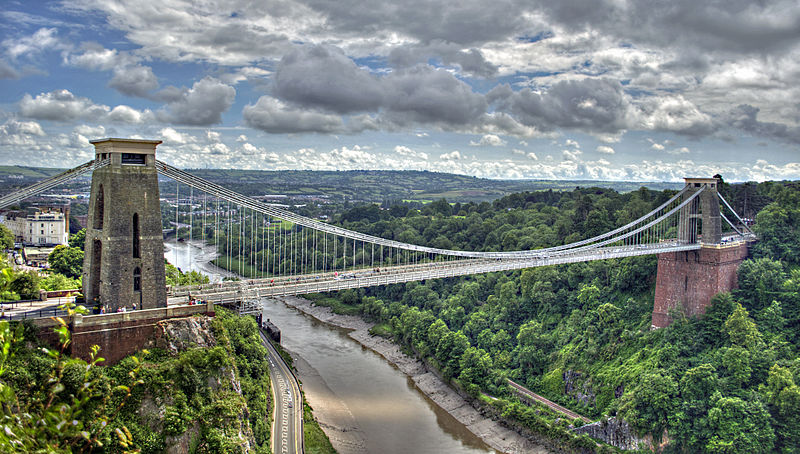
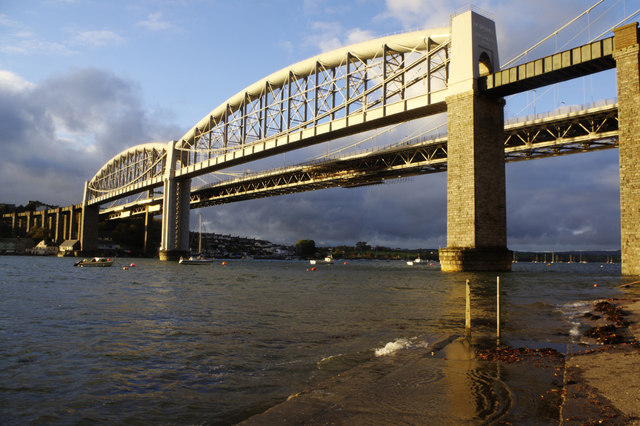
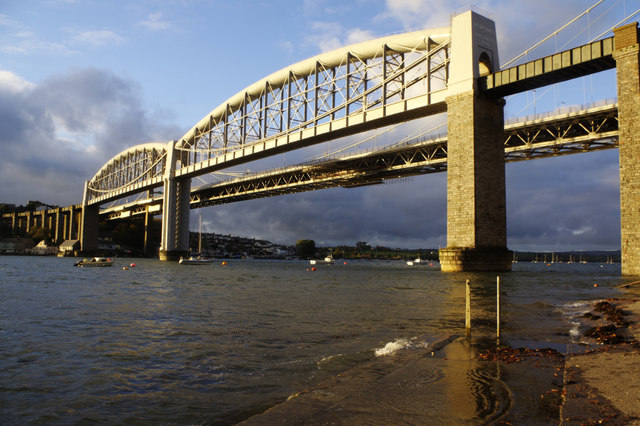
    Three of I.K. Brunel’s most memorable civil engineering projects were a part of the GWR.  The Royal Albert Bridge, the Maidenhead Railway Bridge and the Box Tunnel.  Each of these projects show Isambard’s audacity and vision in their own way.  Spanning the river Tamar, the Royal Albert Bridge was the first of Brunel’s tributes to ancient Egyptian architecture and a bold engineering project.  What was unique about this wrought iron suspension bridge was that it didn’t anchor its pylons in the bank for support, like most suspension bridges still do today. Consider the Clifton bridge, another one of Brunel’s more traditional suspension bridges. Like the Golden Gate Bridge it has cables anchored on either shore supporting the pylons.  The Royal Albert on the other hand, has lens shaped iron trusses (supporting framework) which keep the pylons from collapsing inward from the weight of the bridge.  The Royal Albert Bridge’s elegant design still stands today as a testimony to Brunel’s vision of engineering as not just a pragmatic field of work, but an artistic one as well.

    Clifton Suspension Bridge
    Clifton Suspension Bridge
    The Royal Albert Bridge Truss
    The Royal Albert Bridge Truss
    The Royal Albert Bridge
    The Royal Albert Bridge


    The Maidenhead Railway Bridge further exemplifies Brunel’s audacity and understanding of aesthetics.  At the time, this simple but elegant little bridge had the longest spanning brick arches in the world.  Many engineers laughed at the project,  claiming that the arches were too long and that the bridge would collapse as soon as he took away the scaffolding.  Well, it didn’t collapse and the bridge still stands there to this day, nearly two hundred years later.  Again, Isambard proved his courage and strength of character in the face of adversity.

    Maidenhead Railway Bridge
    Maidenhead Railway Bridge

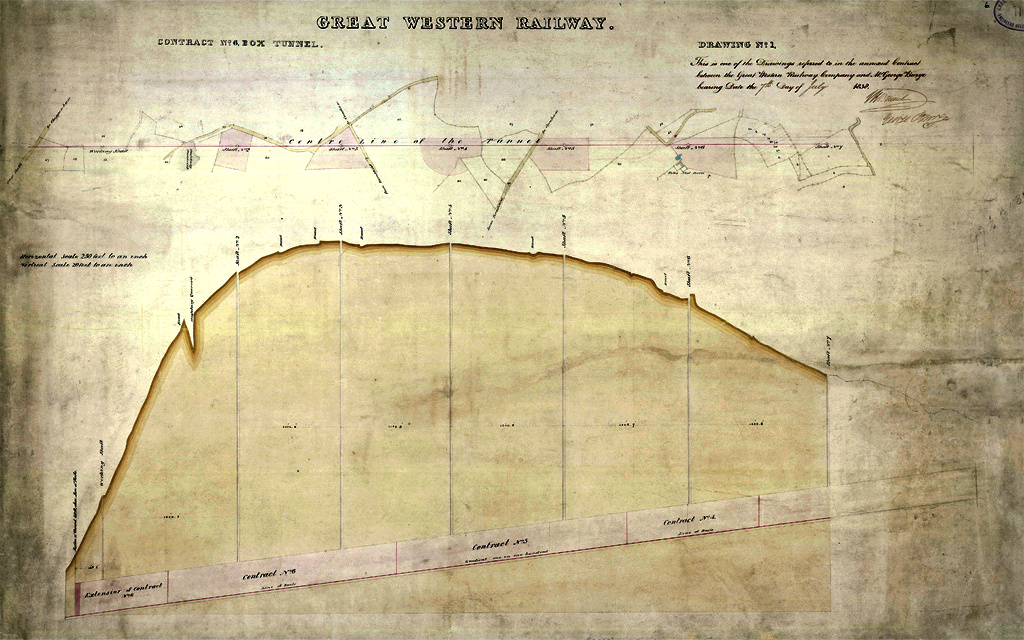
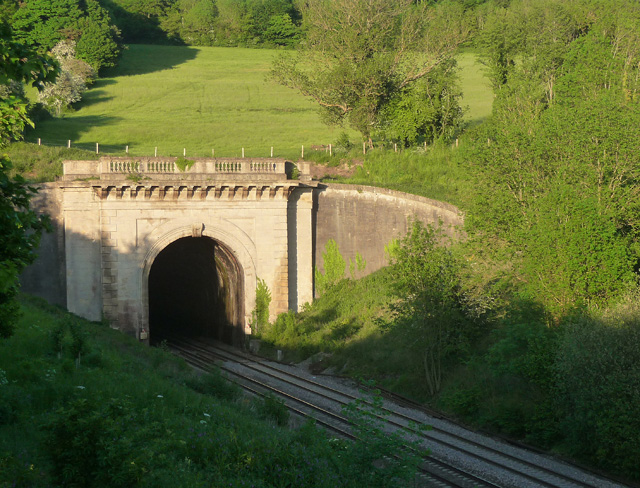
            The third historic civil engineering project we will look at is the Box Tunnel. It goes under Box hill and was one of the most challenging segments of the railway.  The ground they were tunneling through was composed of oolite limestone, fuller’s earth, and forest marble.  The oolite was particularly difficult to tunnel through and required almost exclusively explosives.  Showing wisdom far ahead of his time, Brunel contracted the job out to different teams who had previous experience with each specific forms of geology, thereby making his plans suit the ground, which was something his father always advocated.  The tunnel needed no inner support against cave-ins as it was through such solid rock.  Unfortunately, because of the nature of the tunneling, the loss of life due to accidents was extremely high. Even so, when the Box Tunnel was finished it was the longest tunnel in England.  There is much debate as to whether Brunel built it intentionally so, but the tunnel is oriented so as to let the sun through from end to end only on his birthday.  The length and difficulty of the tunnel along with the graceful entrances on either side made the Box Tunnel one of the most memorable engineering projects on GWR.

    Box Tunnel Plans
    Box Tunnel Plans
    Box Tunnel Entrance
    Box Tunnel Entrance

            Any one of these three constructions would have made Brunel a memorable engineer, but that wasn’t the end.  In addition to being an incredible civil engineer who worked on such world renowned projects as the Thames Tunnel and the Great Western Railway, Brunel was also interested in building ships. I will go on to discuss this monumental career shift into mechanical engineering in my next post.

    Content Sources:

    1. Petroski, Henry. “Engineering: Isambard Kingdom Brunel.” American Scientist. 80.1 (1992): 15-19. Print.
    2. Buchanan, Angus.Brunel: The Life and Times of Isambard Kingdom Brunel. London, New York: Hambledon and London, 2002. Print.
    3. Pugsley, Alfred.The Works of Isambard Kingdom Brunel : an engineering appreciation. London ; Bristol: Institution of Civil Engineers ; University of Bristol, 1976. Print.

    Image Sources:

    http://www.freshford.com/bradford_trains1.htm

    https://commons.wikimedia.org/wiki/File:Clifton_Suspension_Bridge_2012.jpg

    https://commons.wikimedia.org/wiki/File:Royal_albert_bridge_hist.jpg

    Royal Albert Bridge

    https://commons.wikimedia.org/wiki/File:Maidenhead_Bridge_-_fGWR_43132.JPG

    https://commons.wikimedia.org/wiki/File:Network_Rail_Virtual_Archive_Box_Tunnel.jpg

    Box Tunnel, Box

  • England’s Greatest Engineer: The Eighth Wonder of the World

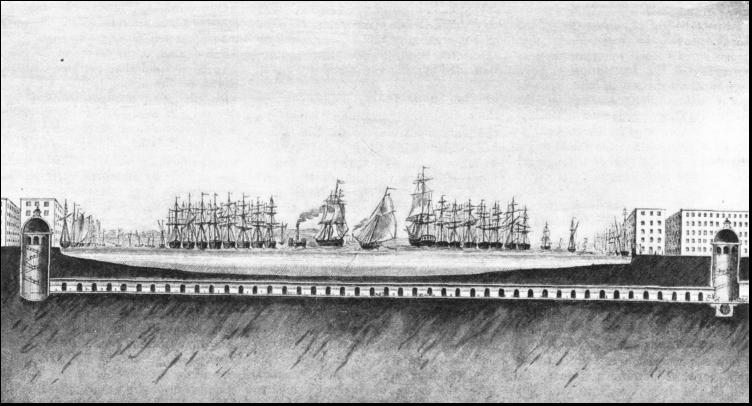
    To Isambard Kingdom Brunel, January 12th, 1828 seemed like just another Saturday morning. Little did he know, it could have been his last. Brunel had only slept a mere four hours the night before, but this was typical as he had been working twenty hours a day trying to build the most daring engineering project in the world: the first-ever underwater tunnel. This tunnel under the river Thames was to be twelve hundred feet long. Brunel and the six workmen he was with that morning knew that the river had been dredged the day before and that there might have been some damage done to the river bed.  As they were walking along the tunnel inspecting the walls, the water suddenly broke through the brickwork and the tunnel flooded with river water. Tragically, the six workmen were swept away to their deaths in the disaster. Unfortunately, workplace deaths such as these were much more common as they were only beginning to develop safety standards. As for Brunel, he was knocked unconscious and flushed back to the entrance of the tunnel where, waterlogged and half drowned, one of his assistants plucked him from the water. This simple act saved Brunel’s life. The twenty two year old would go on to become the greatest British engineer in history.  

    Cross-Section of Thames Tunnel Project
    Cross-Section of Thames Tunnel Project

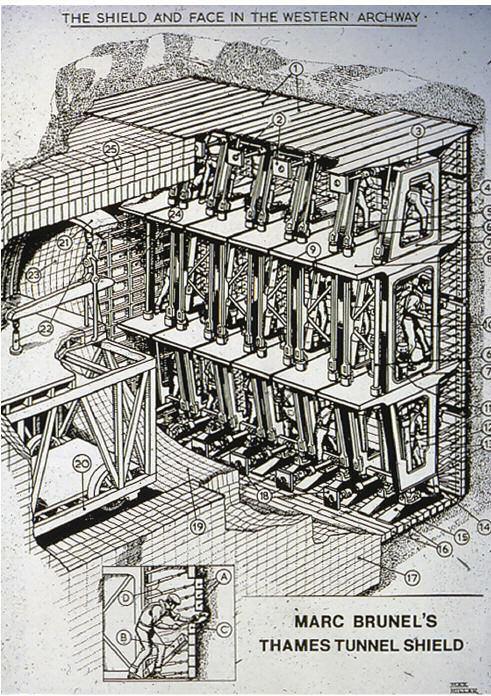
    Isambard Kingdom Brunel was born to Marc Isambard Brunel, who was a well known civil engineer in his own right and patented the tunneling shield mechanism, which protected workers as they dug out individual sections. This tunneling shield’s principles are still used today. At the age of eighteen, I.K. joined his father’s company, which was  building the Thames tunnel. Due to a senior engineer quitting the venture and his father’s ill health, Brunel found himself in charge of the project.  The young engineer was working furiously and often at the front of the operations. The tunneling encountered many problems, particularly flooding. During one of these flooding instances, his swimming prowess enabled him to save the lives of a number of other workers.  

    Tunneling shield invented by Marc Brunel
    Tunneling shield invented by Marc Brunel

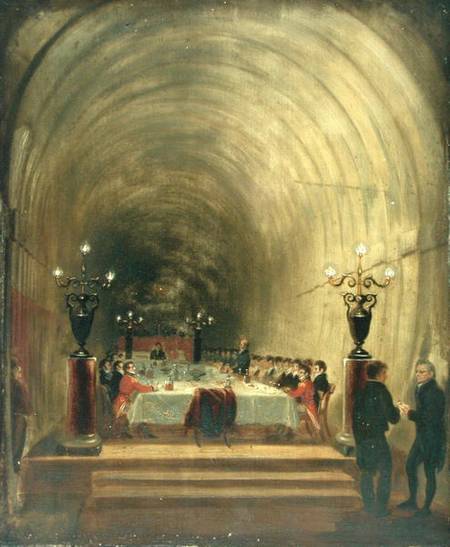
    In addition to the engineering difficulties of the project, Brunel had to overcome financial setbacks as the Thames tunnel project suffered from a chronic lack of funding. He adapted and learned the social graces required to court investors. To promote and publicize the project, he turned the tunnel into a venue where he held dinner parties for curious and influential guests. After the accident on the twelfth of January 1828, Brunel spent a number of years looking for other projects and recovering from internal injuries. His time working on the tunnel, bearing such a great responsibility, had given him experience and authority when leading men.

    Banquet in Thames Tunnel - George Jones
    Banquet in Thames Tunnel – George Jones

    Brunel would go on to make an even greater impact on English civil and mechanical engineering by building railways, tunnels, bridges, and ships which I will continue to tell you about in subsequent posts. His determination and drive in the face of projects that had never been attempted makes Brunel the perfect example of the spirit of England during the industrial revolution. I discovered this historical engineer while I was in high school, and he instantly became one of my role models and a reason why I became interested in mechanical engineering. My hope is that you too can be inspired by this daring young man who was only 22 when he took on the Thames tunnel project, nicknamed “the eighth wonder of the world”.


    Sources:  

    1. Petroski, Henry. “Engineering: Isambard Kingdom Brunel.” American Scientist. 80.1 (1992): 15-19. Print.
    2. Buchanan, Angus. Brunel: The Life and Times of Isambard Kingdom Brunel. London, New York: Hambledon and London, 2002. Print.
    3. Pugsley, Alfred. The Works of Isambard Kingdom Brunel : an engineering appreciation. London ; Bristol: Institution of Civil Engineers ; University of Bristol, 1976. Print.