Author: Sabrina Wilson

  • Rethinking Radiation

    In 1896, the French scientist Henri Becquerel observed spontaneous emissions from uranium and called this phenomenon radiation. The first recorded radiation treatment occurred the same year. Early successful uses of radiation to treat various illnesses and ailments captured the public imagination—everyone hoped their bodily problems could be cured with these seemingly limitless materials.

    Marie Curie’s discovery of radium in 1898 also fascinated the public. Its radioluminescence gave it a magical quality, and companies were quick to churn out radium-infused health and wellness products including toothpastes, soaps, beauty creams, and radium pads that could be placed on afflicted body parts. Liquid sunshine cocktails, or radium-infused beverages, became a health fad in the early 1900s. Upper-class consumers in cities around the world were eager to get their hands on these energizing elixirs which were advertised as all-purpose cures.

    The public’s love affair with radium fizzled out as reports rolled in of painful diseases and deaths associated with radiation poisoning. One of the most famous examples was the 1920s Radium Girls case. Many women working at clock factories developed osteonecrosis (bone tissue death) and osteosarcomas (bone tumors) around their jaws along with other painful conditions. Over a dozen of the women died. Investigators discovered that the women were interacting with toxic levels of radium by constantly pointing brushes on their lips—the brushes being covered in glow-in-the-dark radium paint, of course.

    Eventually, the FDA and FTC (and health officials in other countries) cracked down on the use of radium in consumer products as awareness of radiation poisoning grew. The dangers of radioactive materials overtook the public consciousness in 1945 when the devastation of America’s atomic bombs was revealed. Subsequent studies on radiation and nuclear accidents Three Mile Island (1979) and Chernobyl (1986) further solidified fears of radiation and hindered the development of nuclear medicine.

    This is because we are operating under the linear no-threshold (LNT) radiation paradigm, which is based on the ideas that all radiation exposure levels are harmful and each increment of exposure adds to the overall risk of negative health effects. However, a different paradigm emerged in the 1990s. Radiation hormesis, which is still very controversial, is based on the ideas that low levels of radiation exposure produce different effects than high-level exposure. In fact, small doses of radiation may improve health! 

    Some scientists believe in this paradigm because the body has already evolved to protect DNA against low-level radiation that occurs naturally. Free radical scavengers are a type of radioprotector molecule that can repair the loss of electrons or hydrogen atoms. This naturally occurs in cellular molecules due to metabolic processes but is also caused by radiation exposure. Free radical scavengers can repair this low-level radiation damage. Another concern with radiation is DNA mutation. It is estimated that 10,000 genetic modifications already happen every hour in your body! Whether the cause is a natural error or low-level radiation exposure, enzymes are constantly checking and repairing DNA. Low-level radiation exposure can also cause cell death during reproduction and interphase. Instead of viewing this as a harmful effect, radiation hormesis interprets this as a positive strategy for the body to prevent damaged cells from reproducing.

    This controversial framework is supported by several studies. Among atomic bomb survivors, those exposed to low levels of radiation experience a lower rate of leukemia than average people. This is contrasted by the higher rate of leukemia among survivors exposed to high levels of radiation. Under the LNT paradigm, we expect the leukemia rate to be higher than average even among survivors exposed to low levels of radiation, which is not the case. 

    Other experimental studies demonstrate health benefits from low doses of radiation including reducing the likelihood of neoplastic transformation (when cells begin to grow abnormally or excessively, which can be benign or cancerous), activating enzymes and mechanisms that protect and repair DNA, and stimulating the immune system. Again, the LNT paradigm leads us to expect the opposite results, that even low-level radiation would negatively impact these areas of health.

    So what does radiation hormesis really tell us? Is it okay to guzzle liquid sunshine cocktails again if the radium dose is small enough? Let’s hold off on that…in the meantime, we can take inspiration from the radiation hormesis framework and curb our knee-jerk negative reaction to anything involving radiation. Who knows what will be discovered if we open our minds to the possibilities of nuclear medicine and nuclear energy! 

    (Reminder: refrain from immediately ingesting any new discoveries…)


    Holcomb, W. F. (1999). Humanity and radiation: The good, the bad, and the unusual. Military Medicine, 164(7), 520-5. Retrieved from https://go.openathens.net/redirector/gatech.edu?url=https://search.proquest.com/scholarly-journals/humanity-radiation-good-bad-unusual/docview/217055431/se-2?accountid=11107

    Jolly, D., & Meyer, J. (2009). A brief review of radiation hormesis. Australasian Physical & Engineering Sciences in Medicine, 32(4), 180-7. Retrieved from https://go.openathens.net/redirector/gatech.edu?url=https://search.proquest.com/scholarly-journals/brief-review-radiation-hormesis/docview/204630213/se-2?accountid=11107

    Prekeges, J. L. (2003). Radiation hormesis, or, could all that radiation be good for us? Journal of Nuclear Medicine Technology, 31(2), 11-7. Retrieved from https://go.openathens.net/redirector/gatech.edu?url=https://search.proquest.com/scholarly-journals/radiation-hormesis-could-all-that-be-good-us/docview/218635974/se-2?accountid=11107
  • The Birth of a Cyclops

    Monstrous, one-eyed giants have prowled around our imaginations for at least 4,000 years – the oldest known description of such a creature was written on Babylonian tablets found near the Tigris river. The first stories about Cyclops emerged in Greece in the 8th–7th century BC: Homer’s epic poem Odyssey, followed by Hesiodus’ epic poem Theogonia, and later Euripides’ play Cyclops in the 5th century BC. What inspired these tales of a “horrid creature, not like a human being at all”? In 1914, the paleontologist Othenio Abel suggested that Ancient Greeks found local fossils of pygmy elephant skulls which contained a large, central nasal cavity resembling a single eye socket. You can read more about this idea in a previous Charged article!

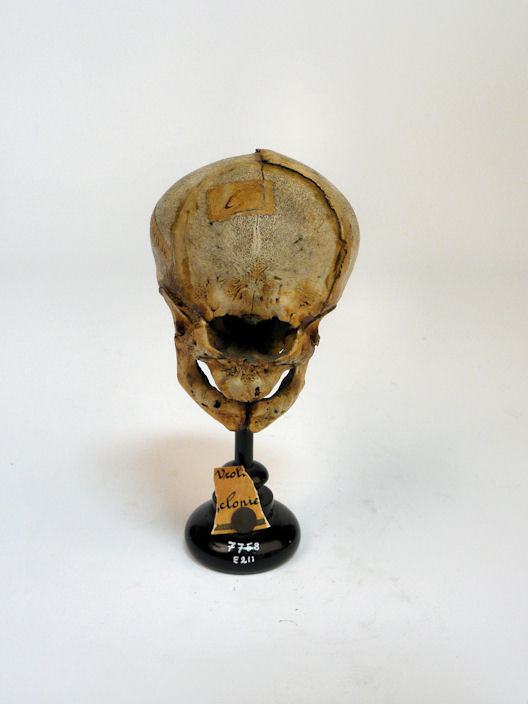
    Cyclopia specimen at Museum Vrolik via Facebook

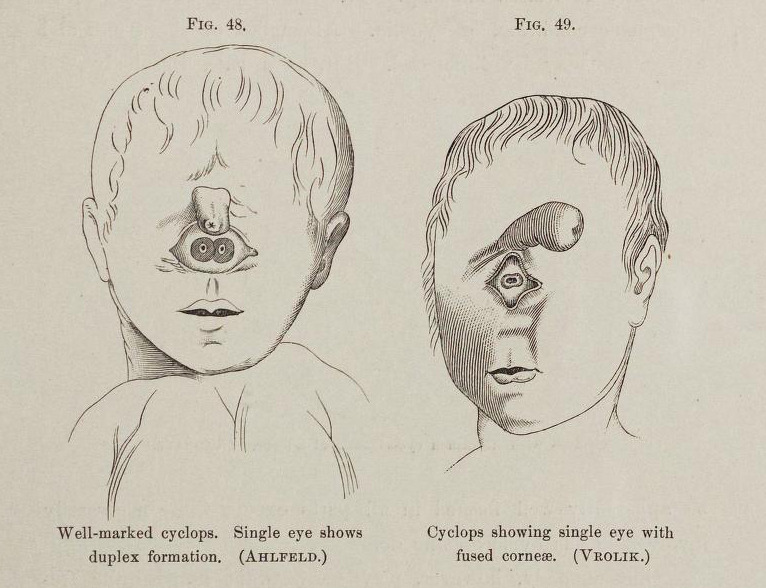
    Descriptions of Cyclops also appear in scientific literature and records throughout history. In 1619, the Italian physician and philosopher Fortunio Liceti wrote a letter about cyclopia, a rare congenital malformation that gives the appearance of a single median eye. Cyclopia gained attention in the 18th–19th century with the rise of teratology, the study of congenital malformations. During this time, Willem Vrolik, a Dutch anatomist and pathologist, developed a collection of human and animal cyclops specimens, and the French naturalist Geoffroy Saint-Hilaire created the “cyclocephaly” classification for facial anomalies affecting the eyes. It was not until the 20th century that scientists developed a better understanding of this rare condition.

    Cyclopia fetuses via Wikipedia

    Cyclopia occurs in about 0.001% of births with an excess of females and twins. Half of these infants are stillborn due to brain development being impacted—cyclopia is a type of holoprosencephaly, a birth defect that causes the ventral brain to form incorrectly. The lack of separation between the cerebral hemispheres causes an ependymal (neural) cyst around the center of the forehead, and in some cases the two eyes fuse together. The appearance of a single median eye is exaggerated by deformed orbital bones that cause protrusions above the eye(s) and the appearance of a single nasal cavity.

    The exact cause of cyclopia remains unknown. It is likely that exposure to teratogenic environmental factors or chromosomal abnormalities contribute to this unusual and deadly congenital development. A study with mice investigated the relevance of Hedgehog (Hh) proteins which are responsible for inducing cells in the ventral brain region of the embryo. Specifically, mutations in Sonic hedgehog (Shh) proteins produced cyclopia in some infant mice. Another study found that transforming growth-factor-B (TGF-B) genes could play a role—in zebrafish, the cyclops (cyc) gene is believed to signal the TGF-B genes to develop the ventral brain and identify the midline where the hemispheres will split, so mutations in the cyc gene can produce cyclopia. However, it will take a lot of research to untangle our brains and truly understand the medical factors behind the mythical Cyclops.

    – – – – –

    Sources

    Blader, P., & Strahle, U. (1998). Casting an eye over cyclopia. Nature, 395(6698), 112-3. doi:http://dx.doi.org/10.1038/25836

    Homer. (1999). The Odyssey (S. Butler, Trans.). Urbana, Illinois: Project Gutenberg. Retrieved from https://www.gutenberg.org/ebooks/1727 

    Kalantzis, G. C., Tsiamis, C. B., & Poulakou-Rebelakou, E. (2013). Cyclopia: From greek antiquity to medical genetics. Italian Journal of Anatomy and Embryology, 118(3), 256-62. Retrieved from https://go.openathens.net/redirector/gatech.edu?url=https://search.proquest.com/scholarly-journals/cyclopia-greek-antiquity-medical-genetics/docview/1497034944/se-2?accountid=11107 

    Källén, B., Castilla, E. E., Lancaster, P. A., Mutchinick, O., Knudsen, L. B., Martinez-Frias, M., …Robert, E. (1992). The cyclops and the mermaid: An epidemiological study of two types of rare malformation. Journal of Medical Genetics, 29(1), 30. doi:http://dx.doi.org/10.1136/jmg.29.1.30

  • Batty or Bacterial?

    On The Origin of the Western Vampire

    The myth of a devilish creature draining the life force (blood) of a community was brought to life by European peasants. In the 1730s, this being was dubbed “vampire”, which came from the Slavic word “vampir”. The story of the vampire was spread throughout Europe by Austrian conquerors, who observed Eastern European protection rituals, such as removing the organs from corpses, and became swept up in the terror. Eventually, European immigrants carried the legends of the vampire to America.

    Bodily Basics

    Superstitions and mythology originate from some kernel of truth, some observable phenomenon. What were all these people seeing that made them believe an undead body was preying on the living in the night?

    Aspects of vampire mythology describe actual events that happen as a body decomposes. A corpse may appear to have “feasted” recently due to remaining liquid blood in the lungs being forced into the mouth. The appearance of a vampire victim as being “eaten” is typical of bloating that occurs during decay. The “screams” of a vampire is usually just gases escaping from the body. Additionally, bodies buried in colder areas may not appear decomposed at all, like the “living dead”. Taken together, it is easy to see why someone with no knowledge of the natural and scientific nature of these events would interpret them as supernatural.

    Contagion Explanation

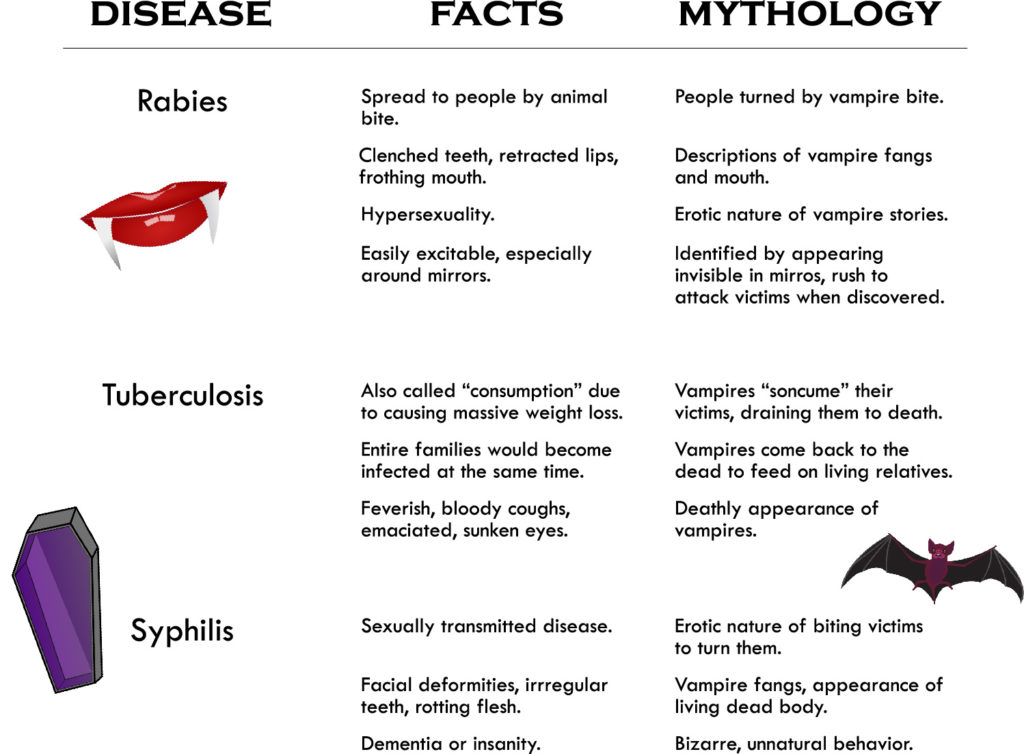
    Vampire panics are not confined to a single spooky body. Over hundreds of years, small towns in America and Europe were terrorized by the idea that a vampire had come to turn family members and drain the community when in fact, these towns were being terrorized by outbreaks of contagious diseases.


    A chart showing symptoms/effects of rabies, tuberculosis, and syphilis, and how these are similar to descriptions of vampires' appearance and behaviors.
    Similarities between some contagious diseases and common vampire mythology.


    Sources:

    Tucker, A. (2012, 10). THE GREAT NEW ENGLAND VAMPIRE PANIC. Smithsonian, 43, 58-65. Retrieved from http://prx.library.gatech.edu/login?url=https://search.proquest.com/docview/1086342252?accountid=11107

    Hammer, K. O. (2005). Vampires: The dark fantasy of the 18th and 19th centuries (Order No. 1449350). Available from ProQuest Dissertations & Theses A&I: Literature & Language; ProQuest Dissertations & Theses Global: Literature & Language. (305363212). Retrieved from http://prx.library.gatech.edu/login?url=https://search.proquest.com/docview/305363212?accountid=11107

    Burcum, J., & Writer, S. (1998, Oct 28). Putting the undead to rest // researchers have tried to shed light on the vampire myth, saying the horrific blood feasters were merely the victims of rabies, blood disorders or superstitious imaginations. Star Tribune Retrieved from http://prx.library.gatech.edu/login?url=https://search.proquest.com/docview/427048134?accountid=11107