Author: Sarah Wang

  • The Science Behind JaPow


    This past winter break, I had the pleasure of returning to the beautiful country of Japan. This trip was different from the other ones because this time, I was getting to see Japan in winter. Every season brings a different feel to the country, with different emphasises on its culture, like hot spring for winter. Another addition to this trip includes going skiing. This was a non-negotiable for my boyfriend, as he develops an insatiable desire for the slopes once December hits. I was a bit intimidated when I first found out since I had not gone skiing since more than a decade ago. The blurred memories of skiing with an instructor came to mind, and the one word I heard all too often:  “Pizza!”. 
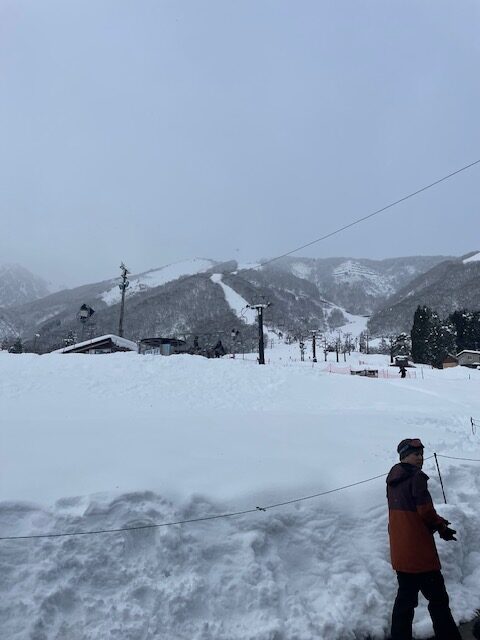
    Fast forward the long flight, train ride, and hike up to the ski resort– it was time. Since the train arrived in the afternoon, we got to the resort midday- there were already set tracks in the snowy mountains. Skiing down the mountain was terrifying with my limited experience. What surprised me was how much lighter and easier it was the next day. We got to the ski resort right when it opened- 8am on the dot. Skiing down was just as nerve inducing, but it seemed like I was floating a bit on the snow. My turns were slower, and therefore easier to execute. Coming to a stop was also more gradual as the snow easily piled behind my skis. This led me to do some research behind the science of snow and the effects it has for the slopes.
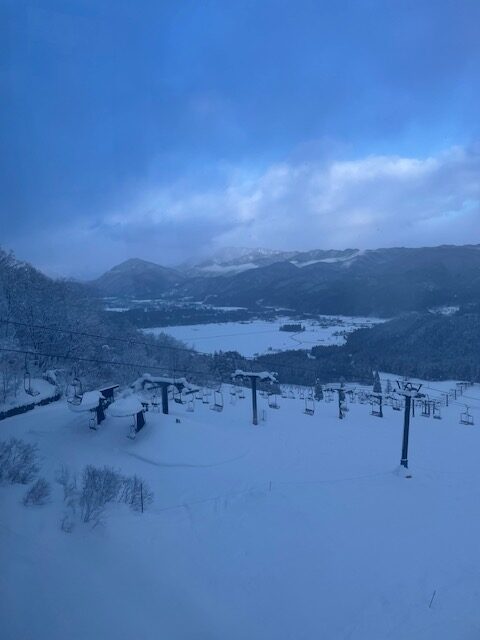
    For snow in the Niseko region of Japan, there are special weather conditions that cause its special snow conditions. It is comically referred to as “Japow” for its powdery snowfall which gives an airy and light conditions for skiing. Snowfall for skiing is rated for its quality, quantity, and consistency, and Japan happens to have the perfect conditions for snow.


    Snowfall in the Japanese Alps takes place under two distinct meteorological scenarios. One scenario involves snowfall associated with synoptic cyclones, while the other is influenced by the northwest winter monsoon, which originates from the frigid Asian continent and moves over the warmer waters of the Japan Sea (Maejima 1980). The Japan sea scenario brings heavy snowfall because of the temperature difference between the water body and the air mass over the Japan Sea (Ninomiya, 1976). The distribution of snowfall associated with the Japan Sea effect is predominantly influenced by orographic lifting  (Estoque and Nimomiya, 1976).. As a result, the northern region of the Northern Japanese Alps experiences significantly greater snowfall compared to the southern regions of the Northern, Central, and Southern Japanese Alps.
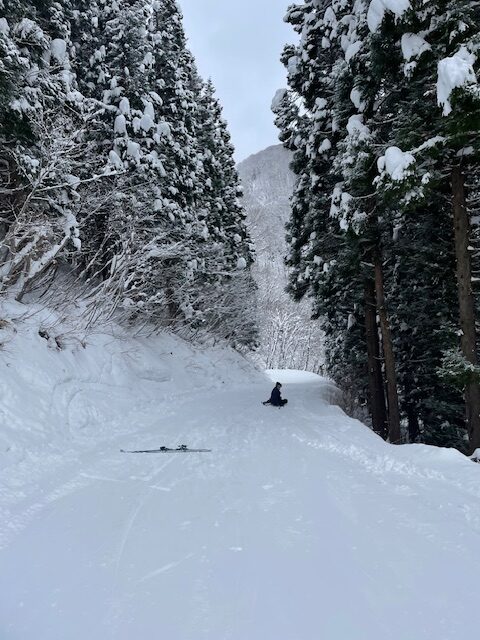
     

    Even with all this information about how the snow should be the best for skiing, I fell many times during my trip. Even the green trails would put my balance and concentration to the test. All in all, come to Japan to ski and hopefully you are skillful enough to enjoy it!


    Estoque, M.A. and Ninomiya, K. (1976) ‘Numerical simulation of Japan Sea effect snowfall’,   <i>Tellus A: Dynamic Meteorology and Oceanography</i>, 28(3), p. 243-253. Available at: https://doi.org/10.3402/tellusa.v28i3.10285.


    Maejima, I.. (1980). Seasonal and regional aspects of Japan’s weather and climate.. 54-72. https://www.researchgate.net/publication/293128007_Seasonal_and_regional_aspects_of_Japan’s_weather_and_climate


    Takami, Kazuya & Kamamoto, Rimpei & Suzuki, Kenji & Yamaguchi, Kosei & Nakakita, Eiichi. (2024). Relationship between Newly Fallen Snow Density and Polarimetric Parameters Obtained from X-Band Radar Observations along the Sea of Japan Coast in January 2021. Journal of Atmospheric and Oceanic Technology. 41. 10.1175/JTECH-D-23-0114.1. 

  • The Cat-astrophic Health of Persian Cats


    These adorable flat-faced cats have existed since the 1600s from Mesopotamia which was later called Persia, giving these cats the name Persian. Today, they are an expensive and highly sought-after breed with prices going from $1,000+ for a single kitten. But the subject at hand that I would like to focus on is the health issues that Persian cats face, and why they are more susceptible to diseases. This topic is very near and dear to my heart, since I happened upon owning a Persian cat at the beginning of the school year. 

    Meet Sammy, my cat that my sister got me from craigslist (long story). Cute, right? In a Garfield/ grumpy cat sort of way. The biggest problem I faced was how often he tears up. It sounds like a simple issue, but it was occurring constantly. Every night when I would pet him, he would build up a brown layer of crust around his eyes. It didn’t matter if I cleaned his face a few hours ago, it was inevitable that the tears would stain his fur again. This led me to do some research.

    Persian cats have a very distinctive feature- their flat face. Scientifically, it is called a brachycephalic structure, which leads to tear ducts that are not fully developed. Typically, cats have ducts to drain excess liquid in their eyes to their nose. In this case, flat-faced cats have tears that cannot drain properly, leading to the fur around their eyes to be stained. The staining comes from the tears oxidizing to turn into a reddish brown color. The official diagnosis for this is called epiphora- which is a cause for concern for most cats but is a common occurrence for Persian and Himalayan cats.

    Having watery eyes is not the only consequence of the brachycephalic facial structure. Some of the others include: brachycephalic airway obstruction syndrome (BAOS) which can cause respiratory problems; maxillary dorsal rotation (rotation of the upper jaw upwards) and brachygnathism (the top jaw is abnormally short). This can cause dental problems, and make it harder for the cat to groom himself. Exophthalmos, when the eyeball protrudes, can lead to an increased risk of corneal ulcers. Cats with the more severe forms of brachycephaly are highly likely to develop these conditions. 

    This leads us to the age-old question- is it unethical to breed these kinds of cats? There are even more loveable breeds of dogs with this condition: pugs, bulldogs, shih tzus, boxers, etc. Would the solution be to stop the breeding of these animals? I love Sammy, but I still believe we should end the breeding and continuation of brachycephalic animals. Choosing a pet for aesthetic reasons, especially when it compromises their quality of life, just feels fundamentally wrong to me. At the end of the day, our love for animals should include decisions that prioritize their health over our preferences.

    ____________________________________________________________________

    Künzel W, Breit S and Oppel M (2003) Morphometric investigations of breed-specific features in feline skulls and considerations on their functional implications. Anatomia, Histologia, Embryologia 32: 223

    Monnet E (2004) Brachycephalic Airway Syndrome. World Small Animal Veterinary Association conference 2004, 6-9th Oct, Rhodes, Greece. Available from VIN Associate, accessed 8.2.11

    O’NEILL, D. G., ROMANS, C., BRODBELT, D. C., CHURCH, D. B., ČERNÁ, P. & GUNN-MOORE, D. A. 2019. Persian cats under first opinion veterinary care in the UK: demography, mortality and disorders. Scientific Reports – Nature doi.org/10.1038/s41598-019-49317-4