Author: Tanvi Vedula

  • How to make glow in the dark cells

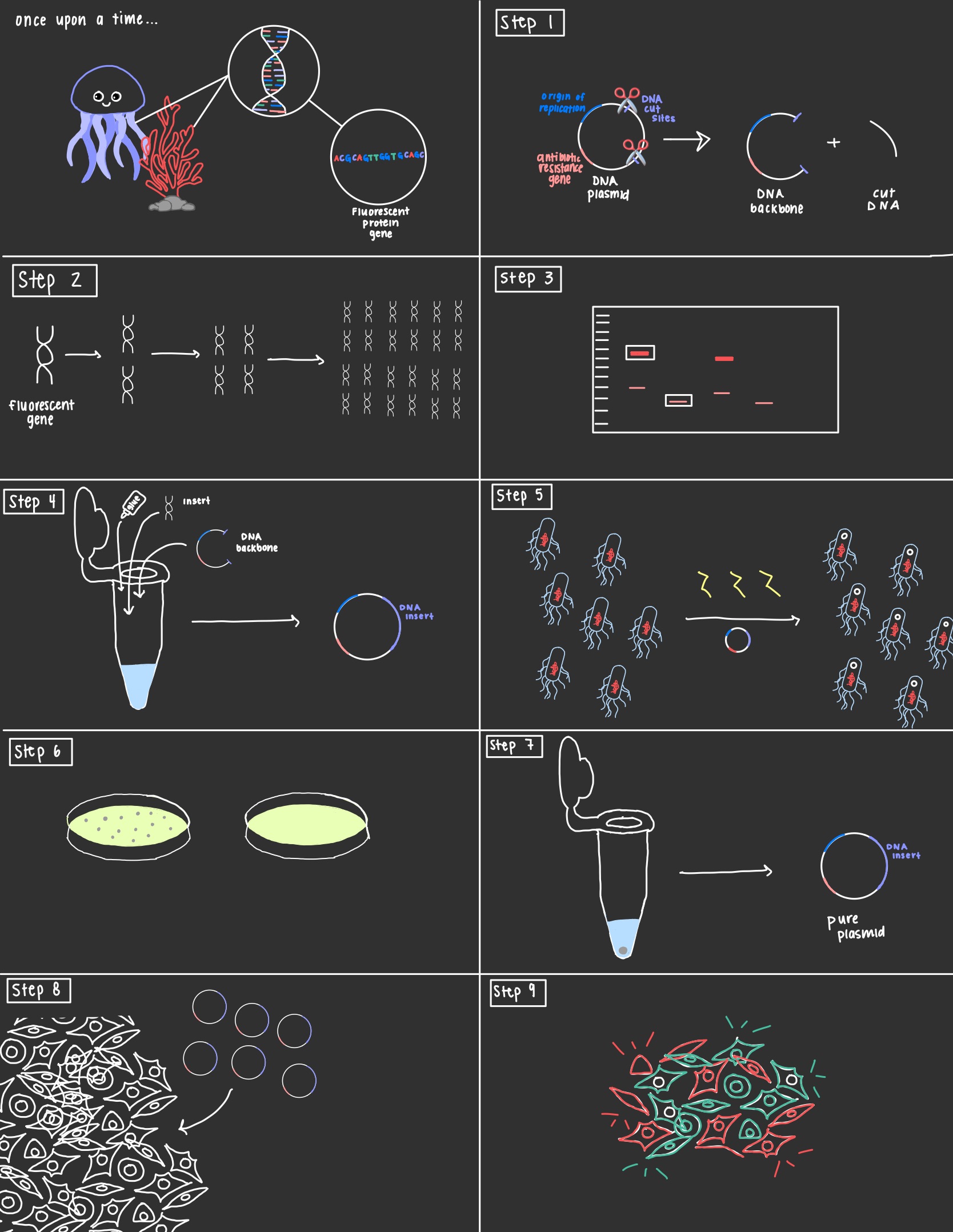
    While these cells don’t technically glow in the dark, scientists have found ways to make cells fluorescent which means they glow when exposed to radiation such as UV light. When a cell has specific ions or proteins fluorescent proteins bind to these small molecules and make the cell appear as if it’s glowing. 

    These special proteins were first discovered in animals like jellyfish and plants like coral. Scientists were able to isolate the genes that were responsible for producing the fluorescent proteins and using a technique called molecular cloning can insert the DNA into our cells of choice. 

    Step 1: The first step is to choose a plasmid, a circular piece of DNA found in bacteria. The plasmid chosen must have an origin of replication where DNA replication begins, a gene for antibiotic resistance, and DNA cut sites. Restriction enzymes are proteins that act as molecular scissors and cut the plasmid at specific cut sites. This turns the circular plasmid DNA into a linear piece of DNA. 

    Step 2: This isn’t always necessary, but the fluorescent gene can be amplified using a technique known as polymerase chain reaction. In a PCR the DNA undergoes cycles of denaturation, annealing, and elongation where the DNA is first turned into single stranded DNA, then the primer tells the DNA where to start extending, and then finally the DNA is extended. At the end of each cycle the amount of DNA is doubled leading to millions of copies of DNA within an hour. 

    Step 3: By this point, we have our amplified PCR DNA and our plasmid DNA that has been cut to produce the backbone and pieces of cut DNA. In order to separate the backbone plasmid from the cut piece we will use gel electrophoresis. A gel electrophoresis separates DNA by size by passing an electric current through a gel containing DNA. Because DNA is negatively charged it will migrate towards the positively charged terminal of the gel with the smaller pieces traveling further than the larger pieces. Because our backbone is larger than the cut DNA, when the pieces separate we can cut out the band closer to the top, and purify it to get rid of the gel leaving just the DNA. 

    Step 4: It’s finally time to glue our DNA pieces together, and the key player is a protein known as DNA ligase. DNA ligase will be added to a tube with our DNA backbone and insert. Following a ligation reaction a plasmid will be re-formed that contains our original backbone with the fluorescent gene inserted in. 

    Step 5 and Step 6: The next two steps are crucial for ensuring that the final product is pure plasmid. This is important because the DNA ligase can make mistakes and may glue backbones together, fail to add in the insert, etc. In step 5 the plasmid is inserted into bacterial cells, usually e-coli cells through a heat shock. Once the bacteria take up the plasmid they are plated onto agar plates containing antibiotics and allowed to grow. Remember the three things every plasmid needs to include (hint: it’s an antibiotic resistance gene)? This is because when the cells are plated only those that have a fully formed plasmid will be able to grow. 

    Step 7: Now we can select a bacterial colony from our plate and using a process known as miniprep isolate the plasmid DNA from these cells. 

    Step 8: The plasmid DNA can then be introduced into your cells of choice. There are many techniques to accomplish this but a common one is called calcium phosphate transfection. 

    Step 9: TA-DA! Your cells should now glow under the right conditions! 

    Sources:

    Ashwini, M., Murugan, S.B., Balamurugan, S. et al. Advances in molecular cloning. Mol Biol 50, 1–6 (2016). https://doi.org/10.1134/S0026893316010131

    Tsien RY. The green fluorescent protein. Annu Rev Biochem. 1998;67:509-44. doi: 10.1146/annurev.biochem.67.1.509. PMID: 9759496.
    cover image created using canva
  • New Year, New Me: A guide to rewiring your brain

    Although it’s been about 4 months since the New Year, the start of summer is another perfect opportunity to get back on track with your new year’s resolutions. And this time, you’re going to stick to it because I’m going to explain the science behind your habits and how you can change your brain to change your habits. 

    Scientifically, a habit is a routine, behavior, or cognitive process that starts spontaneously but is repeated automatically as a result of prior experience (Mendelsohn, 2020). It essentially means that it’s something you do without really thinking because you’ve done it before. For example, brushing your teeth as soon as you wake up, showering before bed, or grabbing a snack as soon as you get back to your apartment even if you’re not hungry. Habits are context dependent which means they are strengthened through repetition and use cues from the surrounding environment. When you perceive a cue, it automatically triggers a response without much cognitive input (Mendelsohn, 2020). In the example above, the cue is getting back to your apartment and your habit is grabbing a snack, because you’re normally hungry when you get back. But today, you ate a bigger lunch and even though you aren’t hungry you carried out your habit, why? 

    The relationship between the cue and the response is strengthened by dopamine, the same molecule that keeps you scrolling on tiktok even though you have to wake up in 5 hours. This means that habits are strengthened and rewarded, urging you to carry them out over and over again. When you do something for the first time, your prefrontal cortex is highly active, aiding in carrying out complex cognitive behavior, attention, and decision making. As you continue to carry out the response, dopamine is released by two other brain regions known as the Ventral Tegmental Area (VTA) and Substantia Nigra (SNc). Here, dopamine helps facilitate learning by spiking the exact neural pathway carried out if an action is worth carrying out again or repeating. This strengthens the firing of those neurons in relation to one another, a process known as neuroplasticity (more on that later). Once the response has been reinforced with dopamine, it’s tagged for repetition which is facilitated by the corticostriatal loop which connects the cortex to the striatum, the part of the brain responsible for motor control and decision making. Over time, the brain starts to correlate the cue not the action with the reward leading to the automatic nature of habits. Finally, the striatum translates dopamine release into motor encoding so the output is not reliant on cognitive input and the prefrontal cortex but associations with contextual cues (Wyatt, 2024). 

    This makes it seem like once a habit is formed, it’s an automatic response wired into us for good. Luckily, our brains are constantly evolving, rebuilding, and restructuring, a process known as synaptic plasticity. This means even though it may be hard, we can restructure, rebuild, and begin new habits. Neuroplasticity is the way the brain changes its activity in response to a stimulus by reorganizing its structure, functions, or connections. This can be carried out through a mechanism known as synaptic plasticity in which long-lasting changes are made to the connections between neurons. In order for this to occur, neurons must “fire together to wire together”(Puderbaugh & Emmady, 2023). At the cellular level, this change happens through synaptic plasticity. When neurons repeatedly fire together, they strengthen their connections, a concept known as “neurons that fire together wire together.” When one neuron activates another, it releases glutamate, an excitatory neurotransmitter. With repeated activation, receptors like AMPA and NMDA work together to increase the sensitivity of the receiving neuron. Over time, this makes the connection stronger, meaning the same signal produces a bigger response. This is how repeated behaviors become more efficient and automatic in the brain. This is obviously really cool science, but how do you use this to form new habits? 

    It’s clear that habits require repetition whether it’s strengthening the synapses between neurons or the control of actions shifting from the prefrontal cortex to the striatum. But repetition can be hard when your brain has already been wired to do something different so here’s some tips to get your brain to repeat actions that aren’t yet habits until they become one. 

    • Write down why your new habit made you feel good 

    The reward pathway and dopamine are key players in why we carry out habits but unfortunately actions don’t feel like a reward until it’s been repeated over and over again. Taking time to think about why your new habit was a good one, and how it made you feel can release some of the “feel good” neurotransmitters and activate the same reward pathways that led to habit formation initially. 

    • Habit stacking 

    Stack new habits into a routine you already have. For example, if you always brush your teeth right when you wake up but forget to take your vitamins, start taking them right after you brush your teeth. This helps link the new behavior to already existing neural pathways making it easier to reinforce through repetition. 

    • Start small 

    Because your brain has wired your habits rendering them automatic, it takes a large cognitive load to override them. By starting small, you lessen the cognitive load and reduce the demand on the prefrontal cortex making it easier to start the task. For example, instead of saying you need to workout, start by saying you’ll go to the gym for 20 minutes. 

    • Pay attention to cues 

    Habit formation is highly cue dependent so start paying attention to the cues that trigger certain habits. The next time you see the cue, you are more likely to break the automatic control of the striatum and engage the decision making and cognitive processing of your prefrontal cortex. 

    Although habit formation may seem hard, your brain is built to be changed if you let it. Now that you know the science behind changing your brain, the summer is a great time to start! 

    Sources: 

    Exploring the brain’s relationship to habits | nsf—U. S. National science foundation. (2013, January 14). https://www.nsf.gov/news/exploring-brains-relationship-habits

    Mendelsohn, A. I. (2019). Creatures of habit: The neuroscience of habit and purposeful behavior. Biological Psychiatry, 85(11), e49–e51. https://doi.org/10.1016/j.biopsych.2019.03.978

    Puderbaugh, M., & Emmady, P. D. (2026). Neuroplasticity. In StatPearls. StatPearls Publishing. http://www.ncbi.nlm.nih.gov/books/NBK557811/

    Wyatt, Zoe. (2024). The Neuroscience of Habit Formation. Neurology and Neuroscience. 5. 3. 10.33425/2692-7918.1063.