Author: Tyra Newton

  • Reacciones Nucleares y Exploración Espacial: “Direct Fusion Drive”

    Se usaron los cohetes por primera vez en China en siglo XIII. Fueron tubos de bambú que se llenaron de pólvora y se fijaron a las flechas para lanzarse a sus enemigos mongoles. Setecientos años después, tubos más grandes se llenaron de hidrógeno y oxígeno líquidos, se fijaron a unas astronaves, y se lanzaron a la luna. Ahora, en el siglo XXI, vemos otra evolución, “Direct Fusion Drive,” (DFD), pero los conceptos fundamentales de cohetería que derrotaron a los mongoles en la Batalla de Kai Keng son los mismos fundamentales que nos van a lanzar a Plutón más rápidamente.

    Los Básicos de la Cohetería

    Pues, ¿cómo funcionan los cohetes? Teoréticamente, funcionan debido a la tercera ley de Newton que dice que las fuerzas ocurren en forma de pares, una acción y una reacción con magnitudes iguales, pero direcciones opuestas. Se mezclan y se queman los propelentes en una cámara de combustión. Los gases producidos van por una tobera y aceleran hacia velocidad supersónica (piensa en cómo cubrir parcialmente la boca de la manguera con el pulgar acelera la velocidad del agua). Al salir del cohete, los gases de escape de la combustión hacen una fuerza de reacción igual pero en la dirección contraria, una fuerza llamada empuje. El empuje hace volar el cohete. Ya que el cohete lleva su propio oxidante (el químico que causa combustión), no necesita oxígeno de la atmósfera para hacer combustión como un motor del coche. Por eso, es ideal para la exploración espacial.

    Cohetes Convencionales

    Desde el comienzo, los cohetes convencionales han sido propulsados por las reacciones químicas exotérmicas. Una reacción exotérmica es una reacción química que produce calor. 

    Hay 2 tipos principales de estos cohetes: cohetes de combustible sólido y cohetes de combustible líquido. En el primero, se mezclan los combustibles desde el principio y entonces se enciende la superficie de la mezcla para causar la combustión. No obstante, en el segundo, originalmente, los propelentes son separados y entonces son inyectados en la cámara donde se mezclan y se queman.

    Cómo Funciona “Direct Fusion Drive”

    Los dos métodos han enviado a incontables astronautas al espacio, pero dentro de las siguientes décadas, DFD los podría reemplazar. DFD pretende usar la potencia de sus reacciones de fusión para propulsar la astronave y generar electricidad. Imanes potentísimos están alineados para crear una forma cilíndrica. Se ubican imanes más pequeños, pero aún más potentes, en ambos cabos. En el centro de esta configuración, helio-3, un isótopo del helio que tiene 1 neutrón, reacciona con deuterio, un isótopo de hidrógeno que pesa el doble que hidrógeno común (isótopos son átomos del mismo elemento pero que tienen cantidades diferentes de neutrones). Estas reacciones y algunas reacciones extras crean una región de fusión. Plasma fresco fluye sobre la región, extrayendo energía. (Plasma es un estado de materia similar a gas, pero que contiene iones y electrones. Porque plasma contiene electrones, es un buen conductor eléctrico e influenciado fácilmente por campos electromagnéticos).

    Antenas alrededor del motor crean un campo magnético giratorio que induce una corriente eléctrica en el plasma. Los iones del plasma se calientan hasta se fusionan. Los productos de fusión salen del motor como los gases calientes de un cohete convencional, generando empuje.

    Este proceso produce un montón de calor que es usado en un ciclo Brayton para producir más de 200 kW de potencia eléctrica. Se expulsa al espacio el calor que queda.

    Una Comparación

     Cohetes convencionales tienen muchas ventajas: gran empuje y bajo costo (relativamente). Son fiables y se han usado hace siglos. Pero el tamaño compacto y la eficiencia de DFD son los que atraen el interés de los científicos. Una variable muy importante de cohetería es el impulso específico– impulso por unidad de masa de propelente o con cuánta eficiencia el cohete crea empuje. Si el impulso específico sube, el combustible necesario para el impulso deseado baja. El máximo del impulso específico de cohetes convencionales es aproximadamente 500 segundos, pero un motor de DFD cuenta con un impulso específico de 10.000 a 20.000 segundos y es tan pequeño como una camioneta.

    NASA predice que una misión de 10.000 kg con DFD podr­ía llegar a Plutón en 4 años, un tiempo más corto que los 9,5 años que tardó New Horizons propulsado por propulsión de hidracina. Además, tendría una enorme capacidad de hacer trabajo científico debido a su potencia eléctrica aumentada.

    El Futuro

    Para concluir, NASA está muy emocionada del concepto de DFD porque puede encajar en la infraestructura actual de NASA y sería una opción de fusión de radiación poca; sin embargo, todavía hay muchas mejoras que hacer. Por ejemplo, aún no se ha mostrado fusión nuclear, el concepto central. El diseño de DFD va a su segunda etapa que pretende mejorar su capacidad de protección radiológica y su proceso de caldear el plasma. Según la cronología actual, se planean vuelos para después de 2030, y en el futuro, DFD podría propulsar plataformas orbitales, viajes interplanetarios, y bases lunares y marcianas aún.


    Do you speak English? See the English translation here!

    —

    Bibliografia

    Paluszek, M., Pajer, G., Razin, Y., Slonaker, J., Cohen, S., Feder, R., … Walsh, M. (2014). (rep.). Direct Fusion Drive for a Human Mars Orbital Mission (pp. 1–9). Princeton, New Jersey: Princeton Plasma Physics Laboratory Office of Reports and Publications. 

    Princeton Satellite Systems. (2018). Technical Video of Dfd Engine. YouTube. https://www.youtube.com/watch?v=hggqvB5I95I. 

    Thomas, S. (n.d.). Direct Fusion Drive: Enabling Rapid Deep Space Propulsion. Lecture. 

    Benson, T. (2014, June 12). Brief History of Rockets. NASA. https://www.grc.nasa.gov/www/k-12/TRC/Rockets/history_of_rockets.html. 

  • The Unbeatable Antibody Squad #1: Covid-19

    NEWSREPORTER: AUTHORITIES REPORT YET ANOTHER HOME INVASION PERPETRATED BY A MAN WE NOW KNOW AS COVID NINETEEN FROM THE CORONAVIRUS CRIME FAMILY. HIS REIGN OF TERROR HAS GRIPPED THIS SLEEPY NEIGHBORHOOD SINCE LAST YEAR. IT SEEMS HIS M. O. IS INVADING THE HOME AND MAIMING OR KILLING EVERYONE INSIDE. HE CAN BE EASILY IDENTIFIED BY HIS UNIQUE LEATHER JACKET AND BOOTS.

    –

    MEANWHILE IN THE JANE JOHNSON HOME…

    GARY: THIS COVID GUY IS OUT OF CONTROL!

    STEPH: YEAH. DID BRAIN EVER ORDER THAT mRNA?

    GARY: SHE DID! VIA VACCINE SAME-DAY EXPRESS DELIVERY. IT SHOULD BE HERE ANY SECOND NOW.

    —

    OUTSIDE…

    THE VACCINE DELIVERY WORKER, MS. LIPID NANOPARTICLE, CARRIES THE BOX TO THE DOOR AND RINGS THE DOORBELL.

    —

    LIPID NANOPARTICLE: HERE’S THE mRNA MANUAL YOU ORDERED!

    GARY: THANK YOU MS…. LIPID NANOPARTICLE.

    LIPID: PLEASE, CALL ME LIPPY. LIPID NANOPARTICLE IS MY MOTHER’S NAME.

    —

    GARY & STEPH CARRY THE mRNA MANUAL, WHICH DETAILS HOW TO MAKE COVID’S LEATHER JACKET AND BOOTS, TO THE ROOM WHERE THEIR HOUSEMATE, AXL THE RIBOSOME, DOES THEIR SEWING. A THOUGHT COMES TO GARY.

    GARY: WAIT! WON’T THAT MANUAL GET MIXED UP WITH THE DNA MANUAL, PERMANENTLY CHANGING THINGS AROUND HERE?

    STEPH: THE DNA MANUAL IS IN A SAFE IN THE STUDY. THIS MANUAL WILL GET NOWHERE NEAR IT. BESIDES, THIS IS WRITTEN IN ENGLISH, AND THE DNA MANUAL IS IN JAPANESE, SO THIS WOULD HAVE TO BE TRANSLATED FIRST, MAKING A MIX UP LIKE THAT IMPOSSIBLE

    —

    THEY GIVE THE MANUAL TO AXL THE WHO GETS TO WORK MAKING THE CLOTHES.

    —

    HOME SECURITY SPOTS THE MANNEQUIN WEARING COVID’S CLOTHES AND DEPLOYS THE ANTIBODY SQUAD TO SUBDUE THE THREAT.

    —

    OTHER MEMBERS OF THE SECURITY TEAM RECORD THEIR FINDINGS

    MEMORY T CELL [LEFT]: WRITE THAT DOWN! WRITE THAT DOWN!

    —

    THEN ONE DAY…

    COVID NINETEEN DECIDES TO PAY THE JANE JOHNSON HOME A VISIT

    —

    BUT THE HOUSE IS BATTLE-TESTED AND READY FOR HIM. THEY ATTACK HIM IMMEDIATELY.

    —

    COVID ANTIBODY SQUAD [ALL]: AND STAY OUT!

    COVID JOINS A LONG LIST OF CRIMINALS WHO ARE NO MATCH FOR HOME SECURITY AND ITS ELITE ANTIBODY SQUAD!


    FIN

  • College Student? Or Air in a Spark-Ignition Engine? A Haiku

    I’m compressed. One spark,

    And I explode. So I work;

    Then leave exhausted

  • Direct Fusion Drive— It IS Rocket Science!

    Rockets had their humble start in 13th century China: bamboo tubes filled with gunpowder, attached to arrows, to be shot at Mongol invaders. Seven hundred years later, similar, albeit slightly bigger, tubes were filled with liquid hydrogen and oxygen, attached to a lunar module, and shot at the moon. Now, in the 21st century, we’re seeing another evolution, this time with Direct Fusion Drive (DFD). But the more things change, the more they stay the same, and the fundamental concepts behind rocketry that repelled the Mongols at the Battle of Kai Keng are the same fundamentals that are going to propel us to Pluto and beyond in record time.

    Rocket Science

    Well, how do rockets work anyway? On a theoretical level, they work thanks to Newton’s Third Law of Motion, which holds that every action has an equal and opposite reaction. Propellant is mixed and burned in a combustion chamber. The gas produced goes through a nozzle and accelerates to supersonic speeds (think about how partially covering the outlet of a hose with your thumb sends the water shooting out). The gas shooting out the other end necessitates an equal reactive force in the opposite direction on the engine, a force called thrust. This thrust is what makes the rocket fly, and since the rocket carries its own fuel and oxidizer (the chemical that fuel needs to burn), it doesn’t need oxygen from the environment to conduct combustion like a car engine does, making it ideal for traveling through the vacuum of space.

    Chemical Rockets

    Since their creation, conventional rockets have depended on exothermic chemical reactions to create the necessary hot, propelling gas. An exothermic reaction is a chemical reaction that produces heat. These rockets come in 2 major forms: solid-fuel rockets and liquid fuel. The fuel and oxidizer grains are mixed from the beginning, and to cause combustion, the surface of the mixture is ignited. Liquid fuel rocket fuel and oxidizer are originally separate and then injected into the combustion chamber, where they mix and burn.

    How DFD Works

    These two methods have sent countless astronauts into space, but in the coming decades, DFD may supplant them. DFD aims to use the power of its fusion reactions to not only propel the module but to generate its electricity. 

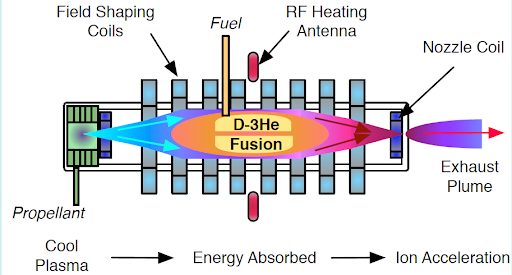
    Schematic showing how DFD works
    Image courtesy of http://fiso.spiritastro.net/telecon/Thomas_5-29-19/Thomas_5-29-19.pdf

    At its core, DFD is a fusion reaction powering a plasma rocket. Powerful rings of magnets are lined up to form something resembling a cylinder. Smaller but stronger magnets are situated at both ends. In the center of this configuration, helium-3, a stable helium isotope with only 1 neutron, is put in a fusion reaction with deuterium, a hydrogen isotope with roughly double the mass of ordinary hydrogen (isotopes are atoms of the same element that have the same number of protons but a different number of neutrons). These reactions and some side reactions create a fusion region the length of a surfboard. Cool plasma flows around it to extract energy (plasma is gas-like matter made up of ions and electrons; the presence of these electrons makes plasma really good at conducting electricity and easily influenced by electromagnetic fields). Antennae surrounding the engine create a rotating magnetic field that induces a current in the plasma. The plasma ions get more and more energized until they fuse, and the fusion products get shot out the back of the engine like hot gases in a conventional rocket, creating thrust.

    This process produces tons of excess heat, which is used in a Brayton Engine to create more than 200 kW of electrical power. All remaining heat gets rejected to space, the ultimate thermal reservoir.

    How DFD Measures Up to Conventional Propulsion

    Conventional rockets have many advantages: high thrust and (relatively) low cost. They’re a reliable mechanism that has been used for centuries. What makes DFD so attractive is its compact design and efficiency. An important quantity in rocketry is specific impulse—impulse per unit of propellant or how efficiently a rocket creates thrust. The higher the specific impulse (often measured in seconds), the less propellant required for the desired impulse. Solid and liquid fuel rockets top out with a specific impulse of around 500 seconds, but a DFD engine boasts a specific impulse of 10,000 to 20,000 seconds, all while being no more than 2 meters in diameter.

    With these numbers, NASA predicts that a 10,000 kg mission with DFD could get to Pluto in 4 years, which is much shorter than the 9.5 years it took 478 kg New Horizons on hydrazine propulsion, with more capabilities to do scientific work thanks to its increased power supply.

    The Future

    All in all, NASA is very excited about the DFD concept, as it can easily fit into NASA’s current launch infrastructure and would be an ultra-low radiation fusion option; however, there’s still a lot of work to be done. For example, while the Brayton Engine has been developed and the ion-energizing process is being developed, the crux of the concept, nuclear fusion, still has to be demonstrated. DFD design is going into its second phase, which seeks to improve its plasma heating system and shielding capabilities. According to the current timeline, actual flights are planned for after 2030 and, in the future, could power orbital platforms, interplanetary travel, and even bases on the Moon and Mars.


    Hablas español? Haz clic aquí para leer una traducción al español!

    —–


    Sources:

     Paluszek, M., Pajer, G., Razin, Y., Slonaker, J., Cohen, S., Feder, R., … Walsh, M. (2014). (rep.). Direct Fusion Drive for a Human Mars Orbital Mission (pp. 1–9). Princeton, New Jersey: Princeton Plasma Physics Laboratory Office of Reports and Publications. 

    Princeton Satellite Systems. (2018). Technical Video of Dfd Engine. YouTube. https://www.youtube.com/watch?v=hggqvB5I95I. 

    Thomas, S. (n.d.). Direct Fusion Drive: Enabling Rapid Deep Space Propulsion. Lecture. 

    Benson, T. (2014, June 12). Brief History of Rockets. NASA. https://www.grc.nasa.gov/www/k-12/TRC/Rockets/history_of_rockets.html.