Tag: cognition

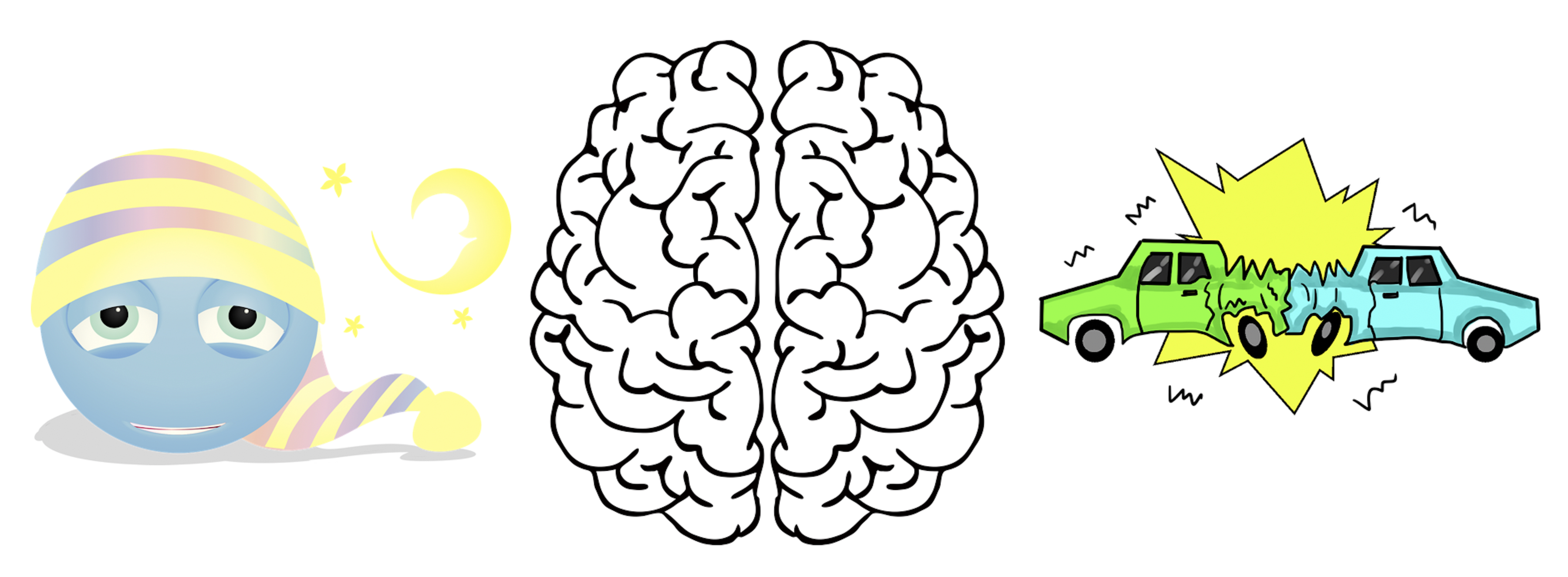
  • DUIs and Driving While Sleep Deprived: The Dangerous Similarities

    Life as a student can be frustratingly busy at times. In the most difficult periods, you have to complete multiple assignments simultaneously, all the while attempting to maintain a moderately healthy social life. You want to ace your tests, maintain your friendships, and visit your family regularly; maintaining balance among these goals is understandably difficult. When life becomes hectic, you may decide to vary from your typical routine, and one of the health behaviors that is often neglected is sleep.

    Sleep deprivation is a common problem in the US. At least a third of adults don’t obtain more than 7 hours of sleep each night, and this is detrimental to physical, psychological, and cognitive health (CDC, 2016; Watson et al., 2015). Total sleep deprivation, or failing to obtain any sleep in a given night (i.e., “all-nighters”), is common in student populations; students have reported pulling all-nighters more than twice per month (Hershner & Chervin, 2015). This may be especially common during exam times. For example, students sometimes pull all-nighters in preparation for tests. However, these behaviors have consequences at the behavioral and neural level.

    Sleep deprivation tends to increase activation in a control center of the brain, the prefrontal cortex, and this is thought to reflect increased effort to maintain cognitive control (Wilckens, Erickson, and Wheeler, 2012). For example, focusing attention and avoiding distractions may require more effort than when well-rested. Thus, studying all night could lead to undesirable consequences. Not only may students not retain crammed information over long time periods (e.g., weeks, years), but they may also experience dangerous psychomotor impairments (Durmer & Dinges, 2005).

    Researchers have found that driving while sleep deprived is statistically equivalent to driving with a blood alcohol content level of being legally intoxicated.

    Psychomotor impairments related to sleep deprivation directly affect driving ability. Researchers have found that driving while sleep deprived is similar to driving while under the influence. In fact, it is statistically equivalent to driving with a blood alcohol content level of being legally intoxicated. Those who drive while sleep deprived and those who drive while drunk have trouble maintaining their place on the road. They tend to accidentally cross into other lanes and look away from the road more often. Not surprisingly, the injury rate of motor crashes related to drowsy driving and drunk driving is similar.

    As students, we are often warned about the dangers of drunk driving and distracting driving (e.g., texting, talking on the phone), but there is little attention given to the dangers of driving while sleep deprived. The evidence is clear in regards to the importance of obtaining enough sleep for general health and cognitive function. However, if you must miss sleep, please refrain from driving. Instead, call a friend or call another ride. Just as you wouldn’t drive while under the influence, don’t drive while sleep deprived.

    References

    Centers for Disease Control and Prevention. (2016). 1 in 3 adults don’t get enough sleep. Atlanta, GA: US Department of Health and Human Services. Retrieved from https://www.cdc.gov/media/releases/2016/p0215-enough-sleep.html

    Durmer, J. S., & Dinges, D. F. (2005). Neurocognitive Consequences of Sleep Deprivation. Seminars in Neurology, 25, 1996. https://doi.org/10.1055/s-2005-867080

    Hershner, S. D. & Chervin, R. D. (2015). Causes and consequences of sleepiness among college students. Nature and Science of Sleep, 2014(6), 73–84.

    Watson, N. F., Badr, M. S., Belenky, G., Bliwise, D. L., Buxton, O. M., & Buysse, D. (2015). Joint consensus statement of the American Academy of sleep medicine and sleep research society on the recommended amount of sleep for a healthy adult: methodology and discussion. Sleep, 38(6), 591–592.

    Wilckens, K. A., Woo, S. G., Kirk, A. R., Erickson, K. I., & Wheeler, M. E. (2014). Role of sleep continuity and total sleep time in executive function across the adult lifespan. Psychology and Aging, 29(3), 658–665. https://doi.org/10.1037/a0037234

  • When to Start Panicking about Killer Robots

    If you’ve seen one too many sci-fi movies (or five minutes of West World), you might think artificially intelligent humanoid robots can, and likely will, outsmart their creators.

    After all, over the past century, humanoid robotics technology has accelerated from barely-believable Disney animatronics, to emotive, joke-cracking, robotic citizens. It’s not a stretch to envision what’s next. However, although potentially unsettling, modern artificial intelligence technology shouldn’t have you perusing panic room catalogs just yet. Or should it?

    RobotHumanShadows

    High-Tech One-Hit Wonders

    It is true that robotic devices developed in the past few decades can perform some truly remarkable tasks, such as have interactive conversations, dance, or do parkour. But, all of these amazing machines fall into two categories: they can move well, or they can think well. None can do both – yet.

    For example, Boston Dynamics is a robotics company that has built several robots with eerily life-like movement capabilities. Take their creation Big Dog. When pushed, this robot almost looks like a scared deer recovering from a fall. These machines, such as their newer creation called Handle, have both reflexes and complicated controls that allow them to move in uncertain environments with extreme precision, carrying heavy weights and performing multiple tasks. However, they aren’t exactly stimulating conversation partners.

    On the other hand, there are robots that very convincingly interact with humans, such as the now-famous Sophia from Hanson Robotics. Sophia can converse with humans relatively seamlessly. She can learn from conversations over time, tell jokes, and even throw shade. But her movements are clunky and relatively non-existent.

    Robots are designed to specialize in one task – they can either walk or talk but cannot yet do both. As prominent roboticist and Oregon State computer science professor Thomas Diettrich, Ph.D., explained in an interview with Tech Insider, “No [artificial intelligence] system comes anywhere close to having this immense breadth of capabilities, particularly when it comes to combining vision, language, and physical manipulation” (Del Prado, 2016). What happens when there is a robot that excels in all of these tasks? At that point, it might be time to consider investing in some off-grid property.

    Walking the Walk so You Can Talk the Talk

    Why does movement matter when talking about artificial intelligence? As MIT neuroscientist Daniel Wolpert, Ph.D. puts it, mammals have brains so that we can move. Evolutionarily speaking, mammals developed the ability to perform complex movements like walking before we developed higher cognitive abilities, such as speech.

    Moving and interacting with your environment is the best way to learn, even for robots. Peter Norvig, Ph.D and director of research at Google agreed. “Reasoning [in artificial intelligence] will be improved as we develop systems that continuously sense and interact with the world, as opposed to learning systems that passively observe information that others have chosen,” Norvig explains (Del Prado, 2016).

    Take, for example, a baby learning to talk. Although you don’t remember it, you probably learned what a ball was by seeing a ball, grabbing it, maybe even putting it in your mouth a few dozen times, all while someone repeated the word “ball” over and over. You were eventually able to define what the word “ball” meant by recalling your interactions with that object. This is likely why early motor skills are predictive language development (Bedford et al., 2016). Observations like these have led cognitive neuroscientists to develop the theory of embodied cognition. This theory suggests that cognitive functions – understanding the emotions of others, developing likes and dislikes, and communicating with those around you, to name a few – are rooted in our physical experiences with the environment, and the sensations we feel from those experiences. Essentially, you know what awkwardness is because you accidentally called your first-grade teacher ‘mom’ once or accidentally said “Love you!” before hanging up the phone with your boss.

    An entire body of developmental and neural imaging evidence supports this theory, showing that we use our own sensory and motor experiences for complex cognitive processes such as understanding the actions of others (Grafton, 2009) and the meaning of words (Pulvermuller, 2005). Fortunately for us, or unfortunately if you are a roboticist, manmade machines do not yet possess this ability.

    Moving Towards Independent Thought

    For a robot to have true, rich artificial intelligence they have to be able to think and learn without supervision. At the moment, robots have a hard time generating their own opinions about the environment because they can’t fully – or perhaps more importantly, independently –  experience the environment. If you tell a robot to “push” or to “walk,” they typically understand what you mean because someone went into the code and defined what those words meant, not because the machine defined it for themselves by actually pushing or walking. Deb Roy, Ph.D and a professor at MIT working on robots that understand language through physical interaction, describes this as “the machine [getting] caught in circular chains of dictionary-like definitions.” (Roy, 2005). Their group has managed to create Ripley, a robot that can physically interact with objects to form its own opinions about the environment. However, these types of machines still have a long way to go before engaging in rich social interactions as well as complicated physical movements.

    So what’s holding us back from developing robots that can move, sense, and think? It seems that researchers investigating things like movement and sensations in humans and robots are largely separated from roboticists developing cognitive algorithms. Similar to Dr. Roy, Dr. Fancesca Odone and colleagues are working to develop the cognitive and physical skills of iCub, a robot that can independently learn to visually recognize objects and perform physical manipulations. Fanello et al. (2017) explain that  “In spite of the complementary challenges, cognitive robotics and computer vision mainly proceeded on independent tracks.” To enable robots to walk and talk, perhaps researchers across fields must first talk to each other.

    We’re Safe. For now.

    Until robots can form experience-based definitions of the things they interact with through their own movement, we are probably safe from the potential robot apocalypse. When robots develop the ability to learn from their own physical experience – experience they gain themselves by interacting with the environment through coordinated movement – that is when their thinking will become truly independent.

    Who knows, maybe if we show them our good side, robots will like humans and decide to live harmoniously with their creators. However, since Sophia recently learned to walk, and seems to have other plans, you might want to keep those panic room catalogs within arm’s reach.


    Works Cited

    Bedford, R., Pickles, A., & Lord, C. (2016). Early gross motor skills predict the subsequent development of language in children with autism spectrum disorder. Autism Research, 9(9), 993-1001.

    Del Prado, G. M. (2016, March 09). Experts explain the biggest obstacles to creating human-like robots. https://www.businessinsider.com/biggest-challenges-human-artificial-intelligence-2016-2

    Fanello, S. R., Ciliberto, C., Noceti, N., Metta, G., & Odone, F. (2017). Visual recognition for humanoid robots. Robotics and Autonomous Systems, 91, 151-168.

    Grafton, S. T. (2009). Embodied cognition and the simulation of action to understand others. Annals of the New York Academy of Sciences, 1156(1), 97-117.

    Pulvermüller, F. (2005). Brain mechanisms linking language and action. Nature Reviews Neuroscience, 6(7), 576.

    Roy, D. (2005). Semiotic schemas: A framework for grounding language in action and perception. Artificial Intelligence, 167(1-2), 170-205.