Tag: marine

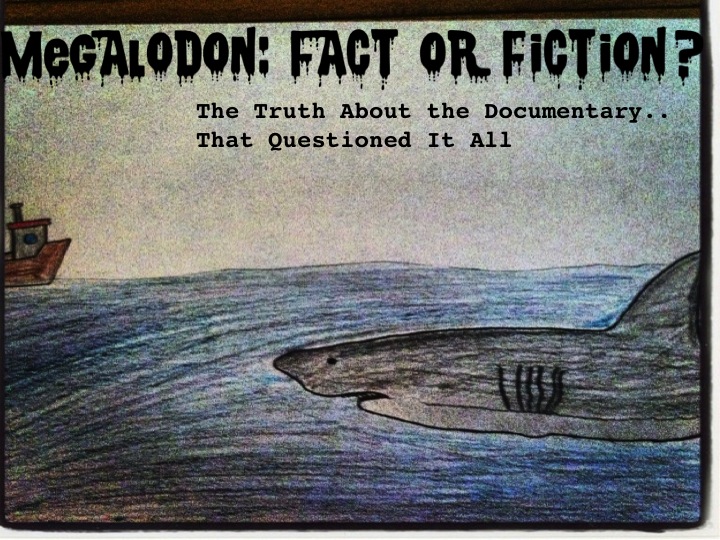
  • Megalodon: Fact or Fiction?

    Megalodon: Fact or Fiction? The Truth About the Documentary That Questioned it All Barbies? Yea right. Doll Houses? Please. I was never the little girl who played with mini tea cups and pretended my stuffed animals were my fellow beauty-pageant friends. I was the girl outside shooting Nerf guns at the neighbor boys and exploring the deep ends of the woods in my backyard. I’m sure my mom was thrilled when I brought pet bugs home from school rather than glitter-filled artwork. Nonetheless my fascination for bugs, animals and anything living for that matter started from a very young age. To this day I find myself watching Discovery channel till wee hours of the night or researching the latest species found in the far corners of the Amazon. It was not until recently that I began indulging in my extreme captivation with sharks.

    Although I would never want to find myself next to one of these sharp-toothed vigilante creatures, the fear and complete awe I feel every time I read, watch, or hear about them gives me an experience unlike any other animal I have studied. They are powerful, stealthy and the ultimate kings of the water. Many can swim up to 40 miles per hour and some can produce up to 20,000 teeth in their lifetime constantly replacing ones that fall out. However, no shark is as intimidating or interesting than the biggest shark that has ever existed…the MEGALODON. And yes, it was mega. This ancient beast was said to be up to 60 feet long and weighed about 77 tons. Just to give you an idea, that is the same mass as 7 school busses. Its size was almost 4 times as long and 15 times the mass of a modern great white shark. That’s big! The Megalodon usually preyed on blue whales and other large fish. In fact, the Megalodon had the jaw strength to crush a whale’s skull in the same way a human jaw can crush a grape. Imagine what it could do to a human skull. Yikes! It was by far the biggest predator in the seas at the time. Because the fossil record dates back 28 million years and is almost completely comprised of teeth, some scientists debate its size, its strength and even its existence. However what current researchers are still stumped with is answering the question, “Does Megalodon exist today?”

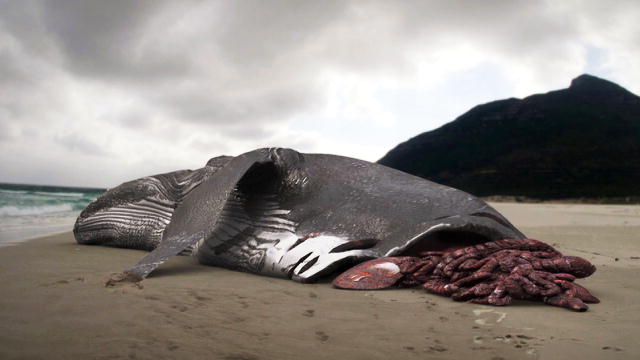
    During shark week in the summer of 2013, the Discovery network aired “Megalodon: The Monster Shark that Lives.” On the program a group of researchers and Megalodon-enthusiasts analyzed a wide range of evidence claiming that Megalodon still exists. For shark lovers like me, the prospect of actually seeing glimpses of Megalodon was enough to get me hooked. On top of the shark fanatics, more than 4 million people tuned in nation-wide to watch the special with hopes of learning, seeing, and believing in a modern-day Megalodon. Boy were we wrong. Throughout the show the “researchers” presented photos of half eaten whales claiming only a shark as big as Megalodon could do such damage. They presented eye-witness testimonies of sightings, boat attacks, and big black blurs in the ocean of the supposed Megalodon skimming the surface of the water. The final spectacle showed the “scientists” dragging a huge model whale through the water as bait with hopes of the Megalodon resurfacing and attacking it.

    And….it did! Sure enough there was a giant explosion, a blur past the camera, and in a second the “Megalodon” was gone. The only redeeming factor of this somewhat ridiculous ending was that the divers were able to tag the animal that surfaced. Despite everything else in the documentary being completely fake, this part was a glimpse of truth. The divers were able to tag an animal that dove from the surface to below 6000 feet in seconds, a behavior unlike any other shark or any other animal for that matter. In the middle of all the bogus Discovery chose to broadcast, they somehow still managed to instill the belief that Megalodon exists solely by placing hope in a tracking tag. In fact, over 3 million of their 4 million viewers believed in Megalodon after the documentary, including myself. Many marine biologists have clearly stated that Megalodon does not currently exist and went extinct about 2 million years ago before humans existed. There is no doubt in their minds that it is gone. In fact, many of them laugh and scoff at the fact that after showing such phony information, Discovery was still able to convince a large part of their viewers that Megalodon is alive. After much thinking and research I have come to my own conclusion. I do not believe that Megalodon is alive but I still hope it exists. While the documentary was full of misleading information, two unforgettable facts keep me hoping.

    First, the tag proves that there is some kind of animal down there that is able to dive that deep that fast. Second, the fact that only 5% of our oceans have been explored leaves the other 95% up to our imagination.  Who knows what’s out there?  With that being said, is there hope that Megalodon still exists? In the minds of scientists the answer would be a cold solid NO. But in the minds of hopeful shark fans like myself, myth-lovers, and the curious general public, Megalodon may very well still be lurking at the bottom of the ocean in waters we may never be able to explore.
     

  • Biology bucket list: algal blooms

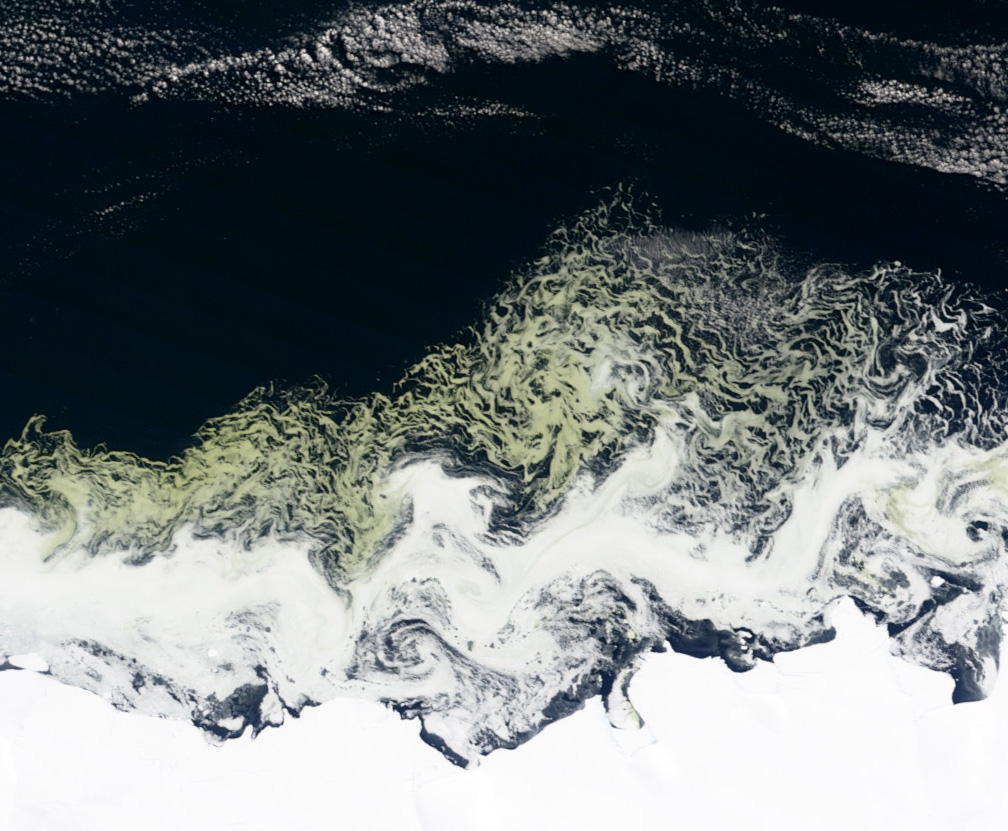
    An algal bloom appears off the Princess Astrid Coast in East Antarctica.
    NASA image courtesy Jeff Schmaltz, LANCE/EOSDIS MODIS Rapid Response Team at NASA GSFC.
    Greetings biophiles! What do algal blooms, great white sharks, and okapis all have in common? They’re all absolutely fascinating and they’re all on my list of events and animals I would jump at the chance to observe. This ever growing list of biology-related items has evolved into something of a bucket list, hence the title, and includes biological phenomena around the globe that I hope to one day see for myself!
    So what ‘s first up on my biology bucket list? Algal blooms.
    First some background: Algal blooms are basically just the growth of aquatic algae at a hyper fast pace, resulting in washes of discoloration over bodies of water. These artworks of nature generally occur due to favorable conditions such as availability of resources like minerals, nutrients, warmth, and sunlight. The algae, usually referred to as phytoplankton, are microscopic, single-celled organisms that make their home in the upper layers of both fresh and marine waters. They serve as vital components of aquatic ecosystems due to their powers of photosynthesis, as they provide food (directly or indirectly) for everything from penguins to blue whales.  Phytoplankton even feed you, as they are used as feed in aquaculture. We depend on these little guys!
    However, I not only appreciate them for their hard work in the upkeep of our oceans, but also for their aesthetic value on both a microscopic and macroscopic level. If you do an image search of either “phytoplankton” or “diatoms” (go, click on it!), you’ll see that these guys come in all kinds of wacky shapes, sizes, and colors. Looking at them under a microscope (and I would love to take my own sample from an algal bloom) is pretty much like walking through an art gallery (except better) because the artwork is made out of living organisms just hangin’ out,  powering an entire ecosystem and being funky shaped. Ahhh, that is the life.
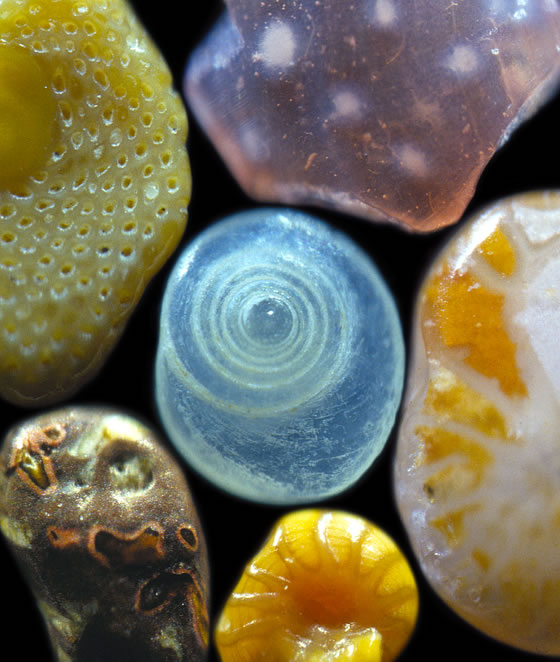
    (Side note: lots of ordinary things look crazy awesome when looked at close up, sand for instance. Oh nature, your beauty reveals itself on so many levels. *swoon*)
    Bits of sand made up of shell, coral, and volcanic rock bits.
    Image Copyright © 2008 Dr. Gary Greenberg, All Rights Reserved.
    How do I plan on experiencing an algal bloom you may ask? By swimming in one of course!* (Or looking at them from the International Space Station, as most algal blooms can be seen from space. NASA, if you want to make dreams come true, hit me up!)

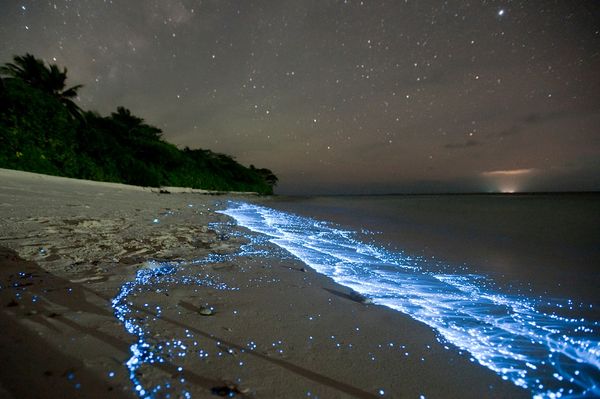
    And no, I’m not talking about taking a dive in the pond scum of the poorly-kept neighborhood pool. Instead, I hope to travel to what are known as bio-bays: bodies of water where bioluminescent phytoplankton, or more specifically dinoflagellates, light up the waters at night and create waves dotted with glowing spots to match the starry night sky. There are several locations around the world where tourists can experience the glowing waters- Puerto Rico, Vietnam, and the Maldives to name a few.

    However, these kinds of trips cost money and, alas, I am a poor college student, so until I can save up to travel to Puerto Rico (or the ISS), I’ll continue looking at satellite photos (like the ones from NASA, linked below). Other types of algal blooms can occur in bodies of water around the world and vary depending on seasonal and causal factors.

    Glowing blue waves on Vaadhoo Island in the Maldives.
    Photograph by Doug Perrine, Alamy

    I like to keep my eye out for new photos of algal blooms, such as this one, which displays Impressionist-esque swirls of green and yellow atop the waters off the Princess Astrid Coast in Antarctica, taken by NASA’s Terra Satellite this past February. Antarctic blooms generally occur in December (the start of summer for Antarctica) as the increased sunlight favors the growth of these photosynthesis superstars and kickstarts the rest of the marine ecosystem in time for baby-making season. This particular algal bloom’s late season appearance excited scientist to the possibility that it was caused by a more unusual factor: nutrients blowing off of a nearby ice shelf. This is just one example of how algal blooms can come about.

    Year round you can find news of all types of algal blooms being spotted in different places around the world, so keep a lookout for this fascinating biological phenomena! If you would like to see more of their intoxicating beauty I would recommend perusing through Visible Earth, a catalog of photos from NASA, or checking out this gallery from Wired magazine, which will also tell you about regional types of algal blooms.

    So, dear readers, what do you think? Would you go swimming in a bioluminescent ocean? I hope you’ll take a look through some of the galleries linked throughout (some of these photos make great wallpapers!), and of course I’d love to know what’s on your biology bucket list via the comments section below. (Also, keep a look out for our next installment of our biology bucket list series!)

    *It should be noted that some algal blooms are harmful (HABs), and certain species, about 2% of the 5000+ species of marine phytoplankton, are associated with toxins and can actually harm an ecosystem through the release of neurotoxins and the depletion of oxygen in water. These HABs can arise naturally and in predictable patterns, but have also increased in frequency due to human activity like agricultural run-off. So please do not just go jumping into any old discolored water and be sure to look out for notifications from your local health and marine departments if you plan on participating in any recreational activities in or near your local lakes or beaches.
    Here are the places I got my information from:
    Diersing, Nancy. “Phytoplankton Blooms: The Basics.” (May 2009). Florida Keys National Marine Sanctuary.
    “Greening the Princess Astrid Coast.” (March 2012). Earth Observatory by NASA.
    Landsberg J.H. “The effects of harmful algal blooms on aquatic organisms.”  (2002). Reviews in Fisheries Science.
    Than, Ker. “Picture: Glowing Blue Waves Explained.” (March 2012). National Georgraphic.
  • Badass Biology: The Pistol Shrimp

    Badass Biology: The Pistol Shrimp

    “Wtf, shrimp!!? I make it all the way to this website from who knows what part of the internet, and I see ‘Badass Biology’. Man, Kevin, you flip my brain out with possibilities of flying sharks, rabbits of doom, or a half-honeybee half-unicorn rainbow pollinators. And what do you deliver? A stupid shrimp??! I hate you, and I quit this website. (╯°□°)╯︵ ┻━┻)” To which I reply, “Charles Barkley, I think you’re over-reacting. Please repair my table at once”.

    It was hard to find a chart that even went up to 150dB, let alone the 220 these guys produce.

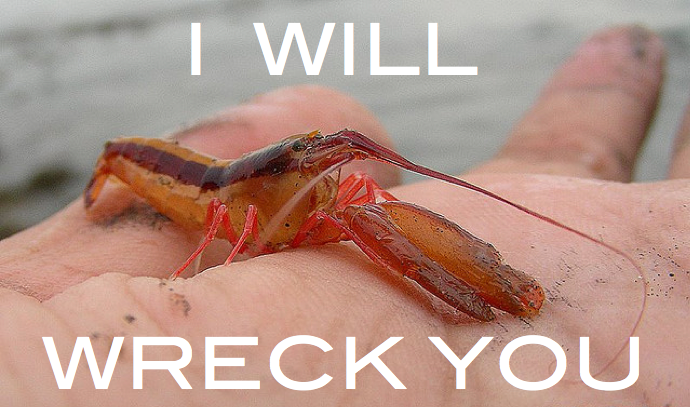
    Yes, it’s a shrimp. A measly two-inch-long shrimp. But you don’t understand. This one single stupid shrimp is just about the coolest thing I’ve ever heard. Trust me, and when you hear one too, you’ll probably go deaf, because this one little shrimp IS ONE OF THE LOUDEST ORGANISMS ON THE PLANET. I’m talking 220+ decibels, much louder than a gunshot and louder than standing next to a jet engine at take-off. O_o.

    First, I want to talk about some other wicked cool stuff this little guy does apart from being a tiny walking firework of sonic pain. These shrimp garner lots of attention from ecologists because of their symbiotic, or mutually-beneficial, relationship with gobies, a type of small marine fish. The coral reef populations of this shrimp build burrows and recruit the help of a goby to stand guard out front while being no more than an antennae’s distance from the shrimp, using the goby’s well-developed vision to watch for danger. Once danger comes, the goby flicks its tail to signal a threat, and both the goby and the shrimp retreat into the same burrow. Then they start slapping five. It’s flippin sweet.

    The mutualisms don't just end at gargoyle-ing.

    From an ecologist’s point of view, this is totally mutualistic, and some scientific literature lists this interaction as “totally f-ing amazing” [citation needed] (Good luck with finding THAT reference -ed.). Yeah, both the goby and the shrimp live to see another day should a shark, barracuda, squid, rogue buoy, really fast snail, very-misplaced land predator, sinking boat part, cloud of wasps, or sentient shrimp-hating spear come around to threaten them. The goby gets a burrow, and the pistol shrimp gets a gargoyle. Selection at work.

    I like to think of the goby as the pistol shrimp’s pet, kinda like me buying a falcon and parading it around the neighborhood on a leash. And once danger comes, the falcon goes “Hey yo, Kevo, you might need to reconsider this route”, we split, we don’t find danger, and I buy the falcon ribs for a job well done (and because I really want ribs right now). So in a sense, pistol shrimp are danger shepherds equipped with sun-blasting cannons of glory that we’ll get to in a moment.

    I need to take a break to collect myself. Holy balls, these shrimp own everything own-able. Next time I see one, I’m buying it ribs. The whole rack.

    Let’s get to that “pistol” thing, why don’t we? Pistol shrimp have one very distinct set of front appendages, like two arms extending outwards from its body. Only, one of these arms is disproportionately larger than the other, and it’s quite a contrast. Like no foolin’ man, this one arm alone can be as long as half the entire length of the shrimp’s body. Imagine walking around with one of your arms the size of the Hulk’s and you get the idea. This may look pretty stupid, but this powerful musculature operates one of the most badass weapons nature can offer.

    Yeah, kinda like this

    When in serious danger or when hunting, the pistol shrimp cocks its massive claw backwards into a 90o position. Once the claw snaps shut, it produces a jet of water propelled forward at 60mph. Yeah, woo, a fast water jet. Big deal. But here’s the amazing part. Are you ready to have your mind blown? If you have ever listened to me before, now is a pretty good time, too: This jet of water creates a bubble that cavitates, or implodes, generating a pressure wave that creates a sound loud enough to break glass in an instant. Not only that, but once the bubble cavitates, the heat generated by the force of the implosion causes the temperatures inside the bubble to reach about 18,000 degrees Fahrenheit. Yes. Eighteen. Thousand. Oh, and to top it off, the whole process takes three tenths of a second. 

    THIS TINY SHRIMP MAKES A BUBBLE SO AWESOME THAT IT’S LOUDER THAN A JET AND MORE THAN TWICE AS HOT AS THE SURFACE OF THE SUN.


    You can imagine the horribly bubbly doom the pistol shrimp’s enemies must face. Stunned (or killed) by the force of that kind of pressure change, the pistol shrimp’s prey has basically just become lunch in an instant. The shrimp pulls its quarry into its burrow, and goes to town, just how I could go to town on some ribs right about now. I dug up a video about this whole process in case what I said wasn’t convincing enough:

    http://www.youtube.com/watch?v=eKPrGxB1Kzc

    If you want me to write about any other badass biological bosses, leave a comment. I may talk about them, or I may just tell you that your suggestions are awful. Probably not the latter though. I like people.

    Well, I like most people except you, Charles Barkley. I really miss that table. Now I’ve got nothing to rest my wine on when Glee’s on.

    Photo credits:

    http://www.airpowered.co.uk/images/dbachart.jpg

    http://loyalkng.com/wp-content/uploads/2009/11/arm_wrestling_champion_03.jpg