Tag: materials

  • Fabrican: Taking a Piece of Chemistry onto the Catwalk

    One of the most valuable experiences for any designer or innovator is the process of mastering new fields of knowledge to better guide and inform creative decisions. Almost every new problem or project requires designers to think of new ways to approach their solution or design. Manel Torres is the perfect example of this approach as he had to immerse himself in chemistry to develop what is now known as spray-on clothing. His work demonstrates how expanding beyond traditional design boundaries can lead to groundbreaking results with multiple applications! Torres’s invention really highlights how impactive ideas often emerge when disciplines intersect.

    During Paris Fashion week in 2022 at the Coperni runway, Bella Hadid made a stunning performance as she stood there practically naked, while being sprayed with some white liquid material. Well, this material so happened to originate from the works of Manel Torres’ Fabrican. Inspired by silly string spray cans, Torres wanted to create a spray-on T-shirt from an aerosol can during his doctoral years at the Royal School of Art in London. With the help of Professor Paul Luckham from Imperial College’s department of Chemical Engineering and Chemical Technology, Torres was able to create the right formulation to produce something that can spray thin fabric onto a model (Melton, 2023). A featured article years back on the home page of the Guardian Newspaper, highlights the work of fashion designer Dr. Manel Torres who invented a spray that “forms a seamless fabric on contact with the body” (Amato, 2011). Along with the article was a video, showing Torres in a lab coat demonstrating his new innovation by spraying the torso of a male model with a liquid mix of fibers and polymers that instantly dried and solidified upon contact with the skin. The results came out to be a skintight t-shirt!

    (source: drawn by An Truong)

    So how is it possible for a liquid material to become something that you can actually wear? 

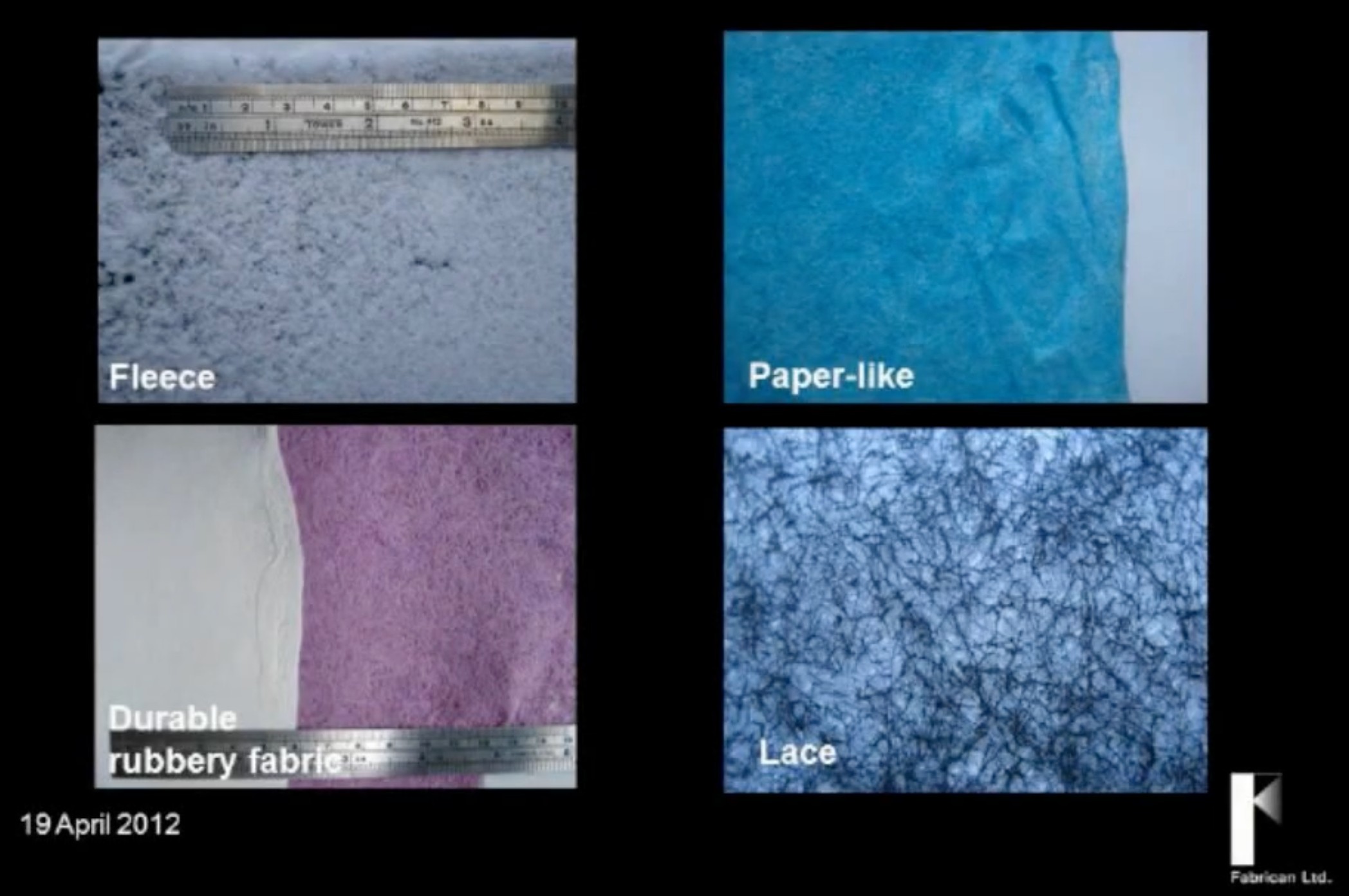
    Torres’ invention consists of a liquid mixture of short fibers that are suspended in a solvent that evaporates when exposed in the air, so that the spray turns into a solid non-woven non-knit material upon contact (Melton, 2023). It was made to be applied using an aerosol can or a spray gun that would be sprayed directly onto a person or onto a mannequin or mold, forming a fabric layer that can be thickened and strengthened by applying multiple layers. With this, you would be able to style, peel off, and shape the fabric as needed. The fibers themselves are biopolymers created from natural or synthetic sources such as corn starch, wool or mohair based keratin, hemp, or even collagen (Amato, 2023). Torres also experimented with various other kinds of fabrics and textures such as a paper-like texture, fleece, rubber, and lace. These fabrics and textures were able to be embossed, molded, and essentially patterned in any ways a designer wishes. 
    (source: TEDxTalk)

    Further Application

    Torres believes that his invention should be and can be used to create a wide range of products, including fashion, automotive components such as dashboards and interior fabrics, and for medical application such as bandages, instant sterile dressings, or drug delivery patches. 

    As any great designer and innovator would do, Manel Torres continues developing and improving his own works. In a TED TALK Torres gave in 2012, he mentions how he wants to push Fabrican to be fully reusable and sustainable as well as incorporate some kind of smart technology in the future. This is a great practice for designers and innovators alike as they should all reflect on their designs and continue to improve them even after its final outcome is presented.

    Conclusion

    Manel Torres’s work with Fabrican shows how innovation in design is truly never finished. It should evolve alongside new ideas, technologies, and needs. By continuing to refine his spray-on fabric with goals of sustainability, material and cost efficiency, and integration of smart technology, Torres sets a perfect example for future designers and innovators that creativity should not end at just the final invention or outcome, it instead continues to grow through constant iteration. Manel Torres’ process demonstrates how science and design can merge to create materials that are functional and adaptable. As Fabrican develops, it has great potential to reshape industries starting from fashion and expanding to fields such as medicine. Ultimately, Torres’s process and work encourages designers to think beyond traditional materials and to embrace experimentation and iteration. His brilliant vision for the future of clothing and textiles challenges the next generation to design with both imagination, experimentation, and research!

    Citations:

    Amato, Sarah. (2011). Fit to a T: Spray-On Clothing, Craft, Commodity Fetishism, and the Agency of Objects. Utopian Studies, 22(2), 285–302. https://doi.org/10.5325/utopianstudies.22.2.0285

    Coperni. (2023, September 14). The making of a dress [Video]. YouTube. https://www.youtube.com/watch?v=YxObP6-ovdk

    Melton, Lisa. The instant spray-on dress. Nat Biotechnol 41, 743 (2023). https://doi.org/10.1038/s41587-023-01829-1

    TEDx Talks. (2012, April 26). Spray-On Fabric: Manel Torres at TEDxImperialCollege [Video]. YouTube. https://www.youtube.com/watch?v=EW6Gv-IoErw
     

  • Carbon Negative Concrete???

    As Industrial Design major who’s future career will most likely consist of creating a wide variety of products, something that is a big concern for me is creating environmentally friendly products. I don’t want to just create things that will eventually just create more waste and end up in a landfill polluting our Earth. I also don’t want to help perpetuate environmentally harmful manufacturing processes like those used to make cement that release tons of greenhouse gases into the atmosphere.  So when I heard about the Calera process I was very interested and wanted to look into it more to see if this was actually an effective and sustainable method for capturing and storing carbon.

    The Calera Corporation developed the Calera process to sequester CO2 from our environment in a way that is actually sustainable and effective over time. They then used this process to create a superior form of concrete that mimics the form of calcium carbonate that marine animals use to create their hard shells. The Calera process results in the production of the vaterite polymorph which is stable when stored in the absence of water. When water and other proprietary additives are added to the vaterite polymorph, a cement reaction occurs in which the vaterite transforms via a dissolution and reprecipitation reaction to form another polymorph of calcium carbonate known as aragonite. This conversion of vaterite to aragonite results in a material with high strength, just as natural systems like mother of pearl are also constructed from the aragonite polymorph of calcium carbonate.

    Concrete is the most widely used man-made material in the world. Concrete is made of roughly 80% aggregate (sand and gravel), 10-15% cement, and the remainder air, water, and additives. The Calera process can permanently mineralize carbon into either fine or coarse aggregates or a supplementary cementitious material that can be used to create building materials such as concrete. The standard process for manufacturing Portland cement generates large amounts of CO2 both from the fuel used to heat the raw materials as well as from the conversion of CaCO3 to CaO, which releases CO2. Because of this, concrete made from Portland cement carries a CO2 footprint of approximately 0.8-1.5 ton CO2/ton cement, translating to roughly 537 pounds of CO2/cubic yard of concrete! Calera SCM both captures carbon from one source and avoids carbon emissions from another. Concrete made with 20% cement replacement with Calera SCM, and 20% cement replacement with fly ash would have carbon footprint of negative 1146 pounds of CO2/cubic yard of concrete. This is a carbon savings of 1683 pounds of CO2/cubic yard of concrete compared to standard concrete. “With projected U.S. Portland cement consumption at nearly 200 million metric tons by 2020, a 20% market penetration with a SCM replacement level of 50% would reduce CO2 emissions by 30 million metric tons.” Which is far more than the reduction that would be accomplished by supplementing fly ash as a replacement for some portions of Portland cement used in regular concrete mix.

    The carbon capture method employed by Calera, is also unique because it has many possible inputs including: fly ash, brines, waste water, and flue gas. In capturing CO2 and other emissions from flue gas, Calera’s carbonate mineralization technology uses solid and liquid sources of alkalinity, such as fly ash, wastewaters, and brines. The outputs of the process are clean air, fresher water, and solid materials that can be used as an aggregate or supplementary cementitious material. Another concern that often comes up in the conversation of carbon capture is how efficient is it, especially since you are trying to capture and manipulate a gas in this process. In its pilot landing facility, the Calera process regularly observes Carbon capture rates greater than 50% and has even reached rates of over 90%.


  • Zinc has bigger game than you do

    Zinc has bigger game than you do


    Still struggling to pick out that one in a million Valentine’s Day gift? Worry no longer, because I have the perfect gift idea sure to make anyone melt. No – it’s not superhot plasma from your favorite star gone supernova (the Biebs?) – We’re talking zinc baby. Baby. Baby. Baby. Oh baby.

    Zinc coatings on steel to be exact, through the process of “hot dip” galvanization.  The hot dip part is literal – pieces of steel are dunked in a bath of molten zinc metal and when they are removed a thin layer of zinc is atomically attached to the surface of the steel. The “galvanized” part belies the true function of the coating, considering this word is derived from a certain Italian who took liberties with dead frogs.

    “Why bother?” Your significant other may ask.  “Here I had this nice piece of steel and now you’ve gone and hot dipped it. I think we’re at two different places in our relationship.” We’ve all been there.

    The role of the zinc is to protect the iron in iron alloys (most importantly steel) from rusting. Like a proverbial knight in shining (preferably hot dipped) armor, zinc prevents the steel from rusting by selflessly doing all the rusting itself. As I describe it, this is starting to sound a lot less romantic and more like zinc has wandered into the friend-zone. Poor zinc.

    If you read my last article, you know that natural corrosion resistance is rare among the elements, but ironically zinc protects steel by being less good at resisting the undesirable reactions with oxygen and water that cause the formation of rust on steel. A good analogy for this process is if both zinc and iron open lemonade stands on the same block and oxygen is the customer. Every time iron is trying to seal the deal zinc unleashes a humorous ad campaign and slashes their prices, so naturally oxygen buys lemonade from zinc instead. Now replace lemonade with electrons and you’ve got a half-decent understanding of how zinc does its job – as far as oxygen is concerned it came to this two bit lemonade town to buy lemonade from somebody (form an atomic bond), and zinc sure is looking pretty good right now. The only discrepancy with this analogy is that in the business world iron would have to resort to foul play and steal all of zinc’s lemons or deface their billboards or something. Probably shouldn’t write that on your next chemistry exam though. But don’t feel bad for zinc – the corrosion products of zinc with the environment (zinc oxide and zinc carbonate), actually prevent continued corrosion of the underlying zinc. This is called “passivation” which is the way that many other metals, like aluminum, avoid needing a hot dip.

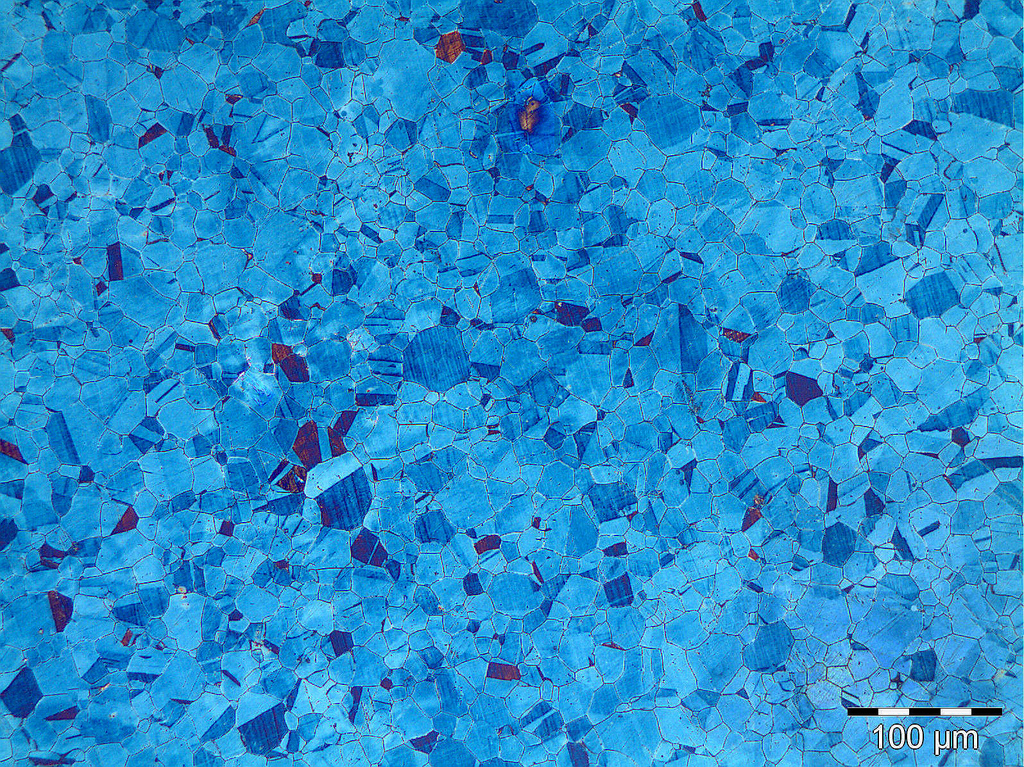
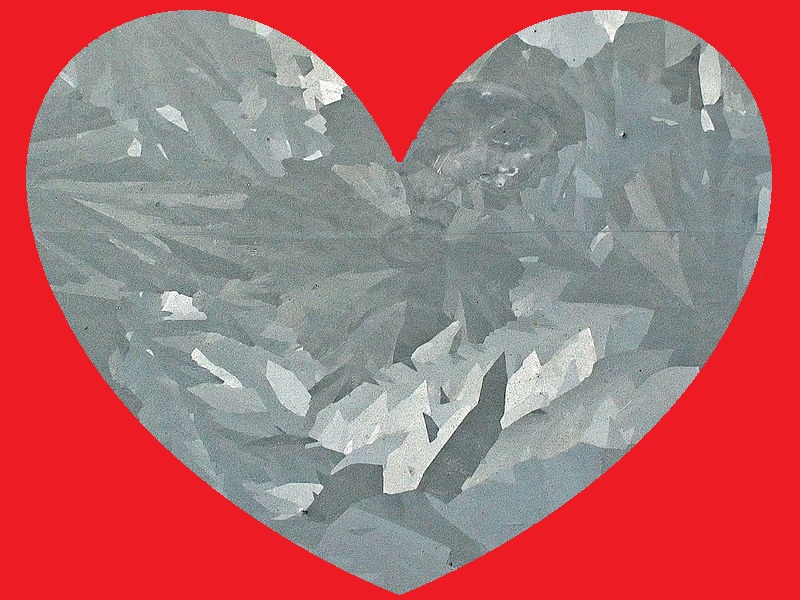
    So we’ve covered the “from the heart” part of a good V-day gift, but a box of galvanized nails might not send the right message to the apple of your eye. The good news is hot-dip galvanized steel looks really cool. The next time you’re passing a guard rail, street light pole or the like, you might notice a kind of patchwork series of flecks on the surface of the steel. No, that’s not art deco, those are the macro-sized crystalline grains of zinc busy oxidizing away. You can see some of these flecks inside the heart at the beginning of this article. In fact, all metals crystallize in this way, but because of how the zinc coating is applied the crystals of zinc that form on the surface of the steel are able to grow very large. If you were to take a high powered microscope and have a look at the surface of un-galvanized steel you would see a very similar grain structure but about 1000 times smaller. A good example is shown below from the Flikr photostream by the department of engineering at the University of Cambridge –  I admit I am a little jealous at all the cool science photos they have. Do yourself a favor and check them out.  The grains in this image are about 30-50 micrometers, which is about half the width of a human hair.

    Normally the grain size in so called “engineering materials” like steel is intentionally kept very small because it improves strength. Zinc, whose only role is as a sacrificial coating, can flaunt its’ big ole’ grains. The only other example I can think of where crystal grains are visible like this is in polycrystalline silicon solar cells. The fact that all three of these materials have the same general appearance is not by chance, but more on that another time.


    If love is sacrifice, then zinc has got it down. I will close with a poem that you can use with your gift:

    Roses are red,

    Rust is red too,

    A coating of zinc,

    says I – LOVE – YOU


    And don’t I just.


    – Gordon


    Original image sources:

    hot dip galvanized

    grains of steel


  • Even though Kim Kardashian’s marriage didn’t last, her engagement ring will. Like forever.

    Even though Kim Kardashian’s marriage didn’t last, her engagement ring will. Like forever.

    I have a joke for you:


    How long does a two million dollar engagement ring buy you with everyone’s favorite (well, mine anyways) Kardashian sister?


    As Kris Humphries found out, about 72 days.


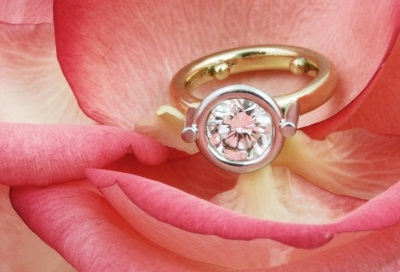
    Sorry Kris, but at least you should take some comfort in the fact that the ring you gave Kim will sit as shiny as it is right now until it’s ready to win hearts and headlines once again. At least the platinum band will anyways. What I’m referring to as the simply staggering resistance of Platinum to oxidation, more commonly known as rust or tarnish.  Platinum, along with gold and to a lesser extent silver are  the only metals on the periodic table that enjoy this distinction. As a logical consequence, these metals were some of the first discovered by ancient peoples because they would have quite literally been found lying on the ground, super shiny. In fact, gold was the first metal discovered ever and goes back as far as the entire history of… well as far back as recorded history itself! I like to imagine when cavemen discovered gold they tried to eat it before proposing to cave ladies with chunks of the stuff. Given that these un-reactive metals are now relatively commonplace, the idea of a metal that doesn’t rust may not seem that cool but trust me, it is.


    So why aren’t these magical metals applied to more commonplace items where rust is a concern? The obvious answer is their astronomical expense. Unfortunately the expense of platinum, gold and silver is not because they don’t rust but because they are super rare, representing some of the rarest elements found it the earths crust. Even if they were more common, each of these metals are extremely ductile and malleable allowing them to be easily fashioned through pulling and hammering into jewelry but preventing their use as structural metals. Gold’s softness is the origin of the quintessential gold rush miner biting into a dubious coin to ensure it’s authenticity. Thus even if you wanted to and were rich and crazy enough to do so, it would be unwise to make solid gold or platinum rims because they would buckle when popping over a curb.


    The diamonds in Kim’s ring are another story. Formed from carbon under extreme conditions of huge temperatures and pressures, diamonds are chemically identical to pencil lead but differ in the way the atoms are arranged. Instead of being soft enough to smear onto a sheet of paper when pressed by hand, diamonds are the hardest naturally occurring substance on earth. Ironically, according to calculations using thermodynamics, a discipline used to determine the equilibrium structure for a given set of conditions and composition, diamonds should not even exist outside of the extreme conditions in which they are formed! Instead, thermodynamics predicts that diamonds should deteriorate to graphite (pencil lead) at the temperatures and pressures found around Kim Kardashian’s hand. Then why don’t they?


    To answer that we can consider again our friends platinum and gold. It is not exactly correct to say that these metals can never oxidize, but more accurate to say that without a huge input of energy they never will. Meanwhile, metals like iron actually give off some energy when they rust. From the standpoint of iron, it is energetically favorable to rust than remain as elemental iron in the presence of oxygen. A good analogy to this kind of “favorable energetics” is a cart balanced at the top of a hill – the cart has potential energy that is converted to kinetic energy and then depleted  when it rolls down the hill. An unfavorable energy case would be a cart in a deep valley. Even though the cart could reach the top of the hill, someone would have to push it up there. Maybe you could get those cavemen to do it by feeding them gold. To transform diamonds into graphite and oxidize platinum will take energy. Lots of energy. So unless Kim visits the National Ignition Facility, an active volcano or these guys, her ring is staying put. Just maybe not on her finger.

    Image: Maggie Smith / FreeDigitalPhotos.net