Tag: physics

  • The Hidden World of the Piano Action

    The cover image was taken by the author.

    In my humble opinion, the best way to unwind after a long, arduous day is to pour out all your stresses onto the beautiful white and black keys of a grand piano.

    (Of course, that’s a little hard to do if you’ve never learned to play… I digress, though.)

    During my time at Georgia Tech, I’d find myself sitting at the piano located in the West Village Dining Hall almost every night – and while I wouldn’t say the piano there is especially well maintained, it still produces a sound that’s pleasant to my ears. In the end, isn’t that all that matters?

    “Enough with the preamble! What’s the point of all these ramblings?” You might be asking. Well, to answer that hypothetical question – I often think about the acoustics of a piano. That, of course, naturally leads to how it works… and believe it or not, there happens to be a surprising amount of physics under the (metaphorical and literal) hood of the instrument!

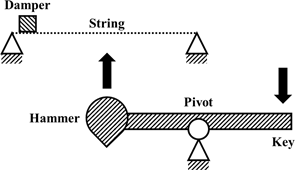
    The story of the piano begins with the clavichord, developed in the 14th century. The clavichord action was as simple as could be – a key lever with a hammer on one end. After the key is depressed, the hammer is immediately lifted until it hits the string, remaining in contact until the key is released (Russo & Robles-Linares, 2020).

    Figure 2 Source: (Russo & Robles-Linares, 2020)

    While this action enables volume dynamics, vibrato, and control over the attack and duration of one’s sounds, there remained one large problem: the string would be damped for as long as the key was held down.

    The harpsichord attempted to address this issue, while sacrificing some of the finer benefits of the clavichord.

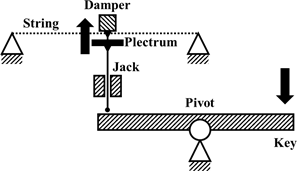
    For its action, when a key is pressed, the jack is lifted along with the plectrum and damper, the latter immediately releasing the string. Right after, the plectrum hits the string, generating sound. At some point, the jack meets a rail up above that stops its motion, allowing the string to resonate for as long as the key is held down. When the key is finally let go, the jack falls such that its plectrum does not hit the string a second time (Russo & Robles-Linares, 2020).

    Figure 3 Source: (Russo & Robles-Linares, 2020)

    Even though this solves the major issue with the clavichord, the harpsichord, in turn, has almost no volume dynamics, nor can vibrato be performed with it!

    That takes us to the mid-17th century, where Bartolomeo Cristofori would invent what was known as the fortepiano – named because of its ability to play forte (loud) and piano (soft).

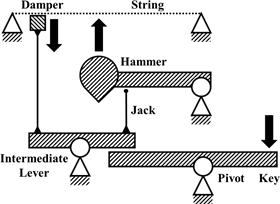
    The action of the fortepiano is far more complex than both the clavichord and the harpsichord. When the key is first pressed, it lifts an intermediate lever; a damper connected to that lever releases the string. After a small period of time, the jack on the intermediate lever pushes the hammer up. The hammer lifts off the jack halfway to the string and uses its existing momentum to hit the string.

    If the key was immediately released, the string is immediately damped, making a staccato (short) sound, as the mechanism returns to its resting position. If the key is held down, the string is undamped and free to resonate; the hammer falls back down onto the jack. After the key is released, the hammer returns to its resting position and the string is damped, muting the sound (Russo & Robles-Linares, 2020).

    Figure 4 Source: (Russo & Robles-Linares, 2020)

    In essence, the fortepiano was the combination of the good of both the clavichord and harpsichord – dynamics and vibrato, along with volume and an ability to sustain sound. In many ways, the fortepiano is similar to the grand pianos of today, but with a few key differences…

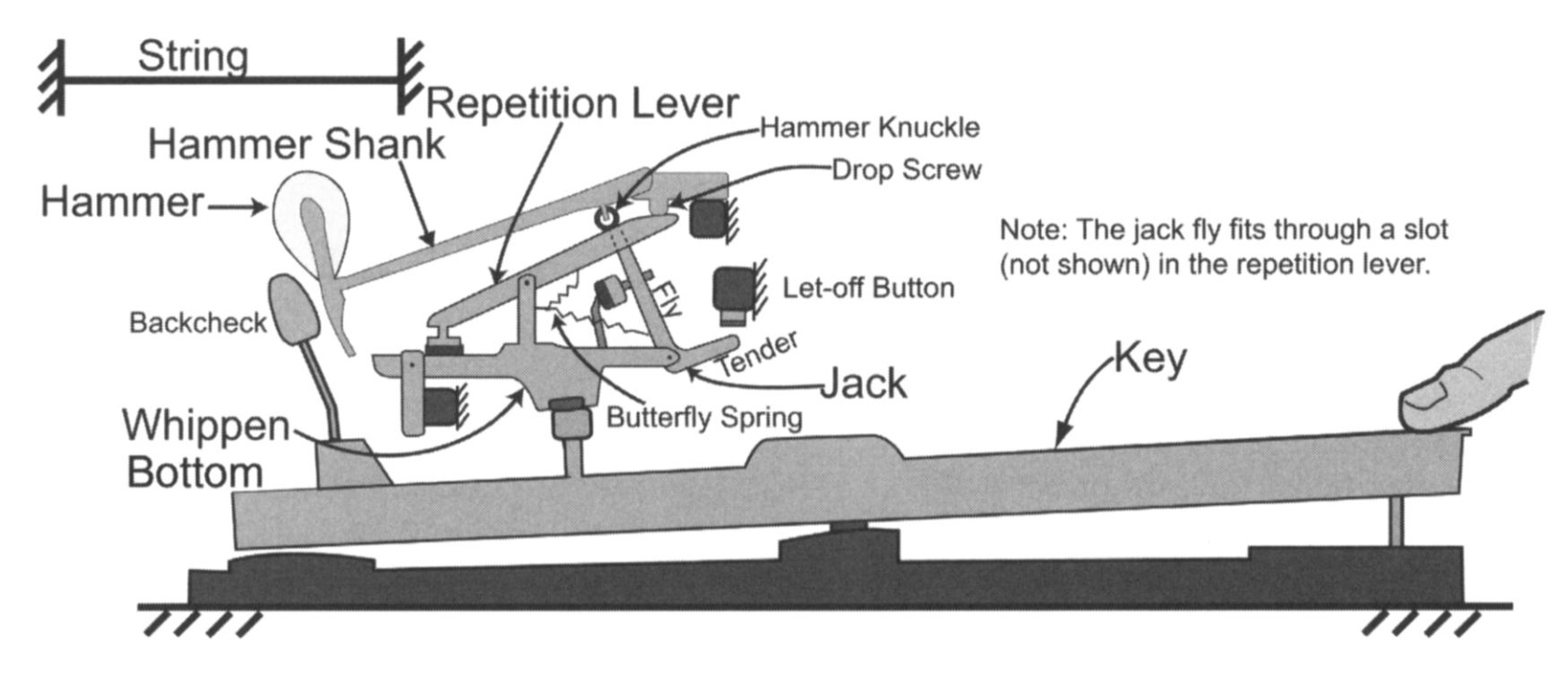
    Figure 5 Source: (Brent et al., 2011)

    …Quite a lot of differences, in fact. From a first glance, this diagram seems far removed from the likes of the fortepiano, but most of the underlying theory remains the same.

    To put it simply, the goal of the grand piano action is to let the hammer hit the string to create vibration – but, most importantly, it should be fast enough that it doesn’t damp the string. Efforts to reduce that time have resulted in the complex system seen in Figure 5… each part of that mechanism plays its own role in giving as much control to the pianist as possible (Brent et al., 2011).

    Control is an important part of playing the piano, in my own experience. The difference between a grand piano and an electronic MIDI keyboard is like night and day. Even the smallest, involuntary actions when playing a grand result in minor yet noticeable changes – and the best of the best (which, unfortunately, doesn’t include me) are able to manipulate each and every facet of control given to them.

    As we close the hood on the fascinating world of the piano action, I hope you’ve gained a proper appreciation for the instrument! The fact that we’ve been able to manufacture such a sleek design, fitting in all the complex mechanisms into such a small area, all while ensuring it works to perfection… it’s an engineering miracle, to be honest.

    When I inevitably return to that piano in West Village, I’ll surely be thinking about the action that I’m invoking with every press.

    Reference List

    Brent, G. R., Yu, B., Grijalva, R., & Awtar, S. (2011). Characterizing the Feel of the Piano Action. Computer Music Journal, 35(1), 43–57. JSTOR. https://www.jstor.org/stable/41241706

    Russo, M., & Robles-Linares, J. A.  (2020). A Brief History of Piano Action Mechanisms. Advances in Historical Studies, 09(05), 312–329. https://doi.org/10.4236/ahs.2020.95024

  • God does not Play Dice

    “I am convinced God does not play dice with the universe.” – Albert Einstein

    Quantum Mechanics, despite how fancy and scifi-esque it sounds, is not a new concept. The “revolution” began in the beginning of the 1900s with Maxwell Planck’s theory that energy is quantized into “packets” called quanta, and has remained at the forefront of scientific discovery to the present day. The majority of the scientific community generally believes that Quantum Mechanics accurately describes the universe, but not everyone. In fact, Albert Einstein, himself, was not convinced of the completeness and accuracy of Quantum Theory. In fact, one of Einstein’s most famous quotations: “I am convinced God does not play dice with the universe.” was him expressing wariness of Quantum Theory, despite his work creating it. He was a champion of an idea that has become known as “Hidden Variable Theory”, an idea that persists to this day. But in order to learn what Hidden variable Theory actually is, we have to better understand what quantum mechanics is, and its difference from classical mechanics.

    You, as a person, have lots of experience dealing with Classical mechanics. Classical mechanics are the “laws of physics” that govern the world you are familiar with. Momentum, acceleration, orbits, forces, without meaning to, we come into contact with classical mechanics every day. Everything from the moon in the sky to the friction stopping your car from rear-ending the car in front of you, to a cornerback making the game-saving tackle at the end of the football game are governed by the laws of classical mechanics. And one important quality of classical mechanics is that it is deterministic. This means that that given all the information about a situation, you can predict what is going to happen. For example, we know, at any given moment, where the moon is in the sky. We know where the moon will be in the sky in 100 year from now because we understand the gravitational interaction between the earth and the moon, and based on the mass of both of the bodies, and their distance from each other, and the orbital speed, we know the path the moon will take for centuries to come. And it is incredible accurate too. At midnight (eastern standard time) on April 2, 3019 the moon will be 19.49% full.

    Quantum Mechanics, however, is not deterministic. Using quantum mechanics, we cannot predict the outcome of the situation with 100% accuracy. Instead, Quantum Mechanics is probabilistic. This means that we can determine the outcome that is most likely to occur, but we still do not know exactly what will happen. We just know the odds. (don’t tell Han). Quantum Mechanics govern the world of incredible small things. In systems nearly atomic in size, the laws of classical mechanics begin to break down, and a new, strange, law rules. And this law is very counter-intuitive, and because of this has faced a lot of backlash. Quantum Mechanics being probabilistic is the chief reason Einstein and other physicists have a problem with quantum mechanics, and is the motivation behind the Hidden Variable Theory.

    Imagine you are at a baseball game. Surrounded by fans and the smell of popcorn, you intently watch the pitcher throw pitch after pitch. Now imagine you had no idea what air was. The air is still there, of course, but in your mind, the pitcher’s hand is the only thing that affects the ball. The pitcher will pitch each ball exactly the same, but the ball will not always end up at the same place. Of course, most of the pitches would end up in the strike zone, but some won’t be. Some balls will curve, while others fly straight, some will be faster, slower, some will fly right down the middle and others will fly wayward. We cannot determine exactly where each pitch will end up, but we can say where it will most likely end up. This is probabilistic.

    Now imagine the same situation, but you are now aware of air. You understand how the spin of the ball interacts with the air to curve the ball, and aware how air currents and wind changes the path of the ball. With this new information, this new variable in the equation, we can now determine exactly where each pitch will end up. The discovery of this new variable turns the probabilistic system into a deterministic one. This is the main idea of Hidden Variable Theory, that Quantum Mechanics is incomplete, and some hidden variable, will make the it deterministic.

    Probabilistic systems are so foreign to us. The laws of physics we learned in high school and we have come in contact with are all deterministic, so it is only natural to think that if Quantum Mechanics is not deterministic, then it is only because we do not fully understand it. The search for this hidden variable persists to this day, albeit without success. Quantum Mechanics has proved to be very accurate when applied to a wide array of systems. The allure of this idea in understandable, after all, it makes sense, deterministic systems are familiar to us, and some of the brightest minds in history have dedicated years to finding this hidden variable. We do not know if God truly does play dice with the universe, but maybe the dice in its own way brings an elegance and beauty to the cosmos that would otherwise be so predictable.

    Genovese, M. (2007, January 12). Research on Hidden Variable Theories: A review of recent progresses. Retrieved March, 2019, from https://arxiv.org/abs/quant-ph/0701071

    Look Up the Moon Phase for Any Date. (n.d.). Retrieved March, 2019, from https://www.moonpage.com/index.html?go=T&auto_dst=T&tzone=et&m=4&d=2&y=3019&hour=0&min=0&sec=0Maguire, S. (2012, November 12).

    It’s been a tough week for hidden variable theories. Retrieved March, 2019, from https://quantumfrontiers.com/2012/11/08/its-been-a-tough-week-for-hidden-variable-theories/

    Townsend, J. S. (2012). A modern approach to quantum mechanics. Sausalito, CA: University Science Books.

    Uzer, A. T. (2018). Introduction to Quantum Mechanics. Lecture presented in Georgia Institute of Technology.

  • Stephen Hawking Tribute Comic Review

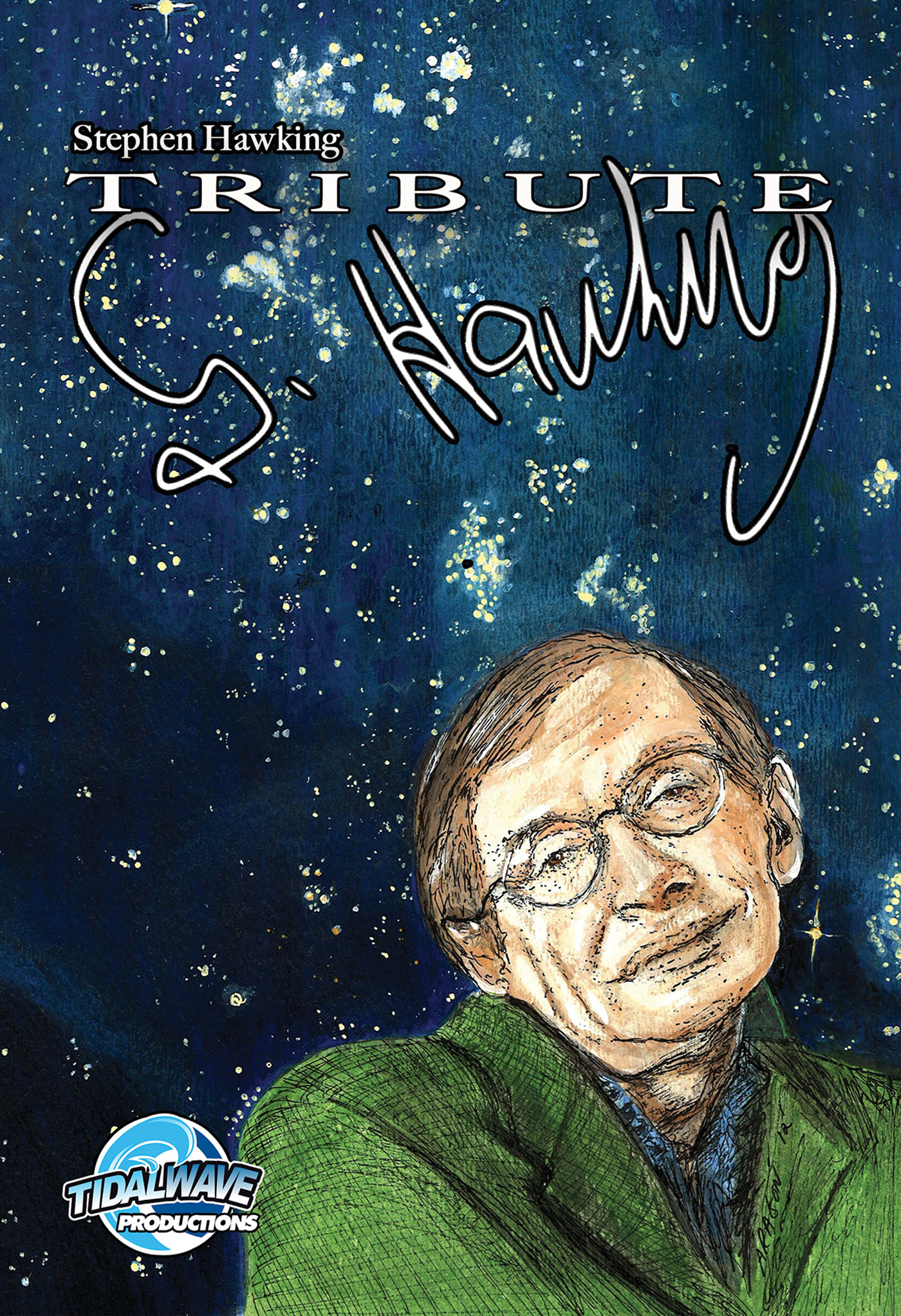
    “Tribute: Stephen Hawking” by Michael Lent and Brian McCarthy with art by Zach Bassett and published by Tidalwave Productions, released 2019.


    I confess: I never really paid attention to Stephen Hawking. I knew who he was: a popular scientist and a man with ALS. He would appear on TV shows I watched in some form or another, so I recognized him. I didn’t think his area of expertise was anything that interested me, so reading this comic was rather eye opening. I didn’t think his area of expertise was anything that interested me, so I was surprised by everything I learned when reading  “Tribute: Stephen Hawking.”


    Stephen Hawking was obviously intelligent, and probably got “needs to apply himself more” written on his report card more than once. In school, he was funny, had a lackadaisical attitude towards studying, and an apparent lack of respect for authority. Stephen Hawking, sports team, and opera goer were never phrases I connected in my mind, but there it was in ink on paper, right in between discussions of his science, his disability, and his belief in aliens.


    The art of the comic is fantastic. I loved some of the more symbolic artistic choices. In one scene, Hawking argued with a professor and the artist set up the confrontation as a wild west shoot out. The references to both popular and classic art– Professor Xavier from X-men and The Creation of Adam, respectively– just highlighted how well rounded and influential an individual Hawking was.


    I wasn’t very affected when Stephen Hawking died. Plenty of people were, and I know a few of them personally. Still, this comic impressed me with how much content there was for the avid fan and layman alike.


    You can read more about the comic by clicking the link here.


  • Fighting Physics

    Though some may view it as violent, martial arts are an integral part of many cultures around the world. While some were created for warfare, such as Indonesia’s Pencak Silat, others, like China’s Kung Fu, were created to be an extension of one’s morals and principles. After centuries of evolution, some aspects of martial arts have been perfected to take full advantage of all the biological levers and pulleys that our bodies are made up of. With physics and data analysis, one can easily find the mechanics of what makes punches and kicks so deadly.

    The Roundhouse Kick

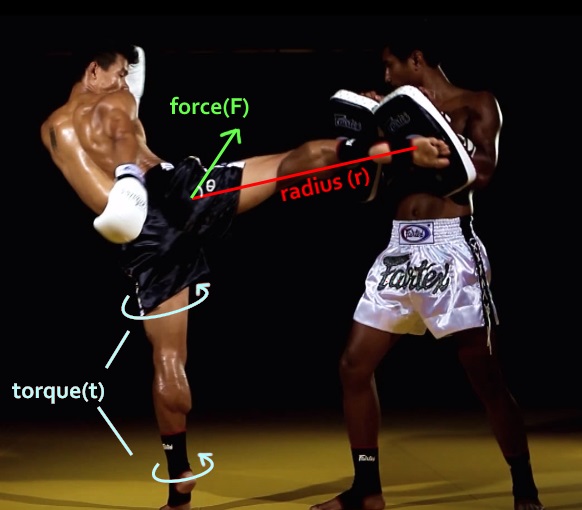
    The roundhouse kick is one of the simplest kicks in martial arts, but it takes full advantage of our built-in body mechanics. The fundamental principles of the roundhouse kick are dependent on the concepts of torque and angular velocity – or rotational force and speed, respectively. Your intuition might tell you that in order to have a stronger kick, you’d either have to put more force into it or make the kick go faster. However, the real question lies in how that’s done.

    The force that is needed to overcome the mass of the leg and cause it to rotate is torque, which is defined as:

                τ = r x F

                            r = length of lever arm

    F = magnitude of force applied


    In the case of a Muay Thai kick (as shown in the video above), the entire leg is swung around in an arc. In a way, the entire leg acts like a baseball bat, rotating around the center of the body. However, torque means nothing in terms of impact strength unless you apply some kind of speed measurement to it. That’s where the equation for power comes in:

                P = τ x ω

                           τ = torque

    ω = angular velocity


    The mechanics involved in a roundhouse kick
    The mechanics involved in a roundhouse kick

    When lifting heavy things, people say that your power comes from your legs. Similarly, when kicking things, your power comes from your hips. Torque is produced by how quickly and how much you rotate your hips and foot, to some extent—you can see this in the feet and hips of the fighter above.

    A study conducted by Colin Gavagan measured the various techniques of experts in Muay Thai, Karate and Taekwondo. He found that the average impact force of a roundhouse kick on a kicking shield from a professional Muay Thai practitioner was 1400 N! The force of this kick is roughly equivalent to a sledgehammer being swung as hard as possible at someone’s body! Through just a simple rotation of the hips and feet, one can deliver kicks strong enough to break bone.


    The Straight Right

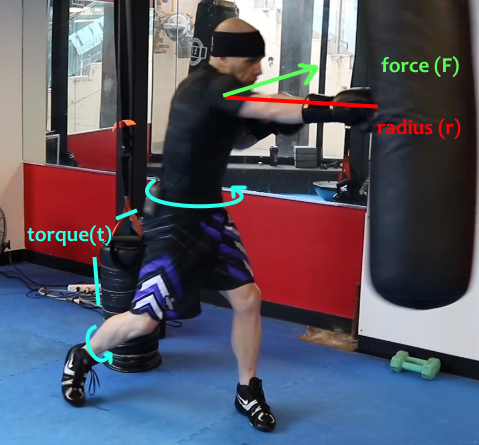
    Similarly to the roundhouse kick, the straight right requires torque in order to generate enough power to do any considerable jab. Something most people may not know, however, is that most of the power from a straight right comes from the legs and hips. Rather than rely solely on the shoulder and arm muscles, a boxer uses his legs and hips to add to the power of his punch.

    The mechanics of a punch are similar to that of a roundhouse kick
    The mechanics of a punch are similar to that of a roundhouse kick

    A punch is at a distinct disadvantage from a roundhouse kick in terms of power, however: a roundhouse kick uses the entire lower leg for contact, while a punch makes contact with only one’s hand. Whereas a leg might weigh 10% of someone’s weight, a fist would reasonably make up only 1%. How does a boxer make up for this difference in weight? The answer lies in the “snap”.

    FΔt = mΔv

    F = magnitude of force applied

    Δt = change in time

    m = mass

    Δv = change in velocity


    Δt stands for the total time it takes for the force to be applied, which in the case of a boxing glove on a punching bag or body, can’t be changed much. However, as the time of impact stays constant, if one increases the speed of their punch one can significantly increase the force of it. By focusing on the extension of the punch in your shoulder and forearm, you can significantly increase the speed your hand. The sheer speed of a punch can make up for it’s lack of mass behind it.

    For such seemingly simple moves, there are so many fundamental processes going on at once that it’s impossible to analyze all the nuances that comprise them! There’s a lot of science that goes into something that, at first glance, seems like a simple punch.


    References:

    Kinoshita, M., Fujii, N. The Analysis of Kinematical Characteristics in Taekwondo Roundhouse Kick. Retrieved from https://ojs.ub.uni-konstanz.de/cpa/article/view/5737

    Estevan, I. Falco, C. 2013 December. Mechanical Analysis of the Roundhouse Kick According to Height and Distance in Taekwondo. Retrieved from https://www.ncbi.nlm.nih.gov/pmc/articles/PMC3944546/

    Gavagan, C., Sayers, M. 2017 August. A biomechanical analysis of the roundhouse kicking technique of expert practitioners: A comparison between the the martial arts disciplines of Muay Thai, Karate, and Taekwondo. Retrieved from http://journals.plos.org/plosone/article?id=10.1371/journal.pone.0182645

  • What’s The Connection Between Complex Chemistry and Islamic Medieval Architecture?


    karbala, iraw


    The expansive domes and minarets of famous mosques such as the Blue Mosque in Istanbul or Al-Masjid An-Nabbi in Medina exude a quiet, powerful energy. Oftentimes these are characterized by a large, stone courtyard. You walk through the simple, colorless path towards the mosque entrance. You feel cleansed, as if you’re leaving a part of the world outside; it’s almost unsettling. At a first glance, you could describe these mosques as plain. Crossing the threshold, however paints a different picture. Your sight is overloaded with bright jewel-toned colors: azure, emerald, turquoise, fuchsia, red. It’s hard to focus on one detail – will it be the gold leaf, intricate etch work, milky marble, shimmering glasswork? You are humbled standing underneath the enormous ceilings.

    The glittering shrines and mosques that characterized medieval Islamic architecture are more than just a pretty sight, but in fact the product of geometrical planning. Aside from the lavish materials and colors, it is the tiling patterns that make the architecture stand out. These patterns are featured prominently in Islamic arts as a substitute for more figurative images. The reasoning was that images depicting people would lead to idol worship. Inside the mosque, you see these tiles plastered densely together on the ceilings, the columns, the minarets, the free wall space.(*)

    Islamic interlacing patterns can be divided into two categories: the arabesque versus girih. While arabesque designs feature more curved elements in an effort to emulate greenery and nature, the girih is composed of geometric lines mostly of stars and polygons with interlaced lines. Muslim architects designed the girih tiling system with only two simple tools: a compass and ruler. These patterns became complex tessellations made up of up to five different shapes: the bowtie, rhombus, pentagon, elongated hexagon, and decagon. Between the 1200s to 1400s, Islamic art developed the girih exhibiting the same complexity as quasi-crystals, a material that defies normal atom packing. Back at the mosque, you trace your fingers along the figurative tiles that blend seamlessly. A lime green pentagon here, an ivory star there.You see that the tiles are made of contrasting colors with a multitude of small shapes.

    Quasi-crystals are made of patterns that look regular but do not repeat exactly. The patterns in Islamic architecture demonstrate this by including “tessellations” that have five, ten, and twelve-fold symmetry. Technically, they are are not actually patterns, but just appear to be so. Scientists conjecture that Islamic architects wanted the effect of extend a pattern without just repeating images. Looking up at some of the mosques ceilings confirms the success of this design – you feel as if you are swallowed by the dizzying depths of shimmering oceans and bright stars.500 years later mathematical physicist, Roger Penrose at University of Oxford discovered the concept of quasi-aperiodic tiling. Sir Penrose stumbled upon a pair of tiles that cannot form a pattern in a periodic manner. This discovery was just a consequence of his work on the famous tiling pattern in mathematics – “given a collection of polygonal shapes, is it possible to cover the whole plane using just these shapes, with no overlaps?”

    Quasicrystals are found mostly in metallic alloys such as (Al-Li-Cu), and lack translational symmetry. The discovery of the non-symmetrical packing of atoms took a while for the scientific community to accept. Although first discovered in the 1960s, much of the scientific community refused to believe that materials could consist of irregular atomic structure. Next, materials scientist, Dr. Dan Shectman, designed an artificial alloy with quasi-crystal properties. He did not publish his results for years because he feared that others would ridicule his work.  Only after researcheres found a  natural quasi-crystal, icosahedrite in the Koryak Mountains, Russia in 2009 that led people to be convinced. Shectman received the Nobel Prize in Chemistry in 2011 for this work.

    Researchers connected Islamic girih and quasi-crystals recently; Dr. Peter Lu a physicist from Harvard University recognized ten-fold symmetry in architectural motifs while visiting Uzbekistan.  He analyzed 3700 Penrose tiles found in an archive of documented medieval Islamic architecture, and published a paper with Princeton University’s Dr. Paul Steinhardt titled ”Decagonal and Quasi-Crystalline Tilings in Medieval Islamic Architecture”. Dr. Lu uses the Darb-I-Imam Shrine in Iran as the iconic “near perfect” example of Penrose tiling. He conjectures that laborers could easily have created mathematically complex patterns by lining tiles decorated with lines that, once set down next to each other, form a continuous pattern.

    Back at the mosque – you see a worshipper prostrated to the ground, oblivious of the art around them. Their hearts disconnected from the ancient mathematics and chemical mimicry in which they are enclosed in. Science and spirituality; a Nobel prize in chemistry yet also an artform. These two paradigms reside side by side in the glorious, kaleidoscopic patterns of centuries old Islamic architecture. There is an elegance in the scales that aperiodic tiling has reached – from the utterly microscopic crystals to the gigantic mosques that can hold thousands of people.

  • What’s behind your screen?

    chargedarticleartwork

    One of the most popular displays today is an LCD display. They come in televisions, computer monitors, phones, and more, but do you know that chemistry and physics are the fundamental to create these screens?

    LCD stands for Liquid Crystal display and were used to replace Cathode Ray Tube displays because the CRTs were too bulky making televisions and computer monitors huge. Inside of an  LCD display there are multiple layers: a thin filmed transistor, an electrode pattern, a liquid crystal and some level of polarization.

    The thin filmed transistor is a very specific form of glass known as Borosilicate glass, made up of around 13% boron trioxide and around 80% silicon dioxide. Its physical properties due to its compound make up allows the glass to be more shock resistant and heat resistant than your average piece of glass. The electrode pattern uses metals like copper and titanium to transfer electrons. The polarizer mainly works with filtering light. Previously, light was just projected onto the television. Now a polarizer filters light waves by direction reducing the amount of power required to use a lit up display. It also allows for smooth picture transition. Finally the liquid crystal is used to produce the crisp look of an LCD screen. This crystal starts out as a liquid and when it comes into contact with the average atmospherics on the surface of the earth, this liquid crystallizes, like a spiders silk. It has the unique ability based on its shape and structure to show or not show various light rays. The polarizer prepares the light for this liquid crystal making its job possible.

    So there you have it, now you know whats behind that magic box in your living room!

  • Learning Quantum Mechanics

    Mastering science concepts for many students can be difficult. Great instructors, learning resources, and even video games can all be ways to help students comprehend difficult information. For college students and some high schoolers, quantum mechanics is a topic that many have a hard time understanding. Researchers Johnston, Crawford and Fletcher at the University of Sydney focus on better approaches to teaching quantum mechanics concepts. Their research is driven by answering two questions: 1) How do we define the most important concepts to learn quantum mechanics and 2) How do students conceptualize the ideas of quantum mechanics (pg 428). Researchers and students at Georgia Institute of Technology have developed a quantum mechanics game for students. I recently had a chance to interview one of the students working on the project, Aditya Anupam a 2nd year PhD student in Digital Media.

    aditya2
    Aditya Anupam working on project

    How long have you been working on the project? Why did you join?

    I started working on the project in 2016. I have a master’s degree in electrical engineering and was frustrated with how science was being taught.

    Why teach quantum mechanics through video games? Its immersive and easily accessible to students and teachers in and outside the classroom.  

    What is the quantum mechanics game about?

    The core concept for the game(which is named: Particle in a Box) was to help undergraduate students challenge their preconceptions about quantum mechanics (which are often rooted in classical mechanics). Quantum mechanics is hard because people don’t get the opportunity to engage actively with the quantum phenomena or experiment with quantum systems.  The game provides a scientifically accurate, yet fun, environment to do this.

    logo2-2

    Why is science important?

    There are four reasons why I think science is important:  

    Jobs: most jobs require at least a basic understanding of science.  

    Personal use:  for example, choosing the right food, fixing things in your house

    Public discourse: It helps us become more informed so that we can support the right policy that will impact science.

    It’s beautiful: It helps us understand the world and our place in it

    Is Particle in a Box being used in the classroom? And where can we play it?

    We tested the game on undergraduate electrical engineering students at Georgia Institute of Technology and received generally favourable results. Who is the audience for the game? The game is primarily for undergraduate students enrolled in courses involving introductory quantum mechanics, but it may also be of interested to high schoolers. Where can we play game?  You can visit: learnqm.gatech.edu and please feel free to share feedback if you have suggestions on how we can improve the game.

    What’s the next project you’ll be working on?

    I plan to continue working on the field of digital media and science education. We are currently in the process of redesigning the game based on our research results. We are interested in making a multiplayer version of the game to encourage a more collaborative learning atmosphere in the classroom. Other than the game, I am also interested in the public understanding of science and how depictions of science in the media affect that understanding.

    If you get a chance, please play the quantum physics game at learnqm.gatech.edu. And let’s work on making sure more students are given the resources to succeed in the field of science!

    Notes: What is Particle in a Box?

    So you maybe wondering, how does the game work?  The game design is very similar to Donkey Kong and Mario in the appearance and layout. Once you begin the game, there is a small textbox on the left bottom corner. The textbox has information on how to play the game and explains principles of quantum mechanics.  The user plays a small blue character that has to pick up certain materials when prompted. 

    Resources:

    Crawford K., I.D. Johnston and P.R. Fletcher. “Student difficulties in Learning Quantum Mechanics.” International Journal of Science Education, vol.20, no. 4, 1998, http://citeseerx.ist.psu.edu/viewdoc/download doi=10.1.1.1009.2311&rep=rep1&type=pdf. Accessed 22 September 2017.

    Special thanks to Aditya Anupam for the interview!!!

  • Why Does Hot Water Freeze Faster?

    1

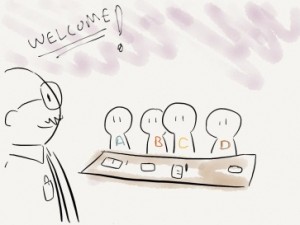
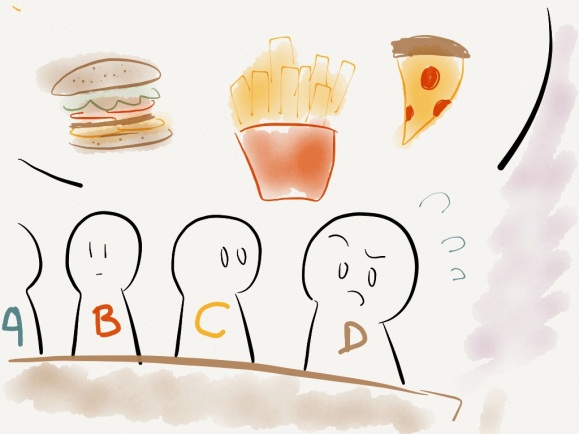
    PROFESSOR: Hello class! Welcome to “Advanced Application of Math and Logic in Natural Philosophy” class. Look to your left and look to your right. One out of five in this room will not pass the class.
    2

    STUDENT A: Sir, but there are only four of us.3

    PROFESSOR: (ignoring the student) Ahem. During our first lecture, we will exercise the use of logic and thought experiments to unveil one of the greatest mysteries in the history of science. Even Aristitotle struggled solving this mystery. For centuries many scientists attempted to solve but failed. (drum roll) Why does hot water freeze faster than cold water?

    STUDENTS B & C: (smile nervously not knowing whether he is joking or not)

    STUDENT A: But sir, hot water needs to be cooled down before it can freeze. So shouldn’t cold water freeze faster?

    PROFESSOR: Good point. However, that is not always true. It’s called the (writing on the board) Mpemba effect. Can anyone guess why? It’s okay even if you are wrong. Don’t be shy – that is why I am here.

    STUDENTS A, B, C, & D: (silence)

    (Satisfied with his authority and the full attention of his students, the professor continues)

    PROFESSOR: Actually, experiments showed that hot water will cool faster than water at 60°C. But this is not the case with water below 60°C. Mpemba effect is a combination of multiple factors. Now let’s figure out each of them together. First, tell me what are the characteristics of hot water?

    STUDENT B: It has higher average kinetic energy.

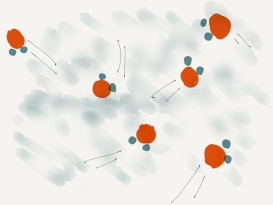
    The water molecules move faster, which means that they occupy greater volume, similar to how an air balloon expands at higher temperature.

    4

    56

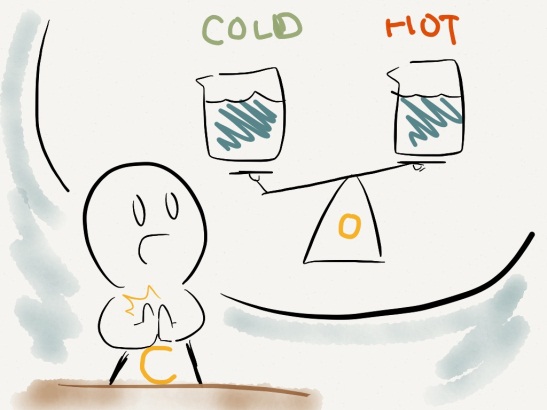
    STUDENT C: Wait, that means that if cold water and hot water have the same volume, the mass of hot water will be less. This is because the evaporation is taking place and dissolved gases in hot water escape at a higher rate.
    7

    PROFESSOR: Great answers. Water is most dense at 4 degrees Celsius and its density changes according to its temperature. Yes, so 1L of water does not always hold the same amount of mass. 1L of hot water will weigh less compared 1L of water near 4°C. However, the mass difference is slim even when we considering the evaporation of water molecule. So there has to be another factor that contributes to Mpemba effect.

    STUDENT: But sir? What about supercooling of water and nucleation? Doesn’t lack of impurities and gases in water lead to supercooling, in which water forms crystal ice at temperatures below 0°C? It has been observed that water can remain liquid at -40°C. If hot water doesn’t have dissolved gas, shouldn’t it be hard to make it freeze?
    8

    PROFESSOR: (as if expected) Good point. Except Mpemba effect has been observed in both hot water and cold water removed of dissolved gases. Dissolved gas does not seem to contribute to the process of freezing. You could, however, make beautiful and clear crystal ice by removing dissolved gas before freezing. So what else? What else does hot water do?

    STUDENT C: It evaporates faster than cold water..?

    PROFESSOR: Yes, the water evaporates faster. But why? And so what?

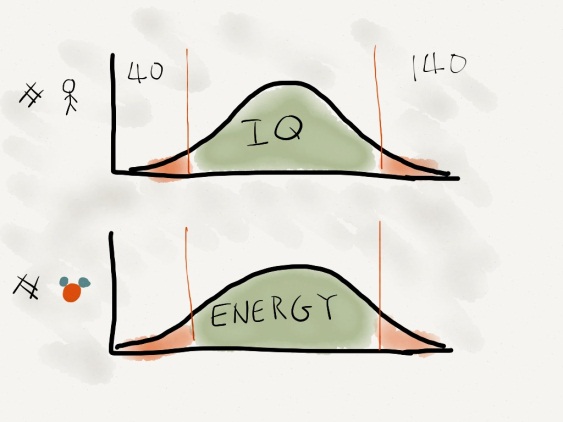
    STUDENT B: Well umm… the temperature of water is the average kinetic energy. At any time, liquid water has molecules with a range of energies. Although most of them have the average kinetic energy of the system, very few have enough energy to escape intermolecular forces such as hydrogen bonds and dipole-dipole attractions. If we were to look at a graph of number of molecules versus energy, it would look similar to a current IQ graph, in which the majority of the population has an IQ of 100 and few have over 140 and under 40.
    9

    STUDENT A: (towards student B) Hydrogen bond and dipole-dipole forces are too weak to contain water molecules in liquid form. It’s actually the atmospheric pressure doing all the work.

    PROFESSOR: Please let him continue.

    STUDENT B: So molecules with higher energy escape, lowering the average energy within the system, and this is evaporative cooling.

    STUDENT C: Oh! So the hot water is not only being cooled through evaporative cooling but also from heat conduction and convection inside the freezer.

    PROFESSOR: Good answers class. But that is not enough.  According to Dr. Takamasa Tkahashi at St. Norbert College, it takes 540 calories to vaporize one gram of water. At above 80°C, the rate of cooling by evaporization is high as vapor draws massive energy from water left behind. To give you an idea how much 540 calories worth, it takes 100 calories to heat up 1 gram of water to 100°C from 0°C.

    STUDENT A: (excited) 1 Calorie is the energy required to raise 1 gram of water 1°C! In fact, scientists measured food calories by burning them and heating up water back in old days.

    STUDENT D: Wow…is that why greasy foods have high calories?10
    PROFESSOR: If we neglect heat transfer through radiation or conduction, water will freeze on a desert purely from evaporation. Interesting, isn’t it? We can use zeolites which facilitate evaporation through adsorption to make ice as well. A team of engineers at Rice University built a prototype of ice machine that uses nothing but zeolites and vacuum pump.

    STUDENT D: (perplexed) But professor, when hot water reaches the temperature of the cold water, don’t both of them have the same evaporation rate?

    PROFESSOR: (impressed and amused) Very good point. I might actually consider allowing one A+ in this class. To answer your question, let’s first consider extreme cases to facilitate our thought experiments. Imagine placing an ice cube onto a very hot plate. What happens?

    STUDENT A: (desperate to not embarrass himself) Uh…The ice melts immediately? And while some water molecules evaporate, others boil around the remaining ice cube, making noise from gases and vapor escaping. Noise is also another form of energy transfer.

    PROFESSOR: Yes but melting the process does not happen instantly. While the ice is melting, what is the average kinetic energy? It is somewhere in between that of boiling water and ice.

    Now, we learned that the energy of liquid water is not perfectly uniform. The faster the change of temperature is applied the greater inconsistency of the energy. Hence, hot water being cooled down to cold temperature has a higher evaporation rate than cold water that remained cold for a prolonged period of time. I think you’ll need to elaborate on this one…

    STUDENT A: Also, Newton’s law of cooling dictates that hot water will cool down faster regardless of the evaporation.

    PROFESSOR: Yes, of course, faster moving molecules will bounce off of each other more frequently, giving and losing energy through these interactions.

    STUDENT D: So that means… initially, cold water has a more uniform temperature. But when hot water is cooled, although the average temperature is cold, there are greater discrepancies of temperature among molecules?

    STUDENT A: (being impatient) Yes, and that is why the hot water will be more likely to have molecules with higher energy, which escapes and cools the liquid faster.

    PROFESSOR: Like washing a car with hot water during winter, evaporative cooling is more evident with larger surface area. So what else? Does anyone else have any more idea?

    STUDENT C: Well… this may seem stupid, but what if Mpemba effect is caused by other effects such as the environment?

    PROFESSOR: (intrigued) What do you mean?
    11

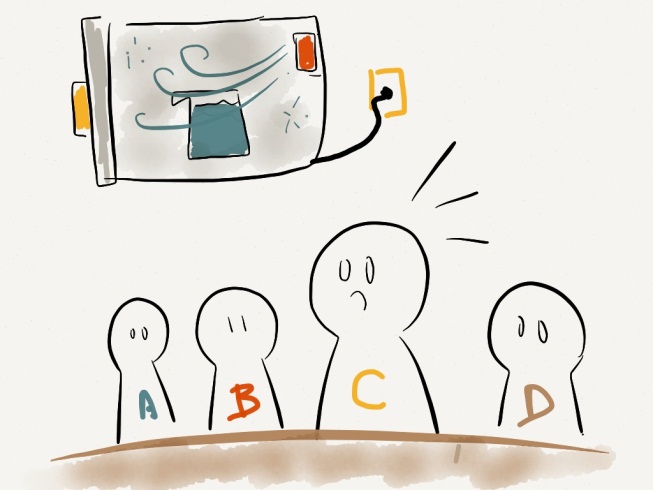
    STUDENT C: The freezer keeps the temperature below zero all the time. But when the temperature increases, cold air is introduced in order to keep the temperature constant. So if we place hot water inside the freezer, and due to heat conduction, radiation, and evaporation, the internal temperature increases, it will trigger the freezer to blow cold air. You need to elaborate on this… And thus, hot water will freeze faster.

    PROFESSOR: Hmm…I like your creative way of thinking.
    12

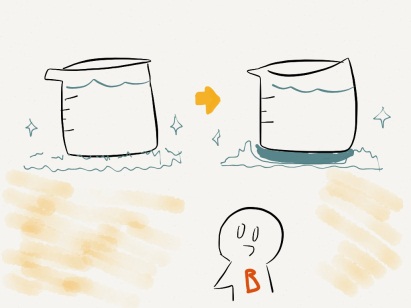
    STUDENT B: Also, freezers have ice dusts inside. And hot water may melt these ice particles within the compartment at contact points of the bowl and the surface. Since water is dense and thus conducts heat faster, hot water will cool down at higher rate. The effect is similar to how ice water cools beer bottles faster than ice cubes.

    PROFESSOR: Excellent point! Water is 829 times denser and transfers heat 25 times faster than air. Hot bowl of water sitting on slightly melted ice will definitely cool faster than cold bowl of water sitting on ice dust. Water covers more surface area as well. But aren’t you slightly underage to know how to cool beer bottles?

    STUDENT A: (hungry for attention) Sir, what about infrared radiation? We know hot objects emit electromagnetic radiation and thus release energy at a faster pace. A combination of this and everything we discussed today will make hot water cool faster.

    PROFESSOR: Now, do you guys remember how water changes its density? Due to heat conduction at contact points, a bowl of water will be colder at the bottom. Let’s consider a cold bowl of water. Cold water near freezing point at the bottom of the bowl will have lower density than water at near 4°C on top. Low density water will rise up switching position with water near 4°C. Neither upper nor lower part of water will freeze until that 4°C temperature is brought to 0°C.13
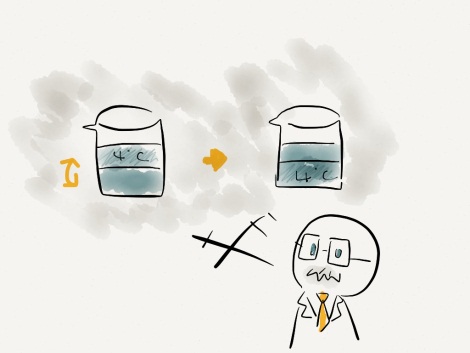
    Now what about hot bowl of water? Hot water at the top has lower density than cold water at the bottom. Thus, cold water near freezing point won’t rise up. This means the water at the bottom can freeze before hot water is cooled to 4°C. This effect will freeze hot water faster.

    STUDENT C: Whoa… there seem to be a lot of factors that play in Mpemba effect. We discussed mass difference, evaporation rate, freezer compartment effects such as more frequent cold air and melting ice at contact points, and how density can slow or speed up the freezing rate. I don’t think we can come up with anymore explanations.

    PROFESSOR: Aha but we are not done! There are more. What are we forgetting class?

    STUDENT D: (as if he had more than enough to learn) Not a clue sir…

    PROFESSOR: (excited) The internal air pressure of the freezer compartment~!

    STUDENT D: But how..?

    PROFESSOR: (showing a video clip on a TV) Do you guys watch a BBC TV series called “Bang Goes the Theory”?

    STUDENT C: Oh my gosh! I absolutely love that show!!

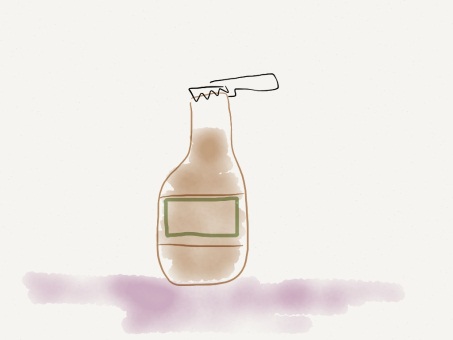
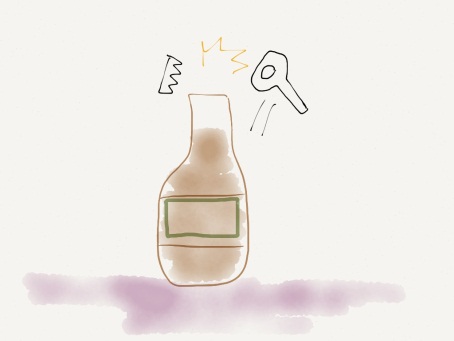
    PROFESSOR: Let’s look at season 2 episode 4. In this episode Dr. Yan shows that when you quickly open a bottle there’s a cloud of white air at the opening. This effect is the opposite of how diesel engine ignites a spark by compressing air. (Professor demonstrates by opening a beer bottle). The air between the liquid and the cap is quickly expanded and loses energy. At this very instant, the temperature drops to around -30°C and this white gas you see is the condensed water molecules in the air.
    14

    1516

    STUDENT A, B, C&D: (intrigued) wow…

    PROFESSOR: As the ideal gas law states, hot air has lower density than cold air under equal pressure and volume. If hot water and cold water were placed in a separate freezer compartments, the one with hot water will have less air molecules inside.

    STUDENT D: But professor, why?17
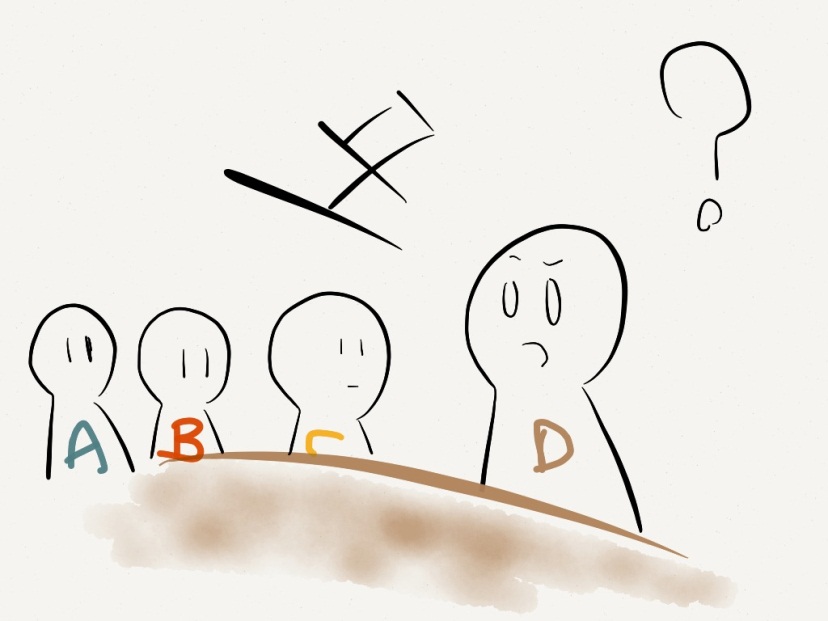
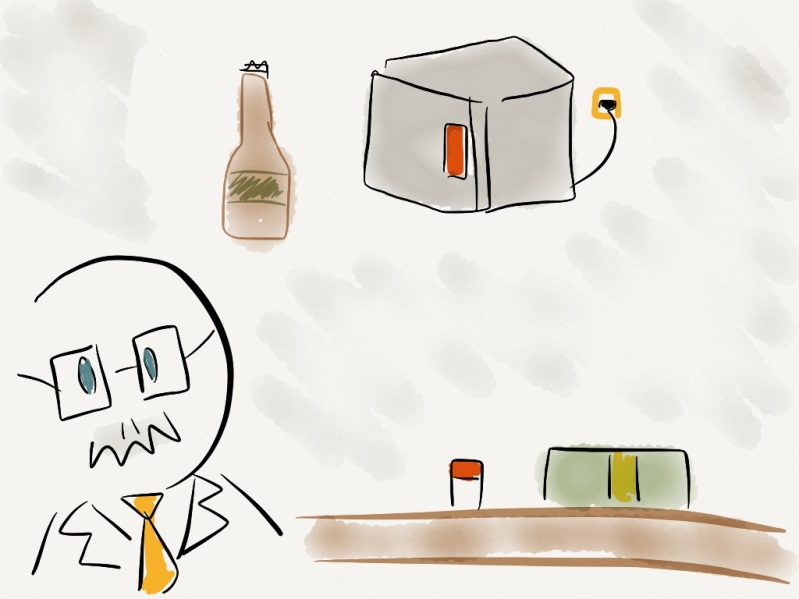
    PROFESSOR: Because hot water will heat up the air inside the compartment. Of course, the longer you wait before closing the door, the more evident the effect would be. You all saw how quickly air cooled down when I opened the beer bottle. (Takes couple of sips of beer). You can create the same effect by opening the freezer compartment. Now when you open both hot and cold water compartments, the one with hot water will experience greater decrease in temperature; air with lower density will lose more energy when expanded at the same volume as air with higher density. This gives the last minute boost of freezing air to hot water compartment.18
    But even if you don’t open the freezer, lower pressure will facilitate freezing. Can anyone guess why?


    STUDENT A: As we can see on the phase diagram, the freezing point of water is higher at lower pressure. Hence, by lowering the pressure, hot water will freeze at higher temperature than cold water.19
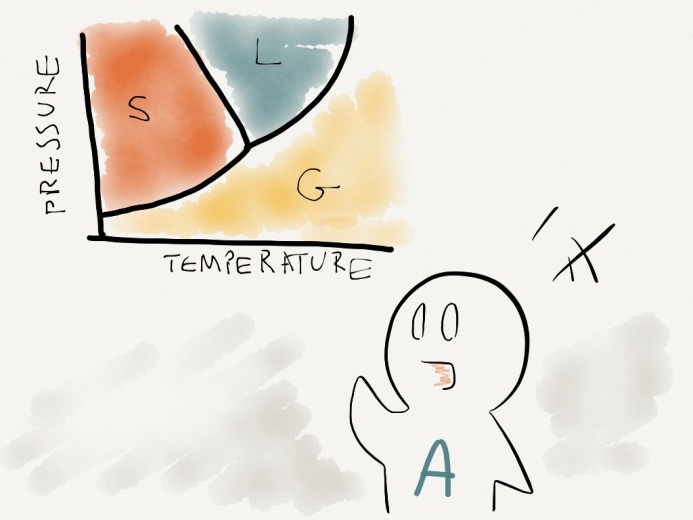
    PROFESSOR: Excellent! Although the boiling point is lower at low pressure, freezing point is higher. Since ice occupies greater volume than liquid water, applying pressure to ice cubes will turn solid into liquid. Not only does lowering pressure increase evaporation rate, it helps to crystalize ice!

    STUDENT C: I see… Mpemba effect isn’t magic. It’s science.!

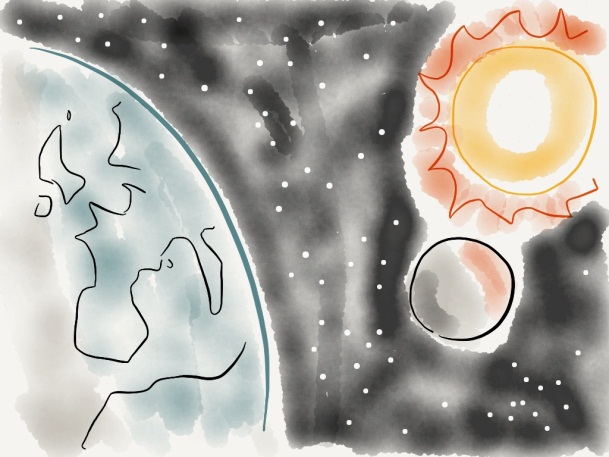
    STUDENT D: (frustrated) But professor, none of these answers answer any questions at all! Why must water evaporate? How come its temperature is not uniform? How come its density changes with the temperature? Why all this?
    20

    PROFESSOR: This class is a natural philosophy class for a reason. Science is a study and observation of the universe, finding pattern in its chaotic behavior and thereby hypothesizing the answer with logic. And we test our hypotheses to come up with a prediction. We, scientists, ask the question ‘why?’ and dwell on solving the mystery. But the answer we find is the answer to the question ‘how?’  We observe the mechanism and apply it, but we still don’t know why the universe behaves in the way it does. For example, why does Earth create gravitational attraction? Einstein explained that it is because mass curves the space. But why does mass create a distortion of space and why does the distortion cause attractive forces? We don’t know. All we know is how mass creates gravity

    Class, I encourage all of you to pursue knowledge with an inquisitive mind. Scientific knowledge is what shapes our future.

    Class dismissed. Write me 50 pages on Mpemba effect by tomorrow.   It should be easy now that we discussed it in class.
    21

  • New Houston: We have a problem


    If you are a technology enthusiast, NASA observer or all around space geek, you don’t need me to point out the connection between two recent news events. First off, SpaceX has successfully launched, maneuvered and docked their spacecraft “Dragon” with the International Space Station. That’s ISS for you acronym junkies. This is impressive not only in the sense that the actual feat is an accolade shared by very few extra-atmospheric vehicles – to my knowledge only the NASA Shuttle, and respective Russian, European and Japanese space agency crafts have ever docked with the ISS – but the Dragon was the first vehicle produced by an independent company. Deeming Space X as “independent” may give some readers pause, as at least at this point, a sizeable portion of their total funding comes from the US government to replace the lost Shuttle capabilities through the “Commercial Orbital Transportation Services” program run by NASA. The second event is the announcement by Dutch company Mars One revealing their plans to colonize Mars. This, again, is really only significant when considering how Mars One has proposed funding their journey to the red planet – namely, and in their own words, via “media spectacle”. I imagine that will include some kind of space Snooki doing shots of Jägermeister while orbiting Phobos or something, but the point is Mars One plans on going where no man (or woman, so as not to exclude Snooki) has ever gone before without being bankrolled by tax dollars. Ironically, the Dutch could be considered experts in the field of corporate colonialism. If memory serves, if you were getting your spice on about 400 years ago you had the Dutch East India Company to thank for that. It does deserve mentioning however that Mars One is not the first organization to ever propose such an undertaking. In fact, independent organizations have been in the planning stages of colonizing Mars for years, with one particularly prominent group being the Mars Society led by Dr. Robert Zubrin, but these organizations are focused on the technical aspects of a journey to and eventual colonization of Mars, rather than how to fund the colonization.

    So, taken in concert, the literal launch of the SpaceX’s Dragon spacecraft and the metaphorical launch of Mars Ones’ venture to fund the colonization of Mars, I would argue that the likelihood of anyone even setting foot on Mars within the next 50 or so years has gone from “not going to happen” to “it might actually happen but still probably not”. Why you ask? Because it’s too expensive, too political, and too dangerous for a single government to do alone.  I have never done any book learning on the Cold War, but from my perspective the whole point of the space race (which as a direct consequence gave us global telecommunications, the above mentioned ISS and the Hubble telescope among others)  between the United States and the former Soviet Union had less to do with legitimate exploration of orbital and sub-orbital space or going to the moon and more with “if my adversary has the capability of global surveillance and strategic space bound nuclear weapons, I want it too.” But now that there are no other communist super powers to compete with (oh wait), why bother going on to Mars? Do the scientific motivations outweigh the risks of sending humans instead of rovers or other autonomous vehicles? I don’t know the answer to that, and I don’t think any government space agency does either, which makes trying to pitch, fund and actually complete a government organized, manned mission to Mars dubious. Thus, as crazy as it sounds, corporate settlement of Mars might be the best option. However, for their part, NASA has not completely given up the ghost (of mars?) on exploring the Martian surface, and has unleashed a parade of satellites and rovers, with an upcoming landing of the curiosity rover celebrated with a recent and admittedly kind of bad ass promo , over the past several years.

    So what would the possible goal of colonizing another planet be? If undertaken by a privately funded company, the obvious answer is money. If Mars One leads the way, it might not be “New Houston” that is home to the future inhabitants of Mars but New Amsterdam (again). Are vast quantities of resources the goal of Mars One and like minded would-be-colonists, or is simply the prospect of settling a new world, unfettered of governments, geopolitical conflict and a breathable atmosphere the ultimate goal? Either way, it’s difficult to grok.


    image source: http://phoenix.lpl.arizona.edu/postcards.php

  • Supermassive Black Hole Causing a Stir in the Milky Way

    Have you ever wondered what goes on in outer space, especially around black holes? I know as a kid, viewing black holes as giant vacuum-like structures, I wondered about the kind of things that might be getting sucked into them while drifting through space. Well, a few weeks ago, I heard a talk by Dr. David Ballantyne about what is actually happening in space around supermassive black holes (SMBHs). (cue Twilight soundtrack)

    Black holes are categorized based on their number of solar masses, where one solar mass is equal to 1.989×1030 kg. In order for a black hole to be considered supermassive, it must be greater than 105 solar masses. Goodness gracious! That’s the equivalent of several million or, in some cases, several BILLION suns. A BILLION suns?!? Yes, folks. A billion. And while the formation of black holes isn’t completely understood, it’s possible for black holes to add to one another and form new, supermassive black holes (known as merging).

    One location of particular interest is the center of the Milky Way galaxy at Sagittarius A* (pronounced “Sagittarius A star”) where a SMBH potentially resides. Abbreviated Sgr A*, this radio source is about 2.5×10⁴ light years away from our solar system. It can be hard to see due to the murky clouding around it, but with advancements in adaptive optics and the use of telescope arrays, astrophysicists have been able to track young stars orbiting around the area— a key indicator that a black hole is present. In the animation below, you can see various stars orbiting around Sgr A* (the stationary star shape). Star S0-2 is particularly cool to watch as it can be seen making a complete orbit:


    Another interesting thing scientists have found is a dense cloud of gas which is moving directly toward this same SMBH. As the gas nears the black hole, part of its structure gets sucked inside. As you can see in the video below (at around 3:22), the cloud will have its closest encounter with the black hole in 2013. That’s next year! As the gas gets sucked into the SMBH, the black hole will gain energy and begin to glow brighter.


    Black holes are typically found at the center of galaxies organized in structures referred to as active galactic nuclei (AGNs), which are comprised of the black hole and any surrounding material, in addition to any gas or radiation present. As the material near the black hole swirls around, it creates what is known as the accretion disk. Like our sun, whose corona emits x-rays, black holes can also emit various forms of radiation, including x-rays. What?! Yessir! In a process called magnetic reconnection, magnetic field lines interact and reconnect with one another, causing (x-ray radiating) plasma to be emitted. These x-rays are then dispersed into space, some of which hit the accretion disc and create a ‘reflection spectrum’ which scientists can study.


    Now, while supermassive black holes weigh millions (sometimes billions) of suns and have the ability to tear apart nearby objects in space, you don’t have to worry about being sucked into one any time soon. Unless you’re this guy, in which case you may have some issues…


    MUSE’s “Supermassive Black Hole”:


    Sources:

    UCLA Galactic Center Group (http://www.astro.ucla.edu/~ghezgroup/gc/)

    Special thanks to Dr. Ballantyne