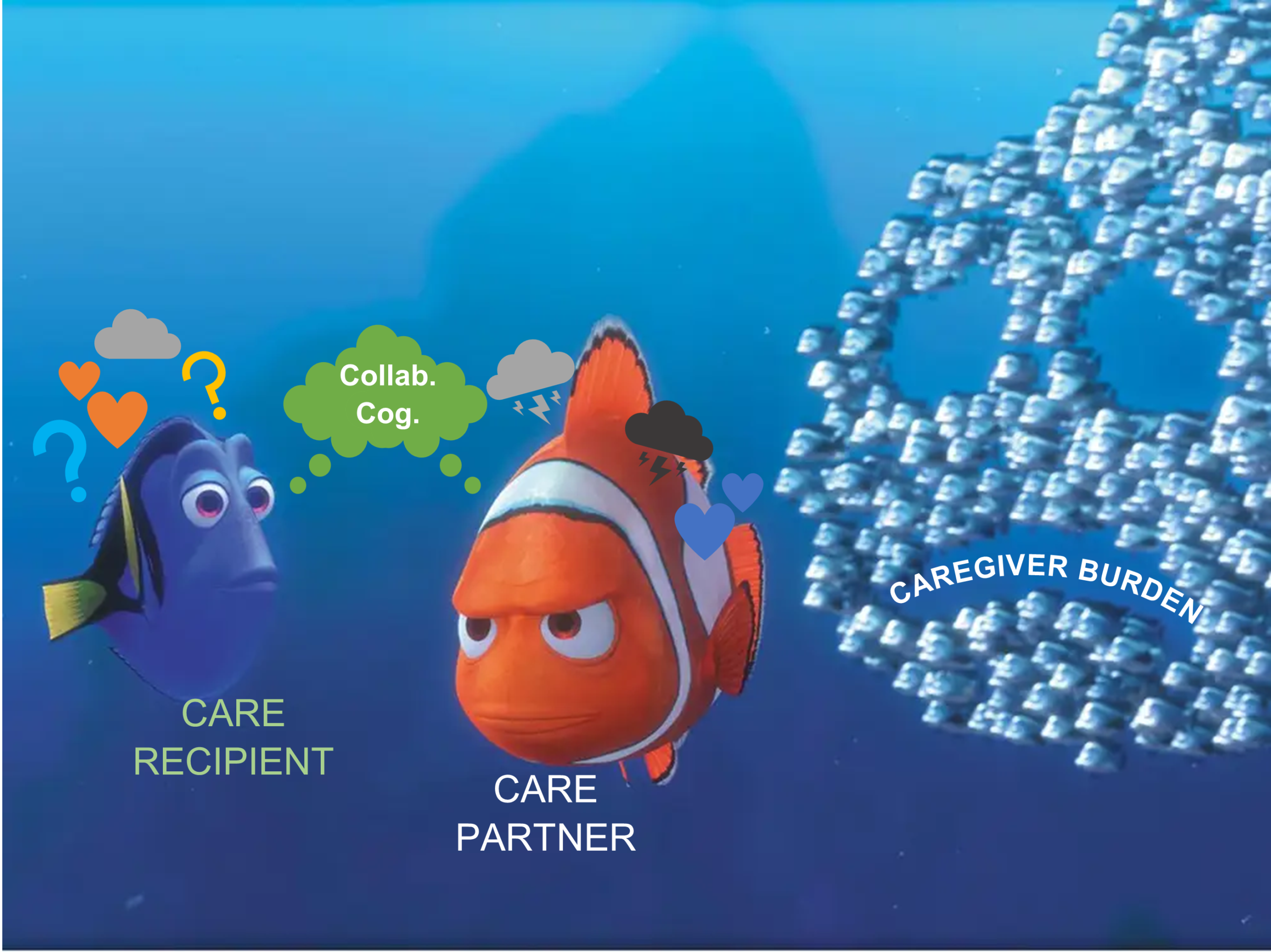
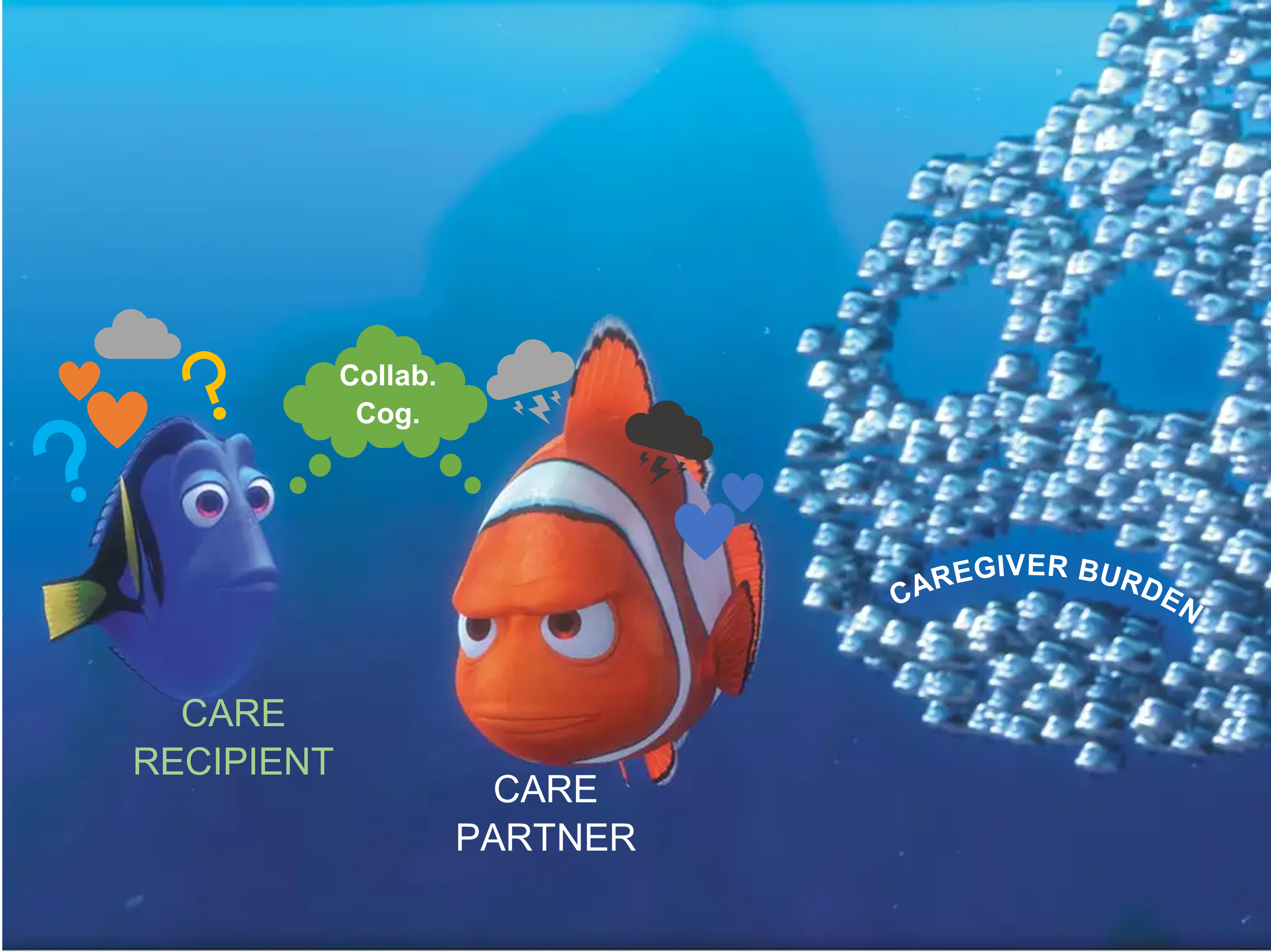
It is the common, but unfortunate, truth of aging that everyone’s memory slowly decays. With this comes lapses in memory in various forms, whether that be for events of the past, or for in-the-moment decisions, like Dory from Finding Nemo. This loveable fish is known for her forgetfulness and inability to retain new information.
Similarly, certain neurodegenerative diseases such as Mild Cognitive Impairment, or MCI, cause older adults to experience what are referred to as memory “blips,” or errors, which can cause inconveniences and difficulties for that individual (Petersen, 2011; Gauthier et al., 2006). Because of this, typically individuals diagnosed with MCI who are also in a romantic relationship end up forming a care partner and care recipient dynamic with their spouse (Hoppman & Gerstorf, 2016). Much like Dory and Marlin, they work together and the care partner assists the recipient on a daily basis (Lara-Ruiz et al., 2019; Paradise et al, 2015). Throughout their adventure, it is seen how Marlin regularly steps in to give her a helping “fin,” by giving her reminders or working collaboratively with her to remember important information.
This is characteristic of something known as collaborative cognition, which refers to a strategy employed by couples to remember and approach daily tasks in a manner that is interactive by nature (Barnier et al., 2008; Harris et al., 2019; Rogoff, 1998). Such techniques can have implications in relationships and how effective they are. There are many components to consider regarding interactions between the couple, as depending on each other can have effects on both the individual with MCI, as well as their caregiver, such as increased stress and potential frustration – known as caregiver burden.
These daily interactions between couples are important to capture, even if it is as simple as the encouragement to “just keep swimming,” as this could lead to information to incorporate into interventions and the bettering of the quality of later life.
References
Barnier, A.J., Sutton, J., Harris, C.B., & Wilson, R.A. (2008). A conceptual and empirical framework for the social distribution of cognition: The case of memory. Cognitive Systems Research, 9(1-2), 33-51. doi.org/10.1016/j.cogsys.2007.07.002
Gauthier, S., Reisberg, B., Zaudig, M., Petersen, R C., Ritchie, K., Broich, K., … & Winblad, B. (2006). Mild cognitive impairment. The lancet, 367(9518), 1262-1270. https://doi.org/10.1016/S0140-6736(06)68542-5
Harris, C.B., Barnier, A.J., Sutton, J., & Savage, G. (2019). Features of successful and unsuccessful collaborative memory conversations in long‐married couples. Topics in cognitive science, 11(4), 668-686. DOI: 10.1111/tops.12350
Hoppmann, C.A., & Gerstorf, D. (2016). Social interrelations in aging: The sample case of married couples. In Handbook of the psychology of aging (pp. 263-277). Academic Press.
Lara-Ruiz, J., Kauzor, K., Gonzalez, K., Nakhla, M. Z., Banuelos, D., Woo, E., … & Razani, J. (2019). The functional ability of MCI and Alzheimer’s patients predicts caregiver burden. GeroPsych. 32(1), 31-39. doi: 10.1024/1662-9647/a000200
Paradise, M., McCade, D., Hickie, I.B., Diamond, K., Lewis, S.J., & Naismith, S. L. (2015). Caregiver burden in mild cognitive impairment. Aging & mental health, 19(1), 72-78. https://doi.org/10.1080/13607863.2014.915922
Petersen, R. C. (2011). Mild cognitive impairment. New England Journal of Medicine, 364(23), 2227–2234. https://doi.org/10.1056/nejmcp0910237
Rogoff, B. (1998). Cognition as a collaborative process. In W. Damon (Ed.), Handbook of Child Psychology: Vol. 2. Cognition, perception, and language (pp. 679–744). John Wiley & Sons Inc.
Unkrich, L., & Stanton, A. (2003). Finding Nemo. Buena Vista Pictures.