Tag: space

  • Coloring Space Green

    “It appears a colonization of the moon could become a reality,” state Cornell University researchers R. W. Langhans and D. R. Dreesen hopefully in 1988 – and it would only be a “true colony [if] food could be produced” (Langhans and Dreesen, 1988).

    The quest for interplanetary travel and colonization is one that, in the modern day, remains far-fetched and distant. While governments and research organizations have landed robots on Mars and mapped much of the Moon, the dream of a permanent, or at least self-sustaining, Moon base is still far off in the distance. One of the largest barriers to that dream is the challenge of growing food in space.
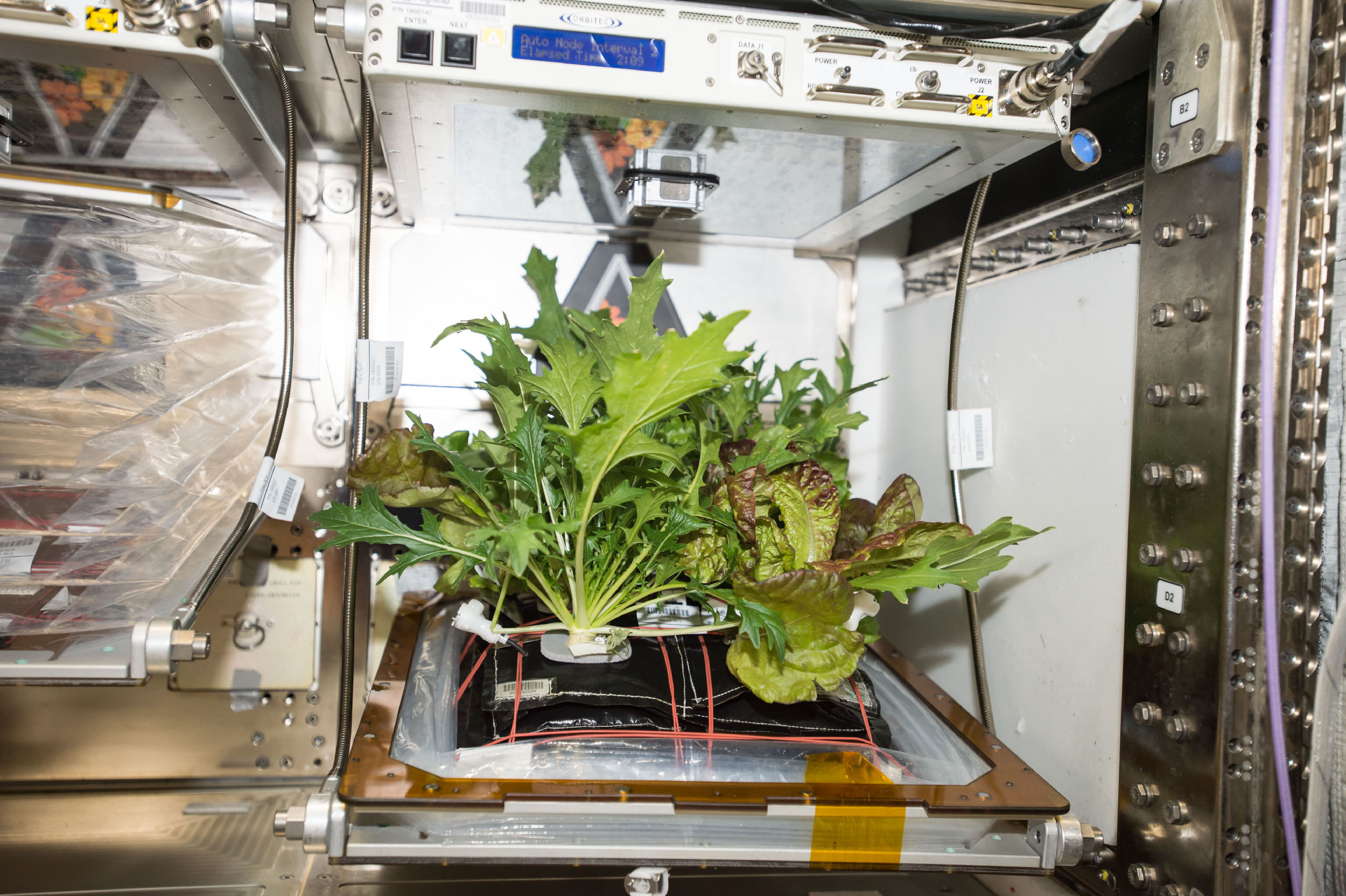
    Plants grown in space through NASA's Veggie system.

    Image Credit: NASA/ISS

    “The opportunities are exciting and almost unlimited in scope” (Langhans and Dreesen, 1988)


    Plant growth in space is challenging for a number of reasons due not only to the harsh conditions of space, but also the harsh design and engineering conditions of the spacecraft. Plants in space need to be able to survive radiation, microgravity, and low-light conditions, while also being physically compact, non-disruptive to the spacecraft’s oxygen and carbon-dioxide levels, and unable to produce excess waste, toxins, and dangerous microbes (Musgrave, 2008; Langhans and Dreesen, 1988; Reed and Vanden Bosch, 2023). Beyond those requirements, these compact space-grown plants must provide all the essential nutrients required for a human diet in the absence of animal products and larger plant products like large fruits (Langhans and Dreesen, 1988).

    While difficult, growing plants in space is extremely rewarding. NASA has determined that only eight species of plants – wheat, rice, white potato, sweet potato, soy bean, peanut, lettuce, and sugar beet – contain all the essential elements, carbohydrates, oils, and amino acids for a balanced human diet (Langhans and Dreesen, 1988). Vitamins, while not fully covered by these eight species of plants, can be supplemented for shorter missions, although they break down when prepackaged for longer ones (Langhans and Dreesen, 1988; and NASA, 2023). In addition, plants have been shown to be positively correlated with psychological well-being on Earth and in space (NASA, 2023). Plants then, are not only beneficial for the astronauts physical health, but their mental health too.

    Currently, NASA employs two growth habitats: the Vegetable Production System (nicknamed Veggie) and the Advanced Plant Habitat (APH) (NASA, 2023). Both Veggie and the APH use enclosed microbiomes with simulated radiance from LED lights and carefully controlled gas content, temperature, and moisture levels (NASA, 2023). While not all eight of the ideal plants identified in 1988 have been successfully grown, the advancements of Veggie, APH and other new technologies shine a light on a hopeful future of plant-filled space exploration.


    Credits

    Langhans, R. W., & Dreesen, D. R. (1988). Challenges to plant growing in space. HortScience, 23(2), 286-293.

    Musgrave, M. E. (2008). Growing plants in space. CABI Reviews. https://doi.org/10.1079/pavsnnr20072065

    NASA. (2023, December 8). Growing plants in space. NASA. https://www.nasa.gov/exploration-research-and-technology/growing-plants-in-space/

    Reed, D. W., & Vanden Bosch, C. A. (2023). Engineering perspectives of growing plants in space. Journal of the Indian Institute of Science, 103(3), 797–805. https://doi.org/10.1007/s41745-023-00369-6

  • Could Aliens be Living in Our Solar System?

    Image Credit: NASA/JPL-Caltech

    http://www.jpl.nasa.gov/visions-of-the-future/

    Water: the ultimate resource. We depend on it to survive, but Earth is not the only place with a substantial amount of water. Buckle up, because I want to tell you about my favorite moon, Europa.

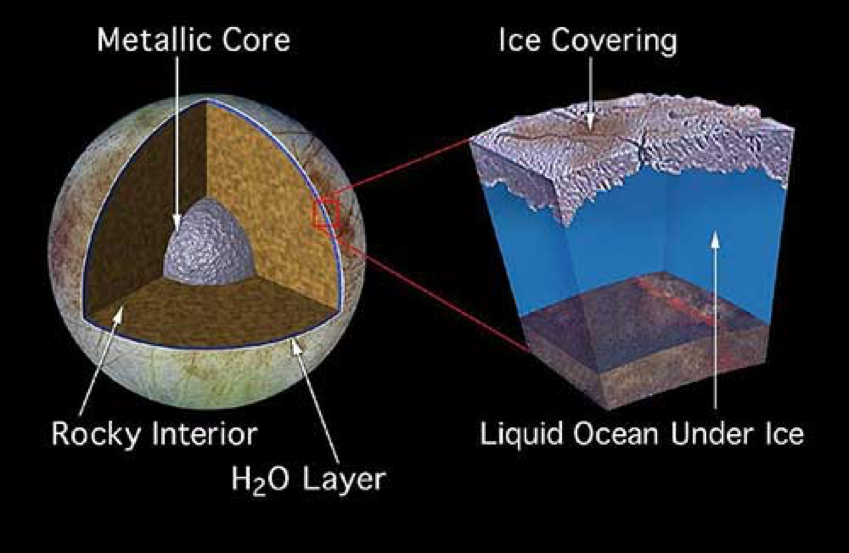
    Europa is one of the moons of Jupiter. It is approximately 4.5 billion years old (about the same age as Jupiter) and is about 485 million miles from the sun. It is the smallest of the Galilean moons with a diameter of 1900 miles (smaller than Earth’s moon but larger than Pluto). Europa looks like a dead, frozen, wasteland covered in large cracks and fractures in the ice, but it is exactly for this reason why it is so cool (literally and figuratively). These cracks are likely caused by tides in an ocean that lies buried underneath Europa’s icy surface. Europa’s tide is the result of host planet Jupiter. Jupiter’s gravity lifts and lowers the sea level causing cracking in the ice. Below the ice and ocean is a rocky interior and inside that is an iron core [1].

    pia20707_fig1_thumb

    Image Credit: NASA/JPL-Caltech/SwRI/MSSS

    http://photojournal.jpl.nasa.gov/catalog/PIA20707

    picture3

    Image Credit: NASA

    http://spaceplace.nasa.gov/europa/en/

    Ok, so you might be thinking, “that’s kinda cool, a frozen moon. Why do I care?” Well, you should care because Europa’s subsurface ocean hosts the possibility of life. That makes Europa a possibly habitable location for us humans (in the future though, cause we are no where near that yet), which is awesome.

    The ocean beneath the surface is widely believed to be salty liquid water which is a big deal (but not yet known for certain since we haven’t sent any missions directly to Europa  thus-far). In a recent study done by NASA’s Jet Propulsion Laboratory (Vance et al., Geophysical controls of chemical disequilibria in Europa), the researchers calculated the potential amount of hydrogen that could be produced from interactions of seawater with the rock below it.This process of interaction is called serpentinization. NASA also looked into oxidants in Europa’s ocean. Jupiter, being the massive gas giant that it is, bathes Europa in radiation from it magnetosphere (Earth actually has this type of radiation too called the Van Allen belts, although they are about a thousand times weaker than Jupiter’s).  This radiation can split apart water ice molecules and create oxidants. One of the lead authors of NASA’s study, Steve Vance, said, “If the rock is cold, it’s easier to fracture. This allows for a huge amount of hydrogen to be produced by serpentinization that would balance the oxidants in a ratio comparable to that in Earth’s oceans”. The balance between hydrogen and oxidants is an indicator to the energy available for life [2]. However since no spacecrafts have been sent to Europa to investigate this, it is currently unknown if serpentinization occurs (several spacecrafts have done flybys such as Pioneer 10 and 11, Voyager 1 and 2, and Galileo [1] ).

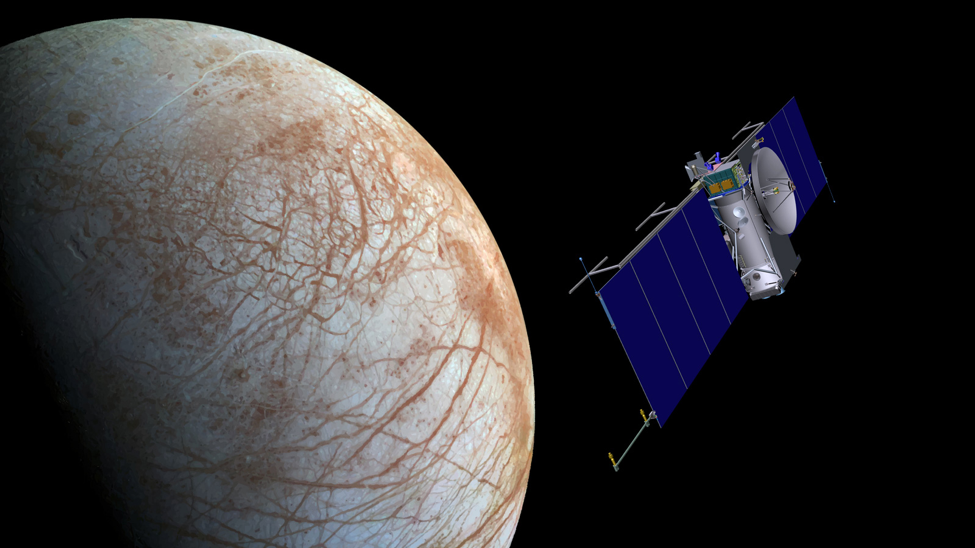
    NASA is planning an orbital reconnaissance mission of Europa called the Europa Clipper with the main goal of investigating the habitability of Europa. The Clipper will have 45 low-altitude flybys over the course of 3.5 years. The clipper will have three main objectives [3] : (1) to investigate the ice shell and ocean, (2) investigate the composition, and (3) investigate the geology of Europa. Essentially, NASA wants to confirm what they think they know about the structure and composition of Europa and how it’s layers interact (like the rocky interior, the ocean, and the icy shell) both mechanically and chemically, and determine the effect Jupiter’s radiation has on Europa. This will give insight to the habitability of Europa. There will be nine scientific instruments aboard to try meet these scientific objectives.

    picture5

    Image Credit: NASA/JPL-Caltech

    http://www.jpl.nasa.gov/news/news.php?feature=4627

    The Europa Clipper’s launch date is not yet determined, but it is likely to be in the early 2020s and would arrive 6-9 years later depending on the launch vehicle [4]. There is still A LOT of work needed to be done on the mission planning, but I’m very optimistic that it will yield in fascinating results, maybe even giving us significant insight to if we are alone in the solar system.

    Here is a NASA/JPL-Caltech video about the Clipper:

    References:

    1. Howell, E. Europa: Facts about Jupiter’s icy moon and its ocean. Retrieved September 4, 2016, from http://www.space.com/15498-europa-sdcmp.html
    2. Greicius, T. (2016, May 16). Europa’s ocean may have an Earthlike chemical balance. Retrieved September 4, 2016, from https://www.nasa.gov/feature/jpl/europas-ocean-may-have-an-earthlike-chemical-balance
    3. The Europa Clipper. (2013, June ). Retrieved September 4, 2016, from http://www.lpi.usra.edu/opag/jul2013/presentations/Clipper_Summary.pdf
    4. Europa Clipper Update. (2015, February 19). Retrieved September 4, 2016, from http://www.lpi.usra.edu/opag/feb2015/presentations/04_Clipper%20OPAG%20Feb%202015.pdf


  • New Houston: We have a problem


    If you are a technology enthusiast, NASA observer or all around space geek, you don’t need me to point out the connection between two recent news events. First off, SpaceX has successfully launched, maneuvered and docked their spacecraft “Dragon” with the International Space Station. That’s ISS for you acronym junkies. This is impressive not only in the sense that the actual feat is an accolade shared by very few extra-atmospheric vehicles – to my knowledge only the NASA Shuttle, and respective Russian, European and Japanese space agency crafts have ever docked with the ISS – but the Dragon was the first vehicle produced by an independent company. Deeming Space X as “independent” may give some readers pause, as at least at this point, a sizeable portion of their total funding comes from the US government to replace the lost Shuttle capabilities through the “Commercial Orbital Transportation Services” program run by NASA. The second event is the announcement by Dutch company Mars One revealing their plans to colonize Mars. This, again, is really only significant when considering how Mars One has proposed funding their journey to the red planet – namely, and in their own words, via “media spectacle”. I imagine that will include some kind of space Snooki doing shots of Jägermeister while orbiting Phobos or something, but the point is Mars One plans on going where no man (or woman, so as not to exclude Snooki) has ever gone before without being bankrolled by tax dollars. Ironically, the Dutch could be considered experts in the field of corporate colonialism. If memory serves, if you were getting your spice on about 400 years ago you had the Dutch East India Company to thank for that. It does deserve mentioning however that Mars One is not the first organization to ever propose such an undertaking. In fact, independent organizations have been in the planning stages of colonizing Mars for years, with one particularly prominent group being the Mars Society led by Dr. Robert Zubrin, but these organizations are focused on the technical aspects of a journey to and eventual colonization of Mars, rather than how to fund the colonization.

    So, taken in concert, the literal launch of the SpaceX’s Dragon spacecraft and the metaphorical launch of Mars Ones’ venture to fund the colonization of Mars, I would argue that the likelihood of anyone even setting foot on Mars within the next 50 or so years has gone from “not going to happen” to “it might actually happen but still probably not”. Why you ask? Because it’s too expensive, too political, and too dangerous for a single government to do alone.  I have never done any book learning on the Cold War, but from my perspective the whole point of the space race (which as a direct consequence gave us global telecommunications, the above mentioned ISS and the Hubble telescope among others)  between the United States and the former Soviet Union had less to do with legitimate exploration of orbital and sub-orbital space or going to the moon and more with “if my adversary has the capability of global surveillance and strategic space bound nuclear weapons, I want it too.” But now that there are no other communist super powers to compete with (oh wait), why bother going on to Mars? Do the scientific motivations outweigh the risks of sending humans instead of rovers or other autonomous vehicles? I don’t know the answer to that, and I don’t think any government space agency does either, which makes trying to pitch, fund and actually complete a government organized, manned mission to Mars dubious. Thus, as crazy as it sounds, corporate settlement of Mars might be the best option. However, for their part, NASA has not completely given up the ghost (of mars?) on exploring the Martian surface, and has unleashed a parade of satellites and rovers, with an upcoming landing of the curiosity rover celebrated with a recent and admittedly kind of bad ass promo , over the past several years.

    So what would the possible goal of colonizing another planet be? If undertaken by a privately funded company, the obvious answer is money. If Mars One leads the way, it might not be “New Houston” that is home to the future inhabitants of Mars but New Amsterdam (again). Are vast quantities of resources the goal of Mars One and like minded would-be-colonists, or is simply the prospect of settling a new world, unfettered of governments, geopolitical conflict and a breathable atmosphere the ultimate goal? Either way, it’s difficult to grok.


    image source: http://phoenix.lpl.arizona.edu/postcards.php