Tag: stem

  • Diary of a Mad Grad Student #1

    In my stress over grad school and figuring out what my life will look like, I’ve been asking myself questions about my goals and my thoughts about existing as an underrepresented minority in academia. Hopefully, putting my thoughts out there will help other students in a similar place feel less alone and reflect on their role as a scientist. You could call this the first public entry of my diary or a grad student’s soliloquy (without the dramatics of a theater show).

    What made me think about writing this in the first place was realizing that I’ve been losing a lot of motivation to finish this first semester of grad school. Even though I put in a ton of work to get to this point and still have big career goals to fill, I keep being reminded of the people who told me that I would fail. The professors that told me, “I’d get kicked out in the first semester,” or “I’m not adequate enough to be a graduate student,” are still stuck in my brain every day that I go to lab and class, and I can’t seem to shake those doubts away in my highs and lows of the semester.

    To get that motivation back, I started to think about how I’ve been doing everything I can to survive and push to the next day, but I haven’t been doing the work to make myself thrive. It brought me back to the question of why I love science. What pushes me not just to do what I need to finish my Master’s but to enjoy every day of it? Looking back to how others in positions of power treated me during my undergrad journey, throughout the grad school application process, and even now, I mainly had been forcing myself to finish everything I could out of spite to prove the doubters wrong. I would not only show them that I did it and finished it even when I thought I couldn’t but also tell the little voice in my head that I didn’t have to worry about anything. I am intelligent, capable, and a real scientist, even when they made me feel like I wasn’t. But now that I’ve become a grad student and I don’t have to see these people anytime soon (hopefully, it’s a small campus, after all), I’ve started making solid strides toward prioritizing my mental health and fighting the imposter syndrome and negative thoughts that come in my head. 

    My most significant step was to begin counseling, which felt like I was going into an unknown world. It was something I wanted to start during my undergrad, but I didn’t have the time or resources for it, so now, as a grad student with a consistent income, I decided it was time to take that leap! With my counselor, I’ve had more profound reflections and conversations about some of the roots of my imposter syndrome. Not only have I gained a better perspective on how I view the world around me, but I’ve also been able to treat myself better than I have in the last few years. 

    There are so many things that my counselor and I have talked about that I could use to show the depth of what I learned, but I think these questions I was asked can give a glimpse of how I’ve been able to grow and move forward. If you’re reading this and have been trying to push yourself to complete your thesis, degree or even get up in the morning, I urge you to reflect on some of these questions. If you have the resources, I would suggest expanding on these questions and ones you’ve been asking yourself in some mental health counseling.

    • How can I better support myself as I finish my M.S. and begin to hit roadblocks in my research? 
    • What is the bigger picture of my work? Does it excite me to go to the lab and work towards completing my thesis?
    • How can I take ownership of my thesis and create a story that will bring new knowledge and understanding to the communities my work will reach? Another question I ended up asking myself while reflecting on this is how can I take myself out of my comfort zone in my project, and have I ever taken myself out of this comfort zone? 

    These questions and my responses to them will likely change throughout my program (as my career goals and my thesis grows). Still, they have reminded me why I became a grad student in the first place and what drives me to become a better researcher and science communicator. I’ve been able to recenter myself, and I’m proud to say that I’m proud of the work I’ve put in so far, and I’m excited for what the next year will hold for me.


    Sincerely,

    A Mad (but Motivated) Grad Student
  • Kiki vs. Bouba: A Psychological Phenomenon


    Begin by taking this fun quiz! –> Are These More “Bouba” Or “Kiki”? (buzzfeed.com)

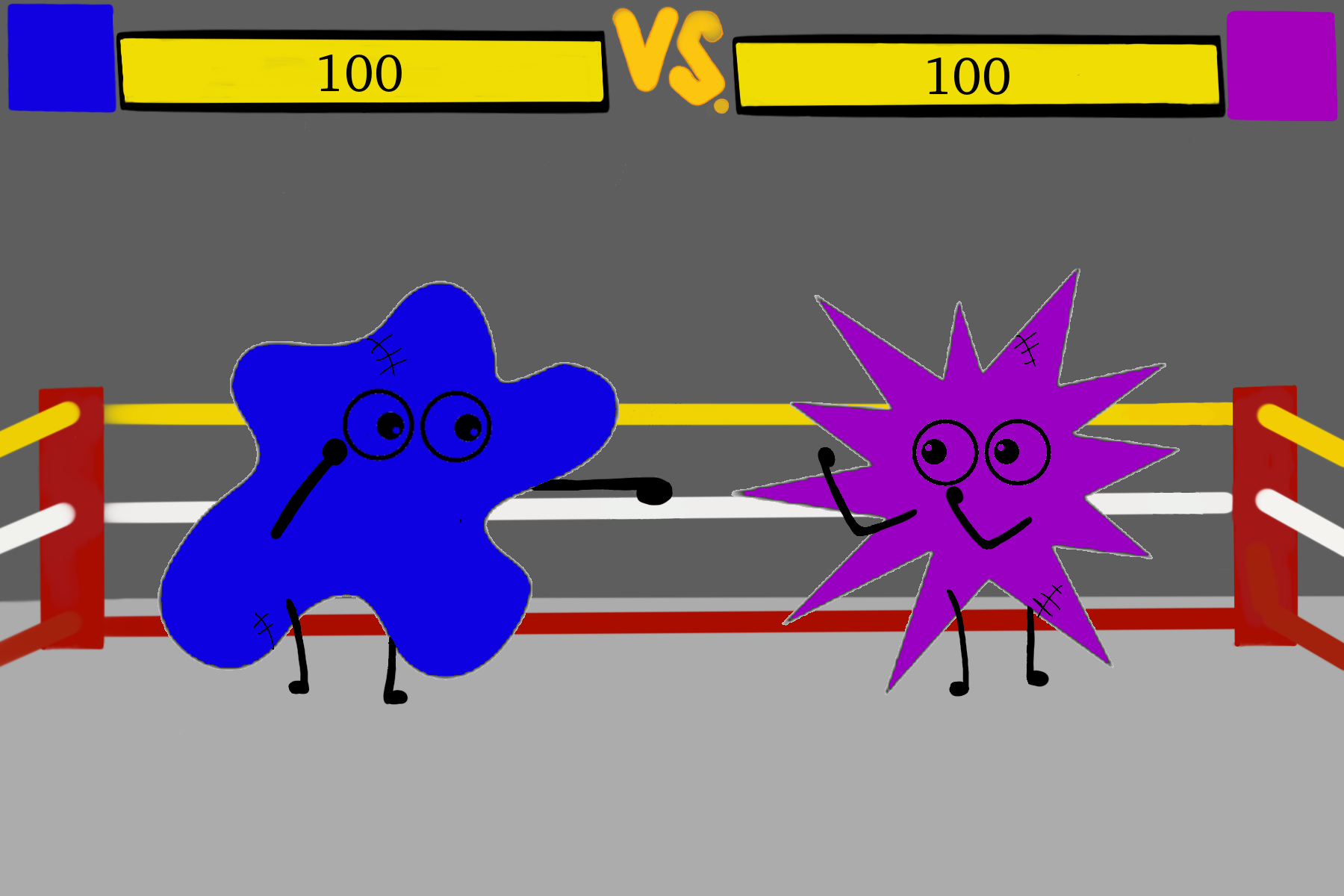
    Were you among the majority that named the spiky figure Kiki and the round figure Bouba? It seems that this is the case for many individuals. This question of “Kiki or Bouba” emerged with the famous psychological experiment conducted by neuroscientist V. S. Ramachandran and Edward Hubbard (Ramachandran and Hubbard, 2001). They asked American and Tamil Speakers to match one of the names to each of the two figures. The results were overwhelmingly the same; enough so to have a significant meaning. However, the real question now is, “Why?”

    There are many theories to answer this specific question. The three that rise to the top are the linguistic, semantic, and perceptual hypotheses (Chen et al., 2021). The linguistic point of view theorizes that this is a result of the sensory-motor connections that humans make when learning speech. The semantic approach, on the other hand, highlights that people may have speech associations to certain meanings. Lastly, the perceptual hypothesis looks into the features of sounds, such as varying frequencies, in relation to the connections people make to those shapes. These hypotheses continue being tested in various ways to narrow down the potential cause of this fascinating effect.

    On a similar note, have you ever associated a certain sound with a color or a number with a texture? When reviewing the literature of this phenomenon, a common term that is brought up is synesthesia. This term refers to the phenomenon that occurs when one particular sense is stimulated, but an individual actually experiences another sense (Huang, 2019). For example, hearing music but seeing colors as a result, or associating certain numbers to different colors. The reason this phenomenon is closely associated with the Kiki-Bouba Effect is because some scientists believe that the same underlying cognitive mechanisms take place for both (Ramachandran and Hubbard, 2001).

    However, the Kiki-Bouba Effect is not just relevant to shapes and sounds as many studies have branched out and broadened this topic to other senses in recent years. For example, one study looks at different tastes in association with the Kiki-Bouba shapes (Bremner et al., 2012). Here it was found that taste and shape do not translate in the same way across cultures.

    Although this may be very fun to think about… many people bring up other potential explanations and there are even some who doubt the veracity of the original conclusions found. One example is the debate on the shapes of the words and the actual shapes. This can be seen in the more “pointy” look of the letters used to spell Kiki compared to the more “rounded” letters used to spell Bouba.

    Another concept brings up the idea of the frequency that a shape that looks like that would make if it were to break in relation to the associated Kiki-Bouba names. For example, a more jagged item would have a higher-frequency noise when dropped, which would correlate to the higher frequency emitted by the word “Kiki.” This could be related to the idea of onomatopoeias, which are words that sound like the thing they are describing.

    With all of this in mind, all current research on this phenomenon is in the stage of finding out why this occurs. By answering that question, much could be unlocked. For one, it would reveal a fundamental component of understanding human perception. In knowing this, we could possibly even create robots that can perceive the world like we do!


    Bibliography:

    Abe, K. A. (2015, April 10). Are these more “Bouba” or “kiki”? BuzzFeed. Retrieved from https://www.buzzfeed.com/keijiroabe/are-these-more-bouba-or-kiki-17wkb. 

    Bremner, A. J., Caparos, S., Davidoff, J., de Fockert, J., Linnell, K. J., & Spence, C. (2013). “Bouba” and “kiki” in Namibia? A remote culture make similar shape–sound matches, but different shape–taste matches to Westerners. Cognition, 126(2), 165–172. https://doi.org/10.1016/j.cognition.2012.09.007 

    Chen, Y.-C., Huang, P.-C., & Spence, C. (2021). Global shape perception contributes to crossmodal correspondences. Journal of Experimental Psychology: Human Perception and Performance, 47(3), 357–371. https://doi.org/10.1037/xhp0000811

    Huang, H. (2019, June 28). What’s the neuroscience behind the Bouba/Kiki Effect? NBB in Paris. Retrieved from https://scholarblogs.emory.edu/nbbparis/2019/06/28/whats-the-neuroscience-behind-the-bouba-kiki-effect/

    Ramachandran V, Hubbard E (2001) Synaesthesia—A Window Into Perception, Thought and Language

  • Eight Gifts under $40 for STEM Nerds

    As the holidays approach, you’re probably panicking about finding the perfect gift to get your nerdy friends in STEM while sticking to a college budget. Look no further; I have compiled a list of the best science gifts under $35 available on Amazon Prime.

    1. Storm Glass $19.99
      • For who? Atmospheric Scientists and Weather Enthusiasts
      • What is it? This water droplet-shaped storm glass will captivate any weather enthusiast. While it may not be nearly as accurate as a real barometer, this gift will be a perfect addition to any room. As the temperature and pressure changes, the liquid inside the glass will change, sometimes forming intricate crystal shapes.
      • How does it work? Storm glasses typically contain water, ethanol, ammonium chloride, potassium nitrate, and camphor. The formations created inside the storm glass change based mostly on temperature and to some extent, pressure. Vice-Admiral Robert FitzRoy, a 19th century meteorologist, created a chart that predicted the weather based on the state of the liquid inside the glass. Clear liquid meant clear skies, cloudy liquid with small stars meant thunderstorms, and crystals at the bottom of the glass meant frost. This device was and still is not accurate in predicting the weather, but it is an interesting piece of the history of meteorology.
    2. USB Digital Microscope $21.99
      • For who? Biologists and Chemists
      • What is it? This digital microscope can be connected to your computer or Android phone and magnify small objects with incredible detail. It is perfect for any aspiring biologist or chemist who wants to view anything from the structure of salt crystals to ­­­­individual plant fibers for less than $20.
      • How does it work? A digital microscope is essentially an optical microscope with an attached digital camera. These commercially available USB microscopes magnify using a macro lens. Macro photography refers to when the size of the object being photographed is life size (or bigger) on the image sensor of the camera. The image from the camera is transmitted to your computer or phone through a USB cable and is able to be viewed in real time.
    3. Low Temperature Stirling Engine $33.99
      • For who? Engineers
      • What is it? Place this Stirling engine on top of a cup of hot water or even ice and watch the wheel turn. It is a great trinket to keep on your desk for when you make your daily cup of coffee, tea, or hot chocolate.
      • How does it work? Stirling engines are driven by a temperature difference. When placed on top of a very hot or very cold substance, the temperature difference between the substance and the surrounding air allows the engine to run. A Stirling engine has two cylinders that are connected to each other containing gases; one is heated and one is cooled. When heat is added to the cylinder, the pressure of the gas increases and forces the piston to move down; this forces the other piston to move up. Gas from the heated cylinder moves to the cooled cylinder, which cools the gas and decreases its pressure. The pistons alternate moving up and down and the Stirling cycle repeats.
    4. Crystal Growing Experiment $17.98
      • For who? Chemists and Geologists
      • What is it? This kit contains everything you need to grow and display seven beautiful crystals that will reach full size in under two weeks.
      • How does it work? Crystals have structures known as lattices that give them their unique shape. Most crystal growing kits come with a solution that contains seed crystal, which makes it easy for crystal to continue to grow until it reaches full size. Molecules in the solution are able to easily interact with the seed crystal and other molecules and form crystal lattices. This is also known as nucleation.
    5. 5 in 1 Engineer Ballpoint Pen $15.95
      • For who? Engineers
      • What is it? This ballpoint pen includes five functions every engineer needs: a ruler, a level, a flat head screwdriver, a touchscreen stylus, and of course, a pen. This all-in-one gift is a useful tool your friends will use on a daily basis.
      • How does it work? The touchscreen stylus is attached at the top of the pen and can be unscrewed to reveal the flat head screwdriver. The ruler is engraved on the side of the pen, and the level is visible on the side of the pen as well. The ink can easily be replaced, so this gift will be long-lasting.
    6. Analog Weather Station with Galileo Thermometer $39.95
      • For who? Atmospheric Scientists and Weather Enthusiasts
      • What is it? This all-in-one weather station has a Galileo thermometer, an analog clock, a hygrometer, and a storm glass. This is a great gift for those who like to keep up with the weather and maybe even practice their own forecasting.
      • How does it work? The Galileo thermometer is a very interesting way to determine temperature and was named after Galileo because he discovered that the density of a liquid changes proportionally with temperature. It consists of multiple glass orbs with different densities inside a cylinder filled with clear liquid. As the temperature changes, the orbs move to their respective positions based on their density. This specific thermometer is not very accurate, however, as the orbs correspond only to 4 degree increments from 64-80 degrees Fahrenheit.
    7. Floating Globe $25.99
      • For who? Physicists
      • What is it? This seemingly gravity-defying device is perfect for the physicists in your life. A black globe levitates while lit by colorful LEDs and will even rotate with just the push of your finger.
      • How does it work? This globe floats with the help of electromagnetism. The C-shaped device surrounding the globe contains an electromagnet at the top, and the globe contains a magnet inside. The force that the electromagnet exerts on the globe equals the force of gravity when the globe is floating.
    8. Math Cutting Board $26.99
      • For who? Mathematicians
      • What is it? This 9×12 inch bamboo cutting board is the ideal gift for anyone who wants to slice fruits and vegetables with the precision of 1/8 of an inch. The lines are burnished into the wood and include guides for the different types of culinary knife cuts.
      • How does it work? Simply follow the guide lines for your desired cut, use the grid, or follow the angles on the cutting board.

    Sources

    DeRose, James, & Georg. (2015, May 27). What You Always Wanted to Know About Digital Microscopy, but Never Got Around to Asking. Retrieved December 2, 2018, from https://www.leica-microsystems.com/science-lab/what-you-always-wanted-to-know-about-digital-microscopy-but-never-got-around-to-asking/

    Floating Globe. (n.d.). Retrieved December 2, 2018, from https://wonders.physics.wisc.edu/floating-globe/

    Galileo thermometer. (2018, July 05). Retrieved December 2, 2018, from https://en.wikipedia.org/wiki/Galileo_thermometer

    Macro photography. (2018, October 13). Retrieved December 5, 2018, from https://en.wikipedia.org/wiki/Macro_photography

    Nice, K. (2001, May 04). How Stirling Engines Work. Retrieved December 2, 2018, from https://auto.howstuffworks.com/stirling-engine.htm

    Optical microscope. (2018, November 25). Retrieved December 2, 2018, from https://en.wikipedia.org/wiki/Optical_microscope#Digital_microscope

    Seed crystal. (2018, September 06). Retrieved December 2, 2018, from https://en.wikipedia.org/wiki/Seed_crystal

    Storm glass. (2018, June 02). Retrieved December 2, 2018, from https://en.wikipedia.org/wiki/Storm_glass

    What is a Storm Glass?  Do Storm Glasses Really Work to Predict the Weather? . (n.d.). Retrieved December 2, 2018, from https://wxobservation.com/do-storm-glasses-really-work/

  • Learn How to Make Water Disappear

    Learning intricate card tricks and complex hand movements can be overwhelming and hard to execute in front of an eager audience, so here is a how to perform a magic trick that does not require any skill but, instead, just a little bit of science. Here is the premise of the trick: You tell an unassuming bystander to pour a glass of water into your magician’s hat. You wave your hands over the hat and chant a seemingly realistic spell. When you flip the hat over, no water pours out… not even a drop. So how did this happen?

    While the audience believes that the enchanting spell you cast over the hat made the water disappear, the real magic is rooted in the chemistry behind one particular item: the diaper. When we think of diapers, words like “ew” or “baby” or even “ew babies” come to mind. However, after reading this, you might have a new perspective on the amazing properties of diapers.

    We’re now going to do something no ordinary person would do: dissect the diaper. The magical substance that you will line your magician’s hat with can be found underneath the lining of a diaper. This substance is a water-absorbing chemical called sodium polyacrylate. Polyacrylate can absorb more than 200 times its own mass (which is extremely fortunate for those potty training and those who have to change the diapers of potty trainers). Although this superabsorbent polymer is now found in a wide variety of products like medical bandages, female hygiene products and diapers, the substance was originally manufactured for the U.S. Department of Agriculture in the 1970s. The original use for polyacrylate gel was to improve the water retention in soils in an effort to improve germination and plant growth (Liu, 2001).

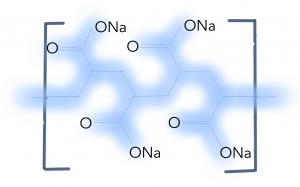
    sodium polyacrylate
    This is the chemical structure of sodium polyacrylate. The molecule is a polymer, so this structure repeats beyond the bars in the diagram.

    Sodium polyacrylate is a network polymer that contains sodium ions. The key to the absorption process and this magic trick is understanding basic rules of diffusion, osmosis and bonding. Osmosis is the when molecules in a solvent move from a less concentrated solution to a more concentrated solution. In this magic trick, when the water comes into contact with the sodium-containing polymer, the sodium diffuses into the water. This results in the replacement of sodium atoms with water molecules in the complex network (Carnegie Mellon University, n.d.). The polymer is essentially a long chain of negatively charged molecules and bonds to water through hydrogen bonds. The bonds allow the network to swell and hold the water in place, which is why the resulting mixture is crystal-like, fluffy substance that does not spill out of the hat. Now that you know the secret to this trick you will now be able to hone and perfect your water vanishing skills!

    Hopefully now when you think of diapers you think “awesome, absorbent polymer.” That said, there are limitations to how amazing this polymer is. Although bunnies are about 70% water, please know a diaper will not make a bunny disappear.

    Here’s what you need for the trick:

    –       Hat

    –       Source of sodium polyacrylate (>2g)

    –       Glass of water (8 floz.)

    Start with some sodium polyacrylate at the base of the hat. You can tape a diaper to the bottom of the hat to conceal the water-absorbing polymer. Ask someone to pour a regular glass of water in the hat. Swirl the hat around and distract the audience while the water absorbs. The absorption time will depend on how much sodium polyacrylate you use and how much water is added, however, this process should occur within a matter of seconds to minutes. Once you are convinced everything has been absorbed, flip the hat over and watch the audience be amazed!


    References:

    Carnegie Mellon University (n.d.). Super absorbing polymer powder. Retrieved from https://www.cmu.edu/gelfand/education/k12-teachers/polymers/polymer-and-absorption/super-absorb-powder.html

    Foy, J. M., & Schnieden, H. (1960). Estimation of total body water (virtual tritium space) in the rat, cat, rabbit, guinea‐pig and man, and of the biological half‐life of tritium in man. The Journal of physiology, 154(1), 169-176.

    Liu, M., & Guo, T. (2001). Preparation and swelling properties of crosslinked sodium polyacrylate. Journal of Applied Polymer Science, 82(6), 1515-1520.

    Parks, L. R. (1981). Cross-linked sodium polyacrylate absorbent. U.S. Patent No. 4,295,987. Washington, DC: U.S. Patent and Trademark Office.