Tag: technology

  • Fabrican: Taking a Piece of Chemistry onto the Catwalk

    One of the most valuable experiences for any designer or innovator is the process of mastering new fields of knowledge to better guide and inform creative decisions. Almost every new problem or project requires designers to think of new ways to approach their solution or design. Manel Torres is the perfect example of this approach as he had to immerse himself in chemistry to develop what is now known as spray-on clothing. His work demonstrates how expanding beyond traditional design boundaries can lead to groundbreaking results with multiple applications! Torres’s invention really highlights how impactive ideas often emerge when disciplines intersect.

    During Paris Fashion week in 2022 at the Coperni runway, Bella Hadid made a stunning performance as she stood there practically naked, while being sprayed with some white liquid material. Well, this material so happened to originate from the works of Manel Torres’ Fabrican. Inspired by silly string spray cans, Torres wanted to create a spray-on T-shirt from an aerosol can during his doctoral years at the Royal School of Art in London. With the help of Professor Paul Luckham from Imperial College’s department of Chemical Engineering and Chemical Technology, Torres was able to create the right formulation to produce something that can spray thin fabric onto a model (Melton, 2023). A featured article years back on the home page of the Guardian Newspaper, highlights the work of fashion designer Dr. Manel Torres who invented a spray that “forms a seamless fabric on contact with the body” (Amato, 2011). Along with the article was a video, showing Torres in a lab coat demonstrating his new innovation by spraying the torso of a male model with a liquid mix of fibers and polymers that instantly dried and solidified upon contact with the skin. The results came out to be a skintight t-shirt!
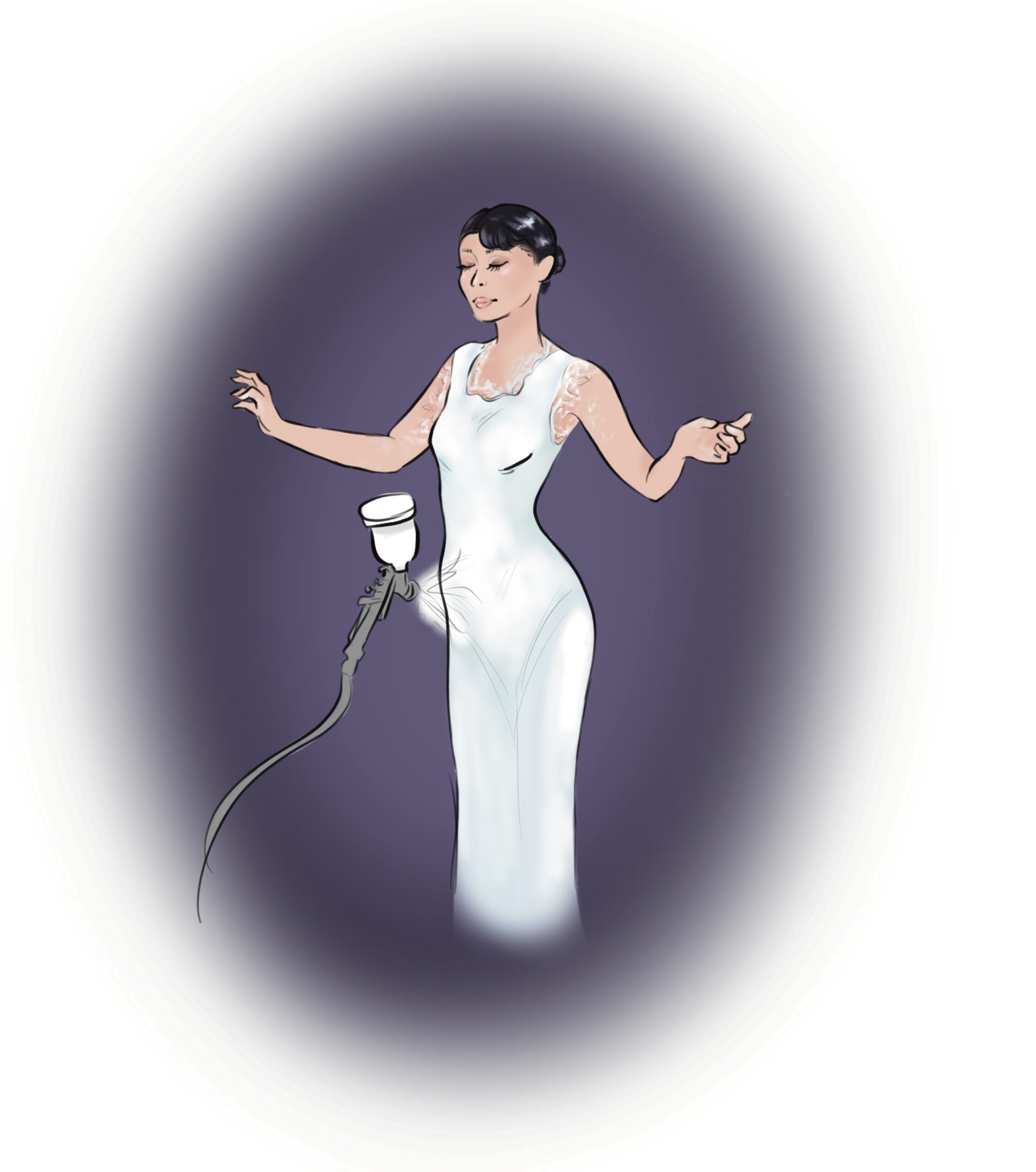
    (source: drawn by An Truong)

    So how is it possible for a liquid material to become something that you can actually wear? 

    Torres’ invention consists of a liquid mixture of short fibers that are suspended in a solvent that evaporates when exposed in the air, so that the spray turns into a solid non-woven non-knit material upon contact (Melton, 2023). It was made to be applied using an aerosol can or a spray gun that would be sprayed directly onto a person or onto a mannequin or mold, forming a fabric layer that can be thickened and strengthened by applying multiple layers. With this, you would be able to style, peel off, and shape the fabric as needed. The fibers themselves are biopolymers created from natural or synthetic sources such as corn starch, wool or mohair based keratin, hemp, or even collagen (Amato, 2023). Torres also experimented with various other kinds of fabrics and textures such as a paper-like texture, fleece, rubber, and lace. These fabrics and textures were able to be embossed, molded, and essentially patterned in any ways a designer wishes. 
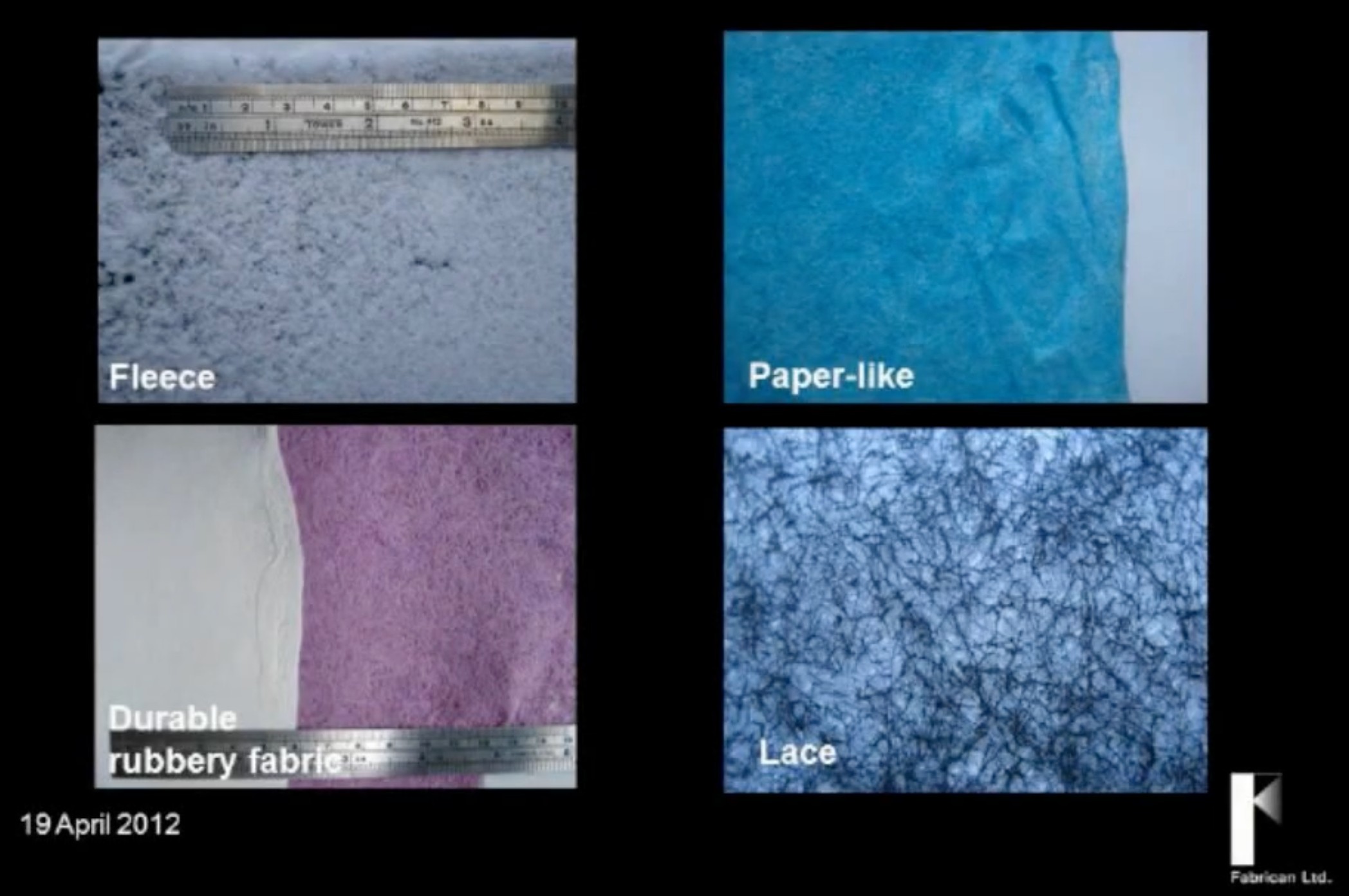
    (source: TEDxTalk)

    Further Application

    Torres believes that his invention should be and can be used to create a wide range of products, including fashion, automotive components such as dashboards and interior fabrics, and for medical application such as bandages, instant sterile dressings, or drug delivery patches. 

    As any great designer and innovator would do, Manel Torres continues developing and improving his own works. In a TED TALK Torres gave in 2012, he mentions how he wants to push Fabrican to be fully reusable and sustainable as well as incorporate some kind of smart technology in the future. This is a great practice for designers and innovators alike as they should all reflect on their designs and continue to improve them even after its final outcome is presented.

    Conclusion

    Manel Torres’s work with Fabrican shows how innovation in design is truly never finished. It should evolve alongside new ideas, technologies, and needs. By continuing to refine his spray-on fabric with goals of sustainability, material and cost efficiency, and integration of smart technology, Torres sets a perfect example for future designers and innovators that creativity should not end at just the final invention or outcome, it instead continues to grow through constant iteration. Manel Torres’ process demonstrates how science and design can merge to create materials that are functional and adaptable. As Fabrican develops, it has great potential to reshape industries starting from fashion and expanding to fields such as medicine. Ultimately, Torres’s process and work encourages designers to think beyond traditional materials and to embrace experimentation and iteration. His brilliant vision for the future of clothing and textiles challenges the next generation to design with both imagination, experimentation, and research!

    Citations:

    Amato, Sarah. (2011). Fit to a T: Spray-On Clothing, Craft, Commodity Fetishism, and the Agency of Objects. Utopian Studies, 22(2), 285–302. https://doi.org/10.5325/utopianstudies.22.2.0285

    Coperni. (2023, September 14). The making of a dress [Video]. YouTube. https://www.youtube.com/watch?v=YxObP6-ovdk

    Melton, Lisa. The instant spray-on dress. Nat Biotechnol 41, 743 (2023). https://doi.org/10.1038/s41587-023-01829-1

    TEDx Talks. (2012, April 26). Spray-On Fabric: Manel Torres at TEDxImperialCollege [Video]. YouTube. https://www.youtube.com/watch?v=EW6Gv-IoErw


  • Real or CGI? How Technology is Used in Netflix’s Life on Our Planet


    Life On Our Planet. Cr. Courtesy of Netflix © 2023

          The image above features two Cave Lions, beautifully captured looking out over the icy foothills of Madagascar. The lions look pristine, and the photo would fit right in inside the latest edition of National Geographic. Except for the fact that this picture isn’t real, and Cave Lions have been extinct for around 14,000 years. This photograph is screen captured from an episode of Netflix’s Life on Our Planet, and the Cave Lions are completely computer generated.

          Now, maybe you guessed that these animals were made with CGI. The fur looks a little but too soft and perfect, and their expressions look just a smidge too human. There are certain tells that can give away whether something is real or computer generated, and human eyes are great at spotting them, usually.

         The other day, I was watching an episode of Life on Our Planet, and I found myself completely unable to distinguish between real and computerized animals. Even prehistoric animals, which I knew were long extinct, looked and moved so realistically that I thought the producers could have filmed some real, unique and unknown creature, and edited the scale and colors to make it look like something new. The way the animals moved, the way they interacted with their environments- my brain could not comprehend the notion that these animals were simply rendered and animated computer models. This coupled with the fact that the real wildlife shots from Life on Our Planet are so beautiful, detailed, and crisp, that even the real animals appear fake at times, had me questioning the authenticity of every scene that I saw.

         Most of the animals depicted in this docuseries are completely real, and breathtaking videos are produced from the tireless work of on-site videographers, who can spend months on location just to get that perfect shot. It is only when depicting dinosaurs and other prehistoric creatures, that the production team relies on CGI.

         It was shocking to me how realistic CGI models have become. One way to see how this technology has improved is to compare the CGI rendering of dinosaurs from Jurassic Park, created in 1993, and Life on our Planet, created in 2023.

          Watching these two clips makes the differences over 30 years even more clear. The contrast in texture, movement, and overall quality has gotten remarkably better since the days where CGI was still in its experimental stages. CGI was not truly integrated into movies until the early 70s. Jurassic Park was a trailblazer in CGI, and considering how early it was made, the computer-generated dinosaurs look pretty good. Jurassic Park utilized RenderMan technology, the same program that was adopted by Pixar and used to create Toy Story and Avatar. Since then, RenderMan has evolved with technology, maintaining its position as one of the most advanced rendering technologies by adopting features like raytracing, which could light animated scenes better than ever before by simulating the behavior of actual light. 

         Life on Our Planet works with a variety of technologies to create their hyper realistic, 3D animations. Their process is primarily done through Industrial Light and Magic, or ILM, a visual effects company founded by George Lucas in 1975 to create effects for the original Star Wars film. ILM utilizes the 3D modeling program, Autodesk Maya, and renders with RenderMan.

        The process for creating these hyper-realistic, CGI creatures for Life on Our Planet is quite extensive. As is documented in behind-the-scenes content for the series, it begins with filming the scenery. Taking beautiful shots of nature is no longer enough. The film crew has to plan every detail of the final scene before they even start filming. Where will the animal stand? What path will it move in? Every twig and leaf in its path must be removed or otherwise accounted for in order to produce a believable animation 

         But animals don’t simply glide over the ground; they affect their environment. How can film-makers create the illusion that an animal is interacting with its environment without it even being there? In cases where the animal is making drastic, visual changes to the environment, like a dinosaur eating a branch off a tree, filmmakers will greenscreen (or more accurately, “bluescreen”) themselves into the scene, modifying the environment with a visible hand that will be edited out later. Smaller and less noticeable environmental interactions can be completely done in post-production, but before we can understand that, it’s important to know how the environment is rendered with this type of CGI.

         In Life on Our Planet, the first step of post production takes place within the Layout Department, and it involves baking in images taken on site into a digital environment in which the animation will take place. With CGI this advanced, the entire environment must be rendered before a character can be placed in it. Simply editing an animation into raw footage would not be able to produce the environmental interactions that are needed to make a character truly seem part of a scene. The animal will need a physical terrain to move across. It will need to be placed behind objects in the foreground. The best method to achieving this is a complete environmental rendering, which, as can be seen in the docuseries, is completely indistinguishable from regular footage.

         Once the digital environment is formed, animators can create believable environmental interactions. Slightly adjusting the terrain can give the appearance of a footprint. An animal can scratch a tree, turn up some foliage, or unearth dirt.

         The process for creating CGI animations is complex, and it varies across studios, production companies, and type of work. Life on Our Planet provides us with a view into the potential of CGI so create true to life animations and visuals, and believable environmental interactions. By melding the real world with the computerized, this series has created some of the most realistic and beautiful animations we have seen yet. Considering the fact that CGI has only been meaningfully used in film for around 50 years, it is exciting to imagine the possibilities as technologies advance even further.


    Works Cited

    Life on Our Planet | Filming Dinosaurs in The Real World | Netflix. (2023, November 3). Www.youtube.com. https://www.youtube.com/watch?v=nKRP2Zc6udA

    Nast, C. (2019, April 10). “Our Planet” filming locations: where was the Netflix series shot? CN Traveller. https://www.cntraveller.com/gallery/our-planet-filming-locations

    Petychakis, M. (2020, June 29). How Technology Evolutions changed Animation. APILama. https://apilama.com/2020/06/29/how-technology-evolutions-changed-animation/

    Schrodt, P. (2023, November 9). What Did Dinosaurs Really Look Like? “Life on Our Planet” Filmmakers Explain. Netflix Tudum. https://www.netflix.com/tudum/articles/life-on-our-planet-what-did-dinosaurs-look-like

    Tyson, J. (2000, November 14). How Industrial Light and Magic Works. HowStuffWorks. https://entertainment.howstuffworks.com/perfect-storm.htm


  • When to Start Panicking about Killer Robots

    If you’ve seen one too many sci-fi movies (or five minutes of West World), you might think artificially intelligent humanoid robots can, and likely will, outsmart their creators.

    After all, over the past century, humanoid robotics technology has accelerated from barely-believable Disney animatronics, to emotive, joke-cracking, robotic citizens. It’s not a stretch to envision what’s next. However, although potentially unsettling, modern artificial intelligence technology shouldn’t have you perusing panic room catalogs just yet. Or should it?

    RobotHumanShadows

    High-Tech One-Hit Wonders

    It is true that robotic devices developed in the past few decades can perform some truly remarkable tasks, such as have interactive conversations, dance, or do parkour. But, all of these amazing machines fall into two categories: they can move well, or they can think well. None can do both – yet.

    For example, Boston Dynamics is a robotics company that has built several robots with eerily life-like movement capabilities. Take their creation Big Dog. When pushed, this robot almost looks like a scared deer recovering from a fall. These machines, such as their newer creation called Handle, have both reflexes and complicated controls that allow them to move in uncertain environments with extreme precision, carrying heavy weights and performing multiple tasks. However, they aren’t exactly stimulating conversation partners.

    On the other hand, there are robots that very convincingly interact with humans, such as the now-famous Sophia from Hanson Robotics. Sophia can converse with humans relatively seamlessly. She can learn from conversations over time, tell jokes, and even throw shade. But her movements are clunky and relatively non-existent.

    Robots are designed to specialize in one task – they can either walk or talk but cannot yet do both. As prominent roboticist and Oregon State computer science professor Thomas Diettrich, Ph.D., explained in an interview with Tech Insider, “No [artificial intelligence] system comes anywhere close to having this immense breadth of capabilities, particularly when it comes to combining vision, language, and physical manipulation” (Del Prado, 2016). What happens when there is a robot that excels in all of these tasks? At that point, it might be time to consider investing in some off-grid property.

    Walking the Walk so You Can Talk the Talk

    Why does movement matter when talking about artificial intelligence? As MIT neuroscientist Daniel Wolpert, Ph.D. puts it, mammals have brains so that we can move. Evolutionarily speaking, mammals developed the ability to perform complex movements like walking before we developed higher cognitive abilities, such as speech.

    Moving and interacting with your environment is the best way to learn, even for robots. Peter Norvig, Ph.D and director of research at Google agreed. “Reasoning [in artificial intelligence] will be improved as we develop systems that continuously sense and interact with the world, as opposed to learning systems that passively observe information that others have chosen,” Norvig explains (Del Prado, 2016).

    Take, for example, a baby learning to talk. Although you don’t remember it, you probably learned what a ball was by seeing a ball, grabbing it, maybe even putting it in your mouth a few dozen times, all while someone repeated the word “ball” over and over. You were eventually able to define what the word “ball” meant by recalling your interactions with that object. This is likely why early motor skills are predictive language development (Bedford et al., 2016). Observations like these have led cognitive neuroscientists to develop the theory of embodied cognition. This theory suggests that cognitive functions – understanding the emotions of others, developing likes and dislikes, and communicating with those around you, to name a few – are rooted in our physical experiences with the environment, and the sensations we feel from those experiences. Essentially, you know what awkwardness is because you accidentally called your first-grade teacher ‘mom’ once or accidentally said “Love you!” before hanging up the phone with your boss.

    An entire body of developmental and neural imaging evidence supports this theory, showing that we use our own sensory and motor experiences for complex cognitive processes such as understanding the actions of others (Grafton, 2009) and the meaning of words (Pulvermuller, 2005). Fortunately for us, or unfortunately if you are a roboticist, manmade machines do not yet possess this ability.

    Moving Towards Independent Thought

    For a robot to have true, rich artificial intelligence they have to be able to think and learn without supervision. At the moment, robots have a hard time generating their own opinions about the environment because they can’t fully – or perhaps more importantly, independently –  experience the environment. If you tell a robot to “push” or to “walk,” they typically understand what you mean because someone went into the code and defined what those words meant, not because the machine defined it for themselves by actually pushing or walking. Deb Roy, Ph.D and a professor at MIT working on robots that understand language through physical interaction, describes this as “the machine [getting] caught in circular chains of dictionary-like definitions.” (Roy, 2005). Their group has managed to create Ripley, a robot that can physically interact with objects to form its own opinions about the environment. However, these types of machines still have a long way to go before engaging in rich social interactions as well as complicated physical movements.

    So what’s holding us back from developing robots that can move, sense, and think? It seems that researchers investigating things like movement and sensations in humans and robots are largely separated from roboticists developing cognitive algorithms. Similar to Dr. Roy, Dr. Fancesca Odone and colleagues are working to develop the cognitive and physical skills of iCub, a robot that can independently learn to visually recognize objects and perform physical manipulations. Fanello et al. (2017) explain that  “In spite of the complementary challenges, cognitive robotics and computer vision mainly proceeded on independent tracks.” To enable robots to walk and talk, perhaps researchers across fields must first talk to each other.

    We’re Safe. For now.

    Until robots can form experience-based definitions of the things they interact with through their own movement, we are probably safe from the potential robot apocalypse. When robots develop the ability to learn from their own physical experience – experience they gain themselves by interacting with the environment through coordinated movement – that is when their thinking will become truly independent.

    Who knows, maybe if we show them our good side, robots will like humans and decide to live harmoniously with their creators. However, since Sophia recently learned to walk, and seems to have other plans, you might want to keep those panic room catalogs within arm’s reach.


    Works Cited

    Bedford, R., Pickles, A., & Lord, C. (2016). Early gross motor skills predict the subsequent development of language in children with autism spectrum disorder. Autism Research, 9(9), 993-1001.

    Del Prado, G. M. (2016, March 09). Experts explain the biggest obstacles to creating human-like robots. https://www.businessinsider.com/biggest-challenges-human-artificial-intelligence-2016-2

    Fanello, S. R., Ciliberto, C., Noceti, N., Metta, G., & Odone, F. (2017). Visual recognition for humanoid robots. Robotics and Autonomous Systems, 91, 151-168.

    Grafton, S. T. (2009). Embodied cognition and the simulation of action to understand others. Annals of the New York Academy of Sciences, 1156(1), 97-117.

    Pulvermüller, F. (2005). Brain mechanisms linking language and action. Nature Reviews Neuroscience, 6(7), 576.

    Roy, D. (2005). Semiotic schemas: A framework for grounding language in action and perception. Artificial Intelligence, 167(1-2), 170-205.

  • The Primary Colors are What?!

    It’s about that time of the year where projects are due. You want to create a fantastic looking poster to present your research in a neat editing software. Yet you’re having trouble choosing the correct colors. Or wait, is it just your computer that’s having trouble choosing the correct colors? What is this section under the “edit colors” tab that says “RGB values”? You just want to make the perfect shade of orange using red and yellow, but the computer only understands RGB. It turns out that when it comes to computer science, red, blue, and green are the primary colors.

    Let’s break down this computational color system. The RGB (red, blue, and green) is known as an additive color system. The additive system was given its name because when wavelengths of light are added together, the color values approach white light. This system makes use of the physics of light to create the colorful (or colorless) pixels on your screen. To understand this further we have to break down the concept of light.

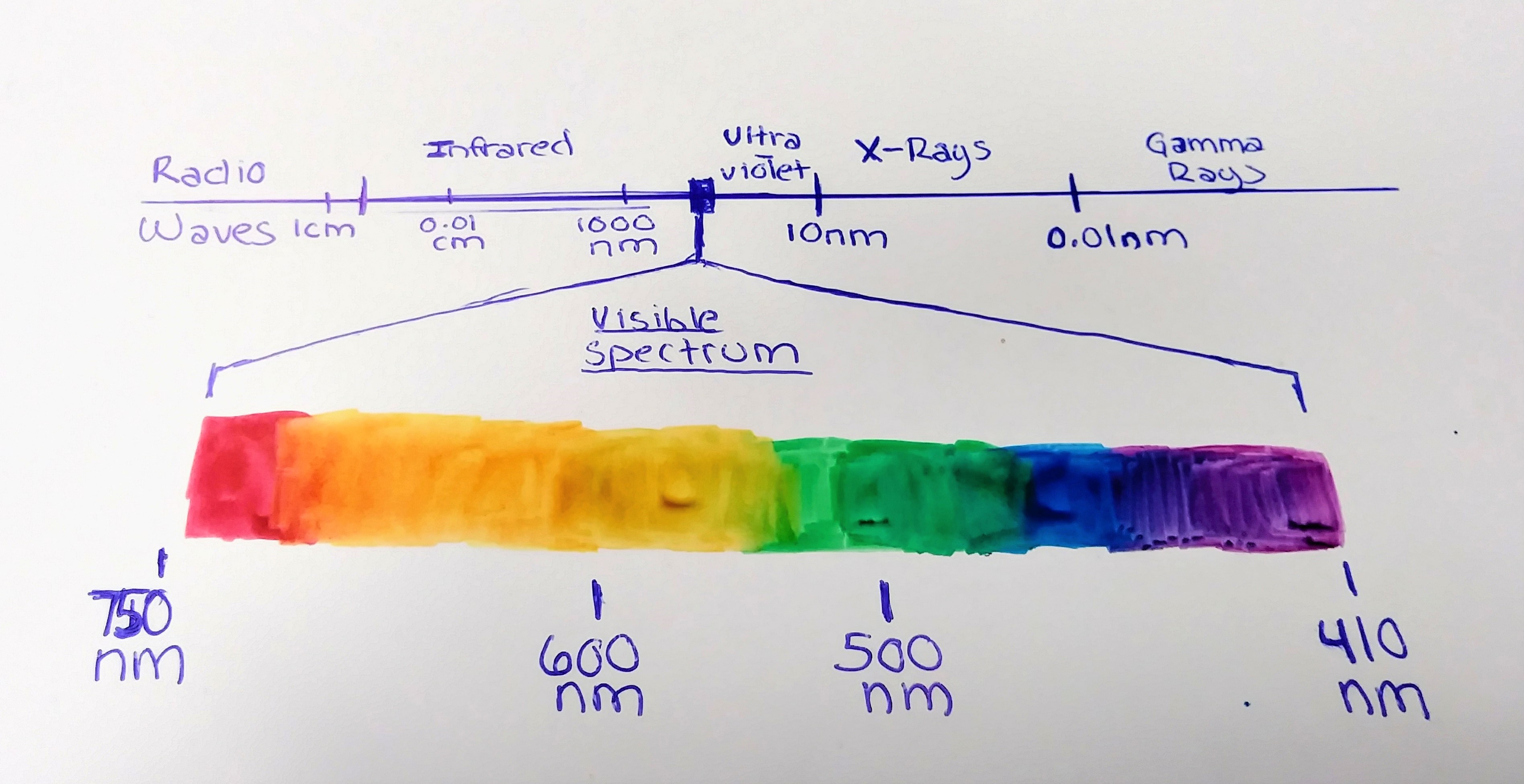
    On a spectrum of radiation, known as the electromagnetic spectrum, light composes the visible part of the spectrum. Light has two natures, but for now, let’s just focus on its wavelike nature. Each range of wavelength corresponds to a different color, with around 700nm (nanometers) being red light, and 400nm being violet light.

    Electromagnetic Spectrum
    Electromagnetic Spectrum

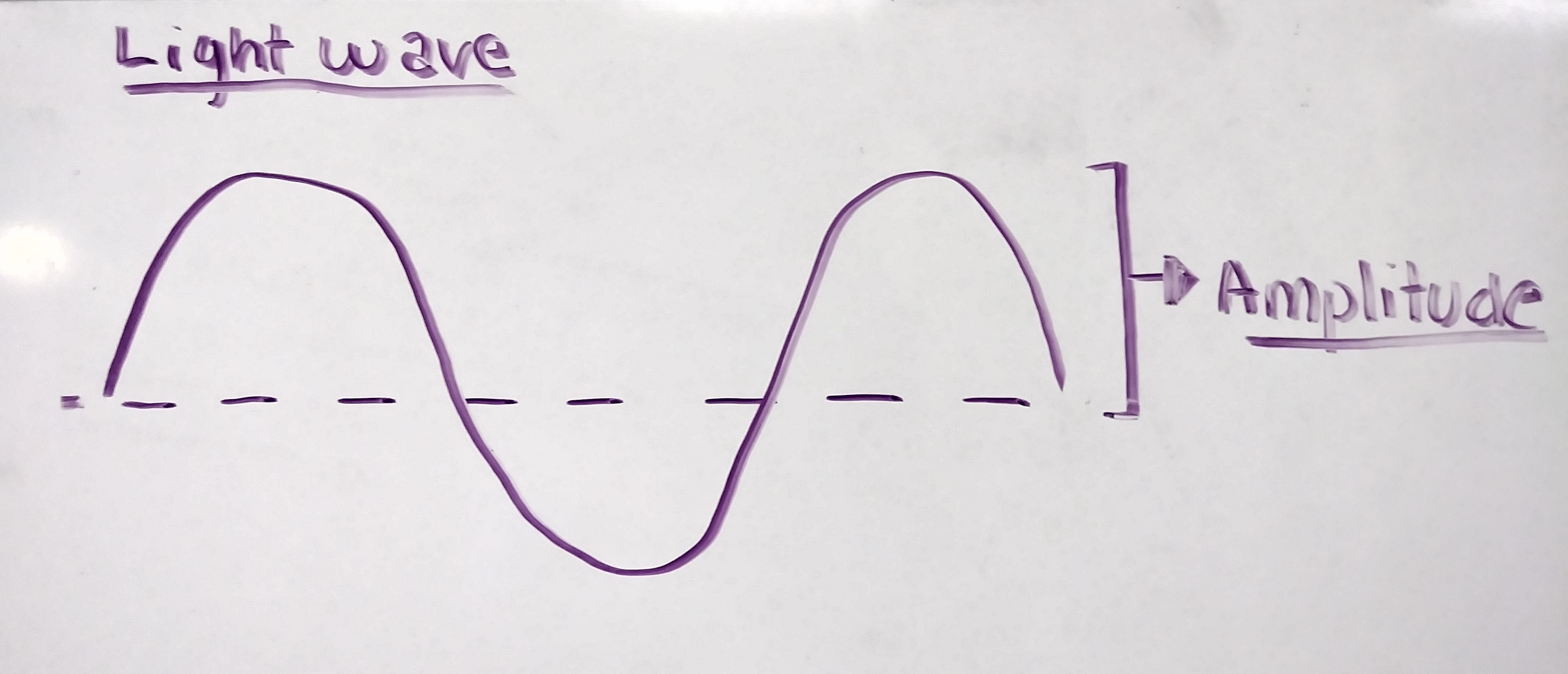
    The height of the wave from its center point, or it’s amplitude, determines how bright the light shines, or how close the value is to white. This means that the colors on your computer screen are not actually programmed into your computer as red, green, or blue. Rather, your computer makes colors by shining specific wavelengths of red, green, and blue lights with different amplitudes through the pixels, tricking your eyes into seeing specific mixes of colors. Neat, right?

    Light waves. The amplitude of the wave is from it's midpoint to the top (crest) of the wave!
    Light waves. The amplitude of the wave is from it’s midpoint to the top (crest) of the wave!

    The colors that you might have learned as primary in your childhood, red, blue, and yellow, follow the subtractive system. This means that as these colors are mixed they approach darker values going towards black. As paints they do not emit wavelengths of energy, like the pixels on your screen. These paints have pigments which reflect the color they show, and absorb all others. For example, a red apple reflects red light, but absorbs all other color wavelengths. Unlike paints, the pixels on your computer screen do not have pigments.

    Now that you know some more about the physics of color on your computer, making that science fair poster should be a breeze! Knowing how to manipulate your red, green, and blue wavelengths of light could save you a ton of time and give you some fantastic looking results! Happy poster making!


    References:

    Stroh, C. (Jul 1997). Basic color theory and color in computers. Art Education; Reston, 50(­4).

  • What’s behind your screen?

    chargedarticleartwork

    One of the most popular displays today is an LCD display. They come in televisions, computer monitors, phones, and more, but do you know that chemistry and physics are the fundamental to create these screens?

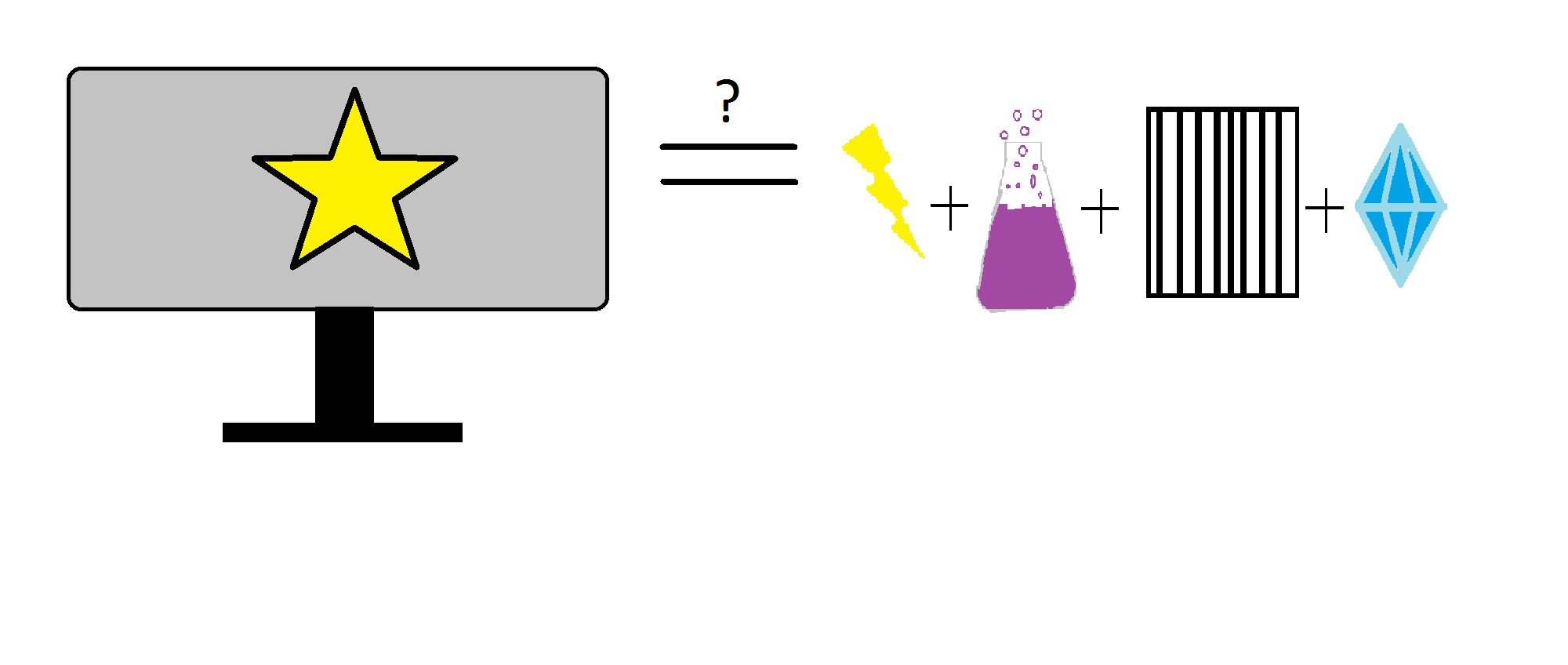
    LCD stands for Liquid Crystal display and were used to replace Cathode Ray Tube displays because the CRTs were too bulky making televisions and computer monitors huge. Inside of an  LCD display there are multiple layers: a thin filmed transistor, an electrode pattern, a liquid crystal and some level of polarization.

    The thin filmed transistor is a very specific form of glass known as Borosilicate glass, made up of around 13% boron trioxide and around 80% silicon dioxide. Its physical properties due to its compound make up allows the glass to be more shock resistant and heat resistant than your average piece of glass. The electrode pattern uses metals like copper and titanium to transfer electrons. The polarizer mainly works with filtering light. Previously, light was just projected onto the television. Now a polarizer filters light waves by direction reducing the amount of power required to use a lit up display. It also allows for smooth picture transition. Finally the liquid crystal is used to produce the crisp look of an LCD screen. This crystal starts out as a liquid and when it comes into contact with the average atmospherics on the surface of the earth, this liquid crystallizes, like a spiders silk. It has the unique ability based on its shape and structure to show or not show various light rays. The polarizer prepares the light for this liquid crystal making its job possible.

    So there you have it, now you know whats behind that magic box in your living room!