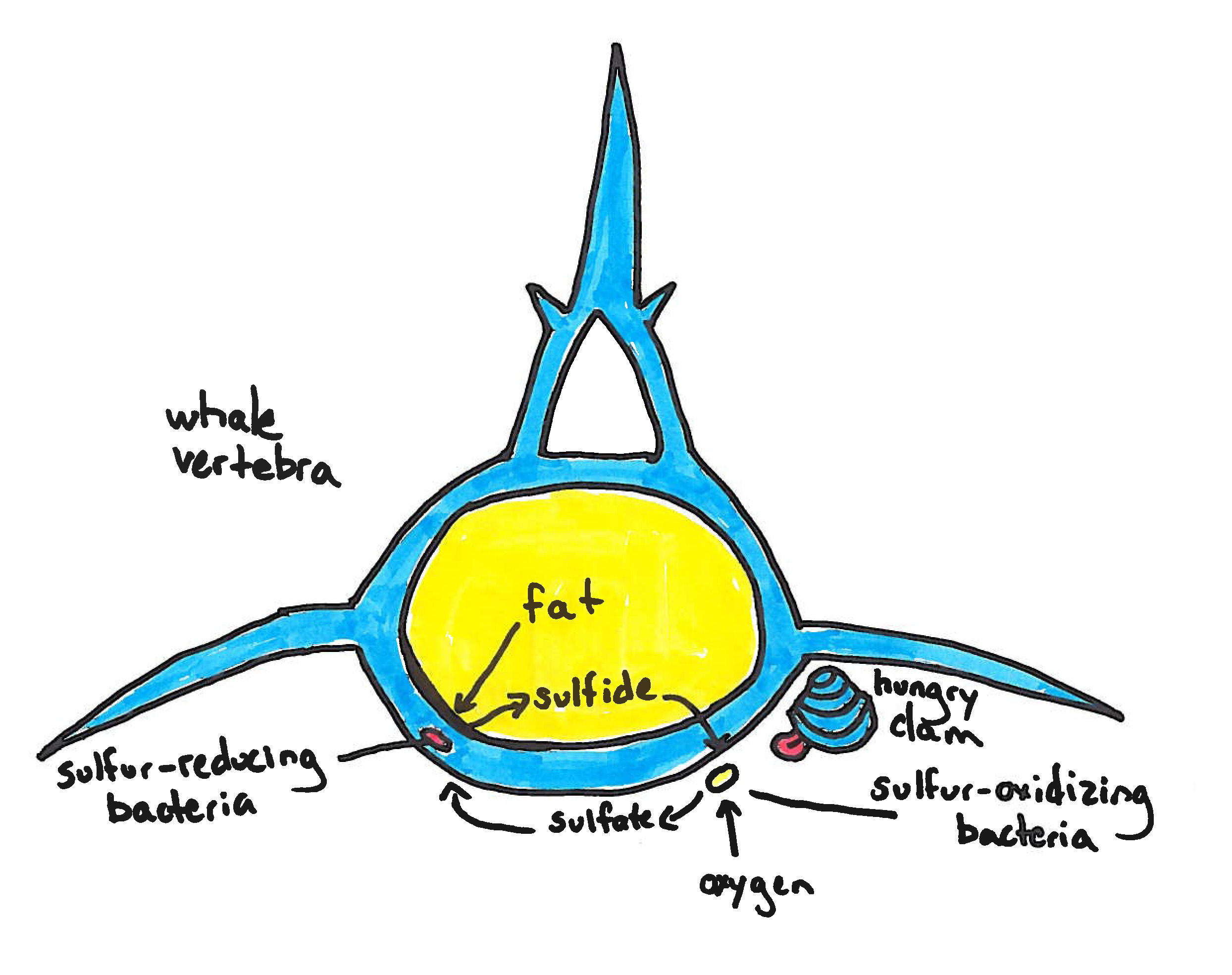
Osedax, from the Latin os, oris (bone) and edāx, edācis (devourer), is a genus of undersea worms that consumes bone. A genus (which is more Latin, this time for a family group) is a group of species that are similar. More distantly, the genus Osedax belongs to the family Siboglinidae. Siboglinidae is a family (a level above in the biological categorization hierarchy from genus) composed of segmented worms, all of which have chitin bristles. Chitin is a natural substance that is found in all sorts of bugs, and it’s similar to the material that makes up your fingernails. Another prominent species in this family are the undersea tubal worms that live at the hydrothermal vents at the bottom of the ocean. It turns out there is a surprising amount of diversity of species of undersea bone eating worms. The worms range in size and in behavior. You can find members of the Osedax genus in all seven oceans, and in all sorts of depths (21 – 4000 m). Some of them are generalists, whereas others specialize in large bone deposits often found on the ocean floor. Whalefalls (you can read more about them here: http://chargedmagazine.org/2012/06/whale-fall-2/) are one such source of large bone deposits on the ocean floor.
Osedax worms were first discovered in 1994. Biologists were initially baffled at what exactly they were. The worms evaded classification until molecular DNA analysis showed that they were related to the tube worms that live in hydrothermal vents on the ocean floor. This breakthrough allowed biologists to finally place the Osedax genus into the Siboglinidae family. Later, fossils were discovered of Osedax worms inhabiting a large, dead reptile, dated to the early-Late Cretaceous period, about 100 million years ago. This led to several revelations about the history of Osedax worms. Firstly, there was now a historical precedent for being generalists, rather than whale specialists. Osedax worms were initially discovered and identified on whale falls, and there was some debate in the scientific community about whether or not they occupied other niches. Well, giant dead reptiles certainly weren’t whales, so this find cleared that up nicely. The fossil finding also illustrates something about the history of Osedax worms and the Siboglinidae family. This finding confirmed an earlier theory that the Siboglinidae family originated somewhere in the mid-Cretaceous period. It also means that the weird bone eating worms under the sea outlasted the dinosaurs, which is neat.
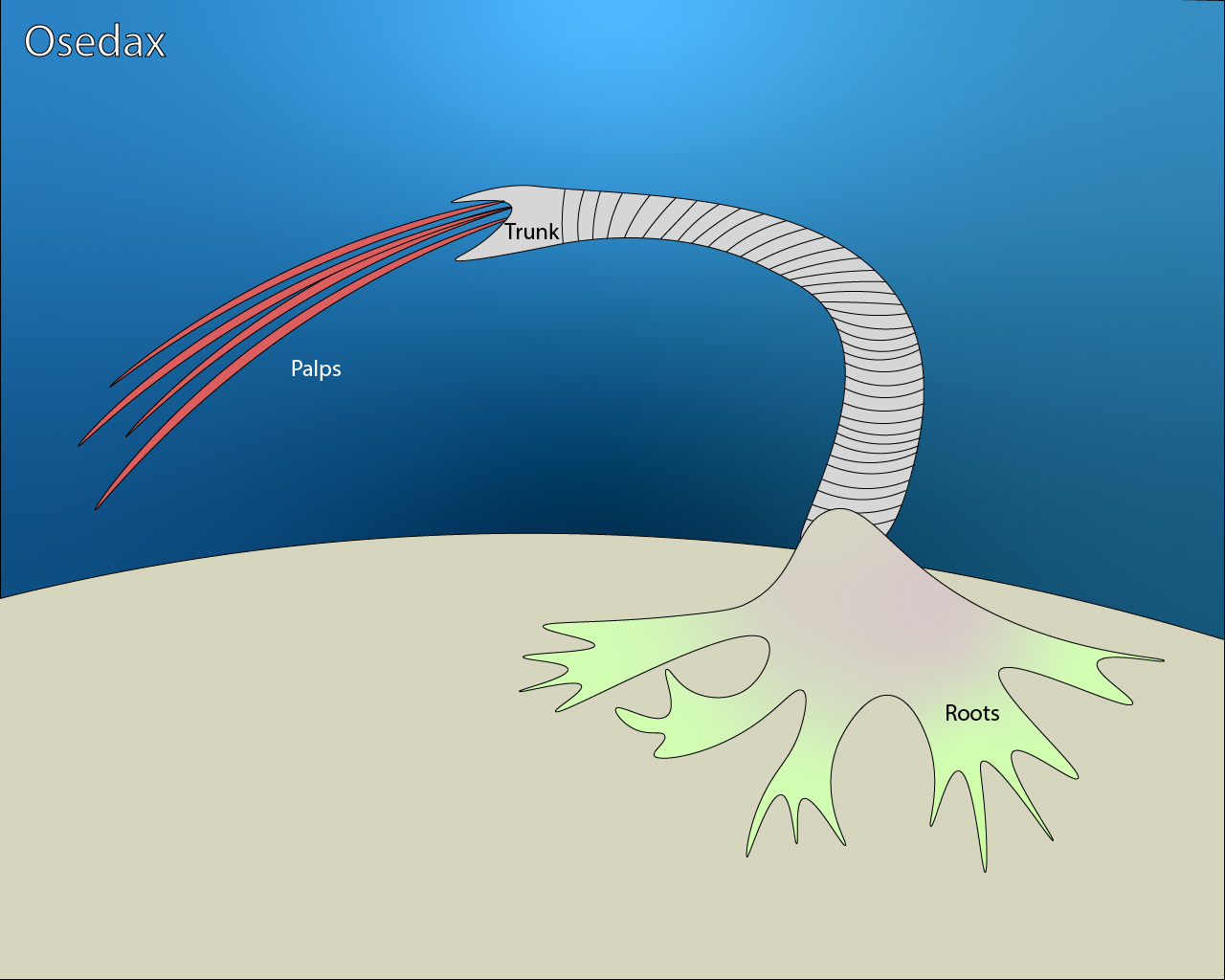
Physically, Osedax worms are strange looking creatures. Red, string-looking bits float out from one side of the main worm body. On the other side, there are green, root-like structures sticking out back. These roots secrete acids to dissolve the bones where they lodge. Their middle is a white, segmented tube. It doesn’t get any more regular on the inside, either. Osedax worms don’t have a digestive system – they just host a wealth of bacteria inside of them to digest the bones they consume. Another strange thing about the inside of an Osedax worm is that the male worms live inside the females. As in, every picture of an Osedax worm you see will be of a female, as the males are teeny tiny and live inside of the females. Dwarf males, as this phenomenon is called, occurs when the males of a species are much smaller (and usually simpler anatomically) than the females. In species where dwarf males exist, the males typically reside somewhere inside or attached to the female members of the species. Osedax worms are at least as odd as you were expecting worms that ate bones to be, at very least.
References
- Smith, Craig R, Glover, Adrian G, Treude, Tina, Higgs, Nicholas D, & Amon, Diva J. (2015). Whale-Fall Ecosystems: Recent Insights into Ecology, Paleoecology, and Evolution. Annual Review of Marine Science, 7(1), 571-596.
- Rouse, G. W. (2004). Osedax: Bone-Eating Marine Worms with Dwarf Males. Science (American Association for the Advancement of Science), 305(5684), 668-671.
- Danise, S, & Higgs, N. D. (2015). Bone-eating Osedax worms lived on Mesozoic marine reptile deadfalls. Biology Letters (2005), 11(4), 20150072.