Nowadays, I “read” books mostly by listening to them. When you have to read textbooks and research papers all day, it’s easier on the eyes and the brain to just have someone do all the reading for you. One of the first books I listened to after realizing this is When, the pop science/self-help book by Daniel H. Pink.
Now, hear me out. I’m usually a hater when it comes to self-help books: I don’t like their overconfident, salesman-like tone, and I don’t like the insinuation that you can change your life with a “few, simple tricks”. I despise buzzwords about “hacking your brain” or “maximizing productivity”. I’m not trying to make my body a more efficient machine–I’m just trying to get by and be happy.
This book doesn’t overpromise on how it will “change your life”. Its tagline, “the scientific secrets of perfect timing”, is a little clickbait-y, but it really does cite scientific literature. Rather than telling you what you should or shouldn’t be doing, Pink tells different stories: anecdotes of folks who run marathons at the end of a decade (19 years old, 29, 39, 49, and so on), research about night owls versus early birds, scheduling customs around the world, etc. And it definitely makes the message sink in more than if he delivered it like a TED talk.
This tone really stuck with me as a highlight of this book. For as long as I’ve been aware of time, I’ve been anxious about it. I’ve worried about running out of it, I’m terrified of wasting it, and I am constantly checking to see if I am using it right. I procrastinate and waffle around and scroll Twitter for too long and suddenly it’s bedtime. If I might be allowed to generalize my neuroses to everyone, I would say that humans just can’t really conceptualize time (see my article on Existential Physics if you want more about time). So, it scares us.
This book sat me down and said, “don’t worry so much”. Like this TikTok comment I saw floating around the internet says, “the time will pass anyways”. Apparently that’s a Earl Nightingale quote?
Take the example of the post lunch slump. I have always noticed that I really get things done from 11-12pm, 3-6 pm, or 9pm-12am (I’m currently writing this article at 10pm!). For the longest time, that stressed me out. If I couldn’t get work done during the typical 9-5, how would I ever be able to keep a job? What would I do? From this book, I learned that my biological clock is just tuned a little bit differently. Instead of trying to fight it, I should make the most of it. During the dead zone around 1-2pm, I don’t even try to do computer work. I’ll walk around, chat with a coworker, or deal with a task that makes me move. Then, when my energy hits a peak again, I tackle those mentally draining activities.
This book didn’t change my life, but funnily enough, it came into my world at just the right time. When you’re a college student juggling work, research, classes, chores, a social life, and your own physical and mental health, it’s really easy to feel overwhelmed. Up to this point, our time has been highly budgeted by parents, teachers, and other authority figures. And then, suddenly you’re just expected to be able to do it all yourself. This book was a small step in learning how to be at peace with time, and be a little more kind to myself in the process. If that sounds like something you’d like, do check out this book. It’s well worth your–nevermind.
What would happen if you fell into a black hole? It’s a question that you want answered fast. After reading verbose academic articles all semester, Black Hole Survival Guide feels like a breath of fresh air. At a slim 190 pages (just 3 hours in the audiobook), author Janna Levin answers just that. Nothing else. No frills, no fuss.
Okay–I lied. There’s a bit at the beginning where the astrophysicist reminisces about how her wonder about black holes led her to pursue her career. And a bit at the end where she details the day the first image of a black hole was taken: the excitement, the awe, the tears. And it’s this personal, lively, and engaging tone that made this book so easy to read. And that’s not something I thought I’d say about a book about black hole theories!
The title of this guide is slightly misleading: there’s likely no chance you’ll survive a black hole. Probably. Levin discusses the different parts of a black hole, circling it in a dance before she takes you into it. The big black hole theories are discussed, from the boring (you’ll lose consciousness before you see anything), to the deliciously macabre (your legs will fall in at a different speed than your head, pulling your body apart limb from limb), to the weirdly existential (time will slow so much that you will see whole galaxies extinguish in the blink of an eye). Her prose is electric. Listening to her describe what it would be like to look out from the event horizon, I can picture myself there now. Just take a look at this video of her explaining black holes to people of different education levels.
Black Hole Survival Guide is a bite-sized romp into the world of the black hole. If you listen to the audiobook, it’s like an audio only NOVA documentary with a wry attitude. I don’t even want to spoil any more of the book than I already have. Dr. Levin doesn’t mince words, and neither will I. Just like with a black hole, you’ll really only understand it if you dive in headfirst. Go read it!
This is a continuation of my first article from last semester where I started my undergraduate thesis writing process. You can find that here.
———————————
January 24nd, 2024
Just submitted my methods and materials section. Honestly, at this point I’m a bit more stressed about actually finishing data collection than the actual writing. I’ve kind of reached a “well it’s just an undergraduate thesis and not the end of the world” mentality, which is helping a little. To be honest, I did have a couple stress dreams last week (one was where I was scrolling through an endless Excel sheet of data that I had to analyze), so just accepting that it’s not that deep is good to me. But we keep working.
I also had to peer review one of my classmates’ methods section. We had this set up last semester too, where we had to peer review other people’s proposals. This semester, I’m paired with a group of other neuro students, so I feel like there’s a lot more back and forth I can actually have with them and their research. For this student, since we had similar experimental setups, I was able to see what she did well, and it also reminded me of things that I need to add to my section.
One thing I’m trying to do this semester is to work on my thesis stuff more consistently, rather than pushing it all to the few days before the deadline. For that reason, I’ve blocked off an hour every workday on my calendar as a reminder to work on my thesis, even if it’s just for 15-30 minutes. I’ll let you all know whether this is helpful or if it stresses me out more to have my thesis on my mind all the time.
———————————
February 27, 2024
As always, problems come up right when you don’t want them to. The stereotaxic frame got broken, so we had to send it in for servicing. This means no surgery practice this month, which sets me back on my deadlines. Luckily, I’ve figured things out with my PI and my thesis class professor, but it’s still disappointing.
Still, the time will pass anyway, and I did practice with perfusions and drop fixing in the meantime. It turns out that I had gotten rusty with these basic skills, so the time spent on that still felt worthwhile.
While I’ve been waiting on unforeseen circumstances to clear up, I’ve continued working on my thesis results and discussion section. You might ask how I could write those parts without having data, but I did a method my professor calls “Mad Libs” writing, where you leave blanks where you don’t have the information yet. This has been helpful, since I have been able to get an outline of what my results and discussion sections will look like.
So, I’ll see you in a month, when I hopefully have some data I can cut my teeth on.
———————————
March 30, 2024
Well, I’ve gotten pretty comfortable with surgeries, and next week I’m planning on doing my first optical implant. If all goes well, I can hopefully collect some data in two weeks. I’ve definitely been stressed about completing this thesis, and part of the process for me this semester is learning to deal with/live with the stress. This isn’t something I can finish in a weekend, after all, so I need to learn to work with this “unfinished task” bell dinging in my head until I turn this thing in. I really really want to have data collection done by the second week of April so we can do data analysis and I can submit the drafts to my readers. It feels like this semester has flown by faster than I thought, and I am worried about the deadline.
In terms of what else I can do on the writing side, I am working on the schematics that will take up part of my figures in my results section. This is something you never really think about when you think of writing a thesis, but working on making good figures is difficult and time intensive. However, it feels good to be able to make those to have in my paper for now.
There’s a lot going on outside of this thesis too–I’m getting ready for graduation, writing term papers, studying for tests, and looking at housing after graduation. It’s a lot to juggle, and I hope I’m doing okay. I’ve been reminding myself that I’m basically in the final lap of this process, and that I can do it.
———————————
April 23, 2024
Finally got some data this month, and I was able to write it all up and make a complete thesis of it all. It was stressful surrounding the data collection, but actually doing it went pretty smoothly. I typed everything up today and sent it off to my first and second readers.
Really, I don’t know what to say here. After actually sending it off, I felt a little relief, but it wasn’t a super big change. That being said, I think I’m still focused on my work because I plan to continue it after graduation, and so my work doesn’t really feel finished. Still, I’m really happy that I was able to turn everything in with time to spare. By having it done about two weeks before I have to submit, this gives my readers enough time to give me feedback and turn in everything to UROP (undergraduate research office that approves undergrad theses).
Now, it’s time to focus on everything else I need to complete before the end of the semester: term papers, exams, and graduation. But tonight, instead of working on it all, I gave myself the evening off. It’s something I deserve after all this, I think.
Am I happy I did all this? Was it all worth it? I think it might be too early to tell, but I think it was well worth my time. I learned so much about research, working on a long term project, and scientific writing. But if I could go back in time and do one thing better, I would try not to stress as much about it. I think during this past year I’ve given myself so much unneeded pressure that never helped make my thesis better in the end. But I doubt that August 2023 me would have taken that advice to heart anyway. In any case, this is my last entry, because I consider this chapter of my life complete. I hope you enjoyed this mad little journal. I’m out.
Existential Physics opens with an anecdote about a difficult question a young man posed the author during outreach: because of quantum physics, his deceased grandmother isn’t really dead, is she? “Physicists are really good at answering questions,” author Sabine Hossenfelder quips, “but really bad at explaining why anyone should care about their answers.” And from my own experiences, I do agree. In the biological sciences, it’s really easy for people to care about the science. Or even if it’s a topic that’s dense, we can usually connect it to some disease that terrifies you to attention. The mechanisms of biology are intimately embedded in our own flesh and blood. No matter how you feel about the Krebs Cycle or the structure of insulin receptors, it’s easy to understand why these are crucial to understand. On the other hand, the sweeping conclusions in physics about the universe feel less universal.
If you’re going to read this book, definitely go with an ebook or a physical copy. I listened to the audiobook, and I found myself rewinding a lot to go back to a definition or an explanation that I missed. There’s also a handy dandy PDF of diagrams that goes along with the book, and I think that would be really helpful for anyone really trying to absorb this information.
As expected, this novel covers a ton of topics: gravity, relativity, black holes, time, aging stars, and even the beginning and ending of the world. Along the way, Dr. Hossenfelder debunks various pseudoscientific physics myths (i.e., people can’t use quantum leaps to travel through time and space). It also encourages us to think critically about these theories, which the doctor admits can sound ridiculous. As a neuroscience major, I really liked the explanation of Boltzmann brains, the product of a theoretical thought experiment where the tiniest chance of atoms colliding in space makes a brain form spontaneously from the element soup. That brain has maybe half a thought before its parts collapse back into the mush.
Honestly, as the book gets deeper, I felt like that brain: briefly having a moment of insight before falling into an ocean of mild confusion. Don’t get me wrong, it was incredibly fun, but I feel like I may have only absorbed about 60% of the information. Don’t underestimate the “Existential” half of Existential Physics. This book not only introduces uncertainty, but it revels in it. Why do we do science at all if the laws of science, just like everything else, might stop working tomorrow? Does anything actually exist or is it just our perception as “brains in a vat”? Where did we come from and how will the world end? Does free will exist?
Still, the prose of this title brings things back to a more understandable state. At the end of each chapter, the professor gives the main takeaway in a sentence or two. So even if we don’t completely know what’s going on, we can get the big idea. Even more, she interviews other physicists about their own views on the theoretical physics theories of the day. These sections, written in a more direct and casual way, helped me understand the concepts in context. It also has some entertainment value, the same way someone would watch an Actors on Actors video interview.
This book is quite unique in that it covers very dense, deep content, but it never feels stifling. Dr. Hossenfelder’s tone, aimed at older teenagers and adults, doesn’t talk down to the audience. She doesn’t mistake oversimplification with approachability, which is something I find really refreshing about this book. I’ve noticed that while short form internet content (Instagram Reels, Youtube Shorts, TikToks) can give people bite sized pieces of information, it also dumbs things down to fit the time limit of the posts. Because of the format, this book is able to really delve into different topics, and the result is a complete, enriching experience. If you want to learn more about how the big physics questions can help you recontextualize your own life, give it a chance.
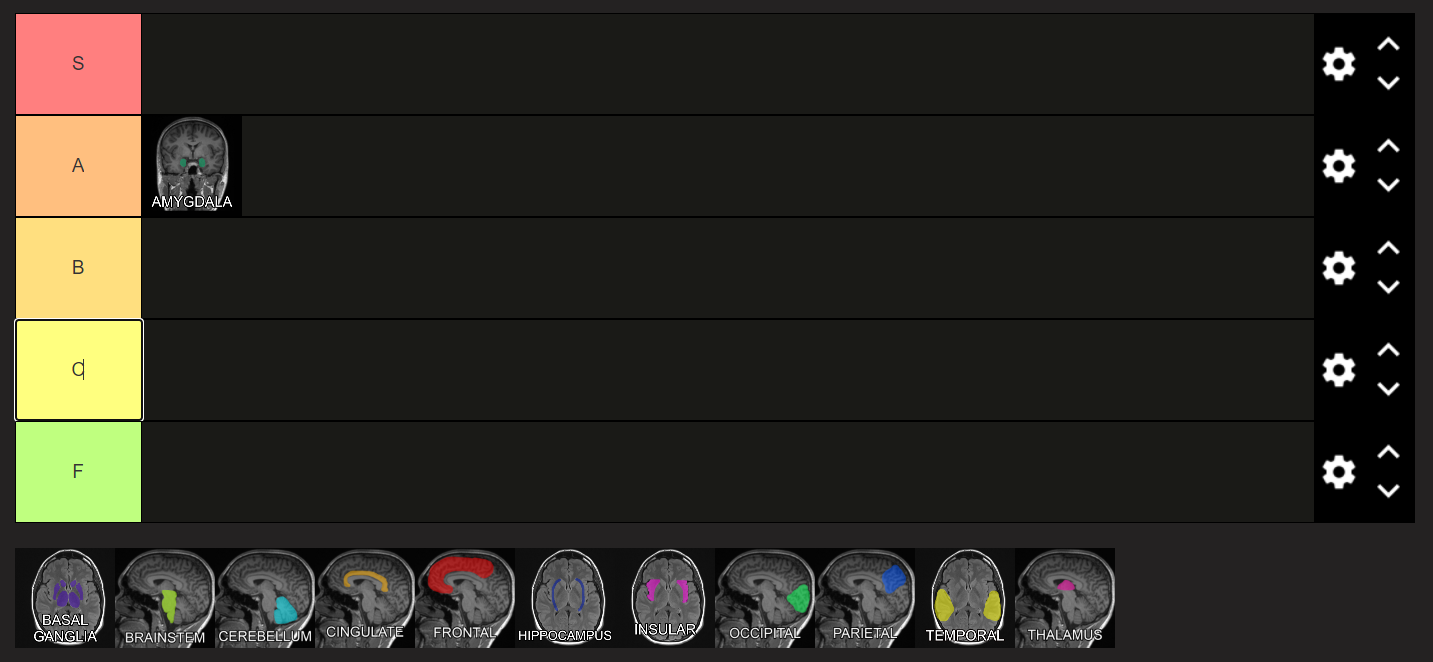
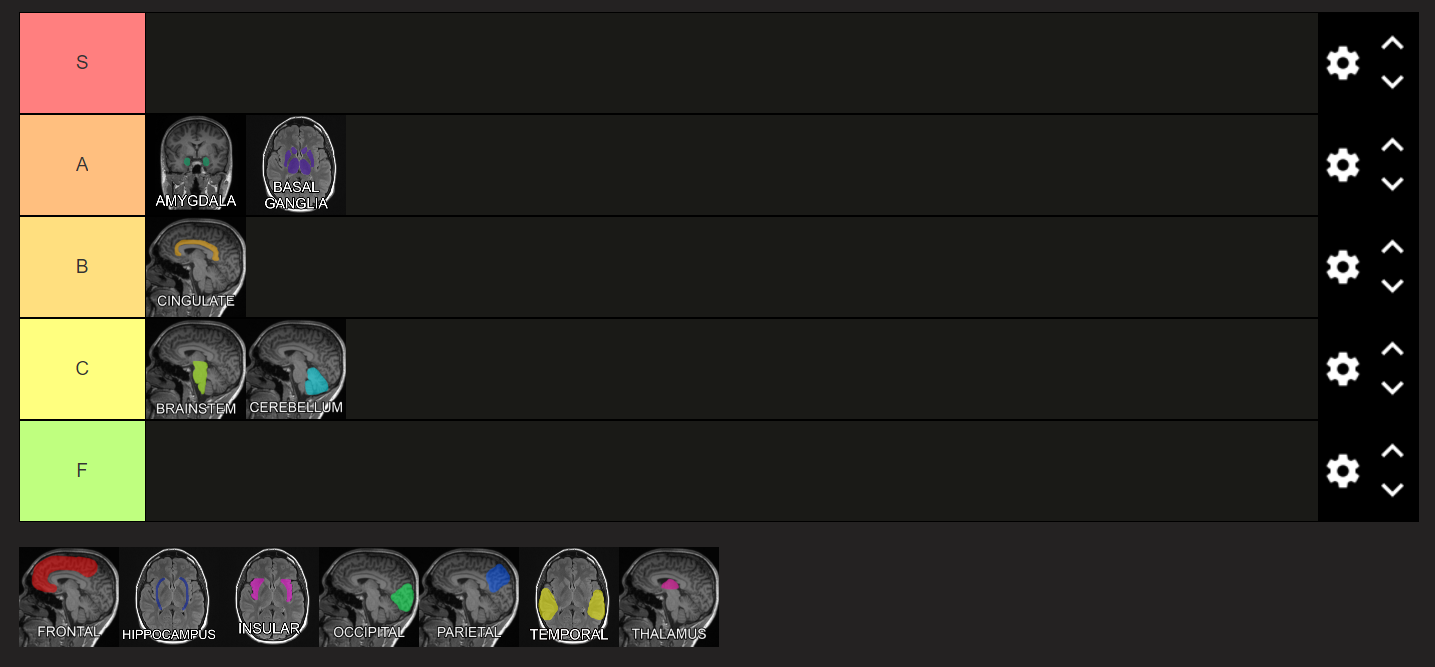
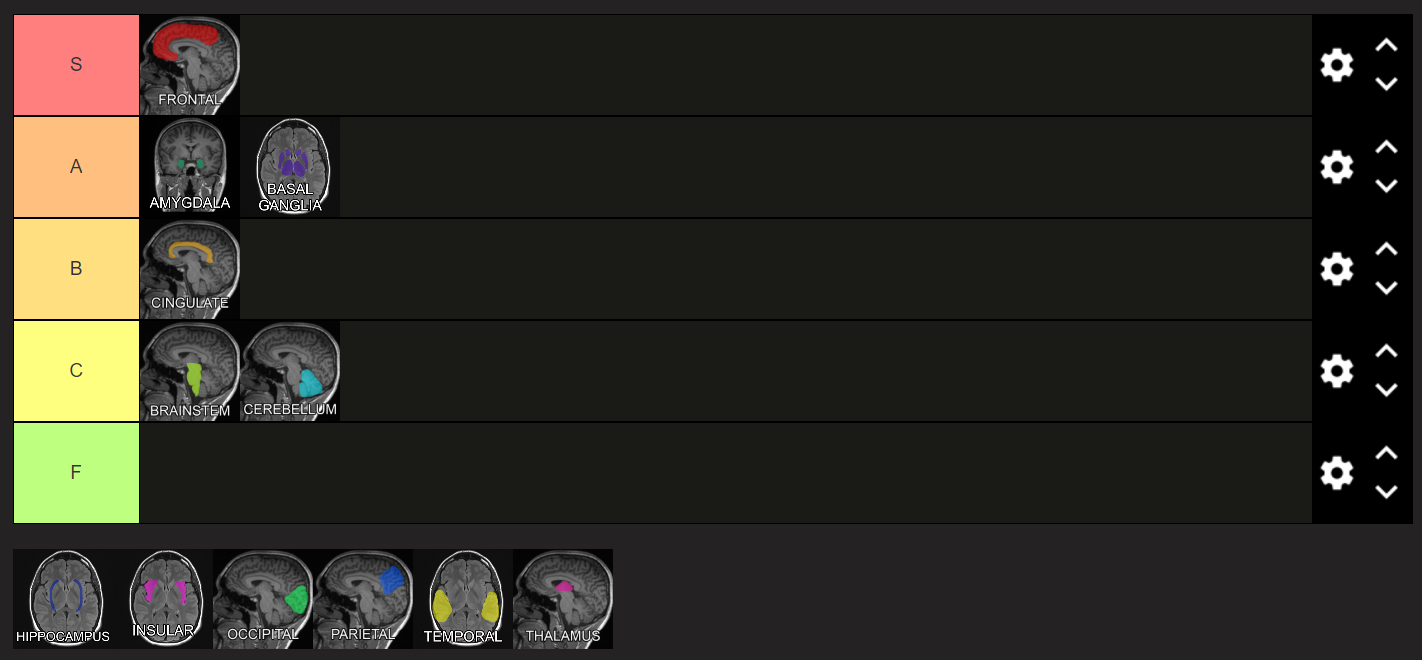
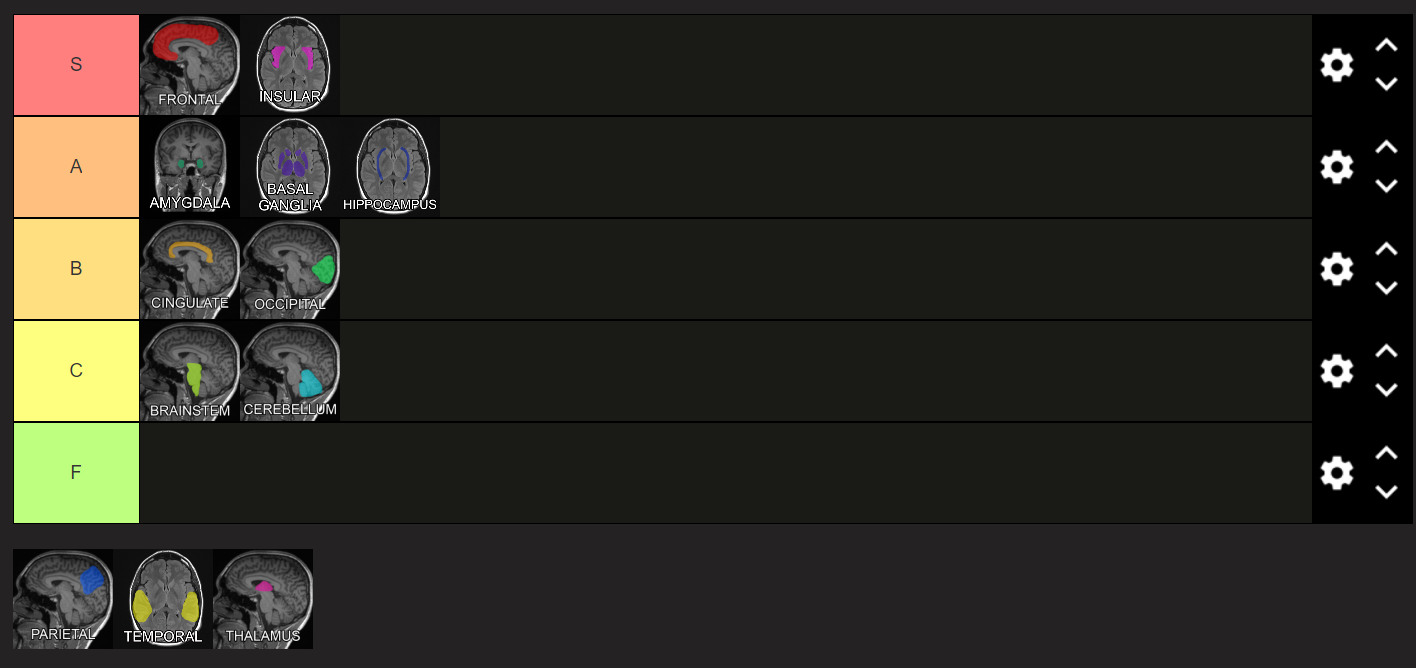
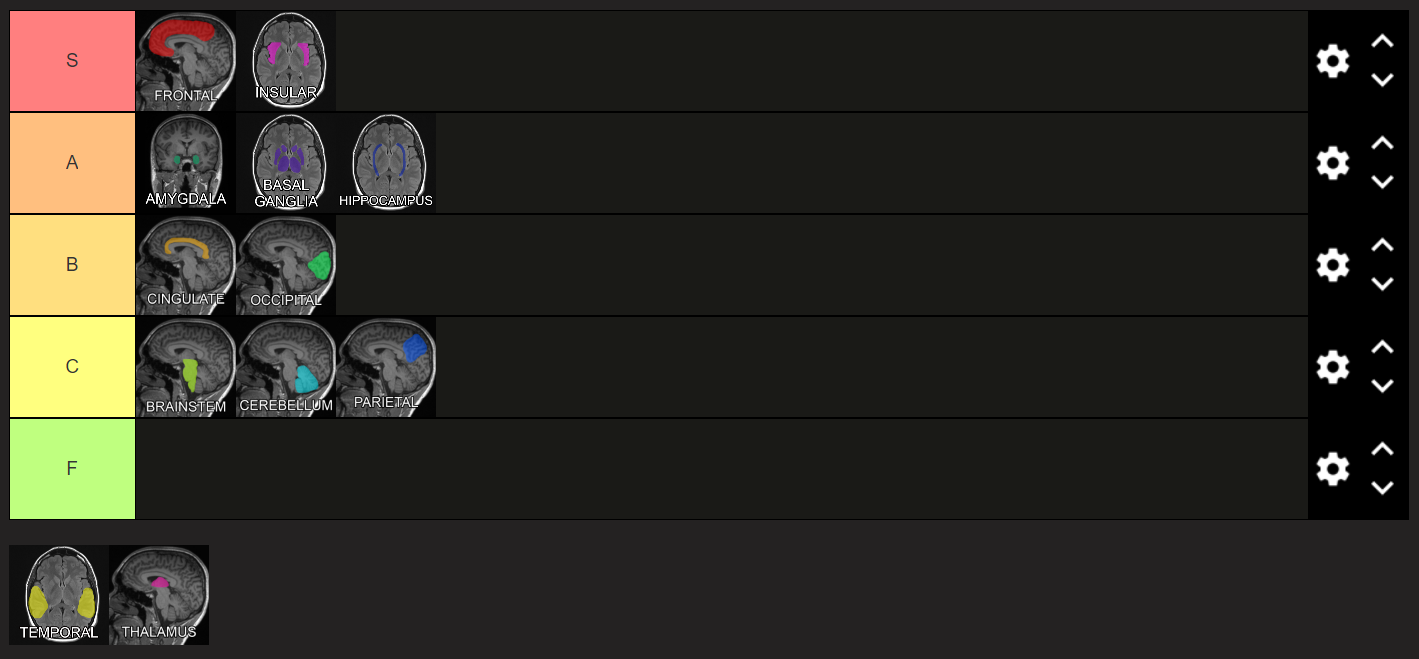
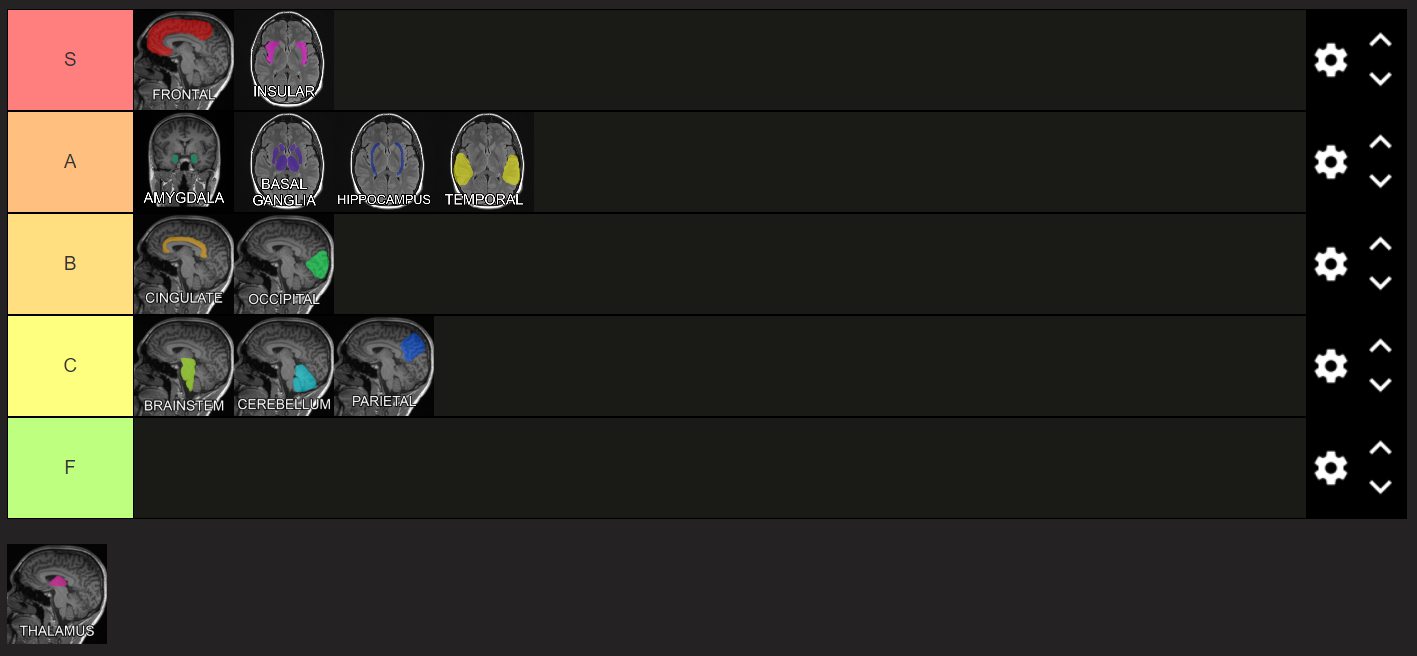
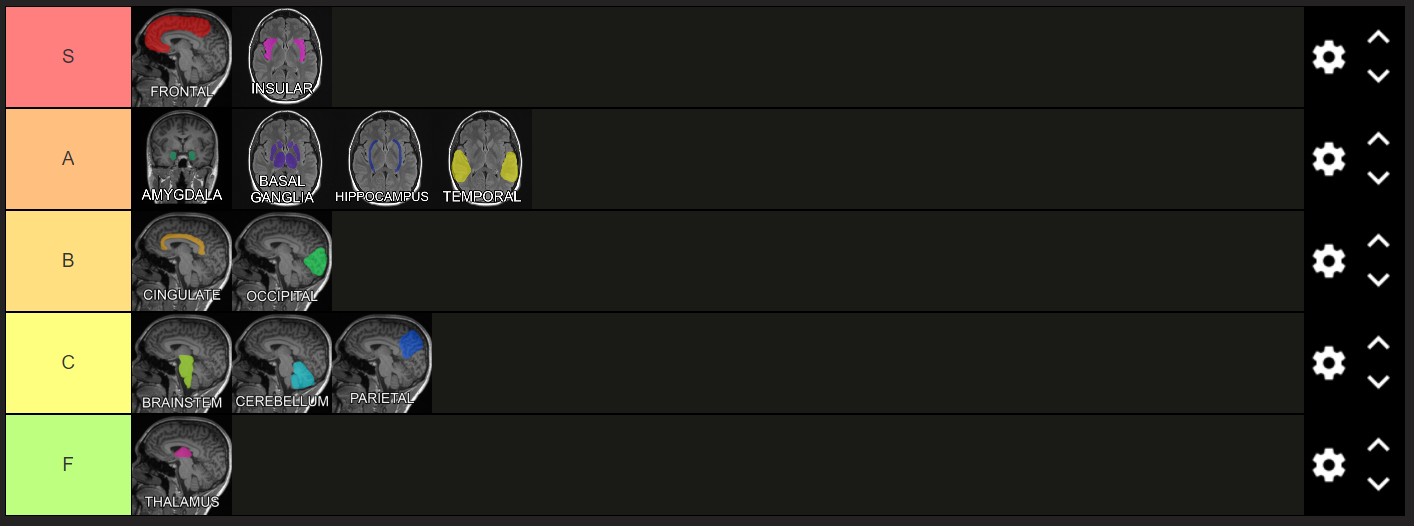
Okay, guys. It’s the end of the semester and my brain is kind of fried. That being said, it would be fun and informational to rank the human brain regions. I used Tiermaker, and this is how I define the different categories. Feel free to make a tierlist yourself before you read the rest of the article to see how our rankings match up.
S tier: coolest brain regions. iconic amazing perfect
A tier: pretty interesting but just missing that star quality, y’know?
B tier: it’s fine. a little boring maybe
C tier: boooooooring
F tier: I have personal beef against this mound of fatty squishy brain tissue
Let’s go!
Amygdala
A tier. Really interesting in that it’s involved in so many circuits (fear, memory, even smell!). If you didn’t have it, you wouldn’t be able to avoid harmful situations–famous patient S.M. had her amygdalae removed and she wasn’t able to get scared at movies or notice when people were robbing her! She’s kinda been pop cultured to death, though…everyone kinda already knows her deal. She needs to bring something new to the table.
Basal Ganglia
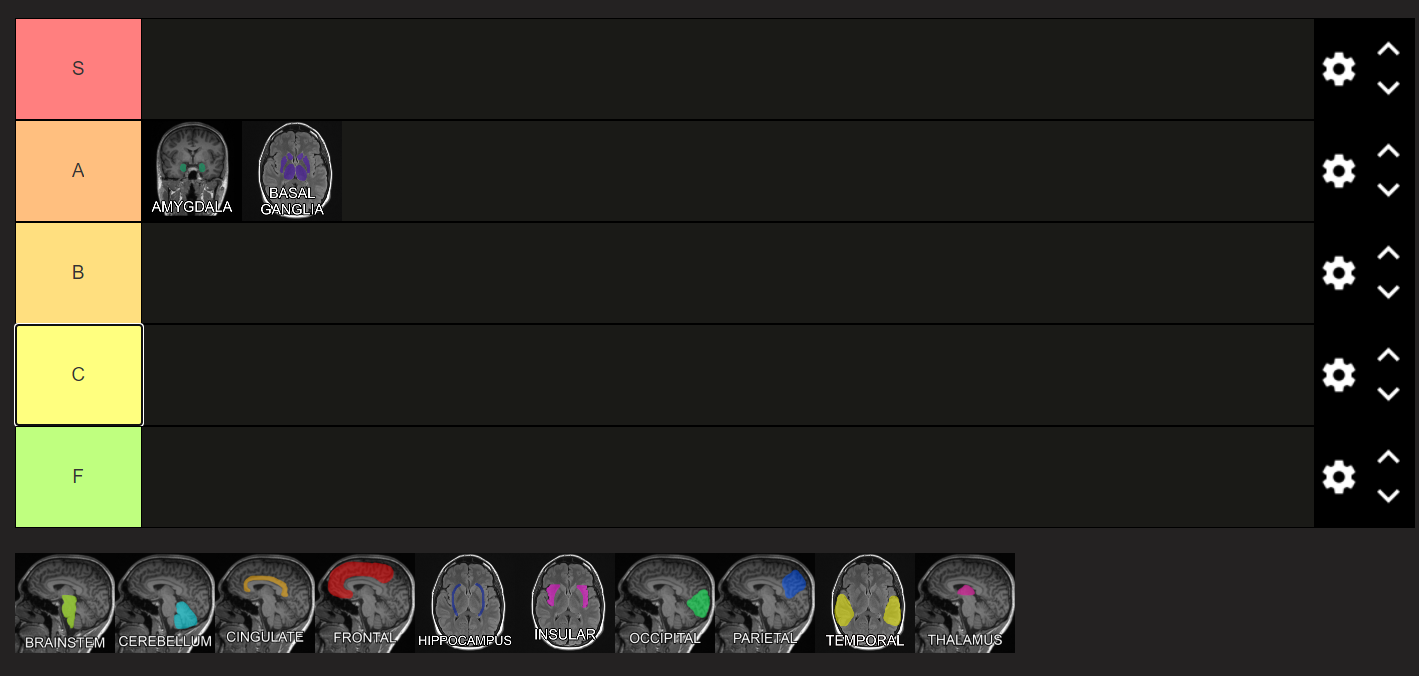
A tier! Okay, I’m gonna say it, I’m biased! This is the area of the brain I research in lab. The basal ganglia isn’t well known outside of neuro circles, but ganglia just means a collection of nodes. This little string of pearls is near the center of our brain and controls voluntary movements while stopping unwanted movements. When things go awry, you can get tics, difficulty moving, or tremors. Think Parkinson’s disease or Huntington’s disease. The basal ganglia is a beautifully complex brain region, but she’s a little hard for beginners to understand. God knows I’ve had many headaches trying to wrap my head around what goes on in here.
Brainstem and Cerebellum
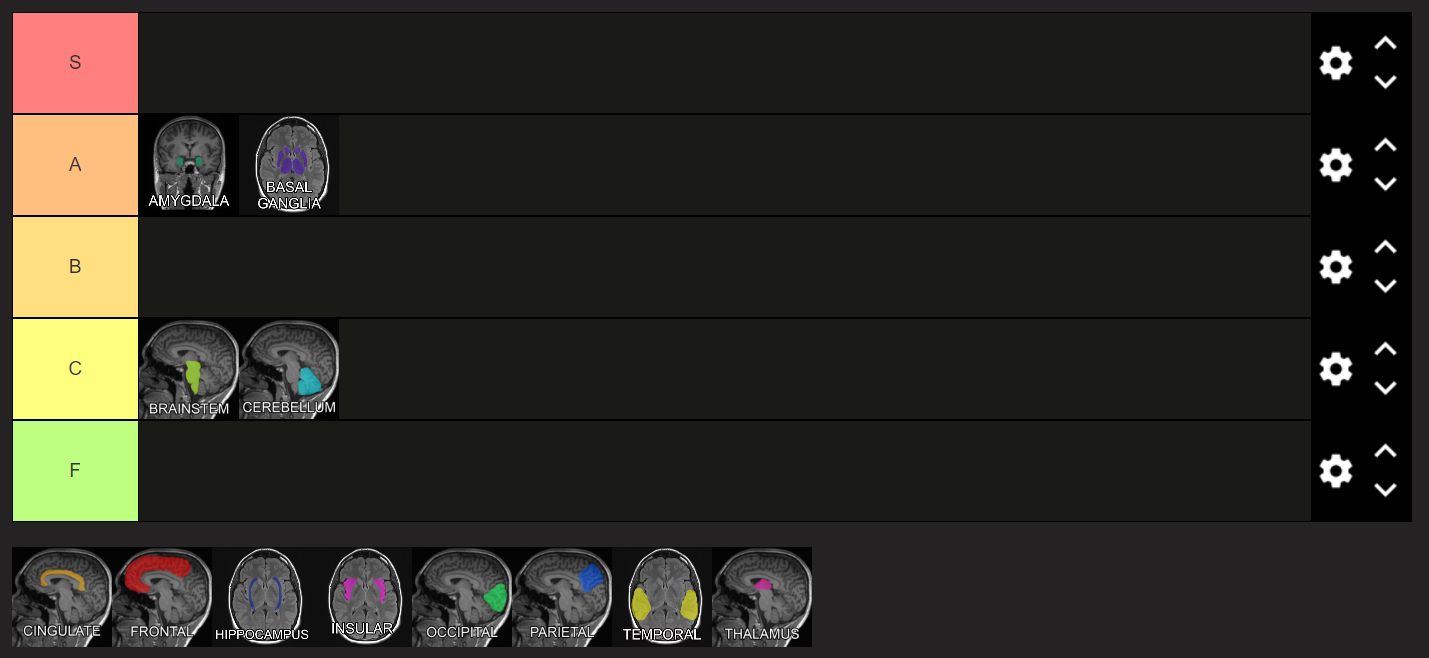
Grouping these 2 together in C tier feels right. Sure, these two play crucial roles doing (brainstem) and coordinating (cerebellum) movements, but these are pretty basic hardware found in pretty much any animal with a centralized brain. These were the first brain areas of the brain to evolve, after all, and they’re the first parts of the brain to form in a human embryo. I’m just saying that you praise basketball players for dunking, not for knowing how to dribble. Too simple.
Cingulate (cortex)
B tier because while I’m really intrigued by it, I always forget all the bajillion things it’s involved in. This gyrus stretches from where the frontal cortex is to the somatosensory cortex (senses), motor cortex (movements), and corpus callosum (connects the two halves of your rain). So, it’s involved in a ton of circuits relating to the way you behave and feel. It’s a part of this cool club called the limbic system, which makes you feel emotions and effects your motivation, learning, and memory. This system also includes the amygdala and its origins are also pretty far up the evolutionary tree, so it’s got retro vibes. Groovy.
Frontal LobeS tier! What is there to say about the frontal lobe? She’s pretty much the it girl in pop psychology at the moment, and it’s hard not to see why. Young Gen Z on the internet love to use the fact that their frontal lobes aren’t mature yet as an excuse for everything–and can you blame them? This area of your brain controls decision-making, goal-setting, and is also involved in self awareness, cognition, and memory too. She can do it all! Your frontal lobe helps determine your personality and controls pretty much any voluntary movements you do (that’s pretty much everything that isn’t hearts beating or intestines squelching). And she is definitely not making me rank her at the top. Absolutely not. I have control. But if my sense of self is determined by my frontal lobe then can I truly be separ–
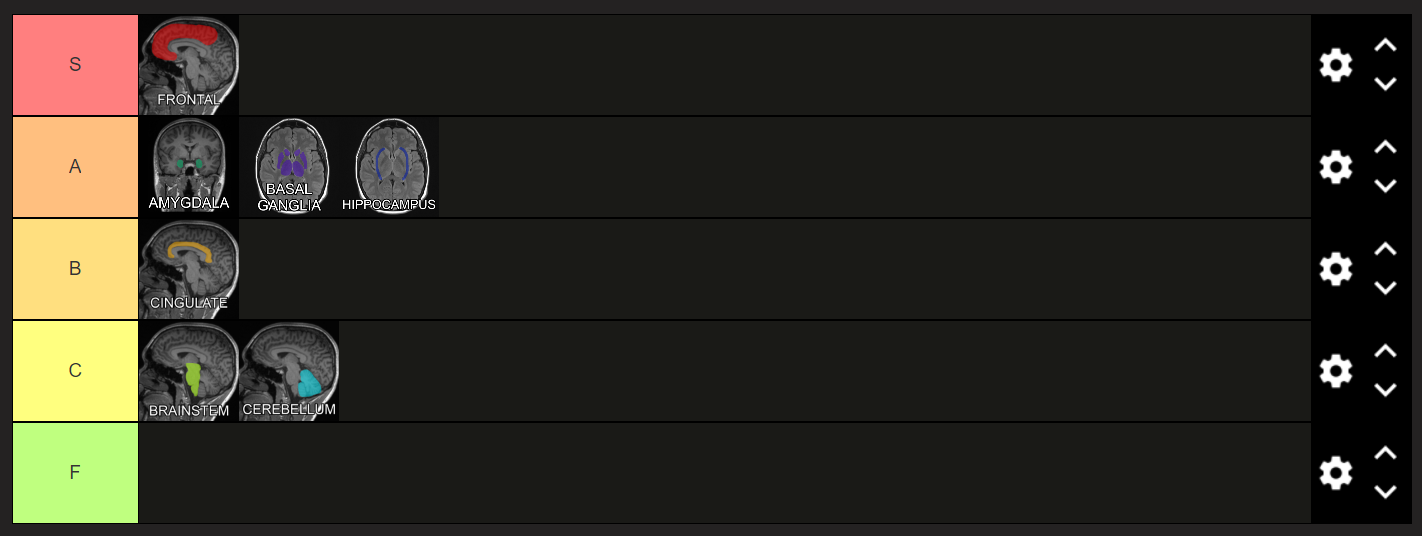
Hippocampus
A classic girlie! One of the first to be really understood, so an A tier feels right. Don’t underestimate the svelte size of this structure in this picture–this area may have been named after the Greek word for “seahorse”, but he has a mighty function. Our memories are formed in the hippocampus, which also acts as a hub for us to remember stuff later. He specialized in one thing, and he does it well! Would be S tier, but I seem to misplace mine around finals.
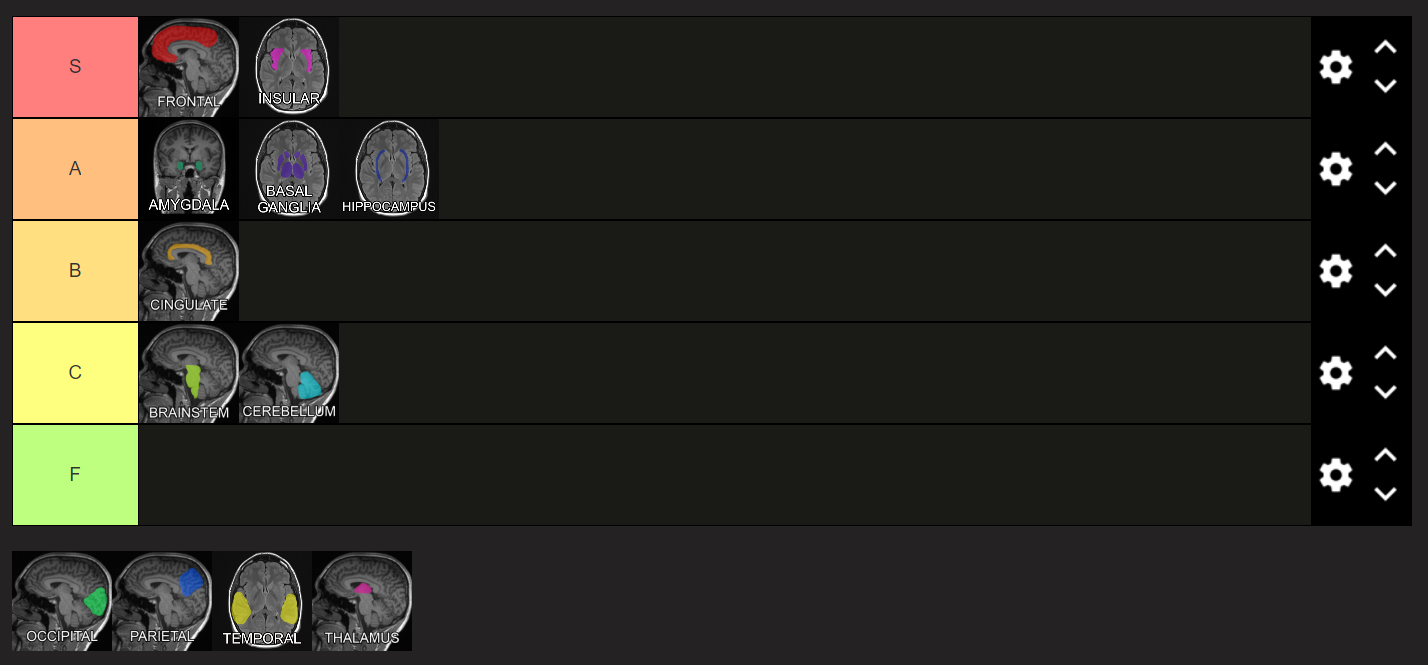
Insula
This one’s an underrated classic! The insula is a region inside the brain under the cortices that’s involved in smell and taste. It is also the area of our brain that helps us feel our organs and know what’s going on under our skin, a “sixth sense” called interoception. This area is still poorly understood, which means it has an air of mystery about it. But what we do know is really cool and spooky. S-tier.
Occipital Lobe
B tier. Not much to say about this one. It helps you see!
Parietal Lobe
Out of the “big four” lobes of the brain (frontal, occipital, temporal being the others), the parietal lobe is the most forgotten one. Every time I think of what it does, I think sensory, maybe? And that is what the parietal lobe does. A lot of sensory information is processed here–in particular, touch, temperature, and pain. All three together are called somatosensation. But honestly, “processing” sensory information is not the most interesting to me. C tier.
Temporal Lobe
This lobe is best known for housing the language centers of the brain (Broca’s area and Wernicke’s area), but it’s involved in so much more! The amygdala and hippocampus are inside this lobe, so fittingly, this one also goes into A tier. This lobe is not just language, but also memory, social functions, emotions, and even some vision! This is because this lobe is just so large and connects with so many regions. The back end of the temporal lobe is right next to the occipital! If you’ve ever heard of synesthesia, people who have it often have more connections between their temporal and occipital lobes. Accordingly, the most common subtype of synesthesia, where sounds are associated with colors, is colored hearing. This lobe is just really cool–and as much as we know about it, we’re still finding new things out all the time!
Thalamus
F-tier. F-tier! Look–I love the brain. That’s why I decided to spend 4 years studying it. That’s why I want to research it when I graduate. But this tiny tiny area is the whole reason I wanted to add an F tier. This area of the brain is like a relay hub where pretty much every area of the brain connects to. That sounds great, until you realize there are hundreds of nuclei (neuron groups) that scientists have identified that do all sorts of different things with about six or seven different separate pathways. There are so many that we’ve had to group them into the anterior nuclear group, the medial nuclear group, midline nuclear group, intralaminar nuclear group, the lateral nuclear group (not to be confused with the ventral lateral group), and so on. Confused yet? This is the most annoying thing about neuroscience to me, and the thing that I feel like puts people off studying the subject. Because who wants to memorize all that? Anyway, if you disagree, you drill all that into your brain for a Neuroanatomy class and get back to me. Take it up with my 97 card “Thalamic Nuclei Groups” Anki set.
Well, here’s my final ranking! How did it match up to yours? Did you learn something new? At least, I hope it made you think of the jelly stuff in your skull a little differently.
The Georgia Tech Research Option is available to all undergraduate students in the College of Sciences. It includes the completion of an undergraduate thesis. Students who choose to take on all this additional work are generally considered a bit sick in the head. Through these diary entries, I hope I can provide some insight into the joys and trials of completing this process. Particularly, for those who (for some reason) want to take on the same path.
August 24, 2023
Finally figured out the direction that I want my thesis to go in! This has been stressing me out quite a bit, so I’m glad I’m able to figure things out. I talked with my PI and we sort of figured out that I can do a project that combines the calcium sensors our lab has been developing and the dopamine recordings in freely moving mice that we’ve been doing. There’s still a lot of directions this project can go, but this sounds like a good place for me to start thinking (and just as importantly, looking at sources for the background section of my thesis). What I found super helpful is that my PI gave me a set of next steps if I want to pursue this project, which alleviated a lot of my uncertainty. Here they are:
Get trained on stereotactic surgery (mouse brain surgery)
Learning how to run and handle mice in our behavior rig
Injecting mice with whichever thing we want to test (probably dopamine and the sensor at first)
Running in vivo experiments
As you can see, running experiments is step 4, after having to learn a lot of other stuff. Hopefully, I’ll be able to start that step in October/November, but if not I should be able to do it in spring.
We also discussed how there’s a huge gap in the literature that I honestly hadn’t really considered: we don’t really know how dopamine impacts the excitability of neuron populations. This seems like something really basic to the field, but we haven’t really had the tools to measure it until very recently. I don’t want to get too deep into the particulars of the field, but basically I’m glad that we’ve found something that I can reasonably say fills a need in this field of research. In addition to that being a required part of my thesis’ introduction, it makes me feel a lot more passionate about the work. I think a big challenge of this thesis will be staying motivated as the going gets tough, so this is good.
My next steps will be to get trained on the techniques I’m planning to use and look at some papers for background.
——————————————
October 6, 2023
I have been super busy this past month and change. I have been practicing stereotactic surgery, which has proven to be really hard. While I’ve been working on experimental techniques, I’ve also been reading a ton of articles.
Right now, I have around 25 articles in my Zotero (research sorting app), and I’ve read about 7. Although I’m improving in my ability to read research articles, it’s still taking such a long time.
Now, my literature review is due in two days, and I haven’t read all the papers yet. However, since it’s just a draft, I’ll try to use the background section of my PURA proposal as a base for it. I’m going on a trip tomorrow, so I really don’t want to work on it during my trip.
I’m going to work on it now and just submit the draft. This thesis process has taught me to just turn something in, even if it isn’t perfect.
————————————–
November 4, 2023
Well–I think I’m at the point of the semester where it all feels like I’m fighting an uphill battle. Looking at my 4 step plan from August, I’m still working through step 1. My plan of conducting actual experiments in October was a little too rosy. One thing that’s slowed my progress is that although I’ve been practicing mouse surgery, I can only pretty much do one mouse per week. I share the surgery room with other people in the lab, and with scheduling around classes and other lab tasks, that’s all the time I have for practice.
Still, I feel like I’m making progress, slow as it is. This week, I’m going to be doing my first survival surgery, which is one step closer to being able to put in implants and biosensors into mice.
On the writing side, it’s time for me to revise my lit review, introduction, and work plan and put them together. It’s also necessary for me to get all three (all together they’re called the proposal) signed off by my research advisor and second reader. Honestly, this part kind of scares me because I feel like I haven’t gone in depth enough for my lit review in particular. I’m meeting with my advisor later this week to show him my proposal, so I’ve got to get working on this today and tomorrow (the weekend). Currently feeling stressed out. But I keep telling myself that it’ll pass.
The thing is–I really like doing research, and I find reading articles and learning more information about the topic interesting. But deadlines and expectations always scare me. Even so, I’m trying to tell myself that I have all the tools I need to succeed. I just need to be patient with myself.
———————————–
December 1st, 2023
Well, I’ve basically done all my revisions. My readers gave me some really helpful feedback, and it turned out that my proposal was in better shape than I originally thought. I just need to check some of the formatting, and then I’ll wait for the approval form to come out so I can submit it.
One thing I noticed–that I also talked to my advisor about–is the fact that when I’ve been working on my thesis, it’s made me think about why I am doing what I’m doing. Like it’s simple enough to say I’m working on a project that uses a biosensor, but when I started writing, I started thinking more about the details in a way that I never really did while just doing bench work. Why do we choose this type of biosensor? What gives our approach the advantage over another? In what way does our experimental setup even work?
I think as undergrads, a lot of stuff is technically really complex and hard to grasp. So the researchers who are mentoring us simplify things so we can get a general gist of what’s going on. But when you’re writing your own thesis, or even making a presentation on your research, you’re encouraged to delve deeper into the reasoning behind what you do. And in that way, I think I finally kind of understand why a thesis was put into the curriculum of the research option.
As the semester is nearing its end, I’ve been thinking a lot about what I’ve done so far. And I feel like while I’m behind on my work plan, I still feel proud about what I’ve accomplished. It’s just an undergraduate thesis–I’m not really expected to produce groundbreaking. Still, I feel like the skills I’m learning (reading journal papers, scientific writing, study design, coordinating with my research advisor) are going to be really helpful in the future.
Or, maybe I just feel like this because the pressure is off, for now. I’m going to put the final touches on my proposal now–see you next semester!
Here is my followup to this article–the finale of my undergrad thesis journey!
As STEM majors, if you look up helpful apps to help you while studying or writing papers, you’ll get a lot of listicles of apps that fall under a few categories:
Costs money (or hidden costs)
Does the same thing as a bunch of other apps. Most everyone already has a note-taking method, to do manager, or calendar that they already are comfortable using. Why use a new one?
Way too technical and hard to understand
Instead, I’ve compiled 3 apps that add value to your life in the following ways:
Free
Works as well/better than paid alternatives
Takes less than 15 minutes to set up
Let’s get it started!
Anki
An example of an Anki flashcard from kenhub.com
I was team Quizlet since middle school, but the increased monetization has really driven me off the platform. This past year, I started using Anki, a free app that’s not only a good replacement, but an improvement.
This app isn’t pretty–but if you look past its boring UI, you’ll find a gem of a tool. Here’s the highlights:
Basic UI + open-source software means it’s very customizable. With a few enabled settings, you can use it to study almost any kind of content: learning languages, doing physics practice problems, anatomy flashcards, and more. There are different mods you can add to your software to make it work better for you.
You can spread out studying over a longer period of time, so you retain info better!
Unlike Quizlet, Anki lets you set deadlines for cards depending on how well you know the content.
Naturally, you’ll end up studying the stuff you don’t know for much longer, saving you time!
So many stats: the app tells you which cards you’re better at, tracks the time you spend studying, and even notes which time of day you answer most accurately.
Zotero
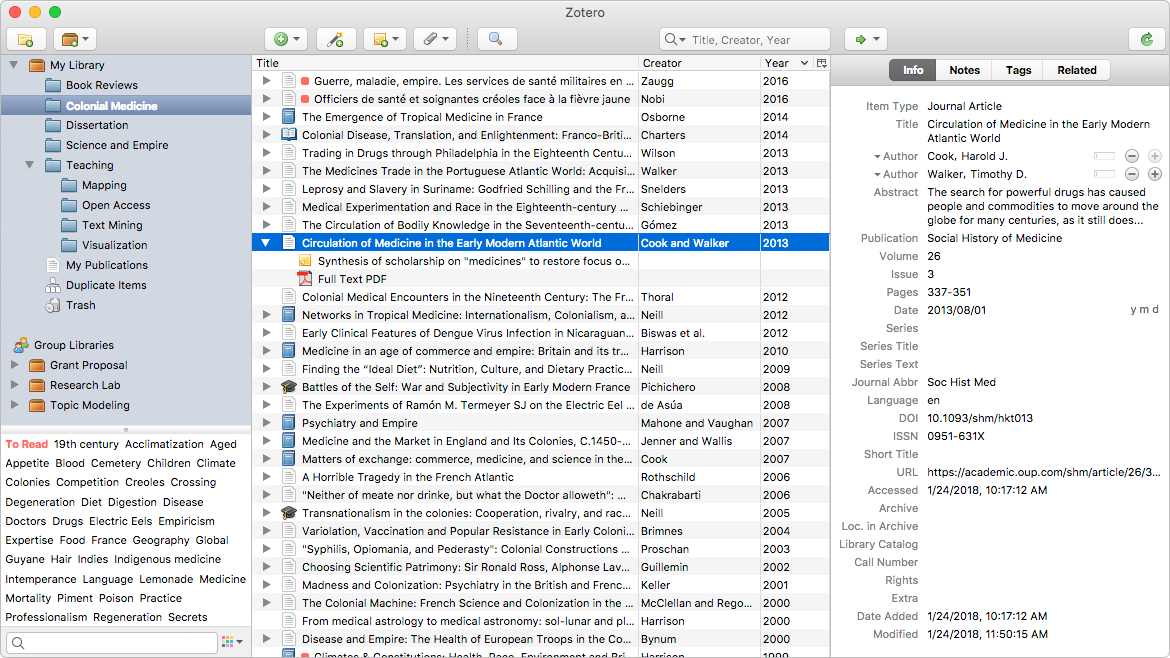
An example of a Zotero library from zotero.org
No more keeping urls to your research sources in some random Word doc! Writing term papers and research essays has been one of my hardest struggles in college. It can be overwhelming to have to consume a bunch of research and analyze it in a meaningful way. Make it easier for yourself with Zotero, a “personal research assistant” that organizes sources for you. This tool is used by lots of people in academia, but not many undergrads know about it. Here’s what makes it great:
It’s easy to add sources! You can use the browser extension to add an entire source with just a click.
Once the source is added, all the information is downloaded: bibliographic information, tags associated with the work, a snapshot/pdf of the work
If there’s a pdf of the work, it’s saved locally to Zotero and you can take notes/highlight in the in-app pdf viewer!
Integrates with Google Docs and Word, where you can quickly add in text citations or a bibliography at the end of your writing
ResearchRabbit
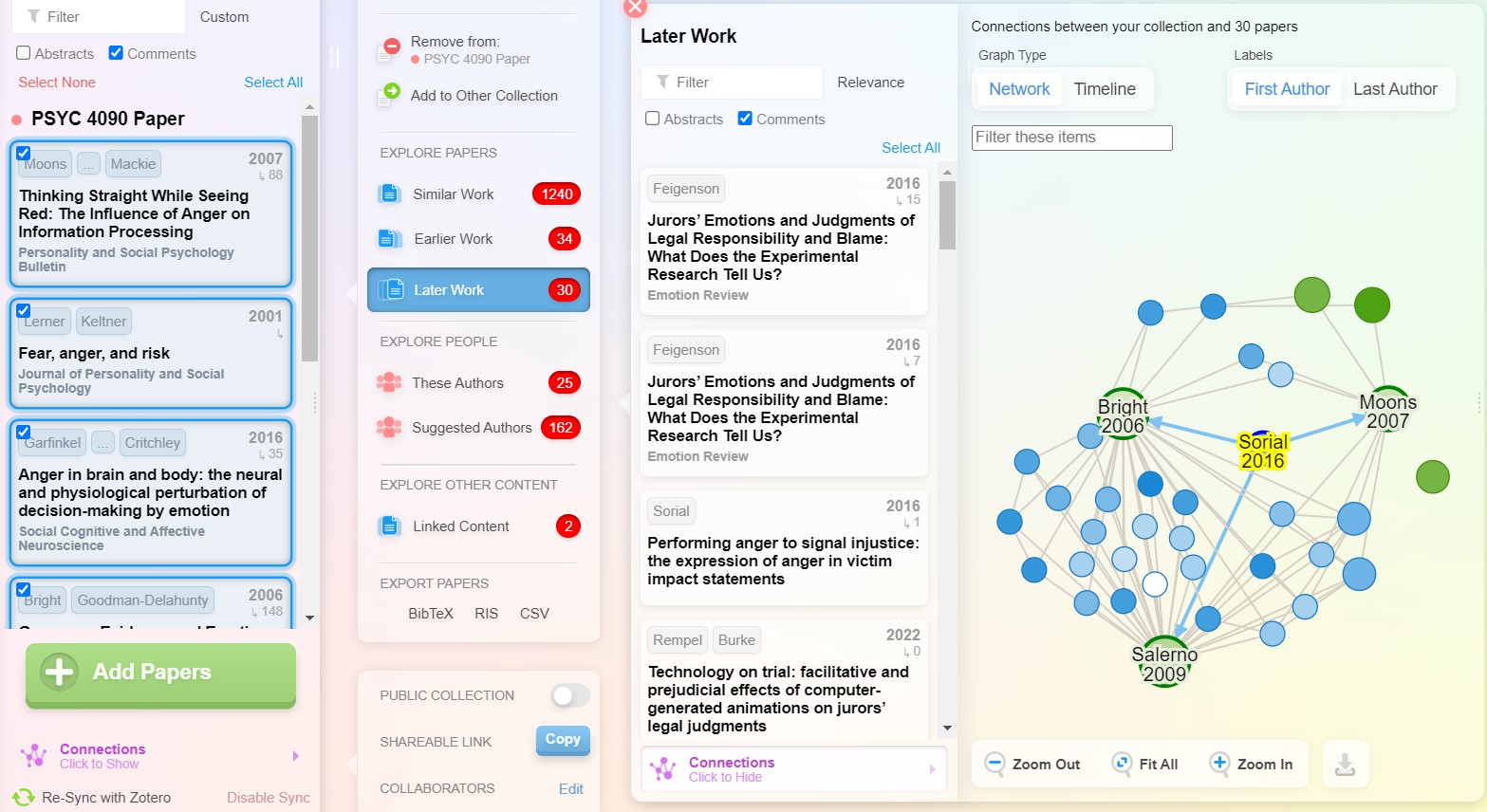
A connection map that ResearchRabbit generated for one of my term papers.
What does it mean to do a “thorough review of the literature”? That phrase can be daunting for undergrads. I don’t know about y’all, but when I’m usually starting a term paper, I don’t even know what I don’t know. Are these papers I’m using representative of the current research? This tool (researchrabbit.ai) gives you suggested papers, and it lets you see how popular your sources are in the field. Here’s my favorite features:
The coolest UI that makes it so easy to use
Visual maps help you “see” the impact of the sources you’re citing
The option to look at “similar work” and “related work” helps you find other sources, especially if you want to look at the current state of the literature
These tools have been really helpful for me this year, and I hope they can help y’all too! Give these a go to help you work smarter, not harder. Good luck!
This semester, I started doing animal work in a research lab that uses mice as model organisms. Every time I’ve explained my training to other people, I usually get a shocked response. And I know this isn’t a common thing people do, so I wanted to give y’all a look into what it’s like working in an animal lab.
The lab I work in does research using a technique called optogenetics. Opto- means light, and genetics refers to the DNA that is changed. This might sound straight out of a sci-fi novel, but by infecting a certain brain area of healthy mice with a special virus (this doesn’t make the mice sick, by the way), the virus can insert a list of instructions written in DNA into the mouse’s own DNA. These instructions tell the cells to start producing light-sensitive proteins in their membranes.
Now, this has a very important application in neuroscience. Neurons, the unit cell of the brain, fire tiny electrical signals called action potentials. If a neuron has light sensitive proteins that respond to blue light (channelrhodopsin), it fires more often. If it has light sensitive proteins that respond to yellow light (halorhodopsin), it fires less often. Using optogenetics, you can directly measure how activation of a brain area leads to behavior in real time.
So how does that factor into what I do? So far, I’ve worked on an often-overlooked but important step: collecting samples. After you inject the virus into the brain, there’s no way to check in the live animal that you did it right. You might have put the virus in the wrong place, or the virus never got its instructions to the cells, or the equipment might be broken. The only way to know for sure that your procedure worked is to take samples of the brain, and look at them under the microscope.
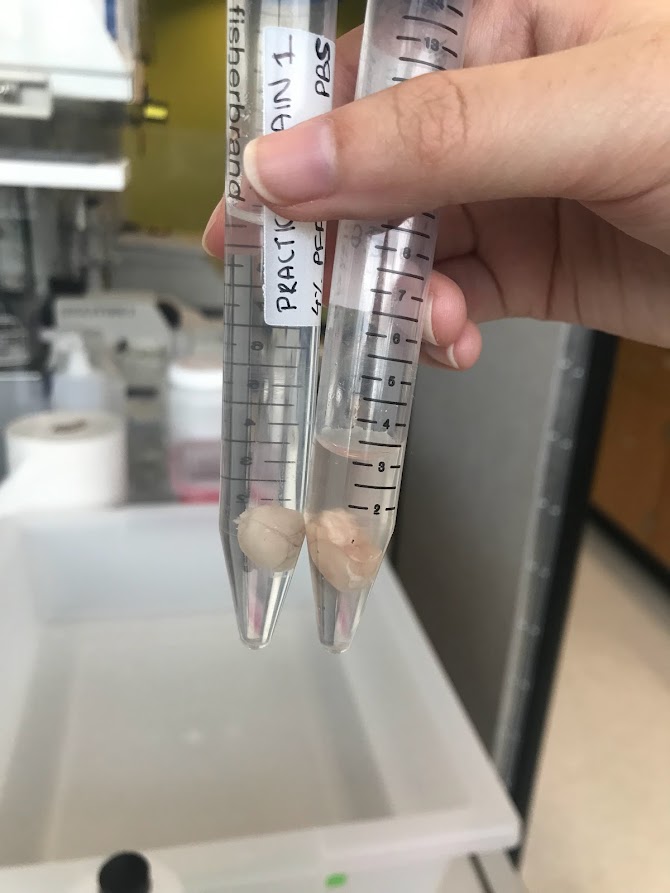
To do that, we first need to collect the brains. Through a process called perfusion, the brain gets fixed in paraformaldehyde (PFA), a safer version of the formaldehyde you might remember from dissections in biology class. During drop fixing, where the brain is severed from the spinal cord and removed from the head, we store it in a test tube with more PFA.
Two mouse brains in a solution of PFA, each in its own test tube.
After 48 hours, the brain is ready to be sliced. There’s a lot of ways to take brain slices, but we use a vibratome. First, we locate the area of the brain that we’re trying to reach. This is where a mouse atlas comes in handy. Using a small, vibrating blade, we make slices of 50 microns–or around the width of a human hair! These slices are then stained with dyes like DAPI (which makes neurons look blue) and placed on microscope slides.
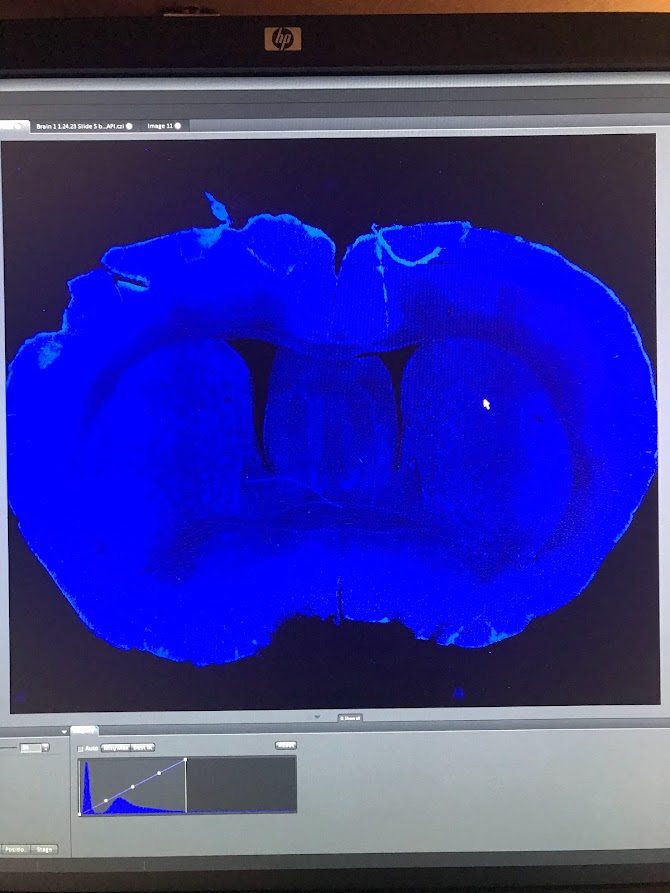
Finally, after all this work, we can see the fruits of our labor. In our lab, we use a confocal microscope because this type of microscope can show us thin layers of cells within thick layers of tissue. Using different colors of light, we can also check how well the light sensitive proteins were able to grow in the area of the brain we’re interested in. In the picture below, you can see the first picture that I took myself from a brain I perfused and sliced. There’s no injection in this brain, so it’s as close to a “natural” brain slice that you can get. The blue color is from the DAPI dye, which indicates the location of DNA in a nucleus. So, each tiny blue dot is a neuron.
A microscope image of the coronal slice of a mouse brain, with thousands of tiny blue dots representing individual neurons.
It was hard to describe the first time I saw this image. Yeah, there were some nicks and tears in the tissue (my hands were shaky during the perfusion), but this was something that I had wholly produced myself. And now, in front of me, was a snapshot of all that this mouse was.
See that little butterfly shaped area in the middle of the brain, right above the hole in the middle? That’s the hippocampus, where every memory is scrawled in your brain through a network of neurons. What mousy memories were kept in there? Looking at this picture, I can almost imagine what it would have been like in there when the mouse was alive. The holes in between and to the side of the “wings” are ventricles, gaps in the tissue where cerebrospinal fluid carrying nutrients and hormones was kept. I can almost imagine waves of it washing over the hippocampus, keeping this great curled machine firing, shooting sparks of electricity in patterns that say I am alive. I have lived. Here is what I have seen, heard, smelled, touched, tasted, hated, loved.
To be honest, this work can be kind of sad. After all, all life is precious. Sometimes, it can feel almost gruesome. To perfuse a mouse, you stick a needle of fixative into its beating heart, so it evenly diffuses and preserves the entire body. The night after I read this protocol, which had a video of this process in high definition, I felt almost too nervous to sleep. When I closed my eyes, I just saw that mouse heart beating out of its chest, beating, beating, beating…
The next morning, I admitted to my principal investigator that I wasn’t sure about trying out the perfusion that day. “Everything else, I’m okay with, but the way you can see the heart pumping freaks me out. I still want to try it, but…”
He nodded. “You never really feel comfortable with this part of the work.”
After a moment, he added, more seriously, “and that’s a good thing.”
Testing on animals is a controversial subject, and I can’t claim to have the definitive opinion. But, I think my experiences give me a special point of view. In the animal labs at this institute, the animals are well cared for. Until the last day they’re with us, we treat them with respect, care, and even love (what else do you call grown adults cooing at a 2 inch long mouse washing its tiny little face with its tiny little paws?). There’s laws, regulations, committees to ensure that animals are treated ethically. They’re given pain medications after surgeries, and during procedures (surgery and perfusions) they’re put under anesthesia. Once, our lab manager stayed in the surgery room with the mouse she was operating on until night fell to make sure she was there to care for him when he woke up.
And yet, we have to sacrifice these animals in the end, and we have complicated feelings about it. I think that’s good and necessary. If we feel sad at the animal’s death, we treat it well when it’s alive. If we feel a bit of horror at watching its life painlessly bleed away in the dissection pan, it means we placed a high value on that life in the first place. We try to perfect our surgical skills, write better protocols, and design better experiments to minimize mistakes and the number of mice who have to undergo this process. I would much prefer that than to become cold and callous.
Because the truth is, we don’t have a better process to study the brain in vivo. Treatments for neurodegenerative disorders, like Parkinson’s and Huntington’s (two diseases targeting the brain area our lab studies), mental illnesses, and mental disorders lag far behind those for many other parts of the body. And the simple reason is that we often can’t get into the nervous system to study it without causing permanent damage. Until better options arise, this is the best way to perform this life-saving research.
Whew. Things got really serious there. But working with something as big as life and death all the time makes you think about big questions. For me, ultimately this type of research is justifiable: this is the only way to validate that the research being conducted is working properly. It’s the only way to make sure that all the weird situations we put mice in weren’t done in vain. And getting to do every step of this process, going from a live mouse to a bright image on a screen–that’s something really special. Through that intricate picture, you can almost see something persisting, living on…helping us unlock the secrets of the brain. There is something to be said, here, about loving something by studying it: giving it all your attention while taking notes, appreciating the simple symmetry of the brain slice, using the gentlest touch to mount delicate tissue onto slides, admiring the natural structural variations that nature gifts every body and every brain.
Finally, I want you to think about your daily life, and the laboratory animals that made it possible. How many medications did you take today? What about cosmetics? Vaccines? Animal testing was where many of them began. One funny thing I’ve noticed recently is that researchers who work with “animals” tend to be the most adamant about using the term “humans and non-human animals”. Other species of animals are intertwined with us in inextricable ways. And there’s really no way to really convey my gratitude to a species that can not understand it.
Yeah, I got my brain scanned for science. And you should too! (If you’re eligible, that is.)
Basically, I got an MRI scan of my brain done recently as part of a study at the GT/GSU Center for Advanced Brain Imaging (CABI). And while I was kind of nervous about the process, I wanted to write about the experience to help other people. If you’re about to get an MRI scan for medical reasons or for a study, I hope this article can relieve any fears or answer any questions you might have!
So, what is an MRI? MRI stands for Magnetic Resonance Imaging. An MRI machine looks like a very large tube with a donut sized hole on the end. During an MRI, you lay down in front of the donut and the technician moves you into the machine. By using magnets, the machine is able to take 3D images of your organs (in my case, my brain!). Since an MRI is so detailed and there’s no radiation risk, it is often used by doctors to detect tumors and look at brain injuries. There’s a version of an MRI called an fMRI, which shows which areas of your brain are activated. The f in fMRI stands for function, and fMRI images are able to help scientists understand how we think.
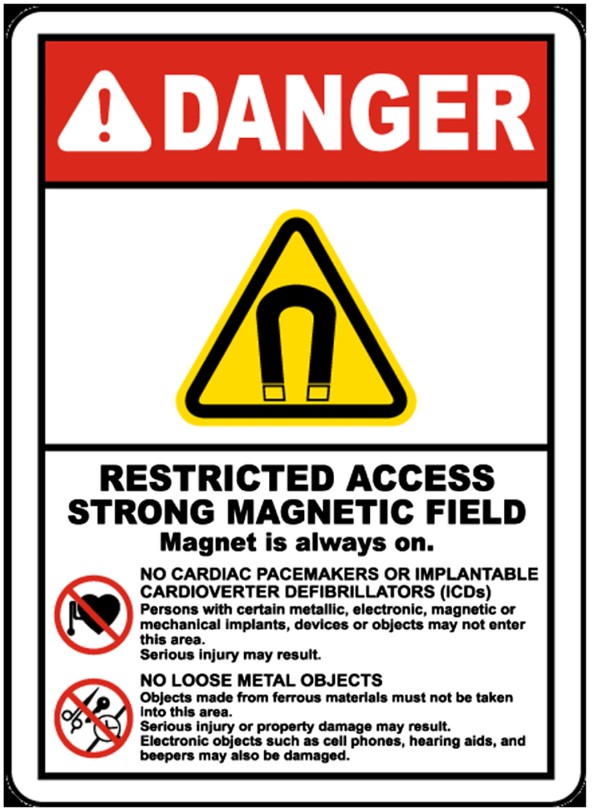
Since an MRI uses a really powerful magnet, you can’t bring anything metal in there. So, people with pacemakers, metal stents, braces, etc. might not be able to get an MRI. And when I say a powerful magnet, I mean it. The MRI machine at CABI is behind a heavy, access locked door with two large signs looking like the one on the right:
And if you have a morbid curiosity as to what would happen if you did bring in metal on or in you, check out this video: MRI vs Metal Coins (American Currency) DO NOT ATTEMPT To Replicate. Notice that just by being near the MRI, the camera goes all wonky. Some other metal things that you might not consider:
Some tattoo inks that include metal
Earrings
Hearing implants
Magnetic eyelashes
Those metal fasteners on pants
If you have any of these, it doesn’t mean you’re automatically disqualified from getting an MRI, but it’s important to bring it up to the technician or radiologist.
After I made sure I was metal free, I stepped into the MRI control room. There was a giant window where the researchers and technician would be able to see me laying in the MRI in the next room. I took off my jacket and shoes, feeling a bit jittery now. I was going to be INSIDE that giant thing.
The research assistant made her way over to me with a Vitamin E capsule and some tape. At my confused look, she explained, “Vitamin E shows up really brightly on the MRI, so we are gonna put this on your left forehead. That way, when the scans come in, we can tell which side is the left.” Makes sense to me. But that didn’t make it feel less weird when I put it on my head.
The technician led me into the MRI room, where I laid down on the extended platform. It felt like the kind of examination table they have at the doctor’s office, but it was more padded. That was to discourage people from moving around and messing up the scan. After I laid down, I felt the technician place down more padding around my head and feet. She also gave me earplugs and a bulb that I was supposed to squeeze if I needed anything once I was in the machine. As she did all this and wheeled me into the darkness of the machine, she told me what she was doing. This helped calm my nerves a lot, considering I couldn’t see what was going on.
Finally, the technician turned the machine on, and I immediately appreciated the earplugs. The beeping reminded me of an alarm clock. I heard that some people can fall asleep during an MRI, but that wasn’t me. It wasn’t earsplitting, but just loud enough that it never faded into the background.
My earplugs were attached to an earpiece. After a burst of static, I heard the research assistant over the beeps.
“Okay, we’re going to do the first part of the MRI and take a picture of your brain’s structure. Do you feel okay?”
I nodded. There was a pause. “Wait, sorry,” I said, smiling sheepishly to myself in the dark of the machine. Obviously, they couldn’t see me. “Yes, I’m all ready.”
The actual imaging itself was boring, but I passed the time imagining the magnetic beam hitting all of my cells. After a while, I could almost feel the beam on my skin. There wasn’t actually anything, of course. Then, the fMRI was done. The beeping was a different rhythm–more pleasant, in my opinion.
While the scan was being performed, I completed a memory task as part of the study. A screen was put in front of me while I was still in the scanner, with the image projected from a computer screen in the control room using some mirrors. Using a control pad of buttons, I was even able to manipulate what was on the screen. I didn’t even know you could do all that while in an MRI machine!
Soon, I was able to be released from the dark void I had been in previously. The whole process took around half an hour–much shorter than I expected. Other than some numbness from staying as still as possible, I felt alright. And I was excited to see what my brain really looked like!
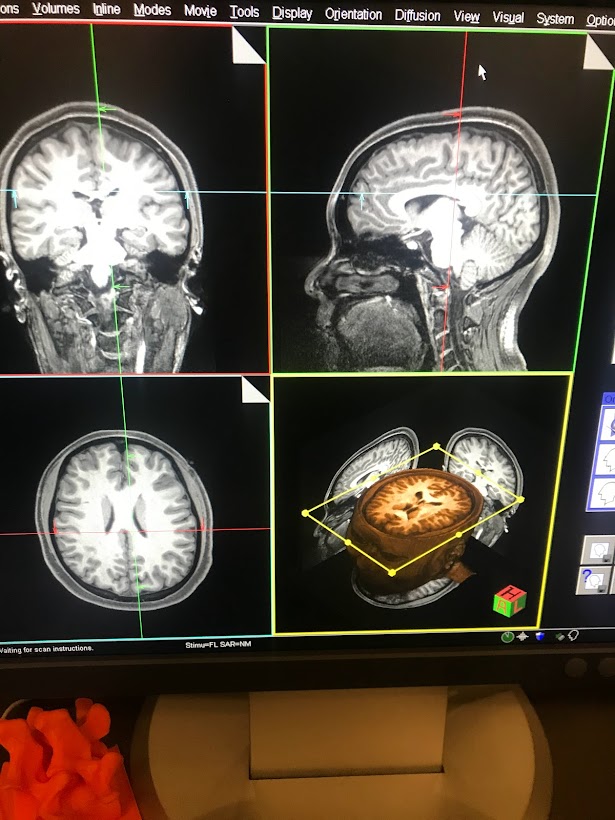
This is my brain! From the top left going counterclockwise, that is the coronal view, horizontal view, and sagittal view. The bottom right shows all the slices of my brain that were taken, which you can see by moving the yellow lines.
And there it was–all of my consciousness, my memories, my thoughts, my emotions, dreams, fears all up on that screen. It looked so complicated and fragile and beautiful. As a neuroscience major, I saw pictures of brains every day. But nothing hits quite like seeing your own brain up there in black and white. And there I was, using my brain to understand that what I saw in front of me was itself. It’s such an indescribable feeling!
And that reason, beyond just the contributions to science, is why I recommend getting an MRI done as part of a study. After this experience, I felt myself thinking about my own brain with more affection. This squishy, bumpy organ is me, and I should treat it with the study and love that it deserves.
Take two of our Neurotransmitter Notes! If you are in the midst of finals season like me, maybe you want something to cheer you up. I might not be able to make your neurons fire off serotonin or oxytocin, but maybe learning about them will help you produce your own! Without further ado, let’s set the tone with serotonin…
“Am I going crazy
Consuming me lately
And I’m well
I’m over it
Not where I’ve been
It’s where I’m going
Looking for my vibe
Wanna bathe myself in serotonin”
Serotonin- Courtney Govan
After dopamine, serotonin might just be the second most well known neurotransmitter. And like dopamine, it has effects beyond making you happier: it could be better described as a mood regulator that can also affect your sleep, digestion, and wound healing (Serotonin, n.d.).
But before you buy those serotonin gummies off the internet, be careful! Too much serotonin can lead to serotonin syndrome, This alliterative ailment can cause vomiting, headache, rapid heart rate, and muscle twitches (Dunkin, n.d.). In this situation, you really can have too much of a good thing. But what about the opposite?
A lot of people being treated for depression know about serotonin in the context of “the thing I need more of”. This perception is described in girl in red’s Serotonin:
“I’m running low on serotonin
Chemical imbalance got me twisting things
Stabilize with medicine
But there’s no depth to these feelings
Dig deep, can’t hide
From the corners of my mind
I’m terrified of what’s inside”
Serotonin- girl in red
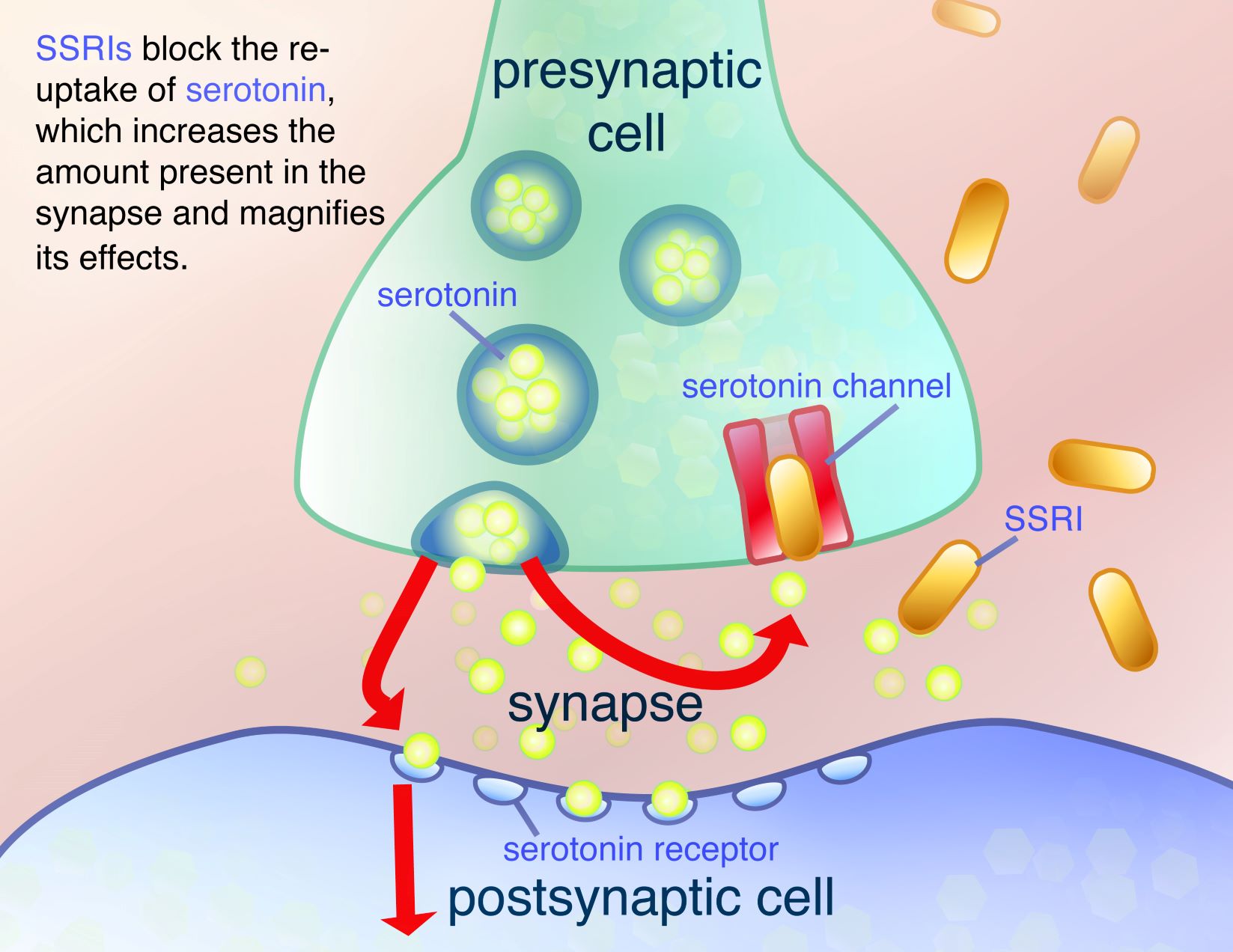
Indeed, depression is linked to lower activity of neurons that use serotonin. One of the most common antidepressants prescribed nowadays are the selective-serotonin reuptake inhibitors (SSRIs). The medicine girl in red describes is likely an SSRI, which works by preventing serotonin from being taken up by neurons after it is released into a synapse (the junction between neurons where neurotransmitters transfer a signal from one neuron to the next). This increases synaptic serotonin levels. Then, like if you were to increase the number of balls in a pinball machine, the serotonin is more likely to bind to a receptor on the other side, activating the next neuron. Boom–more activity!
A diagram showing the function of SSRIs (SSRIs, 2010)
And to round out our discussion of the three “happy chemicals” people know about, let’s talk about oxytocin! Now, oxytocin is technically a hormone and not a neurotransmitter (do you remember the difference from my last article?). Compared to dopamine and serotonin, oxytocin is perhaps the one most related to gettin’ hot and heavy in the public eye. Just take a look at these lyrics from Billie Eilish:
“Can’t take it back once it’s been set in motion
You know I need you for the oxytocin
If you find it hard to swallow
I can loosen up your collar
‘Cause as long as you’re still breathing
Don’t you even think of leaving”
Oxytocin- Billie Eilish
Here, she really shows the burst of excitement that can stem from oxytocin. Oxytocin makes us feel more connected to the people around us. However, it is not just released among lovers–it’s actually a key player in childbirth and nursing (Watson, 2021). It is also released during exercise, listening to music, and any type of physical contact. How touching!
That’s all I have for you all today. Take some personal time to relax and hug a friend (or partner)! We’ll get through this period together.
Check out this playlist with the tunes mentioned in this article, as well as some other neuroscience related songs! (Note: please be aware that some songs in this playlist may have explicit lyrics)
References
Dunkin, M. A. (n.d.). Serotonin syndrome. WebMD. Retrieved April 27, 2022, from https://www.webmd.com/depression/guide/serotonin-syndrome-causes-symptoms-treatments
Serotonin: What is it, function & levels. (n.d.). Cleveland Clinic. Retrieved April 27, 2022, from https://my.clevelandclinic.org/health/articles/22572-serotonin
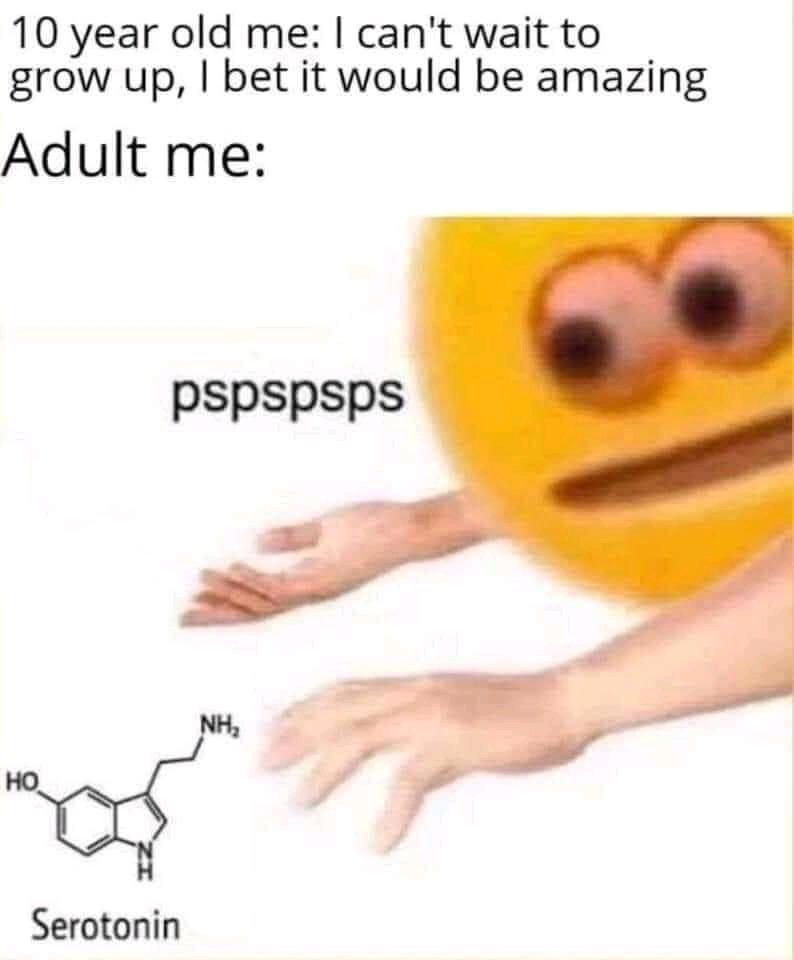
Skabreus. (2021, June 12). I can’t wait to grow up [Reddit Post]. R/Memes. www.reddit.com/r/memes/comments/ny9ds6/i_cant_wait_to_grow_up/
SSRIs. (2010, June 30). HOPES Huntington’s Disease Information. https://hopes.stanford.edu/ssris/
Watson, S. (2021, July 20). Oxytocin: The love hormone. Harvard Health. https://www.health.harvard.edu/mind-and-mood/oxytocin-the-love-hormone

:background_color(FFFFFF):format(jpeg)/images/library/1891/Anki2.png)