Category: Field Notes

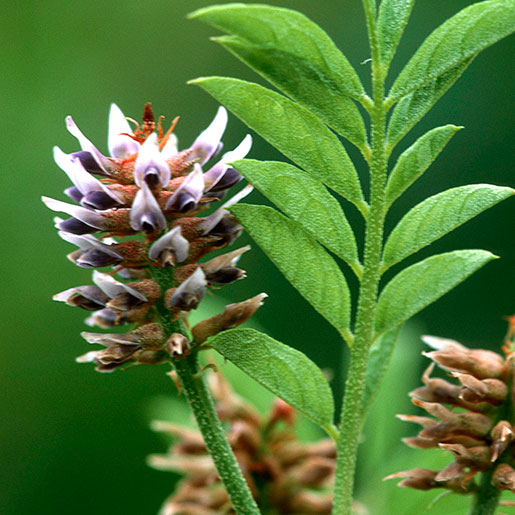
  • A Pocket Guide to Smokable Herbs

    Illustrations by Reggie Slater

    Hey!

    Are you looking to smoke, but want to keep a clear mind or refrain from traditionally addictive tobacco cigarettes? Well, there’s actually a whole variety of plants out there that are safe to smoke, some even boasting calming and mood enhancing benefits. Some, like Chrysanthemum flower or Holy Basil, have long been used as tobacco alternatives.

    Here, I’ve provided a small graphic of safe to smoke herbs that can easily be bought dried and ready to roll online. If you want to check out more about the specifics of each herb and their potential affects, I suggest checking out this article by Thrillist.

    Happy smoking!

  • A Spotlight on Black Licorice and its Darker Side

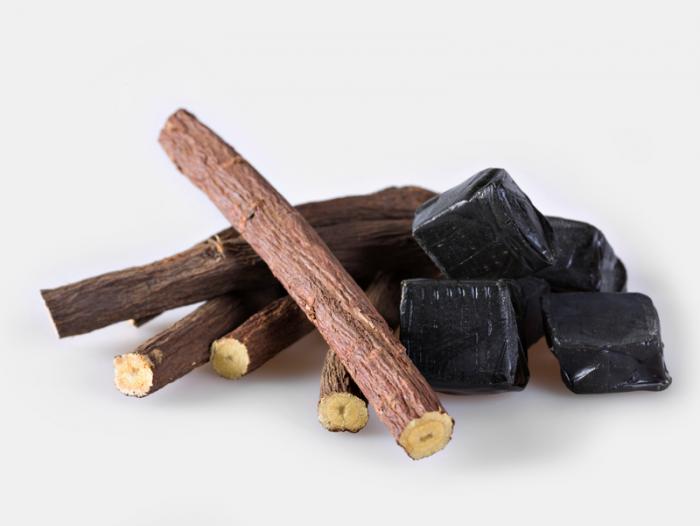
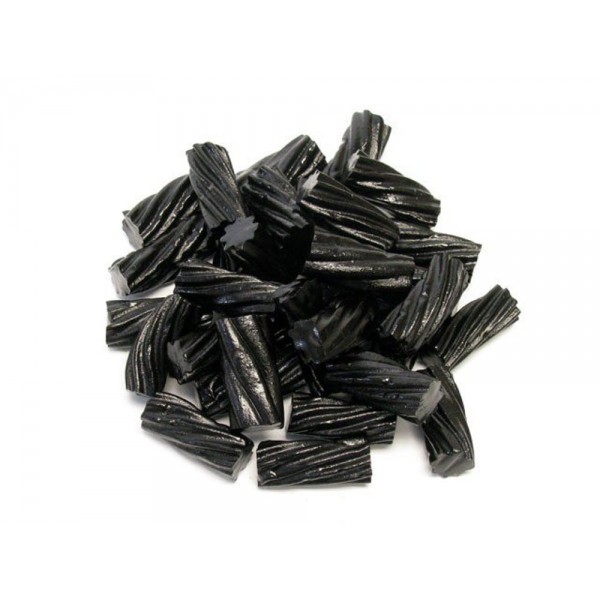
    Black licorice. You either love it or you hate it. Some delight in the intense spice flavor that comes with a bite of licorice and others find it repulsive and gag at the mere scent of it. As a divisive food and old-timey treat, black licorice has a long history of being a chewy confectionery and a popular flavor for drinks and tobacco in many parts of the globe. Licorice (scientifically referred to as Glycyrrhiza glabra) is a flowering plant that comes from the legume family. Its roots contain the flavor that we know as licorice and are commonly extracted for various uses. While it shares similar flavoring compounds, it is not related botanically to anise or fennel as some may think. (though sometimes they are used instead of licorice to evoke the same flavor profile)

    What makes black licorice so sweet?

    The iconic scent and flavor of licorice come from a mix of different compounds, but the one that gives it most of its sweetness is glycyrrhizin (a compound that is about 50 times sweeter than sugar!) This sweetness is different than regular sugar in that it more closely resembles sweeteners like Sweet ‘n’ Low which is comprised of saccharin. Some people vehemently dislike this type of sweetness which is also known to linger on the tastebuds for longer. Many people claim to dislike how “sickeningly sweet” it is and feel that it strongly dominates whatever you taste in your mouth for many minutes even after it is consumed. Others say that their aversion comes from the glycyrrhizin tasting more bitter than sweet.

    This bitterness can be attributed to herbal medicine, which licorice is also known to be useful for. There are many patented licorice-based medicines in China, where its extract is used in the treatment of bronchitis, colds, cough, and upper respiratory diseases. Glycyrrhizin, glycyrrhizinic acid, isoliquiritin, and glycyrrhizic acid are the most notable substances used for health benefits as they possess anti-cancer, anti-microbial, and anti-inflammatory properties. Excessive consumption that allows for the build-up of these compounds, however, may lead to serious adverse health effects.

    Consequences of Overconsumption

    Like most things in life, licorice is best enjoyed in moderation, but for more sinister reasons than you may think. Eating more than 57g of black licorice a day for at least 2 weeks could potentially cause serious health problems, such as an increase in blood pressure and an irregular heart rhythm (arrhythmia). This happens because of an excess of glycyrrhizic acid in the body. Normally your body is able to process glycyrrhizic acid into glycyrrhetinic acid, which is relatively harmless in small amounts, but when larger concentrations are present in the body, it can inhibit an enzyme that assists in converting active cortisol (the hormone that controls adrenaline) into inactive cortisone. You can imagine what too much active cortisol might do to your body, and this imbalance like this can wreak havoc on your body. 

    Cortisol is a hormone that plays a role in your fight-or-flight response and is similar chemically and structurally to aldosterone, which during a stressful event can signal to the body to hold on to water if you’re dehydrated. It does this by binding to structures in the kidneys that cause sodium to be pulled from urine in order to trigger osmosis and cause water to stay in your cells. Sodium has a +1 charge, however, and if it’s taken from the urine, then another +1 charge must replace it. This is done by potassium which can then replace the sodium in the urine and be excreted from the body. Now, when cortisol is present in concentrations that are dangerously high, it can be concluded that it would cause your body to pull more sodium from your urine, and you would lose more potassium right? 


    Cortisol (left) & Aldosterone (right)

    This leads to hypokalemia or low potassium presence in blood, which can be detrimental to the muscles of your body especially one of your most essential muscles, your heart. Potassium is an ion in your body that signals a relaxation of your muscles after a contraction. If there isn’t enough potassium present in your blood, then your muscles will stay contracted, which can be especially bad for your blood vessels and your heart. This is where the increased blood pressure and arrhythmia can restrict proper oxygen flow throughout your body and cause your organs to shut down.


    No Need to Panic

    Now, of course, the chances of this happening to the average black licorice fan are very slim as long as the treat is enjoyed in moderation. Since most people wouldn’t eat 57g of black licorice every day, I think it’s safe to say that fearing death by licorice overdose won’t be found in anyone’s nightmares. All in all, black licorice is a novel sweet with an interesting chemical makeup that is loved (or hated) by many across the globe.


    Sources:

    Pastorino G, Cornara L, Soares S, Rodrigues F, Oliveira MBPP. Liquorice (Glycyrrhiza glabra): A phytochemical and pharmacological review. Phytother Res. 2018 Dec;32(12):2323-2339. doi: 10.1002/ptr.6178. Epub 2018 Aug 17. PMID: 30117204; PMCID: PMC7167772.

    Wahab S, Annadurai S, Abullais SS, Das G, Ahmad W, Ahmad MF, Kandasamy G, Vasudevan R, Ali MS, Amir M. Glycyrrhiza glabra (Licorice): A Comprehensive Review on Its Phytochemistry, Biological Activities, Clinical Evidence and Toxicology. Plants (Basel). 2021 Dec 14;10(12):2751. doi: 10.3390/plants10122751. PMID: 34961221; PMCID: PMC8703329.

    https://www.healthline.com/nutrition/black-licorice-death

    https://www.youtube.com/watch?v=qg76qIZ4BQ8 

  • Native Plants at the Georgia Tech EcoCommons

    Introduction

    The effort to bring greenspace and restore natural ecology to the Georgia Tech campus can be seen in the EcoCommons, a park built near the Keneda building and the Center Street Apartments. One of the goals of the EcoCommons is to restore Georgia’s natural plant life to Atlanta. Today, we’re going to look at some of the native plants which have been brought back to the EcoCommons.

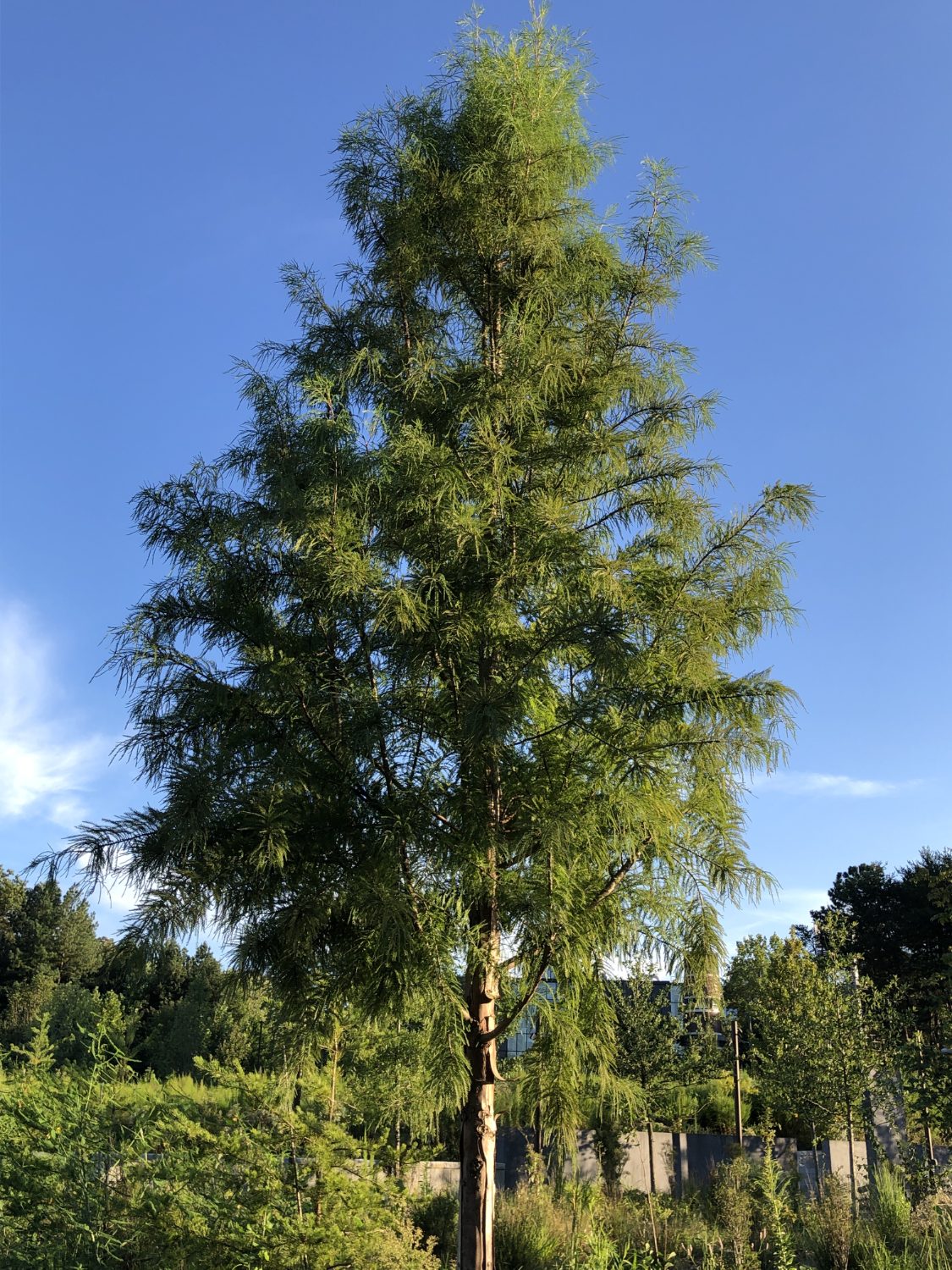
    A smaller variety of the bald cypress tree at the Georgia Tech EcoCommons, known as the pond cypress.Bald Cypress Trees

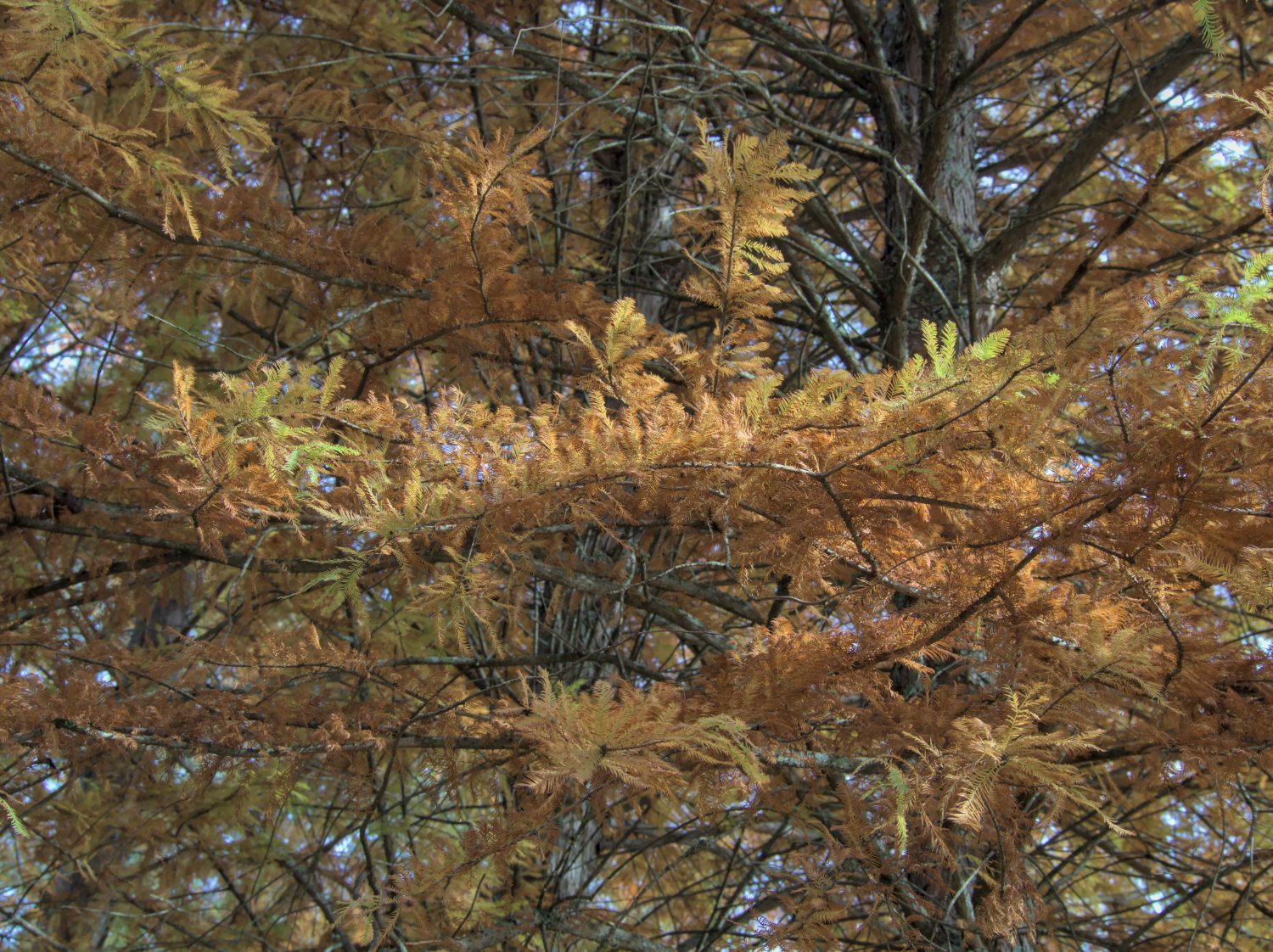
    Bald cypresses are trees native to much of the southeastern United States. They’re hardy and versatile, and can grow in all kinds of soil environments. This, along with their lovely red and orange needles during the fall, makes them popular plants for decorative purposes. Other common names for the bald cypress include swamp cypress, white cypress, tidewater red cypress, gulf cypress and red cypress.

    In the wild, bald cypresses are typically found in wet, swampy areas. They can be identified by their large, spread out needles.

    A close up of baldcypress needles in autumn.FUN FACTS

    • The oldest bald cypress tree (that we know of) has been alive since 605 BCE. That’s a 2627 year old tree!
      • The site of the tree is actually a secret – park rangers don’t want visitors vandalizing it.
    • The bald cypress is the state tree of Louisiana.
    • Bald cypress wood has historically been marketed for its resistance to water, which makes it useful in wet areas.
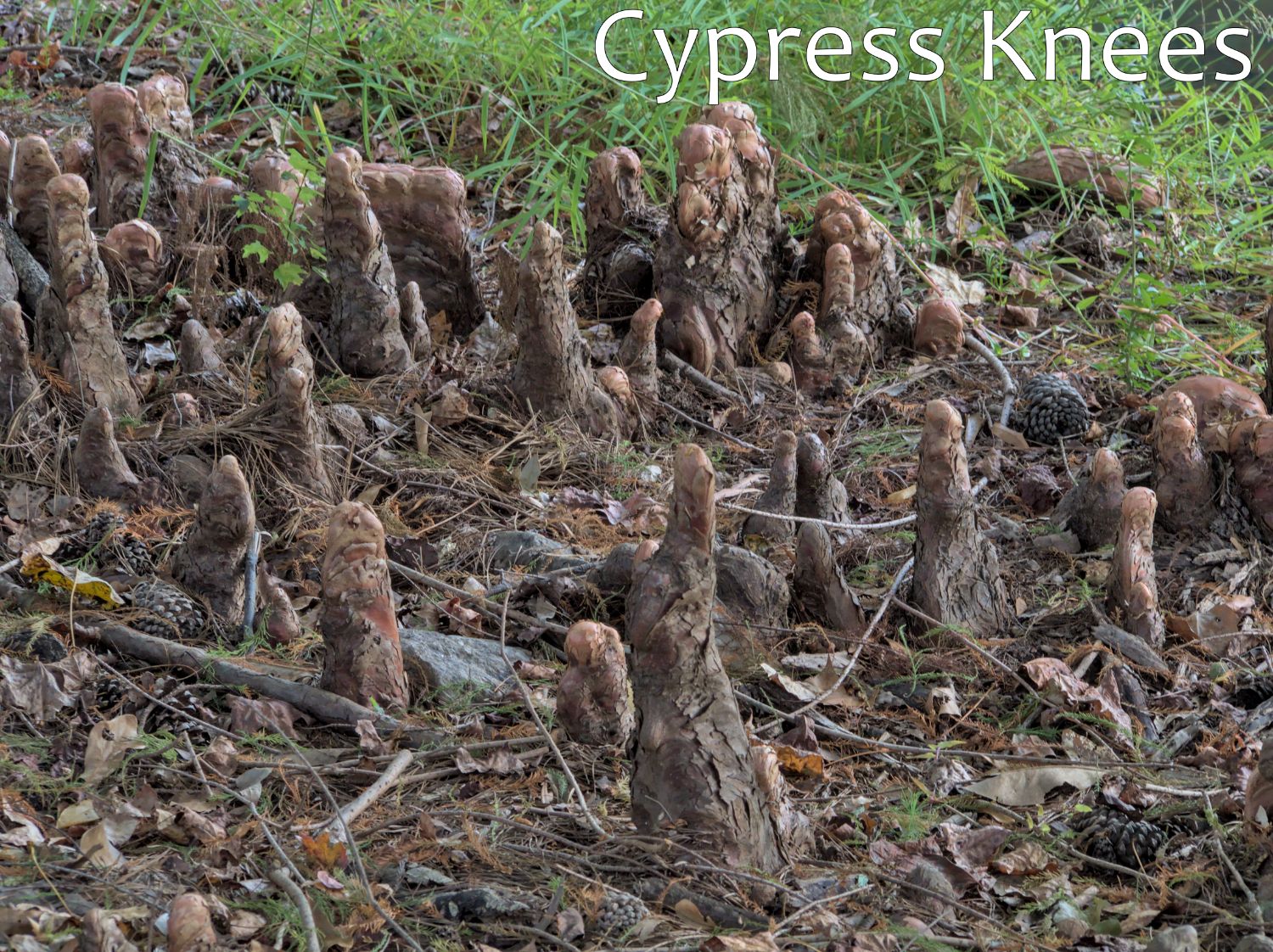
    • Around a bald cypress tree, it’s common to see what are called cypress knees – wooden outgrowths from the ground. They actually extend upward from the main trunk’s root system. They look like small stumps coming out of the ground, although they’re still connected to a “main” tree.

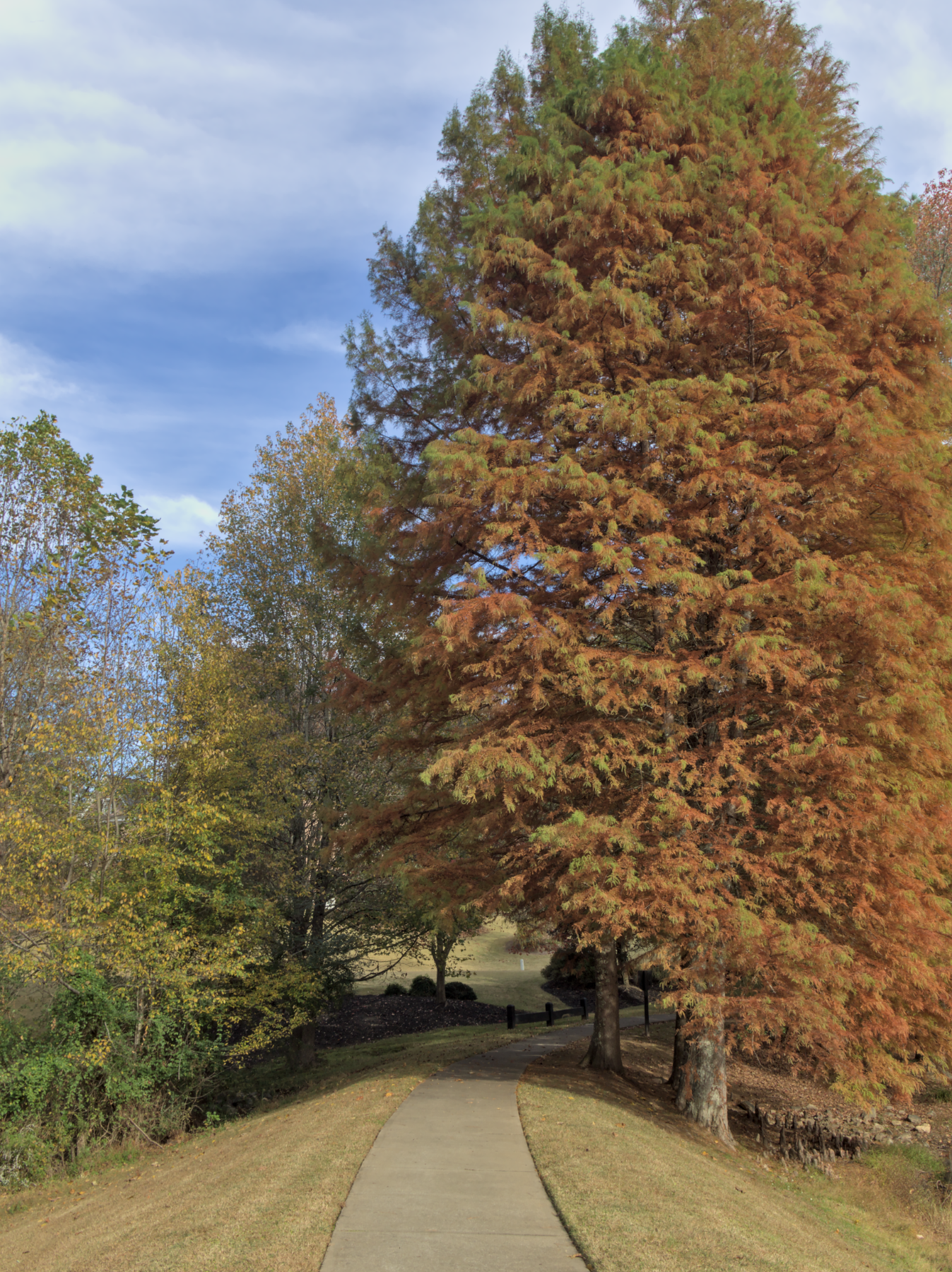
    A zoomed in image of the wooden knobs that extend from the roots of cypress trees, known as cypress knees.Bald cypress trees are famous for their fall colors – here’s a larger bald cypress off of the Georgia Tech campus in November. These native plants are a great choice for people looking for decorative trees that are ecologically beneficial to the local environment.

    A baldcypress tree with its fall russet needles.Cardinal Lobelias

    A shot of cardinal lobelias in bloom.The cardinal flower, lobelia cardinalis, is a red flower, belonging to the bellflower family, that is native to most of the United States (except for far Northwestern states). It primarily lives in moist areas, such as stream banks, ditches, and lake shores.

    FUN FACTS

    • Excellent for hummingbird and butterfly gardens. This plant attracts many native pollinators, so it’s a great addition to your yard or garden if you’d like to see more hummingbirds and butterflies.
    • You can find varieties of the cardinal flower with pink and white flowers, although these are mostly sold in nurseries for decorative plants.
    • Every part of the cardinal flower is poisonous when ingested – don’t eat it!

    New England Aster

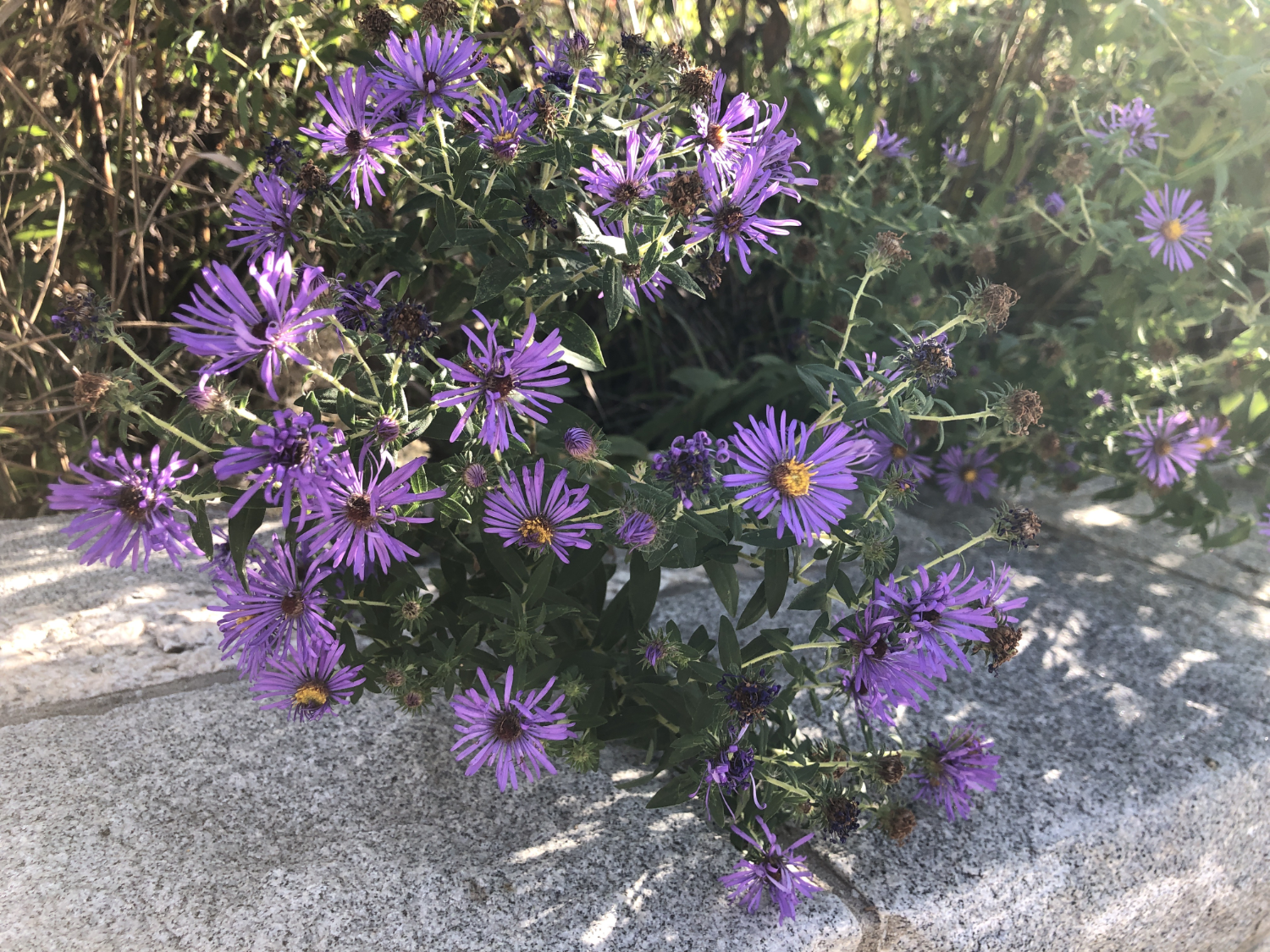
    A New England aster plant with purple flowers.The New England aster, Symphyotrichum novae-angliae, is a perennial flower that is a native plant to much of the northeastern United States. It typically blooms from late summer through fall, with asters blooming in late August to early November depending on the region. New England asters are typically found in moist environments, particularly in wetlands. However, it has been found in dry soils as well.

    FUN FACTS

    • New England asters are a favorite flower of the monarch butterfly! These flowers are known to attract the monarch butterflies during their migration south for the winter.
    • The word “aster” comes from the Greek word ἀστήρ, meaning “star”. Aster shares a language history with astronaut and astronomy.
    • Here in Georgia, New England asters are considered “Critically Imperiled” by NatureServe – this means that their natural range has been reduced significantly by human activity.
    • Domestically, you can find New England asters in all sorts of pinks and purples at nurseries for your garden or yard.

    Blue Mistflower

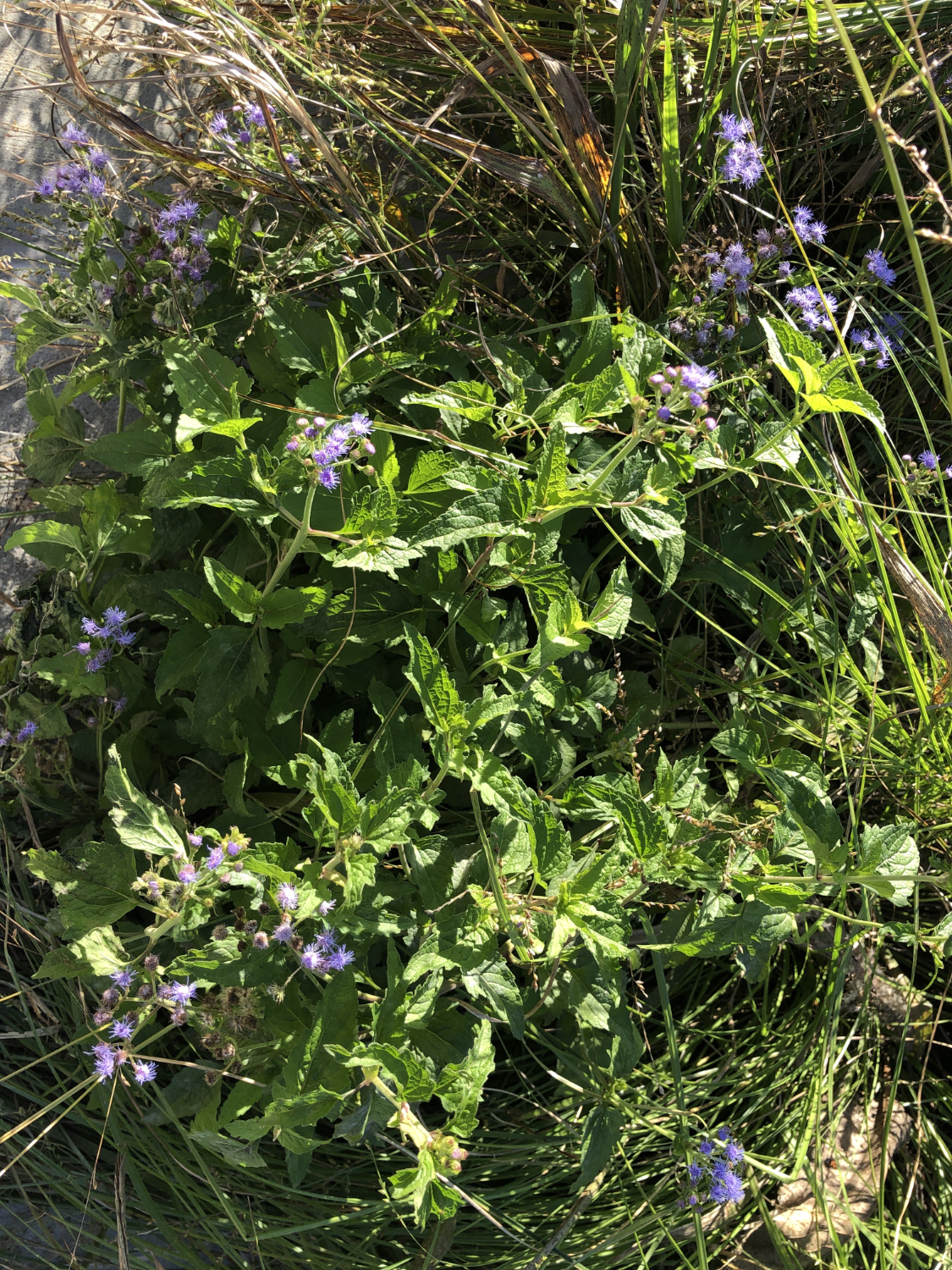
    Blue mistflowers close up.The blue mistflower, conoclinium coelestinum, is a perennial flowering plant in the Asteraceae family. Blue mistflowers are widespread throughout North America, and can be found from Ontario, Canada to Tepoztlan, Mexico. It’s commonly grown in gardens, and flowers from July through November each year.

    FUN FACTS

    • Blue mistflowers are hardy plants that can spread quickly – be warned if you want them in your garden! They’re very capable of choking out their neighbors because their root systems spread out.
    • These flowers are known for their ability to attract pollinators, which makes them great for supporting local ecology.
  • Behind the Baking: Leavening

    Introduction

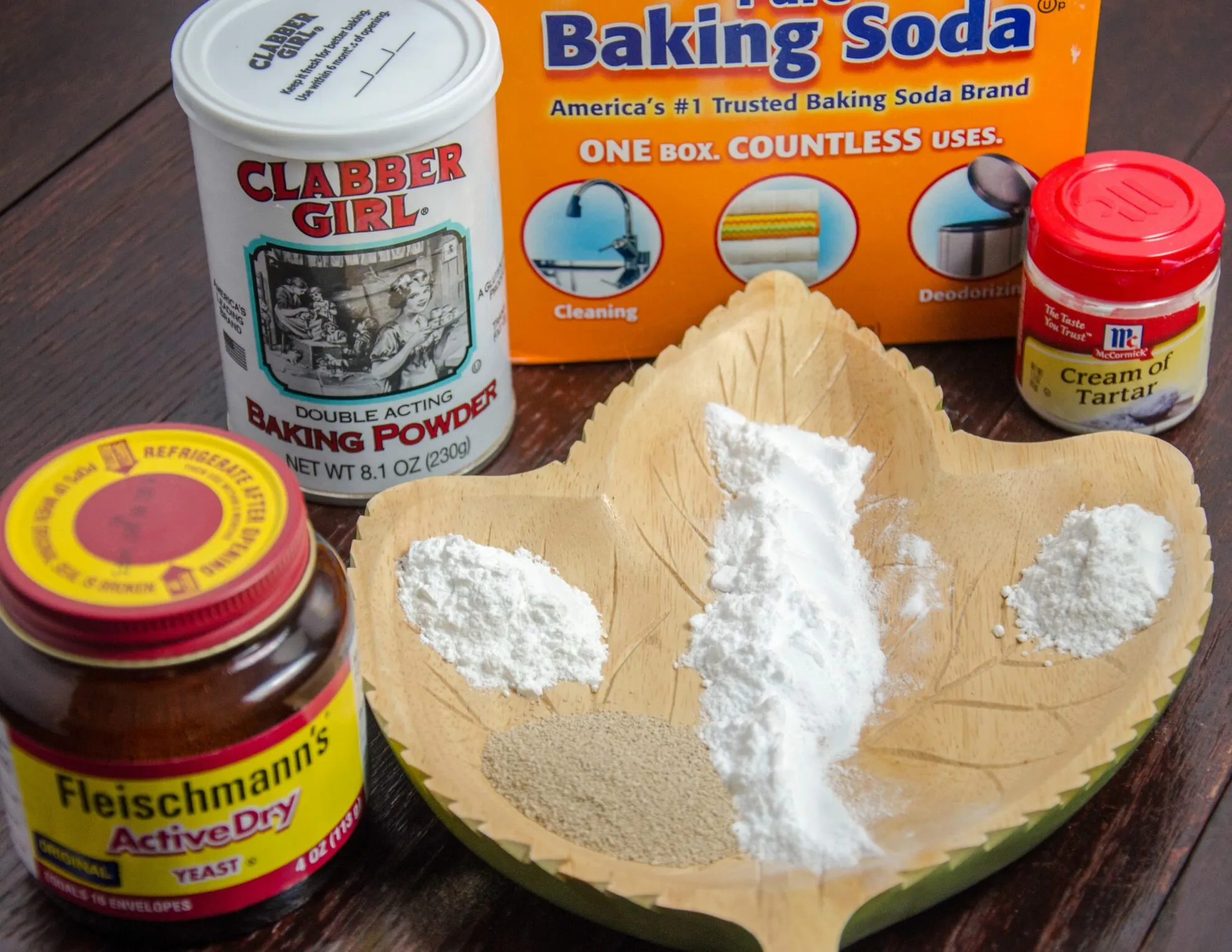
    Welcome to the second installment of my Baking Science series! This time, I’m putting a variety of leavening agents to the test to see how they perform based on taste, texture, and overall look. I will be baking three loaves of bread: one using yeast, one using baking soda, and one using baking powder. I predict that the loaves of bread will all vary greatly from each other, but I am especially interested in finding how the baking soda and baking powder bread differ since a majority of the general population cannot distinguish the two.

    What goes into baking beautiful bread?

    Most kinds of bread come together with only six ingredients: flour, oil, water/milk, a leavening agent, sugar, and salt.

    What’s a leavening agent and how does it work?

    The word ‘leavening’, as defined by Oxford Dictionary, is a substance used in dough or batter to make it rise, such as yeast or baking powder. Without this key ingredient, it would be impossible for the bread to rise, resulting in a flat cracker. In order to create a good ole’ sturdy loaf of bread, a couple of essential chemical reactions need to take place in the oven. The first ingredient, flour, contains two proteins called gliadin and glutenin; when combined with water, these proteins transform into gluten. The chemical makeup of gluten shows that the molecules are chained together to create long chains- this allows the bread dough to be elastic and stretchy. This is also why the longer the dough is kneaded, the more elastic it becomes. The dough’s stretchy quality is super important in achieving the end loaf because of the way the leavening agent works. The agent causes a bunch of tiny gas bubbles to form in the dough either before or while it is in the oven. Ever watched a baking competition and heard the cast talk about ‘proving’ their doughs? I know I have! The proving process involves letting your dough rest and rise before it is put in the oven to bake. This step is integral when using yeast, but not necessary for baking soda and powder since they do their work in the heat of the oven.

    Experiment

    Three loaves. Three agents. One winner. Just kidding, but I will include which bread I enjoyed the most at the end!

    Round 1: Yeast

    Recipe: https://butterwithasideofbread.com/homemade-bread/

    Round 2: Baking soda

    Recipe: https://sallysbakingaddiction.com/no-yeast-bread/

    Round 3: Baking powder

    Recipe: https://www.recipetineats.com/sandwich-bread-without-yeast-quick-easy/

    Observations and Opinions

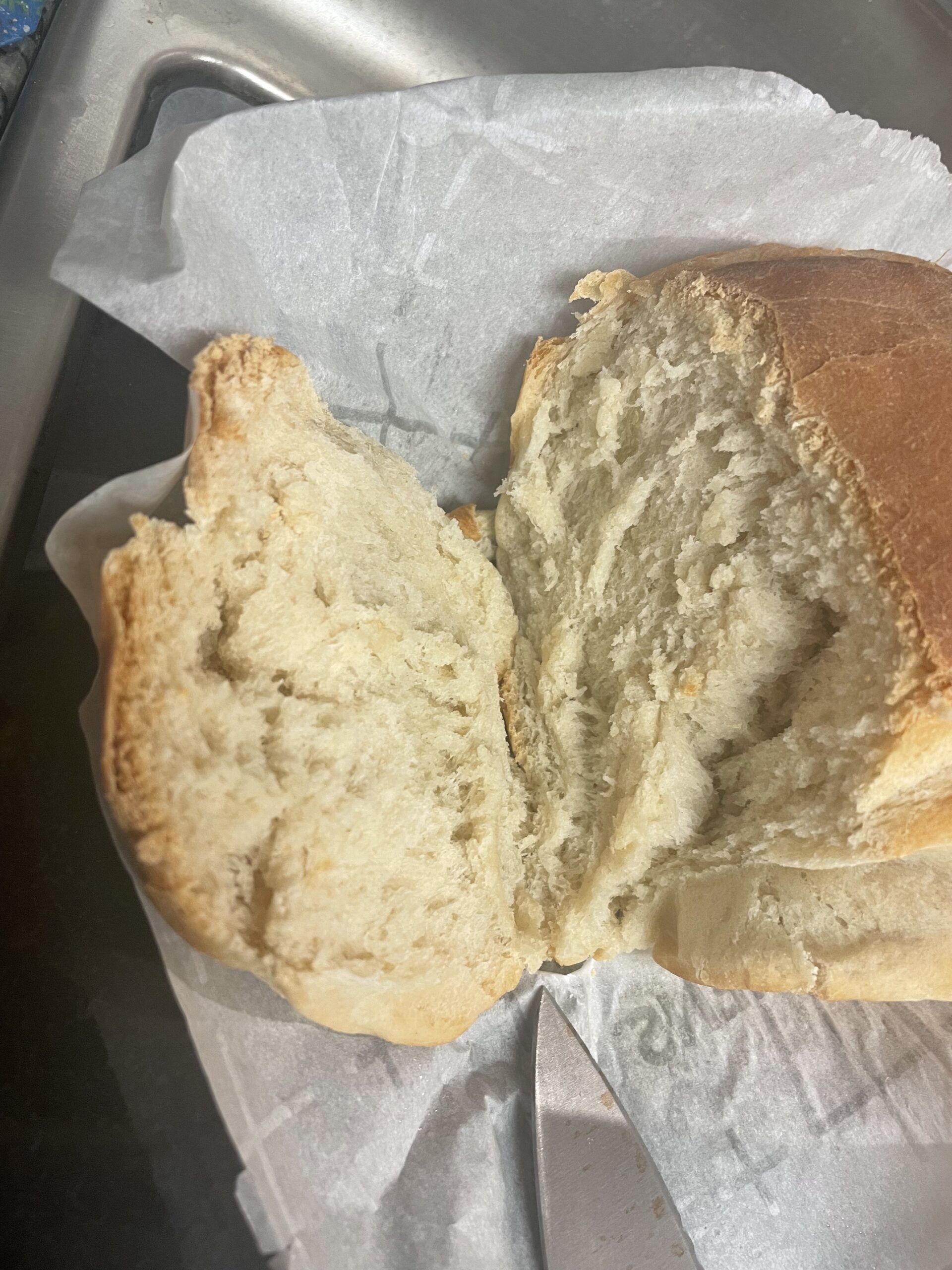
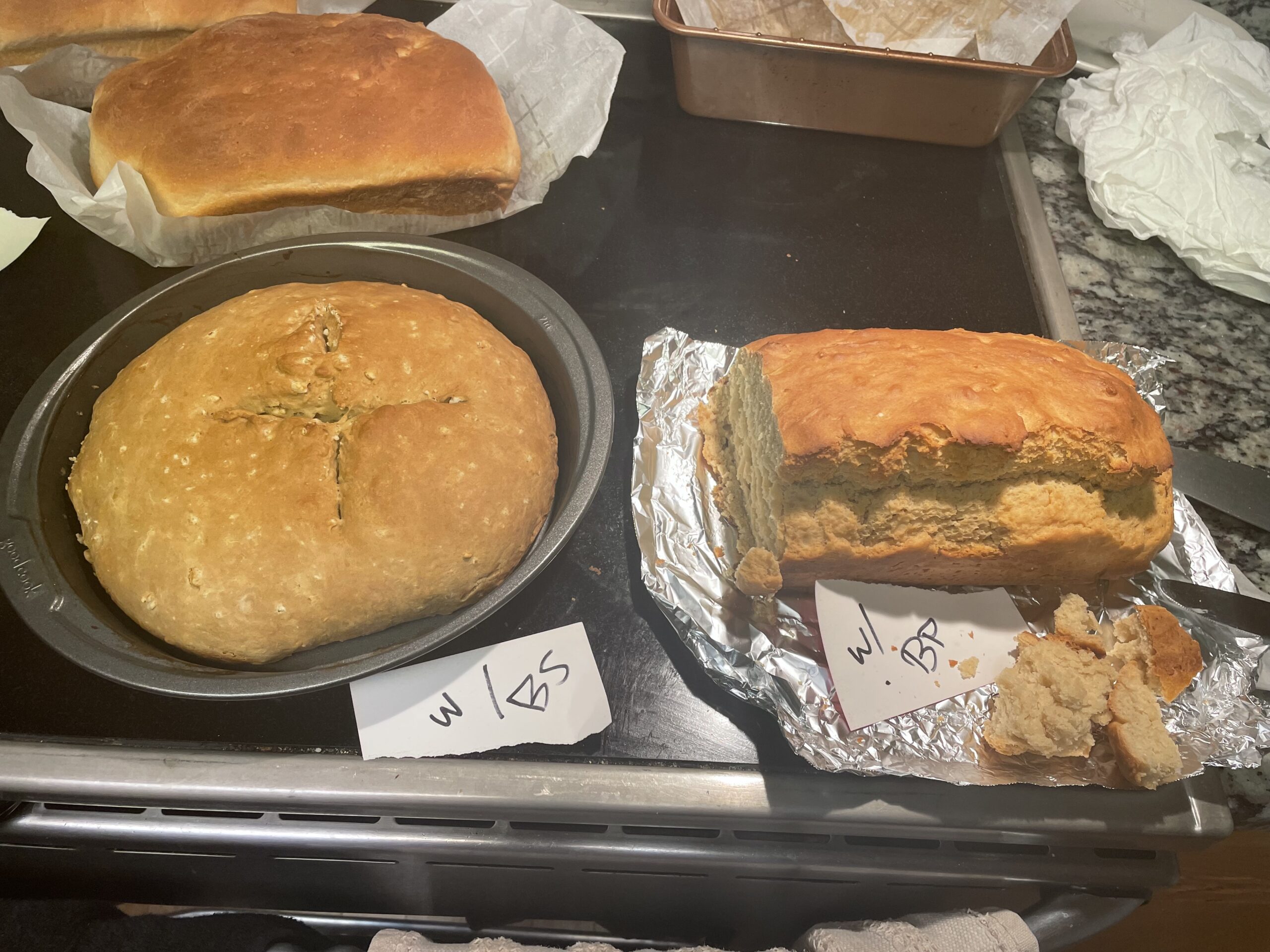
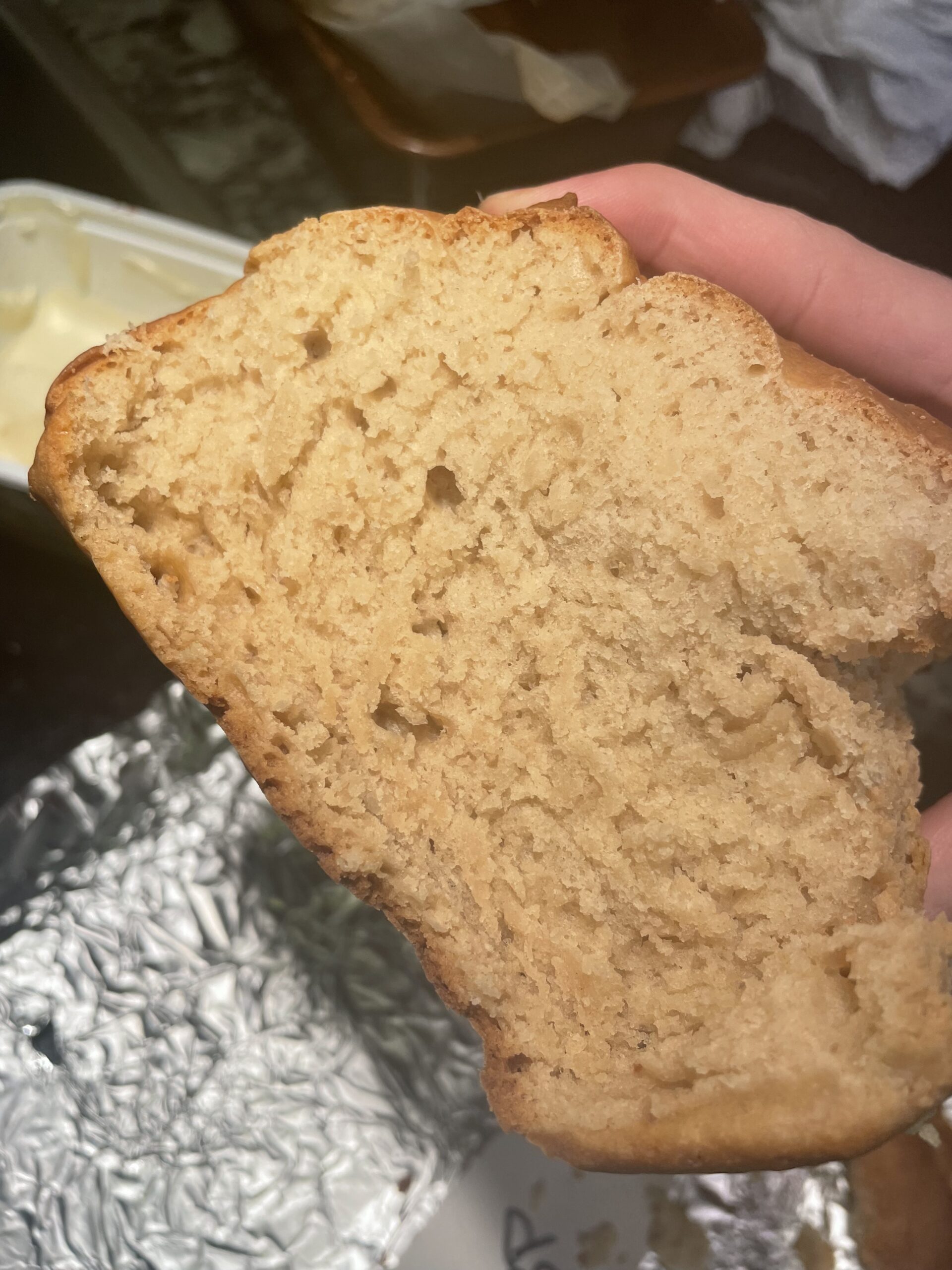
    Unsurprisingly, the bread that came out the best, in my opinion, was the yeast bread. This comes as no surprise because most of the breads that are sold in stores and that people generally think of are made with yeast. It’s hard to beat lightweight, airy feel of the yeast bread crumb. The baking soda bread was also delicious, but much much denser than the yeast bread. The baking powder bread was the weirdest- it was super heavy and stodgy and just not good. That might have been due to my error though, I may have overmixed it or kneaded it too much. The baking powder bread was so tough I didn’t want to cut a slice and eat it.

    Final Thoughts

    My favorite bread of the three was the yeast bread! The other breads honestly did not stand a chance against the tried and true yeast bread and I now know that I do not care for soda bread much. I would advise against making bread with baking powder, it was so hard for me to get it right but maybe some practice could improve it. Overall, it was super fun to test out these leavening agents and see them in their rising action.

  • Math is Friend, Not Foe

    Today I’d like to talk about everyone’s favorite, least-favorite subject in school: Math

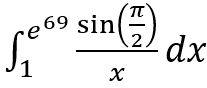
    Math can seem very scary and complicated. And this feeling is very valid to have – math does get more complicated the more you learn. When faced with a problem like:one can really long for the days of “If Sally has 5 apples and gives away 3 how many apples remain?”.

    But the beautiful thing about it, is that all math can be simplified. It builds up into complicated equations and problems, but it can always be broken back down to simple things!

     For example, if you know that sin(π/2) = 1, and how integrals work, you can solve this problem pretty easily – BUT therein lies the rub. Math is all just building blocks, but the key is knowing and sometimes memorizing what blocks to use (which is never fun). Just like it’s hard to understand 5 – 3 if you’re not familiar with counting, it’s almost impossible to answer that question if you’ve never been taught an integral or what sine is. 

    People place so much fear, stigma, and weight on doing math that it becomes so intimidating. So when faced with something strange and hard seeming, they panic and assume “I can never understand this”. BUT THEY CAN!

    We often don’t think about it, but back in elementary when everything about numbers and addition was new, it seemed so confusing then too.

    When I was in high school, I once tutored a fifth grader who needed help with long division, and I found myself having to relearn some key concepts that I’d forgotten and hadn’t thought about in years! I noticed the student was adding the large numbers incorrectly as they worked, so I said, “Oh you have to carry the one here.” To which they responded: “Why?”

    And I had to pause, and then think about because, why DO we do that? I knew it was something to do with numbers no longer being the same category but how did I explain that to someone unfamiliar? Which led me down a bit of a rabbit hole of looking up elementary school textbooks and lesson plans. Because without understanding something like “place values” (ones, tens, hundreds) it’s really hard to understand why you need to “carry a one” in long multiplication and division!

    Even something as retroactively simple as division was once completely baffling – but once you learn it, it becomes instinct. The same can be said for the most complex of mathematics: once you understand its rules, nothing can stop you! 

    If you can remember the rules of a triangle, you can remember sine. If you can understand a grid, you can build up to calculus and beyond.

    Now the hard part is learning all of this for the first time – especially when many people have been burnt out from math, or set at a disadvantage in the past by bad explanations and inattentive teachers who never helped them understand. That is the true tragedy of math, and admittedly makes the subject a lot harder for most. 

    But I’m here to say, never doubt yourself! Even old dogs can learn new tricks, and you can always learn the blocks and break it down when facing “complex” math!

    Think like a gamer: there are challenges, but with enough effort, grinding, and practice you can overcome it (and there’s nothing wrong with coming back later)!

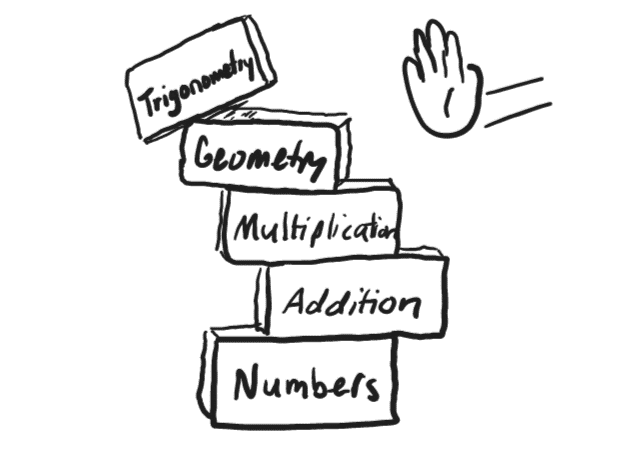
    Math is all just building blocks at the end of the day: simple individual concepts on their own, but you can assemble them into complex structures – amazing but confusing, equations that can describe the way our world and universe work – that can be very intimidating. However, I think it’s very comforting to remember from time to time that even the most intricate towers are still made of individual bricks; and with enough time and effort, you CAN break it back down! 

  • How I Applied To Grad School (and How You Can Too)!

    Last year I thought that I was 100% certain about what I wanted to do when I graduated. My initial plan was to graduate with my bachelor’s and then find a career in the battery industry. I thought “Oh, I don’t need a job that is super involved, doing something simple will make me happy and satisfied”. 

    That changed after Summer 2021 when I took part in an internship at Los Alamos National Laboratory (LANL) in New Mexico. With the help of the Office of Energy Efficiency and Renewable Energy in the Department of Energy, I was connected to LANL to work in their Materials Synthesis group on a project to create metal complexes that can be used as a powerful source of liquid energy through hydrazine. To give a quick summary, Even though I wasn’t able to complete every part of the project over the summer, my time at LANL gave me confidence in myself as a scientist. I learned a ton of new skills and techniques and got feedback from the other interns and my mentors throughout the semester (big shoutout to my mentors Ben and Andrew, and my other friends in MPA-11, y’all rock <3). In addition to the new skills I learned, taking advantage of my time at a national lab allowed me to mess up and understand why things went wrong, go to research talks about topics I had no idea even existed, and ask questions about the field we work in to think about how we can improve. 

    This is one of the reactions I did at LANL. Essentially, the molecule on the left undergoes an electrochemical reaction to lose its positive charge. Then nitrogen gas is added, allowing this molecule to form more bonds. This can react further to form hydrazine (N2H4), an energy-dense liquid.

    Okay cool, great, awesome, why am I raving so much about working in a national lab? Couldn’t I just write a whole article about it? Yes, I could, and hopefully, that’ll come soon! It’s important to me because this internship gave me a new perspective on the different career options that are possible in energy storage, and it became the building block to why I decided to apply for graduate school. I realized that I wanted a career that would allow me to do more in-depth research on energy storage systems. The field is interesting to me because energy generation research, though researched and well understood, doesn’t have a variety of fully commercialized energy storage systems. This makes it harder to use these systems when their demand is the highest. Energy storage research also involves the collaboration of engineers, scientists, and policymakers to promote the research and development of these systems. There is high potential in most of these systems, in my opinion, to become commercialized and integrated into the energy grid. Specifically, I want to do research on batteries and fuel cells because the chemistries of how they work are interesting to me, where changing the material of one part of a battery is a tradeoff on their overall energy efficiency and safety, among many other factors.

    When I thought about all the cool things I could do and take part in (and maybe even lead (; ),  I got even more excited to dive into the industry right after I get my degree. Then, as I started talking to group scientists and researchers (as well as a few disappointing searches through the LinkedIn job portal), I learned that those dreams I had in mind for my career could not be easily done with a bachelor’s degree. And then I thought, “Welp, what am I going to do now?”

    As someone who often talks about being ready to graduate, the realization that pursuing graduate school would very likely be my next option made me a little complacent and frustrated at first. “I thought I would be done by now, and I gotta do MORE WORK?!” was one of the many thoughts that went through my mind. But as I thought about it more, I realized that there were more reasons why I wanted and needed to go to grad school. For the areas of energy storage research that I’m interested in, I need more experience working with different characterization and spectroscopy techniques to understand what’s happening on the nanoscale to better understand why they are happening and what can be done to improve them.

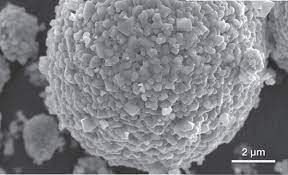
    Scanning Electron Microscope (SEM) image of graphite used in batteries. SEM is one of the many characterization techniques that I hope to learn how to use in graduate school.

    Additionally, there are many new projects in energy storage that up-and-coming scientists want to get to work on, and of course, I want to be a part of the next generation of energy storage research. The biggest roadblock that is keeping me from easily joining these with only a Bachelor’s is that in order to be the ideal employee in the energy storage industry, I need to work on more projects that will build my understanding of different systems. I hope that by achieving these goals, I’ll be prepared to work with batteries, fuel cells, supercapacitors, and whatever technology will be waiting for me.

    Okay, so now that y’all know why I applied to grad school, next up is how. It may or may not be surprising, but preparing my applications and doing them was definitely the hardest and most involved part of the process. I want to start with a few disclaimers before I go over the things I did while completing my applications. First, this journey and how it “ends” are still up in the air, as I haven’t gotten any decisions yet. How all that goes will hopefully be updated later on during the spring semester. Second, my process doesn’t reflect how everyone should do it. Keeping to a timeline is difficult, and changes are bound to happen. Don’t stress if when you decide to apply for grad school you submit things close to the deadlines and you aren’t done weeks early. Lastly, you can take all these tips how you want, if you have any opinions, let me know what you think! I’d love to discuss more things that I may have missed.


    And with that out of the way, let’s get started!


    Step 1: Deciding where you want to go.

    There’s no better step than the first step! This is where you think about what you want to focus on for the next two or more years. If you want to do energy research, then find universities that work with that, and if you wanna work on biochemistry, then find schools that fit in that area. If you have a more specific area of research you want to focus on, once you find a school that has the coursework and facilities you want, you should search for professors who have projects in that area. In my case, I want to research batteries or fuel cells, so I looked for professors who have similar projects. I tried to have at least four professors that I could see myself working with.


    Of course, along with the research and coursework available at the universities you’re interested in, there are other factors that may be important to look into:

    • Fellowships: I could write a lot about fellowships and why they’re so good to apply to. For one, there are a number of opportunities to apply for that will support you whether you’re pursuing a Master’s or Ph.D. (or even both), especially as a minority in STEM. Some examples include the NSF Graduate Research Fellowship Program, the GEM Consortium, Sloan, Hertz, and many more. These fellowships usually help balance the cost of tuition, as well as provide stipends, networking opportunities, and even opportunities for internships.
    • Weather: It may or may not be self-explanatory, but wherever you decide to go, make sure you know how the weather is throughout the year. If you can’t survive in the Southern heat, then Texas or Georgia may not be the best spot to be in. If you love the mountains, then Colorado or New Mexico could be the place for you. 
    • School Demographics: The biggest factor to me when looking at where to apply was the statistics about my class. What I look at is the percentage of students that identify as Black or African American. I also looked into the work that the schools have done to provide spaces and student organizations for their different identities. I applied to Georgia Tech (my current university) because I know that the black community there is strong and I applied to the University of California San Diego because they have a number of initiatives to support black students and the school provides fellowship opportunities for minority students.
    • City Life: Whether you’re social or you’re an introvert, it’s good to live in a city where you can have some extra fun. No matter how dedicated you are to your work, we deserve to treat ourselves to some fun! Most colleges and universities are in a place that has some good food spots and cool attractions. 
    • Testing Requirements: Because of COVID, we’re starting to see a new look at the graduate school application process. This year, the GRE test at most schools is either optional or not required. If a program requires the GRE, then I recommend taking some thought and maybe asking your advisors if it’s worth it. I can’t say much on this because none of the programs I applied to required it.


    Step 2: Organize, organize, organize!

    There are a lot of different things to organize before starting your applications that will you in the long run. First off, get your recommenders in mind ASAP. I always think it’s best to have 4 people you can reach out to because even though many schools will only ask for 2-3, it’s good to have multiple people who can be ready to write a recommendation for you in case someone else is no longer able to. You should have recommenders that can speak to your future goals and how you think you’ll be able to achieve them, your ability to do research well, and if you will be successful in and out of the classroom. For my applications, I asked my academic advisor, my research advisor that I worked with for two semesters, my internship supervisor, and my professor that I’ve worked with for a few years.

    It’s also good to have information for them that will help them while they write about you. With some help and advice that I got from my advisor, I made a spreadsheet that shows the information about the schools that I’m applying to, the deadlines, plus additional info like the submission process and links to learn more about specific programs. Another document I made to help my advisor was a “motivations document”. I used this to make it clear to my recommenders my short and long-term goals, why I want to pursue a Master’s to reach those goals, and what draws me to certain schools and their research labs.

    Lastly, for myself, I kept a larger document that has the application information for each school and fellowship. This helps to keep me organized on any deadlines when I should send out recommendations, what I should think about when writing my statements, and supplemental questions.


    Step 3: WRITING TIME!

    So this is the part that will take a lot of time, but the details aren’t too extensive. It really is just sitting down and thinking hard about how you’re going to talk about who you are, what you’ve done, and how you’re going to be an incredible and successful scientist that any university would love to have. It’s very important to talk about why you want to pursue a graduate degree, any relevant research experiences, what about the school is attractive to you, who you would like to work with. Some additional points that may be good to address are your background (race, ethnicity, financial, etc.), any low grades, and coursework (this is best if your undergrad institution has limited STEM courses or if the field you’re going into is very specific). There are many videos and websites that talk about what makes a good personal statement.

    After you finish your first drafts of your statements, don’t be afraid to send it over to people you know for review. Whether it’s from your friends, your teachers, or your siblings, every little comment given will help make your statement even better. Others will likely notice more minor (or even major) things that could be edited, and once they’re finished I highly recommend reading it out loud to make sure it makes sense to you.


    Step 4: Submit and Wait

    When everything looks right, you don’t see anything else wrong with your statement, and you feel confident and happy with your statement, go ahead and hit submit! After the application, most schools will ask for an application fee, but depending on the school and your situation, you can apply for a fee waiver that covers it! In my case, because of the GEM Consortium Fellowship and some diversity and inclusion events I attended, I was able to get fee waivers for 4 of the 5 universities I applied to.

    The waiting game can be hard to deal with if you’re a little impatient like me and want to know the decisions ASAP, but it provides time and space to reflect and prepare for anything that might come next. Some programs, if they’re exclusively coursework with no research, may ask to interview you, but most will contact you once they reach a decision. If you get that acceptance, amazing, you just have to decide where to go, who to work with, all the fun details. If you don’t get the results you’re hoping for, that’s fine too!! By this point, you will have put in such hard work and dedication towards these applications, and no matter the result, I can be 100% sure that you will have learned something about yourself. 

    So to finish things out, I want to give some more perspective on how the process was on my mental health. Overall, the process of applying made me so much more confident in myself. Looking back at my experiences made me realize just how much I’ve done and how incredible it really is. At first, I felt like it would be difficult to talk about myself well and how I would be a great fit, but I learned how to hype myself up while also proudly noting what I was lacking and ready to learn in grad school.

    I also won’t lie when I say doing grad apps while in one of the heavier semesters in my academic career was STRESSFUL. Working to balance my classes and clubs led to some weeks being quite draining. Many of my other friends who were applying to grad school in this cycle also agreed that there were definitely weeks where our mood was “Yaay, we have a free week to spruce up my application!”, and others where the mood was “Wow, I’m tired from all these classes and meetings, I just wanna take a 37-hour nap.” No matter how we felt though, we stayed strong and pushed through to the end, because we knew that once we finished all of our applications, we were now one step closer to the future that we see ourselves in.

    Hope you enjoyed this article! It’s a lot of information as I wanted to give an honest and helpful look at what I did and what might help others out that might be a bit scared and unsure about applying for grad school. It was terrifying to me when I started, but it’s only thanks to the help of my brother, who’s a grad student now, my friends applying with me, and all the advisors and recommenders, that I felt confident I had done something that I’m proud to share with the world. I can’t wait to see what will happen next, and I’ll keep y’all posted on how things go!

    No better way to end this post than with a beautiful nature pic! This is from the Bandelier National Monument in Los Alamos, New Mexico, taken around the time I decided to take the big step to apply to grad school!

    References

    Sponsored by Thermo Fisher Scientific. (2020, January 28). Determining battery structure and composition using SEM. AZoM.com. Retrieved March 5, 2022, from https://www.azom.com/article.aspx?ArticleID=15475

  • Three Dog Star Night (Part 4)

    Welcome back to our discussion on the Drake Equation and the Fermi Paradox! If you haven’t read part 1, part 2, and part 3 already, then it goes without saying that you should start there! This time we’ll be discussing the last factor in the Drake Equation, run some calculations, and conclude by discussing just what sort of an equation it actually is.

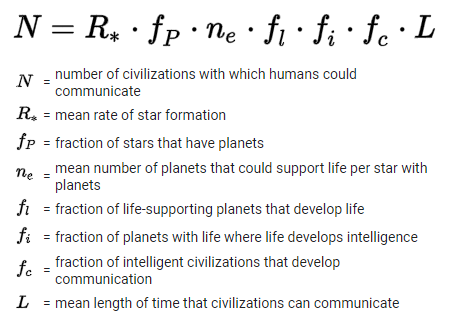
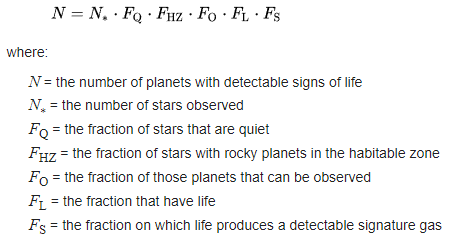
    Before we dive in, we need to do some brief dimensional analysis. Looking at the factors we’ve discussed thus far, we have four which are purely unitless fractions between zero and one (fp, fl, fi, and fc), one with units of stars per year (R*), and one with units of planets per star (ne). What we’re trying to find (N) has units of planets. If we ignore the values for a moment and look only at the units on each side, we have:

    The unit of ‘stars’ cancel out in the usual way fractions do and we are left with:
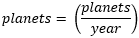
    The unitless numbers simply define what type of planet we are talking about. In this case, those are planets which harbor intelligent (fi), communicating (fc) life (fl). We need the units on each side to match for the equal sign to hold true, meaning we need to introduce a final factor with units of years. Since the Drake Equation is all about detecting alien communications, we should only consider how long they actually spend communicating. We could visualize our own radio signals as a ‘bubble’, expanding out from Earth at the speed of light; any civilizations living inside that bubble could theoretically detect us, but for those outside it would be physically impossible as our signals haven’t reached them yet. The longer we broadcast, the bigger the bubble grows, and the number of civilizations that could detect us increases. If instead they are the broadcasters and we are the detectors, the same logic still applies. The longer an alien civilization broadcasts, the better chance we have of detecting them.
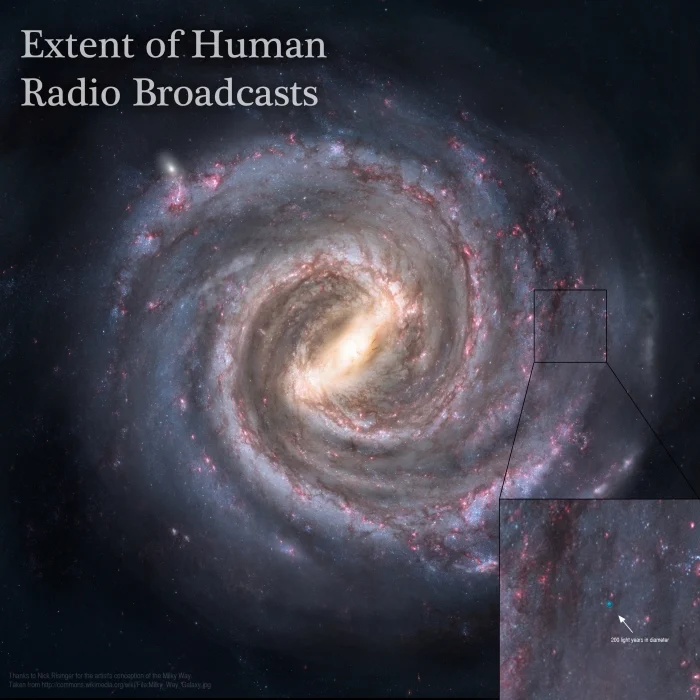
    ~100 years of radio visualized on a galactic scale…

    Average Length of Time that a Civilization Broadcasts, L

    Like so many of the other factors, this one also has a high degree of uncertainty. It could very well range anywhere between one and one billion centuries. In order to decide which one to use, we need to first examine the reasons why a civilization might stop broadcasting.

    The first and most obvious reason is extinction. When the Drake Equation was penned at the height of the Cold War, this was the most widely-assumed reason for the apparent silence of the heavens. With the specter of nuclear war constantly looming overhead, most people simply took it for granted that we would eventually bomb ourselves into oblivion before the end of the 20th century. Carl Sagan himself assumed this parameter of the Drake Equation was the Great Filter. As a result, he dedicated the rest of his life to warning against the dangers of existential threats like climate change and nuclear war. Then, in 1991, the USSR collapsed, effectively ending the Cold War and drastically reducing the threat of atomic annihilation. There may be a lot we don’t know about the universe, but perhaps the fact that I’m even alive right now to write this article speaks to how little we know about ourselves.

    The second reason a civilization may stop broadcasting is that they develop new and better communications technologies. While light is great for the sheer speed at which it travels, it’s also prone to getting scattered, refracted, reflected, diffracted, and absorbed by matter. These reductions in the intensity of a signal are collectively known as ‘attenuation’. Our own atmosphere interferes with numerous wavelengths of light in various ways. Scattering makes the sun and sky appear yellow and blue (the sun looks purely white from space!); absorption of infrared light by CO2 molecules drives the Earth’s greenhouse effect, and refraction causes the sun to appear to melt into the ocean at sunset. While most of space is indeed pretty empty, giant molecular clouds of gas and dust are common in the arms of spiral galaxies like our own. These structures effectively form walls that are opaque to large swaths of the electromagnetic spectrum. One possible alternative that avoids many of these problems would be communicating through gravitational waves. These ripples in the fabric of spacetime also travel at the speed of light but do not suffer from attenuation the way light waves do. However, we detected the first gravitational wave a mere 6 years ago, so the field of gravitational wave astronomy is still in its infancy. We currently require several kilometers of equipment per detector, with three detectors spread widely across Earth’s surface. It’s going to take a while to refine our detection methods, let alone commercialize it. Although, for a potential alien civilization that reached our technological level 1000 years ago, it may well be within the realm of possibility.

    The speed of light is blazingly fast by our standards, but it’s painfully slow when it comes to traversing the enormous distances of interstellar space. Even a message broadcast to the closest star system would take more than four years to arrive. Any reply would then take another four years to get back to us, which makes for a whopping eight year response time for every single message. Unfortunately, nothing can travel through space faster than light, but who says it must be sent through our space? The concept of ‘subspace’ messages is popular in science fiction for a variety of reasons, not the least of which is its convenience as a plot device. The tense disagreements between Picard and the Starfleet high command would lose virtually all of their dramatic effect if it took a millennium to send out a formal reprimand. If we instead had a smaller ‘sub’ space (variously referred to in sci-fi as ‘hyper space’, ‘slip space’, etc.) connecting two distant points in our own universe, we could send and receive messages at the rate we’ve grown accustomed to on Earth. Another similar idea is that of a wormhole. An alien civilization using a network of traversable wormholes for space travel could just as easily use it for two-way communication. Alternatively, if quantum entanglement is found to transmit information, it could also allow for faster-than-light communication. Indeed, wormholes and entanglement may even be the same thing. There are a myriad of reasons to doubt whether using any of these for communication are even physically possible, but the upshot is that if any alien civilizations were using such technology for their interstellar communications, then we would have no chance of detecting them. In principle, we could still detect any transmissions intended to be sent and received on the same planet since radio works perfectly well over short distances. However, such transmissions are generally weaker. Our own TV broadcasts only carry around 100 kilowatts of power, and this dilutes exponentially as distance from the transmitter increases. Despite routine talk about aliens watching our TV reruns, a civilization around Proxima Centauri would need a 2000 foot diameter satellite dish just to receive one photon per frame of The Big Bang Theory. Hardly a worthwhile investment.

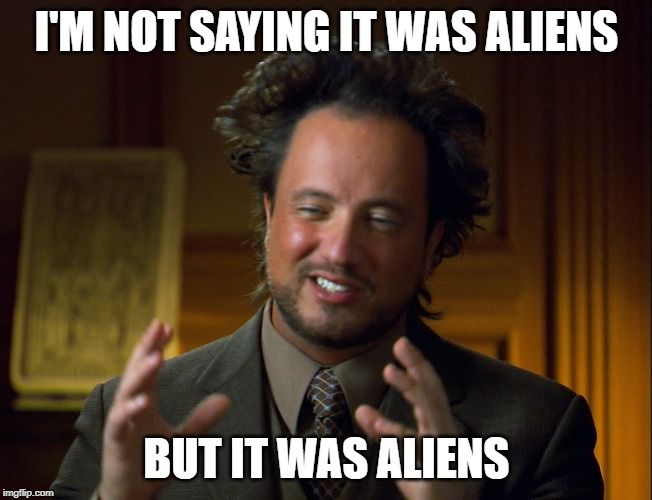
    The REAL reason the aliens will one day destroy Earth

    Another assumption in the construction of the Drake Equation was that communication signals would only become more and more noticeable to aliens as technology progressed. Yet rather than making them more and more powerful, we have instead opted to transmit more information per joule. Compression, which removes patterns from signals, is largely responsible for this, but it also makes otherwise easily-recognizable signs of intelligence difficult to differentiate from random background noise. As a simplified example, let’s say we want to broadcast the phrase “hello alien” ten times. We could either broadcast each individual message ten times, or we could broadcast it one time, followed by a number indicating how many times that phrase is repeated. Our message then becomes “hello alien 10”, and we have removed all semblance of repeating patterns from the message. If the intended recipient of our message already knows that a number following a phrase indicates repetition, then no information has been lost, but if they don’t know, then the lack of repeating patterns and the brevity of the transmitted message would make it hard to distinguish from the random noise of the cosmic background. Ultimately, we might not even notice an alien civilization’s broadcasts unless they want us to.
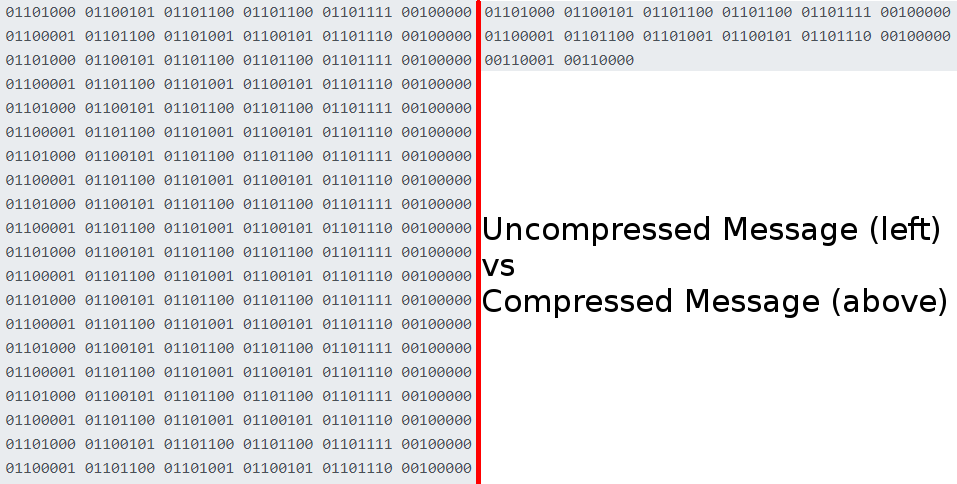
    If YOU had to pay the bill, the choice here is obvious

    If you’ve ever seen TV static, then you’ve seen some of this cosmic background noise with your own eyes. An estimated 1% of all TV static comes from the Cosmic Microwave Background (CMB), a leftover from when our universe was only 300,000 years old! Other sources of background noise include high energy cosmic rays, which can do some pretty wacky things to our electronics.

    Speaking of electronics, another assumption in the Drake Equation is that alien life will be found on habitable planets around stars. This is perfectly reasonable for biological organisms whose chemical processes don’t function well in the cold vacuum of space, but how certain are we that the aliens will be organic? A super-advanced species that goes around wiping others out, so-called cosmic reapers, is a frequently proposed, yet incorrect solution to the Fermi Paradox. Simply replacing one species with another doesn’t solve the problem. After all, the replacements would still be around for us to find, so long as their survival needs, behaviors, and goals are even remotely similar to ours. But what if they aren’t? If we combine these two concepts and consider scenarios in which the replacements are AI, then such machines would have entirely different survival needs and, as a result, entirely different motivations for their behavior. Rather than creating/breaking chemical bonds, they would survive by flipping bits, and the most energy efficient way to flip bits at a given temperature is to do it at the Landauer Limit:

    Boltzmann’s Constant (kB) is a fundamental constant of nature which relates temperature to energy, and ln(2) is equal to approximately 0.693. The only variable that can change in the Landauer Limit is the temperature, and we can easily see from the equation that a lower temperature equates to a lower energy required to flip a single bit. Any AI civilization concerned with maximizing their own survival might logically decide to move their entire civilization into the intergalactic void to increase their longevity through greater computational efficiency. They also might not appreciate organic species using up the universe’s energy for their inefficient biochemical reactions. In short, it’s conceivable that a cybernetic form of the cosmic reapers might exist while simultaneously being exceedingly difficult to detect for anyone not looking in the right place, offering a potential solution to the Fermi Paradox.

    Coming soon to a planet near you!

    All this is to say that, unfortunately, we can pretty well choose whatever length of time we like for this value of the equation. Those with little faith in humanity, like science writer Michael Shermer, might prefer to set this number to 400 years. I personally tend to be a bit of an optimist about our future and wouldn’t set this number any lower than 10,000. Whichever team you bat for, we can take all of our numbers, multiply them together, and calculate an estimate for the number of intelligent civilizations currently in our galaxy.

    For those in the rare Earth, rare intelligence, destined-for-Armageddon camp, we’re probably the only intelligent civilization in the entire Virgo Supercluster:

    For the more optimistic among us, the closest E.T.s might only be a few dozen light years away:

    Ultimately, our calculation is only as good as our estimates, so should we even spend time discussing an equation like this given how little we know? Have I hoodwinked you all into reading my long diatribes about science by dressing them up with references to pop culture and science fiction?

    Well, yes… but actually no.

    What IS the Drake Equation?

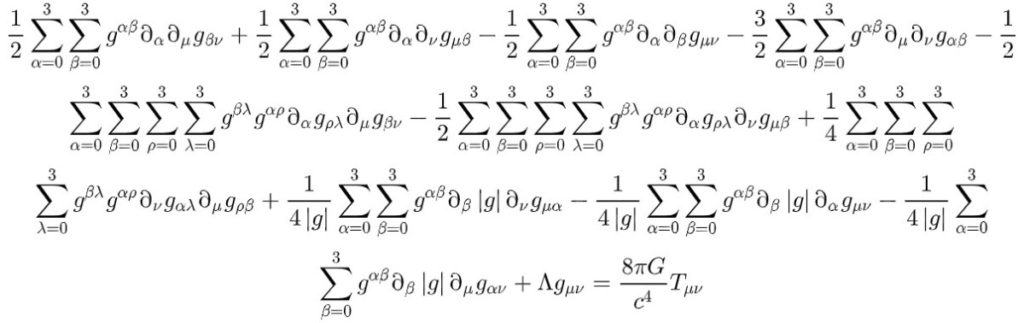
    You see, the Drake Equation isn’t derived from first principles like Newton’s Laws of motion or the Einstein Field Equations, nor was it designed to describe a fundamental aspect of nature. Instead, the Drake Equation is a solution to what’s known as a Fermi Problem. Named after Enrico Fermi, creator of the first nuclear reactor, a Fermi Problem is a type of back-of-the-envelope estimation method designed to approximate answers to extreme scientific calculations. The core idea is surprisingly simple: rather than do the mathematically rigorous calculation to get the precise answer, we can break the problem up into more manageable pieces, throw out some known numbers to place upper/lower bounds on the answer, and finally perform a sanity check at the end. It’s okay to be a bit imprecise with our estimation because any overestimates we make will tend to cancel out with our underestimates. This means that there are actually multiple ways for us to go about making an estimate for the number of other intelligent civilizations in the universe.
    Aww #$&%, here we go again…

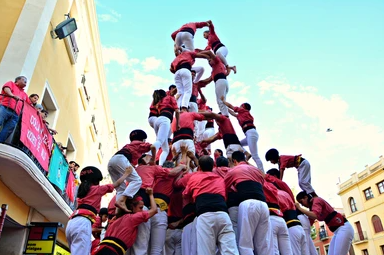
    For example: if every human on Earth formed towers by standing on each other’s heads, how many towers could we make that reach from Earth to the moon? Let’s begin by throwing out some numbers:

    • For starters, I know the moon isn’t closer than 100,000 kilometers away, but it also isn’t further than 1,000,000 kilometers away. We’ll split the difference and say the Earth-Moon distance is 500,000 kilometers, and we want one tower per each of these heights.
    • I don’t know the average human height. However, I know 5 feet sounds too low, and that 6 ft is too high, so we’ll say instead that it’s 5’ 6”. Converting to metric, that’s about 1.68 meters.
    • But wait… adults tend to be taller than children, and most people don’t reach their full height until they’re around 20. I know the average life span is somewhere in the neighborhood of 80, so let’s say that people under the age of 20 represent about 25% of the population and that they have an average height of around 3’. Converted to metric, that’s 0.915 meters.
    • I don’t know precisely how many people are on Earth, but I know the number is getting pretty close to 8 billion, so we’ll just say it’s 8 billion.

    We’re almost ready to calculate, but first we need to check that our units make sense if we multiply all these numbers together. We know we want our answer to be the number of towers, so:

    And indeed, the repeated units on the right side cancel out and leave us with a number of towers! Now, let’s convert our Earth-Moon distance into meters so that it matches the height of each person, i.e. 500,000,000 meters, and we can finally calculate our estimate:

    So by this estimate, we could make almost 24 people-tower-of-Babel’s that reached from the Earth to the Moon! Following more rigorous calculations based on physiological data, population estimates, and the Earth-Moon distance that we’ve measured to better than 1 part in 10 billion, we find that we could make a little over 30 such towers. Despite our seemingly terrible estimates, we arrived at a number within 20% of the true value! This general method can be applied to all sorts of seemingly unanswerable questions. Try coming up with and answering some for yourself!
    Call me, NASA 😉

    In this series of articles about aliens, we’ve discussed topics from astronomy, psychology, chemistry, sociology, history, computer science, mathematics, and theoretical physics, all from a distinctly human perspective. At the end of the day, I guess the Drake Equation is less about analyzing what aliens are like and more about who we are as a species. Wherever, whenever, and whomever the aliens turn out to be, I’m glad that I get to share our little corner of the cosmos with all of you.

  • Two symbols, infinite meanings

    What do you think the following means?

    1010

    One-thousand and ten, right? What if I told you that it meant four-thousand one-hundred and twelve? Or three-hundred and fifty? Or simply ten? The truth is that all of these answers are right, depending on what number system you’re using. Let me illustrate with a more abstract example. Imagine you have two symbols that you’re using to count objects. When you have no objects, you represent that with a triangle. When you have one object, you represent it with a heart. What if you have two objects? Well, we can simply box up both of our symbols and use another heart in a different position, say, slightly to the left, to indicate that we have one box of two symbols! To represent three symbols, we can write two hearts next to each other, one heart representing the original meaning–one object–and the next heart representing the second meaning–a box containing two objects. Now when we add both meanings, we get three because our symbols represent three total objects. To represent four, we can use another heart in a different position that represents a box containing two boxes, each with two objects. This is what is known as the binary system, though it is typically employed using the more familiar symbols 0 and 1. The number which we originally displayed, 1010, can be read as follows, from right to left (in our standard decimal system).
    (0 * 2^0) + (1 * 2^1) + (0 * 2^2) + (1 * 2^3) = (0 * 1) + (1 * 2) + (0 * 4) + (1 * 8) = 0 + 2 + 0 + 8 = 10

    The reason we multiply each number by some power of two is that we have two symbols in this number system. We would call this a base-two number system. In our more familiar decimal system, we have ten symbols–0, 1, 2, 3, 4, 5, 6, 7, 8, and 9. We would call this a base-ten number system. If we wish to represent the number ten, we write “10” to show that we have one box of the preceding ten symbols, and no extra numbers–thus ten total objects. Going back to our original example, the number 1010 in decimal just means
    (0 * 10^0) + (1 * 10^1) + (0 * 10^2) + (1 * 10^3) = (0 * 1) + (1 * 10) + (0 * 100) + (1 * 1000) = 0 + 10 + 0 + 1000 = 1010

    Likewise, if we want to use some strange number of symbols, like thirteen, we are more than free to do so. We could represent them as follows, the first number as the symbol in our base-thirteen system, the second as our symbol in decimal.
    0 = 0, 1 = 1, 2 = 2, … (and so on up to nine), A = 10, B = 11, C = 12. Note that even though we have thirteen symbols, we don’t have a specific symbol that equals thirteen because our symbol for zero gets us up to thirteen total symbols. To represent thirteen, we would write 10 (one box of thirteen objects and zero loose objects). Thus, 1010 would mean
    (0 * 13^0) + (1 * 13^1) + (0 * 13^2) + (1 * 13^3) = (0 * 1) + (1 * 13) + (0 * 169) + (1 * 2197) = 0 + 13 + 0 + 2197 = 2210
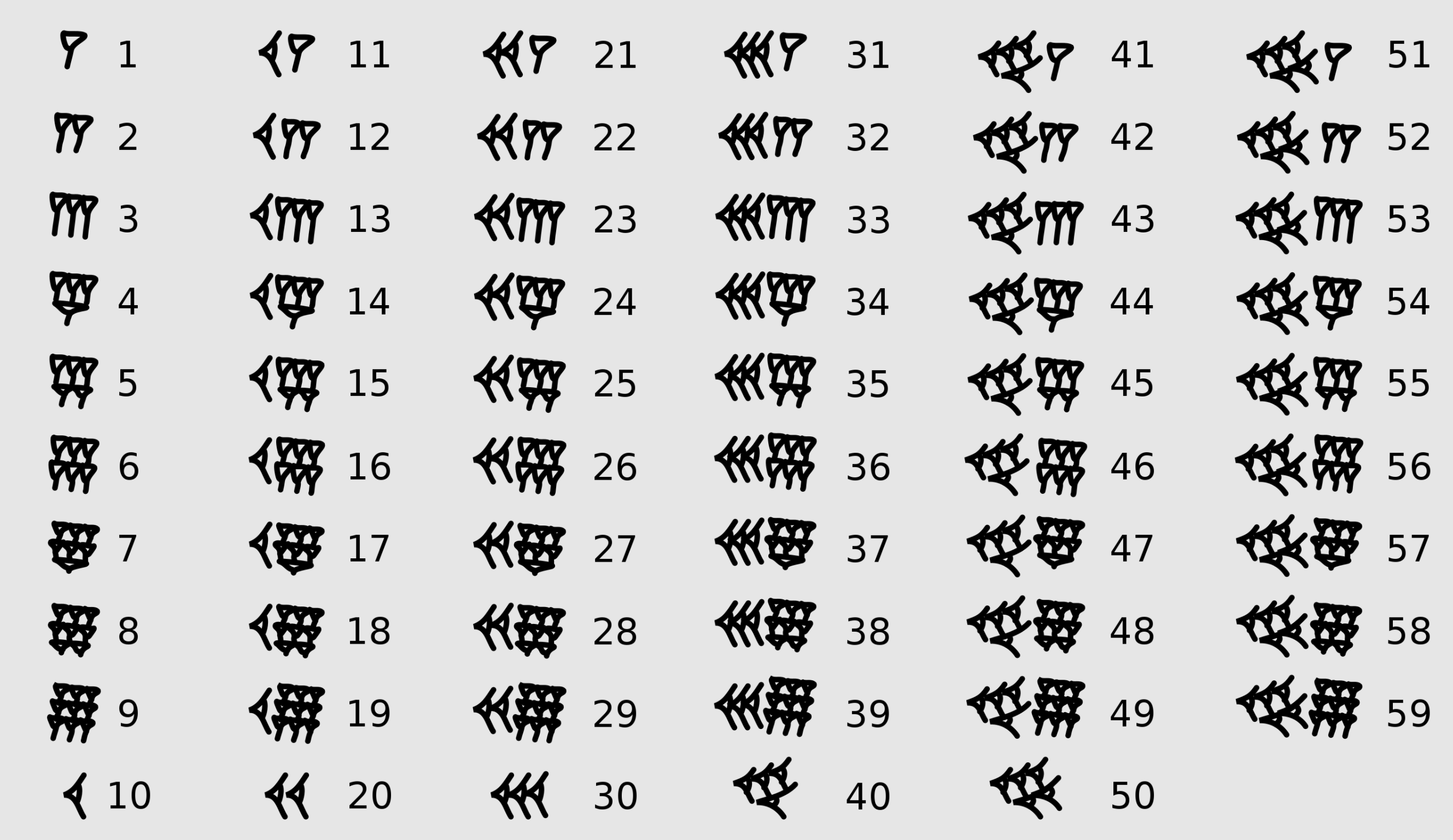
    I hope that makes sense. The main point of this exercise is to show that symbols can be completely arbitrary. Zero does not need to be represented by “0,” nor does two-hundred and eighty-three need to be represented as “283.” We could represent them as a pyramid and a hippo if we wanted to, although the decimal system does a fairly good job at keeping matters concise.

    The sexagesimal (base sixty!) Babylonian number system

    Image Credit: Babylonian numerals under GNU Free Documentation License.

  • Three Dog Star Night (Part 3)

    Welcome back to our discussion on the Drake Equation and the Fermi Paradox! If you haven’t read parts 1 and 2 already, it goes without saying that you should start there! This time we’ll be discussing what we know about the evolution of intelligence and communication… or at least what we think we know. This part is going to be more philosophical and speculative than the last two, but unlike a certain notorious tv show, our aim will be informed speculation.

    The poster child for uninformed speculation

    Before we dive into our discussion, we first need to clear up a common misunderstanding surrounding the evolution of intelligent life: the notion that intelligence is ‘more evolved’ and thus evolution has been “building up” to it all along. Evolution by natural selection is a process by which a species’ genetics change over successive generations to better fit their environment. It is not a guided process with an end goal, nor does it converge to a single result in a given environment. If it did, the word ‘biodiversity’ wouldn’t be part of our lexicon. Intelligence is an example of complexity, but complexity is not synonymous with ‘most evolved’. In fact, the most evolved species are generally those which are the least complex because they reproduce the fastest and have been around the longest. These two factors allow for the greatest number of environmental adaptations to take place in a species. For example, the bacteria in your digestive system are several million times ‘more evolved’ than either you or I are. While it’s certainly true that intelligence provides a substantial survival advantage, this is not unique. By definition all adaptations provide survival advantages, and those that help to survive the threat of mass extinction events should also be considered. In that light, the organisms living around geothermal vents on the ocean floor take first prize. Genetic and molecular clock modelling suggests that the last universal common ancestor (LUCA), to which all extant life originated from, was just such an organism. To put it simply, LUCA was most likely an organism that survived a massive planetary extinction event which wiped out all other genetic lineages around 4 billion years ago. This makes it and life like it not only the ‘most evolved’, but arguably the most capable survivors.

    With that out of the way, let’s examine some more factors!

    Fraction of Inhabited Planets that Develop Intelligent Life, Fi

    The first thing to note is that this factor is heavily debated, with estimates more or less divided into two camps: those who argue this number is very small, and those who argue it’s close to 1. For simplicity, we’ll refer to these as “Rare Intelligence” and “Inevitable Intelligence”, respectively.

    Rare Intelligence

    Anatomically modern humans arose only very recently, around 200,000 years ago, civilization a mere 12,000 years ago, and recorded history began a paltry 5,000 years ago. As a percentage of the total time life has existed on Earth, these account for 0.005%, 0.0003%, and 0.0001%, respectively. The precursor hominids (i.e. not Neanderthals or Denisovans) to our own species did not have the intellectual capacity to become broadcasting civilizations. They never even developed agriculture, which enabled specialization. This was a critical step in making the switch from isolated, nomadic tribes to densely populated cities.  Even if high intelligence is a generic product of the evolutionary process, the enormous amount of time it may take to evolve places constraints on our estimates given the current age of the universe. If the development of intelligence is limited to planets around stars of similar mass to our own, then the window for it to develop is limited to around 5 billion years. In around 1 billion years the sun’s brightness will have increased, significantly raising our planet’s temperature to the point that (unless we do something about it) the Earth will be completely uninhabitable. Thus if intelligence takes on average a few billion years to develop, when a planet only has a few billion years of habitability to begin with, we would expect relatively few organisms to ever develop intelligence.

    David Kipping, from Columbia University’s department of astronomy, recently performed an objective Bayesian analysis on this topic in an attempt to determine just how likely intelligent life is to evolve on other planets given what we know about Earth. Unlike other methodologies, Bayesian analysis seeks to directly compare two or more competing hypotheses in order to determine which explanation is most probable. Using this methodology, he determined that the odds of life arising very soon after a planet becomes habitable may be as high as 9:1. However the evolution of intelligence is far less constrained, with 3:2 odds of intelligence being rare. As we learn more about our own planet’s history and perhaps finally detect life on another planet, these odds will shift quite a bit. The key to this sort of analysis is that the odds can be refined as more information is gained. While the odds of intelligence being common don’t look good at the moment, they have plenty of room to improve.

    For simplicity, we will set the fraction of planets that develop intelligent life under the assumption of rare intelligence at roughly 9:1 odds: Fi,Rare = 0.1.

    Inevitable Intelligence

    Though it took billions of years for intelligence to evolve, we don’t actually know for certain just how long it will survive. Drawing conclusions about the frequency with which intelligent life develops based on Earth’s history thus far is fundamentally flawed. If, for example, intelligent Earth life were to continue on for another trillion years, long after the Sun and Earth are gone, then intelligent Earth life would have been around for 99.6% of the total time Earth life existed. If Earthly intelligence survives until the end of the Stelliferous Era, that percentage increases to 99.996%. Even if Earth life never becomes interplanetary, then our time here is hard-capped at around 7.5 billion years and intelligent life will have accounted for 65% of life’s existence on the planet. Unless we wipe ourselves out tomorrow (a topic we will revisit in Part 4 of this series), the previous analyses of our existence as a fraction of the time life has currently existed on Earth is irrelevant. If we allow for the possibility that life can develop on worlds orbiting red dwarf stars, then the window of habitability could be trillions of years rather than a mere 5 billion.

    Lesser extinction events don’t prohibit evolution to intelligence unless they happen frequently enough that multicellular life can’t gain a long-lasting foothold on the planet before the host star burns out. Given the fast pace at which even the slowest-reproducing life evolves compared to how long typical life-supporting stars live, extinction events would need to be so frequent that such a planet arguably wouldn’t be considered habitable in the first place. It’s only been around 66 million years since the last ‘big one’ hit, a length of time representing less than 2% of the total time that life has existed on the planet, and less than 1% of the sun’s total lifetime. During that short span, mammals progressed from near the bottom of the food chain to dominating the entire planet. Geographically speaking, humans are the most widely distributed single species on land*. In the ocean, that award goes to the killer whale. Both of these species are mammals and both are at the top of their respective food chains. Life has recovered similarly quickly after other mass extinctions events, so we should only expect frequent, near-total extinction of life on a planet to prohibit the development of intelligence. If intelligence ever does arise, then if/when it later goes extinct will be accounted for with the final value in the equation, L.

    The Land Before Time CLXVII: The Great Space Rock Adventure

    Again, for simplicity, we will set the fraction of planets that develop intelligent life under the assumption of inevitable intelligence Fi,Inev = 1.

    Fraction of Intelligent Civilizations that Develop Detectable Communication, FC

    In our discussion of the Drake Equation thus far, we’ve swept an important detail under the rug: how exactly would we detect intelligent extraterrestrial life? The prevailing presumption in all analyses of the Drake Equation has, until very recently, been that we would detect signs of intelligent life via their radio broadcasts. At the time the equation was penned, that was the only pragmatically conceivable means for detecting alien intelligence beyond our solar system. This factor is also disputed, but less so than the previous one. In most conceivable scenarios, it’s likely that intelligent life will eventually develop electromagnetic communication techniques if left to its own devices, as intelligence does provide a great survival advantage once it has developed. Even though complex brains are an enormous energy investment, one of the primary advantages they ultimately provide, through the development of agriculture, is complex societies that enable individuals within a species to become highly specialized and efficient in various tasks. Using the Pareto Principle, a general mathematical principle which states that a majority of the results come from a minority of the causes, we can surmise that an 80% efficiency level in most skills can be attained with around 20% of the effort. Beyond this, the effort required for incremental efficiency attainment increases exponentially. You’re likely familiar with this concept, even if you don’t recognize the name. Anyone who has learned to play an instrument knows that learning how to play all the notes takes only a few months, but true mastery of more advanced techniques like circular breathing can take a lifetime of daily practice. Our nomadic ancestors couldn’t afford to invest limited resources on specializing in a single skill because the marginal returns were low. In contrast, a society with a food surplus (that is, an energy surplus) can afford to make that investment and quite literally ‘reap’ the benefits they ‘sowed’. That’s not to say we don’t see socialization or specialization elsewhere in nature, but never to the same extent as in human societies.

    The sheer degree to which we socialize and specialize in and of itself necessitates an advanced capability like communication through language. The further advancement of this capability into the Information Age has provided us with survival benefits the likes of which our ancestors would never have dreamed of. It’s possible that intelligence, sociality, and advanced communication capabilities are paired at a deep level. Using our own brains as a model, we might reasonably expect that natural selection will disfavor intelligence that does not possess a comprehensive capability to communicate. Similarly we can expect such capabilities to generally trend towards the use of electromagnetic technologies since the speed of light is the fastest possible way to transmit information. While it’s certainly plausible that there may be a species of strong, independent geniuses out there in the cosmos who can comprehend General Relativity by the age of 10, their time spent not doing the basic things required to survive is just as limited as yours or mine. Such capabilities, impressive as they would be, don’t automatically outweigh the benefits of being a social animal. After all, you can’t exactly eat the Einstein Field Equations.

    Part of a Complete Breakfast™

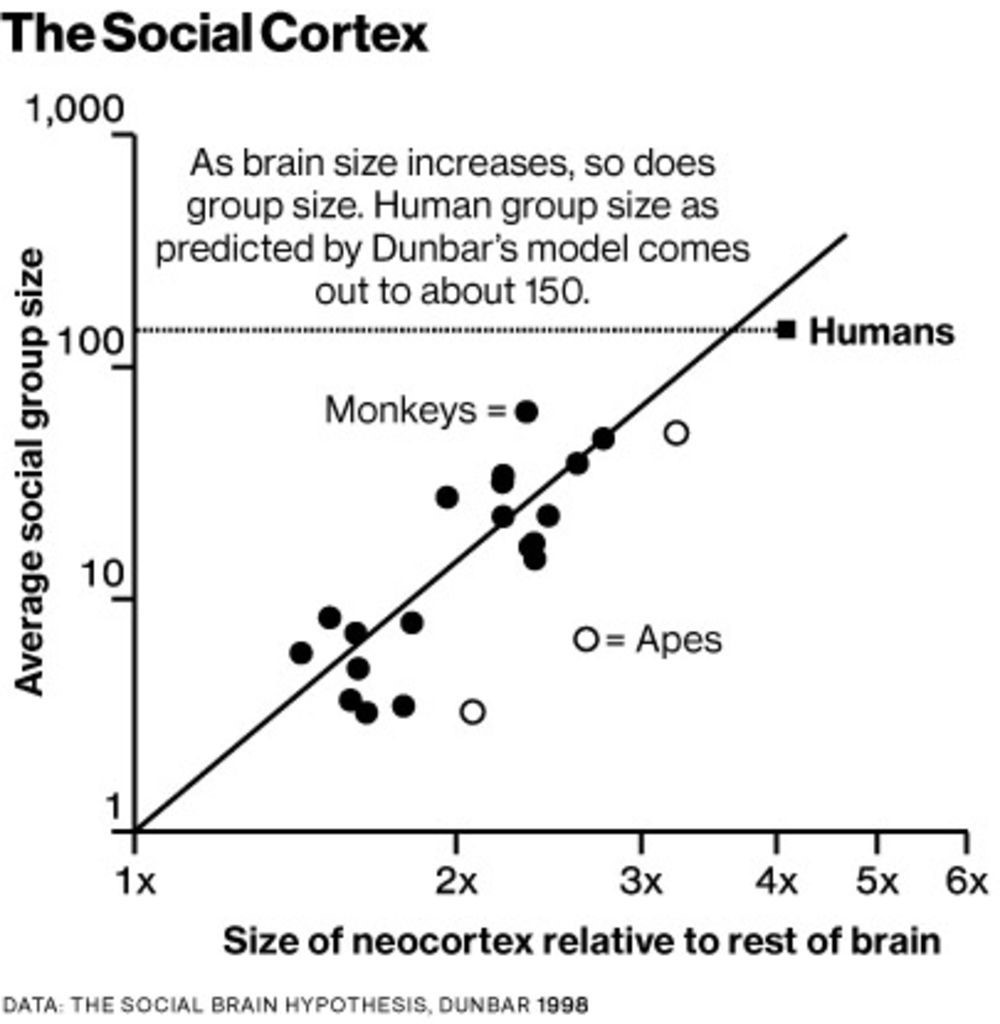
    We generally measure intelligence in humans with the intelligence quotient, but IQ tests are designed for humans and can’t be generalized to other species. In theory, we could instead estimate a species’s intelligence by measuring their degree of sociality, but how exactly would one do that? Dunbar’s Number aims to measure the maximum number of other members of a species with whom its members can maintain meaningful relationships. In his original work, Robin Dunbar compared the relative neocortex sizes of different primates to the average sizes of the social groups they formed and found that the average human social group size is approximately 150. Some real-world examples of Dunbar’s Number include the average size of Hunter-Gatherer societies, average size of Christmas card networks, average number of wedding guests, size of the Roman Maniple, average size of an English Village in the 11th century, and even the number of Super Bowl rings the NFL gives to the winning team each year.

    The link between neocortex complexity, intelligence, and social behaviors means that a species with a larger Dunbar’s Number would generally have higher intelligence, more cooperation, and a higher degree of specialization. These, in turn, contribute to a more rapid pace of technological development. In contrast, a species with an extremely low Dunbar’s Number will have lower intelligence, difficulty cooperating, less specialization, and slower development of technology. As we consider species with lower and lower values, eventually one will be less likely than not to develop electronic communication. Since the values for other primates aren’t all that far behind ours, this lets us set a measurable baseline for what we mean by ‘intelligence’ insofar as the Drake Equation is concerned.

    Of course there are a plethora of conceivable exceptions to this rule, but most fall apart under closer scrutiny. Some insect species live in colonies of more than 100,000, so what about a species of hyper-intelligent alien insectoids like the Formics in Ender’s Game? What about a species of ocean-dwellers with human level intelligence that nonetheless never develops electronic communication due to their aquatic environment? As intriguing as these and other Sci-Fi aliens may be, insects don’t have a neocortex and even the most intelligent sea creatures lag far behind humans. If we wish to extrapolate characteristics of Earth creatures, we should aim to be consistent rather than picking and choosing which features we want them to have.

    On a planet somewhere in the infinite universe… probably…

    Since we expect what we generally define as intelligence to go hand-in-hand with the development of electronic communication, we will set FC ≈ 1.

    As a final note, the Drake Equation was formulated under the assumption that alien intelligence could only be detected via radio signals. With the launch of the James Webb Space Telescope fast approaching, the landscape of possible methods for detecting an extrasolar intelligent civilization are about to shift dramatically. The ability to detect the atmospheric compositions of extrasolar worlds will give us our first chance at detecting alien life forms through the spectroscopic signatures of volatile chemicals they leave in their atmosphere.

    Next time, we’ll be discussing the final factor in the Drake Equation as well as what it and equations like it actually are.

  • The Science of Baking Pt.2

    Introduction

    Welcome to Part 2 of The Science of Baking! Since this is the second installment of the series, I would recommend going back and reading part 1. This article will go through an experiment of baking a flaky pastry using two different types of fat: butter and coconut oil. There are accompanying pictures that I took myself showing in detail the two pastry doughs!

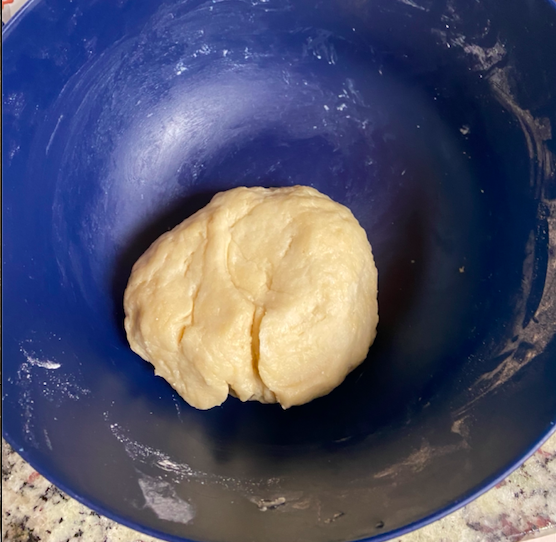
    Step 1: Mix flour, salt, and sugar.

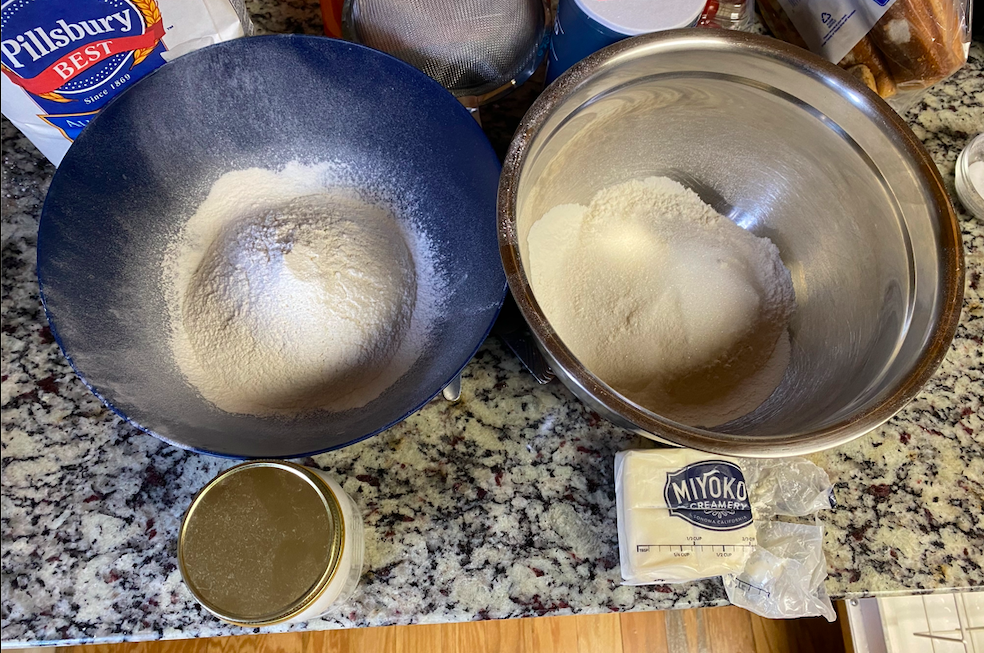
    The two bowls of flour mix for each fat.
    The two bowls of the flour mix and the corresponding fats in front of them.

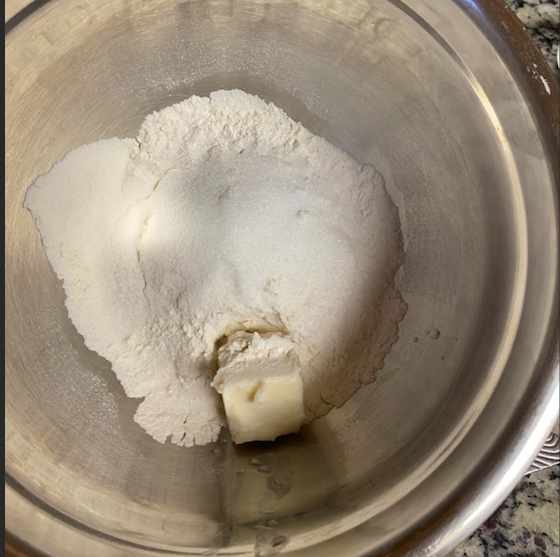
    Step 2: Break the fat up into 4 equal portions and add one portion of the fat component to flour mix.

    The butter + flour mix
    Coconut oil + flour


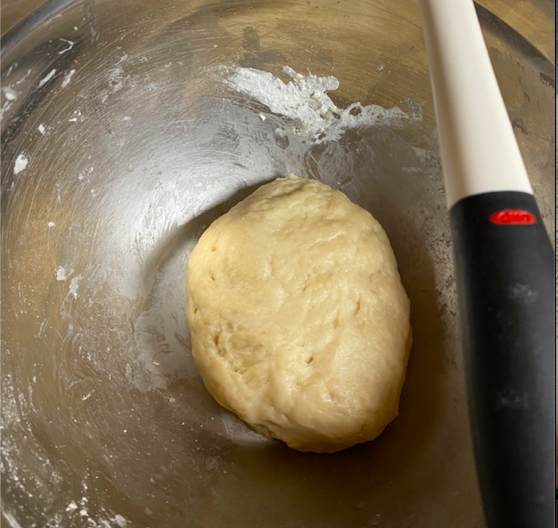
    Step 3: Mix and add water slowly until a dough forms.

    Dough with butter
    Dough with coconut oil

    Step 4: Roll out dough into flat sheet

    The doughs rolled out into rectangles

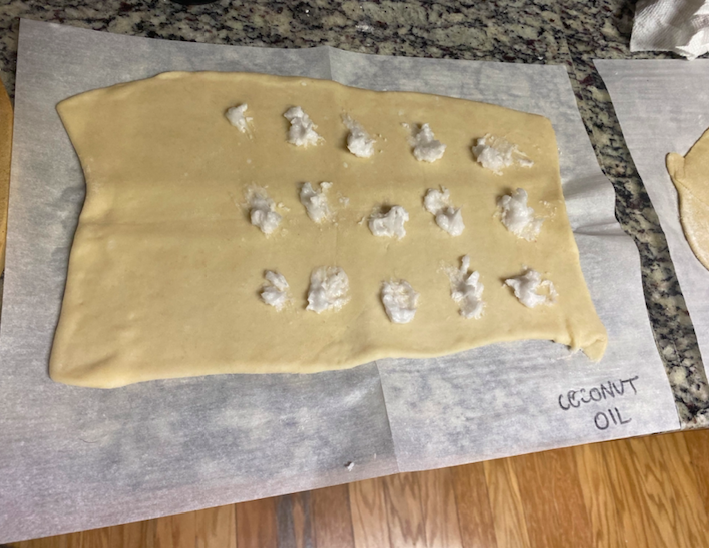
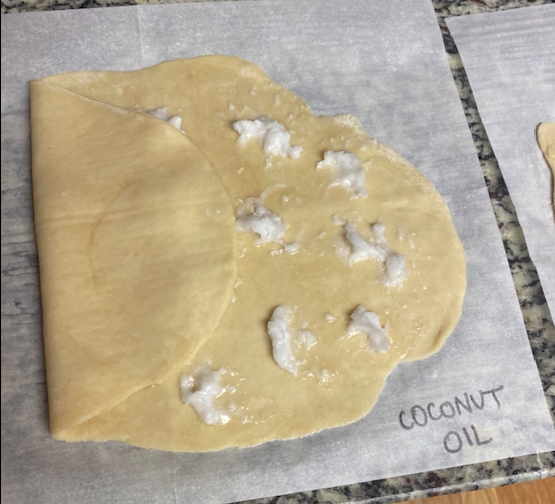
    Step 5: Break up the next portion of fat and spread along sheet of dough

    One portion coconut oil dotted on dough
    Butter dotted on dough


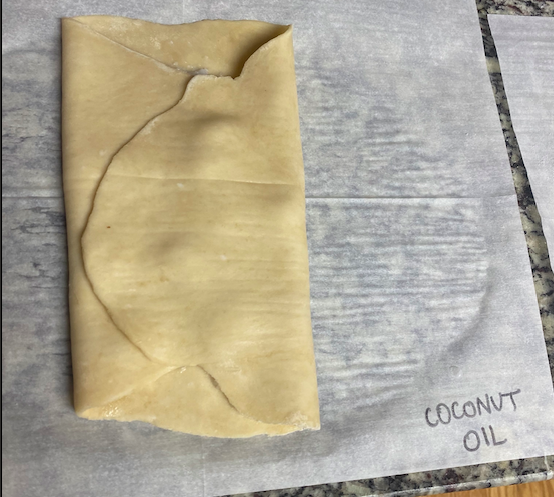
    Step 6: Fold the end without fat over 1/3 of sheet and fold the other end over the top.

    First fold
    Second and last fold

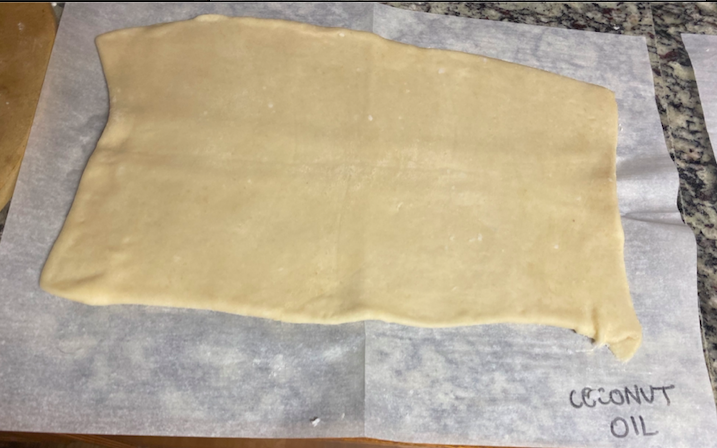
    Step 7: Roll out the dough exactly like in Step 4 carefully.

    Rolled out dough for second time

    Step 8: Repeat steps 5-7 two more times with the next two portions of fat.

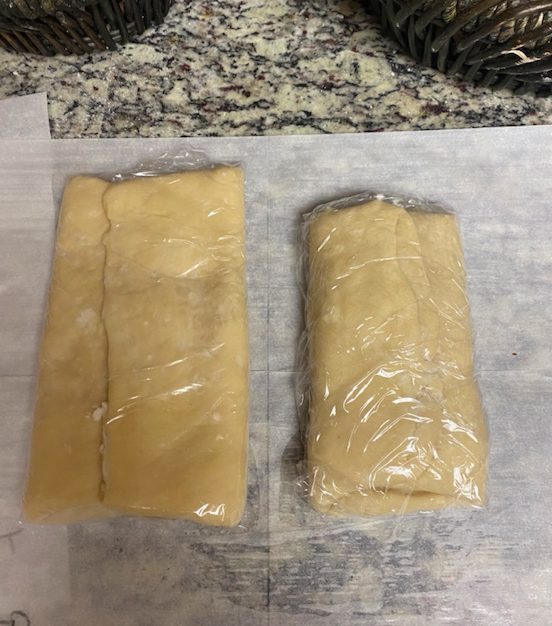
    Step 9: Wrap the dough in plastic wrap and chill in fridge for 30 minutes.

    Wrapped up and ready to go into the oven!

    Step 10: Preheat oven to 450° F and bake pastry for 8-10 minutes. 

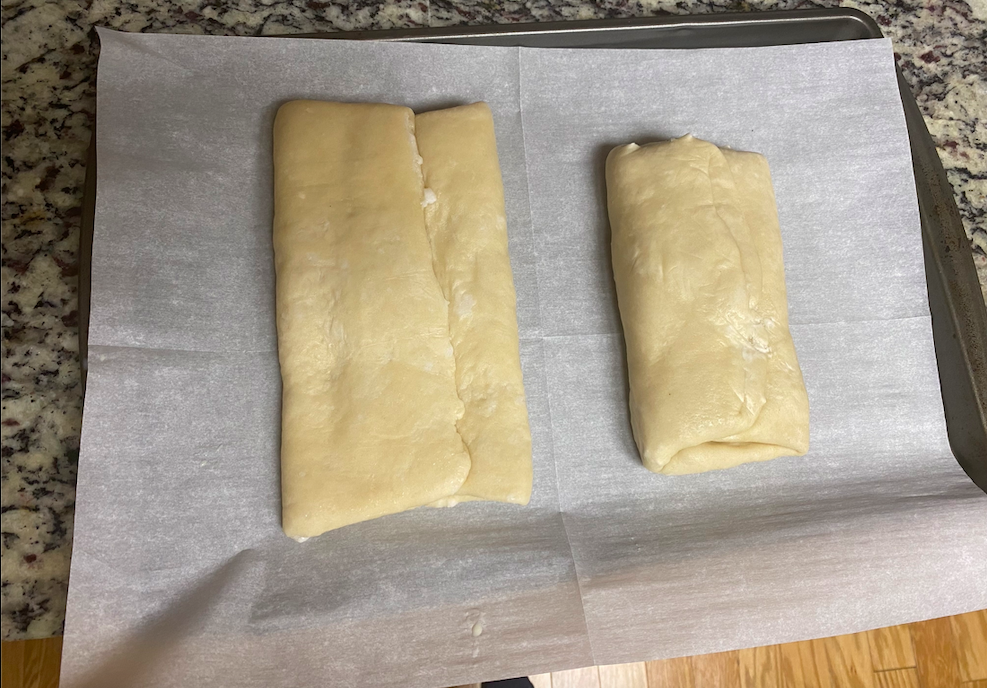
    Before baking…
    Crispy, baked flaky pastry fresh out of the oven!


    Observations

    There were many, many differences between the butter pastry and the coconut oil pastry not only during the preparation, but after baking as well. Although coconut oil and butter have very similar structure at first glance, the butter was much creamier and incorporated into the flaky pastry dough much easier than the coconut oil. The oil melted super quickly, making it difficult to keep very doughy as it was getting way too wet. The coconut oil was also much harder to de-clump while the butter of course, had real clumps. Another huge difference between the doughs was their size. As seen from the photos, the coconut oil dough had a much larger size than the butter dough. My theory for this stark difference was that the butter was much thicker than the coconut oil, making the dough much more cohesive and elastic. The coconut oil pastry was clearer flatter and more spread out, due to the silky nature of the coconut oil. The butter pastry was also much taller than the flat coconut oil version; my thinking tells me the butter allowed for the pastry to rise better than the oil did.

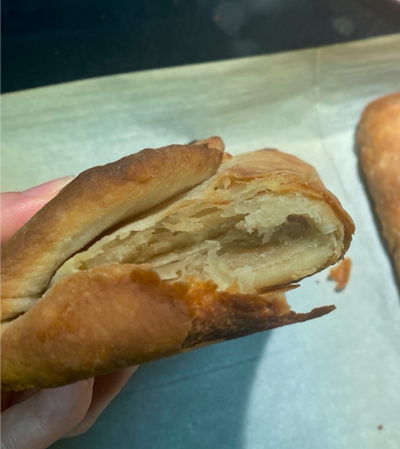
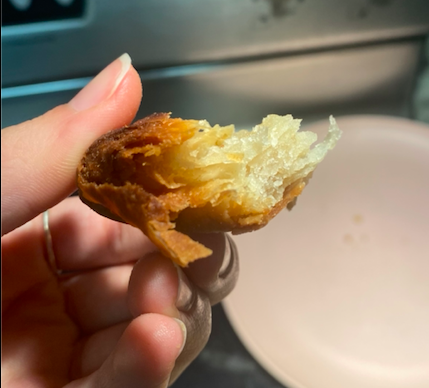
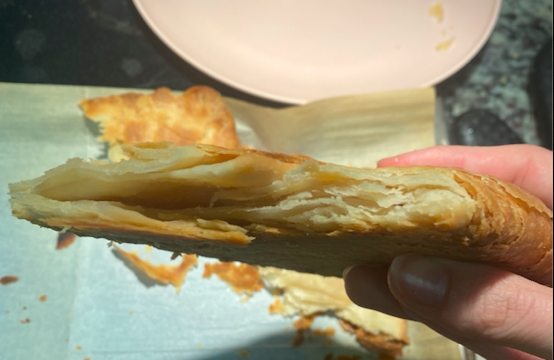
    In terms of taste, texture, and overall flakiness, both doughs performed relatively well but the butter dough definitely outshone the coconut oil. Though the butter dough was better in taste and more compact, the coconut oil pastry was also quite delicious as a substitute for butter. For any coconut lover, this is the perfect pastry substitution for fat. All in all, both doughs baked into beautiful flaky pastries with multiple light layers of crisp pastry, but the dough using the butter cooked better and tasted more like a pastry would normally taste.

    The dough with butter and its nice flaky layers
    Buttery, flaky layers of delicious pastry


    The flatter layers of the coconut oil pastry
    The coconut oil flaky pastry result


    Conclusion

    This experiment was so much fun to do considering I love to bake and have never made a flaky pastry dough before! I learned so much from the experience- not just how to make a flaky pastry but also so much new insight on how the science of baking really works together to create a magnificent dessert when heat is introduced to a couple of different ingredients. I encourage anyone reading this post who enjoys baking to try this experiment out for yourself to see if your results are the same! Not only did this experiment make me want to bake even more, but now I have an urge to try this recipe with all possible substitutes for fat like ghee, vegetable shortening, even lard. The possibilities are endless and we are just getting started!