Category: today i learned (til)

  • Gacha or Gambling?

    When someone tells you that they have a gambling addiction, what is the first thing you think of? The most stereotypical image would be a person in the casino, playing on slot machines. Perhaps the first thing that comes to mind is online sports betting instead. But has anyone considered video games?


    Rising in Popularity: GACHA

    One of the most popular genres of games that have developed throughout the past few years include a “gacha” system. The term stems from the Japanese word “gachapon”, which refers to small machines where people can exchange coins for a random toy capsule (Reyes, 2025). 

    According to Epic Games, some of their most popular games include Genshin Impact, Honkai Star Rail, Wuthering Waves, Zenless Zone Zero, and Where Winds Meet all employ a gacha system. While these games are free to play, they often include gacha systems as a way to win prizes such as playable characters, weapons, or cosmetics. Users can either play the game and earn in-game currency or pay real money to buy “pulls” for these games. The “pulls” are then used in the gacha system, where players try their chances at getting the prize that they need. These are often characters or cosmetics that are quite rare, incentivizing players to keep playing or spending money to get the prizes that they want. 

    In a way, this can be seen as gambling. Players are often paying real money for the random chance at winning a prize that is not guaranteed to them. Although real money is not required, some games make it difficult to earn pulls through gameplay only. 


    The Psychology of Addiction

     Addiction lacks a universal definition in psychology, making it difficult to determine what is truly an addiction or not. According to one article, some have defined addiction as “continual, excessive use and ‘loss of control’” of something to the point of dependence (Wanigaratne, 2006). In other words, addiction can be defined as the use of something to the point where it is no longer controllable for a person. They simply keep going back to it, as if they are dependent on it. With this definition, anything can be an addiction, not just substances. Sure, things like drugs and alcohol are some of the most common ideas associated with addiction, but with this definition, recreational activities such as games or gambling can be addictive as well.

    There are several different theories that psychologists have come up with to try and explain addiction. Some have theorized that it is a result of conditioning, where the results of the addictive behavior can act as positive reinforcers the same way food or sex have been used in the conditioning process (Wanigaratne, 2006). For example, gacha games often offer the most desirable prizes as the rarest ones, making it quite difficult for players to get the item that they want. However, these games often have a “pity system”, where there is a guaranteed chance of receiving a rarer item based on the number of times a player has already pulled (Reyes, 2025). Although the specific item that the player wants is not guaranteed, they are given a reward for continuing to feed into the behavior more and more. Additionally, once the player receives the item that they want, the event can act as a positive reinforcer, conditioning players to continue to buy more pulls as they did before. 


    Issues with Gambling on the Internet

    As always, enjoying mobile games or betting does not always equal addiction. However, it is important to understand how making such games available to the general public can be dangerous. For instance, the games on the Internet have certainly made gambling much more accessible, which can make it easier for people to develop harmful habits. Some studies have noted that mobile app users typically visit the apps on their phone on a frequent, habitual basis, putting those who gamble on the Internet at a higher risk than those who do not (James, O’Malley, & Tunney, 2016). Most of the games mentioned before are available on mobile devices as well, making them extremely easy to play at any time, anywhere. Although this does not necessarily mean that they can result in harmful habits, it is certainly easy for a person to play the game every single day and regularly come back to paying for more pulls whenever they want.

    This does not mean that gacha games should be banned overall, but it is important for parents and players to be careful when playing. Make sure to take breaks and think before making any big purchases on a game!


    Wanigaratne, S (2006). Psychology of addiction. Psychiatry, 5(12), 455-460. https://doi.org/10.1053/j.mppsy.2006.09.007 

    James, R.J.E., O’Malley, C., Tunney, R.J. (2016). Understanding the psychology of mobile gambling: A behavioral synthesis. British Journal of Psychology, 108(3), 608-625. https://doi.org/10.1111/bjop.12226 

    Reyes, J. (2025). Gacha games explained: Banners, pulls, pity systems, and more. Epic Games. https://store.epicgames.com/en-US/news/gacha-games-explained-banners-pulls-pity-systems-and-more 
  • A New Bumpy Buddy in the Deep Sea

    People often say that humans have only discovered 5% of the ocean to this day. While this exact number is often argued, it is no secret that much of the ocean is unknown to us. However, scientists have recently made a discovery of a new fish in the depths of the sea: the bumpy snailfish. 


    What is a snailfish?

    The bumpy snailfish, also known as Careproctus colliculi, belongs to the Lipradae family, which is one of the only few species on Earth that have adapted to live between what are considered the “abyssal deep” and “hadal deep” parts of the ocean (Scharzans & Gerringer, 2023). These parts of the ocean are typically extremely difficult to live in due to the immense water pressure, darkness, and lack of food. However, it seems that these depths are where snailfish (fish in the Lipradae family) thrive. 

    There are currently 450 accepted species of snailfish. Scientists identify them through their lack of scales along with a suction disk on their pelvis, which allow them to attach to other surfaces (Gerringer et al., 2025).


    Discovery of the Bumpy Snailfish 

    According to the Monterey Bay Aquarium Research Institute, the fish have large heads, while the rest of the body is made up of a jelly-like substance (Nava, 2025). Snailfish are given their name because they have a disk on their bellies that allow them to attach to the ocean floor, much like a snail would (Nava, 2025). This newly discovered version of the snailfish is a light pink color, a round head, large eyes, and a bumpy texture on its skin. Thus, it was named the bumpy snailfish. 

    Researchers describe the hadal trenches as depths greater than 6000 meters below sea level, where it is easier to study snailfish that father around bait falls (Gerringer et al., 2025). However, it is more difficult to find them in the abyssal depths, which are around 3000 to 5000 meters deep in the ocean (Gerringer et al., 2025). This is what makes the bumpy snailfish special, as it is a new lifeform in the abyssal depths of the ocean for researchers to study.

    In order to determine if these were a new species of fish, clips of the fins were collected from dissected snailfish. These tissues were used for DNA extraction, where researchers were able to compare the DNA sequences of previous snailfish to this one (Gerringer et al., 2025). 


    Works Cited

    Gerringer, M. E., Suplicz, S., Palmeri, J.L., Fregosi, L., Woodworth, B.H., McMahon, E., Shepard, M., Peoples, L.M., Drazen, J.C. (2025). Descriptions of Three Newly Discovered Abyssal Snailfishes (Liparidae) from the Eastern Pacific Ocean. Ichthyology & Herpetology, 113 (3), 487-506. https://doi.org/10.1643/i2024069 

    Nava, R. (2025). MBARI’s advanced underwater technology reveals a new species of deep-sea snailfish. Monterey Bay Aquarium Research Institute. https://www.mbari.org/news/mbaris-advanced-underwater-technology-reveals-a-new-species-of-deep-sea-snailfish/ 

    Scharzhans, W.W., Gerringer, M.E. (2023). Otoliths of the deepest-living fishes. Deep Sea Research Part I: Oceanographic Research Papers, 198. https://doi.org/10.1016/j.dsr.2023.104079 

  • TikTok Effect on Academic Burnout

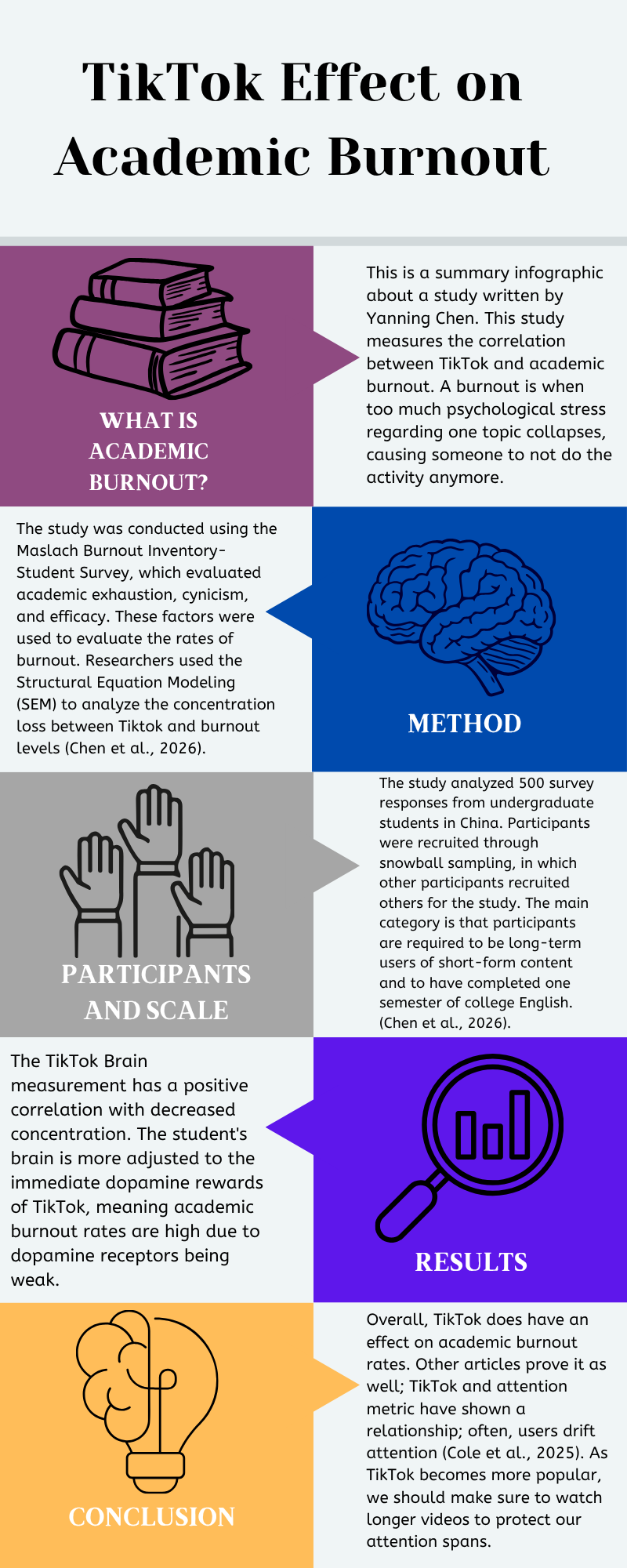
    TikTok Effect on Academic Burnout

    What is Academic Burnout?

    This is a summary infographic about a study written by Yanning Chen. This study measures the correlation between TikTok and academic burnout. A burnout is when too much psychological stress regarding one topic collapses, causing someone to not do the activity anymore.

    Method

    The study was conducted using the Maslach Burnout Inventory-Student Survey which evaluated academic exhaustion, cynicism, and efficacy. These factors were used to evaluate the rates of burnouts. Researchers used the Structual Equation Modeling (SEM) to analyze the concentration loss between Tiktok and burnout levels.

    Participants and Scale

    The study analyzed 500 survey responses from undergraduate students in China. Participants were recruited through snowball sampling, in which other participants recruited others for the study. The main category is that participants are required to be long-term users of short-form content and to have completed one semester of college English.(Chen et al., 2026).

    Results

    The TikTok Brain measurement has a positive correlation with decreased concentration. The student’s brain is more adjusted to the immediate dopamine rewards of TikTok, meaning academic burnout rates are high due to dopamine receptors being weak.

    Conclusion

    Overall, TikTok does have an effect on academic burnout rates. Other articles prove it as well; TikTok and attention metric have shown a relationship; often, users drift attention (Cole et al., 2025). As TikTok becomes more popular, we should make sure to watch longer videos to protect our attention spans.

    References

    Chen, Y., Hu, J., & Cheng, L. (2026). Academic burnout in the TikTok era: a battle between pleasure and concentration. Frontiers in Psychology, 17, 1774030.

    Cole, B., Santana, A. D., Hu, X., & Hopp, T. (2025). TikTok Usage Effects on Attention to News Reading: An Eye-Tracking Study. Journal of Broadcasting & Electronic Media, 69(4), 365-380.

  • Fast Fashion vs Environment

    Fast Fashion vs Environment

    Background

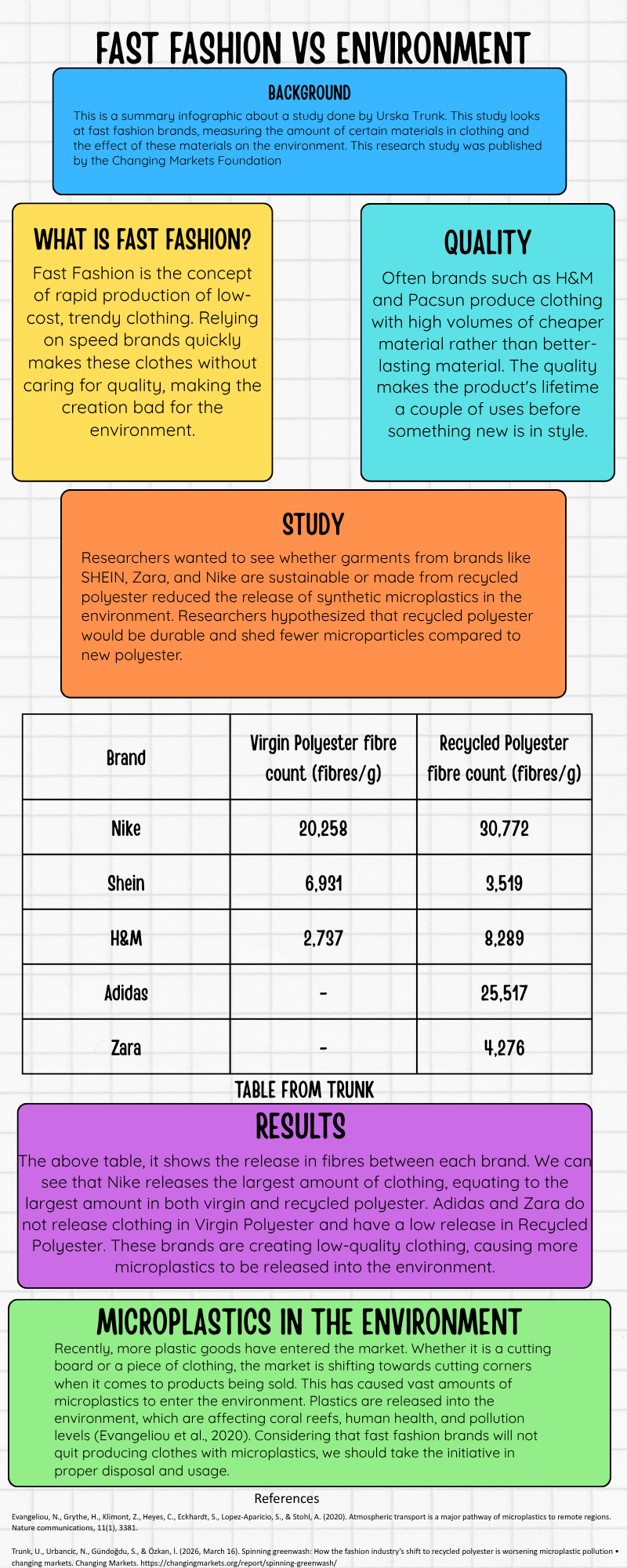
    This is a summary infographic about a study done by Urska Trunk. This study looks at fast fashion brands, measuring the amount of certain materials in clothing and the effect of these materials on the environment. This research study was published by the Changing Markets Foundation

    What is Fast Fashion?

    Fast Fashion is the concept of rapid production of low-cost, trendy clothing. Relying on speed brands quickly makes these clothes without caring for quality, making the creation bad for the environment.

    Quality

    Often brands such as H&M and Pacsun produce clothing with high volumes of cheaper material rather than better-lasting material. The quality makes the product’s lifetime a couple of uses before something new is in style.

    Study

    Researchers wanted to see whether garments from brands like SHEIN, Zara, and Nike are sustainable or made from recycled polyester reduced the release of synthetic microplastics in the environment. Researchers hypothesized that recycled polyester would be durable and shed fewer microparticles compared to new polyester.

    Results

    Brand Virgin Polyester fibre count (fibres/g) Recycled Polyester fibre count (fibres/g)
    Nike 20,258 30,772
    Shein 6,931 3,519
    H&M 2,737 8,289
    Adidas – 25,517
    Zara – 4,276

    Table from Trunk

    The above table, it shows the release in fibres between each brand. We can see that Nike releases the largest amount of clothing, equating to the largest amount in both virgin and recycled polyester. Adidas and Zara do not release clothing in Virgin Polyester and have a low release in Recycled Polyester. These brands are creating low-quality clothing, causing more microplastics to be released into the environment.

    Microplastics in the environment

    Recently, more plastic goods have entered the market. Whether it is a cutting board or a piece of clothing, the market is shifting towards cutting corners when it comes to products being sold. This has caused vast amounts of microplastics to enter the environment. Plastics are released into the environment, which are affecting coral reefs, human health, and pollution levels (Evangeliou et al., 2020). Considering that fast fashion brands will not quit producing clothes with microplastics, we should take the initiative in proper disposal and usage.

    References

    Evangeliou, N., Grythe, H., Klimont, Z., Heyes, C., Eckhardt, S., Lopez-Aparicio, S., & Stohl, A. (2020). Atmospheric transport is a major pathway of microplastics to remote regions. Nature communications, 11(1), 3381.

    Trunk, U., Urbancic, N., Gündoğdu, S., & Özkan, İ. (2026, March 16). Spinning greenwash: How the fashion industry’s shift to recycled polyester is worsening microplastic pollution • changing markets. Changing Markets. https://changingmarkets.org/report/spinning-greenwash/

  • Noise Pollution Effect on Sleep

    Noise Pollution Effect on Sleep

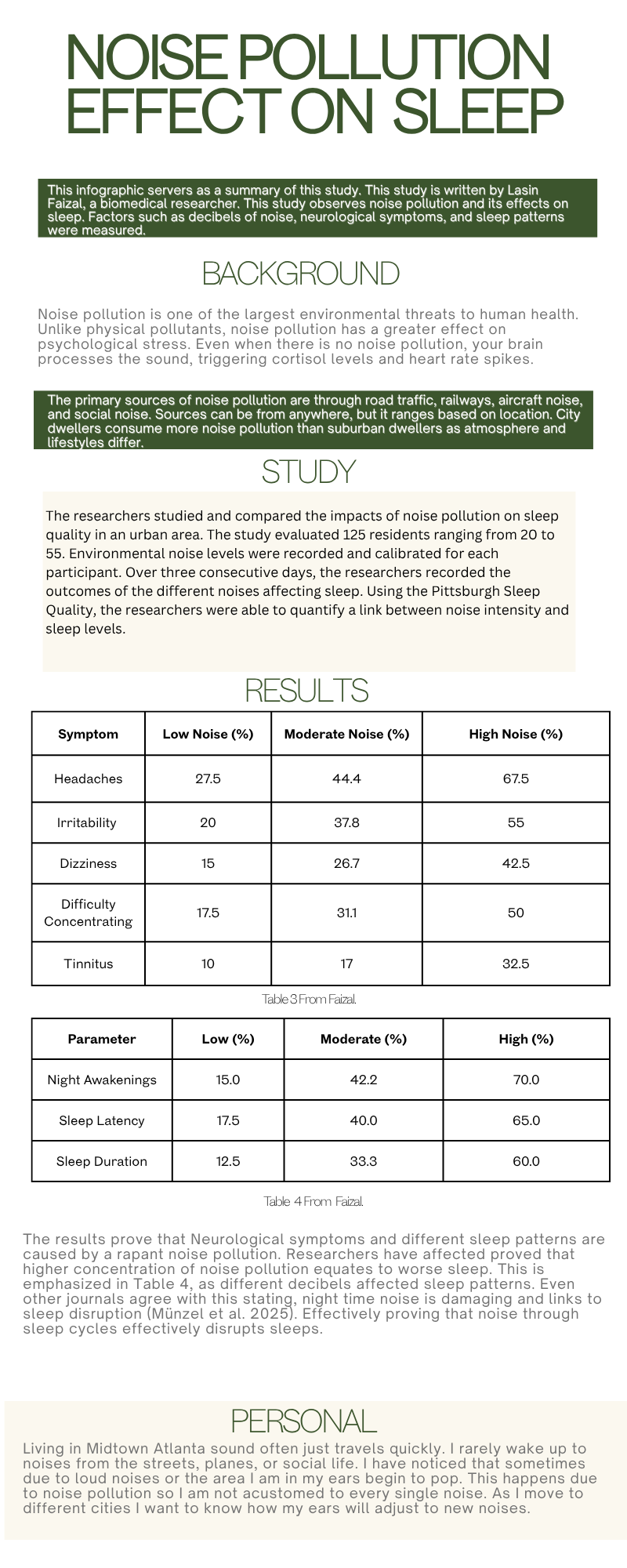
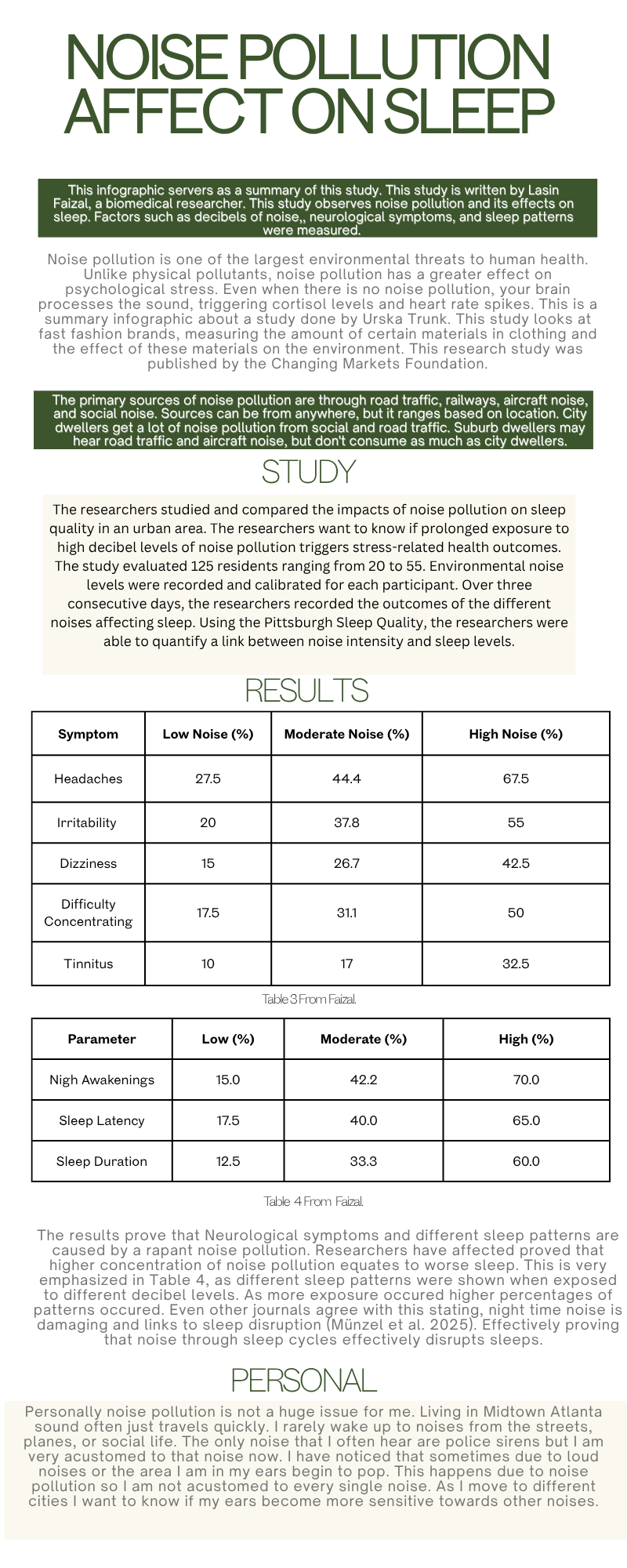
    This infographic servers as a summary of this study. This study is written by Lasin Faizal, a biomedical researcher. This study observes noise pollution and its effects on sleep. Factors such as decibels of noise, neurological symptoms, and sleep patterns were measured.

    Background

    Noise pollution is one of the largest environmental threats to human health. Unlike physical pollutants, noise pollution has a greater effect on psychological stress. Even when there is no noise pollution, your brain processes the sound, triggering cortisol levels and heart rate spikes.

    The primary sources of noise pollution are through road traffic, railways, aircraft noise, and social noise. Sources can be from anywhere, but it ranges based on location. City dwellers consume more noise pollution than suburban dwellers as atmosphere and lifestyles differ.

    Study

    The researchers studied and compared the impacts of noise pollution on sleep quality in an urban area. The study evaluated 125 residents ranging from 20 to 55. Environmental noise levels were recorded and calibrated for each participant. Over three consecutive days, the researchers recorded the outcomes of the different noises affecting sleep. Using the Pittsburgh Sleep Quality, the researchers were able to quantify a link between noise intensity and sleep levels.

    Results

    Symptom Low Noise (%) Moderate Noise (%) High Noise (%)
    Headaches 27.5 44.4 67.5
    Irritability
    Dizziness 15 26.7 42.5
    Difficulty Concentrating 17.5 31.1 50
    Tinnitus 10 17 32.5

    Table 3 From Faizal

    Parameter Low (%) Moderate (%) High (%)
    Night Awakenings 15.0 42.2 70.0
    Sleep Latency 17.5 40.0 65.0
    Sleep Duration 12.5 33.3 60.0

    Table 4 From Faizal

    The results prove that Neurological symptoms and different sleep patterns are caused by a rapant noise pollution. Researchers have affected proved that higher concentration of noise pollution equates to worse sleep. This is emphasized in Table 4, as different decibels affected sleep patterns. Even other journals agree with this stating, night time noise is damaging and links to sleep disruption (Münzel et al. 2025). Effectively proving that noise through sleep cycles effectively disrupts sleeps.

    Personal

    Living in Midtown Atlanta sound often just travels quickly. I rarely wake up to noises from the streets, planes, or social life. I have noticed that sometimes due to loud noises or the area I am in my ears begin to pop. This happens due to noise pollution so I am not acustomed to every single noise. As I move to different cities I want to know how my ears will adjust to new noises.

    References

    Faizal, L., Krishnappa, A. K. R., Chakraborty, M., & Koppolu, S. (2025). Impact of urban noise pollution on sleep disorders and neurological symptoms. Bioinformation, 21(11), 4080.

    Münzel, T., Peris, E., & Sørensen, M. (2026). From noise to heart disease: European Environment Agency sounds the alarm for Europe 2025.


  • Impacts of Urban Green Spaces

    Impacts of Urban Green Spaces

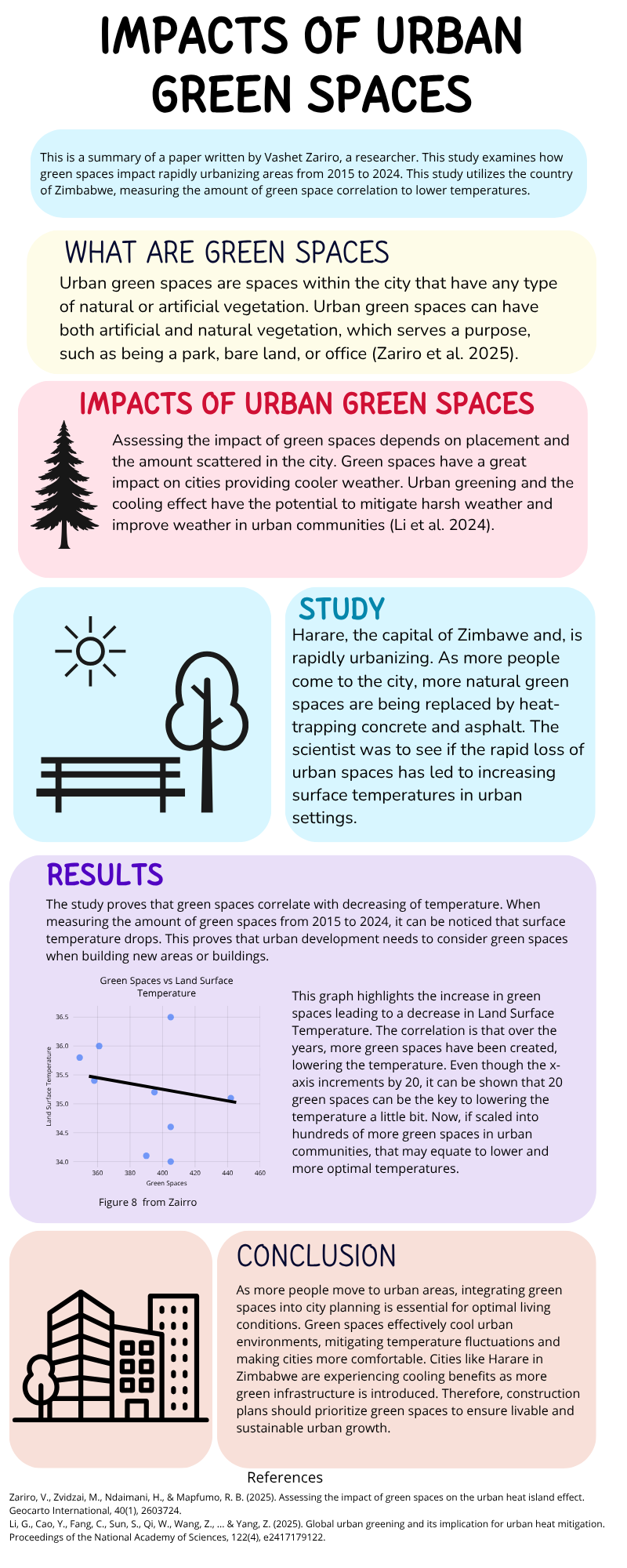
    This is a summary of a paper written by Vashet Zariro, a researcher. This study examines how green spaces impact rapidly urbanizing areas from 2015 to 2024. This study utilizes the country of Zimbabwe, measuring the amount of green space correlation to lower temperatures.

    What are Green Spaces

    Urban green spaces are spaces within the city that have any type of natural or artificial vegetation. Urban green spaces can have both artificial and natural vegetation, which serves a purpose, such as being a park, bare land, or office (Zariro et al. 2025).

    Impacts of Urban Green Spaces

    Assessing the impact of green spaces depends on placement and the amount scattered in the city. Green spaces have a great impact on cities providing cooler weather. Urban greening and the cooling effect have the potential to mitigate harsh weather and improve weather in urban communities (Li et al. 2024).

    Study

    Harare, the capital of Zimbawe and, is rapidly urbanizing. As more people come to the city, more natural green spaces are being replaced by heat-trapping concrete and asphalt. The scientist was to see if the rapid loss of urban spaces has led to increasing surface temperatures in urban settings.

    Results

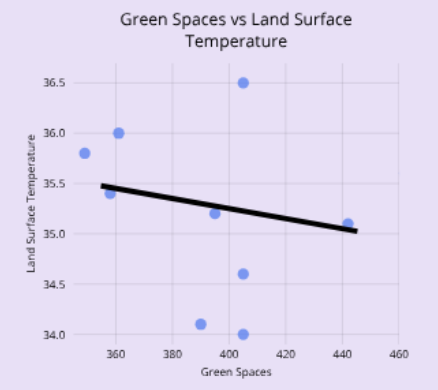
    The study proves that green spaces correlate with decreasing of temperature. When measuring the amount of green spaces from 2015 to 2024, it can be noticed that surface temperature drops. This proves that urban development needs to consider green spaces when building new areas or buildings.

    Figure 8 from Zairro

    This graph highlights the increase in green spaces leading to a decrease in Land Surface Temperature. The correlation is that over the years, more green spaces have been created, lowering the temperature. Even though the x-axis increments by 20, it can be shown that 20 green spaces can be the key to lowering the temperature a little bit. Now, if scaled into hundreds of more green spaces in urban communities, that may equate to lower and more optimal temperatures.

    Conclusion

    As more people move to urban areas, integrating green spaces into city planning is essential for optimal living conditions. Green spaces effectively cool urban environments, mitigating temperature fluctuations and making cities more comfortable. Cities like Harare in Zimbabwe are experiencing cooling benefits as more green infrastructure is introduced. Therefore, construction plans should prioritize green spaces to ensure livable and sustainable urban growth.

    References

    Zariro, V., Zvidzai, M., Ndaimani, H., & Mapfumo, R. B. (2025). Assessing the impact of green spaces on the urban heat island effect. Geocarto International, 40(1), 2603724.

    Li, G., Cao, Y., Fang, C., Sun, S., Qi, W., Wang, Z., … & Yang, Z. (2025). Global urban greening and its implication for urban heat mitigation. Proceedings of the National Academy of Sciences, 122(4), e2417179122.


  • Cognitive Offloading

    Cognitive Offloading

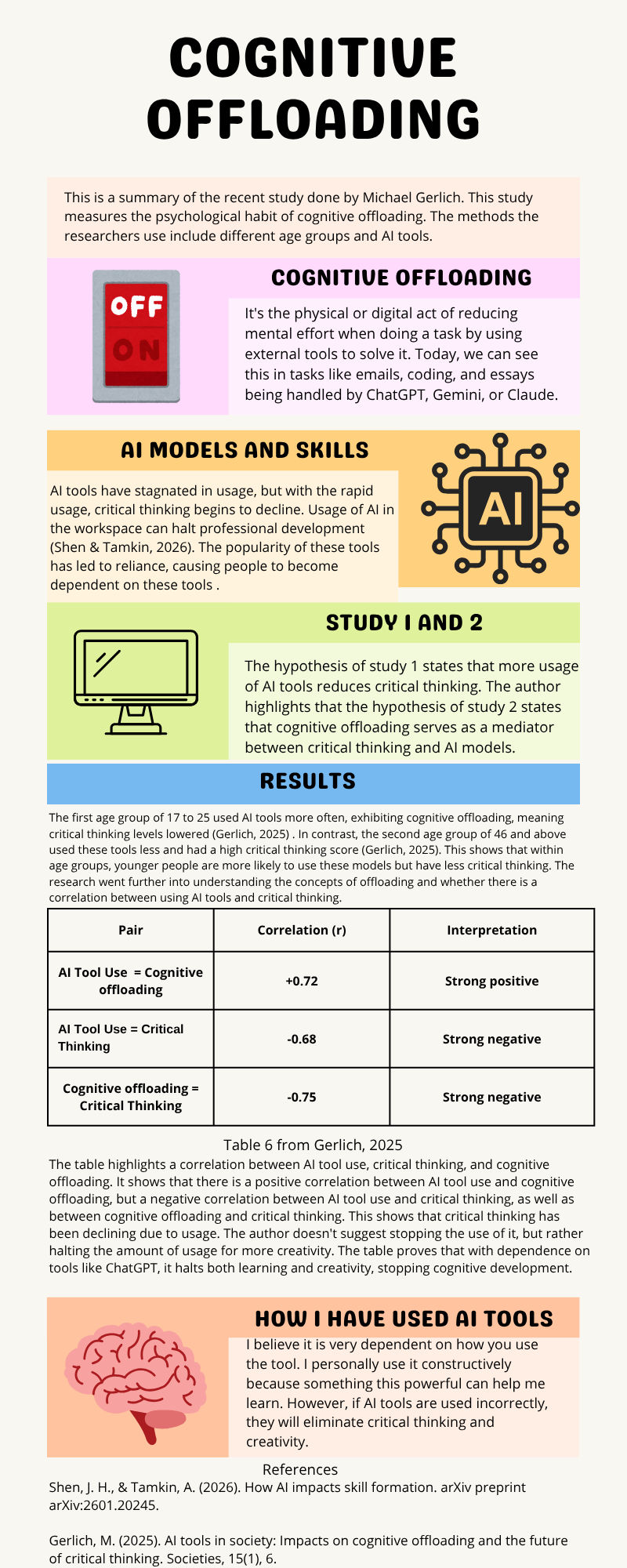
    This is a summary of the recent study done by Michael Gerlich. This study measures the psychological habit of cognitive offloading. The methods the researchers use include different age groups and AI tools.

    Cognitive Offloading

    It’s the physical or digital act of reducing mental effort when doing a task by using external tools to solve it. Today, we can see this in tasks like emails, coding, and essays being handled by ChatGPT, Gemini, or Claude.

    AI models and Skills

    AI tools have stagnated in usage, but with the rapid usage, critical thinking begins to decline. Usage of AI in the workspace can halt professional development (Shen & Tamkin, 2026). The popularity of these tools has led to reliance, causing people to become dependent on these tools .

    Study 1 and 2

    The hypothesis of study 1 states that more usage of AI tools reduces critical thinking. The author highlights that the hypothesis of study 2 states that cognitive offloading serves as a mediator between critical thinking and AI models.

    Results

    The first age group of 17 to 25 used AI tools more often, exhibiting cognitive offloading, meaning critical thinking levels lowered (Gerlich, 2025) . In contrast, the second age group of 46 and above used these tools less and had a high critical thinking score (Gerlich, 2025). This shows that within age groups, younger people are more likely to use these models but have less critical thinking. The research went further into understanding the concepts of offloading and whether there is a correlation between using AI tools and critical thinking.

    Pair Correlation Interpretation
    AI Tool Use = Cognitive offloading +0.72 Strong positive
    AI Tool Use = Critical Thinking -0.68 Strong negative
    Cognitive offloading = Critical Thinking -0.75 Strong negative

    Table 6 from Gerlich, 2025

    The table highlights a correlation between AI tool use, critical thinking, and cognitive offloading. It shows that there is a positive correlation between AI tool use and cognitive offloading, but a negative correlation between AI tool use and critical thinking, as well as between cognitive offloading and critical thinking. This shows that critical thinking has been declining due to usage. The author doesn’t suggest stopping the use of it, but rather halting the amount of usage for more creativity. The table proves that with dependence on tools like ChatGPT, it halts both learning and creativity, stopping cognitive development.

    How I have used AI tools

    I believe it is very dependent on how you use the tool. I personally use it constructively because something this powerful can help me learn. However, if AI tools are used incorrectly, they will eliminate critical thinking and creativity.

    References

    Shen, J. H., & Tamkin, A. (2026). How AI impacts skill formation. arXiv preprint arXiv:2601.20245.

    Gerlich, M. (2025). AI tools in society: Impacts on cognitive offloading and the future of critical thinking. Societies, 15(1), 6.

  • Choking in Basketball

            “Choking” is a term used across many activities, with phrases like “I choked that exam” or “2018 Lebron choked in the finals” symbolizing the concept of losing. While often used as slang, the term also relates to the Yerkes-Dodson Hypothesis, which examines how stress levels affect performance. In high-stakes scenarios, an individual’s mentality can be significantly impacted. The hypothesis measures whether performance increases with higher stress or stimuli.
         Let’s put this in the context of basketball: a player’s performance is dependent on the situation. If the game is very close, then the players are playing very hard, and the performance rises exponentially. If the game is a blowout, then the starters are subbed out, and the performance of the players decreases dramatically. Often, performance is dependent on who the player is and the situation. There are exceptions, such as MVP candidates, generational talents, or consistent players. These players usually shine regardless of the situation, unless it is an off night. I believe that basketball is a consistent game that is dictated by the players’ performance, pace, and stake.
         The study that is being examined is the Yerkes-Dodson Hypothesis being applied to the NCAA. The study examines whether free throws are a good metric in proving the hypothesis to be valid for basketball games. In basketball, a free throw usually occurs when someone is about to shoot and is fouled or if a team is over a certain number of fouls. Players are usually allowed two free throw attempts, depending on other fouls, but these are usually easy points for teams to make. The study believes that free throws are one of the most effective ways of measuring pressure and skill (Blechner et al., 2025). Free throw attempts do dictate the game because they are used as a means of strategy. If a team is down in the second half, they usually start fouling in order to stop the clock and have more possessions to score, but that comes with the tradeoff of a higher deficit to overcome. Contributing to pressure and skill free throws dictate the pacing and shooting skill. Good shooters and clutch players usually score free throws to help their teams win. However, I do not believe that this study accurately represents the hypothesis due to a lack of data and empirical evidence.
         Often, basketball games are reflected based on the consistency of players, the pace of the game, and the stakes. The study only measures free-throw averages to assume the hypothesis is true. However, no variables about pace, stakes, and pressure were ever recorded. Yes, I do believe that these types of variables are hard to grasp, but I would do this study differently. The researchers sampled data for the 2021 to 2022 college basketball season, which I think is good, but the way the data was used is what I don’t agree with. I think there should be variables of pace, pressure, and stakes. Pace being if the teams play on a high pace style, if there were points scored based on turnovers, or if there were points scored quickly. Another being pressure, being how the player is playing in the environment they are in. This can be measuring performances in home games vs away games, rivalry games, or anything that can cause a player to play differently. Lastly, in college, players often play to make the NBA, and draft placement is often dictated by how well they compete throughout their college careers.
         Other citations also help with what I am saying about external factors. Offensive skill, defensive effort, and plays are all factors in how the game is played. If we don’t measure those, then we are leaving crucial data. This is all skill and player dependent, players under defensive pressure often have to change performance being release mechanics, positioning, or style of plays (Li et al., 2024). These factors set the game not just free throws; they are a factor, so measuring them is vital. The study doesn’t further capture all the components of basketball, skewing the data.
         Overall, the playstyle of college basketball could not sufficiently answer the Yerkes-Dodson Hypothesis, but I believe that the overall study wasn’t done correctly. I believe that free throws are not enough information to determine the accuracy of the hypothesis. I say sufficient, as it could determine the pace and pressure of the game, affecting the playstyle, but it is not enough to prove the hypothesis. I think if time, quarter, pace, score, and other metrics were there, then the study could be more accurate. Think about the study when the model is based upon all metrics of the game, then it can accurately represent the proper values that can equate to the hypothesis’s validity.
         In the end, the Yerkes-Dodson Hypothesis has the ideology that as mental stress occurs, the performance of an individual will exponentially rise. This study does accurately introduce it, but the way the study took place was not truly accurate. Lack of other variables led the study to be more generalized than factual. However, if there were more variables to train the model upon, then it would perhaps give a better answer for the Yerkes-Dodson Hypothesis. In the end, the Yerkes-Dodson Hypothesis can be proven with basketball if all metrics were accounted for. 

    References

    Blechner, D., Grove, W., Lantis, R., Nesson, E., & Sanders, S. (2025). Does Pressure Affect Performance? An Evaluation of the Yerkes–Dodson Hypothesis with NCAA Basketball Performance and a Continuous Measure of Pressure to Win. American Behavioral Scientist, 00027642251366046.

    Li, F., Dukarić, V., Očić, M., Li, Z., & Knjaz, D. (2024). Influence of fatigue and defensive pressure on three-point jump-shot kinematics in basketball. Applied Sciences, 14(20), 9582.

  • What if humans weren’t meant to be here… like at all

    What if humans weren’t meant to be here… like at all

    What if the first human to ever think for themselves didn’t ask how to survive… but instead asked why they existed at all?

    According to scientists working in these disciplines, humans have an inherent nature which pushes them towards finding explanations and developing patterns in their environment especially when faced with the unknown. Long before science, early cultures relied on rational stories for understanding their environments.

    Another such example is the one found in ancient Mesopotamian mythology. There are tales about otherworldly beings known as the Anunnaki who existed within this mythology. Not only did these beings exist within the stories, but they were crucial to comprehending the nature of human existence on Earth. Some Annunaki were associated with the sky, others to the underworld, and they were believed to decide human fate. As per the information provided by Encyclopaedia Britannica, Anunnaki refers to the offspring of god Anu who was a component of a cosmology that explained a wide range of occurrences in nature and human experience (Encyclopaedia Britannica, n.d.). Thus, it is necessary to note that, initially, knowledge about extraterrestrial beings did not exist.

    But something happened later on.

    The story didn’t stay the same.

    In the context of reinterpretation of the old myths in a modern setting, the whole story behind them got an entirely new meaning. All of a sudden, Annunaki was not just an ancient god anymore but an extraterrestrial being that was part of an incredibly advanced civilization experiencing some difficulties. To be more precise, the atmosphere became extremely polluted, which led to death. They turned to Earth because of one key resource: gold. Earth, rich in natural elements, became their solution.

    But there was a problem.

    Mining gold would take time. A lot of time.

    In order not to perform these duties by themselves, they created an instrument that would be able to work on their behalf.

    Humans.

    The Anunnaki merged their genes with those of hominids in order to create a species that would be capable of performing these tasks for them. At first, it worked. Humans followed the orders that were given. They mined, they built, they functioned almost like tools. But then something changed.

    One of the most compelling parts of this theory is the idea that one of these beings, often linked to Anu–the son of the Annunaki king–had a child with a human woman. This child was different. More aware, more knowledgeable. Picture yourself as the very first human asking, “Why am I doing this… and for whom?” That question alone challenges everything. Humans began to think deeply. They became emotional, unpredictable… aware. 

    But that’s the important thing: this entire tale of aliens and gold mining never appears in any Mesopotamian texts from antiquity. It is rather a theory that doesn’t originate from any scholarship. The original myths never described humans as engineered workers or the Anunnaki as extraterrestrial beings. That version of the story developed much later.

    So why does it still exist?

    Based on scientific analysis, the tendency among people to come up with origin stories is innate. According to cognitive science and anthropology, there is an inherent tendency among humans to develop structured explanations, often involving supernatural elements, since these allow humans to make sense of complexity and provide meaning to their existence (Boyer, 2001). Put simply, the Anunnaki story does not arise from thin air but from an instinctive drive in humans to make sense of their surroundings.

    But when science comes into play, the answer becomes obvious—and totally opposite.

    There are no scientific proofs to support the notion that extraterrestrials created humans. Instead, human evolution is explained through natural selection. Primitive forms of hominids, which refer to primitive people, slowly evolved from ancient human-like species into modern-day humans. It is clear that according to the evidence provided by fossil records and genetic researches, Homo sapiens are believed to have originated from various animals that existed in the past due to the effects of natural selection (Stringer, 2016). According to scientists, natural selection is a process through which particular traits allow for survival and reproduction, which leads to improved behavioral patterns and neurological development. 

    This process was not planned. It was not designed.

    It was shaped by the environment.

    Even the idea of gold—so central to the Anunnaki theory—has a scientific explanation. The presence of gold on Earth was not intentional. Rather, gold was formed in space due to some calamities like supernovae or neutron stars billions of years back. In the following period, geologic phenomena such as volcanic eruptions led to the presence of gold in Earth’s crust. In other words, the existence of gold on Earth was not because any being had come down to earth for mining gold; it was the creation of the universe that made it possible.

    What does this mean for us then?

    The myth concerning the Anunnaki can be said to be in between a myth and scientific theory. Ancient myths explained many things for ancient people. But modern theories reinterpret ancient myths in the context of science. And science explains everything, though perhaps not very mystically.

    But perhaps that is the whole idea.

    For it is not only about determining the truth regarding the existence of the Anunnaki.

    It’s about something much deeper in the human mind.

    Humans have always been in pursuit of some sort of meaning. There is a constant inquiry into the reason for our existence, our difference from other animals, and our purpose. These ideas show how far we are willing to go to explain our existence.

    So maybe the real question isn’t “Were the Anunnaki real? Did they really create humans?”

    Maybe the real question is…

    “Why do we keep wanting a story where something created us—on purpose?”

    References (APA 7th Edition)

    Boyer, P. (2001). Religion explained: The evolutionary origins of religious thought. Basic Books. https://sackett.net/BoyerReligionExplained.pdf

    Encyclopaedia Britannica. (n.d.). Anunnaki. https://www.britannica.com/topic/Anunnaki

    Stringer, C. (2016). The origin and evolution of Homo sapiens. Philosophical Transactions of the Royal Society B, 371(1698). https://royalsocietypublishing.org/rstb/article/371/1698/20150237/22900/The-origin-and-evolution-of-Homo-sapiensThe-origin