Category: today i learned (til)

  • The Mechanics of Oreo Twisting

    Oreo cookies, beloved for their delicious combination of creamy filling and wafer layers, have become the subject of a scientific study exploring the mechanical mysteries behind their unique properties. Researchers at MIT have delved into the science of Oreo cookies, investigating the distribution of their creamy center, the torque required to twist them open, and the fascinating behavior of the cream under stress.

    Torque Measurements and Cream Texture

    The researchers measured the torque needed to twist open an Oreo, revealing similarities to turning a doorknob and only a fraction of the force required to open a bottle cap. The cream’s failure stress, the force per area needed to deform it, was found to be twice that of cream cheese and peanut butter, resembling the stress magnitude of mozzarella cheese. The cream’s texture was classified as “mushy.” Adding milk into the equation revealed another layer of scientific wonder. Dunking Oreos in milk resulted in a decline in the elastic modulus of the wafer due to swelling. 

    Cream Distribution Mystery

    Despite variations in filling levels and flavors, the study found that the cream tends to separate onto one wafer rather than evenly between both. The researchers mapped this distribution and observed a tendency for the cream to stick to the inward-facing wafer, suggesting a post-manufacturing environmental effect.

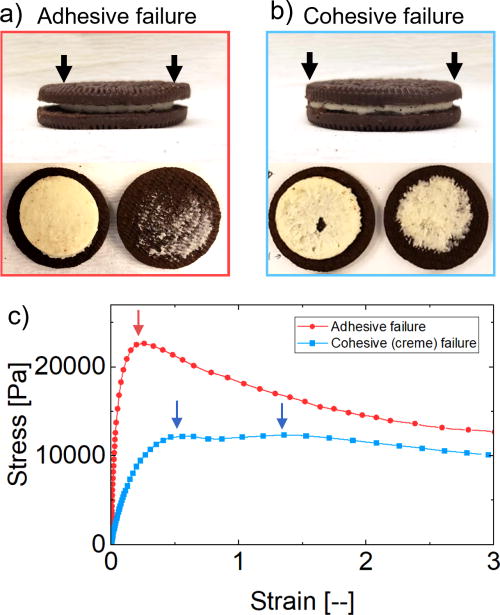
    FIG. 7. (a) While most creme layers failed adhesively in boxes of new cookies, (b) cookies exposed to adverse conditions may cause creme to spread from its initial manufactured state, and then cohesive failure was typical for most cookies in the box. These visual signs of changing creme fill levels (indicated by the black arrows in (a) and (b) are typical but not deterministic predictors of failure mode. (c) Failure tests also distinguished between cases in the computed stress–strain curves resulting from the measured torque as a function of imposed rotation angle. There was a single peak stress for adhesive failure, which occurs as a single delamination step, and two or more maxima in stress for cohesively failing creme layers due to the more complex dynamics of cohesive failure propagation along nonplanar surfaces. Cohesive failure was also typically observed to result in a higher failure strain and lower failure stress, as shown here.

    Manufacturing Process Influence

    Videos of the manufacturing process revealed that a slight time delay in placing the cream between wafers may contribute to better adhesion to the first wafer, influencing the subsequent distribution during twisting.

    FIG. 1. (a) What happens when you twist an Oreo? (b) Eventually it splits into two parts, exposing the creme. (c) and (d) We observed that in a typical failure profile for Oreos from newly opened boxes, the creme most often tends to remain on one side, “wafer 1,” with a consistent orientation per box. In this case, wafer 1 faces to the left side of the upright box for a standard size package of regular Oreos. The creme occasionally splits between sides, often due to defects or small fractures in one or both wafers. (e) This is consistent for cookies with different creme levels, with a strong bias toward wafers facing one side of the box rather than the other, facing left for regular, right for double, and up for mega (where rows are oriented vertically rather than horizontally) in standard size packages.

    The Oreometer

    To make the study accessible and interactive, the researchers even designed a 3D-printable device called the “Oreometer,” allowing precise control over the twisting force applied to an Oreo. This device can be used for tabletop experiments and provides an opportunity for hands-on exploration of Oreo mechanics.

    A 3D printed Oreometer is used to perturb cookies with scientific precision by applying a known and controlled torque. (a) In this device, (1) the cookie is mounted first into one half and then (2) the second half of the rubber band-powered clamps, which are then (3) placed into the vertical assembly mount. (4) “Penny castles” are mounted on the wings, and coins are successively loaded to one side to apply controlled torque until (5) the creme yields. (b) Results replicate values measured by the laboratory rheometer. (c) Photographs demonstrate the same tool, also including the rubber bands in two different arrangements designed to apply different levels of gripping strength in the clamps.

    Confectionary Insights

    The study not only provides a scientific investigation into the mechanics of Oreos but also opens possibilities for further exploration into the design of food materials. The researchers suggest that adding texture to Oreo wafers might enhance cream adhesion, leading to a more even split when twisted open.

    In conclusion, Oreos offer more than just a delightful treat—they serve as a fascinating canvas for exploring the intricate science behind food materials and rheology.

    References

    Massachusetts Institute of Technology. (2022, April 19). Engineers introduce the Oreometer. ScienceDaily. https://www.sciencedaily.com/releases/2022/04/220419124037.htm

    Owens, C. E., Fan, M. R., Hart, A. J., & McKinley, G. H. (2022). On Oreology, the fracture and flow of “milk’s favorite Cookie®.” Physics of Fluids, 34(4). https://doi.org/10.1063/5.0085362

  • Secrets of Animal Immortality


    Senescence and Telomeres

    Biological aging, scientifically known as senescence, involves changes in an organism’s biology after maturity. Telomeres, repetitive DNA sequences at chromosome ends, play a crucial role in preventing DNA damage during cell division (Urdaneta, 2023). Imagine them as protective caps at the end of our chromosomes.


    Our cells start with a healthy supply of telomeres, but each year we lose around 31 of them due to cell duplications. This loss limits the number of times cells can divide, impacting tissue repair and contributing to the aging process. Interestingly, animals with longer telomeres tend to enjoy longer lifespans (Urdaneta, 2023).


    Lobsters

    Lobsters, those crustacean wonders of the ocean, possess a remarkable ability to regenerate even in their old age. Lobsters owe their longevity to the presence of telomerase enzymes scattered throughout their organs. Telomerase helps maintain the conditions of youthful cells for an extended period, showcasing nature’s ingenuity in the battle against aging (Joseph, 2013).

    Hydras

    Enter the hydra, a mesmerizing eukaryotic organism that breaks all the rules of biological aging. Hydras continually divide on a cellular level, effectively “editing” flaws in their DNA during the replication process. What sets them apart is their ability to produce and maintain telomeres, rendering them biologically immortal. The hydra challenges our understanding of senescence, offering insights into potential pathways for extending lifespan (Joseph, 2013).

    Hydra (genus) - Wikipedia

    Jellyfish

    The immortal jellyfish, scientifically known as Turritopsis dohrnii, dances through the ocean with a unique strategy for perpetual life. When faced with threats, disease, or aging, this petite creature undergoes transdifferentiation. It transforms into an earlier life stage, the polyp stage, essentially hitting the reset button on its life cycle. This process not only rejuvenates the jellyfish but also allows it to clone itself, perpetuating its genetic code in an awe-inspiring display of biological immortality (Joseph, 2013).

    Telomeres: A Summary

    In the intricate dance of life, telomeres emerge as central players, orchestrating the rhythm of aging and regeneration. From lobsters’ telomerase-powered longevity to hydras’ defiance of senescence and jellyfish’s transdifferentiation ballet, animals present a captivating narrative in the exploration of cellular immortality. These creatures beckon scientists to unravel the mysteries of telomeres, hinting at potential breakthroughs in understanding and potentially manipulating the aging process.


    References

    Joseph, A. (2013). Senescence, cancer, and immortality. Young Scientists Journal, 6(13), 9. https://doi.org/10.4103/0974-6102.107611

    Urdaneta, I. (2023, July 28). The “biological immortality” in certain animal species. Resonance Science Foundation – Explore the Connected Universe. https://www.resonancescience.org/blog/the-biological-immortality-in-certain-species

  • Autonomous Vehicles: The Road Ahead

    Autonomous vehicles (or “self-driving cars”) was once a fantasy only seen in sci-fi shows and little kid’s drawings; but today, they are rapidly becoming a reality. There have been major advancements in technology over the last 20 years and the way we think about transportation is about to be revolutionized.

    [1]

    But how do self-driving cars drive themselves?

    Well, self-driving cars utilize a massive amount of sensors, cameras, radar, and artificial intelligence to get a map of the world around them, navigate it, and drive without human intervention. Companies like Waymo, General Motors, and – most famously – Tesla are at the forefront of this technology. They’ve all invested heavily in research and development; in fact, according to a report by McKinsey & Company, self-driving vehicles could, by 2030, account for up to 15% of auto sales worldwide [2].

    Many people – young and old – see the potential benefits of AVs. The most short-term impact is an increase in the safety of driving. The National Highway Traffic Safety Administration’s research found that human error is a factor in 94% of serious crashes [3]. Due to the fact AVs operate without distractions, impairments, or human error, they could drastically reduce accidents, saving lives and improving health outcomes. Moreover, as AVs could communicate with each other, they could significantly improve traffic efficiency by reducing congestion and optimizing driving patterns.

    There’s also, of course, the ecological angle. Self-driving cars are often electronic, presenting an opportunity for substantial reductions in emissions. A study by the International Transport Forum (ITF) at the OECD suggests that if managed properly, AVs could reduce energy consumption in urban transport by up to 50% [4].

    However, the road to widespread adoption of autonomous vehicles is fraught with challenges. A significant hurdle is legislative and regulatory. Governments around the world are grappling with how to regulate this emerging technology. Establishing universal standards for safety and performance, adapting infrastructure, and updating road laws to accommodate Self-driving cars are complex tasks that require coordinated effort and time.

    There’s also the concern about the economic impact, particularly job displacement in driving-related professions. 3.6 million Americans are truck drivers [5] and 5.6 million are Uber or Taxi drivers [6]; that’s 8.9 million workers, or 2.5% of the workforce that would become unemployed. While new jobs will be created in tech and maintenance, these will require a high level of education, proficiency in English, and other barriers that driving does not have. This will lead to a significant shift in the employment landscape that will hurt the most marginalized.

    So while autonomous vehicles have the potential to revolutionize transportation, offering numerous benefits in terms of safety, efficiency, and environmental impact, the path forward requires navigating technical, regulatory, ethical, and societal challenges. We have to steer this innovation towards a future where roads are safer, commutes are smoother, and the environmental footprint of transportation is minimized.

    Sources:

    1. “The Future of Self Driving Cars: Top Companies and Challenges.” TechAhead, 6 Nov. 2023, www.techaheadcorp.com/blog/future-of-self-driving-cars.

    2. Deichmann, Johannes, et al. “Autonomous Driving’s Future: Convenient and Connected.” McKinsey & Company, McKinsey & Company, 6 Jan. 2023, www.mckinsey.com/industries/automotive-and-assembly/our-insights/autonomous-drivings-future-convenient-and-connected.

    3. “NHTSA Estimates Traffic Fatalities Continued to Decline in the First Half of 2023.” NHTSA, 28 Sept. 2023, www.nhtsa.gov/press-releases/2023-Q2-traffic-fatality-estimates#:~:text=An%20estimated%2019%2C515%20people%20died,and%20second%20quarters%20of%202023.

    4. Cazzola, Pierpaolo, and Philippe Crist. “Assessing the Environmental Performance of New Mobility.” Itf Oecd.org, 2020, www.itf-oecd.org/sites/default/files/docs/environmental-performance-new-mobility.pdf.

    5. “Number of Truckers at All-Time High.” Census.gov, 27 July 2022, www.census.gov/library/stories/2019/06/america-keeps-on-trucking.html.

    6. Campbell, Harry. “How Many Uber Drivers Are There?” The Rideshare Guy, 17 Mar. 2023, therideshareguy.com/how-many-uber-drivers-are-there.

  • Demystifying Transgender Healthcare

    Fueled by misinformation, transgender healthcare has become a flashpoint of political controversy in recent years. Here at Charged, we’re going to debunk the myths and get down to the science to understand how transgender healthcare works, why it’s important, and what political messages are scientifically supported.


     

    Activists from the National Center for Transgender EqualityActivists from the National Center for Transgender Equity

    Activists from the National Center for Transgender Equality (Health Coverage Guide)


    Terminology

    Cisgender: “People whose gender identity is congruent with what is traditionally expected based on their sex assigned at birth” (Streed et al., 2021).

    Transgender: People “whose gender identity, gender expression, or behavior does not conform to that typically associated with the sex to which they were assigned at birth” (American Psychological Association, 2023).

    Gender Dysphoria: “Intense, persistent gender incongruence” (American Psychological Association, 2023).

    Gender Affirming Care (GAC): “Psychosocial and medical support” that allows people to live in alignment with their gender identity (Lepore, Alstott, McNamara, 2022).


    How Does Transgender Healthcare Work?

    Transgender healthcare involves many steps and processes, not all of which are pursued by all transgender patients. The most common form of GAC for transgender patients is exogenous hormone therapy.

    During hormone therapy, transgender men use testosterone to suppress feminizing characteristics and develop masculinizing characteristics (Unger, 2016). Transgender women use anti-androgens to suppress masculinizing characteristics and use estrogen to develop feminizing characteristics (Unger, 2016).

    Hormone therapy is a strongly positive force in many transgender patients’ lives. Patients that have undergone hormone therapy have shown positive physical and psychological changes, including improvements in sexual function and mood, and a reduction in stress and cortisol levels (Unger, 2016). For these reasons, hormone therapy is considered a core element of GAC.


    Myth 1: Only Transgender People Seek GAC

    Many arguments against the availability of GAC base themselves on the myth that only transgender people seek GAC. This is false. In fact, both cisgender and transgender individuals seek GAC, including such instances as “estrogen for menopause, breast surgery, genital surgery for sexual development disorders, etc.” (Lepore, Alstott, McNamara, 2022). Gender affirming care is not limited to transgender patients, and should be viewed as a general standard of care for patients, rather than a requirement specific to transgender people.


    Myth 2: GAC is Experimental

    Arguments in favor of legal bans against GAC for transgender patients state that GAC is experimental and unsafe, and thus not yet ready for use. This is another myth. GAC is used by cisgender people without legal complaints, involving the “same medications as used in [transgender] hormone therapy, like estrogen, testosterone, and spirolactone” (Lepore, Alstott, McNamara, 2022). Furthermore, puberty and androgen blockers, used by transgender patients to lower the effects of other types of hormones, are also used by cisgender people for “developmental disorders and general medical procedures” (Lepore, Alstott, McNamara, 2022). Evidently, both transgender and cisgender patients take GAC, and cisgender patients have been taking GAC without complaint. Thus, GAC cannot be experimental, and even if it was, it should not be blocked from transgender patients specifically, but from both transgender and cisgender patients, as they both benefit from GAC.


    Myth 3: GAC is Entirely Irreversible

    Another argument against the use of GAC for transgender patients, especially in the case of hormone replacement therapy (HRT) is the myth that GAC is entirely irreversible. While the effects of HRT are irreversible in the long term, patients are “only offered reversible treatments first,” and only take further hormonal treatments for long term symptoms of gender dysphoria (Lepore, Alstott, McNamara, 2022). Beyond treatment, transgender individuals are still able to conceive, and all individuals considering hormone therapy are recommended fertility preservation methods (Lepore, Alstott, McNamara, 2022). Furthermore, irreversible genital surgeries are only reserved for adults who have “adhered to their new identities for at least a year” (Lepore, Alstott, McNamara, 2022). Thus, it can be observed that GAC is not entirely irreversible, and all irreversible decisions are made after long-term, reversible treatment has already begun. To assuage the fears of youth taking irreversible, rash decisions, let it be known that young people seeking GAC are not capable of making irreversible medical decisions within the current guidelines.


    Myth 4: GAC is Unsafe

    Many argue that GAC for transgender patients is unsafe and too dangerous to be medically prescribed. However, dangerous chemicals have been removed from GAC prescriptions for many years, and the risks of cardiovascular disease, which is more prevalent among transgender people, are reviewed before any medication is prescribed (Lepore, Alstott, McNamara, 2022).

    In particular, transgender patients face an excess risk to cardiovascular disease, which can be attributed to “psychological stressors” such as discrimination and structural violence, rather than lower standards of care (Streed et al., 2021). Rates of cardiovascular disease are heightened for people suffering from HIV and AIDS, which are conditions more prevalent among transgender populations for reasons outside of medically prescribed GAC (Streed et al., 2021). While GAC has been shown to increase risks of cardiovascular disease, it is by no means the sole cause of transgender patients’ increased risk, nor is it likely the major cause of it (Streed et al., 2021).

    While GAC is a risk, it is by no means a risk too dangerous to be medically prescribed, and is not a prescription that distorts standards of care.


    Conclusion

    As transgender healthcare remains a sensitive political topic, it’s important to keep the science in mind. Gender affirming care does come with risk, but is not too dangerous to be prescribed, and is shown to be psychologically helpful and at times medically necessary for transgender patients (Unger, 2016).


    Sources

    Lepore C, Alstott A, McNamara M. Scientific Misinformation Is Criminalizing the Standard of Care for Transgender Youth. JAMA Pediatr. 2022;176(10):965–966. doi:10.1001/jamapediatrics.2022.2959

    Streed, C. G., Beach, L. B., Caceres, B. A., Dowshen, N. L., Moreau, K. L., Mukherjee, M., Poteat, T., Radix, A., Reisner, S. L., & Singh, V. (2021). Assessing and addressing cardiovascular health in people who are transgender and gender diverse: A scientific statement from the American Heart Association. Circulation, 144(6). https://doi.org/10.1161/cir.0000000000001003

    American Psychological Association. (2023, March 9). Answers to your questions about transgender people, gender identity, and gender expression. Understanding transgender people, gender identity and gender expression. https://www.apa.org/topics/lgbtq/transgender-people-gender-identity-gender-expression

    Unger CA. Hormone therapy for transgender patients. Transl Androl Urol. 2016 Dec;5(6):877-884. doi: 10.21037/tau.2016.09.04. PMID: 28078219; PMCID: PMC5182227.

    Health Coverage Guide, National Center for Transgender Equality, transequality.org/health-coverage-guide. Accessed 4 Dec. 2023.
  • Possible New Therapies for Deadly Neural Tube Defects!

    Neural Tube Defects (NTDs) are a type of birth defect that can impact the brain, spine, or spinal cord during the early stages of fetal development (1). Common NTDs that fetuses develop include Spina Bifida, Anencephaly, Encephalocele, and Iniencephaly (5,6). NTDs have a strong global prevalence, impacting approximately 322,000 pregnancies worldwide annually (2). In the United States alone, NTDs occur in approximately 3,000 babies annually, with 1,000 of those affected experiencing Anencephaly (1,3,4). NTDs are particularly challenging to treat early, with no effective treatments, as the defects typically begin developing during the first month of pregnancy, which is when some women may not even know they are pregnant (1). Unfortunately, by the time Neural Tube Defects are correctly and definitively diagnosed, it becomes extremely difficult to effectively treat it. Prior to researching more, I had never heard of Neural Tube Defects! However, being a Biomedical Engineer, I only felt that it was my role and responsibility to contribute at least a little bit of the principles that I have learned to come up with new therapies! Who knows? Maybe, it can help someone one day. So, in this article, I decided to highlight what genes I thought of targeting so far. While this may turn out to be a nothing burger, hopefully it’s at least an interesting read for you all!

    Previous literature that I read through established the FOX1, ANKDR6, and WDR4 genes as significant contributors to the development of neural tube defects. Based on this, I came up with two methods by which normal functioning of these genes can be restored, and NTD development can be prevented, both carried out before the 6th week of the first trimester of pregnancy, since that is when the neural tube closes. Each of the genes being targeted plays a significant role in normal transcription regulation/signaling mechanisms that, when disrupted, lead to NTD’s. ANKDR6 mutations affect normal reciprocal mechanisms, causing motor neuron pools to be deactivated, hindering muscle innervation (7). WDR34 mutations affect the PCP signaling pathway, impacting muscle regeneration and neuron orientation (9,10,11); 3). FOX1 gene mutations lead to the formation of abnormal FOX1 proteins, which affects downstream transcriptional regulation of NTF mechanisms (8,12). The rationale for having two methods is that a comparison of both the methods will provide insight into which one is more effective in preventing NTDs over the long-term, especially given the known limitations of synthetic oligonucleotides for gene editing and removal. These aims will be tested on pregnant mice, whose fetuses have mutations in these three genes. 

    As you can see below, based on the research that I did, I compiled a few more details for each of my aims. These are works in progress, but using my creative mind, this is what I was able to think of!

    Aim 1: Utilize synthetic oligonucleotides with Homology Directed Repair to edit genetic mutations in the FOX1, ANKDR6, and WDR4 genes to prevent the formation of Neural Tube Defects.

    1. Mice will be randomly assigned to treatment, placebo, and control groups. 
    2. For the treatment group, complementary DNA Oligonucleotides to the genes will be created, while those unrelated to the three genes will be created for the control group and none will be created for the placebo group (13).
    3. Synthesize Repair DNA template strands, with Fluorescent Reporter Genes (GFP, BFP, MCherry), using promoters. They will then be ligated/joined with the oligonucleotides (14,20,21).
    4. The oligonucleotides with the fluorescent reporter genes will be successfully delivered to the somatic cells of the fetuses, through lipid nanoparticles (18,19). This will facilitate a double strand break at the ends of each of the three genes, which will promote their deletion, due to the HDR Mechanisms present in the cell (15,16,17).
    5. After enough time has passed, these cells will be harvested, and inserted through a flow cytometer. MFI will be measured, with a higher MFI, correlating to a higher success of gene removal (23).

    Aim 2: Utilize Crispr-Cas9, with HDR via a Lipid Nanoparticle delivery system to edit genetic mutations in the FOX1, ANKDR6, and WDR4 genes to prevent the formation of Neural Tube Defects.

    1. Mice will be randomly assigned to treatment and control groups.
    2. For the treatment group, guide RNA strands that correspond to the three genes will be created, while nonspecific guide RNA strands will be created for the control group (16).
    3. Synthesize Repair DNA template strands, with GFP, BFP, MCherry, using promoters (14). The Cas9 proteins, the gRNA and the repair template DNA will be delivered, through lipid nanoparticles (18), to the somatic cells of the fetuses. This will facilitate the breakage of the strands containing these genes, and their substitution with strands that lack these genes and express proteins that induce fluorescence (15,16,17). 
    4. After enough time has passed, these cells will be harvested, and inserted through a flow cytometer. Mean fluorescence intensity will be measured, with a higher MFI, correlating to a higher success of gene removal.

    My hope is that my approach of editing mutated versions of these genes in fetus somatic cells and replacing them, can inspire some scientists to pursue this further, and help to prevent NTD development and save lives. The problem is that, right now at least, if the genes were not edited or replaced, children would inevitably not survive the pregnancy, due to the lack of any effective treatments. These types of diseases simply do not have effective cures, and they require out of the box thinking to make any progress. Conventional wisdom does not always work in science! There are limitations, and challenges down the road, however. Edits will not automatically be passed on to future generations, since they do not affect the germline cells, which means that the offspring of someone who has this gene in their genome will unfortunately still suffer the consequences (19). This is a problem that I unfortunately could not find a way to get around in my methods, but hopefully I have provided a good starting point for other researchers to look into! If you made it this far, kudos to you and hopefully this inspires you to look into these horrible diseases as well!

    Sources:

    1. Cleveland Clinic Medical Professional. Neural tube defects (NTDs): What They Are, Causes & Prevention. Cleveland Clinic. March 30, 2022. Accessed October 28, 2023. https://my.clevelandclinic.org/health/diseases/22656-neural-tube-defects-ntd. 
    2. Kancherla V. Neural tube defects: a review of global prevalence, causes, and primary prevention. Child’s Nervous System. 2023/07/01 2023;39(7):1703-1710. doi:10.1007/s00381-023-05910-7
    3. Neural Tube Defects. March of Dimes. February 2022. Accessed October 28, 2023. https://www.marchofdimes.org/find-support/topics/planning-baby/neural-tube-defects#:~:text=Screening%20tests%20for%20NTDs%20include,to%2022%20weeks%20of%20pregnancy. 
    4. MedlinePlus [Internet]. Bethesda (MD): National Library of Medicine (US); [updated 2020 Jun 24]. Anencephaly; [updated 2019 Oct 01; reviewed 2018 Jun 01; cited 2023 Oct 29]; [about 5 p.]. Available from: https://medlineplus.gov/genetics/condition/anencephaly/. 
    5. King, Jesse, “Anencephaly”. Embryo Project Encyclopedia ( 2013-02-13 ). ISSN: 1940-5030 https://hdl.handle.net/10776/4215
    6. Amorosi S, D’Armiento M, Calcagno G, et al. FOXN1 homozygous mutation associated with anencephaly and severe neural tube defect in human athymic Nude/SCID fetus. Clinical Genetics. 2008;73(4):380-384. doi:https://doi.org/10.1111/j.1399-0004.2008.00977.x
    7. Rai S, Leydier L, Sharma S, Katwala J, Sahu A. A quest for genetic causes underlying signaling pathways associated with neural tube defects. Review. Frontiers in Pediatrics. 2023-May-22 2023;11 doi:10.3389/fped.2023.1126209 
    8. Greene NDE, Stanier P, Copp AJ. Genetics of human neural tube defects. Human Molecular Genetics. 2009;18(R2). doi:10.1093/hmg/ddp347 
    9. Wu G, Huang X, Hua Y, Mu D. Roles of planar cell polarity pathways in the development of neutral tube defects. Journal of Biomedical Science. 2011;18(1). doi:10.1186/1423-0127-18-66 
    10. Butler MT, Wallingford JB. Planar cell polarity in development and disease. Nature Reviews Molecular Cell Biology. 2017;18(6):375-388. doi:10.1038/nrm.2017.11 
    11. Hou P-S, hAilín D, Vogel T, Hanashima C. Transcription and beyond: Delineating Foxg1 function in cortical development and disorders. Frontiers in Cellular Neuroscience. 2020;14. doi:10.3389/fncel.2020.00035 
    12. Wong L-C, Singh S, Wang H-P, Hsu C-J, Hu S-C, Lee W-T. Foxg1-related syndrome: From clinical to molecular genetics and pathogenic mechanisms. International Journal of Molecular Sciences. 2019;20(17):4176. doi:10.3390/ijms20174176 
    13. Sauer NJ, Mozoruk J, Miller RB, et al. Oligonucleotide‐directed mutagenesis for precision gene editing. Plant Biotechnology Journal. 2015;14(2):496-502. doi:10.1111/pbi.12496 
    14. Li S, Chen L, Peng X, et al. Overview of the reporter genes and reporter Mouse Models. Animal Models and Experimental Medicine. 2018;1(1):29-35. doi:10.1002/ame2.12008 
    15. Smirnikhina SA, Zaynitdinova MI, Sergeeva VA, Lavrov AV. Improving homology-directed repair in genome editing experiments by influencing the cell cycle. International Journal of Molecular Sciences. 2022;23(11):5992. doi:10.3390/ijms23115992 
    16. Nambiar TS, Billon P, Diedenhofen G, et al. Stimulation of CRISPR-mediated homology-directed repair by an engineered rad18 variant. Nature Communications. 2019;10(1). doi:10.1038/s41467-019-11105-z 
    17. Chen J, Li S, He Y, Li J, Xia L. An update on precision genome editing by homology-directed repair in plants. Plant Physiology. 2022;188(4):1780-1794. doi:10.1093/plphys/kiac037 
    18. Givens BE, Naguib YW, Geary SM, Devor EJ, Salem AK. Nanoparticle-based delivery of CRISPR/Cas9 genome-editing therapeutics. The AAPS Journal. 2018;20(6). doi:10.1208/s12248-018-0267-9 
    19. Han JP, Kim M, Choi BS, et al. In vivo delivery of CRISPR-Cas9 using lipid nanoparticles enables antithrombin gene editing for sustainable hemophilia A and B therapy. Science Advances. 2022;8(3). doi:10.1126/sciadv.abj6901 
    20. Falzarano MS, Passarelli C, Ferlini A. Nanoparticle delivery of antisense oligonucleotides and their application in the exon skipping strategy for Duchenne muscular dystrophy. Nucleic Acid Therapeutics. 2014;24(1):87-100. doi:10.1089/nat.2013.0450 
    21. Moss KH, Popova P, Hadrup SR, Astakhova K, Taskova M. Lipid nanoparticles for delivery of therapeutic RNA oligonucleotides. Molecular Pharmaceutics. 2019;16(6):2265-2277. doi:10.1021/acs.molpharmaceut.8b01290 
    22. Blackburn L, Brigden T, Hall A, Johnson E. Somatic genome editing: An overview. PHG Foundation. 2019. Accessed November 18, 2023. https://www.phgfoundation.org/briefing/somatic-genome-editing-overview.
    23. Bahreyni-Toossi MT, Dayyani M, Mahmoudi M, Azimian H. Flow cytometric assessment of DNA double-strand break and repair kinetics in prediction of intrinsic radiosensitivity. Iran J Basic Med Sci. 2022;25(9):1104-1109. doi:10.22038/IJBMS.2022.65178.14350
  • My DNA Replication Rap! Effort to Teach Students Science In Ways That They Understand

    Continuing from the previous post, I want to highlight more raps that I have been creating to teach students basic science related topics. In this post, I specifically want to discuss and share Biology-related raps that I have created. While I do not have access to the actual audio files of the raps because they are on my home computer, I can still share the lyrics to hopefully show you how I have been going about this! It all started when I got an email from a past high school teacher of mine asking me if I wanted to become an AP Biology Tutor. At first, I hesitated because it had been so long since I had taken AP Biology or any other Biology course. I was not sure that I remembered enough to teach someone else. The last thing I wanted to do was be a terrible tutor. However, I decided to be courageous and give it a try. Unfortunately, my first two tutoring sessions that I did over Teams were not what I had hoped for. Well, I had thought I explained well, it was clear that the person I was tutoring had not properly understood the concept. After some self-reflection, I decided I needed to try a different approach. That’s when I thought about making a rap song to teach this student the material. We were specifically focusing on the concept of DNA replication in this session. So, I made a rap about DNA replication. Here are the lyrics I’ve written so far:

    In the nucleus where the code exists.

    We got a lit double helix twist.

    This beat gonna slip harder than Sierra Mist.

    DNA replication, so many steps, need to make a list.

    Enzymes come in; Helicase unwound.

    Bonds broken; bonds rewound.

    Strands separate, a zipper out in the light.

    Replication fork shining real bright.

    Primase creates the primer, a starting point.

    New DNA strands made, together joint.

    Leading strand, continuous traction.

    Lagging strand, complete distraction.

    Okazaki fragments created, connected like pieces of a puzzle.

    Stay calm, no need to get confuzzled.

    Proofread code, check for mistakes

    Get the Exonuclease crew. That’s a real hot take.

    Do the Mismatch Repair. Somethin you’ll really preciate.

    I was delighted by what the student told me about their understanding of DNA replication after this rap. Not only did they understand the workflow of the topic better, but they also understood how the different pieces and aspects of the topic came together, even if one aspect only influenced another aspect indirectly. The presence of a higher-level understanding of the topic really heartened me, and it has only corroborated my suspicion that people learn things much better when they are engaged. While only time will tell, if you are teacher or a professor at Georgia Tech or other colleges and you are reading this and you feel like your students are struggling to grasp a concept, feel free to give something like this a try. You might find that you have a lot of fun, and that your students are much less confused! If you do try it, let me know how it goes!


  • A Look Back At How America’s Covid Response Failed

    Do you remember the days of 2020? Do you remember the uncertainty, the anxiety, and the constantly changing advice? Do you remember waking up every day, checking the news hoping for something better, but just seeing bad news after bad news? Perhaps, one of the most disheartening aspects of it was the expectations of scientists vs. what actually happened. At every turn, the virus proved more mysterious, complex, and unpredictable than what was anticipated. Every time, we thought that it was over and that we could declare mission accomplished, there was always something unexpected waiting for us. Taking a look back at some of these different moments during the Pandemic, my hope is to depict how the virus surprised us at every turn, and the lessons that we can take away for the next major Infectious Disease Outbreak.

    The first surprise that the virus threw at us was that the majority of us believed that our vaccines produced something known as sterilizing immunity. This was the ideal scenario because it meant that not only did the vaccine reduce the incidence of symptomatic and severe disease. However, it also reduced the incidence of infection and how frequently it was transmitted. This meant that, even if someone could not or chose not to get vaccinated, they would effectively be protected because the people around them could not spread the infection. This would decrease the overall community burden of Covid, along with the number of hospitalizations and deaths. Initially, it seemed like our vaccines had the potential to do this. For instance, there were studies in early 2021 showing that “The Pfizer vaccine reduced asymptomatic cases by 89.4%, and symptomatic cases by 93.7%”(Israeli Studies find Pfizer Covid-19 Vaccine reduces transmission). Similarly, many Israeli studies in the early part of 2021 observed the phenomenon that “Vaccines reduced the viral load in the respiratory tract of infected individuals, compared to unvaccinated people who were infected”(Israeli Studies find Pfizer Covid-19 Vaccine reduces transmission). Additionally, as Israel and the United States begun vaccinating their population, cases dramatically decreased. For instance, from January to May, Covid cases in Israel decreased from “1000 million per day to less than 3 per million”(What pushed Israel out of herd immunity? Modeling Covid-19 Spread of Delta and Waning Immunity). Unfortunately, these early signs of optimism were misplaced, and it clouded our judgement and took our eyes off the ball for the challenges that were about to come next.

    Around the same time that the incidence of Covid was decreasing in first world countries like the US, Israel, and the UK, the situation was extremely dire in India. In India, the number of infections were significantly increasing, along with the number of hospitalizations and deaths. The cause was not known yet, at the time. However, in April 2021 in India, “56-65-year-olds were spending an average of 13 days in the hospital”(Covid-19 Mortality in the Delta Wave in India: A Hospital-Based Study from Ramanagara District, Karnataka). Additionally, “77-84.62% of individuals in hospitals were completely out of breath, and WBC count was significantly elevated in over 40% of cases”(Covid-19 Mortality in the Delta Wave in India: A Hospital-Based Study from Ramanagara District, Karnataka).  In other words, there were early indications that there was something going on in India that was causing the pathogenicity of Covid to increase, and a significant number of people to get Covid to become seriously ill. To some extent, it was even more than what was seen during the initial Covid wave in New York or during the 2020 winter Covid wave in the United States. This was corroborated by the number of individuals “…needing significant levels of Oxygen”(Covid-19 Mortality in the Delta Wave in India: A Hospital-Based Study from Ramanagara District, Karnataka). Perhaps the largest red flag and warning sign in this situation should have been the fact that most of the population in India had already been infected, and supposedly developed immunity. According to some studies, “55% of India’s population may have been infected by January 2021″(India says it contains spread of COVID-19, no new cases in fifth of country). This only further proves that a new, pathogenic variant that was clearly immune-evasive, and especially adept at penetrating immunity induced by natural infection had arisen and would prove a significant threat to the United States, where so many people had still not been vaccinated. Indeed, the story of what happened in India repeated almost exactly in the United States 2-3 months later.

    So, America experienced the catastrophic effects of the Delta variant surge and then believed that everything was over. Surely there was enough immunity in America, so everything would be okay now, right? Unfortunately, the virus was still not done with us. Not only did our cases end up at a higher baseline than they were prior to the Delta surge. However, we then had a new variant arise in South Africa, which was good at evading all the immunity obtained from the Delta Variant, and previous variants. Specifically, “The reinfection rate of individuals who had been infected by other variants was up to 56% according to studies done by Qatar”(Protection against the Omicron Variant from Previous SARS-CoV-2 Infection). On the bright side, there were some positives on the horizon, though. The variant seemed to induce clinically milder symptoms and may have carried a lower risk of Long Covid. The variant also seemed to confer stronger protection to previous variants, suggesting that it was favored to be the dominant variant. For instance, studies showed that after having the Delta Variant, “Many individuals had a 6-fold increase in neutralization ability/capacity”(Omicron infection enhances Delta antibody immunity in vaccinated persons). This was unique to the Omicron variant, as other variants did not appear to provide such a broad immune response, especially to variants that were so dissimilar to it. This raised the hope that Omicron could signal a start to a more stable state with Covid because Omicron would be able to block reinfection, and infection, even if Covid experienced a significant number of mutations. Plus, the lower pathogenicity of Omicron would give it a survival advantage across populations, given that it would be less likely to kill its hosts. All that being said, while this prediction turned out to be somewhat true and the pandemic has remained stable after that point, with deaths and hospitalizations staying relatively stable in the US (albeit at a high level), and all subvariants being offshoots of Omicron, the 2021 winter Omicron wave caused a high rate of hospitalizations, deaths, and cases, even if it induced immunity in the process. 

    So you might be wondering, what exactly was the point of going down memory lane with Covid? What was the point of discussing all these events? What I hope that you gleamed from this article is that while the Covid-19 Pandemic had an end of sorts, and while we appear to be out of the unstable, uncertain phase of the Pandemic now, America’s response fell quite short in many ways. Any future Pandemics could be made worse, and if we do not focus on how to significantly improve our response, the level of suffering that we undergo then could be made way worse. For one, we needed to be way more proactive, not reactive. We needed to stop hoping that Covid would end by itself, and we needed to actually take the steps to end it. We needed to tightly restrict travel from other countries and put a lot of security measures in place to prevent variants from coming to our country. Similarly, we needed to distribute the vaccine much more equitably and put a much more all hands-on deck effort in getting the world vaccinated by early 2022. It would not have been easy, but it could have been done. Additionally, we needed to keep slight restrictions in place until the world was vaccinated, like having a Federal Mask Mandate to keep cases as low as possible, while vaccinating the world. Finally, with the level of genomic analysis that we have available in today’s day and age, we should have worked on predicting worst case mutations that Covid-19 could undergo and created backup vaccine formulas based on those mutations to have immediately ready the second that we heard of these new variants. All of that would have minimized the level of hospitalizations, deaths, and disruption that society had to undergo throughout this pandemic. So, if nothing else, I hope you as a reader takeaway one point from this article: We needed to do way better in our response, and we are lucky that this was not way worse than it already was!

    Sources:

    Lubell, Maayan. “Israeli Studies Find Pfizer COVID-19 Vaccine Reduces Transmission.” Reuters, Thomson Reuters, 19 Feb. 2021, www.reuters.com/article/health-coronavirus-israel-vaccine-int/israeli-studies-find-pfizer-covid-19-vaccine-reduces-transmission-idUSKBN2AJ08J/.

    De-Leon, Hilla, and Dvir Aran. “What pushed Israel out of herd immunity? modeling covid-19 spread of Delta and waning immunity.” medRxiv, 2021, https://doi.org/10.1101/2021.09.12.21263451.

    Mukhopadhyay, Amita, et al. “Covid-19 mortality in the Delta Wave in India: A hospital-based study from Ramanagara District, Karnataka.” Cureus, 2023, https://doi.org/10.7759/cureus.43678.

    Das, Krishna N. “India Says It Contains Spread of Covid-19, No New Cases in Fifth of Country.” Reuters, Thomson Reuters, 28 Jan. 2021, www.reuters.com/world/india/india-says-it-contains-spread-covid-19-no-new-cases-fifth-country-2021-01-28/.

    Altarawneh, Heba N., et al. “Protection against the Omicron variant from previous SARS-COV-2 infection.” New England Journal of Medicine, vol. 386, no. 13, 2022, pp. 1288–1290, https://doi.org/10.1056/nejmc2200133.

    Khan, Khadija, et al. “Omicron infection enhances Delta antibody immunity in vaccinated persons.” Nature, vol. 607, no. 7918, 2022, pp. 356–359, https://doi.org/10.1038/s41586-022-04830-x.


  • The science and history of the PB&J sandwich

    The PB&J sandwich is a humble combination of sweet, salty, and creamy. Where exactly did this classic sandwich originate, and what are the details behind its nutritional value?

    Before the invention of the PB&J, its three essential ingredients had to be born, beginning with the peanut butter. In 1895, Dr. John Harvey Kellogg patented a process for creating peanut butter, and marketed it as a protein-rich source for patients who couldn’t chew solid food very well. In 1903, Dr. Ambrose Straub patented a peanut-butter-making machine. Peanut butter made its debut at the 1904 St. Louis World Fair, where its popularity skyrocketed [1, 2]. 

    Peanut butter was considered a delicacy during this time, and the first PB&J sandwich recipe was published by Julia Davis Chandler in the Boston Cooking School Magazine of Culinary Science and Domestic Economics. However, this recipe was intended to be served as delicate finger sandwiches at parties and in tea rooms [2, 3].

    Next comes the jelly. Marmalade and jam had been around for a long time, but the familiar purple jelly component of the PB&J was created when Paul Welch patented a method for pureeing grapes into jelly in 1917, naming it Grapelade [2].

    The final piece of the puzzle: sliced bread. The bread slicer was invented in 1928 by Otto Frederick Rohwedder. The availability of pre-sliced bread and the commercialization of the peanut butter industry increased the accessibility of the PB&J ingredients and popularized the sandwich across the nation [2, 3].

    Now that we know its origin story, let’s move on to the science of the PB&J. The nutritional breakdown: a typical PB&J has 15 grams of protein, 13 grams of fat, and 12.5 grams of sugar [4]. While a lot of sugar is never a good idea, for an active individual it can provide a needed burst of energy, and the combination with protein and fat ensures one feels full and satisfied. 

    According to a 2021 study from the University of Michigan School of Public Health, eating a PB&J can add up to 33 minutes to your life span [5]. This study assigned a health nutritional index that measured the health effects from the consumption of over 5,800 different foods, quantifying the results in minutes of healthy life gained or lost. The authors mention that this apparent health benefit of the PB&J is driven by the nut content of the sandwich, which is the source of the protein and fat. Therefore, while the PB&J is not a superfood, it is a much better option than some other processed foods, like hot dogs, which scored notoriously low during the study.

    I can personally attest to the PB&J’s standing as great adventure fuel (all of the photos in this article are from the variety of lunchtime views I’ve shared with a PB&J). It is my go-to for hiking and backpacking trips for a number of reasons: it’s affordable, portable, and customizable. Purchasing the ingredients won’t break the bank, and it doesn’t need to be refrigerated (honestly, I think PB&Js taste even better when they’re a little bit squished…). Additionally, PB&J customization is endless. I personally like to toast the bread or add a layer of plain potato chips to up the crunch factor, but one can also make changes to boost health benefits. Using whole-grain bread, swapping jelly for real fruit slices (banana is particularly delicious), or using natural nut butter are all ways to make the PB&J a little bit healthier.

    Now you know a little bit about the history and science behind a PB&J sandwich, as well as ways to customize it to make it healthier or even more delicious. 


    References

    [1] National Peanut Board. (2023). Who invented peanut butter? Retrieved from https://nationalpeanutboard.org/news/who-invented-peanut-butter/

    [2] National Peanut Board. (2023). Who invented the peanut butter and jelly sandwich? Retrieved from https://nationalpeanutboard.org/news/who-invented-the-peanut-butter-and-jelly-sandwich/

    [3] Dean, S. (2013). History of the PB&J, from spa food to school lunch. Retrieved from https://www.bonappetit.com/entertaining-style/trends-news/article/history-of-the-pbj

    [4] National Peanut Board. (2023). 5 reasons PB&J is the best sandwich ever. Retrieved from https://nationalpeanutboard.org/news/5-reasons-pbj-is-best-sandwich-ever/#:~:text=A%20PB%26J%20has%2015%20grams,of%20energy%20that%20athletes%20need.

    [5] Stylianou, K. S., V. L. Fulgoni III, and O. Jolliet. (2021). Small targeted dietary changes can yield substantial gains for human health and the environment. Nature Food, 2, 616-627.

  • Matcha Magic

    What is matcha? 

    Matcha is high-grade green tea grounded into powdered form. It comes from the leaves of the Camellia sinensis plant.

    Compared to other teas, matcha is a little quirky, due to the fact that it is shade grown, then steamed or stone ground.

    Shade grown means that it is made from shade-grown tea leaves where tea bushes are proteced from sun and light is filtered in a controlled manor. Shading boosts chlorophyll production, which gives the leaves a richer green color. The lack of sun reduces the plant’s photosynthesis of the leaves, which alters the naturally occurring levels of caffeine, flavanols, sugars, antioxidants, and theanine.

    The leaves are then treated with steam heat within to halt the oxidation process and bring out the color even more. Doing this creates a unique flavor profile of sweet and vegetal.

    Matcha can also be stone ground; this is when the leaves are laid flat to dry and become tencha (leaves from which matcha is made). The tencha leaves are stripped of their stems and venins with the remaining ground in slow-turning mills to yield a smooth green tea powder.

    How do you make matcha?

    To make a delicious matcha drink, whisk the powder into hot water to form a frothy drink. Whisking promotes aeration, allowing the matcha powder and water to mix with air to give it a thick head of foam on top. The matcha can be a tea, latte, or even a smoothie!

    Does matcha have caffeine?

    Yes, matcha does have cafeeine! It has less caffeine than brewed coffee, but more than green tea. The tea leaves retain more of their caffeine content. Consuming matcha means you’re consuming the ground tea leaf, which means you’re ingesting more caffeine content than youw ould from the extraction of tea leaves.

    What’s the difference between Green Tea and Matcha?

    Green tea uses brewed tea leaves with a light, grassy flavor. Matcha, on the other hand, is the pulverized version of green tea leaves. It has a stronger concentration of some key nutrients and antioxidants.

    References

    • https://www.teatulia.com/tea-varieties-101/what-is-matcha.html 
    • https://www.medicalnewstoday.com/articles/matcha-vs-green-tea#summary
    • https://www.sugimotousa.com/blog/how-to-whisk-matcha#:~:text=to%20Enjoy%20Matcha-,Why%20Whisk%20Matcha%3F,head%20of%20foam%20on%20top.


  • Cracking the Code: The Towers of Hanoi

    Now that we have developed a fundamental understanding of how different counting systems, especially binary, work, we can begin to understand the optimal solution to the Towers of Hanoi.

    One by One 

    Because binary digits are restricted to just one of two values, counting in binary has a particularly interesting rhythm. Understanding this rhythm is crucial in solving the Towers of Hanoi problem. This online binary counter is particularly useful in visualizing this rhythm. Beginning from zero, continue to count up, adding one with each step. Keep track of the index of the value that switches to a 1 at each step:

    0, 1, 0, 2, 0, 1, 0, 3, 0, 1, 0, 2, 0, 1, 0, 4, …

    Solution to the Towers of Hanoi

    Interestingly enough, the most optimal solution to the Towers of Hanoi comes from following this rhythm exactly. To tie the two together, first assign numeric indices to the disks: 0 is the smallest, 1 the next smallest, and so on. Then, simply follow the pattern, at each step moving the disk whose index matches the next number in the sequence.

    For example, consider the 3 disk problem:

    • 0: move disk 0 to the right peg
    • 1: move disk 1 to the middle peg
    • 0: move disk 0 to the middle peg
    • 2: move disk 2 to the right peg
    • 0: move disk 0 to the left peg
    • 1: move disk 1 to the right peg
    • 0: move disk 0 to the right peg

    And then we are done! There are some beautiful symmetries to this pattern. Also interesting is the fact that, for a setup with n disks, the optimal solution requires exactly 2^n – 1 moves.

    Why Does This Work?

    In so few words: recursion! Both the rhythm of binary counting and the problem of the Towers of Hanoi are self-similar problems. The idea of self-similarity ties directly into recursion: the full process, whether that’s counting up to a certain number or solving a problem with a certain number of disks, involves completing a smaller version of the process.

    In the Towers of Hanoi, consider again the 3 disk problem. If we were somehow able to move the stack of the 2 smallest disks as a single unit, then the problem would reduce to three steps:

    1. Move the 2-disk unit off of the third disk
    2. Move the third desk to the right peg
    3. More the 2-disk unit onto the third disk

    So, through a recursive approach, the problem becomes much simpler to solve.

    In the process of binary counting, return to the counter visualizer. Count up to the number 7 (111 in binary). Notice that we count up to the number 3 (11 in binary), roll over to 4 (100 in binary), and then count up three more to get to 7 (111). This exactly mirrors the recursive pattern in the Towers of Hanoi!

    Conclusion

    Oftentimes in mathematics, and in problem solving in general, finding an inventive way to connect and reduce one problem to another can make understanding optimal solutions much easier. The Towers of Hanoi, though it may appear as a confusing game at first, cleanly works in parallel to just counting up by one in binary. 

    References

    1. https://www.khanacademy.org/computing/computer-science/algorithms/towers-of-hanoi/a/towers-of-hanoi
    2. https://www.mathsisfun.com/games/towerofhanoi.html
    3. https://www.youtube.com/watch?v=2SUvWfNJSsM