Category: Articles

  • Hidden in Plain Sight: How Metamaterials Are Making Invisibility a Reality

    The power of invisibility is one that I have always found to be fascinating, there are many things you could do if you were invisible. The idea of being able to bring this power to life is mind-boggling. The second post of this series will cover invisibility and how scientists are taking us one step closer to being unseen. Superheroes and popular characters like Violet Parr, Harry Potter, and Randall Boggs were capable of invisibility through their unique methods. Things like natural-born powers, invisibility capes, and monster abilities, are methods that are not capable of being replicated by science… at least not yet. The method we will cover here boils down to the basics of how we see things, the way our eyes perceive light. Scientists are playing around with light bending and optics to make objects “disappear”.

    How Do We See?

    To understand invisibility, we must first understand what it means for us to see an object. The process of seeing begins with light. When you see an object, what you are seeing is the light reflecting off that object and entering into your eyes. To make an object invisible, this fundamental interaction with light must be altered. More specifically, the light rays would need to be bent or diverted around/away from the object, preventing them from reaching the eyes and therefore making it unperceivable to the eyes (Lo, 2018).

    Metamaterials

    Scientists are creating metamaterials, which are “artificial materials with the ability to control physical phenomena” (Lo, 2018). With these materials, scientists can control and manipulate light rays, helping create invisibility. This process, known as light bending, is a key component in invisibility cloaks. This is further explained by scientists who state, “Metamaterials are composites designed to have a negative index of refraction, which imparts the extraordinary capability to bend light away from or around an object made from or coated with the material” (“Metamaterials Bend Light to New Levels,” 2023b).  Despite the challenges in scaling these technologies, the progress in metamaterial research could revolutionize how we interact with the physical world and lead to advancements in various scientific fields.

    Challenges

    There are two main challenges when trying to reach full invisibility, size and range. Unfortunately, the invisibility effect isn’t as broad as one might hope. Researchers have only managed to develop metamaterials that function with a single wavelength of light, corresponding to just one color. This means the material can create invisibility in controlled settings with a single light color, but not in natural environments where multiple colors of light are present. While these invisibility cloaks are a remarkable breakthrough, they aren’t perfected for the stealth needed in real-world conditions, limiting them to certain factors. Another challenge is the size of objects. Bigger items are more difficult to manage, and current metamaterials aren’t capable of hiding something as large as the human body. While scientists are optimistic that new ideas and designs will help tackle this problem, it will likely be some time before we can reach the point of making humans fully “disappear” (Lo, 2018).

    Real-World Applications

    Although there are many challenges in the journey to invisibility, there are highly beneficial theoretical uses for this ability that make it all the more exciting to achieve. According to researchers, “the Rochester Cloak, for instance, could one day allow surgeons to see through their hands, preventing their hands from blocking their view of what they’re operating on” (Lo, 2018). This use could change science and the way we view healthcare completely. There are many motivations for perfecting the invisibility cloak as it could help so many in the long run.

    Conclusion

    Though complete invisibility remains a dream and goal for most of us, it is hard to ignore the remarkable progress scientists have made in controlling light to achieve partial invisibility. The innovation of metamaterials and spectral cloaking is bringing us closer to a future where invisibility will leave the realm of fiction and enter into reality. Although the methods are limited, they are the first steps to becoming like the superheroes we see on our screens. If this is what scientists have created so far, I cannot wait to find out what else the future holds for us.


    References

    Lo, A. (2018). Hidden From Plain Sight: Can Science Create Real-Life Invisibility? – Science Communication Club. Utoronto.ca. https://scc.sa.utoronto.ca/content/hidden-from-plain-sight-invisibility/

    Metamaterials Bend Light To New Levels. (2023). Chemical & Engineering News, 86(33). https://doi.org/10.1038/nature07247)

  • Super Strength Unlocked: The Rise of Exoskeleton Technology

    Super Strength Unlocked: The Rise of Exoskeleton Technology

    Superheroes have become such an essential part of pop culture, captivating us with powers far beyond what we know as humanly possible. You likely have watched a superhero movie, read a comic book, or even seen superheroes in your front yard when handing candy out for Halloween. As a kid, I marveled at the idea of having my own powers. As a teenager, I watched Marvel movies all the time because it was so interesting to see made-up powers and the creativity behind them. Now, as a STEM college student, I am learning more about the amazing creations science and technology can bring to life. Now, I wonder: could these powers exist one day, and if so, how close are we to giving humans these abilities? This series will explore how close we are to achieving “superpowers” through advancements in STEM—from super strength to telekinesis and even invisibility. Each post will dive into science and technology bringing us closer to making these powers a reality.

    Super Strength

    Heroes like the Hulk, Superman, Wonder Woman, and many others have been portrayed as having super strength. One that I find particularly interesting is Iron Man— a regular human who, through science and technology, built a suit that granted him super strength and other powers. The idea of using science to create such technology is no longer just fiction; in fact, it’s becoming a real possibility to give humans abilities beyond natural limits. This is happening today through the development of exoskeletons.

    Exoskeleton

    Engineers have been working hard to create exoskeletons that give their wearers an enhanced level of strength. It is stated that “Combining the principles of hydraulic pressure and computer simulation, these suits allow the wearer to complete feats of strength previously confined to comic books and the silver screen” (Osborne & Osborne, 2017). Exoskeletons do not have a mind of their own and are not controlled remotely, they are a tool to aid in human tasks. The exoskeleton responds to its “human operator” and their movements. One such exoskeleton, the HAL-5, assists users by reducing fatigue, supporting static weight, and reinforcing the human frame (Osborne & Osborne, 2017). Meanwhile, Sarcos Robotics has developed the Sarcos Guardian XO, a full-body robotic exoskeleton that enables users to lift up to 200 pounds with ease (Ackerman, 2022).

    Real-World Applications

    Around the world, there are a vast number of exoskeletons being developed, all for different purposes and demographics. Some exoskeletons are built to help elderly individuals with tasks that require strength, while others assist soldiers in the field with activities like crawling, running, and carrying heavy objects. This technology not only boosts productivity but also enhances worker safety when performing labor-intensive tasks. Sarcos Robotics claims that a single worker with the Guardian XO can handle the workload of 4-10 people. According to OSHA regulations, the recommended one-person load is 51 pounds, and that number is reduced if the object must be lifted repeatedly, held for extended periods, or moved over a distance. However, with the Guardian XO, a worker can lift four times that weight, continuously, at speeds of up to 3 mph (Ackerman, 2022).

    Challenges

    One of the biggest obstacles to advancing and commercializing exoskeletons is the high power demand. Operating these suits requires a significant amount of energy due to the high-pressure requirements. The HAL-5, for example, is battery-powered but only lasts around 2.5 hours on a full charge (Osborne & Osborne, 2017). Finding a more efficient or portable power source could make exoskeleton technology more practical and widely accessible.

    Conclusion

    It is fascinating to see how much science has advanced the ability to have “superpowers”. Thinking about where science and technology could go from here is even more interesting. There is still a long way to go in the quest to give humans super strength, but it can no longer be said that it is impossible to do so.


    References

    Ackerman, E. (2022, August 18). Sarcos demonstrates powered exosuit that gives workers super strength. IEEE Spectrum. https://spectrum.ieee.org/sarcos-guardian-xo-powered-exoskeleton

    Osborne, M., & Osborne, M. (2017, November 13). Engineering Super Strength: Combining man and Machine – USC Viterbi School of Engineering. USC Viterbi School of Engineering – USC Viterbi School of Engineering. https://illumin.usc.edu/engineering-super-strength-combining-man-and-machine/

  • The Science of Baking: Know Your Dough

    One of my absolute favorite hobbies is baking, so I wanted to not only share my experience with baking but also discuss the science behind common baking ingredients. We’re going to be exploring five different ingredients: yeast, cream of tartar, butter, baking powder, and baking soda. Let’s get started!


    Yeast

    Yeast is vital when it comes to creating a hearty loaf of bread, but yeast is incredibly temperamental. When growing yeast for bread, you have to put the yeast in lukewarm water (between 105℉ and 110℉). If the water is too hot, the yeast will die, and if the water is too cold, nothing will happen. Having a good base of yeast is the first step to creating bread, so if you mess up this first step, you might as well start over (Exploratorium, n.d.). Luckily, it usually only takes a few minutes to get the yeast to rise after feeding it some sugar, so you won’t be reset too far.

    A bowl of yeast
    Figure 1. The Spruce Eats / Diana Chistruga. This shows a bowl of yeast and flour after proofing.


    Cream of Tartar

    There’s a fair chance that you might not be familiar with this ingredient, so I’ll gladly explain. According to the McGill Office of Science and Society (2023), cream of tartar is a partially neutralized tartaric acid that is a byproduct of winemaking. Cream of tartar can be used for a number of purposes, but its most important use-case for baking is maintaining structure. My main experience with cream of tartar is when making macarons. You have to create a meringue during the process, and this is where cream of tartar is absolutely necessary. Cream of tartar is what allows egg whites to whip into a firm meringue and not lose its form. Using expired cream of tartar or even none at all will affect how your macarons rise, making them collapse in on themselves. For this reason, cream of tartar is crucial in delicate baking.

    A container of cream of tartar.
    Figure 2. All Recipes / Vanessa Greaves. Shows a container of cream of tartar.

    Butter

    Butter is a prominent ingredient in most baked goods, but something most people don’t realize when they’re using butter is how important the temperature is. You’ve probably read a recipe before where it says something like room temperature or melted or frozen; well, this clarification is very important. The temperature of butter when it’s being combined with other ingredients defines its role as a binding agent at different parts of the process. For example, if butter is melted, it will most likely be a part of the liquids section of a recipe, and if it is room temperature, it will most likely be with the solids. From my experience, frozen butter is usually used to prevent butter from melting too quickly and burning in an oven. All of these temperatures have specific and special roles (McCoy, 2015).

    3 sticks of butter.
    Figure 3. All Recipes / Kelsey Ogletree. Shows three sticks of butter.

    Baking powder

    You’ve most likely heard of baking powder or its counterpart, baking soda (which we’ll be talking about next), but you may not know the science behind it. According to Sorangel Rodriguez-Velazquez at American University (n.d.), baking powder is classified as a high quality chemical leavener. Baking powder is activated through moisture and heat and releases gas that moves throughout the baked good, allowing it to expand and grow in the oven. It’s very important to not use too much baking powder because it could cause your baked goods to collapse (Rodriguez-Velazquez, n.d.). Baking powder is pretty crucial to making baked goods like cakes and preventing them from becoming too dense. 

    Container of baking powder.
    Figure 4. Rumford Baking Powder. Shows a container of baking powder.

    Baking Soda 

    Now I know what you’re thinking, what is the difference between baking soda and baking powder? Well for starters, baking soda has only one ingredient, sodium bicarbonate, while baking powder contains that and two acids. The real difference when baking though is that baking soda reacts immediately while baking powder works at different stages, depending on if it’s single or double acting. Both act as leavening agents; however, since baking soda does not have acids built into it, it is only really used when there is some sort of acidic ingredient in it such as cream of tartar or buttermilk (Shipman, 2024). That’s why it’s usually baking soda in recipes involving those ingredients. 

    Box of baking soda.
    Figure 5. Arm & Hammer Pure Baking Soda. Shows a container of baking soda.


    Baking is such a fun and fascinating scientific process. I hope next time you find yourself baking, you understand the ingredients you are working with better and appreciate the science that goes into every little moment.


    References

    Exploratorium. (n.d.). Bread Science 101. Exploratorium. https://www.exploratorium.edu/explore/cooking/bread-science

    Pellegrinelli, C. (2024). What is Yeast?. The Spruce Eats. https://www.thespruceeats.com/basic-yeast-information-304312

    Schwarcz, J. (2017). Cream of Tartar. McGill Office for Science and Society. https://www.mcgill.ca/oss/article/general-science-history/cream-tartar

    Greaves, V. (2023). Cream of Tartar: What It Is and How to Use It [Photograph]. All Recipes. https://www.allrecipes.com/article/cream-of-tartar/

    McCoy, J. (2015). Beyond Flavor: The Science of Butter. Institute of Culinary Education. https://www.ice.edu/blog/beyond-flavor-science-butter

    TWOELLIS. (n.d.). [Photograph of three sticks of butter]. Getty Images. https://www.allrecipes.com/article/salted-vs-unsalted-butter-what-s-the-difference/

    Rodriguez-Velazquez, S. (n.d.). 5.5: Baking Powder. American University. https://chem.libretexts.org/Bookshelves/Biological_Chemistry/Chemistry_of_Cooking_(Rodriguez-Velazquez)/05%3A_Leavening_Agents/5.05%3A_Baking_Powder

    Shipman, M. (2014). The difference between baking soda and baking powder. North Carolina State University. https://phys.org/news/2014-05-difference-soda-powder.html

    Berkheiser, K. & Richter, A. (2023). What’s the Difference Between Baking Soda and Baking Powder?. Healthline. https://www.healthline.com/nutrition/baking-soda-vs-baking-powder#:~:text=When%20to%20use%20which%20one,needed%20to%20produce%20carbon%20dioxide.

    Light, J. (2024). Science of Baking Cover Art. STEMComm.

  • Now You See It! – The Science of Misdirection in Magic

    Magicians have been performing seemingly impossible feats to awe-struck audiences for millennia. With a simple flick of a hand or snap of a finger, magicians can make objects appear and disappear in the blink of an eye, make someone levitate off the ground, or even saw people in half! To perform these feats, magicians often use their knowledge of how attention works and a bit of misdirection to focus their audience’s attention where they want them to focus (Alexander et al., 2022). How does attention work, and how do magicians use misdirection to pull off these incredible feats?

    What is Attention and How Does it Work?

    Attention is selectively choosing to focus on specific aspects of our environment, while ignoring other stimuli (Kuhn et al., 2022). Attention is like a spotlight – we can only focus on one aspect of our environment at a time, and everything else outside of that spotlight goes unnoticed. There are two main types of attention: goal-directed attention and stimulus-driven attention. Goal-directed attention is when we choose to focus on something to accomplish some motivated goal, while stimulus-driven attention is when a stimulus in our surroundings grabs our attention (Yantis, 2002). Imagine this scenario: we’re watching a show on the TV, when we suddenly hear a loud thump from the other room. Our attention was initially focused on the TV show but instinctively shifts as we focus on the source of the loud thump. The loud thump automatically draws our attention as it may be something we need to protect ourselves from. After determining that the sound was from a family member accidentally dropping a box on the floor, we can return our attention to watching the TV show once more. We are using goal-directed attention when we are focused on watching the TV show. When we hear the unexpected loud thump, we switch to stimulus-driven attention as we try to determine the source of that sound. Magicians often use stimulus-driven attention to direct their audience’s attention to what the magician wants them to see.

    How Do Magicians Use Misdirection?

    Misdirection in magic is when a magician guides our attention towards the magical effects and away from what is really happening. Magicians often use their gaze, multiple hand movements, and other cues to carefully control the audience’s attention to where the magicians want them to focus (Alexander et al., 2022; Icard et al., 2024). For example, a magician could do elaborate movements with their right hand, drawing the audience’s attention to their right hand, while their left hand subtlety goes into their pocket. Multiple, quick hand movements within a short period of time can overwhelm our attentional spotlight, allowing magicians to make coins magically appear and disappear within the blink of an eye without seeming to touch the coins (Icard et al., 2024). Misdirection is a skill that must be practiced well to perform in front of an audience. Famous magicians such as Apollo Robins or Penn and Teller have mastered the technique of misdirection, allowing them to perform complex tricks such as changing tin foil balls into baseballs or taking a watch right off someone’s wrist without them noticing.

    Attention is a powerful tool that can shape our perceptions of the world, so be sure to pay attention!


    Citations:

    Alexander, R. G., Macknik, S. L., & Martinez-Conde, S. (2022). What the Neuroscience and Psychology of Magic Reveal about Misinformation. Publications, 10(4), 33. https://doi.org/10.3390/publications10040033

    Icard, B., & Fervari, R. (2024). Beyond the Spell: A Dynamic Logic Analysis of Misdirection. ArXiv.org. https://arxiv.org/abs/2401.14516

    Kuhn, G., Kingori, P., & Peeters Grietens, K. (2022). Misdirection – Magic, Psychology and its Application. Science & Technology Studies, 35(2), 13–29. https://doi.org/10.23987/sts.112182

    Yantis, S. (2002). Stimulus-Driven and Goal-Directed Attentional Control. In: Cantoni, V., Marinaro, M., Petrosino, A. (eds) Visual Attention Mechanisms. Springer, Boston, MA. https://doi.org/10.1007/978-1-4615-0111-4_12

  • The Mystery of Dark Oxygen: Understanding the Viral Phenomenon

    In July of 2024, oxygen was discovered on the ocean floor where no light nor plants were present. After various tests, it seems as though the different minerals located on the floor of the Clarion-Clipperton Zone are acting as a large collection of batteries that are being charged by the electric currents flowing along the ocean floor (Lingam et al., 2024). This immediately sparked numerous tests with the purpose of discovering if life can grow and exist with dark oxygen production (DOP). This research is incredibly important because it may indicate certain conditions in which life may exist on a water or ice planet.

    Through research done at Cornell University, we have learned a few things about this phenomenon. The oxygen was collected using a benthic chamber, a chamber which allows on-site measurements of the exchange rates of substances between the ocean floor and the water in and around the chamber (Sweetman et al., 2024) (Figure 1).

    Benthic Chamber
    Figure 1. Max Planck Institute for Marine Microbiology, V. Carvalho. This shows a benthic chamber in action.

    Based on the oxygen measurements, it seems that the potential reason for oxygen to be present without photosynthesis on the ocean floor is the concept of electrophy, which is the process of separating water into its elements (hydrogen and oxygen) through the use of electricity. For the circumstances on the ocean floor where the phenomenon was discovered, it seems there are numerous electric currents going across the ocean floor which could trigger this electrophy. They then charge the elements on the ocean floor (lithium, cobalt, copper, etc.) to essentially create natural batteries (Lingam et al., 2024). The oxygen created from this phenomenon has since been dubbed, dark oxygen due to its creation from a lack of sunlight (Colarossi, 2024).

    In terms of what creatures could exist in a domain created from DOP, we know that metazoans (animals) may be able to exist in these conditions if they are in the millimeters of sizes; however if an organism is able to have “internal circulation systems for the distribution of oxygen” (Lingam et al., 2024), then the upper size boundary of these organisms could instead be between approximately 0.1 cm to approximately 10 cm.

    There are still many factors to consider during the early stages of this discovery, but if this system proves consistent, the possibility of life on fully water or ice planets increases dramatically. There could be entire systems of creatures living on ocean planets that are entirely unknown to us, but the research of this topic has become threatened by seabed mining companies.

    Since there’s a plethora of elements that are used in making batteries on the ocean floor, many seabed mining companies are pushing for the ability to strip mine in these areas and profit off of the abundance of resources.

    A quote by the BBC with Professor Murray Roberts, a marine biologist from the University of Edinburgh, states, “There’s already overwhelming evidence that strip mining deep-sea nodule fields will destroy ecosystems we barely understand,” (Gill, 2024). These strip mining endeavors could severely hinder the research being done about DOP by disrupting the habitat in which it is occurring. To prevent this over 800 marine biologists from 44 countries have signed a petition in hopes of halting the strip mining process and allowing more discoveries to occur in this field without interruption (Gill, 2024).

    There is still a lot to discover about this process and its impact on the world around us, but the potential of this discovery has incredible implications for our understanding of the creation of life not just on Earth but on other planets as well. We can only look forward to more discoveries like this from the depths of our mysterious oceans.


    References

    Lingam, M., Balbi A., & Tiwari M. (2024, August 13). Dwellers in the Deep: Biological Consequences of Dark Oxygen. Cornell University. https://arxiv.org/pdf/2408.06841

    Gill, V. (2024, July 22). Dark oxygen made by deep sea “batteries.” BBC News. https://www.bbc.com/news/articles/c728ven2v9eo

    Colarossi, J. (2024, August 15). Oxygen produced in the deep sea raises questions about extraterrestrial life on other planets. Boston University. https://www.bu.edu/articles/2024/deep-sea-oxygen-raises-questions-about-extraterrestrial-life/#:~:text=This%20phenomenon%20creates%20enough%20energy,oxygen%20made%20with%20no%20sunlight

    NOAA Office of Ocean Exploration and Research (2019). [Deep sea metal lumps of oxides of iron and manganese]. Southeastern U.S. Deep-sea Exploration.

    Sweetman, A.K., Smith, A.J., de Jonge, D.S.W. et al. Evidence of dark oxygen production at the abyssal seafloor. Nat. Geosci. 17, 737–739 (2024). https://doi.org/10.1038/s41561-024-01480-8

    Carvalho, V. [Benthic Chamber]. Max Planck Institute for Marine Microbiology.

  • Why Is Sleep So Important?

    Many of us are consistently sleep deprived. On average, children need 8-10 hours of sleep per night and adults need 7-9 hours per night (National Heart, Lung, and Blood Institute, 2022). However, many of us get less than the recommended amount of sleep on a consistent basis. Why is sleep so important and what are the benefits of getting enough sleep? This infographic explains the benefits of getting good quality sleep each night.


    Citations:

    1. Aguirre, C. (2015, November 12). What would happen if you didn’t sleep? – Claudia Aguirre. YouTube. https://youtu.be/dqONk48l5vY?si=X8WAdJ3BDkuEeTyx
    2. Finan, P. (2019). The Effects of Sleep Deprivation. Johns Hopkins Medicine Health Library. https://www.hopkinsmedicine.org/health/wellness-and-prevention/the-effects-of-sleep-deprivation
    3. Garbarino, S., Lanteri, P., Bragazzi, N. L., Magnavita, N., & Scoditti, E. (2021). Role of sleep deprivation in immune-related disease risk and outcomes. Communications Biology, 4(1). https://doi.org/10.1038/s42003-021-02825-4
    4. How Much Sleep Kids Need. (2024, June 4). Cleveland Clinic. https://health.clevelandclinic.org/recommended-amount-of-sleep-for-children
    5. Liew, S. C., & Aung, T. (2020). Sleep deprivation and its association with diseases- a review. Sleep Medicine, 77. https://doi.org/10.1016/j.sleep.2020.07.048
    6. National Heart, Lung, and Blood Institute. (2022, March 24). How Sleep Works – How Much Sleep Is Enough? | NHLBI, NIH. Www.nhlbi.nih.gov. https://www.nhlbi.nih.gov/health/sleep/how-much-sleep
    7. Papatriantafyllou, E., Efthymiou, D., Zoumbaneas, E., Popescu, C. A., & Vassilopoulou, E. (2022). Sleep Deprivation: Effects on Weight Loss and Weight Loss Maintenance. Nutrients, 14(8), 1549. https://doi.org/10.3390/nu14081549
    8. Tomaso, C. C., Johnson, A. B., & Nelson, T. D. (2020). The Effect of Sleep Deprivation and Restriction on Mood, Emotion, and Emotion Regulation: Three Meta-Analyses in One. Sleep, 44(6). https://doi.org/10.1093/sleep/zsaa289
    9. You, I. (2013, September 22). What If You Stopped Sleeping? YouTube. https://youtu.be/nNhDkKAvxFk?si=bTGL9bxLfCqiwnnu
  • Rating Neurotransmitters by (Personal Preference?)

    What is a neurotransmitter? 

    Neurotransmitters are the chemical messengers used for communication between neurons. They are released into the synapse (gap between neurons) by the neuron referred to as the presynaptic neuron and then cause some sort of response (generally excitatory, inhibitory, or modulatory) on the postsynaptic neuron (Hook et al, 2019). 

    Some traditionally recognized neurotransmitters include serotonin, dopamine, and adrenaline.

    However, the scope of what a neurotransmitter is has been expanding to include a broader range of signaling chemicals. Now, substances like Nitric Oxide (NO) and ATP (yes, adenosine triphosphate, the one made in the powerhouse of the cell) are beginning to be included as well. 

    Now let’s make a tier list…

    For the purposes of this list, we will be focusing on some of the more traditional neurotransmitters.

    Serotonin

    To start off, we’ll go with one that is pretty well known: serotonin. This monoamine is involved in the signaling for a huge variety of systems including regulation of mood, sleep, digestion, and more. It is commonly associated with depression and a common treatment for depression for decades has been SSRIs (Selective Serotonin Reuptake Inhibitors) which essentially stop processes that clear serotonin from the synaptic cleft (Preskron, 1997). So serotonin is pretty cool, pretty popular, and I guess with it being linked to our ability to be well, not depressed, it should be pretty high up. 

    But to put it in the S tier feels too basic. And recent advances in depression treatments support a new theory of depression involving a different neurotransmitter (more on this coming soon). So I say serotonin gets a solid A. 

    Acetylcholine

    Acetylcholine is one of my personal favorites. It’s most commonly known for being used by pre synaptic neurons at the neuromuscular junction which is where nerve meets muscle. This means the release of acetylcholine is essential for movement. My favorite acetylcholine fact is that botulinum toxin can be used to inhibit its release at these junctions which is actually what botox does (Nigam, 2010). Can’t wrinkle if those muscles can’t move. I’m giving acetylcholine an A!

    GABA

    Ah, the primary inhibitory neurotransmitter in the central nervous system. Inhibition is so important and honestly quite underrated. Without GABA, there would be too much activity which  could lead to a whole host of consequences. Low GABA levels are linked to diseases like epilepsy, motor disorders like stiff person syndrome, and even schizophrenia (Levy & Degnan, 2013). And of course, this inhibition is also crucial for sleep which is a personal favorite activity of mine. So, for the essentialness of inhibition, I think we have our first S tier neurotransmitter.


    Epinephrine 

    I may or may not be wearing my epinephrine (aka adrenaline) necklace as I write this; however, I can not say I am a huge fan of this molecule, at least, not as a neurotransmitter. It’s associated with sympathetic nervous system activity which is the part of our autonomic nervous system that responds unconsciously to stressful situations, often referred to as the fight or flight response (C.C medical). When epinephrine is released in my body, I generally want to get out of whatever situation I am in. I almost want to put this guy in D tier, but I guess the responses in my body due to epinephrine helps me get out of that situation so I’ll cut it some slack and put it in C. 

    Norepinephrine 

    Norepinephrine (Noradrenaline) is also involved in that fight or flight response and is generally important for arousal and alertness (Tank, 2015). I’m going to go ahead and put this one near its very chemically similar friend epinephrine in the B row. 

    Glutamate 

    Now we have our primary excitatory neurotransmitter (the anti-GABA). Glutamate is essential for learning and is believed to be essential in neuroplasticity (aka our brains ability to change which is very cool). Recently, glutamate has been theorized to have a role in depression and ketamine is being utilized as a way to treat treatment resistant depression (Pal, 2021). The results are very impressive and cause long term positive impacts from small doses. I like learning and I like treating depression, so S tier! 

    Dopamine

    Ok, I admit, I have a favorite. Dopamine is extremely important and one of the key processes it is involved in is motivation (Olguín et al, 2016). Its role in reward makes it an important molecule in guiding our behaviors as the presence of dopamine is associated with pleasurable feelings. It is also involved in movement; Parkinson’s disease, a movement disorder, is actually attributed to a decrease in dopamine production in a region called the substantia nigra.

    In my eyes, dopamine is a great example of the complexities of the nervous system because it has involvement in multiple systems and its dysregulation can have a huge range of impacts. Its association with pleasurable feelings displays how in moderate amounts dopamine offers positive feelings but in excess we see how it can become harmful like in the case of addictions. So with that I say, S+ tier!!! 

    To sum it up…

    While creating this list, I thought long and hard about how to compare these neurotransmitters and found myself using the approach of, ‘which one could be removed’. The answer: none of them. Each of these neurotransmitters is involved in multiple systems and some dis-regulation of them can cause widespread consequences. So to completely remove any neurotransmitter would be detrimental. This demonstrates how fine tuned our brains are to function in a way where the production and use of neurotransmitters is precise and modulated. All this to say the rankings of these neurotransmitters was quite arbitrary and are based essentially on just my own opinions, but I hope you learned a little bit about the epic chemicals that allow neurons to communicate along the way! 


    References

    C. medical. (n.d.). Epinephrine (adrenaline): What it is, function, deficiency & side effects. Cleveland Clinic. https://my.clevelandclinic.org/health/articles/22611-epinephrine-adrenaline 

    Hook, V., Kind, T., Podvin, S., Palazoglu, M., Tran, C., Toneff, T., Samra, S., Lietz, C., & Fiehn, O.. (2019). Metabolomics Analyses of 14 Classical Neurotransmitters by GC-TOF with LC-MS Illustrates Secretion of 9 Cell–Cell Signaling Molecules from Sympathoadrenal Chromaffin Cells in the Presence of Lithium. ACS Chemical Neuroscience, 10(3), 1369–1379. https://doi.org/10.1021/acschemneuro.8b00432

    Juárez Olguín H, Calderón Guzmán D, Hernández García E, Barragán Mejía G. The Role of Dopamine and Its Dysfunction as a Consequence of Oxidative Stress. Oxid Med Cell Longev. 2016;2016:9730467. doi: 10.1155/2016/9730467. Epub 2015 Dec 6. PMID: 26770661; PMCID: PMC4684895.

    Levy, L. M., & Degnan, A. J.. (2013). GABA-Based Evaluation of Neurologic Conditions: MR Spectroscopy. American Journal of Neuroradiology, 34(2), 259–265. https://doi.org/10.3174/ajnr.a2902

    Nigam, P. K., & Nigam, A. (2010). Botulinum toxin. Indian journal of dermatology, 55(1), 8–14. https://doi.org/10.4103/0019-5154.60343

    Pal M. M. (2021). Glutamate: The Master Neurotransmitter and Its Implications in Chronic Stress and Mood Disorders. Frontiers in human neuroscience, 15, 722323. https://doi.org/10.3389/fnhum.2021.722323

    Preskorn S. H. (1997). Clinically relevant pharmacology of selective serotonin reuptake inhibitors. An overview with emphasis on pharmacokinetics and effects on oxidative drug metabolism. Clinical pharmacokinetics, 32 Suppl 1, 1–21. https://doi.org/10.2165/00003088-199700321-00003

    Tank, A. W., & Lee Wong, D. (2015). Peripheral and central effects of circulating catecholamines. Comprehensive Physiology, 5(1), 1–15. https://doi.org/10.1002/cphy.c140007


  • Virtual Nature: Could it yield the same effects?

    I recently went on my first backpacking trip and was able to spend my time immersed in a natural environment. Among those trees and streams of water, I felt a sense of serenity and peace that I do not normally experience in my day to day life in Atlanta. I am not alone in feeling a relief and escape in nature. Research over the last couple decades has consistently demonstrated that time in nature has positive impacts on well being due to stress relieving benefits and increasing cognitive function (Berto, 2014). Environments with these benefits are often referred to as restorative environments and a recent focus in research on the therapeutic benefits of these environments has been an effort to recreate them within VR environments. 

    So far, the research seems promising. One study exposed participants to a forest nature environment and a neutral environment both utilizing virtual reality. The simulation utilized both visual and auditory sensory components. The natural environment exposure was found to lead to an increase in cognitive performance, lower perceived stress, and higher restorativeness when compared to the neutral environment (Mostajeran et al., 2023). However, in a review of 21 similar studies, the results across the board were more mixed. There is a generally observed decrease in negative effect from exposure to restorative VR environments, but this review noted limited positive affect (Frost et al., 2022). 

    Overall, where the research on VR based nature interventions seems to be lacking is in comparison between the VR exposure and physical immersion into a nature environment. A key component of VR design that this relates to is the idea of presence vs immersion. Immersion refers to the sensory environment created by the technology and is therefore a reflection of the technology itself. On the other hand, presence is more related to the psychological state of the user and how integrated they feel they are in the environment. Presence is more subjective and can be influenced by the perspectives and experiences of the user (Berkman & Akan, 2019). However, both of these factors influence each other and greater immersion can generally increase feelings of presence. In restorative therapies utilizing VR nature exposure, both presence and immersion are essential, but the immersion is likely lacking. 

    In nature exposure research, there is a general gap in exploring different sensory modalities. Much of the research is highly focused on visual components. Within VR, visual and auditory components are the easiest to replicate so VR technologies are limited in their scope of creating an immersive sensory experience. For example, a key sensory route of positive affect from nature exposure is olfaction. One study examined the impact of indoor plants on psychophysiological health and cognitive performance, and they looked at both visual and olfactory components of the stimuli. The results indicated that “visual, olfactory and combined stimuli all induced spontaneous neural oscillations related to relaxation or cognitive function, and significant changes in metabolic pathways associated with antidepressant, anti-inflammatory or neuro-protective effects were observed” (Li et al., 2024). Another study compared the effects of visual stimuli and olfactory stimuli in park and forest environments and their results suggested that olfactory stimulation may have a greater role in facilitating stress reduction than visual stimuli (Hedblom et al., 2019). 

    Overall, the multi-sensory experience seems to be key to reaping the benefits of restorative environments which is something VR environments are currently unable to replicate. Furthermore, VR exposures may be limited temporally. These interventions would provide a brief, non tangible escape from the environment of the regular lives of those in urban environments. But after the interventions, the environment that could be causing higher stress is still present. Looking at the bigger picture, VR interventions are a bandaid on a bullet hole solution to higher stress levels brought on from urbanization. To reach the root of this problem, it may be more effective to examine what could be done to the environments themselves. 


    So, how can we alter the environments we spend our time in to be better suited for stress reduction and increased cognitive function? Biophilic design!  

    Biophilic design is the idea of integrating the restorative elements of nature into buildings, cities, and public spaces. The ideas of biophilic design relate to the Biophilia Theory which emphasizes the importance of human interaction with nature on the basis of our evolution alongside it. In Kellert and Calabrese’s book, Biophilic Design: The Theory, Science, and Practice of Bringing Buildings to Life, they outline several key components of biophilic design: direct experience with nature, indirect experience with nature, and experience of space and place (Kellert & Calabrese, 2015). Furthermore, the goals of good biophilic design go beyond allowing people to experience nature in their everyday environments; they aim to also be sustainable both environmentally and economically. Kellert and Calabrese also emphasize experiencing nature through different sensory modalities as a key aspect of designing buildings and cities. One literature review examined evidence for the benefits of biophilic design on wellbeing and found that the direct exposure to nature and the presence of natural elements had the most significant positive impact (Gillis & Gatersleben, 2015). 

    One recent example of Biophilic design in action can be seen in the Living Building Project. This initiative aims to design buildings that are self-sufficient, have a positive impact on individuals interacting with them and with the natural systems involved, and that connect people with natural light, space, air, nature, and food (What is The Living Building Challenge, 2024). 

    Ultimately, more research is needed for both VR as a restorative approach and biophilic design. However, biophilic design provides a multi-sensory element that VR currently lacks and both increases the level of positive exposure and decreases the source of negative affect. The increased focus on use of VR in the context of nature based restorative therapies has its merits but with the current limitations and the overall unanswered question of if it could truly replicate experiences in nature remaining, it might be better to focus on alternative approaches that could be more effective like changing the environments people are already present and immersed in. 


    References:

    Berto, R.. (2014). The Role of Nature in Coping with Psycho-Physiological Stress: A Literature Review on Restorativeness. Behavioral Sciences, 4(4), 394–409. https://doi.org/10.3390/bs4040394

    Berkman, M. I., & Akan, E.. (2019). Presence and Immersion in Virtual Reality (pp. 1–10). https://doi.org/10.1007/978-3-319-08234-9_162-1

    Frost, S., Kannis-Dymand, L., Schaffer, V., Millear, P., Allen, A., Stallman, H., Mason, J., Wood, A., & Atkinson-Nolte, J. (2022). Virtual immersion in nature and psychological well-being: A systematic literature review. Journal of Environmental Psychology, 80, 101765. https://doi.org/10.1016/j.jenvp.2022.101765 

    Gillis, K., & Gatersleben, B.. (2015). A Review of Psychological Literature on the Health and Wellbeing Benefits of Biophilic Design. Buildings, 5(3), 948–963. https://doi.org/10.3390/buildings5030948

    Hedblom, M., Gunnarsson, B., Iravani, B., Knez, I., Schaefer, M., Thorsson, P., & Lundström, J. N.. (2019). Reduction of physiological stress by urban green space in a multisensory virtual experiment. Scientific Reports, 9(1). https://doi.org/10.1038/s41598-019-46099-7

    Kellert, S. R., & Calabrese, E. F. (2015). The practice of biophilic design. https://biophilicdesign.umn.edu/sites/biophilic-net-positive.umn.edu/files/2021-09/2015_Kellert%20_The_Practice_of_Biophilic_Design.pdf 

    Li, Z., Zhang, W., Cui, J., Wang, L., Liu, H., & Liu, H. (2024). Biophilic environment with visual-olfactory stimuli contributes to psychophysiological restoration and cognitive enhancement. Building and Environment, 250, 111202. https://doi.org/10.1016/j.buildenv.2024.111202 

    Mostajeran, F., Fischer, M., Steinicke, F., & Kühn, S.. (2023). Effects of exposure to immersive computer-generated virtual nature and control environments on affect and cognition. Scientific Reports, 13(1). https://doi.org/10.1038/s41598-022-26750-6

    What is the Living Building Challenge?. International Living Future Institute. (2024, April 5). https://living-future.org/lbc/ 

  • GaTech Taking Steps to Improve Mental Health!

    As of this semester, Georgia Tech has become a JED Campus! This is a designation given to universities that put systems and programs in place with the goal of protecting student mental health. “JED Campus” is the signature program of The JED Foundation designed to develop customized support for student mental health, substance use, and suicide prevention efforts.  Currently, JED programs have impacted 1078 colleges and high schools across the US.


    Being a student at Tech can be quite challenging with many stressors such as assignments, midterms, and job search. Research shows that first year students especially suffer from emotional problems, some associated with adjustment issues as they transition from high school to college. This difficulty in adjustment can result in poor academic performance and increased dropout rates. In one study, it was shown that more than 86% of students who sought counseling services decided to continue their enrollment for at least another semester. In another study, it was found that counseling centers have started to receive more severe concerns, some of which included suicide, substance abuse, depression, and sexual abuse (Kitzrow, 2003). For these reasons, the demand and need for counseling services in universities has grown substantially.


    Some consequences of poor mental health are low energy, difficulty sleeping, and eating problems, and interest in normal activities. These physical health implications can cause a decline in academic performance which in turn causes a continuous cycle of mental and physical burnout. Counseling serves as a way to minimize these impacts. Fortunately, Tech offers a range of services to help students manage their life in college. I asked fellow Tech students about their favorite resource and how it has helped them manage their stress.

    “I think it’s a really nice break from my normal schedule to stop by and meet the dogs. Even for a few minutes, they’re so friendly and cute it makes my day better. I wish there was also a version with cats, but I’m glad we have these events.” (Sheila)

    Check out this clip of pups on Tech Green from the @gatechlife instagram page!

    “I really enjoy the mental health workshops hosted by the Center of Mental Heath and Services. My favorite one was probably yoga! It was a great way to relax and meet new people”  (Christy)

    “I love to relax on the hammocks especially now that the weather is getting better. After a long day, it helps me destress to just lay there and look up at the sky. Sometimes I read a book or listen to music.” (Tim)

    Take It Outside | News Center

    The Center for Mental Health Care & Resources offers a number of programs for students.


    Some of which include individual/group counseling, couple counseling, and mental health workshops. Short-term individual counseling involves ongoing individual meetings with a counselor, often on a weekly or bi-weekly basis. There is also an option for short-term group counseling which supports students in making positive changes in their lives, as well as group sessions based on specific issues or student identities Couples counseling sessions are geared towards resolving tension and miscommunication between partners. Mental health workshops are hosted monthly to deliver useful tips for coping, stress management, and relationships.


    These services are aimed at helping students reach their academic and personal goals. They have benefited many students on campus and the wellness center is continually striving to better serve the Tech population. And the best part of all is that these services are confidential and completely free!


    Sources

    Kitzrow, M. (2003). The mental health needs of today’s college students. https://ccvillage.buffalo.edu/wp-content/uploads/sites/74/2017/06/NASPA-Mental-Health-Needs-of-College-Students.pdf

    Roggers, V. (n.d.). Take it outside. News Center. https://news.gatech.edu/features/2022/05/take-it-outside

    Services. Center for Mental Health Care & Resources.

    https://mentalhealth.gatech.edu/clinical-services/services

    The story of jed. The Jed Foundation. (2024, February 13).

    https://jedfoundation.org/the-story-of-jed/


  • The Magical Goo!

    Oobleck recipe

    Have you ever heard of Oobleck? I first discovered this substance, a mixture of water and cornstarch, while doing a science experiment in elementary school. Oobleck defies the laws of nature, or at least Newton’s laws. Though it initially appears like a liquid, when you apply pressure, it turns into a solid. How can a substance be both simultaneously?

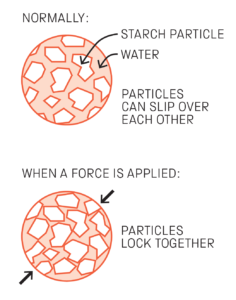
    The reason is because Oobleck is classified as a non-Newtonian fluid, meaning that it does not follow Newton’s law of viscosity. Viscosity is a property that describes how a fluid flows, or more simply, how thick or thin it is. When a fluid’s viscosity is constant, it is called a Newtonian fluid. Most fluids fall under this category. However, Oobleck is one of the few exceptions. Its viscosity is depended on the amount of force applied to it. Known as a shear thickening fluid, it appears thicker as you physically manipulate it. This behavior is explained by the structure of cornstarch, the main ingredient in Oobleck. Cornstarch particles are long and thin, when you mix it with water, the faster you move it, the more tangled the particles become, thus “hardening” and imitating the solid state. The increased amount of friction created through motion also causes increased resistance of the mixture to flow. It is important to note that Oobleck is a suspension, not a solution. This means that the cornstarch does not dissolve in water. Instead, it is suspended in the liquid. If you let it sit in a glass for a while, the cornstarch will separate from the water and settle at the bottom.

    Oozing oobleck activity - Science Museum Group Learning

    Aside from being a fun science experiments for students to enjoy, Oobleck has other potential uses. There have been cases of several patents for the industrial use of the material. One proposed usage was for a system to fill potholes. Permanently fixing potholes involves economic and seasonal considerations. One alternative was to use bags of Oobleck. When the bag is placed in the hole, the Oobleck acts as a liquid to fill the space. When a car drives over it, it hardens, preventing damage to the vehicle.

    Check out this video by Todd Scott to see the concept in action! 

    Another use was for a gear damper. Gear dampers are used in cars to control the movement speed of trays and glove boxes. Oobleck could be used to ensure that these components open when used normally but remain closed when a great force is applied, like in a car accident.

    Experimenting with Oobleck is a great way to explore the properties of non-Newtonian fluids. Though they are typically not mentioned in your typical science class, they exists in our everyday lives. Some common examples include Ketchup, paint, and toothpaste. Though, unlike Oobleck, these fluids become thinner when agitated. They are known as shear thinning fluids. In addition to serving as a fun science experiments, substances like Oobleck can also have practical real world applications!

    Sources

    Lima, E. (2020). Studying the Oobleck with video-analysis. IOPscience. https://iopscience.iop.org/

    Oobleck. Imagination Station.

    https://www.imaginationstationtoledo.org/education/diyactivities/Oobleck#:~:text=Oobleck%20is%20a%20suspension%20of,until%20you%20release%20the%20pressure.

    Oozing oobleck activity – science museum group learning. Science Museum Group. (2022, August 15). https://learning.sciencemuseumgroup.org.uk/resources/oozing-oobleck/

    Ralphs, A.(2023, August 4). Oobleck recipe. One Hundred Toys. https://www.onehundredtoys.com/oobleck-recipe/

    The IP Bloggers. (2018, February 20). Surprising uses for Oobleck. Industrial IP. https://www.industrialsip.com/2018/02/surprising-uses-for-Oobleck.html#:~:text=When%20the%20bag%20is%20placed,necessary%2C%20and%20is%20environmentally%20benign.